

Ladbroke Grove rail crash

Encyclopedia
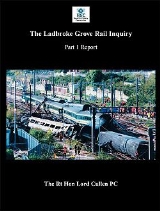
The Ladbroke Grove Rail Crash (also known as the Paddington train crash) was a rail accident which occurred on 5 October 1999 at Ladbroke Grove
, London, England. Thirty-one people were killed and more than 520 injured. This was the second major accident on the Great Western Main Line in just over two years, the first being the Southall rail crash
of September 1997, a few miles west. Both crashes would have been prevented by an operational ATP (Automatic Train Protection
) system, but wider fitting of this had been rejected on cost grounds. This severely damaged public confidence in the management and regulation of safety of Britain's privatised railway system
.
A public inquiry into the crash by Lord Cullen
was held in 2000. A separate 'joint inquiry' in 2000 confirmed the rejection of ATP and the mandatory adoption of a cheaper and less effective system, but noted a mismatch between public opinion and cost-benefit analysis
. The Cullen inquiry was carried out in 2 blocks of sittings , sandwiching the 'joint inquiry'; the first block dealt with the accident itself, the second block dealt with the management and regulation of UK railway safety; this had always been part of the inquiry terms of reference, but was given additional urgency by a further train crash at Hatfield in October 2000. Major changes in the formal responsibilities for management and regulation of safety of UK rail transport ensued.
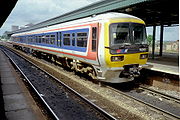
a three-car Class 165
diesel multiple unit
train (no 165 115), operated by Thames Trains
collided with a First Great Western
High Speed Train
(which consisted of eight Mark 3
passenger carriages with a Class 43
power car at each end) (43011 - 43018) at Ladbroke Grove Junction, about two miles (4 km) west of the terminus at London Paddington station
. The trains collided almost head-on at the junction with a combined closing speed of approximately 130 mph (210 km/h).
The first car of the Thames train, the 0806 from Paddington to Bedwyn
, Wiltshire
, driven by Michael Hodder, was totally destroyed on impact. The diesel fuel carried by this train ignited, causing a series of separate fires in the wreckage, particularly in coach H at the front of the HST, which was completely burnt out. Thirty-one people, including the drivers of both trains involved, were killed, and 227 people were admitted to hospital. A further 296 people were treated at the site of the crash for minor injuries.
SN109 when it was showing a red aspect (technically known as a signal passed at danger
or SPAD), 563 metres before the impact point. The public inquiry conducted over the next year by Lord Cullen
identified many contributory factors, blaming Thames Trains' driver training procedures: Driver Hodder had only qualified 13 days earlier, there was no documentary evidence of him being taught anything about the complexities of the route, and his Drivers' Rules examination paper bore neither his signature nor had any 'pass/fail' ticks on it to indicate that any subjects had even been discussed. Under the previous British Railways training regime, trainees would have spent far longer in training and once qualified, were not allowed to drive over the notoriously difficult approach to Paddington until they had at least two years' experience on less complex routes.
Also identified as a causal factor was Railtrack
's Great Western Zone - responsible for the maintenance of the track and signalling
- which had not taken appropriate action in view of the fact that there had been eight SPADs at signal SN109 in the preceding six years (although all those trains stopped before reaching the junction), or taken sufficient action in response to complaints from train drivers about the visibility of various signals, particularly SN109.
The Health and Safety Executive
's HM Railway Inspectorate
was also criticised for its inspection procedures, and the Railtrack signalling centre staff at Slough
were criticised for not sending a radio "emergency all stop" signal immediately when it was realised that the Thames Train had passed a signal at danger. The signalling centre staff were expecting the train to stop shortly after the signal as had happened with the earlier SPADs at that signal, and it is not known if the radio signal eventually sent was received before the impact 33 seconds later. Finally, the system did not provide flank protection; points ahead should have been set as a default to divert an overrunning train to a parallel line instead of into a head-on collision (part of the problem was that the interlocking was incorrectly set-up; it should have been impossible to set the route until the express had cleared the section, thereby leaving the down stopping-train on its original track, and not running across the front of the up express).
and in 2005 of the Rail Accident Investigation Branch
.
On 5 April 2004, Thames Trains was fined a record £2,000,000 for violations of health and safety law in connection with this accident.
On 31 October 2006, Network Rail
pleaded guilty to charges under the Health and Safety at Work Act 1974 in relation to the accident. It received a fine of £4 million on 30 March 2007, and was ordered to pay £225,000 in costs.
Signal SN109 was brought back into service in February 2006. It and many other signals in the Paddington area are now single-lens type signals.
and the West of England
switches from two lines in each direction carrying fast and slow trains, to multiple lines signalled to allow trains to travel in either direction, in and out of the platforms of Paddington Station. The track layout had been modified in this way by British Rail
in the early 1990s, but the line had subsequently been electrified to allow the new Heathrow Express
service to operate from 1994, and the new overhead catenary obstructed the view of various signals. Signal SN109 had a particularly restricted view as there was a road bridge over the railway line one hundred metres before the gantry on which SN109, together with four other signals, was mounted. The design of signal SN109 was non-standard, in that it was shaped like a reversed "L", with the red lamp on the horizontal arm rather than below the other lenses, as is standard, and it is thought that this, together with the bright sun rising in the east behind the train and shining directly into the signal lenses may have misled the inexperienced Hodder into thinking that the signal was showing a 'proceed' aspect.
This was the second major accident on the Great Western Main Line in just over two years, the first being the Southall rail crash
of September 1997, a few miles west, and this severely damaged public confidence in the safety of Britain's privatised railway system
.
A memorial garden, partially overlooking the site, is accessible from the adjacent Sainsburys supermarket car park.
(Nigel Harris) describing it as a "trashy piece of subjective story-telling" (issue 523). The programme stated that the chronology of actual events had been changed, and some scenes fabricated, to "add clarity".
On 19 September 2011, National Geographic Channel aired an episode of Seconds From Disaster
exploring the chain of events that had led up to the collision.
Ladbroke Grove
Ladbroke Grove is a road in west London, in the Royal Borough of Kensington and Chelsea. It is also sometimes the name given informally to the immediate area surrounding the road. Running from Notting Hill in the south to Kensal Green in the north, it is located in North Kensington and straddles...
, London, England. Thirty-one people were killed and more than 520 injured. This was the second major accident on the Great Western Main Line in just over two years, the first being the Southall rail crash
Southall rail crash
The Southall rail crash was an accident on the British railway system that occurred on 19 September 1997, on the Great Western Main Line at Southall, west London. Seven people were killed and 139 injured...
of September 1997, a few miles west. Both crashes would have been prevented by an operational ATP (Automatic Train Protection
Automatic Train Protection
Automatic Train Protection in Great Britain refers to either of two implementations of a train protection system installed in some trains in order to help prevent collisions through a driver's failure to observe a signal or speed restriction...
) system, but wider fitting of this had been rejected on cost grounds. This severely damaged public confidence in the management and regulation of safety of Britain's privatised railway system
Rail transport in the United Kingdom
The United Kingdom consists of Great Britain and Northern Ireland, and previously consisted of Great Britain and the whole of Ireland. Rail transport systems developed independently on the two islands of Great Britain and Ireland, and most of the railway construction in the Republic of Ireland was...
.
A public inquiry into the crash by Lord Cullen
William Cullen, Baron Cullen of Whitekirk
William Douglas Cullen, Baron Cullen of Whitekirk, is one of the senior members of the Scottish judiciary. He formerly served as Lord Justice General and Lord President of the Court of Session, and was an additional Lord of Appeal in the House of Lords prior to the transfer of its judicial...
was held in 2000. A separate 'joint inquiry' in 2000 confirmed the rejection of ATP and the mandatory adoption of a cheaper and less effective system, but noted a mismatch between public opinion and cost-benefit analysis
Cost-benefit analysis
Cost–benefit analysis , sometimes called benefit–cost analysis , is a systematic process for calculating and comparing benefits and costs of a project for two purposes: to determine if it is a sound investment , to see how it compares with alternate projects...
. The Cullen inquiry was carried out in 2 blocks of sittings , sandwiching the 'joint inquiry'; the first block dealt with the accident itself, the second block dealt with the management and regulation of UK railway safety; this had always been part of the inquiry terms of reference, but was given additional urgency by a further train crash at Hatfield in October 2000. Major changes in the formal responsibilities for management and regulation of safety of UK rail transport ensued.
Incident
At 08:08:58 BSTBritish Summer Time
Western European Summer Time is a summer daylight saving time scheme, 1 hour ahead of Coordinated Universal Time. It is used in the following places:* the Canary Islands* Portugal * Ireland...
a three-car Class 165
British Rail Class 165
The British Rail Class 165 Turbo is a fleet of suburban diesel multiple units , originally specified by and built for British Rail, the then United Kingdom state owned railway operator. They were built by BREL at York Works between 1990 and 1992...
diesel multiple unit
Diesel multiple unit
A diesel multiple unit or DMU is a multiple unit train consisting of multiple carriages powered by one or more on-board diesel engines. They may also be referred to as a railcar or railmotor, depending on country.-Design:...
train (no 165 115), operated by Thames Trains
Thames Trains
Thames Trains was a British railway company, owned by the Go-Ahead Group, franchised to run regional and suburban trains from London Paddington station to destinations in the home counties west of London like Slough, to Worcester, Hereford and Stratford-upon-Avon, and the Reading to Gatwick Airport...
collided with a First Great Western
First Great Western
First Great Western is the operating name of First Greater Western Ltd, a British train operating company owned by FirstGroup that serves Greater London, the South East, South West and West Midlands regions of England, and South Wales....
High Speed Train
High Speed Train
There are three types of trains in Britain that have been traditionally viewed as high speed trains:* Advanced Passenger Train - Tilting trains which never entered into regular revenue-earning service....
(which consisted of eight Mark 3
British Rail Mark 3
British Rail's third design of standard carriage was designated 'Mark 3' , and was developed primarily for the InterCity 125 High Speed Train...
passenger carriages with a Class 43
British Rail Class 43 (HST)
The British Rail Class 43 is the TOPS classification used for the InterCity 125 High Speed Train power cars, built by BREL from 1975 to 1982....
power car at each end) (43011 - 43018) at Ladbroke Grove Junction, about two miles (4 km) west of the terminus at London Paddington station
Paddington station
Paddington railway station, also known as London Paddington, is a central London railway terminus and London Underground complex.The site is a historic one, having served as the London terminus of the Great Western Railway and its successors since 1838. Much of the current mainline station dates...
. The trains collided almost head-on at the junction with a combined closing speed of approximately 130 mph (210 km/h).
The first car of the Thames train, the 0806 from Paddington to Bedwyn
Great Bedwyn
Great Bedwyn is a village and civil parish in the east of the English county of Wiltshire.-Location:Great Bedwyn is on the River Dun about south-west of Hungerford and south-east of Marlborough, Wiltshire. The Kennet and Avon Canal and the West of England Main Line railway follow the Dun and pass...
, Wiltshire
Wiltshire
Wiltshire is a ceremonial county in South West England. It is landlocked and borders the counties of Dorset, Somerset, Hampshire, Gloucestershire, Oxfordshire and Berkshire. It contains the unitary authority of Swindon and covers...
, driven by Michael Hodder, was totally destroyed on impact. The diesel fuel carried by this train ignited, causing a series of separate fires in the wreckage, particularly in coach H at the front of the HST, which was completely burnt out. Thirty-one people, including the drivers of both trains involved, were killed, and 227 people were admitted to hospital. A further 296 people were treated at the site of the crash for minor injuries.
Cause
The immediate cause of the disaster was identified as the Thames train passing signalRailway signal
A signal is a mechanical or electrical device erected beside a railway line to pass information relating to the state of the line ahead to train/engine drivers. The driver interprets the signal's indication and acts accordingly...
SN109 when it was showing a red aspect (technically known as a signal passed at danger
Signal passed at danger
A Signal passed at danger , in British railway terminology, occurs when a train passes a stop signal without authority to do so. It is a term primarily used within the British Railway Industry, although it can be applied worldwide.-Categories of SPAD:...
or SPAD), 563 metres before the impact point. The public inquiry conducted over the next year by Lord Cullen
William Cullen, Baron Cullen of Whitekirk
William Douglas Cullen, Baron Cullen of Whitekirk, is one of the senior members of the Scottish judiciary. He formerly served as Lord Justice General and Lord President of the Court of Session, and was an additional Lord of Appeal in the House of Lords prior to the transfer of its judicial...
identified many contributory factors, blaming Thames Trains' driver training procedures: Driver Hodder had only qualified 13 days earlier, there was no documentary evidence of him being taught anything about the complexities of the route, and his Drivers' Rules examination paper bore neither his signature nor had any 'pass/fail' ticks on it to indicate that any subjects had even been discussed. Under the previous British Railways training regime, trainees would have spent far longer in training and once qualified, were not allowed to drive over the notoriously difficult approach to Paddington until they had at least two years' experience on less complex routes.
Also identified as a causal factor was Railtrack
Railtrack
Railtrack was a group of companies that owned the track, signalling, tunnels, bridges, level crossings and all but a handful of the stations of the British railway system from its formation in April 1994 until 2002...
's Great Western Zone - responsible for the maintenance of the track and signalling
Railway signalling
Railway signalling is a system used to control railway traffic safely, essentially to prevent trains from colliding. Being guided by fixed rails, trains are uniquely susceptible to collision; furthermore, trains cannot stop quickly, and frequently operate at speeds that do not enable them to stop...
- which had not taken appropriate action in view of the fact that there had been eight SPADs at signal SN109 in the preceding six years (although all those trains stopped before reaching the junction), or taken sufficient action in response to complaints from train drivers about the visibility of various signals, particularly SN109.
The Health and Safety Executive
Health and Safety Executive
The Health and Safety Executive is a non-departmental public body in the United Kingdom. It is the body responsible for the encouragement, regulation and enforcement of workplace health, safety and welfare, and for research into occupational risks in England and Wales and Scotland...
's HM Railway Inspectorate
HM Railway Inspectorate
Established in 1840, HM Railway Inspectorate was the British organisation responsible for overseeing safety on Britain's railways and tramways...
was also criticised for its inspection procedures, and the Railtrack signalling centre staff at Slough
Slough
Slough is a borough and unitary authority within the ceremonial county of Royal Berkshire, England. The town straddles the A4 Bath Road and the Great Western Main Line, west of central London...
were criticised for not sending a radio "emergency all stop" signal immediately when it was realised that the Thames Train had passed a signal at danger. The signalling centre staff were expecting the train to stop shortly after the signal as had happened with the earlier SPADs at that signal, and it is not known if the radio signal eventually sent was received before the impact 33 seconds later. Finally, the system did not provide flank protection; points ahead should have been set as a default to divert an overrunning train to a parallel line instead of into a head-on collision (part of the problem was that the interlocking was incorrectly set-up; it should have been impossible to set the route until the express had cleared the section, thereby leaving the down stopping-train on its original track, and not running across the front of the up express).
Aftermath
Lord Cullen led a public inquiry into the crash, the recommendations of which led to the creation in 2003 of the Rail Safety and Standards BoardRail Safety and Standards Board
The Rail Safety and Standards Board is an independent not-for-profit company, which was established in 2003, upon the recommendation of the public inquiry into the Ladbroke Grove rail crash...
and in 2005 of the Rail Accident Investigation Branch
Rail Accident Investigation Branch
The Rail Accident Investigation Branch is a government agency that became operational on 17 October 2005. Its primary role is the investigation of rail accidents in the United Kingdom and the Channel Tunnel in order to find a cause, not to lay blame. The agency has operational centres in The...
.
On 5 April 2004, Thames Trains was fined a record £2,000,000 for violations of health and safety law in connection with this accident.
On 31 October 2006, Network Rail
Network Rail
Network Rail is the government-created owner and operator of most of the rail infrastructure in Great Britain .; it is not responsible for railway infrastructure in Northern Ireland...
pleaded guilty to charges under the Health and Safety at Work Act 1974 in relation to the accident. It received a fine of £4 million on 30 March 2007, and was ordered to pay £225,000 in costs.
Signal SN109 was brought back into service in February 2006. It and many other signals in the Paddington area are now single-lens type signals.
The crash site
The disaster occurred at the point where the main line from London to South WalesSouth Wales
South Wales is an area of Wales bordered by England and the Bristol Channel to the east and south, and Mid Wales and West Wales to the north and west. The most densely populated region in the south-west of the United Kingdom, it is home to around 2.1 million people and includes the capital city of...
and the West of England
West of England
The West of England is a loose and locationally unspecific term sometimes given to the area surrounding the city and county of Bristol, England, and also sometimes applied more widely and in other parts of South West England.-Use in the Bristol area:...
switches from two lines in each direction carrying fast and slow trains, to multiple lines signalled to allow trains to travel in either direction, in and out of the platforms of Paddington Station. The track layout had been modified in this way by British Rail
British Rail
British Railways , which from 1965 traded as British Rail, was the operator of most of the rail transport in Great Britain between 1948 and 1997. It was formed from the nationalisation of the "Big Four" British railway companies and lasted until the gradual privatisation of British Rail, in stages...
in the early 1990s, but the line had subsequently been electrified to allow the new Heathrow Express
Heathrow Express
Heathrow Express is an airport rail link from London Heathrow Airport to London Paddington station in London operated by the Heathrow Express Operating Authority, a wholly owned subsidiary of BAA. It was opened by the then Prime Minister Tony Blair in 1998...
service to operate from 1994, and the new overhead catenary obstructed the view of various signals. Signal SN109 had a particularly restricted view as there was a road bridge over the railway line one hundred metres before the gantry on which SN109, together with four other signals, was mounted. The design of signal SN109 was non-standard, in that it was shaped like a reversed "L", with the red lamp on the horizontal arm rather than below the other lenses, as is standard, and it is thought that this, together with the bright sun rising in the east behind the train and shining directly into the signal lenses may have misled the inexperienced Hodder into thinking that the signal was showing a 'proceed' aspect.
This was the second major accident on the Great Western Main Line in just over two years, the first being the Southall rail crash
Southall rail crash
The Southall rail crash was an accident on the British railway system that occurred on 19 September 1997, on the Great Western Main Line at Southall, west London. Seven people were killed and 139 injured...
of September 1997, a few miles west, and this severely damaged public confidence in the safety of Britain's privatised railway system
Rail transport in the United Kingdom
The United Kingdom consists of Great Britain and Northern Ireland, and previously consisted of Great Britain and the whole of Ireland. Rail transport systems developed independently on the two islands of Great Britain and Ireland, and most of the railway construction in the Republic of Ireland was...
.
A memorial garden, partially overlooking the site, is accessible from the adjacent Sainsburys supermarket car park.
Dramatisation
On 20 September 2005, Derailed, a 90-minute documentary-drama programme based on the Ladbroke Grove crash, was aired on BBC1. This dramatisation was heavily criticised in the railway press, with the editor of Rail magazineRail Magazine
RAIL is a UK magazine on the subject of current rail transport in Great Britain. It is published every two weeks by Bauer and is available in the transport sections of many British bookshops, especially WH Smith...
(Nigel Harris) describing it as a "trashy piece of subjective story-telling" (issue 523). The programme stated that the chronology of actual events had been changed, and some scenes fabricated, to "add clarity".
On 19 September 2011, National Geographic Channel aired an episode of Seconds From Disaster
Seconds From Disaster
-By original broadcast date:National Geographic Channel has broadcast many episodes under multiple titles. The title currently or most recently listed on the NGC Calendar is shown first...
exploring the chain of events that had led up to the collision.
External links
- Ladbroke Grove Rail Inquiry Part 1 Report (3 MB pdf file) - Description of the accident and investigation
- Ladbroke Grove Rail Inquiry Part 2 Report (1.3 MB pdf file) - Recommendations
- Health and Safety Executive Report (4.2 MB pdf file)
- Paddington Survivors Group - Website of the Paddington Survivors Group, which campaigned for better rail safety and supports survivors.