
This article is about a USA auto-maker. For the British rail-locomotive company, see
Brush TractionThis article is about a British rail-locomotive maker. For the Detroit auto-maker, see Brush Motor Car CompanyBrush Traction is a manufacturer and maintainer of railway locomotives, part of the FKI group , based at Loughborough in Leicestershire, England situated alongside the Midland Main Line.-...
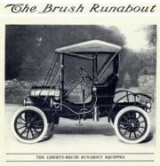
Brush Motor Company, or the "Brush Runabout Company," based in Detroit, Michigan, was founded by
Alanson Partridge Brush (February 10, 1878 in Michigan – March 6, 1952 in Michigan), who designed a light car with a wooden chassis (actually, wooden rails and iron cross-members), friction drive transmission and "underslung" coil springs in tension instead of compression on both sides of each axle. Although there were many makes of small runabouts of similar size and one to four cylinders at this time (before the Model T Ford dominated the low-price market), the Brush has many unusual design details showing the inventiveness of its creator. Power was provided by a large single-cylinder water-cooled engine. Two gas-powered
headlampA headlamp is a lamp, usually attached to the front of a vehicle such as a car or a motorcycle, with the purpose of illuminating the road ahead during periods of low visibility, such as darkness or precipitation. Headlamp performance has steadily improved throughout the automobile age, spurred by...
s provided light, along with a gas-powered light in the rear. The frame, axles, and wheels were made of oak, hickory or maple, and were either left plain or painted to match the trim. The horn was located next to the engine cover, with a metal tube running to a squeeze bulb affixed near the driver. A small storage area was provided in the rear, with a drawer accessible under the rear of the seat.
A feature of engines designed by Brush (who also designed the first Oakland Motor Car, ancestor of
PontiacPontiac was an automobile brand that was established in 1926 as a companion make for General Motors' Oakland. Quickly overtaking its parent in popularity, it supplanted the Oakland brand entirely by 1933 and, for most of its life, became a companion make for Chevrolet. Pontiac was sold in the...
and who helped design the original one-cylinder Cadillac engine) was that they ran counter-clockwise instead of the usual clockwise, which, in those days before the invention of the electric starter, was Brush's idea intended to make them safer for a right-handed person to crank-start by hand. With clockwise-running engines, many injuries were sustained, most often dislocated thumbs and broken forearms, if the hand crank kicked back on starting, especially if the car was not properly adjusted before starting, or the person cranking it did not follow correct safety procedures, including fully retarding the manual spark advance, keeping the thumb alongside the fingers instead of around the crank, and pulling the crank upward in a half turn, never in a full circle or pushing down.
In 1912, Sid Ferguson drove the Brush and Birtles was the Navigator becoming the first persons to drive across the Australian continent from west to east.
The Brush Runabout Company, along with Maxwell-Briscoe, Stoddard-Dayton, and others formed
Benjamin BriscoeBenjamin Briscoe was born in Detroit, Michigan and was an automobile pioneer and industrialist.Briscoe entered business for himself at age of 18 with capital of $472, organizing the firm of Benjamin Briscoe & Co. to manufacture sheet-metal stampings. This later became part of the American Can...
's
United States Motor CompanyThe United States Motor Company was organized by Benjamin Briscoe in 1910 as a selling company, to represent various manufacturers. It had begun life as the International Motor Company in 1908 in an attempt to create the first major consolidation within the industry with Maxwell-Briscoe and Buick,...
from 1910, ending when that company failed in 1913. Runabouts, in general, fell out of vogue quickly, partly due to the lack of protection from the weather.
A restored 1909 Brush Runabout is on display at the Pioneer Heritage Museum,
Brownsville, OregonBrownsville is a city in Linn County, Oregon, United States. As of the 2010 census the population was 1,668. It is the setting for the fictional Castle Rock, Oregon in the film Stand by Me.-History:...
.
See also
- Brass Era car
The automotive Brass Era is the first period of automotive manufacturing, named for the prominent brass fittings used during this time for such things as lights and radiators. It extends from the first commercial automobiles marketed in the 1890s until about World War I...
- List of defunct United States automobile manufacturers
- List of cars
- United States Motor Company
The United States Motor Company was organized by Benjamin Briscoe in 1910 as a selling company, to represent various manufacturers. It had begun life as the International Motor Company in 1908 in an attempt to create the first major consolidation within the industry with Maxwell-Briscoe and Buick,...
- Not to be confused with Brush Electric Company nor Brush Traction
This article is about a British rail-locomotive maker. For the Detroit auto-maker, see Brush Motor Car CompanyBrush Traction is a manufacturer and maintainer of railway locomotives, part of the FKI group , based at Loughborough in Leicestershire, England situated alongside the Midland Main Line.-...
(United KingdomThe United Kingdom of Great Britain and Northern IrelandIn the United Kingdom and Dependencies, other languages have been officially recognised as legitimate autochthonous languages under the European Charter for Regional or Minority Languages...
company)
- Francis Birtles
Francis Edwin Birtles was an Australian adventurer, photographer, cyclist, and filmmaker, who set many long-distance cycling and driving records, including becoming in 1927 the first man to drive a car from England to Australia...
External links