

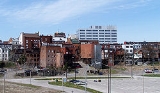
St. Catharines, Ontario

Encyclopedia
St. Catharines is the largest city in Canada's Niagara Region
and the sixth largest urban area in Ontario
, Canada
, with 97.11 square kilometres (37.5 sq mi) of land. It lies in Southern Ontario
51 kilometres (32 mi) south of Toronto
across Lake Ontario
, and is 19 kilometres (12 mi) inland from the international boundary with the United States
along the Niagara River
. It is the northern entrance of the Welland Canal
. Residents of St. Catharines are known as St. Catharinites.
St. Catharines carries the official nickname "The Garden City" due to its 1,000 acre
s (4 km2) of parks, gardens and trails.
St. Catharines is situated in an area for commerce and trade since it is located between the Greater Toronto Area
(GTA) and the Fort Erie
- US Border. Manufacturing is the city's dominant industry, as noted by the heraldic motto, "Industry and Liberality". General Motors of Canada, Ltd.
, the Canadian subsidiary
of General Motors, operates two plants in the city (one plant was partially shut down in 2010) and until recently was the city's largest employer, a distinction now held by the District School Board of Niagara
. TRW
operate a plant in the city, though in recent years employment has shifted from heavy industry and manufacturing to services.
St. Catharines lies on one of the main telecommunications backbones
between Canada and the United States
, and as a result a number of call centre
s operate in the city.
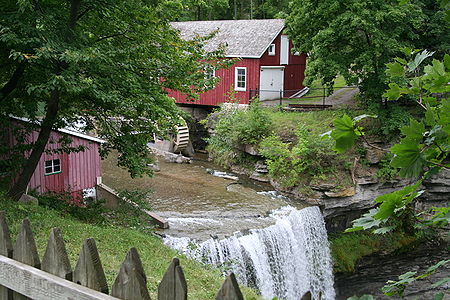 The city was first settled by Loyalists
in the 1780s. Early histories credit Serjeant Jacob Dittrick and Private John Hainer formerly of Butler's Rangers
,among the first to come to the area taking up their Crown Patents where Dick’s Creek and 12 Mile Creek merge, now the city centre of St. Catharines. Although never documented, some local St. Catharine's historians speculate Dick’s Creek was named after Richard Pierpoint, a black Loyalist. Secondary to water routes, native trails provided transportation networks, resulting in the present day radial road pattern from the City centre. The surrounding land was surveyed and Townships created between 1787 and 1789.
After the Butler’s Rangers disbanded in 1784 and settled the area, Duncan Murray as a former Quartermaster in the 84th Regiment of Foot (Royal Highland Emigrants)
was appointed by the Crown the right to distribute free Government supplies (victuals) for 2 years. He did this from his mill, built on the 12 Mile Creek in Power Glen
. After his death in 1786, his holdings were forfeited to merchant Robert Hamilton of Queenston. Hamilton attempted to operate for profit the already well established Murray’s Distribution Centre and Mill under the management of his cousin. Among other ventures, Hamilton became land wealthy expropriating lands from subsistence Loyalist settlers who were incapable of settling their debts. Murray’s distribution centre, later Hamilton’s warehouse, and its location have long been a mystery. Hamilton’s major profits were derived from transhipping supplies for the military and civic establishments from his Queenston enterprise, not from charitably supplying the subsistence Loyalist settlers. With Hamilton’s lack of interest in social development the business was sold to Jesse Thompson before the turn of the 18th Century.
The small settlement was known as “The Twelve” and as “Murray’s District” to military and civic officials but to the local residents in 1796 and earlier as St. Catharines. This is confirmed in St.Catharines’ first history written by J.P. Merritt “to be historically accurate the name St. Catharines preceded all of these….”
The Merritt family arrived after this time being late Loyalists who had re-established themselves after the American Revolution, in the Carolinas, New York and New Brunswick. In 1796, Thomas Merritt arrived to benefit from the favours of his former Commander and Queen's Ranger
, John Graves Simcoe, now the Lieutenant Governor of Upper Canada.
At an unknown early date, an inn was built by Thomas Adams, located on the east side of what is now Ontario Street. It became a community meeting place, election centre, stagecoach stop, and mail delivery deposit. This was preceded by the Church and log school house completed before 1797 all located on the east bank of the 12 Mile Creek at the extreme west end of the what was known at that time as Main Street- an extension of the old Iroquois Trail and renamed St.Paul Street by the mid-19th Century. Several mills, salt works, numerous retail outlets, a ship building yard, distillery and various other businesses followed.
The first Welland Canal was constructed from 1824 to 33 behind what is now known as St. Paul Street, using Twelve Mile and Dick's Creek. William Hamilton Merritt worked to promote the ambitious venture, both by raising funds and by enlisting government support. The canal established St. Catharines as the hub of commerce and industry for the Niagara Peninsula.
Merritt also played a role in making St. Catharines an important place of abolitionist activity. In 1855, the British Methodist Episcopal Church and Salem Chapel was established at the corner of Geneva and North streets, on land granted to the congregation by Merritt in the early 1840s. The area became known to escaped slaves as a place of "refuge and rest", and cemented it as a final terminus on the Underground Railroad for African American slaves. By the mid-1850s the population was about 6000, 800 of whom were "of African descent".[1] St. Catharines remains an important place in Black Canadian history.
The Town of St. Catharines was incorporated in 1845. St. Catharines was incorporated as a city in 1876.
The St. Catharines Armoury is a recognized Federal Heritage building 1991 on the Register of the Government of Canada Heritage Buildings.
(Köppen
Dfb) and can be considered a unique micro-climate because of the moderating influence of Lake Ontario
and Lake Erie
and the sheltering effect of the Niagara Escarpment
to the south. As a result, the city can record a large number of frost-free days in the winter, although it sometimes receives lake-effect snow. The summer season is predominantly warm, sometimes hot, with an average high temperature of 27 °C (80.6 °F) in July, and humidity is often high. Summer thunderstorms are commonplace but less prevalent and less severe than further west in Southern Ontario due to the diminishing effect from the surrounding lakes.
 The complex and extensive glacial history of the Niagara Peninsula
has resulted in similarly complex soil stratigraphy
in the area occupied by the city today. St. Catharines was once at the base of a glacial lake known as Glacial Lake Iroquois
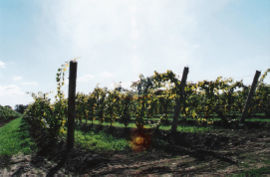
, which deposited thick layers of clay between the Escarpment and Lake Ontario. As a result of these factors, the city's soil is particularly conducive to fruit growing and is capable of producing grapes that are used to make award-winning wines. Three wineries operate in the city's west-end: Henry of Pelham Winery
, Hernder Estates and Harvest Estates.
Since the opening of the first Welland Canal
in 1829, the city has seen four different canal systems, whether modified or newly constructed, carved into its geographical landscape. The fourth and present-day canal forms the majority of the city's eastern boundary. The first three of the city's canals have largely been buried, portions of it beneath the present-day Highway 406 and Queen Elizabeth Way
. Other remnants of the original canals can still be seen in various locations throughout the city, many of which are hidden within forested areas designated as city parks. There has been a growing movement in recent years to restore the original routing of the Welland Canal through the city. The restored waterway and locks would be open to pleasure craft and create a new tourist attraction within the city.
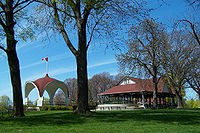
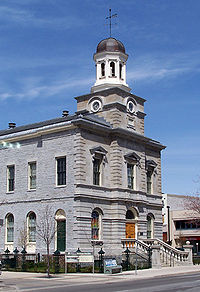
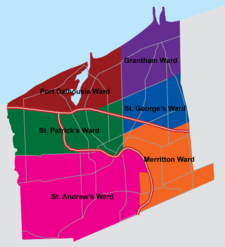 St. Catharines is governed by a mayor and city council of twelve city councillors, with two councillors representing each of the six municipal wards in the city. A city councillor is also elected by the council as a whole to serve as deputy mayor, who only fills the role should the elected mayor not be available. St. Catharines City Council
meets every Monday and is open to participation by the community. Matters put forwarded are voted on by members of city council; the mayor presides over council debate and serves very much like the speaker
, and as a result only votes in the case of a tie. After 2006, municipal elections will be in November every four years rather than the previous three. Unlike most cities its size, city councillors only serve on a part-time basis and continue with their non-political careers in the community. Only the mayor is elected to a full-time position. St. Catharines City Hall is located downtown on Church Street. Tim Rigby
was the Mayor of St. Catharines from 1997 to 2006; Brian McMullan
was elected to succeed Rigby on November 13, 2006, and was sworn in on December 4.
St. Catharines uses a council-manager government
, and as a result a Chief Administrative Officer
is appointed by council to oversee the day-to-day operations of the city and its departments. The CAO, in effect, is the highest ranking municipal civil servant and has authority over the spending of municipal tax dollars. The CAO advises council on policy matters and acts as liaison between the administrative staff and elected officials. Some of the CAOs duties include assisting in the creation of the municipal budget, and ensuring that municipal funds are spent in a responsible manner. Colin Briggs is CAO, replacing B. Robert Puhach who resigned in February 2007.
Residents of St. Catharines also elect six regional councillors to the Niagara Regional Council
on an at-large basis. Unlike many other regional municipalities
in Ontario, regional councillors do not sit on city council and instead only represent at the regional level. Four school board trustees for the District School Board of Niagara
representing St. Catharines and Niagara-on-the-Lake
are elected, as well as and three trustees for the Niagara Catholic District School Board
, two for five of St. Catharines' wards, and one for Thorold
and the Merriton Ward of St. Catharines. Regional councillors and school board trustees are elected at the same time, and on the same ballot, as the mayor and city councillors.
St. Catharines has one of the lowest resident/representative ratios of any large city in Ontario. There are just under 7,000 people per elected municipal representative in St. Catharines, while Oshawa
(a similar-sized city in Ontario) has one representative per 13,500 people. London, Ontario
has one representative per 30,500 people, and Toronto
has one representative per 55,000 people. There has been recent discussion regarding a modification of the city/regional council arrangement, with the possibility of reducing city council to six full-time representatives and having the six regional councillors serve on city council. While there is growing support in the business community for such an arrangement, city council has been unreceptive to such ideas.
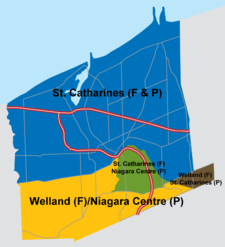 At the provincial level, St. Catharines
is well-known for electing high-profile members of the Legislative Assembly of Ontario
. Jim Bradley, the current member for St. Catharines and Ontario's longest serving Member of Provincial Parliament, is the current Minister of Community Safety and Correctional Services in the Liberal
government of Dalton McGuinty
, and served as Minister of Environment in the government of David Peterson
. Bradley recently celebrated 30 years in provincial politics, and it was noted that he actually served in the Ontario Legislature with the parents of five current MPPs. Peter Kormos
, who represents the southern portions of the city as part of the Welland riding
, is a prominent vocal member of the Ontario New Democratic Party
caucus and served previously as Minister of Consumer and Commercial Relations in the Bob Rae
government.
From 1999 to 2003, during the premierships of Mike Harris
and Ernie Eves
, St. Catharines was the only large city in Ontario to not have at least one government member representing the city, as the Progressive Conservative
-held ridings of Lincoln
and St. Catharines—Brock
were eliminated as a cost saving measure. Robert Welch
, a long-time Deputy Premier of Ontario
, represented the now-eliminated Lincoln and St. Catharines—Brock ridings throughout the 1960s, 1970s and 1980s.
is one of the most bellwether
of any riding in Canada, having only elected an opposition MP twice in its history. Rick Dykstra
is the current MP for St. Catharines and is a member of the Conservative Party of Canada
, which currently forms Canada's government. The southern portion of the city is included as part of the Welland
riding, and is represented by Malcolm Allen
, an NDP
MP. Most federal representatives from St. Catharines have maintained a low profile on either the government or opposition backbenches
. The exception was Gilbert Parent
, who served as Speaker of the House
for seven years while Jean Chrétien
was Prime Minister.
. The Superior Court of Justice is located on Church Street across from City Hall. A satellite court is located in Grimsby
. Wally Essert is the current Crown Attorney
.
The city forms "1 District" of the Niagara Regional Police Service
. The NRPS headquarters are located on Church Street, with administrative offices on James Street and support services on Cushman Road.
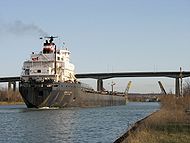 The most defining transportation icon of St. Catharines is the Welland Canal
, a ship canal
that runs 43.4 kilometres (27.0 mi), passing through the city. Three of its locks are within city boundaries. The canal allows shipping vessels to traverse the 99.5 metre (326.5 ft) drop in altitude from Lake Erie to Lake Ontario.
The main access routes into and out of St. Catharines are served by two major freeways. The Queen Elizabeth Way
runs east (at 15-Mile Creek) to west (at Garden City Skyway
) and Highway 406 runs north (at QEW) to south (at St. David's Road). Prior to the construction of these freeways, St. Paul Street (former Highway 8
, now Regional Road 81) and Hartzel Road (former Highway 58
, now a city-maintained street) provided east-west and north-south access to the city.
The QEW is currently undergoing an extensive reconstruction and widening project through the city, which will see it reduced to one lane in each direction for the majority of the construction project. Motorists travelling through St. Catharines are advised to bypass the city, and the Ministry of Transportation has posted special detour signs directing traffic to exit and follow Thorold Stone Road in Niagara Falls
through the Thorold Tunnel
and back to the QEW via Highway 406. The construction project is expected to be complete by 2012.
Public transportation is served by the St. Catharines Transit Commission
, which operates bus routes throughout the city and neighbouring Thorold.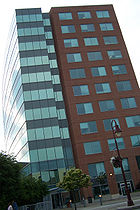 All major routes converge at the St. Catharines Bus Terminal, which is located downtown within the headquarters of the Ontario Ministry of Transportation
. The central station is also served by Greyhound Lines
and Coach Canada
, en route to Toronto and New York City and connecting it to major cities throughout Canada and the United States.
Though transportation by rail is becoming increasingly popular, the St. Catharines train station
is largely underutilized, with car and bus travel being the dominant forms of transportation for the city. The station is located in its original building, outside the downtown core (because of issues involving the crossing of 12-Mile Creek). It is served daily by Via Rail
and Amtrak
trains connecting it to Toronto
and New York City
. The provincial and federal government recently committed $385 million each to GO Transit
to aid in the development of their 10-Year Capital Expansion Plan, which includes an expansion bus line servicing the Niagara Region. Currently, regular GO Bus service exists to St. Catharines with a stop at Fairview Mall, allowing riders to travel either west toward Burlington or east toward Niagara Falls. A potential rail link with GO Transit
in the near future continues to be debated among the City of St. Catharines and GO Transit.
St. Catharines/Niagara District Airport
services general aviation
as well as chartered jetliner
flights. It is located near the city's east-end in neighbouring Niagara-on-the-Lake
.
St. Catharines had one of the first interurban
electric streetcar routes, which ran between the city and Merritton
and was eventually extended to Port Dalhousie
in the north and Thorold
to the south. Like most streetcar routes throughout the world, it was decommissioned in the 1960s, and the right-of-way has since been converted to parks and trails.
(established 1964), a modern comprehensive university located on the Niagara Escarpment. A partnership between the university and the Ontario Grape and Wine Industry established the city as a centre for cool-climate grape and wine research. "Brock" offers an Honours Bachelor of Science
in Oenology
and Viticulture
.
McMaster University
's Michael G. DeGroote School of Medicine opened a satellite campus in St. Catharines in September 2008. The Hamilton, Ontario
-based university educates 28 first-year medical students in local hospitals within the city.
Ridley College
, located near the city's downtown core in the Western Hill neighbourhood, is a distinguished co-educational boarding and day school. It was established as a boys' school in 1889, and became co-educational in 1973.
A campus of the Niagara College of Applied Arts and Technology
is located near the city's east end. Niagara College is the only fully licensed teaching winery in Canada. The "Niagara College Teaching Winery" (or NCT for short) has created award winning wines. Niagara College has also taken home various medals from international wine competitions such as "Cuvee", "The Ontario Wine Awards" and "The Finger Lakes International Competition" to name a few. The school's Horticultural Campus was once located on 360 Niagara Street in the 1970s-1990s but has since been relocated to Niagara-on-the-Lake
. One of its greatest teachers, R. Roy Forster, was recognized with the Order of Canada on April 14, 1999, for his work in creating the VanDusen Botanical Garden
in Vancouver
, British Columbia
.
The District School Board of Niagara
(DSBN), responsible for managing a school system of nearly 119 faculties, contains 8 Secondary Schools in the city of St. Catharines, Kernahan Park, Laura Secord, Sir Winston Churchill
, Governor Simcoe
, St. Catharines Collegiate, Eden
, West Park, and Lakeport.
The Niagara Catholic District School Board
(NCDSB) manages 61 elementary and secondary schools within the Niagara Region and operates 3 Catholic Secondary Schools within the city, Holy Cross
, Denis Morris Catholic High School
, and St. Francis
.
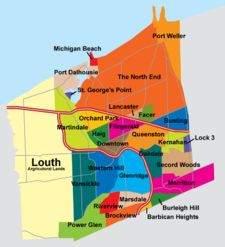 St. Catharines' development history has resulted in a number of unique and distinct communities within the city. The historical area of St. Catharines consisted of nothing more than what is now the downtown core, with the remaining land being part of Louth Township
on the west and Grantham Township on the east. St. Catharines continued to steadily grow through the late 19th and early 20th centuries, eventually annexing land to the southwest that would become Western Hill
and Old Glenridge
, and to the east and north that would collectively become the central part of St. Catharines. In addition to the growth of St. Catharines, the Town of Merritton
and the Town of Port Dalhousie
existed as separate municipalities to the South and North of the city, each slowly growing their own residential base.
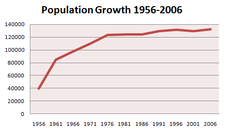 Along with the rest of Ontario, St. Catharines experienced explosive growth after World War II
. St. Catharines continued to annex Grantham Township as development continued, including the large swaths of land to the north known now as "The North End
". St. Catharines would also absorb Merritton and Port Dalhousie in 1961, making them part of the city. During this time, St. Catharines nearly tripled in population.
With the formation of the Regional Municipality of Niagara
in 1970, the portion of Louth Township east of Fifteen Mile Creek was transferred to the City of St. Catharines. This included the eastern portion of the Hamlet of Rockway, as well as the Hamlet of Power Glen
. The few remaining portions of Grantham Township in the Northeast corner of the area, including Port Weller
, were also transferred to the city. With the new Louth Township lands belonging to the city, St. Catharines would begin two developments in the west end — Martindale in 1983, and Vansickle in 1987. These developments are nearing completion. There was also a push to continue further expansion to the west in the late 1990s, but this has since been halted by Ontario Greenbelt
legislation.
The following distinct communities exist within St. Catharines:
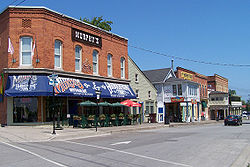
According to the 2006 census, there were 131,989 people residing in city of St. Catharines, located in the province of Ontario, of whom 47.8% were male and 52.2% were female. Minors (youth under the age of 19) totalled 22.6 percent of the population compared to pensioners who number 18.1 percent. This compares with the Canadian average of 24.4 percent (minors) and 13.7 percent (pensioners). The average age of St. Catharines residents is 41.7 compared to the Canadian average of 39.5. In the five years between 2001 and 2006, the population of St. Catharines grew by 2.2%, while Canada as a whole grew by 5.4 percent.
As of 2006, 90.00% of the population was White
. Other groups include black
: 2.0%, Aboriginal
: 1.6%, mixed race: 1.5%, south Asian: 1.3%, and Chinese
: 1.1%. Approximately 21 percent of the population was foreign born.
Christianity
is the dominant religion of the city. Some 81.0 percent of the population profess a Christian faith, the largest being various Protestant groups (42.9%), followed by Roman Catholicism (34.2%), while the remaining consists of Orthodox
, and independent Christian groups. Non-Christian groups are also present, namely Islam (1.5%), Judaism
(0.5%), and Buddhism
(0.5%). (The city contains a synagogue and Jewish community centre, as well a mosque). The remaining 16.5% report other or no religion.
Employment
Top five employers:
showed that 57.3 percent of its residents were overweight. This has caused some elements of the media, including CTV
, the Canadian Broadcasting Corporation
and the Globe and Mail to dub St. Catharines as Canada's "fattest" city.
In 2008, new statistics were released that show that the percentage obese or obese/overweight residents of Hamilton
(74.3%), Kingston
(70.1%), and St. John's, Newfoundland and Labrador
(70%) is now higher than St. Catharines-Niagara (69.3%), though the obesity rate in St. Catharines was higher in 2008 than in 1998.
in early 2005 to call St. Catharines the Garbage City. In 2006, many of these issues were brought to the forefront during municipal elections, with the hope that many of these issues can be addressed and changed in the coming years.
In addition, numerous tourist and travel advisory stations are available off-air in the Niagara area.
and Buffalo
are available over-the-air in the region.
A local specialty news and information channel called Niagara News TV launched in February 2011, but ceased operations only 3 months later in April.
In 2003, a local business consortium applied to the Canadian Radio-television and Telecommunications Commission (CRTC) for a licence to operate TV Niagara, a community television station in St. Catharines. The application was denied by the CRTC in 2005, citing concerns about the group's business plan and its dependence on gaining audience share in the Toronto market. The organization's appeal to the Cabinet of Canada
failed in 2006. The TV Niagara website remains to be updated; the last update occurred in 2006.
Junior 'A' Hockey in 1943 as the St. Catharines Falcons
. In 1947, they became the Teepees and were affiliated with the American Hockey League
's Buffalo Bisons. When the National Hockey League
's (NHL) Chicago Black Hawks
made the Bisons their number one farm team, they inherited the Teepees. In the 1960s, the Jr. 'A' team went deeply into debt to the Chicago Black Hawks, but continued as a successful franchise and were named the St.Catharines Black Hawks. The Hamilton
Fincups moved to St. Catharines in 1976 and played here for one year before moving back to Hamilton. The AHL St. Catharines Saints
played in St. Catharines between 1982 and 1986, before being forced to re-locate to Newmarket
due to protests from the NHL Buffalo Sabres
. The St. Catharines Saints served as the farm team
for the Toronto Maple Leafs
, and today are known as the Toronto Marlies
.
A new OHL
team returned to St. Catharines, in time for the 2007-2008 season http://www.stcatharinesstandard.ca/webapp/sitepages/content.asp?contentid=499733&catname=Local+News&classif=. The Niagara IceDogs
play out of Jack Gatecliff Arena
, within the newly named Gatorade Garden City Complex. The city's Junior 'B' Hockey team, the St. Catharines Falcons
, also plays out of the complex.
's St. Catharines Blue Jays
, the Short-season A affiliate of the Toronto Blue Jays
, from 1986 to 1999. In 1996 the team was renamed the St. Catharines Stompers, and was subsequently sold and relocated to Queens
, New York City
in late 1999, where they became the Queens Kings
.
's St. Catharines Wolves
are one of the most successful professional soccer teams in Canada, and play at Club Roma in the west-end of the city.
, a world-class event that brings over 3,000 athletes from various nations to the city. The site hosted the FISA World Rowing Championships
in both 1970 and in 1999. More recently, the World Master's Rowing Championship was held at the Martindale Pond in the summer of 2010, with $500,000 in improvements to the facility such as: a weed harvester, new docking and a new timing system. There are currently talks to bring the Canadian Rowing Hall of Fame to St. Catharines sometime in the near future. The pond is also home to the St. Catharines rowing club
, Brock University
rowing club, Ridley College
rowing club and to the annual CSSRA Championships, which draws hundreds of high school athletes from Canada, the U.S. and Mexico. The Martindale Pond or Henley, continues to hold its world-renowned status as a major rowing venue in the world. The rowing event in the Pan American Games
will be held in St. Catharines in 2015. Two Olympic medallists in rowing hail from St. Catharines, including Melanie Kok
and Buffy Williams.
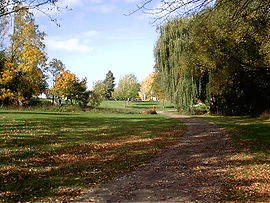 The city's trail system offers over 90 kilometres (55 mi) of accessible pathways that are suitable for walking, jogging, cycling, hiking and cross-country skiing.
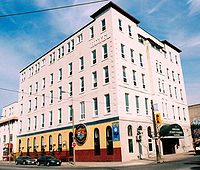 A dedicated group of local paddlers and businesses is trying to bring a Whitewater
facility, suitable for hosting world-class kayaking events, to the City of St. Catharines. The proposed course would utilize the Wellandvale stretch of Twelve Mile Creek, near the downtown core. If made reality, the project would be Canada's first urban Whitewater
facility.
Plans for the facility were made public in Toronto
's bid to host the 2008 Summer Olympic Games. When Toronto lost the bid to Beijing
, the Niagara Whitewater Park Association was created to keep the project alive. In September 2006, the St. Catharines Standard
http://www.stcatharinesstandard.ca/webapp/sitepages/content.asp?contentID=199185&catname=Local+News reported that St. Catharines Hydro is in talks with Ontario Power Generation
to construct a small generating station adjacent to the proposed site of the Whitewater facility. The proposed Shickluna Generating Station would create electricity for up to 5,000 homes while regulating waterflow to the course. Unfortunately the cost of operating the course was found to be aprox. $200,000 per year and the funds could not be found. The proposal has been tabled until an alternative can be found.
to purchase the building. Today, it is affiliated with the Brock School of Fine and Performing Arts and continues to serve and welcome the public.
The Niagara Artists' Centre (NAC) is a not-for-profit, charitably registered, collective formed by local community artists and dedicated to serving the working artists and art-enthusiasts of Niagara. It runs a series of diverse exhibitions throughout the year involving abstract paintings, sculptures, new media installations and film screenings. Recently, the Niagara Artists' Centre moved out of its former location on Bond St. to a newly renovated storefront building on St. Paul Street in the city's downtown.
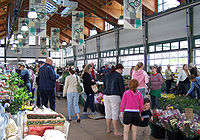 The Folk Arts Festival was first presented to the city by representatives from the ethno cultural communities of Niagara over 35 years ago. From that first festival was created the Folk Arts Council of St. Catharines, which continues to run its festival each year throughout the month of May and concludes with "Folk Arts in the Park", which takes place in Montebello Park
in the city's downtown.
The Art of Peace Festival is now in its fifth year, the Festival seeks to increase community engagement in art as a tool for reflecting on peace issues. Montebello Park fills with performing arts events, Speak Your Peace! open mic program, community art workshops, an elementary school art exhibition, vendors, and Peace Through Art Stations at which peace groups make information available and offer arts activities. Presented by St. Catharines and Area Arts Council and Project Ploughshares Niagara.
The Niagara Grape & Wine Festival is a non-profit organization that presents three popular wine festivals in St. Catharines and Niagara during the year. The Niagara Icewine Festival (Winter), the Niagara New Vintage Festival (Summer), and the Niagara Wine Festival (Fall), which is the largest of the festivals, attract hundreds of thousands of visitors to the region each year. This event known by most locals simply as "Grape and Wine" attracts young and old varying from partiers to wine connoisseurs.
The SCENE Music Festival
is one-day event held in various clubs and pubs downtown. Rock, indie, pop, singer-songwriter, ska, punk, metal, and many other genres are represented by bands such as Alexisonfire
, Bedouin Soundclash
, Moneen
, Del Tha Funky Homosapien, Damn 13, Shad
, Sick Boys, Raising the Fawn
, Supergarage
, Sailboats Are White, Revenge of the Egg People, IllScarlett
, Silverstein
, Bang Theory, Dead and Divine
, Teenage Head
, Cancer Bats
, The New Cities
, Lights, Madball
, Billy Talent
and Down with Webster
who have played at the festival, which has been sponsored by Solo Mobile
in the past. Traditionally, a compact disc of select performers is included with admission prices — although in recent years the CD has been expanded to a 2-disc compilation — representative of the growth of the festival. SCENE 2008 and SCENE 2009 included a card with a PIN enabling 50 MP3 downloads, instead of CD's.
The International Chicken Chucking Championships takes placed every January in the St.Catharines neighbourhood of Port Dalhousie and attracts hundreds of participants and observers. Chicken Chucking consists of pitching or sliding frozen chickens along the ice covered Martindale Pond similar to curling and shuffleboard. The bird-brained fundraiser began in 2000 by patrons of the Kilt and Clover
after realizing that there was not much to do in Port Dalhousie in the middle of winter. The Kilt and Clover
hosts the event and the money raised is given to local charities including the food bank.
, off the Welland Canals Parkway. An elevated viewing platform at the museum allows visitors to get a close-up look at ships from around the world as they climb this major section of the St. Lawrence Seaway. Along with its exhibits dedicated to the city's history and the canals, the museum is home to the Ontario Lacrosse
Hall of Fame
and Museum.
Morningstar Mill, perched atop the Niagara Escarpment
, is one of Ontario's oldest mills on an original site, and is fully powered by water. The picturesque park provides a glimpse into the innovative and pioneering spirit of the 19th Century.
The YMCA Discovery Centre (formerly The Children's Discovery Centre of Niagara), located in the former Niagara College
Horticulture
School, provides children and their families with an educational yet entertaining and stimulating place to visit using hands-on, interactive exhibits and outdoor activities.
Theatre in Port put on a year-round schedule of professionally produced musicals, comedies and dramas.
Regional Municipality of Niagara, Ontario
The Regional Municipality of Niagara , also known as the Niagara Region, or, colloquially, "Regional Niagara", is a regional municipality comprising twelve municipalities of Southern Ontario, Canada....
and the sixth largest urban area in Ontario
Ontario
Ontario is a province of Canada, located in east-central Canada. It is Canada's most populous province and second largest in total area. It is home to the nation's most populous city, Toronto, and the nation's capital, Ottawa....
, Canada
Canada
Canada is a North American country consisting of ten provinces and three territories. Located in the northern part of the continent, it extends from the Atlantic Ocean in the east to the Pacific Ocean in the west, and northward into the Arctic Ocean...
, with 97.11 square kilometres (37.5 sq mi) of land. It lies in Southern Ontario
Southern Ontario
Southern Ontario is a region of the province of Ontario, Canada that lies south of the French River and Algonquin Park. Depending on the inclusion of the Parry Sound and Muskoka districts, its surface area would cover between 14 to 15% of the province. It is the southernmost region of...
51 kilometres (32 mi) south of Toronto
Toronto
Toronto is the provincial capital of Ontario and the largest city in Canada. It is located in Southern Ontario on the northwestern shore of Lake Ontario. A relatively modern city, Toronto's history dates back to the late-18th century, when its land was first purchased by the British monarchy from...
across Lake Ontario
Lake Ontario
Lake Ontario is one of the five Great Lakes of North America. It is bounded on the north and southwest by the Canadian province of Ontario, and on the south by the American state of New York. Ontario, Canada's most populous province, was named for the lake. In the Wyandot language, ontarío means...
, and is 19 kilometres (12 mi) inland from the international boundary with the United States
United States
The United States of America is a federal constitutional republic comprising fifty states and a federal district...
along the Niagara River
Niagara River
The Niagara River flows north from Lake Erie to Lake Ontario. It forms part of the border between the Province of Ontario in Canada and New York State in the United States. There are differing theories as to the origin of the name of the river...
. It is the northern entrance of the Welland Canal
Welland Canal
The Welland Canal is a ship canal in Canada that extends from Port Weller, Ontario, on Lake Ontario, to Port Colborne, Ontario, on Lake Erie. As a part of the St...
. Residents of St. Catharines are known as St. Catharinites.
St. Catharines carries the official nickname "The Garden City" due to its 1,000 acre
Acre
The acre is a unit of area in a number of different systems, including the imperial and U.S. customary systems. The most commonly used acres today are the international acre and, in the United States, the survey acre. The most common use of the acre is to measure tracts of land.The acre is related...
s (4 km2) of parks, gardens and trails.
St. Catharines is situated in an area for commerce and trade since it is located between the Greater Toronto Area
Greater Toronto Area
The Greater Toronto Area is the largest metropolitan area in Canada, with a 2006 census population of 5.5 million. The Greater Toronto Area is usually defined as the central city of Toronto, along with four regional municipalities surrounding it: Durham, Halton, Peel, and York...
(GTA) and the Fort Erie
Fort Erie, Ontario
Fort Erie is a town on the Niagara River in the Niagara Region, Ontario, Canada. It is located directly across the river from Buffalo, New York....
- US Border. Manufacturing is the city's dominant industry, as noted by the heraldic motto, "Industry and Liberality". General Motors of Canada, Ltd.
General Motors Canada
General Motors of Canada Limited is General Motors' Canadian division. Its national headquarters office, Canadian Regional Engineering Centre, and main manufacturing plants are located in Oshawa, Ontario. GM Canada is 100% owned by GM.As of Apr...
, the Canadian subsidiary
Subsidiary
A subsidiary company, subsidiary, or daughter company is a company that is completely or partly owned and wholly controlled by another company that owns more than half of the subsidiary's stock. The subsidiary can be a company, corporation, or limited liability company. In some cases it is a...
of General Motors, operates two plants in the city (one plant was partially shut down in 2010) and until recently was the city's largest employer, a distinction now held by the District School Board of Niagara
District School Board of Niagara
District School Board of Niagara is a school board in the public school system of Ontario, Canada, in the Regional Municipality of Niagara. Its head office is in St. Catharines. The DSBN operates schools in each of the twelve municipalities in the region. It employs close to 2,500 instructional...
. TRW
TRW
TRW Inc. was an American corporation involved in a variety of businesses, mainly aerospace, automotive, and credit reporting. It was a pioneer in multiple fields including electronic components, integrated circuits, computers, software and systems engineering. TRW built many spacecraft,...
operate a plant in the city, though in recent years employment has shifted from heavy industry and manufacturing to services.
St. Catharines lies on one of the main telecommunications backbones
Internet backbone
The Internet backbone refers to the principal data routes between large, strategically interconnected networks and core routers in the Internet...
between Canada and the United States
United States
The United States of America is a federal constitutional republic comprising fifty states and a federal district...
, and as a result a number of call centre
Call centre
A call centre or call center is a centralised office used for the purpose of receiving and transmitting a large volume of requests by telephone. A call centre is operated by a company to administer incoming product support or information inquiries from consumers. Outgoing calls for telemarketing,...
s operate in the city.
History
Loyalist (American Revolution)
Loyalists were American colonists who remained loyal to the Kingdom of Great Britain during the American Revolutionary War. At the time they were often called Tories, Royalists, or King's Men. They were opposed by the Patriots, those who supported the revolution...
in the 1780s. Early histories credit Serjeant Jacob Dittrick and Private John Hainer formerly of Butler's Rangers
Butler's Rangers
Butler's Rangers was a British provincial regiment composed of Loyalists in the American Revolutionary War, raised by Loyalist John Butler.Most members of the regiment were Loyalists from upstate New York...
,among the first to come to the area taking up their Crown Patents where Dick’s Creek and 12 Mile Creek merge, now the city centre of St. Catharines. Although never documented, some local St. Catharine's historians speculate Dick’s Creek was named after Richard Pierpoint, a black Loyalist. Secondary to water routes, native trails provided transportation networks, resulting in the present day radial road pattern from the City centre. The surrounding land was surveyed and Townships created between 1787 and 1789.
After the Butler’s Rangers disbanded in 1784 and settled the area, Duncan Murray as a former Quartermaster in the 84th Regiment of Foot (Royal Highland Emigrants)
84th Regiment of Foot (Royal Highland Emigrants)
The 84th Regiment of Foot was a British regiment in the American Revolutionary War that was raised to defend present day Ontario, Quebec and Atlantic Canada from the constant land and sea attacks by American Revolutionaries...
was appointed by the Crown the right to distribute free Government supplies (victuals) for 2 years. He did this from his mill, built on the 12 Mile Creek in Power Glen
Power Glen, Ontario
Power Glen is a hamlet located in the St. Andrew's Ward of the city of St. Catharines, Ontario, Canada.It can trace its history back to 1786 when Robert Hamilton acquired from a Mr. Duncan Murray, a mill site on the waters of Twelve Mile Creek. This mill operated until 1800 as a sawmill. In 1811, a...
. After his death in 1786, his holdings were forfeited to merchant Robert Hamilton of Queenston. Hamilton attempted to operate for profit the already well established Murray’s Distribution Centre and Mill under the management of his cousin. Among other ventures, Hamilton became land wealthy expropriating lands from subsistence Loyalist settlers who were incapable of settling their debts. Murray’s distribution centre, later Hamilton’s warehouse, and its location have long been a mystery. Hamilton’s major profits were derived from transhipping supplies for the military and civic establishments from his Queenston enterprise, not from charitably supplying the subsistence Loyalist settlers. With Hamilton’s lack of interest in social development the business was sold to Jesse Thompson before the turn of the 18th Century.
The small settlement was known as “The Twelve” and as “Murray’s District” to military and civic officials but to the local residents in 1796 and earlier as St. Catharines. This is confirmed in St.Catharines’ first history written by J.P. Merritt “to be historically accurate the name St. Catharines preceded all of these….”
The Merritt family arrived after this time being late Loyalists who had re-established themselves after the American Revolution, in the Carolinas, New York and New Brunswick. In 1796, Thomas Merritt arrived to benefit from the favours of his former Commander and Queen's Ranger
Queen's Rangers
The Queen's Rangers was a military unit who fought on the Loyalist side during the American War of Independence. After the war they moved to Nova Scotia and disbanded, but were reformed again in Upper Canada before disbanding again, in 1802, a decade prior to the War of 1812.-French and Indian...
, John Graves Simcoe, now the Lieutenant Governor of Upper Canada.
At an unknown early date, an inn was built by Thomas Adams, located on the east side of what is now Ontario Street. It became a community meeting place, election centre, stagecoach stop, and mail delivery deposit. This was preceded by the Church and log school house completed before 1797 all located on the east bank of the 12 Mile Creek at the extreme west end of the what was known at that time as Main Street- an extension of the old Iroquois Trail and renamed St.Paul Street by the mid-19th Century. Several mills, salt works, numerous retail outlets, a ship building yard, distillery and various other businesses followed.
The first Welland Canal was constructed from 1824 to 33 behind what is now known as St. Paul Street, using Twelve Mile and Dick's Creek. William Hamilton Merritt worked to promote the ambitious venture, both by raising funds and by enlisting government support. The canal established St. Catharines as the hub of commerce and industry for the Niagara Peninsula.
Merritt also played a role in making St. Catharines an important place of abolitionist activity. In 1855, the British Methodist Episcopal Church and Salem Chapel was established at the corner of Geneva and North streets, on land granted to the congregation by Merritt in the early 1840s. The area became known to escaped slaves as a place of "refuge and rest", and cemented it as a final terminus on the Underground Railroad for African American slaves. By the mid-1850s the population was about 6000, 800 of whom were "of African descent".[1] St. Catharines remains an important place in Black Canadian history.
The Town of St. Catharines was incorporated in 1845. St. Catharines was incorporated as a city in 1876.
The St. Catharines Armoury is a recognized Federal Heritage building 1991 on the Register of the Government of Canada Heritage Buildings.
Geography and climate
St. Catharines' climate is humid continentalHumid continental climate
A humid continental climate is a climatic region typified by large seasonal temperature differences, with warm to hot summers and cold winters....
(Köppen
Köppen climate classification
The Köppen climate classification is one of the most widely used climate classification systems. It was first published by Crimea German climatologist Wladimir Köppen in 1884, with several later modifications by Köppen himself, notably in 1918 and 1936...
Dfb) and can be considered a unique micro-climate because of the moderating influence of Lake Ontario
Lake Ontario
Lake Ontario is one of the five Great Lakes of North America. It is bounded on the north and southwest by the Canadian province of Ontario, and on the south by the American state of New York. Ontario, Canada's most populous province, was named for the lake. In the Wyandot language, ontarío means...
and Lake Erie
Lake Erie
Lake Erie is the fourth largest lake of the five Great Lakes in North America, and the tenth largest globally. It is the southernmost, shallowest, and smallest by volume of the Great Lakes and therefore also has the shortest average water residence time. It is bounded on the north by the...
and the sheltering effect of the Niagara Escarpment
Niagara Escarpment
The Niagara Escarpment is a long escarpment, or cuesta, in the United States and Canada that runs westward from New York State, through Ontario, Michigan, Wisconsin and Illinois...
to the south. As a result, the city can record a large number of frost-free days in the winter, although it sometimes receives lake-effect snow. The summer season is predominantly warm, sometimes hot, with an average high temperature of 27 °C (80.6 °F) in July, and humidity is often high. Summer thunderstorms are commonplace but less prevalent and less severe than further west in Southern Ontario due to the diminishing effect from the surrounding lakes.
Niagara Peninsula
The Niagara Peninsula is the portion of Southern Ontario, Canada lying between the south shore of Lake Ontario and the north shore of Lake Erie. It stretches from the Niagara River in the east to Hamilton, Ontario in the west. The population of the peninsula is roughly 1,000,000 people...
has resulted in similarly complex soil stratigraphy
Stratigraphy
Stratigraphy, a branch of geology, studies rock layers and layering . It is primarily used in the study of sedimentary and layered volcanic rocks....
in the area occupied by the city today. St. Catharines was once at the base of a glacial lake known as Glacial Lake Iroquois
Glacial Lake Iroquois
Glacial Lake Iroquois was a prehistoric proglacial lake that existed at the end of the last ice age approximately 13,000 years ago.The lake was essentially an enlargement of the present Lake Ontario that formed because the St. Lawrence River downstream from the lake was blocked by the ice sheet...
, which deposited thick layers of clay between the Escarpment and Lake Ontario. As a result of these factors, the city's soil is particularly conducive to fruit growing and is capable of producing grapes that are used to make award-winning wines. Three wineries operate in the city's west-end: Henry of Pelham Winery
Henry of Pelham Winery
Henry of Pelham Family Estate Winery is an Ontario winery that released their first vintage in 1988. The namesake of the winery, Henry of Pelham was an early settler in Upper Canada’s Niagara Peninsula...
, Hernder Estates and Harvest Estates.
Since the opening of the first Welland Canal
Welland Canal
The Welland Canal is a ship canal in Canada that extends from Port Weller, Ontario, on Lake Ontario, to Port Colborne, Ontario, on Lake Erie. As a part of the St...
in 1829, the city has seen four different canal systems, whether modified or newly constructed, carved into its geographical landscape. The fourth and present-day canal forms the majority of the city's eastern boundary. The first three of the city's canals have largely been buried, portions of it beneath the present-day Highway 406 and Queen Elizabeth Way
Queen Elizabeth Way
The Queen Elizabeth Way, commonly abbreviated as the QEW, is a 400-Series highway in the Canadian province of Ontario. The freeway links Buffalo, New York and the Niagara Peninsula with Toronto. It begins at the Peace Bridge in Fort Erie and travels around the western shore of Lake Ontario, ending...
. Other remnants of the original canals can still be seen in various locations throughout the city, many of which are hidden within forested areas designated as city parks. There has been a growing movement in recent years to restore the original routing of the Welland Canal through the city. The restored waterway and locks would be open to pleasure craft and create a new tourist attraction within the city.
Major parks
- Montebello ParkMontebello ParkMontebello Park is a public park in downtown St. Catharines, Ontario, Canada, designed by Frederick Law Olmsted. It features a commemorative rose garden with over 1,300 bushes in 25 varieties is the city's largest rose collection and an ornamental fountain. The focal point of the park is a historic...
- Designed by Frederick Law OlmstedFrederick Law OlmstedFrederick Law Olmsted was an American journalist, social critic, public administrator, and landscape designer. He is popularly considered to be the father of American landscape architecture, although many scholars have bestowed that title upon Andrew Jackson Downing...
in 1887, who went on to create New York CityNew York CityNew York is the most populous city in the United States and the center of the New York Metropolitan Area, one of the most populous metropolitan areas in the world. New York exerts a significant impact upon global commerce, finance, media, art, fashion, research, technology, education, and...
's Central ParkCentral ParkCentral Park is a public park in the center of Manhattan in New York City, United States. The park initially opened in 1857, on of city-owned land. In 1858, Frederick Law Olmsted and Calvert Vaux won a design competition to improve and expand the park with a plan they entitled the Greensward Plan...
. A commemorative rose garden with over 1,300 bushes in 25 varieties is the city's largest rose collection and features an ornamental fountain. The focal point of the park is a band shell and pavilion built in 1888. The park is designated under the Ontario Heritage ActOntario Heritage ActThe Ontario Heritage Act, first enacted on March 5, 1975, allows municipalities and the provincial government to designate individual properties and districts in the Province of Ontario, Canada, as being of cultural heritage value or interest....
.
- Lakeside Park — Located in the North end, along the shores of Lake Ontario in the community known as Port Dalhousie. Hosts yearly fireworks displays on July 1 (Canada Day). Has picnic areas, a pavilion, snack bar, change rooms, washrooms, playground equipment, boardwalk, the Lakeside Park Carousel, and public docks for visiting boaters. The beach offers magnificent sunset views over Lake Ontario. Lakeside Park inspired a songLakeside Park (song)"Lakeside Park" is the third song from Rush's third album Caress of Steel. The music was written by Geddy Lee and Alex Lifeson and the lyrics were written by Neil Peart. The song details Peart's memories of many summers spent at the park....
by RushRush (band)Rush is a Canadian rock band formed in August 1968, in the Willowdale neighbourhood of Toronto, Ontario. The band is composed of bassist, keyboardist, and lead vocalist Geddy Lee, guitarist Alex Lifeson, and drummer and lyricist Neil Peart...
which describes the park itself and Neil PeartNeil PeartNeil Ellwood Peart , OC, is a Canadian musician and author. He is the drummer for the rock band Rush.Peart grew up in Port Dalhousie, Ontario . During adolescence, he floated from regional band to regional band in pursuit of a career as a full-time drummer...
's memories there.
- Burgoyne Woods — A 50-hectare (0.5 km2) wooded area and recreational park located near the Downtown core. It also contains a dog park and is the host of annual cross country races within the District School Board of NiagaraDistrict School Board of NiagaraDistrict School Board of Niagara is a school board in the public school system of Ontario, Canada, in the Regional Municipality of Niagara. Its head office is in St. Catharines. The DSBN operates schools in each of the twelve municipalities in the region. It employs close to 2,500 instructional...
(DSBN) and the Niagara Catholic District School BoardNiagara Catholic District School BoardThe Niagara Catholic District School Board is a school board in the public separate school system of Ontario, Canada, in the Regional Municipality of Niagara...
(NCDSB).
- Happy Rolph’s Bird Sanctuary — A 6-hectare (0.06 km2) park on the shores of Lake OntarioLake OntarioLake Ontario is one of the five Great Lakes of North America. It is bounded on the north and southwest by the Canadian province of Ontario, and on the south by the American state of New York. Ontario, Canada's most populous province, was named for the lake. In the Wyandot language, ontarío means...
in the community of Port WellerPort Weller, OntarioPort Weller, Ontario is a community in St. Catharines, Regional Municipality of Niagara, Ontario, Canada and is part of the Golden Horseshoe region. It is located north of the centre of St...
. It is home to hundreds of native and migratory birds and features an exotic collection of flowering rhododendronRhododendronRhododendron is a genus of over 1 000 species of woody plants in the heath family, most with showy flowers...
s. An onsite petting farm (containing horses, pigs, sheep, goats and llamas, as well as a donkey named 'Hoti'—'Don Quixote') is operated by the city from Victoria DayVictoria DayVictoria Day is a federal Canadian public holiday celebrated on the last Monday before May 25, in honour of Queen Victoria's birthday. The date is also, simultaneously, that on which the current reigning Canadian sovereign's official birthday is recognized...
to ThanksgivingThanksgiving (Canada)Thanksgiving, or Thanksgiving Day , occurring on the second Monday in October , is an annual Canadian holiday to give thanks at the close of the harvest season....
Weekend. A trail running throughout the park leads to a peaceful waterfront memorial to Canadian victims of the 9/11 terrorist attacks.
- Ontario Jaycee Gardens — Overlooking the Henley Rowing Course, this is the city's largest horticultural park with more than 8 hectares (0.08 km2) of meticulously landscaped gardens and flower displays. Among the displays is a beautiful memorial site dedicated to Kristen FrenchKristen FrenchKristen Dawn French was a Canadian Catholic school girl and the victim of a gruesome and much-publicized murder.-Biography:...
. The park exists on land that once featured the Third Welland CanalWelland CanalThe Welland Canal is a ship canal in Canada that extends from Port Weller, Ontario, on Lake Ontario, to Port Colborne, Ontario, on Lake Erie. As a part of the St...
. The former entrance to the canal can still be seen at the North-West end of the park.
- Walker Arboretum — Located along the hillside of Rodman Hall and the Twelve Mile Creek below, the original owner of this estate was Thomas Rodman MerrittThomas Rodman MerrittThomas Rodman Merritt was an Ontario businessman and political figure in Upper Canada. He represented Lincoln in the Canadian House of Commons as a Liberal member from 1868 to 1874....
, son of William Hamilton MerrittWilliam Hamilton MerrittWilliam Hamilton Merritt was an influential figure in the Niagara Peninsula of Upper Canada in early 19th century and one of the fathers of the Welland Canal....
. In the late 19th century, an English landscape designLandscape designLandscape design is an independent profession and a design and art tradition, practised by landscape designers, combining nature and culture. In contemporary practice landscape design bridges between landscape architecture and garden design.-Design scope:...
er named Samuel Richardson was hired by Merritt to tend the grounds. As a result, the arboretumArboretumAn arboretum in a narrow sense is a collection of trees only. Related collections include a fruticetum , and a viticetum, a collection of vines. More commonly, today, an arboretum is a botanical garden containing living collections of woody plants intended at least partly for scientific study...
is an extensive, rambling garden with rare conifers which benefit from an exceptional micro-climate. It boasts one of the largest Chinese Empress trees in CanadaCanadaCanada is a North American country consisting of ten provinces and three territories. Located in the northern part of the continent, it extends from the Atlantic Ocean in the east to the Pacific Ocean in the west, and northward into the Arctic Ocean...
.
- Woodgale Park — Located along Glendale Avenue between Glenridge Avenue and the Pen Centre. Features wide open spaces, flowing fruit trees, rare birds, a soccer field and tennis courts. Also features a memorial to the original farm building on the north end of the park near Denis Morris Catholic High SchoolDenis Morris Catholic High SchoolDenis Morris Catholic High School is a Roman Catholic Secondary School in St. Catharines, Ontario. The school is administered by the Niagara Catholic District School Board.-Notable alumni:*Linda Evangelista - Supermodel...
. Locally known as Doug Hill Park, after a nearby resident who coached a number of baseball and tug of war teams in this area.
Municipal
St. Catharines City Council
The St. Catharines City Council is the governing body of the City of St. Catharines, Ontario, Canada.The council consists of the mayor plus twelve elected councilors, with two councilors representing each of the six municipal wards...
meets every Monday and is open to participation by the community. Matters put forwarded are voted on by members of city council; the mayor presides over council debate and serves very much like the speaker
Speaker (politics)
The term speaker is a title often given to the presiding officer of a deliberative assembly, especially a legislative body. The speaker's official role is to moderate debate, make rulings on procedure, announce the results of votes, and the like. The speaker decides who may speak and has the...
, and as a result only votes in the case of a tie. After 2006, municipal elections will be in November every four years rather than the previous three. Unlike most cities its size, city councillors only serve on a part-time basis and continue with their non-political careers in the community. Only the mayor is elected to a full-time position. St. Catharines City Hall is located downtown on Church Street. Tim Rigby
Tim Rigby
Timothy H. Rigby is a politician in Ontario, Canada. He served as Mayor of St. Catharines from 1997 to 2006, and is currently a Niagara Regional Councillor....
was the Mayor of St. Catharines from 1997 to 2006; Brian McMullan
Brian McMullan
Brian James McMullan is the mayor of St. Catharines, Ontario, Canada. He was elected to the position in the 2006 St. Catharines municipal election. He was previously a St. Catharines city councillor and a Niagara regional councillor.-Early life and career:...
was elected to succeed Rigby on November 13, 2006, and was sworn in on December 4.
St. Catharines uses a council-manager government
Council-manager government
The council–manager government form is one of two predominant forms of municipal government in the United States; the other common form of local government is the mayor-council government form, which characteristically occurs in large cities...
, and as a result a Chief Administrative Officer
Chief administrative officer
A chief administrative officer is responsible for administrative management of private, public or governmental corporations. The CAO is one of the highest ranking members of an organization, managing daily operations and usually reporting directly to the chief executive officer. In some companies,...
is appointed by council to oversee the day-to-day operations of the city and its departments. The CAO, in effect, is the highest ranking municipal civil servant and has authority over the spending of municipal tax dollars. The CAO advises council on policy matters and acts as liaison between the administrative staff and elected officials. Some of the CAOs duties include assisting in the creation of the municipal budget, and ensuring that municipal funds are spent in a responsible manner. Colin Briggs is CAO, replacing B. Robert Puhach who resigned in February 2007.
Residents of St. Catharines also elect six regional councillors to the Niagara Regional Council
Niagara Regional Council
The Niagara Regional Council is the governing body of the Regional Municipality of Niagara in Ontario, Canada.The council consists of a Regional Chair, the Mayors of all twelve Niagara Regional municipalities, and eighteen additional regional councillors elected to represent the various...
on an at-large basis. Unlike many other regional municipalities
Regional municipality
A regional municipality is a type of Canadian municipal government similar to and at the same municipal government level as a county, although the specific structure and servicing responsibilities may vary from place to place...
in Ontario, regional councillors do not sit on city council and instead only represent at the regional level. Four school board trustees for the District School Board of Niagara
District School Board of Niagara
District School Board of Niagara is a school board in the public school system of Ontario, Canada, in the Regional Municipality of Niagara. Its head office is in St. Catharines. The DSBN operates schools in each of the twelve municipalities in the region. It employs close to 2,500 instructional...
representing St. Catharines and Niagara-on-the-Lake
Niagara-on-the-Lake
Niagara-on-the-Lake is a Canadian town located in Southern Ontario where the Niagara River meets Lake Ontario in the Niagara Region of the southern part of the province of Ontario. It is located across the Niagara river from Youngstown, New York, USA...
are elected, as well as and three trustees for the Niagara Catholic District School Board
Niagara Catholic District School Board
The Niagara Catholic District School Board is a school board in the public separate school system of Ontario, Canada, in the Regional Municipality of Niagara...
, two for five of St. Catharines' wards, and one for Thorold
Thorold, Ontario
Thorold is a city in Ontario, Canada, located on the Niagara Escarpment. It is also the seat of the Regional Municipality of Niagara....
and the Merriton Ward of St. Catharines. Regional councillors and school board trustees are elected at the same time, and on the same ballot, as the mayor and city councillors.
St. Catharines has one of the lowest resident/representative ratios of any large city in Ontario. There are just under 7,000 people per elected municipal representative in St. Catharines, while Oshawa
Oshawa
Oshawa is a city in Ontario, Canada, on the Lake Ontario shoreline. It lies in Southern Ontario approximately 60 kilometres east of downtown Toronto. It is commonly viewed as the eastern anchor of both the Greater Toronto Area and the Golden Horseshoe. It is now commonly referred to as the most...
(a similar-sized city in Ontario) has one representative per 13,500 people. London, Ontario
London, Ontario
London is a city in Southwestern Ontario, Canada, situated along the Quebec City – Windsor Corridor. The city has a population of 352,395, and the metropolitan area has a population of 457,720, according to the 2006 Canadian census; the metro population in 2009 was estimated at 489,274. The city...
has one representative per 30,500 people, and Toronto
Toronto
Toronto is the provincial capital of Ontario and the largest city in Canada. It is located in Southern Ontario on the northwestern shore of Lake Ontario. A relatively modern city, Toronto's history dates back to the late-18th century, when its land was first purchased by the British monarchy from...
has one representative per 55,000 people. There has been recent discussion regarding a modification of the city/regional council arrangement, with the possibility of reducing city council to six full-time representatives and having the six regional councillors serve on city council. While there is growing support in the business community for such an arrangement, city council has been unreceptive to such ideas.
Provincial
St. Catharines (electoral district)
St. Catharines is a federal electoral district in Ontario, Canada, that has been represented in the Canadian House of Commons since 1968.It consists of the part of the City of St. Catharines lying north of a line drawn from west to east along St. Paul Street West, St...
is well-known for electing high-profile members of the Legislative Assembly of Ontario
Legislative Assembly of Ontario
The Legislative Assembly of Ontario , is the legislature of the Canadian province of Ontario, and is the second largest provincial legislature of Canada...
. Jim Bradley, the current member for St. Catharines and Ontario's longest serving Member of Provincial Parliament, is the current Minister of Community Safety and Correctional Services in the Liberal
Ontario Liberal Party
The Ontario Liberal Party is a provincial political party in the province of Ontario, Canada. It has formed the Government of Ontario since the provincial election of 2003. The party is ideologically aligned with the Liberal Party of Canada but the two parties are organizationally independent and...
government of Dalton McGuinty
Dalton McGuinty
Dalton James Patrick McGuinty, Jr., MPP is a Canadian lawyer, politician and, since October 23, 2003, the 24th and current Premier of the Canadian province of Ontario....
, and served as Minister of Environment in the government of David Peterson
David Peterson
David Robert Peterson, PC, O.Ont was the 20th Premier of the Province of Ontario, Canada, from June 26, 1985 to October 1, 1990. He was the first Liberal premier of Ontario in 42 years....
. Bradley recently celebrated 30 years in provincial politics, and it was noted that he actually served in the Ontario Legislature with the parents of five current MPPs. Peter Kormos
Peter Kormos
Peter Kormos is a politician in Ontario, Canada. A former lawyer, he was first elected as an Ontario New Democratic Party Member of Provincial Parliament to the Legislative Assembly of Ontario in the Welland constituency in a 1988 provincial by-election. He replaced veteran NDP legislator Mel...
, who represents the southern portions of the city as part of the Welland riding
Welland (electoral district)
Welland is a federal electoral district in Ontario, Canada, represented in the Canadian House of Commons from 1867 to 1988, and since 2004. Its population in 2006 was 112,875....
, is a prominent vocal member of the Ontario New Democratic Party
Ontario New Democratic Party
The Ontario New Democratic Party or , formally known as New Democratic Party of Ontario, is a social democratic political party in Ontario, Canada. It is a provincial section of the federal New Democratic Party. It was formed in October 1961, a few months after the federal party. The ONDP had its...
caucus and served previously as Minister of Consumer and Commercial Relations in the Bob Rae
Bob Rae
Robert Keith "Bob" Rae, PC, OC, OOnt, QC, MP is a Canadian politician. He is the Member of Parliament for Toronto Centre and interim leader of the Liberal Party of Canada....
government.
From 1999 to 2003, during the premierships of Mike Harris
Mike Harris
Michael Deane "Mike" Harris was the 22nd Premier of Ontario from June 26, 1995 to April 15, 2002. He is most noted for the "Common Sense Revolution", his Progressive Conservative government's program of deficit reduction in combination with lower taxes and cuts to government...
and Ernie Eves
Ernie Eves
Ernest Lawrence "Ernie" Eves was the 23rd Premier of the province of Ontario, Canada, from April 15, 2002, to October 23, 2003.-Beginnings:...
, St. Catharines was the only large city in Ontario to not have at least one government member representing the city, as the Progressive Conservative
Progressive Conservative Party of Ontario
The Progressive Conservative Party of Ontario , is a right-of-centre political party in Ontario, Canada. The party was known for many years as "Ontario's natural governing party." It has ruled the province for 80 of the years since Confederation, including an uninterrupted run from 1943 to 1985...
-held ridings of Lincoln
Lincoln (electoral district)
Lincoln was a federal electoral district represented in the Canadian House of Commons from 1867 to 1883 and from 1904 to 1997. It was on the Niagara Peninsula in the Canadian province of Ontario...
and St. Catharines—Brock
St. Catharines—Brock
St. Catharines—Brock was a provincial electoral division in Ontario, Canada containing the town of Niagara-on-the-Lake as well as the southern portion of the city of St. Catharines. It was created prior to the 1975 provincial election, and was abolished in 1999 when Ontario adjusted all of its...
were eliminated as a cost saving measure. Robert Welch
Robert Stanley Welch
Robert Stanley Kemp "Bob" Welch, OC was a Canadian politician. He served in the Legislative Assembly of Ontario from 1963 to 1985 as a member of the Progressive Conservative Party, and was a cabinet minister in the governments of John Robarts, Bill Davis and Frank Miller.-Early life:Welch was...
, a long-time Deputy Premier of Ontario
Deputy Premier of Ontario
The Deputy Premier of Ontario is the representative of the Premier of Ontario in the Canadian province of Ontario when the current Premier is unable to attend functions executed by the Premier...
, represented the now-eliminated Lincoln and St. Catharines—Brock ridings throughout the 1960s, 1970s and 1980s.
Federal
Federally, St. CatharinesSt. Catharines (electoral district)
St. Catharines is a federal electoral district in Ontario, Canada, that has been represented in the Canadian House of Commons since 1968.It consists of the part of the City of St. Catharines lying north of a line drawn from west to east along St. Paul Street West, St...
is one of the most bellwether
Bellwether
A bellwether is any entity in a given arena that serves to create or influence trends or to presage future happenings.The term is derived from the Middle English bellewether and refers to the practice of placing a bell around the neck of a castrated ram leading his flock of sheep.The movements of...
of any riding in Canada, having only elected an opposition MP twice in its history. Rick Dykstra
Rick Dykstra
Richard "Rick" Dykstra is a Canadian politician. He was elected to the Canadian House of Commons in the 2006 federal election, for the Ontario riding of St. Catharines. Dykstra is a member of the Conservative Party of Canada...
is the current MP for St. Catharines and is a member of the Conservative Party of Canada
Conservative Party of Canada
The Conservative Party of Canada , is a political party in Canada which was formed by the merger of the Canadian Alliance and the Progressive Conservative Party of Canada in 2003. It is positioned on the right of the Canadian political spectrum...
, which currently forms Canada's government. The southern portion of the city is included as part of the Welland
Welland (electoral district)
Welland is a federal electoral district in Ontario, Canada, represented in the Canadian House of Commons from 1867 to 1988, and since 2004. Its population in 2006 was 112,875....
riding, and is represented by Malcolm Allen
Malcolm Allen (politician)
Malcolm Allen is a Canadian politician. He has represented the riding of Welland in the Canadian House of Commons since 2008 as a member of the New Democratic Party...
, an NDP
New Democratic Party
The New Democratic Party , commonly referred to as the NDP, is a federal social-democratic political party in Canada. The interim leader of the NDP is Nycole Turmel who was appointed to the position due to the illness of Jack Layton, who died on August 22, 2011. The provincial wings of the NDP in...
MP. Most federal representatives from St. Catharines have maintained a low profile on either the government or opposition backbenches
Backbencher
In Westminster parliamentary systems, a backbencher is a Member of Parliament or a legislator who does not hold governmental office and is not a Front Bench spokesperson in the Opposition...
. The exception was Gilbert Parent
Gilbert Parent
Gilbert "Gib" Parent, PC was a Canadian Member of Parliament. He is best known in his role of Speaker of the Canadian House of Commons between 1994 and 2001....
, who served as Speaker of the House
Speaker of the Canadian House of Commons
The Speaker of the House of Commons of Canada is the presiding officer of the lower house of the Parliament of Canada and is elected at the beginning of each new parliament by fellow Members of Parliament...
for seven years while Jean Chrétien
Jean Chrétien
Joseph Jacques Jean Chrétien , known commonly as Jean Chrétien is a former Canadian politician who was the 20th Prime Minister of Canada. He served in the position for over ten years, from November 4, 1993 to December 12, 2003....
was Prime Minister.
Legal
St. Catharines is the judicial seat of the Niagara North Judicial District of Ontario, Central South Region, which represents the northern half of the Niagara Region equivalent to historic Lincoln CountyLincoln County, Ontario
Lincoln County is a historic county in the Canadian province of Ontario.The county was formed in 1792. In 1845, the southern portion of Lincoln County was separated to form Welland County....
. The Superior Court of Justice is located on Church Street across from City Hall. A satellite court is located in Grimsby
Grimsby, Ontario
Grimsby is a town on Lake Ontario in the Niagara Region, Ontario, Canada. Grimsby is a part of the Hamilton Census Metropolitan Area. The majority of residents reside in the area bounded by Lake Ontario and the Niagara escarpment...
. Wally Essert is the current Crown Attorney
Crown attorney
Crown Attorneys or Crown Counsel are the prosecutors in the legal system of Canada.Crown Attorneys represent the Crown and act as prosecutor in proceedings under the Criminal Code of Canada...
.
The city forms "1 District" of the Niagara Regional Police Service
Niagara Regional Police Service
The Niagara Regional Police Service provides policing services for the Regional Municipality of Niagara in the Canadian province of Ontario....
. The NRPS headquarters are located on Church Street, with administrative offices on James Street and support services on Cushman Road.
Transportation
Welland Canal
The Welland Canal is a ship canal in Canada that extends from Port Weller, Ontario, on Lake Ontario, to Port Colborne, Ontario, on Lake Erie. As a part of the St...
, a ship canal
Ship canal
A ship canal is a canal especially constructed to carry ocean-going ships, as opposed to barges. Ship canals can be enlarged barge canals, canalized or channelized rivers, or canals especially constructed from the start to accommodate ships....
that runs 43.4 kilometres (27.0 mi), passing through the city. Three of its locks are within city boundaries. The canal allows shipping vessels to traverse the 99.5 metre (326.5 ft) drop in altitude from Lake Erie to Lake Ontario.
The main access routes into and out of St. Catharines are served by two major freeways. The Queen Elizabeth Way
Queen Elizabeth Way
The Queen Elizabeth Way, commonly abbreviated as the QEW, is a 400-Series highway in the Canadian province of Ontario. The freeway links Buffalo, New York and the Niagara Peninsula with Toronto. It begins at the Peace Bridge in Fort Erie and travels around the western shore of Lake Ontario, ending...
runs east (at 15-Mile Creek) to west (at Garden City Skyway
Garden City Skyway
The Garden City Skyway is a major high-level bridge located in St. Catharines and Niagara-on-the-Lake, Ontario, Canada, that allows the Queen Elizabeth Way to cross the Welland Canal without the interruption of a lift bridge. Six lanes of traffic are carried across the bridge, which is 2.2km in...
) and Highway 406 runs north (at QEW) to south (at St. David's Road). Prior to the construction of these freeways, St. Paul Street (former Highway 8
Highway 8 (Ontario)
Provincial Highway 8 is a provincially maintained highway in the Canadian province of Ontario. Its total length is 138.5 km, though it was once much longer, running farther east from Hamilton to Niagara Falls, before the Queen Elizabeth Way replaced its role.- History :Highway 8 is one of the...
, now Regional Road 81) and Hartzel Road (former Highway 58
Highway 58 (Ontario)
King's Highway 58, commonly referred to as Highway 58, is a provincially maintained highway in the Canadian province of Ontario. Highway 58 currently runs from the Highway 406 junction on the St. Catharines – Thorold boundary to the Highway 406 junction near Turner's Corners, all...
, now a city-maintained street) provided east-west and north-south access to the city.
The QEW is currently undergoing an extensive reconstruction and widening project through the city, which will see it reduced to one lane in each direction for the majority of the construction project. Motorists travelling through St. Catharines are advised to bypass the city, and the Ministry of Transportation has posted special detour signs directing traffic to exit and follow Thorold Stone Road in Niagara Falls
Niagara Falls, Ontario
Niagara Falls is a Canadian city on the Niagara River in the Golden Horseshoe region of Southern Ontario. The municipality was incorporated on June 12, 1903...
through the Thorold Tunnel
Thorold Tunnel
The Thorold Tunnel, located in Thorold, Ontario, Canada, is an underwater tunnel, carrying Highway 58 underneath the Welland Canal. Built between 1965 and 1967, the tunnel is 840 metres in length. It consists of two separate tubes, each two lanes wide...
and back to the QEW via Highway 406. The construction project is expected to be complete by 2012.
Public transportation is served by the St. Catharines Transit Commission
St. Catharines Transit
St. Catharines Transit provides bus service to the City of St. Catharines, Canada, and the neighbouring City of Thorold. The St. Catharines Transit Commission took over operation of transit services within the city from Canadian National Transportation in 1961....
, which operates bus routes throughout the city and neighbouring Thorold.
Ministry of Transportation (Ontario)
The Ministry of Transportation of Ontario is the provincial ministry of the government of Ontario which is responsible for transport infrastructure and related law in Ontario. The ministry traces its roots back over a century to the 1890s, when the province began training Provincial Road Building...
. The central station is also served by Greyhound Lines
Greyhound Lines of Canada
Greyhound Canada is the prominent operator of inter-city coach services in Canada. Greyhound Canada is a subsidiary of Scotland's FirstGroup plc, linked with Dallas-based Greyhound Lines .-History:In 1929, Greyhound Canada was founded as Canadian Greyhound Coaches, Limited, operating in Alberta...
and Coach Canada
Coach Canada
Coach Canada is the Canadian affiliate of Coach USA, and part of the North American operations of Stagecoach, the international transport group, with its headquarters in Perth, Scotland, UK....
, en route to Toronto and New York City and connecting it to major cities throughout Canada and the United States.
Though transportation by rail is becoming increasingly popular, the St. Catharines train station
St. Catharines, Ontario railway station
St. Catharines station is a railway station in St. Catharines, Ontario, Canada that is served by Via Rail trains connecting it with Toronto, and by the Maple Leaf joint Via-Amtrak train between Toronto and New York City...
is largely underutilized, with car and bus travel being the dominant forms of transportation for the city. The station is located in its original building, outside the downtown core (because of issues involving the crossing of 12-Mile Creek). It is served daily by Via Rail
VIA Rail
Via Rail Canada is an independent crown corporation offering intercity passenger rail services in Canada. It is headquartered near Montreal Central Station at 3 Place Ville-Marie in Montreal, Quebec....
and Amtrak
Amtrak
The National Railroad Passenger Corporation, doing business as Amtrak , is a government-owned corporation that was organized on May 1, 1971, to provide intercity passenger train service in the United States. "Amtrak" is a portmanteau of the words "America" and "track". It is headquartered at Union...
trains connecting it to Toronto
Toronto
Toronto is the provincial capital of Ontario and the largest city in Canada. It is located in Southern Ontario on the northwestern shore of Lake Ontario. A relatively modern city, Toronto's history dates back to the late-18th century, when its land was first purchased by the British monarchy from...
and New York City
New York City
New York is the most populous city in the United States and the center of the New York Metropolitan Area, one of the most populous metropolitan areas in the world. New York exerts a significant impact upon global commerce, finance, media, art, fashion, research, technology, education, and...
. The provincial and federal government recently committed $385 million each to GO Transit
GO Transit
GO Transit is an inter-regional public transit system in Southern Ontario, Canada. It primarily serves the Greater Toronto and Hamilton Area conurbation, with operations extending to several communities beyond the GTHA proper in the Greater Golden Horseshoe...
to aid in the development of their 10-Year Capital Expansion Plan, which includes an expansion bus line servicing the Niagara Region. Currently, regular GO Bus service exists to St. Catharines with a stop at Fairview Mall, allowing riders to travel either west toward Burlington or east toward Niagara Falls. A potential rail link with GO Transit
GO Transit
GO Transit is an inter-regional public transit system in Southern Ontario, Canada. It primarily serves the Greater Toronto and Hamilton Area conurbation, with operations extending to several communities beyond the GTHA proper in the Greater Golden Horseshoe...
in the near future continues to be debated among the City of St. Catharines and GO Transit.
St. Catharines/Niagara District Airport
St. Catharines/Niagara District Airport
St. Catharines/Niagara District Airport, , is located in Niagara-on-the-Lake, Ontario, Canada, on Niagara Stone Road at Airport Road , just north of the Queen Elizabeth Way and east of the City of St. Catharines...
services general aviation
General aviation
General aviation is one of the two categories of civil aviation. It refers to all flights other than military and scheduled airline and regular cargo flights, both private and commercial. General aviation flights range from gliders and powered parachutes to large, non-scheduled cargo jet flights...
as well as chartered jetliner
Jet airliner
A jet airliner is an airliner that is powered by jet engines. This term is sometimes contracted to jetliner or jet.In contrast to today's relatively fuel-efficient, turbofan-powered air travel, first generation jet airliner travel was noisy and fuel inefficient...
flights. It is located near the city's east-end in neighbouring Niagara-on-the-Lake
Niagara-on-the-Lake, Ontario
Niagara-on-the-Lake is a Canadian town located in Southern Ontario where the Niagara River meets Lake Ontario in the Niagara Region of the southern part of the province of Ontario. It is located across the Niagara river from Youngstown, New York, USA...
.
St. Catharines had one of the first interurban
Interurban
An interurban, also called a radial railway in parts of Canada, is a type of electric passenger railroad; in short a hybrid between tram and train. Interurbans enjoyed widespread popularity in the first three decades of the twentieth century in North America. Until the early 1920s, most roads were...
electric streetcar routes, which ran between the city and Merritton
Merritton, Ontario
thumb|right|275px|The Keg RestaurantMerritton is both a distinct community within and a council ward of St. Catharines, Ontario, Canada. It was named after William Hamilton Merritt, a prominent local entrepreneur and founder of the Welland Canal Company...
and was eventually extended to Port Dalhousie
Port Dalhousie, Ontario
Port Dalhousie is a community in St. Catharines, Ontario, Canada. It is known for its waterfront appeal. It is also home to the Royal Canadian Henley Regatta and is historically significant as the terminus for the first three routes of the Welland Canal.The city's most popular beach, on the...
in the north and Thorold
Thorold, Ontario
Thorold is a city in Ontario, Canada, located on the Niagara Escarpment. It is also the seat of the Regional Municipality of Niagara....
to the south. Like most streetcar routes throughout the world, it was decommissioned in the 1960s, and the right-of-way has since been converted to parks and trails.
Education
St. Catharines is home to Brock UniversityBrock University
Brock University is a comprehensive university located in St. Catharines, Ontario, Canada. Brock offers undergraduate, graduate and doctoral degree programs that include co-op and other experiential learning opportunities to an enrolment of over 17,000 full-time students.The enabling legislation is...
(established 1964), a modern comprehensive university located on the Niagara Escarpment. A partnership between the university and the Ontario Grape and Wine Industry established the city as a centre for cool-climate grape and wine research. "Brock" offers an Honours Bachelor of Science
Bachelor of Science
A Bachelor of Science is an undergraduate academic degree awarded for completed courses that generally last three to five years .-Australia:In Australia, the BSc is a 3 year degree, offered from 1st year on...
in Oenology
Oenology
Oenology,[p] œnology , or enology is the science and study of all aspects of wine and winemaking except vine-growing and grape-harvesting, which is a subfield called viticulture. “Viticulture & oenology” is a common designation for training programmes and research centres that include both the...
and Viticulture
Viticulture
Viticulture is the science, production and study of grapes which deals with the series of events that occur in the vineyard. When the grapes are used for winemaking, it is also known as viniculture...
.
McMaster University
McMaster University
McMaster University is a public research university whose main campus is located in Hamilton, Ontario, Canada. The main campus is located on of land in the residential neighbourhood of Westdale, adjacent to Hamilton's Royal Botanical Gardens...
's Michael G. DeGroote School of Medicine opened a satellite campus in St. Catharines in September 2008. The Hamilton, Ontario
Hamilton, Ontario
Hamilton is a port city in the Canadian province of Ontario. Conceived by George Hamilton when he purchased the Durand farm shortly after the War of 1812, Hamilton has become the centre of a densely populated and industrialized region at the west end of Lake Ontario known as the Golden Horseshoe...
-based university educates 28 first-year medical students in local hospitals within the city.
Ridley College
Ridley College
Ridley College is a co-educational boarding and day university-preparatory school located in St. Catharines, Ontario, Canada, 20 miles from Niagara Falls...
, located near the city's downtown core in the Western Hill neighbourhood, is a distinguished co-educational boarding and day school. It was established as a boys' school in 1889, and became co-educational in 1973.
A campus of the Niagara College of Applied Arts and Technology
Niagara College
Niagara College is a College of Applied Arts and Technology within the Niagara Region of Southern Ontario. The College has four campuses: the Welland Campus in Welland, the Niagara-on-the-Lake Campus in Niagara-on-the-Lake, the Maid of the Mist Campus in Niagara Falls, home of the Tourism Industry...
is located near the city's east end. Niagara College is the only fully licensed teaching winery in Canada. The "Niagara College Teaching Winery" (or NCT for short) has created award winning wines. Niagara College has also taken home various medals from international wine competitions such as "Cuvee", "The Ontario Wine Awards" and "The Finger Lakes International Competition" to name a few. The school's Horticultural Campus was once located on 360 Niagara Street in the 1970s-1990s but has since been relocated to Niagara-on-the-Lake
Niagara-on-the-Lake
Niagara-on-the-Lake is a Canadian town located in Southern Ontario where the Niagara River meets Lake Ontario in the Niagara Region of the southern part of the province of Ontario. It is located across the Niagara river from Youngstown, New York, USA...
. One of its greatest teachers, R. Roy Forster, was recognized with the Order of Canada on April 14, 1999, for his work in creating the VanDusen Botanical Garden
VanDusen Botanical Garden
VanDusen Botanical Garden is situated in Vancouver, British Columbia, Canada. Named for local lumberman and philanthropist Whitford Julian VanDusen, it has been a public garden since its opening on August 30, 1975 and is managed by the Vancouver Park Board and run by a large staff of volunteers...
in Vancouver
Vancouver
Vancouver is a coastal seaport city on the mainland of British Columbia, Canada. It is the hub of Greater Vancouver, which, with over 2.3 million residents, is the third most populous metropolitan area in the country,...
, British Columbia
British Columbia
British Columbia is the westernmost of Canada's provinces and is known for its natural beauty, as reflected in its Latin motto, Splendor sine occasu . Its name was chosen by Queen Victoria in 1858...
.
The District School Board of Niagara
District School Board of Niagara
District School Board of Niagara is a school board in the public school system of Ontario, Canada, in the Regional Municipality of Niagara. Its head office is in St. Catharines. The DSBN operates schools in each of the twelve municipalities in the region. It employs close to 2,500 instructional...
(DSBN), responsible for managing a school system of nearly 119 faculties, contains 8 Secondary Schools in the city of St. Catharines, Kernahan Park, Laura Secord, Sir Winston Churchill
Sir Winston Churchill Secondary School (St. Catharines)
Sir Winston Churchill Secondary School is a secondary school in St. Catharines, Ontario, Canada. It is one of 8 public high schools in St. Catharines, and is located in the Glenridge area of the city...
, Governor Simcoe
Governor Simcoe Secondary School
Governor Simcoe Secondary School named after John Graves Simcoe, is a public high school in St. Catharines, Ontario, Canada. It is a three-floored school with a theatre attachment. It has an enrollment of about 1100 students....
, St. Catharines Collegiate, Eden
Eden High School, St. Catharines, Ontario
Eden High School, also known simply as Eden, is a co-educational, public secondary school in St. Catharines, Ontario, Canada. Students from Grade Nine to Grade Twelve study under the Curriculum of the Province of Ontario....
, West Park, and Lakeport.
The Niagara Catholic District School Board
Niagara Catholic District School Board
The Niagara Catholic District School Board is a school board in the public separate school system of Ontario, Canada, in the Regional Municipality of Niagara...
(NCDSB) manages 61 elementary and secondary schools within the Niagara Region and operates 3 Catholic Secondary Schools within the city, Holy Cross
Holy Cross Secondary School (St. Catharines)
Holy Cross is a Catholic Secondary School in St. Catharines, Ontario. The school is administered by the Niagara Catholic District School Board.-History:Holy Cross was founded in 1985. Originally known as P.K...
, Denis Morris Catholic High School
Denis Morris Catholic High School
Denis Morris Catholic High School is a Roman Catholic Secondary School in St. Catharines, Ontario. The school is administered by the Niagara Catholic District School Board.-Notable alumni:*Linda Evangelista - Supermodel...
, and St. Francis
St. Francis Catholic Secondary
St. Francis is a Catholic High School and is one of three Catholic secondary schools found in St. Catharines, Ontario. St. Francis is the smallest of the eight high schools in the Niagara Catholic District School Board. However, St...
.
Communities and development
Louth, Ontario
Louth is the largest community in St. Catharines, Ontario, Canada It is on the western side of town. Most of the land is farm land....
on the west and Grantham Township on the east. St. Catharines continued to steadily grow through the late 19th and early 20th centuries, eventually annexing land to the southwest that would become Western Hill
Western Hill, Ontario
Western Hill is a community in the city of St. Catharines, Ontario, Canada. It borders highway 406 to the north, Regional Road 72 to the south, the Twelve Mile Creek to the east, and Louth St to the west,....
and Old Glenridge
Glenridge, Ontario
Glenridge is a community in the city of St. Catharines, Ontario, Canada. It is located in the south part of the city, spanning the downtown in the north to Glendale Avenue in the south. On the east side, it is bounded by Highway 406 and the 12 Mile Creek on the west.Old Glen Ridge, in the Northern...
, and to the east and north that would collectively become the central part of St. Catharines. In addition to the growth of St. Catharines, the Town of Merritton
Merritton, Ontario
thumb|right|275px|The Keg RestaurantMerritton is both a distinct community within and a council ward of St. Catharines, Ontario, Canada. It was named after William Hamilton Merritt, a prominent local entrepreneur and founder of the Welland Canal Company...
and the Town of Port Dalhousie
Port Dalhousie, Ontario
Port Dalhousie is a community in St. Catharines, Ontario, Canada. It is known for its waterfront appeal. It is also home to the Royal Canadian Henley Regatta and is historically significant as the terminus for the first three routes of the Welland Canal.The city's most popular beach, on the...
existed as separate municipalities to the South and North of the city, each slowly growing their own residential base.
World War II
World War II, or the Second World War , was a global conflict lasting from 1939 to 1945, involving most of the world's nations—including all of the great powers—eventually forming two opposing military alliances: the Allies and the Axis...
. St. Catharines continued to annex Grantham Township as development continued, including the large swaths of land to the north known now as "The North End
North End St. Catharines, Ontario
The North End of St. Catharines, Ontario, Canada is not a community per se, but rather describes the large swaths of land annexed by St. Catharines from Grantham Township...
". St. Catharines would also absorb Merritton and Port Dalhousie in 1961, making them part of the city. During this time, St. Catharines nearly tripled in population.
With the formation of the Regional Municipality of Niagara
Regional Municipality of Niagara, Ontario
The Regional Municipality of Niagara , also known as the Niagara Region, or, colloquially, "Regional Niagara", is a regional municipality comprising twelve municipalities of Southern Ontario, Canada....
in 1970, the portion of Louth Township east of Fifteen Mile Creek was transferred to the City of St. Catharines. This included the eastern portion of the Hamlet of Rockway, as well as the Hamlet of Power Glen
Power Glen, Ontario
Power Glen is a hamlet located in the St. Andrew's Ward of the city of St. Catharines, Ontario, Canada.It can trace its history back to 1786 when Robert Hamilton acquired from a Mr. Duncan Murray, a mill site on the waters of Twelve Mile Creek. This mill operated until 1800 as a sawmill. In 1811, a...
. The few remaining portions of Grantham Township in the Northeast corner of the area, including Port Weller
Port Weller, Ontario
Port Weller, Ontario is a community in St. Catharines, Regional Municipality of Niagara, Ontario, Canada and is part of the Golden Horseshoe region. It is located north of the centre of St...
, were also transferred to the city. With the new Louth Township lands belonging to the city, St. Catharines would begin two developments in the west end — Martindale in 1983, and Vansickle in 1987. These developments are nearing completion. There was also a push to continue further expansion to the west in the late 1990s, but this has since been halted by Ontario Greenbelt
Greenbelt (Ottawa)
The Greenbelt is a crescent of land within the present-day boundaries of the city of Ottawa, Ontario, Canada, in which real estate development is strictly controlled. It begins at Shirleys Bay in the west and extends to Green's Creek in the east...
legislation.
The following distinct communities exist within St. Catharines:
- North
- BuntingBunting, OntarioBunting is a community in the city of St. Catharines, Ontario, Canada. The community is centred between the Garden City Skyway and Regional Road 77. To the north are Regional Road 77 and Welland Avenue, to the south is the Garden City Skyway to the south, and to the east is the Welland Canal....
- FacerFacer, OntarioFacer is a community in the city of St. Catharines, Ontario, Canada. It is located in the central part of the city, bounded by the Queen Elizabeth Way and Welland Avenue to the South, Grantham Avenue to the East, Carlton Street to the North and Niagara Street to the West, with Facer Street being...
- LancasterLancaster (St. Catharines), OntarioLancaster is one of the smallest communities in the city of St. Catharines, Ontario, Canada. It borders Regional Road 83 to the north, Garden City Skyway to the south, and Regional Road 48 to the east....
- Michigan BeachMichigan Beach, OntarioMichigan Beach is a beach and small community on the south shore of Lake Ontario in St. Catharines, Regional Municipality of Niagara, Ontario, Canada and is part of the Golden Horseshoe region. It is located between Port Dalhousie and Port Weller...
- The North EndNorth End St. Catharines, OntarioThe North End of St. Catharines, Ontario, Canada is not a community per se, but rather describes the large swaths of land annexed by St. Catharines from Grantham Township...
- Port DalhousiePort Dalhousie, OntarioPort Dalhousie is a community in St. Catharines, Ontario, Canada. It is known for its waterfront appeal. It is also home to the Royal Canadian Henley Regatta and is historically significant as the terminus for the first three routes of the Welland Canal.The city's most popular beach, on the...
- Port WellerPort Weller, OntarioPort Weller, Ontario is a community in St. Catharines, Regional Municipality of Niagara, Ontario, Canada and is part of the Golden Horseshoe region. It is located north of the centre of St...
- St. George's PointSt. George's Point, OntarioSt. George's Point is a small community in the city of St. Catharines, Ontario, Canada, surrounded by the much larger Martindale community. It is the location of upscale homes, and some of the city's most wealthy residents live in this small community...
- Bunting
- Central
- FitzgeraldFitzgerald, OntarioFizgerald is a community in the city of St. Catharines, Ontario, Canada. It borders Regional Road 83, Garden City Skyway to the north, Regional Road 44 to the west, and Regional Road 77 to the south....
- HaigHaig, OntarioHaig is a community in the city of St. Catharines, Ontario, Canada. Its borders are Regional Road 83 to the north, Regional Road 77 to the south, Regional Road 44 to the east, and the Twelve Mile Creek to the west....
- Orchard Park
- Queenston
- Downtown St. CatharinesDowntown St. Catharines, OntarioThe downtown core of St. Catharines, Ontario, Canada is defined by the city as the area between Highway 406 on the west and south, Geneva Street on the east until it reaches St. Paul Street then Niagara Street north until it meets Welland Avenue....
- Fitzgerald
- West
- MartindaleMartindale, OntarioMartindale is a community in the city of St. Catharines, Ontario, Canada. It is located in the west end, concentrated in and around Martindale Road...
- Power GlenPower Glen, OntarioPower Glen is a hamlet located in the St. Andrew's Ward of the city of St. Catharines, Ontario, Canada.It can trace its history back to 1786 when Robert Hamilton acquired from a Mr. Duncan Murray, a mill site on the waters of Twelve Mile Creek. This mill operated until 1800 as a sawmill. In 1811, a...
- Vansickle
- Western HillWestern Hill, OntarioWestern Hill is a community in the city of St. Catharines, Ontario, Canada. It borders highway 406 to the north, Regional Road 72 to the south, the Twelve Mile Creek to the east, and Louth St to the west,....
- Martindale
- East
- KernahanKernahan, OntarioKernahan is a community in the city of St. Catharines, Ontario, Canada. The community is centred at Victoria Lawn Cemetery. To the north is the Garden City Skyway, to the west are Hatzel Road, Bunting Road and minor roads, to the south are minor roads and, and to the east are minor roads and the...
- Lock 3Lock 3 (Neighbourhood), OntarioLock 3 is a community in the city of St. Catharines, Ontario, Canada. It borders Regional Road 81 to the north, Secord Woods to the south, Welland Canal to the east, and Emmett Road to the west....
- MerrittonMerritton, Ontariothumb|right|275px|The Keg RestaurantMerritton is both a distinct community within and a council ward of St. Catharines, Ontario, Canada. It was named after William Hamilton Merritt, a prominent local entrepreneur and founder of the Welland Canal Company...
- Oakdale
- Secord WoodsSecord Woods, OntarioSecord Woods is a community in the city of St. Catharines, Ontario, Canada. Inner neighbourhoods roads border the north, Regional Road 89, and inner neighbourhood roads border the south, the Welland Canal border the east, and Regional Road 52 border the west....
- Kernahan
- South
- Barbican HeightsBarbican Heights, OntarioBarbican Heights is a community in the city of St. Catharines, Ontario, Canada. It borders Highway 406 to the north, Regional Road 77 to the south, Woodmount Drive to the east, and Highway 406 to the west....
- BrockviewBrockview, OntarioBrockview is a community in the city of St. Catharines, Ontario, Canada. It is where Brock University is. The community is centered at the Brock University houses. To the north are Lockhart Drive and a bunch of trees, to the west is the west end of Brock University, to the south is St. David's...
- Burleigh HillBurleigh Hill, OntarioBurleigh Hill is a community in the city of St. Catharines, Ontario, Canada. It borders Regional Road 89, Mountain Street, Bradley Street to the north, Regional Road 71 to the south, Woodmount Dr, Highway 406 to the west....
- GlenridgeGlenridge, OntarioGlenridge is a community in the city of St. Catharines, Ontario, Canada. It is located in the south part of the city, spanning the downtown in the north to Glendale Avenue in the south. On the east side, it is bounded by Highway 406 and the 12 Mile Creek on the west.Old Glen Ridge, in the Northern...
- MarsdaleMarsdale, OntarioMarsdale is a community in the city of St. Catharines, Ontario, Canada. It borders Regional Road 89 to the north, Lockhart Road, open wasteland to, the south, Highway 406 to the east, and Marsdale Road to the west....
- RiverviewRiverview, St. Catharines, OntarioRiverview is a community in the city of St. Catharines, Ontario, Canada. It borders Regional Road 89 to the north, Lockhart Road to the south, Marsdale Drive to the east, and the Twelve Mile Creek to the west....
- Barbican Heights
- Louth Agricultural LandsLouth, OntarioLouth is the largest community in St. Catharines, Ontario, Canada It is on the western side of town. Most of the land is farm land....
Demographics
| Ethnic Origin http://www12.statcan.ca/english/census06/data/highlights/ethnic/pages/Page.cfm?Lang=E&Geo=CSD&Code=3526053&Table=2&Data=Count&StartRec=1&Sort=3&Display=All&CSDFilter=5000 | Population | Percent |
|---|---|---|
| English English people The English are a nation and ethnic group native to England, who speak English. The English identity is of early mediaeval origin, when they were known in Old English as the Anglecynn. England is now a country of the United Kingdom, and the majority of English people in England are British Citizens... |
40,430 | 31.09% |
| Scottish Scottish people The Scottish people , or Scots, are a nation and ethnic group native to Scotland. Historically they emerged from an amalgamation of the Picts and Gaels, incorporating neighbouring Britons to the south as well as invading Germanic peoples such as the Anglo-Saxons and the Norse.In modern use,... |
28,645 | 22.03% |
| Irish Irish people The Irish people are an ethnic group who originate in Ireland, an island in northwestern Europe. Ireland has been populated for around 9,000 years , with the Irish people's earliest ancestors recorded having legends of being descended from groups such as the Nemedians, Fomorians, Fir Bolg, Tuatha... |
23,830 | 18.33% |
| German | 18,450 | 14.19% |
| French French people The French are a nation that share a common French culture and speak the French language as a mother tongue. Historically, the French population are descended from peoples of Celtic, Latin and Germanic origin, and are today a mixture of several ethnic groups... |
15,120 | 11.63% |
| Italian Italian people The Italian people are an ethnic group that share a common Italian culture, ancestry and speak the Italian language as a mother tongue. Within Italy, Italians are defined by citizenship, regardless of ancestry or country of residence , and are distinguished from people... |
7,820 | 8.61% |
| Dutch Dutch people The Dutch people are an ethnic group native to the Netherlands. They share a common culture and speak the Dutch language. Dutch people and their descendants are found in migrant communities worldwide, notably in Suriname, Chile, Brazil, Canada, Australia, South Africa, New Zealand, and the United... |
7,820 | 6.17% |
| Polish | 6,940 | 5.47% |
| Ukrainian | 6,875 | 5.42% |
| Census | Population |
|---|---|
| 1841 | 3,500 |
| 1871 | 7,864 |
| 1881 | 9,631 |
| 1891 | 9,170 |
| 1901 | 9,946 |
| 1911 | 12,484 |
| 1921 | 19,881 |
| 1931 | 24,753 |
| 1941 | 30,025 |
| 1951 | 37,984 |
| 1961 | 84,472 |
| 1971 | 109,722 |
| 1981 | 124,018 |
| 1991 | 129,300 |
| 2001 | 129,170 |
| 2006 | 131,989 |
According to the 2006 census, there were 131,989 people residing in city of St. Catharines, located in the province of Ontario, of whom 47.8% were male and 52.2% were female. Minors (youth under the age of 19) totalled 22.6 percent of the population compared to pensioners who number 18.1 percent. This compares with the Canadian average of 24.4 percent (minors) and 13.7 percent (pensioners). The average age of St. Catharines residents is 41.7 compared to the Canadian average of 39.5. In the five years between 2001 and 2006, the population of St. Catharines grew by 2.2%, while Canada as a whole grew by 5.4 percent.
As of 2006, 90.00% of the population was White
White people
White people is a term which usually refers to human beings characterized, at least in part, by the light pigmentation of their skin...
. Other groups include black
Black
Black is the color of objects that do not emit or reflect light in any part of the visible spectrum; they absorb all such frequencies of light...
: 2.0%, Aboriginal
Aboriginal peoples in Canada
Aboriginal peoples in Canada comprise the First Nations, Inuit and Métis. The descriptors "Indian" and "Eskimo" have fallen into disuse in Canada and are commonly considered pejorative....
: 1.6%, mixed race: 1.5%, south Asian: 1.3%, and Chinese
Chinese people
The term Chinese people may refer to any of the following:*People with Han Chinese ethnicity ....
: 1.1%. Approximately 21 percent of the population was foreign born.
Christianity
Christianity
Christianity is a monotheistic religion based on the life and teachings of Jesus as presented in canonical gospels and other New Testament writings...
is the dominant religion of the city. Some 81.0 percent of the population profess a Christian faith, the largest being various Protestant groups (42.9%), followed by Roman Catholicism (34.2%), while the remaining consists of Orthodox
Orthodox Christianity
The term Orthodox Christianity may refer to:* the Eastern Orthodox Church and its various geographical subdivisions...
, and independent Christian groups. Non-Christian groups are also present, namely Islam (1.5%), Judaism
Judaism
Judaism ) is the "religion, philosophy, and way of life" of the Jewish people...
(0.5%), and Buddhism
Buddhism
Buddhism is a religion and philosophy encompassing a variety of traditions, beliefs and practices, largely based on teachings attributed to Siddhartha Gautama, commonly known as the Buddha . The Buddha lived and taught in the northeastern Indian subcontinent some time between the 6th and 4th...
(0.5%). (The city contains a synagogue and Jewish community centre, as well a mosque). The remaining 16.5% report other or no religion.
Employment
- Employment rate: 58.2%
- Unemployment rate: 9.5%
- Average earnings: $26,997
Top five employers:
- District School Board of NiagaraDistrict School Board of NiagaraDistrict School Board of Niagara is a school board in the public school system of Ontario, Canada, in the Regional Municipality of Niagara. Its head office is in St. Catharines. The DSBN operates schools in each of the twelve municipalities in the region. It employs close to 2,500 instructional...
: 5,000 - General Motors: 2,653
- Niagara Health SystemNiagara Health SystemThe Niagara Health System is Ontario's largest multi-site hospital amalgamation, comprising the following seven sites serving 434,000 residents across the 12 municipalities making up the Regional Municipality of Niagara, Canada....
: 1,800 - Brock UniversityBrock UniversityBrock University is a comprehensive university located in St. Catharines, Ontario, Canada. Brock offers undergraduate, graduate and doctoral degree programs that include co-op and other experiential learning opportunities to an enrolment of over 17,000 full-time students.The enabling legislation is...
: 1,324 - SitelSitelSitel is a telemarketing and outsourcing business headquartered in Nashville, TN. It maintains over 140 call centers in 27 countries.Prior to its acquisition by ClientLogic, described below, it had 70 call centers in 25 countries and over 30,000 employees...
: Approx. 1100
Obesity
Since 1998, St. Catharines has had one of the highest obesity rates of any centre in Canada. A 2001 analysis by Statistics CanadaStatistics Canada
Statistics Canada is the Canadian federal government agency commissioned with producing statistics to help better understand Canada, its population, resources, economy, society, and culture. Its headquarters is in Ottawa....
showed that 57.3 percent of its residents were overweight. This has caused some elements of the media, including CTV
CTV television network
CTV Television Network is a Canadian English language television network and is owned by Bell Media. It is Canada's largest privately-owned network, and has consistently placed as Canada's top-rated network in total viewers and in key demographics since 2002, after several years trailing the rival...
, the Canadian Broadcasting Corporation
Canadian Broadcasting Corporation
The Canadian Broadcasting Corporation, commonly known as CBC and officially as CBC/Radio-Canada, is a Canadian crown corporation that serves as the national public radio and television broadcaster...
and the Globe and Mail to dub St. Catharines as Canada's "fattest" city.
In 2008, new statistics were released that show that the percentage obese or obese/overweight residents of Hamilton
Hamilton, Ontario
Hamilton is a port city in the Canadian province of Ontario. Conceived by George Hamilton when he purchased the Durand farm shortly after the War of 1812, Hamilton has become the centre of a densely populated and industrialized region at the west end of Lake Ontario known as the Golden Horseshoe...
(74.3%), Kingston
Kingston, Ontario
Kingston, Ontario is a Canadian city located in Eastern Ontario where the St. Lawrence River flows out of Lake Ontario. Originally a First Nations settlement called "Katarowki," , growing European exploration in the 17th Century made it an important trading post...
(70.1%), and St. John's, Newfoundland and Labrador
St. John's, Newfoundland and Labrador
St. John's is the capital and largest city in Newfoundland and Labrador, and is the oldest English-founded city in North America. It is located on the eastern tip of the Avalon Peninsula on the island of Newfoundland. With a population of 192,326 as of July 1, 2010, the St...
(70%) is now higher than St. Catharines-Niagara (69.3%), though the obesity rate in St. Catharines was higher in 2008 than in 1998.
Social housing
St. Catharines also has a chronic shortage of social housing, causing hardship on low-income families. Downtown St. Catharines also has an unusually high vacancy rate of 10%, causing The Globe and MailThe Globe and Mail
The Globe and Mail is a nationally distributed Canadian newspaper, based in Toronto and printed in six cities across the country. With a weekly readership of approximately 1 million, it is Canada's largest-circulation national newspaper and second-largest daily newspaper after the Toronto Star...
in early 2005 to call St. Catharines the Garbage City. In 2006, many of these issues were brought to the forefront during municipal elections, with the hope that many of these issues can be addressed and changed in the coming years.
Poverty
The median total family income of $64,500 for the St. Catharines–Niagara census metropolitan area is the lowest in Ontario (2009).Newspapers
- St. Catharines StandardSt. Catharines StandardThe St. Catharines Standard is the prominent daily newspaper of the city of St. Catharines, Ontario, Canada.-History:The St. Catharines Standard was started in 1891, by W. B. Burgoyne. The Standard, located in St. Catharines, Ontario, is the largest daily newspaper in Niagara Region...
(daily) - Niagara This Week (community weekly)
- The Brock Press (academic)
- St. Catharines Shopping News (commercial advertiser)
- SNAP St.catharines
Radio
- AM 610 - CKTBCKTB (AM)CKTB is a radio station in St. Catharines, Ontario, Canada. Broadcasting at 610 AM, the station airs a news/talk format. CKTB is housed in the former mansion of William Hamilton Merritt, the main promoter of the first Welland Canal....
, newsNewsNews is the communication of selected information on current events which is presented by print, broadcast, Internet, or word of mouth to a third party or mass audience.- Etymology :...
/TalkTalk radioTalk radio is a radio format containing discussion about topical issues. Most shows are regularly hosted by a single individual, and often feature interviews with a number of different guests. Talk radio typically includes an element of listener participation, usually by broadcasting live... - AM 1220 - CHSCCHSC (AM)CHSC was an AM radio station located in St. Catharines, Ontario, Canada. CHSC broadcast both daytime and nighttime with a radiated power of 10,000 watts at 1220 kHz AM...
, adult contemporary & Italian (This station lost its license in 2010 and is off-the-air now.) - FM 97.7 - CHTZCHTZ-FMCHTZ-FM is a radio station in St. Catharines, Ontario, Canada. The station airs at 97.7 on the FM dial, and broadcasts an active rock format with the brand name HTZ FM...
, active rockActive rockActive rock is a radio format used by many commercial radio stations across the United States and Canada. Active rock plays contemporary rock artists with a mix of songs common in the classic rock radio format.-Format background:... - FM 103.7 - CFBUCFBU-FMCFBU-FM is the community-based campus radio station of Brock University in St. Catharines, Ontario, Canada. The station broadcasts at 103.7 FM, with an effective radiated power of 250 watts...
, Brock UniversityBrock UniversityBrock University is a comprehensive university located in St. Catharines, Ontario, Canada. Brock offers undergraduate, graduate and doctoral degree programs that include co-op and other experiential learning opportunities to an enrolment of over 17,000 full-time students.The enabling legislation is...
campus radioCampus radioCampus radio is a type of radio station that is run by the students of a college, university or other educational institution. Programming may be exclusively by students, or may include programmers from the wider community in which the radio station is based... - FM 105.7 - CHRECHRE-FMCHRE-FM is a radio station in St. Catharines, Ontario, Canada. Airing at 105.7 FM, the station broadcasts an adult contemporary format for the Niagara region, especially for Buffalo, New York with the brand name 105.7 EZ Rock...
(EZ RockEZ RockEZ Rock is a brand of adult contemporary music radio stations heard primarily in Canada. The branding was originally created by Telemedia in the mid-1990s for its adult contemporary stations, and based on the call sign of its former Toronto flagship CJEZ .Telemedia was later acquired by Standard...
), adult contemporary
In addition, numerous tourist and travel advisory stations are available off-air in the Niagara area.
Television
The Niagara region currently has no local television service of its own; however, stations broadcasting from Toronto, HamiltonHamilton, Ontario
Hamilton is a port city in the Canadian province of Ontario. Conceived by George Hamilton when he purchased the Durand farm shortly after the War of 1812, Hamilton has become the centre of a densely populated and industrialized region at the west end of Lake Ontario known as the Golden Horseshoe...
and Buffalo
Buffalo, New York
Buffalo is the second most populous city in the state of New York, after New York City. Located in Western New York on the eastern shores of Lake Erie and at the head of the Niagara River across from Fort Erie, Ontario, Buffalo is the seat of Erie County and the principal city of the...
are available over-the-air in the region.
A local specialty news and information channel called Niagara News TV launched in February 2011, but ceased operations only 3 months later in April.
In 2003, a local business consortium applied to the Canadian Radio-television and Telecommunications Commission (CRTC) for a licence to operate TV Niagara, a community television station in St. Catharines. The application was denied by the CRTC in 2005, citing concerns about the group's business plan and its dependence on gaining audience share in the Toronto market. The organization's appeal to the Cabinet of Canada
Cabinet of Canada
The Cabinet of Canada is a body of ministers of the Crown that, along with the Canadian monarch, and within the tenets of the Westminster system, forms the government of Canada...
failed in 2006. The TV Niagara website remains to be updated; the last update occurred in 2006.
Online news
- Pulse Niagara
- Niagara this Week
- Niagara Region Info
- Niagara Sports News
- St. Catharines Standard
- SNAP Stcatharines
Sister cities
 Port of SpainPort of SpainPort of Spain, also written as Port-of-Spain, is the capital of the Republic of Trinidad and Tobago and the country's third-largest municipality, after San Fernando and Chaguanas. The city has a municipal population of 49,031 , a metropolitan population of 128,026 and a transient daily population...
, Trinidad and TobagoTrinidad and TobagoTrinidad and Tobago officially the Republic of Trinidad and Tobago is an archipelagic state in the southern Caribbean, lying just off the coast of northeastern Venezuela and south of Grenada in the Lesser Antilles...
Hockey
St. Catharines entered into the Ontario Hockey AssociationOntario Hockey Association
The Ontario Hockey Association is the governing body for the majority of Junior and Senior level ice hockey teams in the Province of Ontario. The OHA is sanctioned by the Ontario Hockey Federation along with the Northern Ontario Hockey Association. Other Ontario sanctioning bodies along with the...
Junior 'A' Hockey in 1943 as the St. Catharines Falcons
St. Catharines Falcons
The St. Catharines Falcons were a junior ice hockey team in the Ontario Hockey Association from 1943 to 1947. The team was based in St. Catharines, Ontario, Canada.-History:...
. In 1947, they became the Teepees and were affiliated with the American Hockey League
American Hockey League
The American Hockey League is a 30-team professional ice hockey league based in the United States and Canada that serves as the primary developmental circuit for the National Hockey League...
's Buffalo Bisons. When the National Hockey League
National Hockey League
The National Hockey League is an unincorporated not-for-profit association which operates a major professional ice hockey league of 30 franchised member clubs, of which 7 are currently located in Canada and 23 in the United States...
's (NHL) Chicago Black Hawks
Chicago Blackhawks
The Chicago Blackhawks are a professional ice hockey team based in Chicago, Illinois. They are members of the Central Division of the Western Conference of the National Hockey League . They have won four Stanley Cup championships since their founding in 1926, most recently coming in 2009-10...
made the Bisons their number one farm team, they inherited the Teepees. In the 1960s, the Jr. 'A' team went deeply into debt to the Chicago Black Hawks, but continued as a successful franchise and were named the St.Catharines Black Hawks. The Hamilton
Hamilton, Ontario
Hamilton is a port city in the Canadian province of Ontario. Conceived by George Hamilton when he purchased the Durand farm shortly after the War of 1812, Hamilton has become the centre of a densely populated and industrialized region at the west end of Lake Ontario known as the Golden Horseshoe...
Fincups moved to St. Catharines in 1976 and played here for one year before moving back to Hamilton. The AHL St. Catharines Saints
St. Catharines Saints
The St. Catharines Saints was a minor league ice hockey team in St. Catharines, Ontario. It played in the American Hockey League from 1982–1986 as the farm team of the Toronto Maple Leafs....
played in St. Catharines between 1982 and 1986, before being forced to re-locate to Newmarket
Newmarket, Ontario
Newmarket is a town in Southern Ontario located approximately 50 km north of downtown Toronto, Ontario, Canada. It is part of the Greater Toronto Area and is connected to Toronto by freeway, and is served by three interchanges along Highway 404. It is also connected to Highway 400 via Highway 9...
due to protests from the NHL Buffalo Sabres
Buffalo Sabres
The Buffalo Sabres are a professional ice hockey team based in Buffalo, New York. They are members of the Northeast Division of the Eastern Conference of the National Hockey League .-Founding and early success: 1970-71—1980-81:...
. The St. Catharines Saints served as the farm team
Farm team
In sports, a farm team, farm system, feeder team or nursery club, is generally a team or club whose role is to provide experience and training for young players, with an agreement that any successful players can move on to a higher level at a given point...
for the Toronto Maple Leafs
Toronto Maple Leafs
The Toronto Maple Leafs are a professional ice hockey team based in Toronto, Ontario, Canada. They are members of the Northeast Division of the Eastern Conference of the National Hockey League...
, and today are known as the Toronto Marlies
Toronto Marlies
The Toronto Marlies is a Canadian professional ice hockey team currently playing in the American Hockey League . The top affiliate of the National Hockey League 's Toronto Maple Leafs, the Marlies play at the Ricoh Coliseum in Toronto, Ontario...
.
A new OHL
Ontario Hockey League
The Ontario Hockey League is one of the three Major Junior ice hockey leagues which constitute the Canadian Hockey League. The league is for players aged 15-20.The OHL also operates under the Ontario Hockey Federation of Hockey Canada....
team returned to St. Catharines, in time for the 2007-2008 season http://www.stcatharinesstandard.ca/webapp/sitepages/content.asp?contentid=499733&catname=Local+News&classif=. The Niagara IceDogs
Niagara IceDogs
The Niagara IceDogs are a major junior ice hockey team in the Ontario Hockey League based in St. Catharines, Ontario, Canada. The franchise was originally known as the Mississauga IceDogs and founded in 1996. The team was relocated to St. Catharines and played its inaugural season in the Niagara...
play out of Jack Gatecliff Arena
Jack Gatecliff Arena
The Gatorade Garden City Complex is the main arena facility in St. Catharines, Ontario. It houses two arena pads - the Jack Gatecliff Arena which is home to the Niagara IceDogs, and the smaller Rex Stimers Arena. The original section was constructed in 1938, and was named the Garden City Arena...
, within the newly named Gatorade Garden City Complex. The city's Junior 'B' Hockey team, the St. Catharines Falcons
St. Catharines Falcons Jr. B
The St. Catharines Falcons are a Canadian junior ice hockey team based in St. Catharines, Ontario, Canada. They play in the Golden Horseshoe division of the Greater Ontario Junior Hockey League. The Falcons play their home games inside Jack Gatecliff Arena in downtown St. Catharines.-History:The...
, also plays out of the complex.
Baseball
The city was the home of the New York - Penn LeagueNew York - Penn League
The New York – Penn League is a minor league baseball league which operates in the northeastern United States. It is classified as a "Short-Season A" league; its season starts in June, after major-league teams have signed their amateur draft picks to professional contracts, and ends in early...
's St. Catharines Blue Jays
St. Catharines Blue Jays
The St. Catharines Blue Jays were a minor league baseball team that played at Community Park in St. Catharines, Ontario. They were the Short-Season A affiliate of the Toronto Blue Jays in the New York-Penn League. The team began play in 1986 as the Blue Jays, though were later renamed the St....
, the Short-season A affiliate of the Toronto Blue Jays
Toronto Blue Jays
The Toronto Blue Jays are a professional baseball team located in Toronto, Ontario, Canada. The Blue Jays are a member of the Eastern Division of Major League Baseball 's American League ....
, from 1986 to 1999. In 1996 the team was renamed the St. Catharines Stompers, and was subsequently sold and relocated to Queens
Queens
Queens is the easternmost of the five boroughs of New York City. The largest borough in area and the second-largest in population, it is coextensive with Queens County, an administrative division of New York state, in the United States....
, New York City
New York City
New York is the most populous city in the United States and the center of the New York Metropolitan Area, one of the most populous metropolitan areas in the world. New York exerts a significant impact upon global commerce, finance, media, art, fashion, research, technology, education, and...
in late 1999, where they became the Queens Kings
Queens Kings
The Queens Kings were the Toronto Blue Jays' Short-Season A classification team in the New York-Penn League in the 2000 season. The team was formerly the St. Catharines Stompers and was sold by the Blue Jays and relocated to Queens, New York and played at The Ballpark at St. Johns...
.
Rugby league
St. Catharines Bobcats were the first team to be announced in a re-launced Canadian rugby league.Soccer
The Canadian Soccer LeagueCanadian Soccer League (current)
The Canadian Soccer League is the top soccer league in Canada and is controlled by the Canadian Soccer Association. It was formerly known as the Canadian Professional Soccer League , and was officially re-branded on May 17, 2006...
's St. Catharines Wolves
St. Catharines Wolves
St. Catharines Wolves, also known as St. Catharines Roma Wolves or simply Roma Wolves, are a Canadian soccer team, founded in 1977. The team is a member of the Canadian Soccer League.- History :...
are one of the most successful professional soccer teams in Canada, and play at Club Roma in the west-end of the city.
Rowing
Martindale Pond in St. Catharines' Port Dalhousie is the site of the annual Royal Canadian Henley RegattaRoyal Canadian Henley Regatta
The Royal Canadian Henley Regatta started in 1880 as the first championship for the newly formed Canadian Amateur Rowing Association. It changed venues often until 1903, when it was decided to hold it at St. Catharines Port Dalhousie's Martindale Pond hosted by the St...
, a world-class event that brings over 3,000 athletes from various nations to the city. The site hosted the FISA World Rowing Championships
World Rowing Championships
The World Rowing Championships is an international rowing regatta organized by FISA . It is a week long event held at the end of the northern hemisphere summer and in non-Olympic years is the highlight of the international rowing calendar.The first event was held in Lucerne, Switzerland in 1962...
in both 1970 and in 1999. More recently, the World Master's Rowing Championship was held at the Martindale Pond in the summer of 2010, with $500,000 in improvements to the facility such as: a weed harvester, new docking and a new timing system. There are currently talks to bring the Canadian Rowing Hall of Fame to St. Catharines sometime in the near future. The pond is also home to the St. Catharines rowing club
St. Catharines rowing club
The St. Catharines Rowing Club is a non-profit organization located in St. Catharines, Ontario, Canada.It has a long history of rowing excellence and community service dating back over more than a century....
, Brock University
Brock University
Brock University is a comprehensive university located in St. Catharines, Ontario, Canada. Brock offers undergraduate, graduate and doctoral degree programs that include co-op and other experiential learning opportunities to an enrolment of over 17,000 full-time students.The enabling legislation is...
rowing club, Ridley College
Ridley College
Ridley College is a co-educational boarding and day university-preparatory school located in St. Catharines, Ontario, Canada, 20 miles from Niagara Falls...
rowing club and to the annual CSSRA Championships, which draws hundreds of high school athletes from Canada, the U.S. and Mexico. The Martindale Pond or Henley, continues to hold its world-renowned status as a major rowing venue in the world. The rowing event in the Pan American Games
Pan American Games
The Pan-American or Pan American Games are a major event in the Americas featuring summer and formerly winter sports, in which thousands of athletes participate in a variety of competitions. The Pan American Games are the second largest multi-sport event after the Summer Olympics...
will be held in St. Catharines in 2015. Two Olympic medallists in rowing hail from St. Catharines, including Melanie Kok
Melanie Kok
Melanie Kok [pronounced "Cook"] is a Canadian rower. Kok won a bronze medal in the Women's Lightweight Double Sculls at the 2008 Olympic Games with partner Tracy Cameron.-University career:Kok earned a B.A...
and Buffy Williams.
Trails system
- Bruce TrailBruce TrailThe Bruce Trail is a hiking trail in southern and central Ontario, Canada.-General:The trail follows the edge of the Niagara Escarpment, one of the thirteen UNESCO World Biosphere Reserves in Canada, for almost...
- Canada's oldest and longest hiking trail, following the Niagara EscarpmentNiagara EscarpmentThe Niagara Escarpment is a long escarpment, or cuesta, in the United States and Canada that runs westward from New York State, through Ontario, Michigan, Wisconsin and Illinois...
(designated as a UNESCOUNESCOThe United Nations Educational, Scientific and Cultural Organization is a specialized agency of the United Nations...
World Biosphere Reserve site) from Niagara-on-the-LakeNiagara-on-the-LakeNiagara-on-the-Lake is a Canadian town located in Southern Ontario where the Niagara River meets Lake Ontario in the Niagara Region of the southern part of the province of Ontario. It is located across the Niagara river from Youngstown, New York, USA...
to TobermoryTobermory, OntarioTobermory is a small community located at the northern tip of the Bruce Peninsula in the municipality of Northern Bruce Peninsula, Ontario, Canada. It is 300 km northwest of Toronto...
. A 20-kilometre (12 mi) section with associated side trails winds through St. Catharines passing by places such as the Morningstar Mill. - Merritt Trail — a segmented 11 km (6.8 mi) trail that passes many of the old sections of the second Welland Canal and remnants of its locks.
- Terry Fox Fitness Trail — named after Canadian hero Terry FoxTerry FoxTerrance Stanley "Terry" Fox , was a Canadian humanitarian, athlete, and cancer research activist. In 1980, with one leg having been amputated, he embarked on a cross-Canada run to raise money and awareness for cancer research...
, a 1.5 km trail that runs along the former interurbanInterurbanAn interurban, also called a radial railway in parts of Canada, is a type of electric passenger railroad; in short a hybrid between tram and train. Interurbans enjoyed widespread popularity in the first three decades of the twentieth century in North America. Until the early 1920s, most roads were...
railway right-of-way through central St. Catharines. Placed strategically along the Terry Fox Fitness Trail are six exercise stations of Dynatract Fitness Course, with instruction boards at each station. - Waterfront TrailWaterfront TrailThe Waterfront Trail refers to an interconnected series of trails along the shores of Lake Ontario in Canada, currently beginning in Niagara-on-the-Lake, Ontario and extending to Brockville, Ontario, with an extension along Former Highway 2, to the Quebec provincial border...
- follows the shore of Lake Ontario, connecting communities from Niagara-on-the-Lake to Brockville. The Port DalhousiePort Dalhousie, OntarioPort Dalhousie is a community in St. Catharines, Ontario, Canada. It is known for its waterfront appeal. It is also home to the Royal Canadian Henley Regatta and is historically significant as the terminus for the first three routes of the Welland Canal.The city's most popular beach, on the...
portion of the trail is a major highlight. - Welland Canals Parkway - provides an uninterrupted 9-kilometre (5.6 mi) paved path for non-motorized traffic, along the western-side of the scenic Welland CanalWelland CanalThe Welland Canal is a ship canal in Canada that extends from Port Weller, Ontario, on Lake Ontario, to Port Colborne, Ontario, on Lake Erie. As a part of the St...
. It links with the waterfront trails of Niagara-on-the-Lake and Port Colbourne, and the Niagara ParkwayNiagara ParkwayThe Niagara Parkway, formerly known as Niagara Boulevard and historically as the Niagara Road, is a scenic road in the province of Ontario that travels on the Canadian side of the Niagara River from the town of Fort Erie to Niagara-on-the-Lake...
to create the Greater Niagara Circle Route, measuring approximately 150 kilometres (90 mi). An equestrianEquestrianismEquestrianism more often known as riding, horseback riding or horse riding refers to the skill of riding, driving, or vaulting with horses...
trail is located on the east-side of the canal and is part of the parkway.
Whitewater park
Whitewater
Whitewater is formed in a rapid, when a river's gradient increases enough to disturb its laminar flow and create turbulence, i.e. form a bubbly, or aerated and unstable current; the frothy water appears white...
facility, suitable for hosting world-class kayaking events, to the City of St. Catharines. The proposed course would utilize the Wellandvale stretch of Twelve Mile Creek, near the downtown core. If made reality, the project would be Canada's first urban Whitewater
Whitewater
Whitewater is formed in a rapid, when a river's gradient increases enough to disturb its laminar flow and create turbulence, i.e. form a bubbly, or aerated and unstable current; the frothy water appears white...
facility.
Plans for the facility were made public in Toronto
Toronto
Toronto is the provincial capital of Ontario and the largest city in Canada. It is located in Southern Ontario on the northwestern shore of Lake Ontario. A relatively modern city, Toronto's history dates back to the late-18th century, when its land was first purchased by the British monarchy from...
's bid to host the 2008 Summer Olympic Games. When Toronto lost the bid to Beijing
Beijing
Beijing , also known as Peking , is the capital of the People's Republic of China and one of the most populous cities in the world, with a population of 19,612,368 as of 2010. The city is the country's political, cultural, and educational center, and home to the headquarters for most of China's...
, the Niagara Whitewater Park Association was created to keep the project alive. In September 2006, the St. Catharines Standard
St. Catharines Standard
The St. Catharines Standard is the prominent daily newspaper of the city of St. Catharines, Ontario, Canada.-History:The St. Catharines Standard was started in 1891, by W. B. Burgoyne. The Standard, located in St. Catharines, Ontario, is the largest daily newspaper in Niagara Region...
http://www.stcatharinesstandard.ca/webapp/sitepages/content.asp?contentID=199185&catname=Local+News reported that St. Catharines Hydro is in talks with Ontario Power Generation
Ontario Power Generation
Ontario Power Generation is a public company wholly owned by the Government of Ontario. OPG is responsible for approximately 70% of the electricity generation in the Province of Ontario, Canada. Sources of electricity include nuclear, hydroelectric, solar, wind, and fossil fuel...
to construct a small generating station adjacent to the proposed site of the Whitewater facility. The proposed Shickluna Generating Station would create electricity for up to 5,000 homes while regulating waterflow to the course. Unfortunately the cost of operating the course was found to be aprox. $200,000 per year and the funds could not be found. The proposal has been tabled until an alternative can be found.
Arts and culture
Art councils
The St. Catharines and Area Arts Council is a not-for-profit organization working to facilitate communication, collaboration and programs among artists, arts organizations and the community with the goal of enhancing cultural life.Art galleries
Rodman Hall runs a diverse program of exhibitions throughout the year, featuring the work of local, national and international artists. It also houses a permanent collection of over 850 works including paintings, photographs, sculptures and outdoor installations. Rodman Hall was a public-run gallery from 1960 to 2003 when financial issues provoked Brock UniversityBrock University
Brock University is a comprehensive university located in St. Catharines, Ontario, Canada. Brock offers undergraduate, graduate and doctoral degree programs that include co-op and other experiential learning opportunities to an enrolment of over 17,000 full-time students.The enabling legislation is...
to purchase the building. Today, it is affiliated with the Brock School of Fine and Performing Arts and continues to serve and welcome the public.
The Niagara Artists' Centre (NAC) is a not-for-profit, charitably registered, collective formed by local community artists and dedicated to serving the working artists and art-enthusiasts of Niagara. It runs a series of diverse exhibitions throughout the year involving abstract paintings, sculptures, new media installations and film screenings. Recently, the Niagara Artists' Centre moved out of its former location on Bond St. to a newly renovated storefront building on St. Paul Street in the city's downtown.
Festivals
Montebello Park
Montebello Park is a public park in downtown St. Catharines, Ontario, Canada, designed by Frederick Law Olmsted. It features a commemorative rose garden with over 1,300 bushes in 25 varieties is the city's largest rose collection and an ornamental fountain. The focal point of the park is a historic...
in the city's downtown.
The Art of Peace Festival is now in its fifth year, the Festival seeks to increase community engagement in art as a tool for reflecting on peace issues. Montebello Park fills with performing arts events, Speak Your Peace! open mic program, community art workshops, an elementary school art exhibition, vendors, and Peace Through Art Stations at which peace groups make information available and offer arts activities. Presented by St. Catharines and Area Arts Council and Project Ploughshares Niagara.
The Niagara Grape & Wine Festival is a non-profit organization that presents three popular wine festivals in St. Catharines and Niagara during the year. The Niagara Icewine Festival (Winter), the Niagara New Vintage Festival (Summer), and the Niagara Wine Festival (Fall), which is the largest of the festivals, attract hundreds of thousands of visitors to the region each year. This event known by most locals simply as "Grape and Wine" attracts young and old varying from partiers to wine connoisseurs.
The SCENE Music Festival
SCENE Music Festival
The SCENE Music Festival is a one-day music festival held in downtown St. Catharines, Ontario, Canada. The event has been held annually in late June/early July since 1996. The acronym "SCENE" stands for St. Catharines Event for New Music Entertainment.The first festival in 1996 drew about 800 people...
is one-day event held in various clubs and pubs downtown. Rock, indie, pop, singer-songwriter, ska, punk, metal, and many other genres are represented by bands such as Alexisonfire
Alexisonfire
Alexisonfire was a five-piece, Juno-nominated post-hardcore band that formed in St. Catharines, Ontario, Canada in 2001. The band consisted of George Pettit , Dallas Green , Wade MacNeil , Chris Steele , and Jordan Hastings .They describe their music as "the sound of two Catholic high-school girls...
, Bedouin Soundclash
Bedouin Soundclash
Bedouin Soundclash is a Canadian band currently based in Toronto. Their sound can be described as reggae and ska.-History:The band's current lineup consists of vocalist and guitarist Jay Malinowski, and bassist Eon Sinclair with Sekou Lumumba on drums. Their debut album, Root Fire, released in 2001...
, Moneen
Moneen
Moneen is an indie rock band from Brampton, Ontario, Canada.-History:The band formed in 1999 after the dissolution of another band, called Perfectly Normal. Moneen's original bass player, Mark Bowser, was replaced by Chris Slorach, who left the band after the release of The Theory of Harmonial Value...
, Del Tha Funky Homosapien, Damn 13, Shad
Shad (rapper)
Shadrach Kabango , credited as Shad or Shad K., is a Canadian hip hop artist.-Early life:Born in Kenya, of Rwandan parents, Shad was raised in London, Ontario. His mother worked in London as a hospital lab technician; his father, as a machinist...
, Sick Boys, Raising the Fawn
Raising the Fawn
Raising the Fawn is a Canadian indie rock band, with its roots in Toronto. The band is composed of John Crossingham , Scott Remila and Dylan Green...
, Supergarage
Supergarage
Supergarage is a Canadian indie rock band formed in 1996 in Thorold, Ontario, Canada. They have released four albums.-History:Supergarage took their name from and auto shop owned by Passero's father. Supergarage is based out of Toronto. They have released four albums. In 1996, they released their...
, Sailboats Are White, Revenge of the Egg People, IllScarlett
IllScarlett
IllScarlett is a Canadian rock and reggae band.Their sound can be defined as pop infused rock reggae. They have made a name for themselves in the Canadian music scene and are making their name known throughout the United States and around the world...
, Silverstein
Silverstein (band)
Silverstein is a Canadian post-hardcore band from Burlington, Ontario, formed in 2000. Their band name is a reference to the famous children's author Shel Silverstein, whom the band had admired and read the stories of as children. They have released a total of five studio albums, three EP's, a...
, Bang Theory, Dead and Divine
Dead and Divine
Dead and Divine is a five-piece Post-Hardcore band out of Burlington, Ontario, Canada. Their initial success spawned from their 2005 EP What Really Happened At Lover's Lane on Verona Records .-What Really Happened At Lovers Lane :What Really Happened At Lover's Lane beat all expectations when in...
, Teenage Head
Teenage Head (band)
Teenage Head is a Canadian rock group from Hamilton, Ontario and was one of the most popular Canadian punk rock bands during the early 1980s....
, Cancer Bats
Cancer Bats
Cancer Bats are a hardcore punk/sludge metal band from Toronto, Ontario, Canada.-Background:Cancer Bats originated in May 2004 with singer Liam Cormier and guitarist Scott Middleton, former member of Toronto heavy metal band At the Mercy of Inspiration...
, The New Cities
The New Cities
The New Cities is a Juno Award and ADISQ Award nominated band originating from Trois-Rivières, Quebec, Canada and currently based in Montreal, Quebec, Canada. The current members of The New Cities are David Brown, Christian Bergeron, Nicolas Denis, Francis Fugere, Philippe Lachance, and Julien...
, Lights, Madball
Madball
Madball is a New York-based hardcore band that originated in the late 1980s, as a side-project of Agnostic Front .- History :Madball was founded in 1988 and featured most of Agnostic Front's members...
, Billy Talent
Billy Talent
Billy Talent is a Canadian post-hardcore band from Streetsville, Ontario. They formed in 1993 with Ben Kowalewicz as the lead vocalist, Ian D'Sa on lead guitar, bassist Jon Gallant and drummer Aaron Solowoniuk ....
and Down with Webster
Down with Webster
Down with Webster, or DWW, is a 7-man Canadian rap rock band from The Beaches area of Toronto, Ontario who signed with Universal Motown in April 2009. During live shows the band occasionally uses a 3-piece horn section....
who have played at the festival, which has been sponsored by Solo Mobile
Solo Mobile
Solo Mobile is a mobile brand in Canada started by Bell Mobility in 2000. Solo is considered a discount wireless brand, offering low price monthly plans with some unlimited options in certain cities...
in the past. Traditionally, a compact disc of select performers is included with admission prices — although in recent years the CD has been expanded to a 2-disc compilation — representative of the growth of the festival. SCENE 2008 and SCENE 2009 included a card with a PIN enabling 50 MP3 downloads, instead of CD's.
The International Chicken Chucking Championships takes placed every January in the St.Catharines neighbourhood of Port Dalhousie and attracts hundreds of participants and observers. Chicken Chucking consists of pitching or sliding frozen chickens along the ice covered Martindale Pond similar to curling and shuffleboard. The bird-brained fundraiser began in 2000 by patrons of the Kilt and Clover
Kilt and Clover
The Kilt and Clover is a restaurant and public house located at 17 Lock Street in Port Dalhousie, Ontario, a district within the City of St. Catharines, Ontario on the shores of Lake Ontario. It is known for its eccentricities, eclectic customers, and acts as a meeting place for the residents of...
after realizing that there was not much to do in Port Dalhousie in the middle of winter. The Kilt and Clover
Kilt and Clover
The Kilt and Clover is a restaurant and public house located at 17 Lock Street in Port Dalhousie, Ontario, a district within the City of St. Catharines, Ontario on the shores of Lake Ontario. It is known for its eccentricities, eclectic customers, and acts as a meeting place for the residents of...
hosts the event and the money raised is given to local charities including the food bank.
Museums
The St. Catharines Museum is located at Lock 3 on the Welland CanalWelland Canal
The Welland Canal is a ship canal in Canada that extends from Port Weller, Ontario, on Lake Ontario, to Port Colborne, Ontario, on Lake Erie. As a part of the St...
, off the Welland Canals Parkway. An elevated viewing platform at the museum allows visitors to get a close-up look at ships from around the world as they climb this major section of the St. Lawrence Seaway. Along with its exhibits dedicated to the city's history and the canals, the museum is home to the Ontario Lacrosse
Lacrosse
Lacrosse is a team sport of Native American origin played using a small rubber ball and a long-handled stick called a crosse or lacrosse stick, mainly played in the United States and Canada. It is a contact sport which requires padding. The head of the lacrosse stick is strung with loose mesh...
Hall of Fame
Hall of Fame
A hall of fame, wall of fame, walk of fame, walk of stars or avenue of stars is a type of attraction established for any field of endeavor to honor individuals of noteworthy achievement in that field...
and Museum.
Morningstar Mill, perched atop the Niagara Escarpment
Niagara Escarpment
The Niagara Escarpment is a long escarpment, or cuesta, in the United States and Canada that runs westward from New York State, through Ontario, Michigan, Wisconsin and Illinois...
, is one of Ontario's oldest mills on an original site, and is fully powered by water. The picturesque park provides a glimpse into the innovative and pioneering spirit of the 19th Century.
The YMCA Discovery Centre (formerly The Children's Discovery Centre of Niagara), located in the former Niagara College
Niagara College
Niagara College is a College of Applied Arts and Technology within the Niagara Region of Southern Ontario. The College has four campuses: the Welland Campus in Welland, the Niagara-on-the-Lake Campus in Niagara-on-the-Lake, the Maid of the Mist Campus in Niagara Falls, home of the Tourism Industry...
Horticulture
Horticulture
Horticulture is the industry and science of plant cultivation including the process of preparing soil for the planting of seeds, tubers, or cuttings. Horticulturists work and conduct research in the disciplines of plant propagation and cultivation, crop production, plant breeding and genetic...
School, provides children and their families with an educational yet entertaining and stimulating place to visit using hands-on, interactive exhibits and outdoor activities.
Musical theatre
Garden City Productions (formerly the Operatic Society of Grantham United Church 1956-1962) puts on two community theatre shows per year at the Mandeville Theatre in Ridley College.Theatre in Port put on a year-round schedule of professionally produced musicals, comedies and dramas.
Theatres
St. Catharines is also home to a variety of theatre companies. These include Carousel Players (located in the Courthouse), Mirror Theatre, Essential Collectives Theatre and the Empty Box Theatre Company.Shopping
- The Pen CentreThe Pen CentreThe Pen Centre is the largest mall in the Niagara Region, located in St. Catharines, Ontario. At one point, The Pen was the fourth largest mall in Canada, with over one million square feet of floor space...
- largest shopping mall in the Niagara PeninsulaNiagara PeninsulaThe Niagara Peninsula is the portion of Southern Ontario, Canada lying between the south shore of Lake Ontario and the north shore of Lake Erie. It stretches from the Niagara River in the east to Hamilton, Ontario in the west. The population of the peninsula is roughly 1,000,000 people... - Fairview Mall
- Smart!Centres (formerly First Pro Garden City)
- Lincoln Mall — demolished, replaced by Lincoln Value Centre
- DowntownDowntown St. Catharines, OntarioThe downtown core of St. Catharines, Ontario, Canada is defined by the city as the area between Highway 406 on the west and south, Geneva Street on the east until it reaches St. Paul Street then Niagara Street north until it meets Welland Avenue....
Farmers Market - Port DalhousiePort Dalhousie, OntarioPort Dalhousie is a community in St. Catharines, Ontario, Canada. It is known for its waterfront appeal. It is also home to the Royal Canadian Henley Regatta and is historically significant as the terminus for the first three routes of the Welland Canal.The city's most popular beach, on the...
Business District - Merritt Street, South St. Catharines (Downtown Merritton)
See also
- List of people from St. Catharines
- (( save lakeside park!)) http://kaylamariehillier.com/journalism/battle-to-save-historic-port-dalhousie-rages-on/
External links
- City of St. Catharines' Official Website
- Niagara Peninsula Communities Website
- Junior 'A' Hockey in St. Catharines - St. Catharines Museum
- Official Town Crier for the City of St. Catharines
- (http://kaylamariehillier.com/journalism/battle-to-save-historic-port-dalhousie-rages-on/- save port dalousie
- Images from the Niagara Falls Public Library's Historic Digital Collections