


Touring car

Encyclopedia
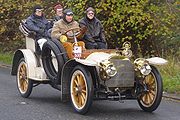
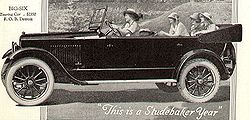
The touring car style
Car body style
Automobiles' body styles are highly variable. Some body styles remain in production, while others become less common or obsolete. They may or may not correlate to a car's price, size or intended market classification. The same car model might be available in multiple body styles comprising a...
was popular in the early 20th century, being a larger alternative to the runabout
Runabout (car)
Runabouts were a popular car body style at the beginning of the 20th Century. They were small, inexpensive, open cars. Most runabouts had just a single row of seats, providing seating for two passengers. Many also had a tonneau at the rear to provide optional seating for four or five...
and the roadster
Roadster
A roadster is a two-seat open car with emphasis on sporty handling and without a fixed roof or side weather protection. Strictly speaking a roadster with wind-up windows is a convertible but as true roadsters are no longer made the distinction is now irrelevant...
. By the mid-teens in the United States, the touring car body had evolved into a variety of types, with the four door touring car, equipped with a convertible top, being the most popular body style offered.
The majority of Model T's
Ford Model T
The Ford Model T is an automobile that was produced by Henry Ford's Ford Motor Company from September 1908 to May 1927...
produced by Ford
Ford Motor Company
Ford Motor Company is an American multinational automaker based in Dearborn, Michigan, a suburb of Detroit. The automaker was founded by Henry Ford and incorporated on June 16, 1903. In addition to the Ford and Lincoln brands, Ford also owns a small stake in Mazda in Japan and Aston Martin in the UK...
between 1908 and 1927 were four and then three-door models (with drivers sliding behind the wheel from passenger seat) touring cars, accounting for 6,519,643 cars sold out of the 15,000,000 estimated Model T's built. In terms of percentage, the 5-passenger touring car model was Ford's most popular body type and accounted for 44% of all Model T's (cars, trucks and chassis) sold over the model's eighteen-plus year life span; Ford's second most popular body style during the same period was its Model T based truck.
Side curtains, when available for a particular model, could be installed to protect passengers from wind and weather by snapping or zipping them into place; otherwise, drivers and passengers braved the elements. When the top was folded down, it formed a bulky mass known as the "fan" behind the back seat: "fan covers" were made to protect the top and its wooden ribs while in the down position.
The popularity of the touring car began to wane in the early 1920s when cars with enclosed passenger compartments became more affordable, and began to consistently out-sell the open cars.
See also
- BarchettaBarchettaA barchetta was originally an Italian style of open 2-seater sports car which was built for racing. Weight and wind resistance were kept to a minimum, and any unnecessary equipment or decoration were sacrificed in order to maximize performance....
– an Italian style of roadster or spyder developed for racing cars after World War II - Phaeton bodyPhaeton bodyA Phaeton is a style of open car or carriage without proper weather protection for passengers. Use of this name for automobiles was limited to North America or its products....
– similar to a touring car, but initially lighter and more sporting - RoadsterRoadsterA roadster is a two-seat open car with emphasis on sporty handling and without a fixed roof or side weather protection. Strictly speaking a roadster with wind-up windows is a convertible but as true roadsters are no longer made the distinction is now irrelevant...
– a.k.a. "spider" or "spyder", open car similar to a touring car, but with only one row of seats. Usually with emphasis on performance, may be considered to be a "single" phaeton. - Runabout (car)Runabout (car)Runabouts were a popular car body style at the beginning of the 20th Century. They were small, inexpensive, open cars. Most runabouts had just a single row of seats, providing seating for two passengers. Many also had a tonneau at the rear to provide optional seating for four or five...
– a light, open two-seat car, similar to a roadster but with emphasis on economy instead of performance. - Torpedo (car)Torpedo (car)The torpedo body style was a type of automobile body used from the early twentieth century until the mid-1930s, and which fell quickly into disuse by the Second World War....
– a touring car with an unbroken body line from the radiator to the back of the car.