

Queen II

Encyclopedia
Queen II is the second album by British rock
group Queen
, released in March 1974. It was recorded at Trident Studios
, London in August 1973 with co-producers Roy Thomas Baker
and Robin Cable, and engineered by Mike Stone.
The two sides of the original LP
were labelled "Side White" and "Side Black" (instead of the conventional sides "1" and "2"), with corresponding photos of the band dressed in white or in black on either side of the record's label face. It is also a concept album, with the white side having songs with a more emotional theme and the black side almost entirely about fantasy, often with quite dark themes. Mick Rock
's album cover
photograph was frequently re-used by the band throughout its career, most notably in the music video for the song "Bohemian Rhapsody
" (1975).
Released to an initially mixed critical reception, Queen II remains one of the band's lesser-known albums. Nonetheless, the album has retained a cult following since its release, has garnered praise from musicians such as Axl Rose
, Steve Vai
and Billy Corgan
, and is significant in being the first album to contain elements of the band's signature sound of multi layered overdubs, vocal harmonies, and varied musical styles.
was recorded and mixed by the end of November 1972, Queen set about touring and promoting it. Management problems forced the album to be released under the independent Trident label, but only after eight months had gone by since completion. During that time, Queen were writing new material and anxious to record it. Several new songs were written immediately after the first album, and some dated from even earlier. "See What A Fool I've Been" was left over from the Smile days. "Ogre Battle" was written during the debut album sessions, as was "Father To Son", but the band decided to wait on recording them until they had more ample studio time.
August 1973 found the band back in Trident Studios
, now allowed to book proper hours there, with an album under their belts. For what is generally considered a complex album (with layered vocals, harmonies and instruments), it took a very short time—only one month—to record Queen II. A full version of "Seven Seas of Rhye" was laid down, recorded with the specific intention of being the album's leading single. After the commercial failure of "Keep Yourself Alive", which was taken from the first album, Queen decided it needed a single that did not take "too long to happen" (without a lengthy guitar intro). So, Queen and Baker made sure that "Rhye" began in a way which would grab people. Mythology
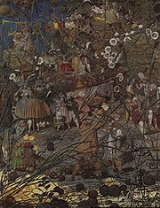
and art were passions of Mercury's, and Richard Dadd
's painting "The Fairy Feller's Master-Stroke
" (which currently hangs in the Tate Gallery
) sparked his creativity. This scene from Dadd's imagination was inspired by characters from faery myths, which in the painting are gathered around the Feller of Trees to watch him crack a walnut for Queen Mab
's new carriage.
Rock photographer Mick Rock
was employed to do the photography for the album's artwork. This single picture of Queen, used on the Queen II album cover, would become one of the band's most iconic images, revisited and brought to life for the "Bohemian Rhapsody" promotional film. Robin Cable, with whom Mercury had worked during the "I Can Hear Music
" session, was recruited to reproduce the Spector production sound for "Funny How Love Is".
The "White" side is very diverse: four of the five numbers were composed by Brian May
, where one is instrumental, one is sung by Freddie Mercury
and Roger Taylor (with May at the piano), the next is sung by Mercury, and the last by May. The closing track of The "White" Side is Taylor's only composition in the album, which he also sings. John Deacon
played acoustic guitar
as well as bass
on most of the album, except the songs "White Queen" and "Some Day One Day", which were performed by May—partly on an inexpensive Hairfred guitar that he had owned since his childhood.
Lead vocalist Freddie Mercury composed the entire "Black" side, contributing virtuosic piano
and harpsichord
pieces and a wide range of distinctive vocal performances.
of, according to VH1, "Queen standing in diamond formation, heads tilted back like Easter Island statues" against a black background. The band had hired Rock because they wanted to, in Rock's words, "graft some of [the trademark] decadent 'glam' sensibility" of his work with artists such as David Bowie
, Iggy Pop
and Lou Reed
. Subsequently, the brief the photographer received from Queen was to have a black and white theme for the Queen II artwork. According to Rock, the group were looking to grab people's attention with the cover, especially since their first album had failed to do so; "They realized that if you could catch people's eyes you could get them interested in music." Describing it as a "sort of a knockoff of an old Marlene Dietrich
shot", the photographer took inspiration for the cover from a still of the actress from the 1932 film Shanghai Express
. "And of course no one was ever more 'glam' than the divine Ms Dietrich", Rock quips.
Although the band almost rejected the photograph because they felt it too pretentious, Rock convinced them otherwise; "It made them look like much bigger a deal then they were at the time, but it was a true reflection of their music." The image was reused by Queen for the promotional video of their 1975 single "Bohemian Rhapsody
" and "One Vision
" (1986).
and consequently, government-enforced measures for energy conservation
delayed its manufacture by several months. Once the long-overdue first pressing arrived in record shops, the band noticed a spelling error on the sleeve, and had to complain persistently to correct it.
Queen II received a mixed critical reaction from the contemporary music press. Disc
wrote, "The material, performance, recording and even artwork standards are very high." NME
opined that the record showcased "all their power and drive, their writing talents, and every quality that makes them unique," while Sounds
wrote, "Simply titled Queen II, this album captures them in their finest hours." Rolling Stone
awarded the album two-and-a-half stars out of five. While the magazine had little enthusiasm for "Side Black", they applauded "Side White", writing that it featured the "saving grace of timely and well-chosen power chords and some rather pretty tunes."
Melody Maker
had little praise for the record, writing, "It's reputed Queen have enjoyed some success in the States, it's currently in the balance whether they'll really break through here. If they do, then I'll have to eat my hat or something. Maybe Queen try too hard, there's no depth of sound or feeling." Record Mirror
were also unamused, writing, "This is it, the dregs of glam rock
. Weak and over-produced, if this band are our brightest hope for the future, then we are committing rock and roll suicide." Robert Christgau
gave the album a "C−" rating, describing it as "Wimpoid royaloid heavoid android void".
Queen II entered UK stores on 8 March 1974. The album enjoyed chart success in the UK, peaking at number 5. It peaked at number 49 in the US, improving on debut album Queen
, which peaked at number 83. The only single taken from Queen II, "Seven Seas of Rhye
" (released in February 1974) peaked at number 10 on the UK Singles Chart
, giving the band their first chart hit.
as the 5th best of the year. While the album remains one of the band's lesser-known works, it has since retained a cult following and has in recent years been cited by a number of music publications, fellow artists and fans as one of Queen's finest works. In 1987, the Post-Tribune
ranked Queen II 9th in an article covering "albums that should be in everyone's record collection, but aren't." In the 1994 edition of The Guinness All Time Top 1000 Albums
, Queen II was voted number 202 in the all-time greatest rock and pop albums. In 2003, Q magazine
included Queen II in a list of fifty little-known albums recommended by the magazine to supplement their "The 50 Best British Albums Ever" poll. In 2005, Kerrang!
readers voted Queen II the 72nd greatest British rock album ever. In 2006, the album was featured in Classic Rock
and Metal Hammer
s "The 200 Greatest Albums of the 70s," being listed alongside Sheer Heart Attack
as one of the 20 greatest albums of 1974. In 2008, IGN Music
named Queen II as one of their "10 Classic Glam Rock Albums", writing, "Queen gave glam a bigger, more anthemic sound with this glittery opus. Combined with Freddie Mercury's underrated keyboard work, Brian May's ringing leads and pristine riffs created a backdrop for songs that were by turns ferocious and elegant." In 2010, Mojo
ranked Queen II as the 60th greatest album ever released on the Elektra Records
label. Along with the Queen albums Sheer Heart Attack
and A Night at the Opera
, Queen II is featured in the book 1001 Albums You Must Hear Before You Die
, where it is described as "a distinctly dark album" which "displayed their diversity," and contrasted with their later "expansive, stadium-pleasing anthems."
Allmusic said of the record, "Queen is coiled, tense, and vicious here, delivering on their inherent sense of drama, and that gives Queen II real power as music, as well as a true cohesion... Queen II is one of the favorites of their hardcore fans." In 2009, The Quietus
published an article highlighting Queen's "lesser-known brilliance" to coincide with the release of that year's Absolute Greatest compilation, describing Queen II as "an absolute scorcher of an album" which features two of the band's best tracks: "Ogre Battle" and "Father to Son".
Endorsements from younger recording artists have introduced the album to a new generation of fans. In a 1989 Rolling Stone interview, Guns N' Roses
lead singer Axl Rose
said of the record, "With Queen, I have my favorite: Queen II. Whenever their newest record would come out and have all these other kinds of music on it, at first I'd only like this song or that song. But after a period of time listening to it, it would open my mind up to so many different styles. I really appreciate them for that. That's something I've always wanted to be able to achieve". Smashing Pumpkins frontman Billy Corgan
spoke to Melody Maker in August 1993 about "the records which changed his life," stating, "I worked at this record store where we had lots of old records, and I found Queen II, probably their least popular album. It's so over the top, so many vocal and guitar track overdubs - total Queen overload. I loved it. I loved the cool, weird, ambiguous songs about Freddie’s sexuality and the way it shifts from heavy to beautiful ballads."
The influence of this album is also seen in Latin America. The Argentine rock band Soda Stereo
, said as one of their influences was Queen and this was reflected in 1997 when they released, as tribute, a Spanish version of "Some Day One Day" called "Algún Día".
except where noted. All songs on the black side written by Freddie Mercury
.
through John Deacon's custom-made amplifier (the Deacy Amp
). Roger Taylor also contributes to this instrumental, using only a bass pedal.
sections as well as a quiet piano part, which May played. Like the preceding number, "Father to Son" has parts with May on multi-tracked guitar, played through the Deacy Amp. It is written in the father's perspective when talking or thinking about his son. Queen added "Father to Son" to their live setlists immediately and toured extensively, but the song was dropped from the setlists in 1975. The song covers a two-octave range: Mercury (G3-A4), Taylor (G4-A5).
and the last guitar solo
(during the fade-out
) features three solo guitars. This kind of complex guitar arrangement is typical of May; however, usually the guitars are harmonious, but in this case, all of the guitars play different parts.
The ogre
-like screams in the middle are Mercury's, and the high harmonies at the end of the chorus hook
are sung by Taylor. As the title suggests, it tells the story of a battle between ogres, and features a May guitar solo and sound effect
s to simulate the sound of a battle. The beginning of the song is the end of the song in reverse including the final gong, which when played backwards at the start of the song, creates the building wave sound.
The song is one of Queen's heaviest works. The guitar riff
along with Taylor's drumming give it a very "thrash" sound. It was a longtime live favourite, although in this case, it was played slower than in the studio. They stopped playing the song somewhere around 1977-1978, playing it on almost every concert up until then.
A different version of "Ogre Battle" exists, recorded in December 1973 for the BBC Radio 1 "Sound of the 70s" programme. This version starts right away with its riff (without any long intro), does not have any effects that the version on "Queen II" has and sounds much less polished. The BBC version of "Ogre Battle" did originally have a long intro featuring a grand guitar build up; it was not used for this release, allegedly because the original tape was damaged.
 Mercury was inspired to write "The Fairy Feller's Master-Stroke" after seeing Richard Dadd
's painting The Fairy Feller's Master-Stroke
. For the intricately-arranged studio recording, Mercury played harpsichord as well as piano, and Roy Thomas Baker played the castanet
s. Taylor called this song Queen's "biggest stereo experiment", referring to the intricate use of panning
in the mix.
The song, like most of the songs on the album, features medieval fantasy-based lyrics, and makes direct reference to the painting's characters as detailed in Dadd's poem, such as Queen Mab
, Waggoner Will, the Tatterdemalion, and others. Apparently whenever Queen had spare time, Mercury would drag them to the London's Tate Gallery
, where the painting was, and still is today.
The complex arrangements are based around a backing track of piano, bass guitar and drums, but also included harpsichord, multiple vocal overdubs and overdubbed guitar parts. The lyrics follow the claustrophobic atmosphere of the painting, and each of the scenes are described. The use of the word "Quaere" has no reference to Mercury's sexuality, according to Taylor. The band never performed this song live.
in 1973, and the song is the only Queen song containing polyrhythm
/polymeter (two different time signature
s simultaneously 8/8 and 12/8), which is very rare for popular music.
The full piece was too complicated to perform live by the band; however, the uptempo section containing the lines "My life is in your hands, I'll foe and I'll fie..." etc. was sometimes included in a live medley, with vocals by Mercury and Taylor, during the 1970s.
The song segues into the next track, "Funny How Love Is". This song ends with an ascending note progression, which climaxes in the first second of the following track.
" technique. The song was never performed live, largely due to the demanding high-register vocals from Mercury throughout the song.
, peaking at number 10 in the UK charts.
The song, like many of the songs on the album, and on Queen
and Sheer Heart Attack
, is about a fantasy world named Rhye. The song became a live favourite throughout Queen's existence. It features a distinctive arpeggiated piano introduction – on the Queen II recording, the arpeggios are played with both the right and left hands, an octave apart, whereas on the Queen recording, and most live performances, Mercury played the simpler one-handed version of these arpeggios. The theme also appears at the end of "It's a Beautiful Day (reprise)" on the album Made In Heaven
. This version ends with a cross fade, instruments blending into a "singsong"-style rendition of "I Do Like to Be Beside the Seaside
".
The seven seas of Rhye are also mentioned in another Queen song, "Lily of the Valley" from Sheer Heart Attack; in the lyric "Messenger from Seven Seas has flown/To tell the king of Rhye he's lost his throne".
With
Production
would come to an end after almost 40 years. According to Universal Music, all Queen albums are to be remastered and reissued in 2011.
Rock music
Rock music is a genre of popular music that developed during and after the 1960s, particularly in the United Kingdom and the United States. It has its roots in 1940s and 1950s rock and roll, itself heavily influenced by rhythm and blues and country music...
group Queen
Queen (band)
Queen are a British rock band formed in London in 1971, originally consisting of Freddie Mercury , Brian May , John Deacon , and Roger Taylor...
, released in March 1974. It was recorded at Trident Studios
Trident Studios
Trident Studios was a British recording facility, originally located at 17 St. Anne's Court in London's Soho district. It was constructed in 1967 by Norman Sheffield a drummer of former 1960's group The Hunters and his Brother Barry....
, London in August 1973 with co-producers Roy Thomas Baker
Roy Thomas Baker
Roy Thomas Baker is a multiple award-winning Anglo-American music producer, songwriter, arranger and Recording Academy Governor, who has produced Platinum and Gold certified pop and rock records from the 1970s to the present.- Career :Baker began his career at Decca Records in England at the age...
and Robin Cable, and engineered by Mike Stone.
The two sides of the original LP
Gramophone record
A gramophone record, commonly known as a phonograph record , vinyl record , or colloquially, a record, is an analog sound storage medium consisting of a flat disc with an inscribed, modulated spiral groove...
were labelled "Side White" and "Side Black" (instead of the conventional sides "1" and "2"), with corresponding photos of the band dressed in white or in black on either side of the record's label face. It is also a concept album, with the white side having songs with a more emotional theme and the black side almost entirely about fantasy, often with quite dark themes. Mick Rock
Mick Rock
Mick Rock is a British photographer best known for his iconic shots of rock and roll legends such as Queen, David Bowie, Syd Barrett, Lou Reed, Iggy Pop and The Stooges, The Sex Pistols, The Ramones, Joan Jett, Talking Heads, Roxy Music, Crossfade, Thin Lizzy, Motley Crue, and Blondie...
's album cover
Album cover
An album cover is the front of the packaging of a commercially released audio recording product, or album. The term can refer to either the printed cardboard covers typically used to package sets of 10" and 12" 78 rpm records, single and sets of 12" LPs, sets of 45 rpm records , or the front-facing...
photograph was frequently re-used by the band throughout its career, most notably in the music video for the song "Bohemian Rhapsody
Bohemian Rhapsody
"Bohemian Rhapsody" is a song by the British rock band Queen. It was written by Freddie Mercury for the band's 1975 album A Night at the Opera...
" (1975).
Released to an initially mixed critical reception, Queen II remains one of the band's lesser-known albums. Nonetheless, the album has retained a cult following since its release, has garnered praise from musicians such as Axl Rose
Axl Rose
W. Axl Rose is an American singer-songwriter and musician. He is the lead vocalist and only remaining original member of the hard rock band Guns N' Roses, with whom he enjoyed great success and recognition in the late 1980s and early 1990s, before disappearing from the public eye for several years...
, Steve Vai
Steve Vai
Steven Siro "Steve" Vai is a three time Grammy Award-winning American guitarist, songwriter and producer who has sold over 15 million albums. Steve Vai is widely known as a flamboyant guitar virtuoso....
and Billy Corgan
Billy Corgan
William Patrick "Billy" Corgan, Jr. is an American singer, songwriter, guitarist and occasional poet best known as the frontman and sole permanent member of The Smashing Pumpkins. Formed by Corgan and guitarist James Iha in Chicago, Illinois in 1987, the band quickly gained steam with the...
, and is significant in being the first album to contain elements of the band's signature sound of multi layered overdubs, vocal harmonies, and varied musical styles.
Background and recording
After their debut album QueenQueen (album)
Queen is the eponymous debut album by British rock group Queen, released in July 1973. It was recorded at Trident Studios and De Lane Lea Music Centre, London, with production by Roy Thomas Baker , John Anthony and Queen....
was recorded and mixed by the end of November 1972, Queen set about touring and promoting it. Management problems forced the album to be released under the independent Trident label, but only after eight months had gone by since completion. During that time, Queen were writing new material and anxious to record it. Several new songs were written immediately after the first album, and some dated from even earlier. "See What A Fool I've Been" was left over from the Smile days. "Ogre Battle" was written during the debut album sessions, as was "Father To Son", but the band decided to wait on recording them until they had more ample studio time.
August 1973 found the band back in Trident Studios
Trident Studios
Trident Studios was a British recording facility, originally located at 17 St. Anne's Court in London's Soho district. It was constructed in 1967 by Norman Sheffield a drummer of former 1960's group The Hunters and his Brother Barry....
, now allowed to book proper hours there, with an album under their belts. For what is generally considered a complex album (with layered vocals, harmonies and instruments), it took a very short time—only one month—to record Queen II. A full version of "Seven Seas of Rhye" was laid down, recorded with the specific intention of being the album's leading single. After the commercial failure of "Keep Yourself Alive", which was taken from the first album, Queen decided it needed a single that did not take "too long to happen" (without a lengthy guitar intro). So, Queen and Baker made sure that "Rhye" began in a way which would grab people. Mythology
Mythology
The term mythology can refer either to the study of myths, or to a body or collection of myths. As examples, comparative mythology is the study of connections between myths from different cultures, whereas Greek mythology is the body of myths from ancient Greece...
and art were passions of Mercury's, and Richard Dadd
Richard Dadd
Richard Dadd was an English painter of the Victorian era, noted for his depictions of fairies and other supernatural subjects, Orientalist scenes, and enigmatic genre scenes, rendered with obsessively minuscule detail...
's painting "The Fairy Feller's Master-Stroke
The Fairy Feller's Master-Stroke
The Fairy Fellers' Master-Stroke is a Richard Dadd painting. It was commissioned by George Henry Hayden, who was head steward at Bethlem Royal Hospital at the time. He was impressed by Dadd's artistic efforts and asked for a fairy painting of his own...
" (which currently hangs in the Tate Gallery
Tate Gallery
The Tate is an institution that houses the United Kingdom's national collection of British Art, and International Modern and Contemporary Art...
) sparked his creativity. This scene from Dadd's imagination was inspired by characters from faery myths, which in the painting are gathered around the Feller of Trees to watch him crack a walnut for Queen Mab
Queen Mab
Queen Mab is a fairy referred to in Shakespeare's play Romeo and Juliet. She also appears in other 17th century literature, and in various guises in later poetry, drama and cinema...
's new carriage.
Rock photographer Mick Rock
Mick Rock
Mick Rock is a British photographer best known for his iconic shots of rock and roll legends such as Queen, David Bowie, Syd Barrett, Lou Reed, Iggy Pop and The Stooges, The Sex Pistols, The Ramones, Joan Jett, Talking Heads, Roxy Music, Crossfade, Thin Lizzy, Motley Crue, and Blondie...
was employed to do the photography for the album's artwork. This single picture of Queen, used on the Queen II album cover, would become one of the band's most iconic images, revisited and brought to life for the "Bohemian Rhapsody" promotional film. Robin Cable, with whom Mercury had worked during the "I Can Hear Music
I Can Hear Music
"I Can Hear Music" is a song written by Jeff Barry, Ellie Greenwich and Phil Spector. It was originally performed by the Ronettes in 1966, and later covered by the Beach Boys in 1969, by Larry Lurex in 1973, by José Hoebee in 1983, and by She & Him in 2010.-Beach Boys version:"I Can Hear Music"...
" session, was recruited to reproduce the Spector production sound for "Funny How Love Is".
The "White" side is very diverse: four of the five numbers were composed by Brian May
Brian May
Brian Harold May, CBE is an English musician and astrophysicist most widely known as the guitarist and a songwriter of the rock band Queen...
, where one is instrumental, one is sung by Freddie Mercury
Freddie Mercury
Freddie Mercury was a British musician, singer and songwriter, best known as the lead vocalist of the rock band Queen. As a performer, he was known for his flamboyant stage persona and powerful vocals over a four-octave range...
and Roger Taylor (with May at the piano), the next is sung by Mercury, and the last by May. The closing track of The "White" Side is Taylor's only composition in the album, which he also sings. John Deacon
John Deacon
John Richard Deacon is a retired English multi-instrumentalist and song writer, best known as the bassist for the rock band Queen. Of the four members of the band, he was the last to join and also the youngest, being only 19 years old when he was recruited by the other members of the band...
played acoustic guitar
Steel-string acoustic guitar
A steel-string acoustic guitar is a modern form of guitar descended from the classical guitar, but strung with steel strings for a brighter, louder sound...
as well as bass
Bass guitar
The bass guitar is a stringed instrument played primarily with the fingers or thumb , or by using a pick....
on most of the album, except the songs "White Queen" and "Some Day One Day", which were performed by May—partly on an inexpensive Hairfred guitar that he had owned since his childhood.
Lead vocalist Freddie Mercury composed the entire "Black" side, contributing virtuosic piano
Piano
The piano is a musical instrument played by means of a keyboard. It is one of the most popular instruments in the world. Widely used in classical and jazz music for solo performances, ensemble use, chamber music and accompaniment, the piano is also very popular as an aid to composing and rehearsal...
and harpsichord
Harpsichord
A harpsichord is a musical instrument played by means of a keyboard. It produces sound by plucking a string when a key is pressed.In the narrow sense, "harpsichord" designates only the large wing-shaped instruments in which the strings are perpendicular to the keyboard...
pieces and a wide range of distinctive vocal performances.
Packaging
The Queen II album cover features a photograph taken by Mick RockMick Rock
Mick Rock is a British photographer best known for his iconic shots of rock and roll legends such as Queen, David Bowie, Syd Barrett, Lou Reed, Iggy Pop and The Stooges, The Sex Pistols, The Ramones, Joan Jett, Talking Heads, Roxy Music, Crossfade, Thin Lizzy, Motley Crue, and Blondie...
of, according to VH1, "Queen standing in diamond formation, heads tilted back like Easter Island statues" against a black background. The band had hired Rock because they wanted to, in Rock's words, "graft some of [the trademark] decadent 'glam' sensibility" of his work with artists such as David Bowie
David Bowie
David Bowie is an English musician, actor, record producer and arranger. A major figure for over four decades in the world of popular music, Bowie is widely regarded as an innovator, particularly for his work in the 1970s...
, Iggy Pop
Iggy Pop
Iggy Pop is an American singer, songwriter, musician, and actor. Though considered an innovator of punk rock, Pop's music has encompassed a number of styles over the years, including pop, metal, jazz and blues...
and Lou Reed
Lou Reed
Lewis Allan "Lou" Reed is an American rock musician, songwriter, and photographer. He is best known as guitarist, vocalist, and principal songwriter of The Velvet Underground, and for his successful solo career, which has spanned several decades...
. Subsequently, the brief the photographer received from Queen was to have a black and white theme for the Queen II artwork. According to Rock, the group were looking to grab people's attention with the cover, especially since their first album had failed to do so; "They realized that if you could catch people's eyes you could get them interested in music." Describing it as a "sort of a knockoff of an old Marlene Dietrich
Marlene Dietrich
Marlene Dietrich was a German-American actress and singer.Dietrich remained popular throughout her long career by continually re-inventing herself, professionally and characteristically. In the Berlin of the 1920s, she acted on the stage and in silent films...
shot", the photographer took inspiration for the cover from a still of the actress from the 1932 film Shanghai Express
Shanghai Express (film)
Shanghai Express is a 1932 American film directed by Josef von Sternberg. The pre-Code picture stars Marlene Dietrich, Clive Brook, Anna May Wong, and Warner Oland. It was written by Jules Furthman, based on a story by Harry Hervey. It was the fourth of seven teamings of Sternberg and Dietrich.The...
. "And of course no one was ever more 'glam' than the divine Ms Dietrich", Rock quips.
Although the band almost rejected the photograph because they felt it too pretentious, Rock convinced them otherwise; "It made them look like much bigger a deal then they were at the time, but it was a true reflection of their music." The image was reused by Queen for the promotional video of their 1975 single "Bohemian Rhapsody
Bohemian Rhapsody
"Bohemian Rhapsody" is a song by the British rock band Queen. It was written by Freddie Mercury for the band's 1975 album A Night at the Opera...
" and "One Vision
One Vision
"One Vision" is a song written and recorded by the rock band Queen, first released as a single in November 1985 and then included on their 1986 album A Kind of Magic...
" (1986).
Release and reception
After the album's completion in the end of August 1973, Queen added "Ogre Battle", "Procession" and "Father to Son" to their live setlists immediately and toured extensively. Once again, however, Trident delayed the record since Queen's first album had only just been released in the UK and had yet to be issued in the USA. Numerous other problems beset the album's release, as well. Its completion coincided with the 1973 oil crisis1973 oil crisis
The 1973 oil crisis started in October 1973, when the members of Organization of Arab Petroleum Exporting Countries or the OAPEC proclaimed an oil embargo. This was "in response to the U.S. decision to re-supply the Israeli military" during the Yom Kippur war. It lasted until March 1974. With the...
and consequently, government-enforced measures for energy conservation
Energy conservation
Energy conservation refers to efforts made to reduce energy consumption. Energy conservation can be achieved through increased efficient energy use, in conjunction with decreased energy consumption and/or reduced consumption from conventional energy sources...
delayed its manufacture by several months. Once the long-overdue first pressing arrived in record shops, the band noticed a spelling error on the sleeve, and had to complain persistently to correct it.
Queen II received a mixed critical reaction from the contemporary music press. Disc
Disc (magazine)
Disc was a weekly British popular music magazine, published between 1958 and 1975, when it was incorporated into Record Mirror. It was also known for periods as Disc Weekly and Disc and Music Echo ....
wrote, "The material, performance, recording and even artwork standards are very high." NME
NME
The New Musical Express is a popular music publication in the United Kingdom, published weekly since March 1952. It started as a music newspaper, and gradually moved toward a magazine format during the 1980s, changing from newsprint in 1998. It was the first British paper to include a singles...
opined that the record showcased "all their power and drive, their writing talents, and every quality that makes them unique," while Sounds
Sounds (magazine)
Sounds was a long-term British music paper, published weekly from 10 October 1970 – 6 April 1991. It was produced by Spotlight Publications , which was set up by Jack Hutton and Peter Wilkinson, who left "Melody Maker" to start their own company...
wrote, "Simply titled Queen II, this album captures them in their finest hours." Rolling Stone
Rolling Stone
Rolling Stone is a US-based magazine devoted to music, liberal politics, and popular culture that is published every two weeks. Rolling Stone was founded in San Francisco in 1967 by Jann Wenner and music critic Ralph J...
awarded the album two-and-a-half stars out of five. While the magazine had little enthusiasm for "Side Black", they applauded "Side White", writing that it featured the "saving grace of timely and well-chosen power chords and some rather pretty tunes."
Melody Maker
Melody Maker
Melody Maker, published in the United Kingdom, was, according to its publisher IPC Media, the world's oldest weekly music newspaper. It was founded in 1926 as a magazine targeted at musicians; in 2000 it was merged into "long-standing rival" New Musical Express.-1950s–1960s:Originally the Melody...
had little praise for the record, writing, "It's reputed Queen have enjoyed some success in the States, it's currently in the balance whether they'll really break through here. If they do, then I'll have to eat my hat or something. Maybe Queen try too hard, there's no depth of sound or feeling." Record Mirror
Record Mirror
Record Mirror was a British weekly pop music newspaper, founded by Isadore Green and featured, news articles, interviews, record charts, record reviews, concert reviews, letters from readers and photographs. The paper became respected by both mainstream pop music fans and serious record collectors...
were also unamused, writing, "This is it, the dregs of glam rock
Glam rock
Glam rock is a style of rock and pop music that developed in the UK in the early 1970s, which was performed by singers and musicians who wore outrageous clothes, makeup and hairstyles, particularly platform-soled boots and glitter...
. Weak and over-produced, if this band are our brightest hope for the future, then we are committing rock and roll suicide." Robert Christgau
Robert Christgau
Robert Christgau is an American essayist, music journalist, and self-proclaimed "Dean of American Rock Critics".One of the earliest professional rock critics, Christgau is known for his terse capsule reviews, published since 1969 in his Consumer Guide columns...
gave the album a "C−" rating, describing it as "Wimpoid royaloid heavoid android void".
Queen II entered UK stores on 8 March 1974. The album enjoyed chart success in the UK, peaking at number 5. It peaked at number 49 in the US, improving on debut album Queen
Queen (album)
Queen is the eponymous debut album by British rock group Queen, released in July 1973. It was recorded at Trident Studios and De Lane Lea Music Centre, London, with production by Roy Thomas Baker , John Anthony and Queen....
, which peaked at number 83. The only single taken from Queen II, "Seven Seas of Rhye
Seven Seas of Rhye
"Seven Seas of Rhye" is a song by British rock group Queen. Written by Queen lead vocalist Freddie Mercury, it is the final track on both the group's debut album Queen and its follow-up Queen II . However, only a less-developed instrumental version was featured on the former...
" (released in February 1974) peaked at number 10 on the UK Singles Chart
UK Singles Chart
The UK Singles Chart is compiled by The Official Charts Company on behalf of the British record-industry. The full chart contains the top selling 200 singles in the United Kingdom based upon combined record sales and download numbers, though some media outlets only list the Top 40 or the Top 75 ...
, giving the band their first chart hit.
Legacy
As 1974 drew to a close, public reaction to Queen II had been enthusiastic. The album was also ranked by DiscDisc (magazine)
Disc was a weekly British popular music magazine, published between 1958 and 1975, when it was incorporated into Record Mirror. It was also known for periods as Disc Weekly and Disc and Music Echo ....
as the 5th best of the year. While the album remains one of the band's lesser-known works, it has since retained a cult following and has in recent years been cited by a number of music publications, fellow artists and fans as one of Queen's finest works. In 1987, the Post-Tribune
Post-Tribune
The Post-Tribune of Northwest Indiana is a daily newspaper headquartered in Merrillville, Indiana, United States. It serves the Northwest Indiana region, and is owned by the Sun-Times Media Group.-History:...
ranked Queen II 9th in an article covering "albums that should be in everyone's record collection, but aren't." In the 1994 edition of The Guinness All Time Top 1000 Albums
Guinness World Records
Guinness World Records, known until 2000 as The Guinness Book of Records , is a reference book published annually, containing a collection of world records, both human achievements and the extremes of the natural world...
, Queen II was voted number 202 in the all-time greatest rock and pop albums. In 2003, Q magazine
Q (magazine)
Q is a popular music magazine published monthly in the United Kingdom.Founders Mark Ellen and David Hepworth were dismayed by the music press of the time, which they felt was ignoring a generation of older music buyers who were buying CDs — then still a new technology...
included Queen II in a list of fifty little-known albums recommended by the magazine to supplement their "The 50 Best British Albums Ever" poll. In 2005, Kerrang!
Kerrang!
Kerrang! is a UK-based magazine devoted to rock music published by Bauer Media Group. It was first published on June 6, 1981 as a one-off supplement in the Sounds newspaper...
readers voted Queen II the 72nd greatest British rock album ever. In 2006, the album was featured in Classic Rock
Classic Rock (magazine)
Classic Rock is a British magazine dedicated to the radio format of classic rock, published by Future Publishing, who are also responsible for its "sister" publication Metal Hammer. Although firmly focusing on key bands from the 1960s through early 1990s, it also includes articles and reviews of...
and Metal Hammer
Metal Hammer
Metal Hammer is a monthly heavy metal music magazine published in the United Kingdom by Future Publishing, and in several other countries by different publishers. Metal Hammer articles feature both mainstream bands and more unusual acts from the whole spectrum of heavy metal music...
s "The 200 Greatest Albums of the 70s," being listed alongside Sheer Heart Attack
Sheer Heart Attack
Sheer Heart Attack is the third album by the British rock group Queen, released in November 1974. It was produced by Queen and Roy Thomas Baker and distributed by EMI in the United Kingdom, and Elektra in the United States....
as one of the 20 greatest albums of 1974. In 2008, IGN Music
IGN
IGN is an entertainment website that focuses on video games, films, music and other media. IGN's main website comprises several specialty sites or "channels", each occupying a subdomain and covering a specific area of entertainment...
named Queen II as one of their "10 Classic Glam Rock Albums", writing, "Queen gave glam a bigger, more anthemic sound with this glittery opus. Combined with Freddie Mercury's underrated keyboard work, Brian May's ringing leads and pristine riffs created a backdrop for songs that were by turns ferocious and elegant." In 2010, Mojo
Mojo (magazine)
MOJO is a popular music magazine published initially by Emap, and since January 2008 by Bauer, monthly in the United Kingdom. Following the success of the magazine Q, publishers Emap were looking for a title which would cater for the burgeoning interest in classic rock music...
ranked Queen II as the 60th greatest album ever released on the Elektra Records
Elektra Records
Elektra Records is an American record label owned by Warner Music Group. In 2004, it was consolidated into WMG's Atlantic Records Group. After five years of dormancy, the label was revived by Atlantic in 2009....
label. Along with the Queen albums Sheer Heart Attack
Sheer Heart Attack
Sheer Heart Attack is the third album by the British rock group Queen, released in November 1974. It was produced by Queen and Roy Thomas Baker and distributed by EMI in the United Kingdom, and Elektra in the United States....
and A Night at the Opera
A Night at the Opera (Queen album)
A Night at the Opera is the fourth studio album by the British rock group Queen, released in November 1975. Co-produced by Roy Thomas Baker and Queen, A Night at the Opera was, at the time of its release, the most expensive album ever recorded...
, Queen II is featured in the book 1001 Albums You Must Hear Before You Die
1001 Albums You Must Hear Before You Die
1001 Albums You Must Hear Before You Die is a musical reference book edited by Robert Dimery, first published in 2005. The most recent edition consists of a list of albums released between 1955 and 2010, part of a series from Quintessence Editions Ltd...
, where it is described as "a distinctly dark album" which "displayed their diversity," and contrasted with their later "expansive, stadium-pleasing anthems."
Allmusic said of the record, "Queen is coiled, tense, and vicious here, delivering on their inherent sense of drama, and that gives Queen II real power as music, as well as a true cohesion... Queen II is one of the favorites of their hardcore fans." In 2009, The Quietus
The Quietus
The Quietus is a British online rock music and pop culture magazine, focusing on arts news, reviews, and features. The site is an editorially independent publication led by John Doran and a group of freelance journalists and critics, some of whom have worked for other media outlets...
published an article highlighting Queen's "lesser-known brilliance" to coincide with the release of that year's Absolute Greatest compilation, describing Queen II as "an absolute scorcher of an album" which features two of the band's best tracks: "Ogre Battle" and "Father to Son".
Endorsements from younger recording artists have introduced the album to a new generation of fans. In a 1989 Rolling Stone interview, Guns N' Roses
Guns N' Roses
Guns N' Roses is an American hard rock band, formed in Hollywood, Los Angeles, California, in 1985. The band has released six studio albums, three EPs, and one live album...
lead singer Axl Rose
Axl Rose
W. Axl Rose is an American singer-songwriter and musician. He is the lead vocalist and only remaining original member of the hard rock band Guns N' Roses, with whom he enjoyed great success and recognition in the late 1980s and early 1990s, before disappearing from the public eye for several years...
said of the record, "With Queen, I have my favorite: Queen II. Whenever their newest record would come out and have all these other kinds of music on it, at first I'd only like this song or that song. But after a period of time listening to it, it would open my mind up to so many different styles. I really appreciate them for that. That's something I've always wanted to be able to achieve". Smashing Pumpkins frontman Billy Corgan
Billy Corgan
William Patrick "Billy" Corgan, Jr. is an American singer, songwriter, guitarist and occasional poet best known as the frontman and sole permanent member of The Smashing Pumpkins. Formed by Corgan and guitarist James Iha in Chicago, Illinois in 1987, the band quickly gained steam with the...
spoke to Melody Maker in August 1993 about "the records which changed his life," stating, "I worked at this record store where we had lots of old records, and I found Queen II, probably their least popular album. It's so over the top, so many vocal and guitar track overdubs - total Queen overload. I loved it. I loved the cool, weird, ambiguous songs about Freddie’s sexuality and the way it shifts from heavy to beautiful ballads."
The influence of this album is also seen in Latin America. The Argentine rock band Soda Stereo
Soda Stereo
Soda Stereo were an Argentine rock band who are recognized as one of the most influential and important Latin American and Ibero-American bands of all time...
, said as one of their influences was Queen and this was reflected in 1997 when they released, as tribute, a Spanish version of "Some Day One Day" called "Algún Día".
Track listing
All songs on the white side written by Brian MayBrian May
Brian Harold May, CBE is an English musician and astrophysicist most widely known as the guitarist and a songwriter of the rock band Queen...
except where noted. All songs on the black side written by Freddie Mercury
Freddie Mercury
Freddie Mercury was a British musician, singer and songwriter, best known as the lead vocalist of the rock band Queen. As a performer, he was known for his flamboyant stage persona and powerful vocals over a four-octave range...
.
Procession
"Procession" is a short instrumental piece performed by Brian May on multi-tracked guitar. He recorded it by playing overlapping parts on the Red SpecialRed Special
The Red Special is an electric guitar owned by Queen guitarist Brian May and custom-built by May and his father. The Red Special is also sometimes named in reviews as the Fireplace or the Old Lady, both nicknames used by May when referring to the guitar. A guitar that would define May's signature...
through John Deacon's custom-made amplifier (the Deacy Amp
Deacy Amp
The Deacy Amp is a small, one-watt, roughly amplifier created by and named after Queen bassist John Deacon and used by guitarist Brian May. The amplifier produces a trumpet-like or orchestral sound when plugged into a guitar....
). Roger Taylor also contributes to this instrumental, using only a bass pedal.
Father to Son
"Father to Son" was written by May and features heavy metalHeavy metal music
Heavy metal is a genre of rock music that developed in the late 1960s and early 1970s, largely in the Midlands of the United Kingdom and the United States...
sections as well as a quiet piano part, which May played. Like the preceding number, "Father to Son" has parts with May on multi-tracked guitar, played through the Deacy Amp. It is written in the father's perspective when talking or thinking about his son. Queen added "Father to Son" to their live setlists immediately and toured extensively, but the song was dropped from the setlists in 1975. The song covers a two-octave range: Mercury (G3-A4), Taylor (G4-A5).
White Queen (As It Began)
Written by May, this song features contrasting acoustic and heavy metal sections.Some Day One Day
This is the first song sung entirely by May on lead vocals. It features May on acoustic guitar and electric guitarElectric guitar
An electric guitar is a guitar that uses the principle of direct electromagnetic induction to convert vibrations of its metal strings into electric audio signals. The signal generated by an electric guitar is too weak to drive a loudspeaker, so it is amplified before sending it to a loudspeaker...
and the last guitar solo
Guitar solo
In popular music, a guitar solo is a melodic passage, section, or entire piece of music written for an electric guitar or an acoustic guitar. Guitar solos, which often contain varying degrees of improvisation, are used in many styles of popular music such as blues, jazz, rock and metal styles such...
(during the fade-out
Fade (audio engineering)
In audio engineering, a fade is a gradual increase or decrease in the level of an audio signal. The term can also be used for film cinematography or theater lighting, in much the same way ....
) features three solo guitars. This kind of complex guitar arrangement is typical of May; however, usually the guitars are harmonious, but in this case, all of the guitars play different parts.
The Loser in the End
"The Loser in the End" was Taylor's sole contribution on the album both as a songwriter and lead vocalist.Ogre Battle
Mercury wrote "Ogre Battle" on guitar (as confirmed by May in several interviews) in 1972. The band did not want to record it for their first album, but rather waited until they could have more studio freedom to do it properly.The ogre
Ogre
An ogre is a large, cruel, monstrous, and hideous humanoid monster, featured in mythology, folklore, and fiction. Ogres are often depicted in fairy tales and folklore as feeding on human beings, and have appeared in many classic works of literature...
-like screams in the middle are Mercury's, and the high harmonies at the end of the chorus hook
Hook (music)
A hook is a musical idea, often a short riff, passage, or phrase, that is used in popular music to make a song appealing and to "catch the ear of the listener". The term generally applies to popular music, especially rock music, hip hop, dance music, and pop. In these genres, the hook is often...
are sung by Taylor. As the title suggests, it tells the story of a battle between ogres, and features a May guitar solo and sound effect
Sound effect
For the album by The Jam, see Sound Affects.Sound effects or audio effects are artificially created or enhanced sounds, or sound processes used to emphasize artistic or other content of films, television shows, live performance, animation, video games, music, or other media...
s to simulate the sound of a battle. The beginning of the song is the end of the song in reverse including the final gong, which when played backwards at the start of the song, creates the building wave sound.
The song is one of Queen's heaviest works. The guitar riff
RIFF
The Resource Interchange File Format is a generic file container format for storing data in tagged chunks. It is primarily used to store multimedia such as sound and video, though it may also be used to store any arbitrary data....
along with Taylor's drumming give it a very "thrash" sound. It was a longtime live favourite, although in this case, it was played slower than in the studio. They stopped playing the song somewhere around 1977-1978, playing it on almost every concert up until then.
A different version of "Ogre Battle" exists, recorded in December 1973 for the BBC Radio 1 "Sound of the 70s" programme. This version starts right away with its riff (without any long intro), does not have any effects that the version on "Queen II" has and sounds much less polished. The BBC version of "Ogre Battle" did originally have a long intro featuring a grand guitar build up; it was not used for this release, allegedly because the original tape was damaged.
The Fairy Feller's Master-Stroke
Richard Dadd
Richard Dadd was an English painter of the Victorian era, noted for his depictions of fairies and other supernatural subjects, Orientalist scenes, and enigmatic genre scenes, rendered with obsessively minuscule detail...
's painting The Fairy Feller's Master-Stroke
The Fairy Feller's Master-Stroke
The Fairy Fellers' Master-Stroke is a Richard Dadd painting. It was commissioned by George Henry Hayden, who was head steward at Bethlem Royal Hospital at the time. He was impressed by Dadd's artistic efforts and asked for a fairy painting of his own...
. For the intricately-arranged studio recording, Mercury played harpsichord as well as piano, and Roy Thomas Baker played the castanet
Castanet
Castanets are a percussion instrument , used in Moorish, Ottoman, ancient Roman, Italian, Spanish, Sephardic Music, and Portuguese music. The instrument consists of a pair of concave shells joined on one edge by a string. They are held in the hand and used to produce clicks for rhythmic accents or...
s. Taylor called this song Queen's "biggest stereo experiment", referring to the intricate use of panning
Panning (audio)
Panning is the spread of a sound signal into a new stereo or multi-channel sound field. A typical physical recording console pan control is a knob with a pointer which can be placed from the 8 o'clock dial position fully left to the 4 o'clock position fully right...
in the mix.
The song, like most of the songs on the album, features medieval fantasy-based lyrics, and makes direct reference to the painting's characters as detailed in Dadd's poem, such as Queen Mab
Queen Mab
Queen Mab is a fairy referred to in Shakespeare's play Romeo and Juliet. She also appears in other 17th century literature, and in various guises in later poetry, drama and cinema...
, Waggoner Will, the Tatterdemalion, and others. Apparently whenever Queen had spare time, Mercury would drag them to the London's Tate Gallery
Tate Gallery
The Tate is an institution that houses the United Kingdom's national collection of British Art, and International Modern and Contemporary Art...
, where the painting was, and still is today.
The complex arrangements are based around a backing track of piano, bass guitar and drums, but also included harpsichord, multiple vocal overdubs and overdubbed guitar parts. The lyrics follow the claustrophobic atmosphere of the painting, and each of the scenes are described. The use of the word "Quaere" has no reference to Mercury's sexuality, according to Taylor. The band never performed this song live.
Nevermore
The previous track ends with a three-part vocal harmony from May, Mercury and Taylor which flows into Mercury playing the piano on this track. All the vocal parts were performed by Mercury, who added some contemporary piano "ring" effects as well. These effects were widely suspected to be synthesizers; however, they were created by someone plucking the piano strings while Mercury played the notes. Nevermore is quite a short ballad about the feelings after a heartbreak.The March of the Black Queen
Mercury composed this song on pianoPiano
The piano is a musical instrument played by means of a keyboard. It is one of the most popular instruments in the world. Widely used in classical and jazz music for solo performances, ensemble use, chamber music and accompaniment, the piano is also very popular as an aid to composing and rehearsal...
in 1973, and the song is the only Queen song containing polyrhythm
Polyrhythm
Polyrhythm is the simultaneous sounding of two or more independent rhythms.Polyrhythm in general is a nonspecific term for the simultaneous occurrence of two or more conflicting rhythms, of which cross-rhythm is a specific and definable subset.—Novotney Polyrhythms can be distinguished from...
/polymeter (two different time signature
Time signature
The time signature is a notational convention used in Western musical notation to specify how many beats are in each measure and which note value constitutes one beat....
s simultaneously 8/8 and 12/8), which is very rare for popular music.
The full piece was too complicated to perform live by the band; however, the uptempo section containing the lines "My life is in your hands, I'll foe and I'll fie..." etc. was sometimes included in a live medley, with vocals by Mercury and Taylor, during the 1970s.
The song segues into the next track, "Funny How Love Is". This song ends with an ascending note progression, which climaxes in the first second of the following track.
Funny How Love Is
"Funny How Love Is" was created in the studio. Mercury wrote it and played the piano while Robin Cable produced. It was produced using the "wall of soundWall of Sound
The Wall of Sound is a music production technique for pop and rock music recordings developed by record producer Phil Spector at Gold Star Studios in Los Angeles, California, during the early 1960s...
" technique. The song was never performed live, largely due to the demanding high-register vocals from Mercury throughout the song.
Seven Seas of Rhye
"Seven Seas of Rhye" had been half-written at the time of recording for Queen's first album, so a short clip of it was included there. However, when Queen finished the song, it ended up being much different from what they'd first envisioned. It was the band's first hit singleHit single
A hit single is a recorded song or instrumental released as a single that has become very popular. Although it is sometimes used to describe any widely-played or big-selling song, the term "hit" is usually reserved for a single that has appeared in an official music chart through repeated radio...
, peaking at number 10 in the UK charts.
The song, like many of the songs on the album, and on Queen
Queen (album)
Queen is the eponymous debut album by British rock group Queen, released in July 1973. It was recorded at Trident Studios and De Lane Lea Music Centre, London, with production by Roy Thomas Baker , John Anthony and Queen....
and Sheer Heart Attack
Sheer Heart Attack
Sheer Heart Attack is the third album by the British rock group Queen, released in November 1974. It was produced by Queen and Roy Thomas Baker and distributed by EMI in the United Kingdom, and Elektra in the United States....
, is about a fantasy world named Rhye. The song became a live favourite throughout Queen's existence. It features a distinctive arpeggiated piano introduction – on the Queen II recording, the arpeggios are played with both the right and left hands, an octave apart, whereas on the Queen recording, and most live performances, Mercury played the simpler one-handed version of these arpeggios. The theme also appears at the end of "It's a Beautiful Day (reprise)" on the album Made In Heaven
Made in Heaven
Made in Heaven is the fifteenth studio album by British rock group Queen and the final one to feature lead singer Freddie Mercury and bassist John Deacon, released on 6 November 1995...
. This version ends with a cross fade, instruments blending into a "singsong"-style rendition of "I Do Like to Be Beside the Seaside
I Do Like To be Beside the Seaside
"I Do Like To Be Beside The Seaside" is a popular British music hall song. It was written in 1907 by John A. Glover-Kind and made famous by music hall singer Mark Sheridan who first recorded it in 1909. It speaks of the singer's love for the seaside, and their wish to return there for their summer...
".
The seven seas of Rhye are also mentioned in another Queen song, "Lily of the Valley" from Sheer Heart Attack; in the lyric "Messenger from Seven Seas has flown/To tell the king of Rhye he's lost his throne".
Queen comments on the record
Personnel
- Freddie MercuryFreddie MercuryFreddie Mercury was a British musician, singer and songwriter, best known as the lead vocalist of the rock band Queen. As a performer, he was known for his flamboyant stage persona and powerful vocals over a four-octave range...
- lead and backing vocals, pianoPianoThe piano is a musical instrument played by means of a keyboard. It is one of the most popular instruments in the world. Widely used in classical and jazz music for solo performances, ensemble use, chamber music and accompaniment, the piano is also very popular as an aid to composing and rehearsal...
, harpsichordHarpsichordA harpsichord is a musical instrument played by means of a keyboard. It produces sound by plucking a string when a key is pressed.In the narrow sense, "harpsichord" designates only the large wing-shaped instruments in which the strings are perpendicular to the keyboard... - Brian MayBrian MayBrian Harold May, CBE is an English musician and astrophysicist most widely known as the guitarist and a songwriter of the rock band Queen...
- electricElectric guitarAn electric guitar is a guitar that uses the principle of direct electromagnetic induction to convert vibrations of its metal strings into electric audio signals. The signal generated by an electric guitar is too weak to drive a loudspeaker, so it is amplified before sending it to a loudspeaker...
and acoustic guitarAcoustic guitarAn acoustic guitar is a guitar that uses only an acoustic sound board. The air in this cavity resonates with the vibrational modes of the string and at low frequencies, which depend on the size of the box, the chamber acts like a Helmholtz resonator, increasing or decreasing the volume of the sound...
s, bellsBell (instrument)A bell is a simple sound-making device. The bell is a percussion instrument and an idiophone. Its form is usually a hollow, cup-shaped object, which resonates upon being struck...
on "The March of the Black Queen", lead vocals on "Some Day One Day", backing vocals, piano and organElectronic organAn electronic organ is an electronic keyboard instrument which was derived from the harmonium, pipe organ and theatre organ. Originally, it was designed to imitate the sound of pipe organs, theatre organs, band sounds, or orchestral sounds....
on "Father to Son" - Roger TaylorRoger Meddows-TaylorRoger Meddows Taylor , known as Roger Taylor, is a British musician, singer-songwriter and multi-instrumentalist. He is best known as the drummer, backing vocalist and occasional lead vocalist of British rock band Queen. As a drummer he is known for his "big" unique sound and is considered one of...
- drumsDrum kitA drum kit is a collection of drums, cymbals and often other percussion instruments, such as cowbells, wood blocks, triangles, chimes, or tambourines, arranged for convenient playing by a single person ....
, gongGongA gong is an East and South East Asian musical percussion instrument that takes the form of a flat metal disc which is hit with a mallet....
, marimbaMarimbaThe marimba is a musical instrument in the percussion family. It consists of a set of wooden keys or bars with resonators. The bars are struck with mallets to produce musical tones. The keys are arranged as those of a piano, with the accidentals raised vertically and overlapping the natural keys ...
, backing vocals, additional vocals on one line of "The March of the Black Queen", lead vocals on "The Loser in the End" - John DeaconJohn DeaconJohn Richard Deacon is a retired English multi-instrumentalist and song writer, best known as the bassist for the rock band Queen. Of the four members of the band, he was the last to join and also the youngest, being only 19 years old when he was recruited by the other members of the band...
- bass guitarBass guitarThe bass guitar is a stringed instrument played primarily with the fingers or thumb , or by using a pick....
, acoustic guitar
With
- Roy Thomas BakerRoy Thomas BakerRoy Thomas Baker is a multiple award-winning Anglo-American music producer, songwriter, arranger and Recording Academy Governor, who has produced Platinum and Gold certified pop and rock records from the 1970s to the present.- Career :Baker began his career at Decca Records in England at the age...
- castanets on "The Fairy Feller's Master-Stroke", stylophone on "Seven Seas Of Rhye". - Robin Cable - piano effects (with Mercury) on "Nevermore"
Production
- All songs produced by Queen and Roy Thomas Baker excluding:
- "Nevermore" and "Funny How Love Is" - Robin Cable and Queen
- "The March of the Black Queen" - Baker, Cable and Queen
Chart performance
| Chart (1974) | Peak position |
|---|---|
| Canadian Albums Chart | 40 |
| Norwegian Albums Chart | 19 |
| UK Albums Chart | 5 |
| U.S. Billboard 200 | 49 |
2011 re-issue
On 8 November 2010, record company Universal Music announced a remastered and expanded reissue of the album set for release in May 2011. This as part of a new record deal between Queen and Universal Music, which meant Queen's association with EMIEMI
The EMI Group, also known as EMI Music or simply EMI, is a multinational music company headquartered in London, United Kingdom. It is the fourth-largest business group and family of record labels in the recording industry and one of the "big four" record companies. EMI Group also has a major...
would come to an end after almost 40 years. According to Universal Music, all Queen albums are to be remastered and reissued in 2011.
External links
- Queen II at Queen Online, the band's official website.
- Tate Gallery: Richard Dadd's "The Fairy Feller's Master-Stroke"
- Queen II at Queenpedia