
All Topics  
Electronic organ

 
Electronic Organ

   Email Print
   Bookmark   Link


Electronic organ


An electronic organ is an electronic keyboard
Electronic keyboard

An electronic keyboard or digital keyboard is a type of keyboard instrument. Its sound is generated or amplified by one or more electronic devices....
 instrument originally designed to imitate the sound of a pipe organ
Pipe organ

The pipe organ is a keyboard musical instrument that produces sound by venting mechanically compressed air through resonant Organ pipe. Each pipe produces sound at one fixed pitch, so they are provided in sets or "ranks" with one pipe or more per note, each rank having a common timbre and loudness throughout....
. It has developed today into two forms of the instrument, the digital church organ that imitates a pipe organ for classical music and use in churches, and the Hammond organ
Hammond organ

The Hammond organ is an electronic organ which was invented by Laurens Hammond in 1934 and manufactured by the Hammond Organ Company. While the Hammond organ was originally sold to Church as a lower-cost alternative to the wind-driven pipe organ, in the 1960s and 1970s, it became a standard keyboard instrument for jazz, blues, Rock and r...
-style instrument used in more popular music genres.

Digital Classical Instruments
These are instruments designed as pipe organ replacements or as digital consoles
Organ console

The pipe organ is played from an area called the console, which holds the manuals, pedals, and stop controls. In electric-action organs, the console is often movable....
 to play existing pipes.


Discussion
Ask a question about 'Electronic organ'
Start a new discussion about 'Electronic organ'
Answer questions from other users
Full Discussion Forum


Encyclopedia


An electronic organ is an electronic keyboard
Electronic keyboard

An electronic keyboard or digital keyboard is a type of keyboard instrument. Its sound is generated or amplified by one or more electronic devices....
 instrument originally designed to imitate the sound of a pipe organ
Pipe organ

The pipe organ is a keyboard musical instrument that produces sound by venting mechanically compressed air through resonant Organ pipe. Each pipe produces sound at one fixed pitch, so they are provided in sets or "ranks" with one pipe or more per note, each rank having a common timbre and loudness throughout....
. It has developed today into two forms of the instrument, the digital church organ that imitates a pipe organ for classical music and use in churches, and the Hammond organ
Hammond organ

The Hammond organ is an electronic organ which was invented by Laurens Hammond in 1934 and manufactured by the Hammond Organ Company. While the Hammond organ was originally sold to Church as a lower-cost alternative to the wind-driven pipe organ, in the 1960s and 1970s, it became a standard keyboard instrument for jazz, blues, Rock and r...
-style instrument used in more popular music genres.

Digital Classical Instruments


These are instruments designed as pipe organ replacements or as digital consoles
Organ console

The pipe organ is played from an area called the console, which holds the manuals, pedals, and stop controls. In electric-action organs, the console is often movable....
 to play existing pipes. They have developed greatly over the last two decades, and are now a common alternative to the pipe organ
Pipe organ

The pipe organ is a keyboard musical instrument that produces sound by venting mechanically compressed air through resonant Organ pipe. Each pipe produces sound at one fixed pitch, so they are provided in sets or "ranks" with one pipe or more per note, each rank having a common timbre and loudness throughout....
, particularly in churches. These are often referred to as digital organs. The technology has advanced to such a level that there is very little difference in sound timbre between piped and pipeless instruments, although this is still debated by some organists, who may argue that there is no substitute for a real pipe organ. However, many churches that are unable to afford costly pipe organs have turned to less-expensive electronic organs as a viable alternative; even a congregation that could afford a modest pipe organ may instead opt for a digital organ that simulates a pipe organ that would be larger than they could afford.

Digital organs by custom builders have also become a viable alternative for churches who may have had a pipe organ and can no longer afford to maintain it, or for those situations where a pipe organ is not financially possible. Some proponents of pipe organs claim that digital organs should be regarded as no more than multi-note hi-fi systems of durability no more than standard electronic equipment, in contrast to pipe organs that might still be playing without major rebuilding for many years. However, the high initial cost of pipe organs has limited their production, and all-digital and pipe/digital combination organs now significantly outsell pipe organs.

Most of the current digital church organs produce sounds based on recorded pipe samples, while others may model the pipe sound by digital synthesis. Custom digital organs can require large and expensive computer systems and an organ "voicer" may finish the organ, much like the process of regulating and voicing a pipe organ. These organs typically use very high quality custom-designed audio systems. The builders of both custom and factory organs include the firms of Allen
Allen Organ

Allen Organ Company, formed in 1937 by Jerome Markowitz, is located in Macungie, Pennsylvania. It is one of the world's largest builders of Electronic_organ....
, Johannus, Makin
Makin

Makin may refer to:*Makin , Kiribati**Makin Island, Makin, the main island***Makin , the capital of Makin**The Makin Island raid, a 1942 attack by US Marines on Japanese military forces on Makin Island...
, Rodgers
Rodgers Instruments

Rodgers Instruments LLC manufactures church organ , using patented stereophonic digital organ technology. Rodgers is the largest builder of custom church organs in the world....
 and Wyvern
Wyvern

A wyvern or wivern is a Legendary creature winged reptile creature with two legs often found in mediaeval heraldry. The word is derived from Middle English wyvere, from Old North French wivre "viper"....
.

This style of instrument is also popular with popular concert organists, such as Carlo Curley
Carlo Curley

Carlo Curley is a flamboyant and popular classical concert organist. Dubbed the Pavarotti of the Organ by the press, he is one of only a few concert organists worldwide who supports himself exclusively by giving recitals, concerts and master classes, without any supplement from teaching or church position....
, who tours with a substantial Allen Organ
Allen Organ

Allen Organ Company, formed in 1937 by Jerome Markowitz, is located in Macungie, Pennsylvania. It is one of the world's largest builders of Electronic_organ....
 in the USA and with an Allen in the UK, which means he does not need to spend time getting used to a new pipe organ for every concert he performs. These instruments will often contain effects that are not seen on pipe organs, and there may be additional features, such as orchestral and percussion sounds, and console aids. The most advanced digital organs also offer some capabilities and features not found in pipe organs, such as changing historical pitch standards
Pitch (music)

Pitch represents the perceived fundamental frequency of a sound. It is one of the three major auditory system attributes of sounds along with loudness and timbre....
 and temperament
Musical temperament

In musical tuning, a temperament is a system of tuning which slightly compromises the pure intervals of just intonation in order to meet other requirements of the system....
s.

History

The immediate predecessor of the electronic organ was the harmonium
Harmonium

A harmonium is a free-standing keyboard instrument similar to a reed organ or pipe organ. Sound is produced by air, supplied by foot-operated or hand-operated bellows, being blown through sets of Free reed aerophone, resulting in a sound similar to that of an accordion....
, or reed organ
Reed organ

A reed organ, also called parlor organ, pump organ, cabinet organ, cottage organ, is an organ that generates its sounds using free metal reed ....
, an instrument that was very popular in homes and small churches in the late nineteenth and early twentieth centuries. In a fashion not totally unlike that of pipe organs, reed organs generated sound by forcing air over a set of reeds by means of a bellows, usually operated by constantly pumping a set of pedals. While reed organs had limited tonal quality, they were small, inexpensive, self-powered, and self-contained. The reed organ was thus able to bring an organlike sound to venues that were incapable of housing or affording pipe organs. This concept was to play an important role in the development of the electric organ.

Electricity arrived on the organ scene in the first decades of the 1900s, but it was slow to have a major impact. Thaddeus Cahill
Thaddeus Cahill

Thaddeus Cahill was a prominent inventor of the early 20th century. He is widely credited with the invention of the first electromechanical musical instrument, which he dubbed the telharmonium....
's gargantuan and controversial instrument, the Telharmonium
Telharmonium

The Telharmonium was an early electronic musical instrument, developed by Thaddeus Cahill in 1897. The Telharmonium was intended to be listened to using telephone receivers....
, which began piping music to New York City establishments over the telephone system in 1897, predated the advent of electronics
Electronics

Electronics refers to the flow of charge through nonmetal electrical conductor , whereas electrical refers to the flow of charge through metal electrical conductor....
, yet was the first instrument to demonstrate the use of the combination of many different pure electrical waveforms to synthesize real-world instrument sounds. Cahill's techniques were later used by Laurens Hammond
Laurens Hammond

Laurens Hammond , was an engineer and inventor. His inventions include, most famously, the Hammond organ and the Hammond clock....
 in his organ design, and the 200-ton instrument served as the world's first demonstration of electrically-produced music on a grand scale. Electrically powered reed organs appeared during the first decades of electricity, but their tonal qualities remained much the same as the older, foot-pumped models. Meanwhile, some further experimentation with producing sound by electric impulses was taking place, especially in France. The first widespread success in this field, however, was a product of the Hammond
Hammond organ

The Hammond organ is an electronic organ which was invented by Laurens Hammond in 1934 and manufactured by the Hammond Organ Company. While the Hammond organ was originally sold to Church as a lower-cost alternative to the wind-driven pipe organ, in the 1960s and 1970s, it became a standard keyboard instrument for jazz, blues, Rock and r...
 Corporation in the mid-1930s. The Hammond Organ
Hammond organ

The Hammond organ is an electronic organ which was invented by Laurens Hammond in 1934 and manufactured by the Hammond Organ Company. While the Hammond organ was originally sold to Church as a lower-cost alternative to the wind-driven pipe organ, in the 1960s and 1970s, it became a standard keyboard instrument for jazz, blues, Rock and r...
 quickly became the successor of the reed organ, displacing it completely.

From the start, electronic organs operated on a radically different principle from all previous organs. In the place of reeds and pipes, Hammond introduced a set of rapidly spinning magnetic wheels, called tonewheel
Tonewheel

A tonewheel is a relatively primitive apparatus for generating electronic musical notes. The tonewheel assembly consists of a synchronous electric motor and an associated Transmission that drives a series of rotating disks....
s, which excited transducer
Transducer

A transducer is a device, usually electricity, electronics, electro-mechanical, electromagnetic, photonic, or photovoltaic that converts one type of energy or physical attribute to another for various purposes including measurement or information transfer ....
s that generated electrical signals of various frequencies that were mixed and fed through an amplifier
Amplifier

Generally, an amplifier or simply amp, is any machine that changes, usually increases, the amplitude of a Signal . The "signal" is usually voltage or current....
 to a loudspeaker
Loudspeaker

A loudspeaker, speaker, or speaker system is an electroacoustical transducer that converts an electricity signal processing to sound....
. The organ was electrically powered, replacing the reed organ’s twin bellows pedals with a single swell (or "expression") pedal more like that of a pipe organ. Instead of having to pump at a constant rate, as had been the case with the reed organ, the organist simply varied pressure on this pedal at will to change the volume as desired. Unlike reed organs, this gave great control over the music's dynamic range, while at the same time freeing one or both of the player's feet to play on a pedalboard, which, unlike nearly all reed organs, electronic organs incorporated. From the beginning, the electronic organ also had a second manual
Manual (music)

A manual is a musical keyboard designed to be played with the hands on a pipe organ, harpsichord, clavichord, electronic organ, or synthesizer. The term "manual" is used with regard to any hand keyboard on these instruments to distinguish it from the Pedal clavier, which is a keyboard that the organist plays with his or her feet....
, also very rare among reed organs. While this meant that the electronic organ required greater musical skills of the organist than the reed organ had, the second manual and the pedalboard along with the expression pedal greatly enhanced playing, far surpassing the reed organ's limited capabilities.

The most revolutionary difference in the Hammond, however, was its huge number of tonewheel settings, achieved by manipulating a system of drawbar
Drawbar

Drawbar may refer to:*Drawbar , a device for coupling a hauling vehicle to a load. This usage may be road, agriculture or rail.*Drawbar organ...
s located near the manuals. By using the drawbars, the organist could combine a variety of electrical tones and harmonics in varying proportions, thus giving the Hammond vast "registration." In all, the Hammond was capable of producing more than 250 million tones. This feature, combined with the three-keyboard layout (i.e., manuals and pedalboard), the freedom of electrical power, and a wide, easily controllable range of volume made the first electronic organs far more flexible than any reed organ, or indeed any other musical instrument in history except, perhaps, for the pipe organ itself.

In the wake of the Hammond Organ’s invention, later models—especially those of competitors—used various combinations of oscillators and filters
Audio filter

An audio filter is a type of Filter used for processing sound signal . Many types of filters exist for applications including equalizers, synthesizers, sound effects, Compact disc players and virtual reality systems....
 to produce electric tones. Today, however, modern electronic organs use high-quality digital
Digital

A digital system uses discrete values, usually but not always symbolized numerically to represent information for input, processing, transmission, storage, etc....
 samples
Sampling (music)

In music, sampling is the act of taking a portion, or sample, of one sound recording and reusing it as an musical instrument or a different sound recording of a song....
 to produce as accurate a sound as possible. The heat generated by early models with vacuum tube
Vacuum tube

In electronics, a vacuum tube, electron tube , thermionic valve, or just valve is a device used to amplifier, switch, otherwise modify, or create an Electricity signal by controlling the movement of electrons in a low-pressure space....
 tone generators and/or amplifiers led to the somewhat derogatory nickname "toaster"; today’s solid-state instruments do not suffer from this problem nor do they require the several minutes the vacuum tube organs needed to bring the filament heaters up to temperature.

Electronic organs were once popular home instruments, comparable in price to pianos and frequently sold in department stores. After their début in the 1930s, they captured the public imagination, largely through the film performances of Hammond organist Ethel Smith
Ethel Smith (organist)

Ethel Smith was an organist who played primarily in a popular music style on the Hammond organ.Her recording of Tico Tico was her best-known hit....
. Nevertheless, they initially suffered in sales during the Great Depression and World War II. After the war they became more widespread, peaking in popularity in the mid 1970s, but undoubtedly undercut by the rapid growth of television
Television

Television is a widely used telecommunication mass-media for transmitting and receiving moving , either monochrome or color, usually accompanied by sound....
 and high fidelity
High fidelity

High fidelity or hi-fi reproduction is a term used by home stereo listeners and home audio enthusiasts to refer to high-quality sound reproduction or video that are very faithful to the original performance....
 audio systems as home entertainment alternatives during that same period. Home electronic organ models usually attempted to imitate the sounds of theatre organ
Theatre organ

A theatre organ is a pipe organ originally designed specifically for imitation of an orchestra, but in latter years new designs have tended to be around some of the sounds and blends unique to the instrument itself....
s and/or Hammonds
Hammond organ

The Hammond organ is an electronic organ which was invented by Laurens Hammond in 1934 and manufactured by the Hammond Organ Company. While the Hammond organ was originally sold to Church as a lower-cost alternative to the wind-driven pipe organ, in the 1960s and 1970s, it became a standard keyboard instrument for jazz, blues, Rock and r...
, rather than classical organs.

Spinet Organ


Following World War II, most electronic home organs were built in a configuration usually called a spinet organ, which first appeared in 1949. These compact and relatively inexpensive instruments became the natural successors to the reed organ
Reed organ

A reed organ, also called parlor organ, pump organ, cabinet organ, cottage organ, is an organ that generates its sounds using free metal reed ....
s. They were marketed as competitors of home piano
Piano

The piano is a musical instrument played by means of a keyboard instrument. Widely used in Western music for solo performance, ensemble use, chamber music, and accompaniment, the piano is also very popular as an aid to musical composition and rehearsal....
s and often aimed at would-be home organists who were already pianists (hence the name "spinet
Spinet

A spinet is a smaller type of harpsichord or other keyboard instrument, such as a piano or organ ....
," in the sense of a small upright piano). The instrument's design reflected this concept: the spinet organ physically resembled a piano, and it presented simplified controls and functions that were both less expensive to produce and less intimidating to learn. One feature of the spinet was automatic chord generation; with many models, the organist could produce an entire chord to accompany the melody merely by playing the tonic note, i.e., a single key, on a special section of the manual.

On spinet organs the keyboards were typically at least an octave shorter than is normal for organs, with the upper manual missing the bass (typically 44 notes, from F3-C7 in Scientific Pitch Notation
Scientific pitch notation

Scientific pitch notation is one of several methods that name the notes of the standard Western music chromatic scale by combining a letter-name, accidental , and a number identifying the Pitch 's octave....
), and the lower manual missing the treble (typically F2-C6). The manuals were usually offset, inviting (although not requiring) the new organist to dedicate the right hand to the upper manual and the left to the lower, rather than using both hands on a single manual. This seemed designed in part to encourage the pianist, who was accustomed to a single keyboard, to make use of both manuals. Stops on such instruments, relatively limited in number, were frequently named after orchestral instruments that they could, at best, only roughly approximate, and were often brightly colored (even more so than those of theatre organ
Theatre organ

A theatre organ is a pipe organ originally designed specifically for imitation of an orchestra, but in latter years new designs have tended to be around some of the sounds and blends unique to the instrument itself....
s). The spinet organ's loudspeaker, unlike the original Hammond models of the 1930s and 1940s, was housed within the main instrument (behind the kickboard), which saved even more space, although it produced a sound inferior to that of free-standing speakers.

The spinet organ’s pedalboard normally spanned only a single octave, was often incapable of playing more than one note at a time, and was effectively playable only with the left foot (and on some models only with the left toes). This limitation, combined with the shortened manuals, made the spinet organ all but useless for performing or practicing classical organ music, but at the same time it allowed the novice home organist to explore the challenge and flexibility of simultaneously playing three keyboards (two hands and one foot). The expression pedal was located to the right and either partly or fully recessed within the kickboard, thus conveniently reachable only with the right foot. This arrangement spawned a style of casual organist who would naturally rest the right foot on the expression pedal the entire time, unlike classically-trained organists or performers on the earlier Hammonds. This position, in turn, instinctively encouraged pumping of the pedal while playing, especially if already accustomed to using a piano’s sustain pedal
Sustain pedal

A sustain pedal or sustaining pedal is the most commonly used piano pedals in a modern piano. It is typically the rightmost of two or three pedals....
 to shape the music. Expressive pumping added a strong dynamic element to home organ music that much classical literature and hymnody lacked, and would help influence a new generation of popular keyboard artists.

Chord Organ


Shortly after the debut of the spinet the "chord organ" appeared. This was an even simpler instrument designed for those who wanted to produce an organlike sound in the home without having to learn much organ (or even piano) playing technique. The chord organ had only a single manual that was usually an octave shorter than its already-abbreviated spinet counterpart. It relied more heavily on automatic chord generation than other models; it also possessed scaled-down registration and no pedalboard or expression pedal (volume being determined by a knob near the manual instead, an inefficient arrangement that effectively eliminated the dynamic playing that an expression pedal allowed). The left hand operated not a keyboard but an array of chord buttons adapted from those of an accordion
Accordion

The accordion is a portable box-shaped musical instrument of the hand-held bellows-driven free reed aerophone family, sometimes referred to as a squeezebox....
. Early models had two pedals sounding the root and fifth of the selected chord; later models incorporated a drum machine
Drum machine

A drum machine is an electronic musical instrument designed to imitate the sound of drums and/or other percussion instruments. Drum machines are very useful instruments for a wide variety of musical genres, not just purely electronic music....
 and auto-accompaniment unit. As was the case with the spinet, the loudspeaker was housed within the kickboard.

Console Organ


On the other end of the spectrum were larger and more expensive home models, known as “console organs” because they resembled pipe organ consoles. These instruments had a more traditional configuration, including full-range manuals, a wider variety of stops, and a two-octave (or occasionally even a full thirty-two note) pedalboard easily playable by both feet in standard toe-and-heel fashion. (Console organs having thirty-two note boards were sometimes known as "concert organs.") Console models, like spinet and chord organs, had their speakers mounted above the pedals, though the classic Hammond design of the 1930s and 1940s made use of free-standing loudspeakers, usually manufactured by Leslie
Leslie speaker

The Leslie speaker is a specially constructed amplifier/loudspeaker used to create special audio effects utilizing the Doppler effect. Named after its inventor, Donald Leslie, it is particularly associated with the Hammond organ....
, that produced a higher-quality sound than a spinet organ’s small built-in speakers. With their more traditional configuration, greater capabilities, and better performance compared to spinets, console organs were especially suitable for use in small churches, public performance, and even organ instruction. The home musician or young student who first learned to play on a console model often found that [s]he could later make the transition to a pipe organ in a church setting with relative ease.

By the 1960s, electronic organs were ubiquitous in all genres of popular music, from Lawrence Welk
Lawrence Welk

Lawrence Welk was a musician, accordionist, bandleader, and television impresario, hosting The Lawrence Welk Show from 1951 to 1982. His style came to be known to his large number of radio, television, and live-performance fans as "champagne music." He is a 1961 inductee of North Dakota's Roughrider Award....
 to acid rock
Acid rock

Acid rock is a form of psychedelic rock, which is characterized with long instrumental solos, few lyrics and musical improvisation. Tom Wolfe describes the Lysergic acid diethylamide-influenced music of The Jimi Hendrix Experience, The Doors, Cream, Jefferson Airplane, New Riders of the Purple Sage and the Grateful Dead as "acid rock" in his...
 to the Bob Dylan album Blonde on Blonde
Blonde on Blonde

Blonde on Blonde is singer-songwriter Bob Dylan's seventh studio album, released in 1966 by Columbia Records.It is believed to be the first significant double album in rock music, its length forcing it to two Gramophone records, although some digital reissues fit the album on one compact disc....
. In some cases, Hammonds
Hammond organ

The Hammond organ is an electronic organ which was invented by Laurens Hammond in 1934 and manufactured by the Hammond Organ Company. While the Hammond organ was originally sold to Church as a lower-cost alternative to the wind-driven pipe organ, in the 1960s and 1970s, it became a standard keyboard instrument for jazz, blues, Rock and r...
 were used, while in others, very small all-electronic instruments, only slightly larger than a modern digital keyboard
Electronic keyboard

An electronic keyboard or digital keyboard is a type of keyboard instrument. Its sound is generated or amplified by one or more electronic devices....
, called combo organ
Combo organ

A combo organ is a type of electronic organ of the frequency divider type, generally produced between the early 1960s and the late 1970s. The combo organ concept, at least in the context of mass-production, was born from the transistor accordion, probably in Italy, as the brainchild of necessity for portable organs of simple design, mainly fo...
s, were used. (Various organs made by Farfisa
Farfisa

Farfisa is a manufacturer of electronics based in Italy. The Farfisa brand name is commonly associated with a series of compact electronic organ, and later, a series of multi-timbral synthesizer....
 were especially popular, and remain so among retro-minded rock combos.) The 1970s 1980s and the 1990s saw increasing specialization: both the gospel
Gospel music

Gospel music is music that is written to express either personal or a communal belief regarding Christian life, as well as to give a Christian alternative to mainstream secular music....
 and jazz
Jazz

Jazz is a primarily American musical art form which originated at the beginning of the 20th century in African American communities in the Southern United States from a confluence of African and European music traditions....
 scene continued to make heavy use of Hammonds
Hammond organ

The Hammond organ is an electronic organ which was invented by Laurens Hammond in 1934 and manufactured by the Hammond Organ Company. While the Hammond organ was originally sold to Church as a lower-cost alternative to the wind-driven pipe organ, in the 1960s and 1970s, it became a standard keyboard instrument for jazz, blues, Rock and r...
, while various styles of rock
Rock music

Rock music is a loosely defined genre of popular music that entered the mainstream in the mid 1950's. It has its roots in 1940s and 1950s rhythm and blues, country music and other influences....
 began to take advantage of more and more complex electronic keyboard instruments as Large-scale integration
Integrated circuit

In electronics, an integrated circuit is a miniaturized electronic circuit that has been manufactured in the surface of a thin Wafer of semiconductor material....
 and then digital
Digital

A digital system uses discrete values, usually but not always symbolized numerically to represent information for input, processing, transmission, storage, etc....
 technology began to enter the mainstream. Although the original Hammond tonewheel design was phased out in the mid-1970s, it is still very much in demand by professional organists, and the industry continues to see a lively trade in refurbished instruments even as technological advance allows new organs to perform at levels unimaginable only two or three decades ago.

Frequency Divider Organs

With the development of the transistor
Transistor

In electronics, a transistor is a semiconductor device commonly used to Electronic amplifier or switch Electronics signals. A transistor is made of a solid piece of a semiconductor material, with at least three terminals for connection to an external circuit....
, electronic organs that used no mechanical parts to generate the waveforms became practical. The first of these was the frequency divider organ, the first of which used twelve oscillators to produce one octave of chromatic scale, and frequency dividers to produce other notes. These were even cheaper and more portable than the Hammond. Later developments made it possible to run an organ from a single radio frequency
Radio frequency

Radio frequency is a frequency or rate of oscillation within the range of about 3 Hz to 300 GHz. This range corresponds to frequency of alternating current electrical signals used to produce and detect radio waves....
 oscillator. Frequency divider organs were built by many companies, and were offered in kit form to be built by hobbyists. A few of these have seen notable use, such as the Lowrey
Lowrey organ

The Lowrey organ is an electronic organ named after its inventor: Chicago industrialist Frederick Lowrey. During the 1960s and 1970s, Lowrey was the largest manufacturer of electronic organs in the world....
 played by Garth Hudson
Garth Hudson

Eric Garth Hudson is a Canada musician. As the organ and keyboard instrument for Canada-American Rock music group The Band, he was a principal architect of the group's unique sound....
. Its electronic design made the Lowrey easily equipped with a pitch bend feature that is unavailable for the Hammond, and Hudson built a style around its use.

During the period from the 1940s through approximately the 1970s, a variety of more modest self-contained electronic home organs from a variety of manufacturers were popular forms of home entertainment. These instruments often simplified the traditional organ stops into imitative voicings such as "trumpet" and "marimba" and as technology progressed they increasingly included automated features such as one-touch chords, electronic rhythm and accompaniment devices, and even built-in tape players. These were intended to make playing complete, layered "one-man band" arrangements easy, especially for people who had not trained as organists. While a few such instruments are still sold today, their popularity has waned greatly, and many of their functions have been incorporated into more modern and inexpensive portable keyboards. The Lowrey line of home organs is the epitome of this type of instrument.

In the '60s and '70s, a type of simple, portable electronic organ called the combo organ
Combo organ

A combo organ is a type of electronic organ of the frequency divider type, generally produced between the early 1960s and the late 1970s. The combo organ concept, at least in the context of mass-production, was born from the transistor accordion, probably in Italy, as the brainchild of necessity for portable organs of simple design, mainly fo...
 was popular, especially with pop and rock bands, and was a signature sound in the pop music of the period (e.g. The Doors
The Doors

The Doors were an United States rock music band formed in 1965 in Los Angeles, California by Singer Jim Morrison, keyboard instrument Ray Manzarek, drummer John Densmore, and guitarist Robby Krieger....
, Iron Butterfly
Iron Butterfly

Iron Butterfly is an United States psychedelic rock and early Heavy metal music band, well known for their 1968 hit "In-A-Gadda-Da-Vida". They are considered an early heavy metal music band as a result of this song and others like it, as well as the title of their debut album, Heavy ....
). The most popular combo organs were manufactured by Farfisa
Farfisa

Farfisa is a manufacturer of electronics based in Italy. The Farfisa brand name is commonly associated with a series of compact electronic organ, and later, a series of multi-timbral synthesizer....
 and Vox
Vox

Vox is Latin for Voice, but may refer to:* Vocals, abbreviated...
. The Paul Winter
Paul Winter

Paul Winter is an United States Saxophone , and is a six-time Grammy Award winner....
 Consort traveled and recorded with a Rodgers
Rodgers

Rodgers is a surname, originally German and suggesting prowess with a spear, and is modified with the letter d as a Welsh addition. It may refer to many people....
 classical organ, most notably used on the "Common Ground" album.

Church Organs


In contrast to the frequency divider circuitry with only a few independent pitch sources, quality church organs have always have had at least one oscillator per note and often additional sets to creature superior ensemble effect. For instance, Rodgers Opus 1, a three manual Model 38 the world’s first solid-state, transistorized church organ in 1958, featured eight sets of transistorized pitch generators. Even today, digital organs use software-based digital oscillators to create large numbers of independent pitch and tone sources to better produce the effect of a large pipe organ
Pipe organ

The pipe organ is a keyboard musical instrument that produces sound by venting mechanically compressed air through resonant Organ pipe. Each pipe produces sound at one fixed pitch, so they are provided in sets or "ranks" with one pipe or more per note, each rank having a common timbre and loudness throughout....
.

The first electronic church organ was built in 1939 by Jerome Markowitz, founder of the Allen Organ
Allen Organ

Allen Organ Company, formed in 1937 by Jerome Markowitz, is located in Macungie, Pennsylvania. It is one of the world's largest builders of Electronic_organ....
 Company, who had worked for years to perfect the replication of pipe organ sound through the use of radio tube based oscillator circuitry. In 1958, Rodgers Organ Company built the first solid-state (transistor
Transistor

In electronics, a transistor is a semiconductor device commonly used to Electronic amplifier or switch Electronics signals. A transistor is made of a solid piece of a semiconductor material, with at least three terminals for connection to an external circuit....
) organ. Rodgers was founded in 1958 by Rodgers W. Jenkins and Fred Tinker, employees of Tektronix
Tektronix

Tektronix, Inc. is a United States company best known for its test and measurement equipment such as oscilloscopes, logic analyzers, and video and mobile test protocol equipment....
 Inc., of Portland, Oregon and members of the Tektronix team that developed transistor-based oscillator circuits.

Allen introduced the world's first digital organs (and first digital musical instrument
Musical instrument

A musical instrument is an object constructed or used for the purpose of making music. In principle, anything that produces sound can serve as a musical instrument....
) in 1971 – the Allen Digital Computer Organ. This new technology was developed for use in home organs by North American Rockwell (project leader Ralph Deutsch) and licensed to Allen, who ended up putting it in their church organs. Allen later sued Rockwell and Deutsch and gained sole rights to the digital computer organ technology. In 1972, the first successful pipe/electronic combination organ was installed the Atlanta area home of organist Emily Spivey. It was a Rodgers electronic organ with the Great Division based on Ruffatti organ pipes and included a tuning control so the pipes and electronics could be tune with each other.

In 1980, Rodgers Organ Company introduced the first church organs controlled by microprocessor
Microprocessor

A microprocessor incorporates most or all of the functions of a central processing unit on a single integrated circuit . The first microprocessors emerged in the early 1970s and were used for electronic calculators, using Binary-coded decimal arithmetic on 4-bit Word ....
s partially based on research at the University of Bradford
University of Bradford

The University of Bradford is a university in Bradford, West Yorkshire in the United Kingdom. Formed from a technical college in 1966, there are three campuses: the main campus, located on Richmond Road, the School of Health, on Trinity Road, and the School of Management, at Emm Lane....
. The university’s "Bradford Computing Organ" has technological descendants in some European digital organs using synthesis technology today. In 1990, Rodgers, now renamed Rodgers Instruments
Rodgers Instruments

Rodgers Instruments LLC manufactures church organ , using patented stereophonic digital organ technology. Rodgers is the largest builder of custom church organs in the world....
, introduced the first software-based digital organs with its patented Parallel Digital Imaging© technology which paralleled many digital signal processors to generate stereo
STEREO

STEREO is a Sun observation mission which was launched on 26 October 2006 at 00:52 GMT. Two nearly identical spacecraft were launched into orbits that cause them to pull respectively further ahead of and fall gradually behind the earth....
 imaged pipe organ sound.

Modern Digital Organ Technology

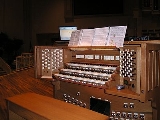
Modern digital church organs have reached a degree of sophistication, complexity, and expense surpassed only by the pipe organ itself. The consoles of some of these instruments, at first glance, may be almost indistinguishable from those of large pipe organs. Electronic organs are still made for the home market, but they have been largely replaced by the digital keyboard or synthesizer
Synthesizer

A synthesizer is an electronic instrument capable of producing a variety of sounds by generating and combining signals of different frequency....
, which is not only smaller and cheaper than typical electronic organs or traditional pianos, but also far more capable than the most advanced electronic organs of earlier years. Modern digital organs, by the same token, are far more advanced in design and capabilities than their ancestors.

Today’s instruments incorporate real time tone generation based on sampling
Sampling (music)

In music, sampling is the act of taking a portion, or sample, of one sound recording and reusing it as an musical instrument or a different sound recording of a song....
 or synthesis technologies, MIDI, and Internet
Internet

The Internet is a global network of interconnected computers, enabling users to share information along multiple channels. Typically, a computer that connects to the Internet can access information from a vast array of available server and other computers by moving information from them to the computer's local memory....
 connectivity for downloading of music data and instructional materials, as well as making use of USB flash drive
USB flash drive

A USB flash drive consists of a Flash memory#NAND memories-type flash memory data storage device integrated with a USB interface. USB flash drives are typically removable and rewritable, much smaller than a floppy disk , and most USB flash drives weigh less than an ounce ....
 or media card storage. While electronically they are radically different from their predecessors, their basic appearance makes them instantly identifiable as the latest generation in a long line of electronic organs that now reaches back more than seventy years.

The best digital organs of the 2000s have a number of features which distinguish their sound from earlier, simpler instruments. Digital organs may use multiple Digital Signal Processor
Digital signal processor

A digital signal processor is a specialized microprocessor designed specifically for digital signal processing, generally in real-time computing....
 (DSP) chips paralleled for extremely fast processing and generation of the organ sound. Pipe organ sound in most current digital organs is derived from digital signal processors generating the pipe sound in either a sampled or synthesis type generation system. Sampled technologies use sound files recorded from various ranks of organ pipes and then processed to be the root basis for generation of the pipe organ sound. In synthesis systems, the pipe wave shape is created without using an actual sample as a guide. Both systems actually generate organ tone, sometimes in stereo in better systems, rather than simply playing back recordings as a simple digital keyboard sampler might do. It has been claimed by its manufacturers that an organ voicer might have slightly more control in some synthesis systems. Marketed as a "Real Time System" by Eminent and also sold by Wyvern, Copeman & Hart, Cantor, and Van der Pole in Europe, synthesis organs may use circuitry purchased from Musicom, an English supply company. Synthesis-based organs are rarely seen outside of Europe.

Sampled systems may have individual samples of actual organ pipes for each note, or may use only one or a few samples which are then frequency shifted to generate the equivalent of a 61 note pipe rank. Some digital organs like Walker Technical and the extremely costly Marshall & Ogletree organs claim to use longer samples for additional realism, rather than having to repeat shorter samples in their generation of sound. Most sampling systems are typically done with 24-bit or 32-bit resolution instead of CD-quality 16-bit resolution. Sampling in 2000s-era organs is done at a higher frequency than the 44,100 samples per second of CD-quality audio.

On most typical organs, several audio channels are used to create a more spacious sound. Higher quality custom digital organ builders use custom audio and speaker systems and may provide from 8 to 32 or more independent channels of audio, depending on the size of the organ and the overall budget for the instrument. With dedicated high power subwoofer
Subwoofer

A subwoofer is a woofer, or a complete loudspeaker dedicated to the reproduction of bass audio frequency, from perhaps 150 hertz down as far as 20 Hz, or in rare cases lower....
s for the low frequencies of the sound, the best digital organs can thus approach the physical feeling of a pipe organ if a sufficient number of subwoofers and sufficiently powerful amplifiers are used.

To better imitate pipe organs, some digital organs simulate changes of windchest pressure (in a pipe organ, the air pressure may drop slightly when many notes are sounding at once, which changes the sound of all the pipes). Digital organs may also have simulated models of Swell boxes which mimic the environmental effects on pipes, pipe chest valve release and other pipe organ characteristics. These effects are often added to the computer sound generation in modern electronic organs to create more realistic pipe organ tone. Pipe sound can be generated to include sampled or modeled room acoustic. Rodgers patented "RSS" technology which uses biaural and transaural processing to create real time acoustic models and Allen's "Acoustic Portrait", purchased from Lake Industries in 2004, are examples of better quality acoustic systems where room acoustic is part of the pipe sound generation.

In the United States, both Allen and Rodgers claim parts inventories for older electronic organs they support in excess of $1 million and regularly support organs of 30 or 40 or more years old.

Pipe/Digital Organs


Although experimental combinations of electronic tone generators and pipe organs had been made since the 1950s, Rodgers was the first to build hybrid instruments in a major way, beginning in the early '70s. Today, custom digital organ consoles occasionally replace aging pipe consoles, thereby updating the electrical control system for the pipes as well as adding digital voices to the organ.

For combination organs, which join pipes to electronic stops, an important issue is that pipes change pitch with environmental changes, but digital audio systems do not. The frequency of sound produced by an organ pipe is determined by its geometry and by the speed of sound in the air within it. The speed of sound changes with the temperature and humidity of the air; therefore the pitch of a pipe organ will change as the environmental changes, so the pitch of the digital side in a hybrid instrument must be retuned as needed. The simplest way this can be done is with a manual control that the organist can adjust, but better models can make such adjustments automatically.

Organ Software Programs


The processing power of today's personal computers have brought the world of organs closer than ever before. Software applications are available for Microsoft Windows
Microsoft Windows

Microsoft Windows is a series of software operating systems and graphical user interfaces produced by Microsoft. Microsoft first introduced an operating environment named Windows in November 1985 as an add-on to MS-DOS in response to the growing interest in graphical user interfaces ....
 and Apple Computer's Mac OS X
Mac OS X

Mac OS X is a line of computer operating systems developed, marketed, and sold by Apple Inc., and since 2002 has been included with all new Macintosh computer systems....
 that store digital pipe samples and sum them in real time in response to input from one or more MIDI sources. The most advanced of these is , but others include , , and . Many hobbyists have used these tools to assemble home-built organs that can rival the sound quality of commercially built digital organs at a lower cost.

In popular music

Electone Stagea
The other branch of electronic organ is the Hammond
Hammond organ

The Hammond organ is an electronic organ which was invented by Laurens Hammond in 1934 and manufactured by the Hammond Organ Company. While the Hammond organ was originally sold to Church as a lower-cost alternative to the wind-driven pipe organ, in the 1960s and 1970s, it became a standard keyboard instrument for jazz, blues, Rock and r...
-style organ used in more popular genres such as Jazz
Jazz

Jazz is a primarily American musical art form which originated at the beginning of the 20th century in African American communities in the Southern United States from a confluence of African and European music traditions....
, Gospel
Gospel music

Gospel music is music that is written to express either personal or a communal belief regarding Christian life, as well as to give a Christian alternative to mainstream secular music....
 and Pop music
Pop music

Pop music is a music genre that features a noticeable rhythmic element, melodies and hook , a mainstream style and a conventional structure.The term "pop music" was first used in 1926 in the sense of "having popular appeal" , but since the 1950s it has been used in the sense of a musical genre, originally characterized as a lighter alternat...
. These bear little resemblance to the pipe organ, and instruments such as the Yamaha Electone
Electone

Electone is the trademark used for electronic organs produced by Yamaha Corporation. ...
 series, have few, if any, pipe-organ sounds. In 2006, Yamaha launched its latest model of Electone, the Stagea.

See also

  • Johannus Orgelbouw
    Johannus Orgelbouw

    Johannus Orgelbouw b.v. is a notable family company that was founded in 1972. Johannus is currently located in Ede, Netherlands. Their specialty is in classical home and church organs....
  • Makin Organs
  • Allen Organ
    Allen Organ

    Allen Organ Company, formed in 1937 by Jerome Markowitz, is located in Macungie, Pennsylvania. It is one of the world's largest builders of Electronic_organ....
  • Organ
    Organ (music)

    The organ is a keyboard instrument of one or more divisions, each played with its own keyboard played either Manual or Pedal clavier. The organ is one of the oldest musical instruments in the European classical music....
  • Farfisa
    Farfisa

    Farfisa is a manufacturer of electronics based in Italy. The Farfisa brand name is commonly associated with a series of compact electronic organ, and later, a series of multi-timbral synthesizer....
  • Rodgers Instruments
    Rodgers Instruments

    Rodgers Instruments LLC manufactures church organ , using patented stereophonic digital organ technology. Rodgers is the largest builder of custom church organs in the world....
  • Kawai
    Kawai

    The Kawai Musical Instruments Manufacturing Co. Ltd. of Japan is best known for its pianos, electronic keyboards & electronic synthesizers. The company was established in August, 1927, and is headquartered in Hamamatsu, Shizuoka....
  • Roland Corporation
    Roland Corporation

    is a Japanese manufacturer of electronic musical instruments, electronic equipment and software. It was founded by Ikutaro Kakehashi in Osaka on April 18, 1972, with ?33 million in capital....
  • Wersi
    Wersi

    Wersi is a German manufacturer of electronic organs, keyboards and pianos. They were used by organists like Franz Lambert and the late Klaus Wunderlich....
  • Yamaha Corporation
  • Musicom Ltd
  • Ahlborn-Galanti
  • Hauptwerk Virtual Organ
    Hauptwerk Virtual Organ

    Summary Hauptwerk is a computer program that enables an organist to play digital samples of pipe organs using MIDI keyboards and pedalboard connected to a computer....


External links

  • : A synthesised (i.e. not sampled) pipe organ emulator that should be good enough to make an organist enjoy playing it.
  • of a digital organ at Hammerwood Park in Sussex after serving a dozen years at Londonderry Cathedral, where visitors had said it was "remarkably effective". This has now been enlarged to 5 manuals using further electronic organ units known as "expanders", often used to enhance pipe organs, made by in Holland and in Italy