

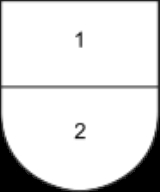
Polish heraldry

Encyclopedia
Polish heraldry is a branch of heraldry
focused on studying the development of coats of arms in the lands of historical Poland (and Polish-Lithuanian Commonwealth
), as well as specifically-Polish traits of heraldry. The term is also used to refer to Polish heraldic system, as opposed to systems used elsewhere, notably in Western Europe. As such, it is an integral part of the history of the szlachta
, the Polish nobility
.
Because of a distinct evolution of feudal society in Poland, the heraldic traditions of Poland differ significantly from those in German lands, France or British Isles.
class of knights under Chivalry
, but stemmed in great part from an earlier Slavic
class of Free Warriors or Mercenaries. These warriors were often hired by rulers to form guard units (Polish
Drużyna) and were eventually paid in land. There is, however, a lot of written evidence from the Middle Ages which demonstrates how some elements of the Polish nobility did emerge from the ranks of the knightly class under the terms of chivalric law (ius militare).
Only a small number of szlachta families or clans can be traced all the way back to the traditional clan
system. Most szlachta
, since at least the 12th century, were not related and their unions were mostly voluntary and based on followership and brotherhood rather than kinship
.
However, in regards to consanguinity, the matter is far from settled, and the question matters because of historiographical concern to discover the origins of the privileged status by membership in the knights' clan. In the year 1244, Bolesław, Duke of Masovia, identified members of the knights' clan as members of a genealogia:
The documentation regarding Raciborz and Albert's tenure is the earliest surviving of the use of the clan name and cry defining the honorable status of Polish knights. The names of knightly genealogiae only came to be associated with heraldic devices later in the Middle Ages and in the early modern period. The Polish clan name and cry ritualized the ius militare, i.e., the power to command an army; and they had been used some time before 1244 to define knightly status. .
According to Polish historian Tadeusz Manteuffel
, the clans (ród
) consisted of people related by blood and descending from a common ancestor, giving the ród/clan a highly developed sense of solidarity. (See gens
.) The starosta
(or starszyna) had judicial and military power over the ród/clan, although this power was often exercised with an assembly of elders. Strongholds called gród were built where a unifying religious cult was powerful, where trials were conducted, and where clans gathered in the face of danger. The opole was the territory occupied by a single tribe. .
Since Poland
emerged almost at once as a relatively unified duchy
in the 10th century, it was the prince or, later, the King
who was considered the patron of all the clan
s. He granted privileges and land to clan members rather than to clans as such and was allowed, in theory to assign new knight
s to the clans of his choice. In practice, however, such a means of entering an existing noble clan would require a formal adoption from the bloodline members of a clan. In any event, this route to clan membership was later forbidden. As a result, a stable system of strong and wealthy groups of relatives never developed in Poland, as in Scotland. The Polish clans, perhaps, were much more like the Norse clans, with the result that they were much more unstable than their western counterparts. Historic evidence, however, shows clans even fighting wars one against the other like the famous domestic war between the Nalecz and the Grzymala in Greater Poland of the late 14th century.
Heraldic symbols began to be used in Poland in the 13th century. The generic Polish
term for a coat of arms, herb, dates from the early 15th century, originating as a translation of the Czech
erb, which in turn came from the German
Erbe - heritage.
Under the Union of Horodło (1413), the noble families of the Grand Duchy of Lithuania
were adopted en masse into the various Polish noble clans and began to use Polish coats of arms.
The most striking peculiarity of the system is that a coat of arms does not belong to a single family. A number of unrelated families (sometimes hundreds of them), usually with a number of different family names, may use the same, undifferenced
coat of arms, and each coat of arms has its own name. The total number of coats of arms in this system was relatively low – ca. 200 in the late Middle Ages. The same can be also seen in Western Europe, when families of different surnames but sharing clan origin would use similar coats-of-arms, the fleur-de-lis of the many Capetian families being perhaps the best known example.
One side-effect of this unique arrangement was that it became customary to refer to noblemen by both their family name and their coat of arms name (or clan name). For example: Jan Zamoyski
herbu Jelita means Jan Zamoyski of the Jelita coat of arms (though it is often translated as ... of the clan Jelita ).
From 15th to 17th centuries, the formula seems to have been to copy the ancient Roman naming convention: praenomen (or given name), nomen gentile (or Gens
/Clan name) and cognomen (surname), following the Renaissence fashion. So we have: Jan Jelita Zamoyski, forming a double-barrelled name
(nazwisko złożone, literally compound name).
Later, the double-barrelled name began to be joined with a hyphen: Jan Jelita-Zamoyski. (See Polish name
s).
The Polish émigrés of 19th century sometimes used adaptations of their names according to the Western European (mainly French) style, becoming (to use the same example): Jan de Jelita-Zamoyski or Jan Zamoyski de Jelita. Some would also keep the Latin forms of their surnames, as Latin was the official language of the Kingdom of Poland. Hence the popularity of Late-Medieval or Early-Modern forms such as "de Zamosc Zamoyski".
A single coat of arms could appear in slightly different versions, typically in different colours, depending on the custom of the family using it. Such modifications ( odmiany ) are still considered to represent the same coat of arms.
One of the most visually striking characteristics of Polish heraldry is the abundance of gules
(red) fields. Among the oldest coats of arms
in Poland, nearly half use a red background, with blue (azure
) coming in a distant second. Nowhere else in Europe shows such a strong bias towards a particular color scheme. It follows however the well known heraldic custom of all Europe that the vassals would follow the colour-scheme of their overlord. It had even a practical meaning in the battlefield.
Other typical features used in Polish heraldry include horseshoes, arrows, Maltese cross
es, scythes, stars and crescents. There are also many purely geometrical shapes for which a separate set of heraldic terms was invented. It has been suggested that originally all Polish coats of arms were based on such abstract geometrical shapes, but most were gradually "rationalized" into horseshoes, arrows and so on. If this hypothesis is correct, it suggests in turn that Polish heraldry, also unlike western European heraldry, may be at least partly derived from a kind of rune-like symbols: the Tamgas used by nomadic peoples of the Steppe, such as the Sarmatians
or the Avars
, to mark property. However, the evidence about the origins of the system is scanty, and this hypothesis has been criticized as being part of the Polish noble tradition of romanticizing their supposed Sarmatian ancestry. On this matter, research and controversy continue.
A Polish coat of arms consists of: shield
, crest
, helm
and crown
. The 18th and 19th centuries fashion includes the mantling
.
Supporters
, motto
s and compartments normally do not appear, although certain individuals used them, especially in the final stages of the system's development, partly in response to French and German influence. Preserved medieval evidence shows Polish coats-of-arms with mantling
and supporters
.
. However, since coats of arms were originally granted to clans rather than to separate families, there was no need to join coats of arms into one when a new branch of a family was formed. Thus Polish escutcheons are rarely parted. There is however a lot of preserved quartered coats-of-arms. These would most often show the arms of the four grandparents of the bearer. Or also the paternal-paternal great-grandmother in the 5th field if the male-line coat-of-arms goes in the heart field.
The tradition of differentiating between the coat of arms
proper and a lozenge
granted to women did not develop in Poland. Usually men inherited a coat of arms from their fathers (or a member of a clan who had adopted them), while women either inherited a coat from their mothers or adopted the arms of their husbands. The brisure was rarely used. All children would inherit the coat-of-arms of their father.
Heart-shaped shields were mostly used in representations of the coats of arms of royalty. Following the union between Poland and Lithuania, and the creation of the elective monarchy, it became customary to place the coats of Poland
and Lithuania
diagonally, with the coat of arms of the specific monarch
placed centrally on top. Research continues to find out what a "heart-shaped" shield is. Most likely, the coat of Poland was placed on the left-right diagonal (I & IV)and Lithuania on the right-left diagonal (II & III) as evidenced in the shield at the top of this page. The specific monarch crest then being placed in the "heart" position.
In addition to these seven basic tinctures, which were standard in English heraldry and elsewhere in western Europe, many more tinctures were used in Poland and (after the union with Poland) Lithuania, including grey, steel, brunatre, weasel and carnation.
and in armorials, known in Polish
as herbarz. Such publications, akin to Almanach de Gotha
or Gelre Armorial
and descended from the tradition of rolls of arms
, appeared in Poland regularly from 15th century onwards. The first such armorial was Insignia seu clenodia incliti Regni Poloniae by Jan Długosz. In recent years growing interest in family histories has led to publication of numerous newly-compiled listings of coats of arms and families. Some of the most notable among such publications are:
(published in 15 volumes, unfinished)
Heraldry
Heraldry is the profession, study, or art of creating, granting, and blazoning arms and ruling on questions of rank or protocol, as exercised by an officer of arms. Heraldry comes from Anglo-Norman herald, from the Germanic compound harja-waldaz, "army commander"...
focused on studying the development of coats of arms in the lands of historical Poland (and Polish-Lithuanian Commonwealth
Polish-Lithuanian Commonwealth
The Polish–Lithuanian Commonwealth was a dualistic state of Poland and Lithuania ruled by a common monarch. It was the largest and one of the most populous countries of 16th- and 17th‑century Europe with some and a multi-ethnic population of 11 million at its peak in the early 17th century...
), as well as specifically-Polish traits of heraldry. The term is also used to refer to Polish heraldic system, as opposed to systems used elsewhere, notably in Western Europe. As such, it is an integral part of the history of the szlachta
Szlachta
The szlachta was a legally privileged noble class with origins in the Kingdom of Poland. It gained considerable institutional privileges during the 1333-1370 reign of Casimir the Great. In 1413, following a series of tentative personal unions between the Grand Duchy of Lithuania and the Kingdom of...
, the Polish nobility
Nobility
Nobility is a social class which possesses more acknowledged privileges or eminence than members of most other classes in a society, membership therein typically being hereditary. The privileges associated with nobility may constitute substantial advantages over or relative to non-nobles, or may be...
.
Because of a distinct evolution of feudal society in Poland, the heraldic traditions of Poland differ significantly from those in German lands, France or British Isles.
History
Unlike the case of Western Europe, in Poland, the szlachta did not emerge exclusively from the feudalFeudalism
Feudalism was a set of legal and military customs in medieval Europe that flourished between the 9th and 15th centuries, which, broadly defined, was a system for ordering society around relationships derived from the holding of land in exchange for service or labour.Although derived from the...
class of knights under Chivalry
Chivalry
Chivalry is a term related to the medieval institution of knighthood which has an aristocratic military origin of individual training and service to others. Chivalry was also the term used to refer to a group of mounted men-at-arms as well as to martial valour...
, but stemmed in great part from an earlier Slavic
Slavic peoples
The Slavic people are an Indo-European panethnicity living in Eastern Europe, Southeast Europe, North Asia and Central Asia. The term Slavic represents a broad ethno-linguistic group of people, who speak languages belonging to the Slavic language family and share, to varying degrees, certain...
class of Free Warriors or Mercenaries. These warriors were often hired by rulers to form guard units (Polish
Polish language
Polish is a language of the Lechitic subgroup of West Slavic languages, used throughout Poland and by Polish minorities in other countries...
Drużyna) and were eventually paid in land. There is, however, a lot of written evidence from the Middle Ages which demonstrates how some elements of the Polish nobility did emerge from the ranks of the knightly class under the terms of chivalric law (ius militare).
Only a small number of szlachta families or clans can be traced all the way back to the traditional clan
Clan
A clan is a group of people united by actual or perceived kinship and descent. Even if lineage details are unknown, clan members may be organized around a founding member or apical ancestor. The kinship-based bonds may be symbolical, whereby the clan shares a "stipulated" common ancestor that is a...
system. Most szlachta
Szlachta
The szlachta was a legally privileged noble class with origins in the Kingdom of Poland. It gained considerable institutional privileges during the 1333-1370 reign of Casimir the Great. In 1413, following a series of tentative personal unions between the Grand Duchy of Lithuania and the Kingdom of...
, since at least the 12th century, were not related and their unions were mostly voluntary and based on followership and brotherhood rather than kinship
Kinship
Kinship is a relationship between any entities that share a genealogical origin, through either biological, cultural, or historical descent. And descent groups, lineages, etc. are treated in their own subsections....
.
However, in regards to consanguinity, the matter is far from settled, and the question matters because of historiographical concern to discover the origins of the privileged status by membership in the knights' clan. In the year 1244, Bolesław, Duke of Masovia, identified members of the knights' clan as members of a genealogia:
"I received my good servitors [Raciborz and Albert] from the land of [Great] Poland, and from the clan [genealogia] called Jelito, with my well-disposed knowledge [i.e., consent and encouragement] and the cry [vocitatio], [that is], the godło, [by the name of] Nagody, and I established them in the said land of mine, Masovia, [on the military tenure described elsewhere in the charter]."
The documentation regarding Raciborz and Albert's tenure is the earliest surviving of the use of the clan name and cry defining the honorable status of Polish knights. The names of knightly genealogiae only came to be associated with heraldic devices later in the Middle Ages and in the early modern period. The Polish clan name and cry ritualized the ius militare, i.e., the power to command an army; and they had been used some time before 1244 to define knightly status. .
According to Polish historian Tadeusz Manteuffel
Tadeusz Manteuffel
Tadeusz Manteuffel or Tadeusz Manteuffel-Szoege was a Polish historian, specializing in the medieval history of Europe.- Biography :...
, the clans (ród
Polish clans
Polish clans differ from most clan systems in that while they are mostly composed of families sharing male-line origin there can also be some genealogically unrelated families bearing the same coat of arms and clan name because of a formal adoption upon ennoblement or sometimes because of a...
) consisted of people related by blood and descending from a common ancestor, giving the ród/clan a highly developed sense of solidarity. (See gens
Gens
In ancient Rome, a gens , plural gentes, referred to a family, consisting of all those individuals who shared the same nomen and claimed descent from a common ancestor. A branch of a gens was called a stirps . The gens was an important social structure at Rome and throughout Italy during the...
.) The starosta
Starosta
Starost is a title for an official or unofficial position of leadership that has been used in various contexts through most of Slavic history. It can be translated as "elder"...
(or starszyna) had judicial and military power over the ród/clan, although this power was often exercised with an assembly of elders. Strongholds called gród were built where a unifying religious cult was powerful, where trials were conducted, and where clans gathered in the face of danger. The opole was the territory occupied by a single tribe. .
Since Poland
Poland
Poland , officially the Republic of Poland , is a country in Central Europe bordered by Germany to the west; the Czech Republic and Slovakia to the south; Ukraine, Belarus and Lithuania to the east; and the Baltic Sea and Kaliningrad Oblast, a Russian exclave, to the north...
emerged almost at once as a relatively unified duchy
Duchy
A duchy is a territory, fief, or domain ruled by a duke or duchess.Some duchies were sovereign in areas that would become unified realms only during the Modern era . In contrast, others were subordinate districts of those kingdoms that unified either partially or completely during the Medieval era...
in the 10th century, it was the prince or, later, the King
Monarch
A monarch is the person who heads a monarchy. This is a form of government in which a state or polity is ruled or controlled by an individual who typically inherits the throne by birth and occasionally rules for life or until abdication...
who was considered the patron of all the clan
Clan
A clan is a group of people united by actual or perceived kinship and descent. Even if lineage details are unknown, clan members may be organized around a founding member or apical ancestor. The kinship-based bonds may be symbolical, whereby the clan shares a "stipulated" common ancestor that is a...
s. He granted privileges and land to clan members rather than to clans as such and was allowed, in theory to assign new knight
Knight
A knight was a member of a class of lower nobility in the High Middle Ages.By the Late Middle Ages, the rank had become associated with the ideals of chivalry, a code of conduct for the perfect courtly Christian warrior....
s to the clans of his choice. In practice, however, such a means of entering an existing noble clan would require a formal adoption from the bloodline members of a clan. In any event, this route to clan membership was later forbidden. As a result, a stable system of strong and wealthy groups of relatives never developed in Poland, as in Scotland. The Polish clans, perhaps, were much more like the Norse clans, with the result that they were much more unstable than their western counterparts. Historic evidence, however, shows clans even fighting wars one against the other like the famous domestic war between the Nalecz and the Grzymala in Greater Poland of the late 14th century.
Heraldic symbols began to be used in Poland in the 13th century. The generic Polish
Polish language
Polish is a language of the Lechitic subgroup of West Slavic languages, used throughout Poland and by Polish minorities in other countries...
term for a coat of arms, herb, dates from the early 15th century, originating as a translation of the Czech
Czech language
Czech is a West Slavic language with about 12 million native speakers; it is the majority language in the Czech Republic and spoken by Czechs worldwide. The language was known as Bohemian in English until the late 19th century...
erb, which in turn came from the German
German language
German is a West Germanic language, related to and classified alongside English and Dutch. With an estimated 90 – 98 million native speakers, German is one of the world's major languages and is the most widely-spoken first language in the European Union....
Erbe - heritage.
Under the Union of Horodło (1413), the noble families of the Grand Duchy of Lithuania
Grand Duchy of Lithuania
The Grand Duchy of Lithuania was a European state from the 12th /13th century until 1569 and then as a constituent part of Polish-Lithuanian Commonwealth until 1791 when Constitution of May 3, 1791 abolished it in favor of unitary state. It was founded by the Lithuanians, one of the polytheistic...
were adopted en masse into the various Polish noble clans and began to use Polish coats of arms.
Peculiarities
Although the Polish heraldic system evolved under the influence of French and German heraldry, there are many notable differences.The most striking peculiarity of the system is that a coat of arms does not belong to a single family. A number of unrelated families (sometimes hundreds of them), usually with a number of different family names, may use the same, undifferenced
Cadency
In heraldry, cadency is any systematic way of distinguishing similar coats of arms belonging to members of the same family. Cadency is necessary in heraldic systems in which a given design may be owned by only one person at once...
coat of arms, and each coat of arms has its own name. The total number of coats of arms in this system was relatively low – ca. 200 in the late Middle Ages. The same can be also seen in Western Europe, when families of different surnames but sharing clan origin would use similar coats-of-arms, the fleur-de-lis of the many Capetian families being perhaps the best known example.
One side-effect of this unique arrangement was that it became customary to refer to noblemen by both their family name and their coat of arms name (or clan name). For example: Jan Zamoyski
Jan Zamoyski
Jan Zamoyski , was a Polish-Lithuanian nobleman, magnate, 1st duke/ordynat of Zamość. Royal Secretary since 1566, Lesser Kanclerz ) of the Crown since 1576, Lord Grand-Chancellor of the Crown since 1578, and Grand Hetman of the Crown since 1581...
herbu Jelita means Jan Zamoyski of the Jelita coat of arms (though it is often translated as ... of the clan Jelita ).
From 15th to 17th centuries, the formula seems to have been to copy the ancient Roman naming convention: praenomen (or given name), nomen gentile (or Gens
Gens
In ancient Rome, a gens , plural gentes, referred to a family, consisting of all those individuals who shared the same nomen and claimed descent from a common ancestor. A branch of a gens was called a stirps . The gens was an important social structure at Rome and throughout Italy during the...
/Clan name) and cognomen (surname), following the Renaissence fashion. So we have: Jan Jelita Zamoyski, forming a double-barrelled name
Double-barrelled name
In English speaking and some other Western countries, a double-barrelled name is a family name with two parts, which may or may not be joined with a hyphen and is also known as a hyphenated name. An example of a hyphenated double-barrelled surname is Bowes-Lyon; an example of an unhyphenated...
(nazwisko złożone, literally compound name).
Later, the double-barrelled name began to be joined with a hyphen: Jan Jelita-Zamoyski. (See Polish name
Polish name
A Polish personal name, like names in most European cultures, consists of two main elements: imię, the first name, or given name, followed by nazwisko, the last name, surname, or family name....
s).
The Polish émigrés of 19th century sometimes used adaptations of their names according to the Western European (mainly French) style, becoming (to use the same example): Jan de Jelita-Zamoyski or Jan Zamoyski de Jelita. Some would also keep the Latin forms of their surnames, as Latin was the official language of the Kingdom of Poland. Hence the popularity of Late-Medieval or Early-Modern forms such as "de Zamosc Zamoyski".
A single coat of arms could appear in slightly different versions, typically in different colours, depending on the custom of the family using it. Such modifications ( odmiany ) are still considered to represent the same coat of arms.
One of the most visually striking characteristics of Polish heraldry is the abundance of gules
Gules
In heraldry, gules is the tincture with the colour red, and belongs to the class of dark tinctures called "colours". In engraving, it is sometimes depicted as a region of vertical lines or else marked with gu. as an abbreviation....
(red) fields. Among the oldest coats of arms
Coat of arms
A coat of arms is a unique heraldic design on a shield or escutcheon or on a surcoat or tabard used to cover and protect armour and to identify the wearer. Thus the term is often stated as "coat-armour", because it was anciently displayed on the front of a coat of cloth...
in Poland, nearly half use a red background, with blue (azure
Azure
In heraldry, azure is the tincture with the colour blue, and belongs to the class of tinctures called "colours". In engraving, it is sometimes depicted as a region of horizontal lines or else marked with either az. or b. as an abbreviation....
) coming in a distant second. Nowhere else in Europe shows such a strong bias towards a particular color scheme. It follows however the well known heraldic custom of all Europe that the vassals would follow the colour-scheme of their overlord. It had even a practical meaning in the battlefield.
Other typical features used in Polish heraldry include horseshoes, arrows, Maltese cross
Maltese cross
The Maltese cross, also known as the Amalfi cross, is identified as the symbol of an order of Christian warriors known as the Knights Hospitaller or Knights of Malta and through them came to be identified with the Mediterranean island of Malta and is one of the National symbols of Malta...
es, scythes, stars and crescents. There are also many purely geometrical shapes for which a separate set of heraldic terms was invented. It has been suggested that originally all Polish coats of arms were based on such abstract geometrical shapes, but most were gradually "rationalized" into horseshoes, arrows and so on. If this hypothesis is correct, it suggests in turn that Polish heraldry, also unlike western European heraldry, may be at least partly derived from a kind of rune-like symbols: the Tamgas used by nomadic peoples of the Steppe, such as the Sarmatians
Sarmatians
The Iron Age Sarmatians were an Iranian people in Classical Antiquity, flourishing from about the 5th century BC to the 4th century AD....
or the Avars
Eurasian Avars
The Eurasian Avars or Ancient Avars were a highly organized nomadic confederacy of mixed origins. They were ruled by a khagan, who was surrounded by a tight-knit entourage of nomad warriors, an organization characteristic of Turko-Mongol groups...
, to mark property. However, the evidence about the origins of the system is scanty, and this hypothesis has been criticized as being part of the Polish noble tradition of romanticizing their supposed Sarmatian ancestry. On this matter, research and controversy continue.
A Polish coat of arms consists of: shield
Shield
A shield is a type of personal armor, meant to intercept attacks, either by stopping projectiles such as arrows or redirecting a hit from a sword, mace or battle axe to the side of the shield-bearer....
, crest
Crest (heraldry)
A crest is a component of an heraldic display, so called because it stands on top of a helmet, as the crest of a jay stands on the bird's head....
, helm
Helmet
A helmet is a form of protective gear worn on the head to protect it from injuries.Ceremonial or symbolic helmets without protective function are sometimes used. The oldest known use of helmets was by Assyrian soldiers in 900BC, who wore thick leather or bronze helmets to protect the head from...
and crown
Coronet
A coronet is a small crown consisting of ornaments fixed on a metal ring. Unlike a crown, a coronet never has arches.The word stems from the Old French coronete, a diminutive of coronne , itself from the Latin corona .Traditionally, such headgear is – as indicated by the German equivalent...
. The 18th and 19th centuries fashion includes the mantling
Mantling
In heraldry, mantling or lambrequin is drapery tied to the helmet above the shield. It forms a backdrop for the shield. In paper heraldry it is a depiction of the protective cloth covering worn by knights from their helmets to stave off the elements, and, secondarily, to decrease the effects of...
.
Supporters
Supporters
In heraldry, supporters are figures usually placed on either side of the shield and depicted holding it up. These figures may be real or imaginary animals, human figures, and in rare cases plants or inanimate objects...
, motto
Motto
A motto is a phrase meant to formally summarize the general motivation or intention of a social group or organization. A motto may be in any language, but Latin is the most used. The local language is usual in the mottoes of governments...
s and compartments normally do not appear, although certain individuals used them, especially in the final stages of the system's development, partly in response to French and German influence. Preserved medieval evidence shows Polish coats-of-arms with mantling
Mantling
In heraldry, mantling or lambrequin is drapery tied to the helmet above the shield. It forms a backdrop for the shield. In paper heraldry it is a depiction of the protective cloth covering worn by knights from their helmets to stave off the elements, and, secondarily, to decrease the effects of...
and supporters
Supporters
In heraldry, supporters are figures usually placed on either side of the shield and depicted holding it up. These figures may be real or imaginary animals, human figures, and in rare cases plants or inanimate objects...
.
Shield
Polish coats of arms are divided in the same way as their western counterpartsHeraldry
Heraldry is the profession, study, or art of creating, granting, and blazoning arms and ruling on questions of rank or protocol, as exercised by an officer of arms. Heraldry comes from Anglo-Norman herald, from the Germanic compound harja-waldaz, "army commander"...
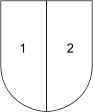
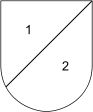
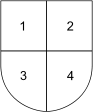
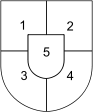
. However, since coats of arms were originally granted to clans rather than to separate families, there was no need to join coats of arms into one when a new branch of a family was formed. Thus Polish escutcheons are rarely parted. There is however a lot of preserved quartered coats-of-arms. These would most often show the arms of the four grandparents of the bearer. Or also the paternal-paternal great-grandmother in the 5th field if the male-line coat-of-arms goes in the heart field.
| Example | 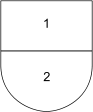 |
 |
 |
 |
 |
|---|---|---|---|---|---|
| English name | Parted per fess | Parted per pale | Parted per bend sinister | Parted quarterly | Parted quarterly with an inescutcheon |
| Polish name | tarcza dwudzielna w pas | tarcza dwudzielna w słup | tarcza dwudzielna w lewy skos | tarcza czterodzielna w krzyż | tarcza czterodzielna w krzyż z polem sercowym |
The tradition of differentiating between the coat of arms
Coat of arms
A coat of arms is a unique heraldic design on a shield or escutcheon or on a surcoat or tabard used to cover and protect armour and to identify the wearer. Thus the term is often stated as "coat-armour", because it was anciently displayed on the front of a coat of cloth...
proper and a lozenge
Lozenge (heraldry)
The lozenge in heraldry is a diamond-shaped charge , usually somewhat narrower than it is tall. It is to be distinguished in modern heraldry from the fusil, which is like the lozenge but narrower, though the distinction has not always been as fine and is not always observed even today...
granted to women did not develop in Poland. Usually men inherited a coat of arms from their fathers (or a member of a clan who had adopted them), while women either inherited a coat from their mothers or adopted the arms of their husbands. The brisure was rarely used. All children would inherit the coat-of-arms of their father.
Heart-shaped shields were mostly used in representations of the coats of arms of royalty. Following the union between Poland and Lithuania, and the creation of the elective monarchy, it became customary to place the coats of Poland
Poland
Poland , officially the Republic of Poland , is a country in Central Europe bordered by Germany to the west; the Czech Republic and Slovakia to the south; Ukraine, Belarus and Lithuania to the east; and the Baltic Sea and Kaliningrad Oblast, a Russian exclave, to the north...
and Lithuania
Lithuania
Lithuania , officially the Republic of Lithuania is a country in Northern Europe, the biggest of the three Baltic states. It is situated along the southeastern shore of the Baltic Sea, whereby to the west lie Sweden and Denmark...
diagonally, with the coat of arms of the specific monarch
Monarch
A monarch is the person who heads a monarchy. This is a form of government in which a state or polity is ruled or controlled by an individual who typically inherits the throne by birth and occasionally rules for life or until abdication...
placed centrally on top. Research continues to find out what a "heart-shaped" shield is. Most likely, the coat of Poland was placed on the left-right diagonal (I & IV)and Lithuania on the right-left diagonal (II & III) as evidenced in the shield at the top of this page. The specific monarch crest then being placed in the "heart" position.
Tinctures
| Tincture | Heraldic name | Polish name |
|---|---|---|
| Metals | ||
| Gold/Yellow | Or Or (heraldry) In heraldry, Or is the tincture of gold and, together with argent , belongs to the class of light tinctures called "metals". In engravings and line drawings, it may be represented using a field of evenly spaced dots... |
Złoto |
| Silver/White | Argent Argent In heraldry, argent is the tincture of silver, and belongs to the class of light tinctures, called "metals". It is very frequently depicted as white and usually considered interchangeable with it... |
Srebro |
| Colours | ||
| Blue | Azure Azure In heraldry, azure is the tincture with the colour blue, and belongs to the class of tinctures called "colours". In engraving, it is sometimes depicted as a region of horizontal lines or else marked with either az. or b. as an abbreviation.... |
Błękit |
| Red | Gules Gules In heraldry, gules is the tincture with the colour red, and belongs to the class of dark tinctures called "colours". In engraving, it is sometimes depicted as a region of vertical lines or else marked with gu. as an abbreviation.... |
Czerwień |
| Purple | Purpure Purpure In heraldry, purpure is a tincture, more or less the equivalent of the colour "purple", and is one of the five main or most usually used colours... |
Purpura |
| Black | Sable Sable (heraldry) In heraldry, sable is the tincture black, and belongs to the class of dark tinctures, called "colours". In engravings and line drawings, it is sometimes depicted as a region of crossed horizontal and vertical lines or else marked with sa. as an abbreviation.The name derives from the black fur of... |
Czerń |
| Green | Vert Vert The colour green is commonly found in modern flags and coat of arms, and to a lesser extent also in the classical heraldry of the Late Middle Ages and the Early Modern period.... |
Zieleń |
In addition to these seven basic tinctures, which were standard in English heraldry and elsewhere in western Europe, many more tinctures were used in Poland and (after the union with Poland) Lithuania, including grey, steel, brunatre, weasel and carnation.
See also
- Coat of armsCoat of armsA coat of arms is a unique heraldic design on a shield or escutcheon or on a surcoat or tabard used to cover and protect armour and to identify the wearer. Thus the term is often stated as "coat-armour", because it was anciently displayed on the front of a coat of cloth...
- HeraldryHeraldryHeraldry is the profession, study, or art of creating, granting, and blazoning arms and ruling on questions of rank or protocol, as exercised by an officer of arms. Heraldry comes from Anglo-Norman herald, from the Germanic compound harja-waldaz, "army commander"...
- History of PolandHistory of PolandThe History of Poland is rooted in the arrival of the Slavs, who gave rise to permanent settlement and historic development on Polish lands. During the Piast dynasty Christianity was adopted in 966 and medieval monarchy established...
- List of Polish coats of arms
- List of Polish coat of arms images
- SzlachtaSzlachtaThe szlachta was a legally privileged noble class with origins in the Kingdom of Poland. It gained considerable institutional privileges during the 1333-1370 reign of Casimir the Great. In 1413, following a series of tentative personal unions between the Grand Duchy of Lithuania and the Kingdom of...
- Belarusian heraldryBelarusian heraldryThe uses of heraldry in Belarus is used by government bodies, subdivisions of the national government, organizations, corporations and by families.-History:...
- Polish namePolish nameA Polish personal name, like names in most European cultures, consists of two main elements: imię, the first name, or given name, followed by nazwisko, the last name, surname, or family name....
- Polish clansPolish clansPolish clans differ from most clan systems in that while they are mostly composed of families sharing male-line origin there can also be some genealogically unrelated families bearing the same coat of arms and clan name because of a formal adoption upon ennoblement or sometimes because of a...
- Coats of arms of Polish voivodeshipsCoats of arms of Polish voivodeshipsThis is a list of coats of arms of the voivodeships of Poland....
Armorials and Listings of Coats of Arms
Traditionally coats of arms were published in various listings of szlachtaSzlachta
The szlachta was a legally privileged noble class with origins in the Kingdom of Poland. It gained considerable institutional privileges during the 1333-1370 reign of Casimir the Great. In 1413, following a series of tentative personal unions between the Grand Duchy of Lithuania and the Kingdom of...
and in armorials, known in Polish
Polish language
Polish is a language of the Lechitic subgroup of West Slavic languages, used throughout Poland and by Polish minorities in other countries...
as herbarz. Such publications, akin to Almanach de Gotha
Almanach de Gotha
The Almanach de Gotha was a respected directory of Europe's highest nobility and royalty. First published in 1763 by C.W. Ettinger in Gotha at the ducal court of Frederick III, Duke of Saxe-Gotha-Altenburg, it was regarded as an authority in the classification of monarchies, princely and ducal...
or Gelre Armorial
Gelre Armorial
The Gelre Armorial is an armorial composed between 1370 and 1414 in the Duchy of Guelders. The book displays some 1,700 coats-of-arms from all over Europe, in colour. Most historians claim that the book was written by the herald Claes Heinenszoon. It is now located at the Royal Library of Belgium....
and descended from the tradition of rolls of arms
Roll of arms
A roll of arms is a collection of coats of arms, usually consisting of rows of painted pictures of shields, each shield accompanied by the name of the person bearing the arms...
, appeared in Poland regularly from 15th century onwards. The first such armorial was Insignia seu clenodia incliti Regni Poloniae by Jan Długosz. In recent years growing interest in family histories has led to publication of numerous newly-compiled listings of coats of arms and families. Some of the most notable among such publications are:
(published in 15 volumes, unfinished)
External links
- Polish coats of arms - a full list of Polish coats of arms
- Rycerskie Herby Polaków - a very good site in Polish with beautiful images of the arms and complete surname lists of 48 of the clans
- Polish Nobility and Its Heraldry
- Armorial
- Coats of Arms within the context of the hereditary aristocracy of the historic Polish Noble Republic, The Polish-Lithuanian Commonwealth