


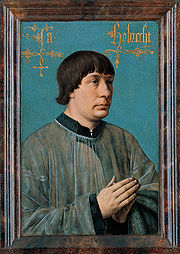
Jacob Obrecht

Encyclopedia
Franco-Flemish School
In music, the Franco-Flemish School or more precisely the Netherlandish School refers, somewhat imprecisely, to the style of polyphonic vocal music composition in Europe in the 15th and 16th centuries, and to the composers who wrote it...
composer of the Renaissance
Renaissance music
Renaissance music is European music written during the Renaissance. Defining the beginning of the musical era is difficult, given that its defining characteristics were adopted only gradually; musicologists have placed its beginnings from as early as 1300 to as late as the 1470s.Literally meaning...
. He was the most famous composer of masses
Mass (music)
The Mass, a form of sacred musical composition, is a choral composition that sets the invariable portions of the Eucharistic liturgy to music...
in Europe in the late 15th century, being eclipsed by only Josquin des Prez
Josquin Des Prez
Josquin des Prez [Josquin Lebloitte dit Desprez] , often referred to simply as Josquin, was a Franco-Flemish composer of the Renaissance...
after his death.
Life
What little is known of Obrecht's origins and early childhood comes mostly from his motet Mille quingentis. He was the only son of GhentGhent
Ghent is a city and a municipality located in the Flemish region of Belgium. It is the capital and biggest city of the East Flanders province. The city started as a settlement at the confluence of the Rivers Scheldt and Lys and in the Middle Ages became one of the largest and richest cities of...
city trumpeter Willem Obrecht and Lijsbette Gheeraerts. His mother died in 1460 at the age of 20, and his father, in 1488 in Ghent.
Details of his early education are sparse, but he likely learned to play the trumpet
Trumpet
The trumpet is the musical instrument with the highest register in the brass family. Trumpets are among the oldest musical instruments, dating back to at least 1500 BCE. They are played by blowing air through closed lips, producing a "buzzing" sound which starts a standing wave vibration in the air...
, like his father, and in so doing learned the art of counterpoint
Counterpoint
In music, counterpoint is the relationship between two or more voices that are independent in contour and rhythm and are harmonically interdependent . It has been most commonly identified in classical music, developing strongly during the Renaissance and in much of the common practice period,...
and improvisation over a cantus firmus
Cantus firmus
In music, a cantus firmus is a pre-existing melody forming the basis of a polyphonic composition.The plural of this Latin term is , though the corrupt form canti firmi is also attested...
. There is a good chance he knew Antoine Busnois
Antoine Busnois
Antoine Busnois was a French composer and poet of the early Renaissance Burgundian School. While also noted as a composer of sacred music, such as motets, he was one of the most renowned 15th-century composers of secular chansons...
at the Burgundian court; at any rate he certainly knew his music, since his earliest mass shows close stylistic parallels with the elder composer.
Scholar, composer and clergyman, Obrecht seems to have had a succession of short appointments, two of which ended in less than ideal circumstances. There is one interesting record of his compensating a shortfall in his accounts by donating choirbooks he had copied. Throughout the period he was held in the highest respect both by his patrons and by the composers who were his peers. Tinctoris
Johannes Tinctoris
Johannes Tinctoris was a Flemish composer and music theorist of the Renaissance. He is known to have studied in Orléans, and to have been master of the choir there; he also may have been director of choirboys at Chartres...
, who was writing in Naples
Naples
Naples is a city in Southern Italy, situated on the country's west coast by the Gulf of Naples. Lying between two notable volcanic regions, Mount Vesuvius and the Phlegraean Fields, it is the capital of the region of Campania and of the province of Naples...
, singles him out in a short list of the master composers of the day—all the more significant because he was only 25 at the time Tinctoris made his list, and on the other side of Europe. Erasmus, interestingly enough, served as one of Obrecht's choirboys around the year 1476.
While most of Obrecht's appointments were in Flanders
Flanders
Flanders is the community of the Flemings but also one of the institutions in Belgium, and a geographical region located in parts of present-day Belgium, France and the Netherlands. "Flanders" can also refer to the northern part of Belgium that contains Brussels, Bruges, Ghent and Antwerp...
in the Netherlands, he made at least two trips to Italy, once in 1487 at the invitation of Duke Ercole d'Este I
Ercole d'Este I
Ercole I d'Este was Duke of Ferrara from 1471 until 1505. He was a member of the house of Este. He was nicknamed North Wind and the Diamond.-Biography:...
of Ferrara, and again in 1504. Duke Ercole had heard Obrecht's music, which is known to have circulated in Italy between 1484 and 1487, and said that he appreciated it above the music of all other contemporary composers; consequently he invited Obrecht to Ferrara for six months in 1487. In 1504 Obrecht once again went to Ferrara, but on the death of the Duke at the beginning of the next year he became unemployed. In what capacity he stayed in Ferrara is unknown, but he died in the outbreak of plague there just before 1 August 1505.
Works
Obrecht wrote mainly sacred music: massesMass (music)
The Mass, a form of sacred musical composition, is a choral composition that sets the invariable portions of the Eucharistic liturgy to music...
and motet
Motet
In classical music, motet is a word that is applied to a number of highly varied choral musical compositions.-Etymology:The name comes either from the Latin movere, or a Latinized version of Old French mot, "word" or "verbal utterance." The Medieval Latin for "motet" is motectum, and the Italian...
s. His oeuvre, though, did include some chansons.
Combining elements of modern and archaic, Obrecht's style is multi-dimensional. Perhaps more than those of the mature Josquin, the masses of Obrecht display a profound debt to the music of Johannes Ockeghem in the wide-arching melodies and long musical phrases that typify the music of the older master. Obrecht's style is, indeed, a fascinating example of the contrapuntal
Counterpoint
In music, counterpoint is the relationship between two or more voices that are independent in contour and rhythm and are harmonically interdependent . It has been most commonly identified in classical music, developing strongly during the Renaissance and in much of the common practice period,...
extravagance of the late 15th century. He often used a cantus firmus
Cantus firmus
In music, a cantus firmus is a pre-existing melody forming the basis of a polyphonic composition.The plural of this Latin term is , though the corrupt form canti firmi is also attested...
technique for his masses: sometimes he took his source material and divided it up into short phrases; other times he used retrograde
Permutation (music)
In music, a permutation of a set is any ordering of the elements of that set. Different permutations may be related by transformation, through the application of zero or more of certain operations, such as transposition, inversion, retrogradation, circular permutation , or multiplicative operations...
versions of complete melodies, or melodic fragments. In one case he even extracted the component notes and ordered them by note value, long to short, constructing new melodic material from the reordered sequences of notes. Clearly to Obrecht there could not be too much variety, particularly true regarding the musically exploratory period of his early twenties. He began to break free from conformity to formes fixes, especially in his chansons. Of the formes fixes, the rondeau retained its popularity longest. However, he much preferred composing in the Mass genre where he possessed greater freedom.
In his Missa Sub tuum presidium, the number of voice parts in the six movements increases from three in the Kyrie, to four in the Gloria, and so on, until there are seven voice parts in the Agnus Dei. The title chant is clearly heard in the top voice throughout the work, and five additional Marian chants are found in movements other than the Kyrie. His late four-voice mass, Missa Maria zart, tentatively dated to around 1504, is based on a devotional song popular in Tyrol
Tyrol (state)
Tyrol is a state or Bundesland, located in the west of Austria. It comprises the Austrian part of the historical region of Tyrol.The state is split into two parts–called North Tyrol and East Tyrol–by a -wide strip of land where the state of Salzburg borders directly on the Italian province of...
, which he probably heard as he went through the region around 1503 to 1504. Requiring more than an hour to perform, it is one of the longest polyphonic settings of the mass Ordinary ever written.
Despite being contemporaries, Obrecht and Johannes Ockeghem
Johannes Ockeghem
Johannes Ockeghem was the most famous composer of the Franco-Flemish School in the last half of the 15th century, and is often considered the most...
(Obrecht's senior by some 30 years) differ significantly in musical style. Obrecht does not share Ockeghem's fanciful treatment of the cantus firmus but chooses to quote it verbatim. While the phrases in Ockeghem's music are ambiguously defined, those of Obrecht's music can be easily distinguished, though both composers favor wide-arching melodic structure. Furthermore, Obrecht splices the cantus firmus melody with the intent of audibly reorganizing the motives; Ockeghem, on the other hand, exercises this treatment to a far lesser extent.
Obrecht's procedures show a startling contrast to the works of the next generation as well (prefigured by some works of his contemporary Josquin
Josquin Des Prez
Josquin des Prez [Josquin Lebloitte dit Desprez] , often referred to simply as Josquin, was a Franco-Flemish composer of the Renaissance...
), who favored an increasing simplicity of approach. Though he was renowned in his time, Obrecht appears to have had little influence on subsequent generations: most likely he simply went out of fashion along with the other contrapuntal masters of his generation.
Media
Recordings
- Flemish Masters, Virginia Arts Recordings, VA-04413, performed by Zephyrus. Includes the Obrecht Missa Sub tuum presidium, as well as motets by Willaert, Clemens non Papa, Ockeghem, Des Prez, Mouton, and Gombert.
- Missa Maria zart, Gimell CDGIM 032, performed by the Tallis Scholars, directed by Peter Phillips.
- Jacob Obrecht. Chansons, Songs, Motets, Capilla FlamencaCapilla FlamencaCapilla Flamenca is a vocal and instrumental early music consort based in Leuven, Belgium. The group specialises in 14th to 16th Century music from Flanders and takes its name from the choir of the court chapel of Emperor Charles V...
and Piffaro, 2005 (Eufoda 1361)
External links
- Obrecht biography and discography
- Free access to high-resolution images of manuscripts containing works by this composer from Digital Image Archive of Medieval Music