

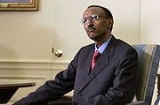
Paul Kagame

Encyclopedia
Paul Kagame is the sixth and current President of the Republic of Rwanda. He rose to prominence as the leader of the Rwandan Patriotic Front
(RPF), whose victory over the incumbent government in July 1994 effectively ended the Rwandan genocide
. Under his leadership, Rwanda has been called Africa’s “biggest success story” and Kagame has become a public advocate of new models for foreign aid designed to help recipients become self-reliant.
However, Paul Kagame's rule has been criticized for his domestic policies that have been described as authoritarian.
family in Ruhango, Rwanda-Urundi in October 1957 to Deogratius and Asteria Rutagambwa. In November 1959, an increasingly restive Hutu
population sparked a revolt, eventually resulting in the overthrow of Mwami
Kigeri V Ndahindurwa in 1961. During the 1959 revolt and its aftermath, more than 150,000 people were killed in the fighting, with the Tutsi
s suffering the greatest losses. Several thousand moved to neighbouring countries including Burundi
and Uganda
. In all, some 20,000 Tutsis were killed. In 1960 Kagame left with his family at the age of two and moved to Uganda with many other Tutsis. In 1962 they settled in the Gahunge refugee camp, Toro, where Kagame spent the rest of his childhood years. He attended Ntare Secondary School
in Uganda. During this time Kagame was a "motivated student" and bore an early fascination with revolutionaries such as Che Guevara
.
's National Resistance Army
(NRA) and spent years fighting as a guerrilla
against the government of Milton Obote
in what is commonly known in Uganda as the bush war
.
On 27 July 1985, Milton Obote was ousted in a military coup led by Tito Okello
. In 1986 the NRA succeeded in overthrowing Okello and the NRA leader Yoweri Museveni
became President of Uganda
.
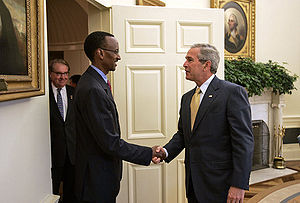 This same year, Kagame as a Tutsi was instrumental in forming, along with his close friend Fred Rwigema
, the Rwandese Patriotic Front (RPF), which was composed mainly of expatriate Rwandan Tutsi
soldiers that had also fought with the NRA; the RPF was also based in Uganda.
In 1986, Kagame became the head of military intelligence
in the NRA, and was regarded as one of Museveni's closest allies. He also joined the official Ugandan military.
During 1990, Kagame went to Fort Leavenworth
where the U.S. Army gave him military training. When the RPF started an invasion of Rwanda and his close friend and RPF co-founder Fred Rwigema
was killed, the U.S. arranged the return of Kagame to Uganda and thence to take the leadership of the invasion, thus signaling that the U.S. was siding with Uganda and the RPF against the incumbent Rwandan government. Broadening this connection, the U.S. and U.K. military provided further training and active logistical support to the RPF, which it used to take over power in Rwanda after 1994; and after coming to power, Kagame arranged for the RPF to receive further counterinsurgency and combat training from U.S. Special Forces, which was put to use in the 1996–1997 Rwandan-backed military campaign to overthrow the government of neighboring Zaire
.
minority ethnic group. Only two days into the invasion, Rwigema was murdered, making Kagame the military commander of the RPF. Despite initial successes, a force of French
, Belgian
, Rwandan, and Zaire
an soldiers forced the RPF to retreat. A renewed invasion was attempted in late 1991, but also had limited success.
The invasion increased ethnic tension throughout the region, including in neighbouring Burundi
where similar tensions existed. Peace talks between the RPF and the Rwandan government resulted in the Arusha accords
, including political participation of the RPF in Rwanda. Despite the agreement, ethnic tensions still flared dangerously.
On 6 April 1994, a plane carrying both the Rwandan President Juvénal Habyarimana
and Burundi
an President Cyprien Ntaryamira
was shot down by a surface-to-air missile as it approached Kigali
airport. All on board were killed. The deaths immediately sparked the Rwandan Genocide
and an estimated 800,000 to 1,000,000 Rwandans were killed. The outbreak of genocide ended what vestiges remained of the cease fire. The RPF, under the leadership of Kagame, proceeded to take control of the whole country. Kigali was captured 4 July 1994, bringing the downfall of the government of Jean Kambanda
.
, who controversially concluded that the shooting of the plane was ordered by Kagame. In November 2006, Judge Bruguière signed international indictments against nine of President Kagame's senior aides, and accused Kagame of ordering the assassination of the two African presidents. Kagame could not be indicted under French law, because as a head-of-state he had immunity from prosecution. The indictments have not produced any arrests, due to non-cooperation from the Rwandan government, which accused the judge of partiality. The Kagame government countered that the indictment was based on declarations by fugitives and disgruntled former lower-rank RPF members who testified that the RPF was the only organization with the type of missiles that were used in the assassination. It also pointed out that, at the time of the shooting of the plane, the French military was in control of Kigali Airport; however that point is irrelevant because the plane was shot down on approach to the airport and not from the zone controlled by French forces. The former chief prosecutor for Yugoslavia and Rwanda, Judge Richard Goldstone
, argued in the interview that political motivations were at play in the indictment, though this did not negate the potential veracity of the accusations by Judge Bruguière. Judge Goldstone stated that: "Well I don't think that case has been made at all. It's a very political judgement and I don't believe that it's borne out by the evidence. Certainly the witnesses who spoke to Bruguiere allege that those were statements made by President Kagame himself. He is a type of guy that knows how to play with people's emotions. Whether he did or not obviously is a matter in dispute, in hot dispute, but the political judgment it seems to me is another matter."
The accusations against Kagame were corroborated by several witnesses, including former intelligence RPF members, the most publicly known being Commando Lieutenant Abdul Ruzibiza
. Ruzibiza published a book (Rwanda: L'histoire secrete) and released testimony pertaining to Kagame and the RPF's involvement in the plane downing and massacres; however, Ruzibiza subsequently retracted part of his testimony, especially as pertains to Kagame senior aide Rose Kabuye
after she was arrested in Germany and extradited to France. The Association des Avocats de la Defence released a statement backing Judge Bruguière's allegations. Paul Rusesabagina
, a Rwandan of mixed Hutu and Tutsi origin, whose feat saving 1,268 civilians has been the basis of the Academy Award nominated film Hotel Rwanda
(2004), has supported the allegation that Kagame and the RPF were behind the plane downing, and stated that:
In a political countereffort, Kagame broke diplomatic relations with France in November 2006 and ordered the formation of a commission of loyal Rwandans that was officially "charged with assembling proof of the involvement of France in the genocide". The political character of that investigation was further averred when the commission issued its report solely to Kagame in November 2007 and its head, Jean de Dieu Mucyo, stated that the commission would now "wait for President Kagame to declare whether the inquiry was valid."
In a 2007, interview with BBC
, Mr Kagame said he would co-operate with an impartial inquiry. The BBC concluded that "Whether any judge would want to take on such a task is quite another matter."
As of 2009, a report commissioned by the Rwandan government concluded the RPF and Kagame were not responsible for the crash of the president's plane.
, a Spanish judge, indicted 40 current or former Rwandan military officers for several counts of genocide and human rights abuses during the Rwandan Genocide
.
The judge issued international arrest warrants against the 40, including Gen. James Kabarebe, whom the judge believed to be the chief of staff of Rwanda's military; Gen. Kayumba Nyamwasa
, Rwanda's ex-ambassador to India; and Lt. Col. Rugumya Gacinya, military attache at Rwanda's embassy in Washington.
Evidence was presented of crimes allegedly perpetrated by the RPA/RPF in Rwanda and the Democratic Republic of Congo in the period 1990–2000, primarily. This revealed that the RPA/RPF’s hierarchical chain of command headed by Kagame, is responsible for three major and closely interrelated blocks of crime:
, who came to power in the aftermath of the genocide. Kagame was made Vice President of Rwanda
and Defense Minister. Bizimungu was also a member of the RPF, and as its military leader, Kagame was viewed as the power behind the throne, and eventually became President when Bizimungu was deposed in March 2000.
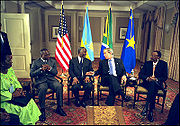 Paul Kagame became President of Rwanda in March 2000, after Bizimungu was deposed. Three and a half years later, on 25 August 2003, he won a landslide victory in the first national elections
since his government took power in 1994 winning 95.5% of the votes.
Kagame is highly critical of the United Nations and its role in the 1994 genocide. In March 2004, his public criticism of France for its role in the genocide and its lack of preventative actions caused a diplomatic row. In November 2006, Rwanda severed all diplomatic ties with France and ordered all its diplomatic staff out of Rwanda within 24 hours following Judge Bruguiere issuing warrants accusing nine high ranking Rwandans of plotting the downing of President Juvenal Habyarimana's airplane in 1994 and also accusing Kagame of ordering the plane shot down.
As president, Kagame has also been critical of the West's lack of development aid in Africa. Kagame believes that Western countries keep African products out of the world marketplace. In contrast, he has praised China, saying in a 2009 interview that "the Chinese bring what Africa needs: investment and money for governments and companies."
Paul Kagame has in presidential standing expressed positive views on private enterprise and free market
s.
In May 2011, Kagame answered a series of questions on a YouTube Worldview Interview.
and Human Rights Watch described what they called "serious violations of international humanitarian law committed by the Rwanda Patriotic Army".
According to The Economist
, Kagame "allows less political space and press freedom at home than Robert Mugabe
does in Zimbabwe
", and "[a]nyone who poses the slightest political threat to the regime is dealt with ruthlessly". Adam Hochschild
, in a New York Times book review of Jason Stearns
' book "Dancing in the Glory of Monsters," wrote, "[h]ow this media-savvy autocrat has managed to convince so many American journalists, diplomats, and political leaders that he is a great statesman is worth a book in itself."
The United States' government in 2006 described the human rights record of the Kagame government as "mediocre", citing the "disappearances
" of political dissidents, as well as arbitrary arrests and acts of violence, torture and murders committed by police. US authorities listed human rights problems including the existence of political prisoners and limited freedom of the press, freedom of assembly and freedom of religion.
Reporters Without Borders
listed Rwanda in 147th place out of 169 for freedom of the press in 2007, and reported that "Rwandan journalists suffer permanent hostility from their government and surveillance by the security services". It cited cases of journalists being threatened, harassed and arrested for criticising the government. According to Reporters Without Borders, "President Paul Kagame and his government have never accepted that the press should be guaranteed genuine freedom." In 2011, Kagame took issue with a British journalist on Twitter after the journalist's tweets asserted that Kagame is "despotic."
The decoration is awarded exclusively to personalities of the rank of Head of State in recognition of outstanding achievement or to express esteem.
|-
|-
Rwandan Patriotic Front
The Rwandan Patriotic Front abbreviated as RPF is the current ruling political party of Rwanda, led by President Paul Kagame. It governs in a coalition with other parties...
(RPF), whose victory over the incumbent government in July 1994 effectively ended the Rwandan genocide
Rwandan Genocide
The Rwandan Genocide was the 1994 mass murder of an estimated 800,000 people in the small East African nation of Rwanda. Over the course of approximately 100 days through mid-July, over 500,000 people were killed, according to a Human Rights Watch estimate...
. Under his leadership, Rwanda has been called Africa’s “biggest success story” and Kagame has become a public advocate of new models for foreign aid designed to help recipients become self-reliant.
However, Paul Kagame's rule has been criticized for his domestic policies that have been described as authoritarian.
Early life
Kagame was born to a TutsiTutsi
The Tutsi , or Abatutsi, are an ethnic group in Central Africa. Historically they were often referred to as the Watussi or Watusi. They are the second largest caste in Rwanda and Burundi, the other two being the Hutu and the Twa ....
family in Ruhango, Rwanda-Urundi in October 1957 to Deogratius and Asteria Rutagambwa. In November 1959, an increasingly restive Hutu
Hutu
The Hutu , or Abahutu, are a Central African people, living mainly in Rwanda, Burundi, and eastern DR Congo.-Population statistics:The Hutu are the largest of the three peoples in Burundi and Rwanda; according to the United States Central Intelligence Agency, 84% of Rwandans and 85% of Burundians...
population sparked a revolt, eventually resulting in the overthrow of Mwami
Mwami
Mwami is the chiefly title in Kirundi and Kinyarwanda, the Congolese Nande and Bashi languages, Luhya in Kenya and various other Bantu languages, such as the Tonga language . The word is usually translated as king...
Kigeri V Ndahindurwa in 1961. During the 1959 revolt and its aftermath, more than 150,000 people were killed in the fighting, with the Tutsi
Tutsi
The Tutsi , or Abatutsi, are an ethnic group in Central Africa. Historically they were often referred to as the Watussi or Watusi. They are the second largest caste in Rwanda and Burundi, the other two being the Hutu and the Twa ....
s suffering the greatest losses. Several thousand moved to neighbouring countries including Burundi
Burundi
Burundi , officially the Republic of Burundi , is a landlocked country in the Great Lakes region of Eastern Africa bordered by Rwanda to the north, Tanzania to the east and south, and the Democratic Republic of the Congo to the west. Its capital is Bujumbura...
and Uganda
Uganda
Uganda , officially the Republic of Uganda, is a landlocked country in East Africa. Uganda is also known as the "Pearl of Africa". It is bordered on the east by Kenya, on the north by South Sudan, on the west by the Democratic Republic of the Congo, on the southwest by Rwanda, and on the south by...
. In all, some 20,000 Tutsis were killed. In 1960 Kagame left with his family at the age of two and moved to Uganda with many other Tutsis. In 1962 they settled in the Gahunge refugee camp, Toro, where Kagame spent the rest of his childhood years. He attended Ntare Secondary School
Ntare School
Ntare School is a residential boys' secondary school located in Mbarara, Mbarara District, western Uganda. It was founded in 1956 by a Scottish educator named William Crichton....
in Uganda. During this time Kagame was a "motivated student" and bore an early fascination with revolutionaries such as Che Guevara
Che Guevara
Ernesto "Che" Guevara , commonly known as el Che or simply Che, was an Argentine Marxist revolutionary, physician, author, intellectual, guerrilla leader, diplomat and military theorist...
.
Military service
His military career started when he joined Yoweri MuseveniYoweri Museveni
Yoweri Kaguta Museveni is a Ugandan politician and statesman. He has been President of Uganda since 26 January 1986.Museveni was involved in the war that deposed Idi Amin Dada, ending his rule in 1979, and in the rebellion that subsequently led to the demise of the Milton Obote regime in 1985...
's National Resistance Army
National Resistance Army
The National Resistance Army , the military wing of the National Resistance Movement , was a rebel army that waged a guerrilla war, commonly referred to as the Luwero War or "the war in the bush", against the government of Milton Obote, and later that of Tito Okello.NRA was supported by Muammar...
(NRA) and spent years fighting as a guerrilla
Guerrilla warfare
Guerrilla warfare is a form of irregular warfare and refers to conflicts in which a small group of combatants including, but not limited to, armed civilians use military tactics, such as ambushes, sabotage, raids, the element of surprise, and extraordinary mobility to harass a larger and...
against the government of Milton Obote
Milton Obote
Apolo Milton Obote , Prime Minister of Uganda from 1962 to 1966 and President of Uganda from 1966 to 1971, then again from 1980 to 1985. He was a Ugandan political leader who led Uganda towards independence from the British colonial administration in 1962.He was overthrown by Idi Amin in 1971, but...
in what is commonly known in Uganda as the bush war
Ugandan Bush War
The Ugandan Bush War refers to the guerrilla war waged between 1981 and 1986 in Uganda by the National Resistance Army against the government of Milton Obote, and later that of Tito Okello.-Events leading to the war:Following the Uganda-Tanzania War that removed Idi Amin in 1979, a...
.
On 27 July 1985, Milton Obote was ousted in a military coup led by Tito Okello
Tito Okello
General Tito Lutwa Okello , was a Ugandan Military officer and politician. He was the President of Uganda from 29 July 1985 until 26 January 1986.-Background:Tito Okello was born in 1914 in Kitgum District...
. In 1986 the NRA succeeded in overthrowing Okello and the NRA leader Yoweri Museveni
Yoweri Museveni
Yoweri Kaguta Museveni is a Ugandan politician and statesman. He has been President of Uganda since 26 January 1986.Museveni was involved in the war that deposed Idi Amin Dada, ending his rule in 1979, and in the rebellion that subsequently led to the demise of the Milton Obote regime in 1985...
became President of Uganda
President of Uganda
-List of Presidents of Uganda:-Affiliations:-See also:*Uganda*Vice President of Uganda*Prime Minister of Uganda*Politics of Uganda*History of Uganda*Political parties of Uganda...
.
Fred Rwigema
Fred Gisa Rwigema , born Emmanuel Gisa , was a founding member of and leader of the Rwandan Patriotic Front, an anti-Hutu Power guerrilla group that fought in the Rwandan Civil War.Rwigema was born in Gitarama, in the south of Rwanda...
, the Rwandese Patriotic Front (RPF), which was composed mainly of expatriate Rwandan Tutsi
Tutsi
The Tutsi , or Abatutsi, are an ethnic group in Central Africa. Historically they were often referred to as the Watussi or Watusi. They are the second largest caste in Rwanda and Burundi, the other two being the Hutu and the Twa ....
soldiers that had also fought with the NRA; the RPF was also based in Uganda.
In 1986, Kagame became the head of military intelligence
Military intelligence
Military intelligence is a military discipline that exploits a number of information collection and analysis approaches to provide guidance and direction to commanders in support of their decisions....
in the NRA, and was regarded as one of Museveni's closest allies. He also joined the official Ugandan military.
During 1990, Kagame went to Fort Leavenworth
Fort Leavenworth
Fort Leavenworth is a United States Army facility located in Leavenworth County, Kansas, immediately north of the city of Leavenworth in the upper northeast portion of the state. It is the oldest active United States Army post west of Washington, D.C. and has been in operation for over 180 years...
where the U.S. Army gave him military training. When the RPF started an invasion of Rwanda and his close friend and RPF co-founder Fred Rwigema
Fred Rwigema
Fred Gisa Rwigema , born Emmanuel Gisa , was a founding member of and leader of the Rwandan Patriotic Front, an anti-Hutu Power guerrilla group that fought in the Rwandan Civil War.Rwigema was born in Gitarama, in the south of Rwanda...
was killed, the U.S. arranged the return of Kagame to Uganda and thence to take the leadership of the invasion, thus signaling that the U.S. was siding with Uganda and the RPF against the incumbent Rwandan government. Broadening this connection, the U.S. and U.K. military provided further training and active logistical support to the RPF, which it used to take over power in Rwanda after 1994; and after coming to power, Kagame arranged for the RPF to receive further counterinsurgency and combat training from U.S. Special Forces, which was put to use in the 1996–1997 Rwandan-backed military campaign to overthrow the government of neighboring Zaire
Zaire
The Republic of Zaire was the name of the present Democratic Republic of the Congo between 27 October 1971 and 17 May 1997. The name of Zaire derives from the , itself an adaptation of the Kongo word nzere or nzadi, or "the river that swallows all rivers".-Self-proclaimed Father of the Nation:In...
.
Invasions, assassinations
In October 1990, while Kagame was undergoing military training in the U.S., the RPF invaded Rwanda in the struggle for the interests of Rwanda's TutsiTutsi
The Tutsi , or Abatutsi, are an ethnic group in Central Africa. Historically they were often referred to as the Watussi or Watusi. They are the second largest caste in Rwanda and Burundi, the other two being the Hutu and the Twa ....
minority ethnic group. Only two days into the invasion, Rwigema was murdered, making Kagame the military commander of the RPF. Despite initial successes, a force of French
Military of France
The French Armed Forces encompass the French Army, the French Navy, the French Air Force and the National Gendarmerie. The President of the Republic heads the armed forces, with the title "chef des armées" . The President is the supreme authority for military matters and is the sole official who...
, Belgian
Military of Belgium
The Belgian Army is the national military of Belgium. The Belgian Army was established after Belgium became independent in October 1830...
, Rwandan, and Zaire
Zaire
The Republic of Zaire was the name of the present Democratic Republic of the Congo between 27 October 1971 and 17 May 1997. The name of Zaire derives from the , itself an adaptation of the Kongo word nzere or nzadi, or "the river that swallows all rivers".-Self-proclaimed Father of the Nation:In...
an soldiers forced the RPF to retreat. A renewed invasion was attempted in late 1991, but also had limited success.
The invasion increased ethnic tension throughout the region, including in neighbouring Burundi
Burundi
Burundi , officially the Republic of Burundi , is a landlocked country in the Great Lakes region of Eastern Africa bordered by Rwanda to the north, Tanzania to the east and south, and the Democratic Republic of the Congo to the west. Its capital is Bujumbura...
where similar tensions existed. Peace talks between the RPF and the Rwandan government resulted in the Arusha accords
Arusha Accords
The Arusha Accords were a set of five accords signed in Arusha, Tanzania on August 4, 1993, by the government of Rwanda and the rebel Rwandan Patriotic Front , under mediation, to end a three-year Rwandan Civil War...
, including political participation of the RPF in Rwanda. Despite the agreement, ethnic tensions still flared dangerously.
On 6 April 1994, a plane carrying both the Rwandan President Juvénal Habyarimana
Juvénal Habyarimana
Juvénal Habyarimana was the third President of the Republic of Rwanda, the post he held longer than any other president to date, from 1973 until 1994. During his 20-year rule he favored his own ethnic group, the Hutus, and supported the Hutu majority in neighboring Burundi against the Tutsi...
and Burundi
Burundi
Burundi , officially the Republic of Burundi , is a landlocked country in the Great Lakes region of Eastern Africa bordered by Rwanda to the north, Tanzania to the east and south, and the Democratic Republic of the Congo to the west. Its capital is Bujumbura...
an President Cyprien Ntaryamira
Cyprien Ntaryamira
Cyprien Ntaryamira , was President of Burundi from 5 February 1994 until his death when his plane was shot down on 6 April 1994.-Biography:...
was shot down by a surface-to-air missile as it approached Kigali
Kigali
Kigali, population 965,398 , is the capital and largest city of Rwanda. It is situated near the geographic centre of the nation, and has been the economic, cultural, and transport hub of Rwanda since it became capital at independence in 1962. The main residence and offices of the President of...
airport. All on board were killed. The deaths immediately sparked the Rwandan Genocide
Rwandan Genocide
The Rwandan Genocide was the 1994 mass murder of an estimated 800,000 people in the small East African nation of Rwanda. Over the course of approximately 100 days through mid-July, over 500,000 people were killed, according to a Human Rights Watch estimate...
and an estimated 800,000 to 1,000,000 Rwandans were killed. The outbreak of genocide ended what vestiges remained of the cease fire. The RPF, under the leadership of Kagame, proceeded to take control of the whole country. Kigali was captured 4 July 1994, bringing the downfall of the government of Jean Kambanda
Jean Kambanda
Jean Kambanda was the Prime Minister in the caretaker government of Rwanda from the start of the 1994 Rwandan Genocide...
.
French indictment
Because three French citizens, crew members of the aircraft, died during the crash, an investigation was carried out by French judge Jean-Louis BruguièreJean-Louis Bruguière
Jean-Louis Bruguière was the leading French investigating magistrate in charge of counter-terrorism affairs. He was appointed in 2004 vice-president of the Paris Court of Serious Claims . He has garnered controversy for various acts, including the indictment of Rwandan president Paul Kagame for the...
, who controversially concluded that the shooting of the plane was ordered by Kagame. In November 2006, Judge Bruguière signed international indictments against nine of President Kagame's senior aides, and accused Kagame of ordering the assassination of the two African presidents. Kagame could not be indicted under French law, because as a head-of-state he had immunity from prosecution. The indictments have not produced any arrests, due to non-cooperation from the Rwandan government, which accused the judge of partiality. The Kagame government countered that the indictment was based on declarations by fugitives and disgruntled former lower-rank RPF members who testified that the RPF was the only organization with the type of missiles that were used in the assassination. It also pointed out that, at the time of the shooting of the plane, the French military was in control of Kigali Airport; however that point is irrelevant because the plane was shot down on approach to the airport and not from the zone controlled by French forces. The former chief prosecutor for Yugoslavia and Rwanda, Judge Richard Goldstone
Richard Goldstone
Richard Joseph Goldstone is a South African former judge. After working for 17 years as a commercial lawyer, he was appointed by the South African government to serve on the Transvaal Supreme Court from 1980 to 1989 and the Appellate Division of the Supreme Court of South Africa from 1990 to 1994...
, argued in the interview that political motivations were at play in the indictment, though this did not negate the potential veracity of the accusations by Judge Bruguière. Judge Goldstone stated that: "Well I don't think that case has been made at all. It's a very political judgement and I don't believe that it's borne out by the evidence. Certainly the witnesses who spoke to Bruguiere allege that those were statements made by President Kagame himself. He is a type of guy that knows how to play with people's emotions. Whether he did or not obviously is a matter in dispute, in hot dispute, but the political judgment it seems to me is another matter."
The accusations against Kagame were corroborated by several witnesses, including former intelligence RPF members, the most publicly known being Commando Lieutenant Abdul Ruzibiza
Abdul Ruzibiza
Abdul Joshua Ruzibiza was a former member of the Rwandan Patriotic Front who at one time claimed to be part of a group that carried out the assassination of President of Rwanda Juvénal Habyarimana and Burundian president Cyprien Ntaryamira in April 1994, an event that marked the beginning of the...
. Ruzibiza published a book (Rwanda: L'histoire secrete) and released testimony pertaining to Kagame and the RPF's involvement in the plane downing and massacres; however, Ruzibiza subsequently retracted part of his testimony, especially as pertains to Kagame senior aide Rose Kabuye
Rose Kabuye
Rose Kabuye is a retired Lieutenant Colonel in the Rwandan Army and remains the highest ranking woman ever to serve in her country's armed forces...
after she was arrested in Germany and extradited to France. The Association des Avocats de la Defence released a statement backing Judge Bruguière's allegations. Paul Rusesabagina
Paul Rusesabagina
Paul Rusesabagina is a Rwandan humanitarian who has been internationally honored for saving 1,268 refugees during the Rwandan Genocide. He was the assistant manager of the Sabena Hôtel des Mille Collines before he became the manager of the Hôtel des Diplomates, both in Kigali, Rwanda...
, a Rwandan of mixed Hutu and Tutsi origin, whose feat saving 1,268 civilians has been the basis of the Academy Award nominated film Hotel Rwanda
Hotel Rwanda
Hotel Rwanda is a 2004 American drama film directed by Terry George. It was adapted from a screenplay written by both George and Keir Pearson. Based on real life events which took place in Rwanda during the spring of 1994, the film stars Don Cheadle as hotelier Paul Rusesabagina, who attempts to...
(2004), has supported the allegation that Kagame and the RPF were behind the plane downing, and stated that:
It defies logic why the UN Security Council has never mandated an investigation of this airplane missile attack to establish who was responsible, especially since everyone agrees it was the one incident that touched off the mass killings commonly referred to as the “Rwandan genocide of 1994”.
In a political countereffort, Kagame broke diplomatic relations with France in November 2006 and ordered the formation of a commission of loyal Rwandans that was officially "charged with assembling proof of the involvement of France in the genocide". The political character of that investigation was further averred when the commission issued its report solely to Kagame in November 2007 and its head, Jean de Dieu Mucyo, stated that the commission would now "wait for President Kagame to declare whether the inquiry was valid."
In a 2007, interview with BBC
BBC
The British Broadcasting Corporation is a British public service broadcaster. Its headquarters is at Broadcasting House in the City of Westminster, London. It is the largest broadcaster in the world, with about 23,000 staff...
, Mr Kagame said he would co-operate with an impartial inquiry. The BBC concluded that "Whether any judge would want to take on such a task is quite another matter."
As of 2009, a report commissioned by the Rwandan government concluded the RPF and Kagame were not responsible for the crash of the president's plane.
Spanish indictment
In February 2008, Fernando AndreuFernando Andreu
Fernando Andreu is a judge of the National Audience in Spain. He plays a leading role especially in humanitarian law and in pursuing war-crime and similar issues ....
, a Spanish judge, indicted 40 current or former Rwandan military officers for several counts of genocide and human rights abuses during the Rwandan Genocide
Rwandan Genocide
The Rwandan Genocide was the 1994 mass murder of an estimated 800,000 people in the small East African nation of Rwanda. Over the course of approximately 100 days through mid-July, over 500,000 people were killed, according to a Human Rights Watch estimate...
.
The judge issued international arrest warrants against the 40, including Gen. James Kabarebe, whom the judge believed to be the chief of staff of Rwanda's military; Gen. Kayumba Nyamwasa
Kayumba Nyamwasa
Lieutenant General Faustin Kayumba Nyamwasa was a Rwandan Army former Chief of Staff who fled to South Africa in February 2010 afterbeing accused of involvement in terrorist activity within Rwanda.Nyamwasa had formerly been head of Rwandan intelligence....
, Rwanda's ex-ambassador to India; and Lt. Col. Rugumya Gacinya, military attache at Rwanda's embassy in Washington.
Evidence was presented of crimes allegedly perpetrated by the RPA/RPF in Rwanda and the Democratic Republic of Congo in the period 1990–2000, primarily. This revealed that the RPA/RPF’s hierarchical chain of command headed by Kagame, is responsible for three major and closely interrelated blocks of crime:
- crimes perpetrated against 9 Spanish victims – missionaries and aid workers- observers of the killings of Hutu inhabitants in both countries
- crimes against Rwandans and Congolese, against various specific leaders, or systematically carried out as mass murders of civilians
- crimes of war pillage- the systematic, large-scale plundering of natural resources, especially strategically valuable minerals.
Second Congo War
Kagame was part of the cabinet of President Pasteur BizimunguPasteur Bizimungu
Pasteur Bizimungu was the fifth President of Rwanda from 19 July 1994 until 23 March 2000. He is considered belonging to the Hutu caste/ethnic group and was born in the Gisenyi prefecture of Rwanda. Bizimungu worked within the Hutu MRND regime which ruled Rwanda , including as director general of...
, who came to power in the aftermath of the genocide. Kagame was made Vice President of Rwanda
Vice President of Rwanda
Vice President of Rwanda was a political position in Rwanda created for Paul Kagame from 1994 to 2000. The office was abolished in 2000....
and Defense Minister. Bizimungu was also a member of the RPF, and as its military leader, Kagame was viewed as the power behind the throne, and eventually became President when Bizimungu was deposed in March 2000.
Presidency
Rwandan presidential election, 2003
A presidential election was held in Rwanda on 25 August 2003. Paul Kagame easily won the election against a weak opposition.-Source:*...
since his government took power in 1994 winning 95.5% of the votes.
Kagame is highly critical of the United Nations and its role in the 1994 genocide. In March 2004, his public criticism of France for its role in the genocide and its lack of preventative actions caused a diplomatic row. In November 2006, Rwanda severed all diplomatic ties with France and ordered all its diplomatic staff out of Rwanda within 24 hours following Judge Bruguiere issuing warrants accusing nine high ranking Rwandans of plotting the downing of President Juvenal Habyarimana's airplane in 1994 and also accusing Kagame of ordering the plane shot down.
As president, Kagame has also been critical of the West's lack of development aid in Africa. Kagame believes that Western countries keep African products out of the world marketplace. In contrast, he has praised China, saying in a 2009 interview that "the Chinese bring what Africa needs: investment and money for governments and companies."
Paul Kagame has in presidential standing expressed positive views on private enterprise and free market
Free market
A free market is a competitive market where prices are determined by supply and demand. However, the term is also commonly used for markets in which economic intervention and regulation by the state is limited to tax collection, and enforcement of private ownership and contracts...
s.
In May 2011, Kagame answered a series of questions on a YouTube Worldview Interview.
Human rights
In June 2006, the International Federation of Human RightsInternational Federation of Human Rights
The International Federation for Human Rights is a non-governmental federation for human rights organizations. Founded in 1922, FIDH is the oldest international human rights organisation worldwide and today brings together 164 member organisations in over 100 countries.FIDH is nonpartisan,...
and Human Rights Watch described what they called "serious violations of international humanitarian law committed by the Rwanda Patriotic Army".
According to The Economist
The Economist
The Economist is an English-language weekly news and international affairs publication owned by The Economist Newspaper Ltd. and edited in offices in the City of Westminster, London, England. Continuous publication began under founder James Wilson in September 1843...
, Kagame "allows less political space and press freedom at home than Robert Mugabe
Robert Mugabe
Robert Gabriel Mugabe is the President of Zimbabwe. As one of the leaders of the liberation movement against white-minority rule, he was elected into power in 1980...
does in Zimbabwe
Zimbabwe
Zimbabwe is a landlocked country located in the southern part of the African continent, between the Zambezi and Limpopo rivers. It is bordered by South Africa to the south, Botswana to the southwest, Zambia and a tip of Namibia to the northwest and Mozambique to the east. Zimbabwe has three...
", and "[a]nyone who poses the slightest political threat to the regime is dealt with ruthlessly". Adam Hochschild
Adam Hochschild
Adam Hochschild is an American author and journalist.-Biography:Hochschild was born in New York City. As a college student, he spent a summer working on an anti-government newspaper in South Africa and subsequently worked briefly as a civil rights worker in Mississippi in 1964...
, in a New York Times book review of Jason Stearns
Jason Stearns
Jason K. Stearns is an American writer who worked for ten years in the Congo, including three years during the Second Congo War. He first traveled to the Congo in 2001 to work for a local human rights organization, Héritiers de la Justice, in Bukavu. He went on to work for the United Nations...
' book "Dancing in the Glory of Monsters," wrote, "[h]ow this media-savvy autocrat has managed to convince so many American journalists, diplomats, and political leaders that he is a great statesman is worth a book in itself."
The United States' government in 2006 described the human rights record of the Kagame government as "mediocre", citing the "disappearances
Forced disappearance
In international human rights law, a forced disappearance occurs when a person is secretly abducted or imprisoned by a state or political organization or by a third party with the authorization, support, or acquiescence of a state or political organization, followed by a refusal to acknowledge the...
" of political dissidents, as well as arbitrary arrests and acts of violence, torture and murders committed by police. US authorities listed human rights problems including the existence of political prisoners and limited freedom of the press, freedom of assembly and freedom of religion.
Reporters Without Borders
Reporters Without Borders
Reporters Without Borders is a France-based international non-governmental organization that advocates freedom of the press. It was founded in 1985, by Robert Ménard, Rony Brauman and the journalist Jean-Claude Guillebaud. Jean-François Julliard has served as Secretary General since 2008...
listed Rwanda in 147th place out of 169 for freedom of the press in 2007, and reported that "Rwandan journalists suffer permanent hostility from their government and surveillance by the security services". It cited cases of journalists being threatened, harassed and arrested for criticising the government. According to Reporters Without Borders, "President Paul Kagame and his government have never accepted that the press should be guaranteed genuine freedom." In 2011, Kagame took issue with a British journalist on Twitter after the journalist's tweets asserted that Kagame is "despotic."
Honors and accolades
- Kagame was in March 2003 awarded the 2003 Global Leadership Award by the Young Presidents' OrganizationYoung Presidents' OrganizationThe Young Presidents’ Organization is a global network of young chief executives. With approximately 18,000 members in more than 100 countries, YPO and its graduate organization, WPO share a founding mission: Better Leaders Through Education and Idea Exchange....
(YPOYPOYPO may refer to:* Young Presidents' Organization* Peawanuck Airport...
). He received the award in recognition of his "commitment and tireless work to address crises, to foster understanding, unity, and peace to benefit all people." YPO regard his role in reconciling the Tutsi and the Hutu differences in Rwanda and in developing a peaceful solution to the conflict in the Democratic Republic of Congo as a benchmark of great leadership, uncommon inspiration and remarkable achievement.
- In April 2005, Kagame was awarded an Honorary Degree of Doctor Laws by the University of the Pacific in the United States.
- In September 2005, Kagame was awarded the Andrew YoungAndrew YoungAndrew Jackson Young is an American politician, diplomat, activist and pastor from Georgia. He has served as Mayor of Atlanta, a Congressman from the 5th district, and United States Ambassador to the United Nations...
Medal for Capitalism and Social Progress by Georgia State UniversityGeorgia State UniversityGeorgia State University is a research university in downtown Atlanta, Georgia, USA. Founded in 1913, it serves about 30,000 students and is one of the University System of Georgia's four research universities...
in the United States. - In September 2005, Kagame was awarded the African National Achievement Award by the Africa America Institute in the USA.
- In April 2006, Kagame was awarded an Honorary Doctorate by Oklahoma Christian UniversityOklahoma Christian UniversityOklahoma Christian University is a private comprehensive coeducational Christian liberal arts university founded in 1950 by members of the churches of Christ. OC is located on a campus in Oklahoma City. Enrollment for the fall 2011 semester numbered 2,194, which included 1,854 undergraduate and...
in the USA. - In May 2006, Kagame was given the 2006 ICTInformation and communication technologiesInformation and communications technology or information and communication technology, usually abbreviated as ICT, is often used as an extended synonym for information technology , but is usually a more general term that stresses the role of unified communications and the integration of...
Africa Award, an award that is designed to recognize and reward organizations and individuals that have demonstrated excellence in promoting the use of ICTs for the overall development of the African continent. - In September 2006, Rwanda was listed as a Top-10 reformer on the Ease of doing business indexEase of Doing Business IndexThe Ease of Doing Business Index is an index created by the World Bank. Higher rankings indicate better, usually simpler, regulations for businesses and stronger protections of property rights...
by the World Bank. - July 2007, Kagame won the Best Head Of State in Africa in Support of ICT Award. Kagame won the same award in May 2006, in an event that took place in Kigal.
- In August 2007, Kagame was given the Hands Off Cain Award for his role in ending the death penalty in his country.
- In November 2007, Kagame was awarded an Honorary Degree of Doctor in Law by the University of GlasgowUniversity of GlasgowThe University of Glasgow is the fourth-oldest university in the English-speaking world and one of Scotland's four ancient universities. Located in Glasgow, the university was founded in 1451 and is presently one of seventeen British higher education institutions ranked amongst the top 100 of the...
in Scotland. - In December 2007, Kagame was given the African Gender Award in Dakar, Senegal for his role in promoting gender equality in Rwanda.
- March 2009, Kagame was awarded with “The Distinction of the Grand Cordon in the Most Venerable Order of the Knighthood of Pioneers” by Liberia’s President Ellen Johnson-Sirleaf.The highest honour in Liberian was given to Kagame in recognition of his exemplary leadership and exceptional contribution to the promotion of women’s rights.
- In June 2009, Kagame was awarded the Children's Champion Award by the US Fund for UNICEF for Promoting Children's Rights
- In September 2009, Kagame was awarded the International Peace Medal from Saddleback Church for his support and role in the P.E.A.C.E. plan.
- In September 2009, Kagame honoured with the Clinton Global Citizen Award in recognition of his leadership in public service that has improved the lives of people of Rwanda.
- November 2009, Kagame was presented with the ‘Most Innovative People Award for Economic Innovation’ at the Lebanon2020 Summit.
- May 2010, Kagame was awarded 'Lifetime Leadership Award for Development and Equality' by Rwandan Women in recognition of his efforts in developing the nation and promoting equality amongst Rwandans.
- May 2010, Kagame was awarded the 2010 Rwanda Convention Association (RCA) Award of Excellence in recognition of his role in steering Rwanda towards a knowledge-based economy and promotion of the private sector.
- On 5 June 2010, Kagame was awarded the prestigious 'Energy Globe Award' on the occasion of World Environment Day celebrated in Kinigi, Rwanda.
- On 5 July 2010, Rwanda International Network Association (RINA) awarded Kagame for his continuous efforts in the promotion of Education.
- On 27 September 2010, British Magazine New StatesmanNew StatesmanNew Statesman is a British centre-left political and cultural magazine published weekly in London. Founded in 1913, and connected with leading members of the Fabian Society, the magazine reached a circulation peak in the late 1960s....
included Paul Kagame in the list of "The World's 50 Most Influential Figures 2010" on 49th place. - On 19 November 2010, Kagame was presented the “Grand Croix – Ordre de merit du Benin” the country’s highest national award.
The decoration is awarded exclusively to personalities of the rank of Head of State in recognition of outstanding achievement or to express esteem.
- 01 June, 2011: President Kagame was awarded the Chello Foundation Humanitarian Award 2011 for his “outstanding leadership of the Republic of Rwanda since 1994”
- 1 September 2011: THE International Olympic Committee (IOC) awarded President Paul Kagame with the 2010 IOC award for 'Inspiring Young People' around the world
- On 7th November 2011, AERG (Association des Etudiants Rescapes du Genocide) awarded Kagame "... in recognition of his efforts and courage to stop the Genocide as he led the Rwanda Patriotic Army,", at the cerebration of AERG 15th Anniversary
See also
- Military of Rwanda
- History of RwandaHistory of RwandaHuman occupation of Rwanda is thought to have begun shortly after the last ice age. By the fifteenth century the inhabitants had organized into a number of kingdoms...
- Tokyo International Conference on African DevelopmentTokyo International Conference on African Developmentis a conference held every five years in Tokyo, Japan, with the objective "to promote high-level policy dialogue between African leaders and development partners." Japan is a co-host of these conferences. Other co-organizers of TICAD are the United Nations Office of the Special Advisor on Africa...
(TICAD-IV), 2008.
External links
- Column archive at The GuardianThe GuardianThe Guardian, formerly known as The Manchester Guardian , is a British national daily newspaper in the Berliner format...
- Democratic Republic of Congo – Rwandese-Controlled East – Devastating Human Death Toll, Amnesty InternationalAmnesty InternationalAmnesty International is an international non-governmental organisation whose stated mission is "to conduct research and generate action to prevent and end grave abuses of human rights, and to demand justice for those whose rights have been violated."Following a publication of Peter Benenson's...
, June 2001 - Rwanda 2005, Freedom HouseFreedom HouseFreedom House is an international non-governmental organization based in Washington, D.C. that conducts research and advocacy on democracy, political freedom and human rights...
- Paul Kagame: A Tarnished African Hero, The GuardianThe GuardianThe Guardian, formerly known as The Manchester Guardian , is a British national daily newspaper in the Berliner format...
, 18 July 2010
|-
|-