
|
|
|
|
Paul Rusesabagina
|
| |
|
| |
Paul Rusesabagina (born June 15, 1954) is a Rwandan who has been internationally honoured for saving 1,268 civilians during the Rwandan Genocide. He was the assistant manager of the Sabena Hôtel des Mille Collines before he became the manager of the Hôtel des Diplomates, both in Kigali, Rwanda. During the 1994 Rwandan genocide Rusesabagina used his influence and connections as temporary manager of the 'Mille Collines' to shelter 1,268 Tutsis and moderate Hutus from being slaughtered by the Interahamwe militia.

Discussion
Ask a question about 'Paul Rusesabagina'
Start a new discussion about 'Paul Rusesabagina'
Answer questions from other users
|
Encyclopedia
Paul Rusesabagina (born June 15, 1954) is a Rwandan who has been internationally honoured for saving 1,268 civilians during the Rwandan Genocide. He was the assistant manager of the Sabena Hôtel des Mille Collines before he became the manager of the Hôtel des Diplomates, both in Kigali, Rwanda. During the 1994 Rwandan genocide Rusesabagina used his influence and connections as temporary manager of the 'Mille Collines' to shelter 1,268 Tutsis and moderate Hutus from being slaughtered by the Interahamwe militia. His story was the basis of the Academy Award nominated film Hotel Rwanda (2004). He currently lives in Belgium with his wife, children, and two adopted nieces. He drove a taxi in Brussels and after three years opened a trucking company.
Birth and career
Rusesabagina was born in Gitarama in the Central-South region of Rwanda to a farming family. He wanted to be a pastor when he grew up, but currently is a lapsed Seventh-day Adventist. He had three children with his first wife Esther. After they separated in 1981, he graduated from the Hotel Management program of Utalii College in Nairobi, Kenya, which included a trip to Switzerland. When he returned from Switzerland, he was employed in the Hôtel des Mille Collines as assistant general manager from October 1984 until November 1992, upon which he was promoted to general manager of the company's Diplomate Hotel in Kigali. He met his current wife Tatiana in 1987 at a wedding party. Tatiana was a Tutsi suffering discrimination at her job as a nurse, so Paul arranged for her to be moved closer to him for this reason, and to get to know her better. After they married, they had a daughter, who died after she was a few days old, and later a son Tresor.
Genocide
The Rwandan Genocide started on April 6, 1994 as the Hutu led Interahamwe began to slaughter the Tutsi population. Though Rusesabagina was of mixed heritage - his father was Hutu and his mother Tutsi - he was relatively safe from the Interahamwe due to his position and business connections with important Hutu military leaders. These connections notwithstanding, his wife Tatiana was a Tutsi, and their children were considered mixed, so he could not escape the war zone with his family without outside help. However, no foreign aid came from the United Nations or its more powerful Western member states until after over 800,000 Rwandans had been murdered.
When the violence broke out, Rusesabagina brought his family to the Hôtel des Mille Collines for safety. As other managers departed, Rusesabagina phoned the hotel's corporate owners, Sabena, and secured a letter appointing him the acting general manager of the Mille Collines. Despite some difficulty in getting the staff to accept his authority, he was able to use his position to shelter orphans and other refugees who came to the hotel. His neighbours had moved into his house for safety, though Rusesabagina did not even own a gun. For protection against bullets and grenades they put mattresses against the windows. He described the hardships they faced, which included having to drink the water from the hotel's swimming pool. Murderous Hutu militia threatened to enter the Mille Collines, so Rusesabagina made sure his wife and children could flee in a truck past the militia roadblocks. The truck set out for Kigali airport so they could flee to another country. He himself remained in the hotel because the refugees needed him. Rusesabagina and his wife discussed this decision for hours, because he had promised her he would never leave her in this situation. Rusesabagina wanted to stay, fearing the remaining refugees would be killed and feeling that he would never be able to forgive himself.
The truck was forced to return to the hotel, never having reached the airport. Everybody in the truck, including Tatiana and the children, had been beaten. Tatiana was a specific target for the beatings because she was the wife of the manager of the Mille Collines; the Hutu militia knew she and her children were in the truck owing to radio messages sent out by presenter Georges Ruggiu. Ruggiu was an Italian and a Belgian who together with other presenters on the station urged the Hutu population to kill all the Tutsis. Ruggiu called Rusesabagina's family "cockroaches who were fleeing, but would return later to kill all the Hutus".
Tatiana's mother,and 4 nieces/nephews, died in the genocide. Her brother and sister-in-law are missing in action. Her father paid to be executed so he would not die a more painful death:
Rusesabagina, his wife and children, and the refugees eventually managed to escape to Tanzania, thanks to the RPF. After staying in Rwanda for two more years, Rusesabagina applied for asylum in Belgium and moved to Brussels in 1996 after receiving credible threats on his life.
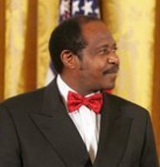
Paul Rusesabagina received the US Presidential Medal of Freedom on November 9, 2005 from President George W. Bush.
Media
Autobiography
His autobiography entitled An Ordinary Man (written with ISBN 0-670-03752-4) was published by Viking Penguin in April 2006.
Film
Paul's work is dramatised in the 2004 movie Hotel Rwanda in which he is played by Don Cheadle. There are few differences with the actual story.
- Tatiana Rusesabagina was not in fact angry about Paul putting her and her children on a truck to escape the Hôtel des Mille Collines but was instead sad about the decision - which she nevertheless accepted due to the circumstances. Paul did not make his decision at the last moment, but rather he discussed the matter with Tatiana and the children the night before they attempted the evacuation.
- Tatiana was so badly beaten after leaving the hotel 'she lay in bed for two weeks unable to turn herself'.
- Paul and his family did not leave Rwanda immediately after they escaped the Hôtel des Mille Collines.
- "KaKa mother is Tutsi although he and his father are Hutu; the film says he is Hutu with no mention of his mixed background."
- Paul Rusesabagina said in a lecture that the film was "less violent" than the actual genocide, claiming that "you couldn't invite someone to watch the real thing."
Relationship with Paul Kagame
Rusesabagina and Rwandan president and former head of the RPF Paul Kagame have become public enemies of each other. In An Ordinary Man, Rusesabagina alleges "Rwanda is today a nation governed by and for the benefit of a small group of elite Tutsis...Those few Hutus who have been elevated to high-ranking posts are usually empty suits without any real authority of their own. They are known locally as Hutus de service or Hutus for hire." He has also criticized Kagame's election to president. On April 6, 2006, Kagame said, "(Rusesabagina) should try his talents elsewhere and not climb on the falsehood of being a hero, because it's totally false." Francois Xavier Ngarambe, the president of Ibuka, the umbrella body of genocide survivors' associations, said of Rusesabagina, "he has hijacked heroism. He is trading with the genocide. He should be charged." In December, 2006, Rusesabagina sent a letter to Queen Elizabeth II, calling Kagame a war criminal.
In 2008, the book Hotel Rwanda or the Tutsi Genocide as seen by Hollywood, by Alfred Ndahiro, a public relations advisor to Mr. Kagame, and journalist Privat Rutazibwa, was published. It provides an alternative take to the portrayal of Rusesabagina's actions as seen in Hotel Rwanda. Rusesabagina issued a response to the charges of the book , which in turn was responded to.
Timeline
- 1954 Paul Rusesabagina's birth
- 1984 Begins work at the Mille Collines Hotel in October
- 1992 Begins work at the Diplomate Hotel in November
- 1994 Massacre begins on April 6th
- 1994 Returns to work at Mille Collines Hotel in July
- 1996 Emigrates to Belgium with family in September
- 2000 Receives Immortal Chaplains Prize for Humanity.
- 2005 Receives Wallenberg Medal of the University of Michigan
- 2005 Receives National Civil Rights Museum Freedom Award
- 2005 Receives Presidential Medal of Freedom
- 2007 Receives Honorary Doctorate of Law from the University of Guelph
- 2008 Receives Honorary Degree from Gustavus Adolphus College
Sources
- Interview with Paul and Tatiana Rusesabagina in the Belgian magazine HUMO, nr. 3365, March 1, 2005.
- Hotel Rwanda: A Lesson Yet to be Learned - talk (part of the Presidential Events series) at Eckerd College on February 23rd, 2006.
External links
|
| |
|
|