
All Topics  
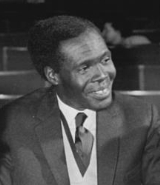
Milton Obote

 
Milton Obote

   Email Print
   Bookmark   Link


Milton Obote


Apolo Milton Obote (December 28, 1925 October 10, 2005), Prime Minister of Uganda
Prime Minister of Uganda

The Prime Minister is the Uganda head of government....
 from 1962 to 1966 and President of Uganda
President of Uganda

The President of Uganda is the head of state in Uganda. The role began as a largely ceremonial position, with the Prime Minister of Uganda holding the true power....
 from 1966 to 1971 and from 1980 to 1985, was a Ugandan political leader who led Uganda
Uganda

The Republic of Uganda is a landlocked country in East Africa. It is bordered on the east by Kenya, on the north by Sudan, on the west by the Democratic Republic of the Congo, on the southwest by Rwanda, and on the south by Tanzania....
 to independence from the British
United Kingdom

The United Kingdom of Great Britain and Northern Ireland, commonly known as the United Kingdom , the UK or Britain,is a sovereign state located off the northwestern coast of continental Europe....
 colonial
Colonialism

Colonialism is the extension of a nation's sovereignty over Territory beyond its borders by the establishment of either settler or exploitation colony in which Indigenous people populations are direct rule, Population transfers, or Genocide....
 administration in 1962. He was overthrown by Idi Amin
Idi Amin

Idi Amin Dada , commonly known as Idi Amin, was a Ugandan Military dictatorship and the President of Uganda of Uganda from 1971 to 1979. Amin joined the British colony regiment, the King's African Rifles, in 1946, and advanced to the rank of Major General and Commander of the Ugandan Army....
 in 1971, but regained power in 1980. His second rule was marred by repression, and the deaths of many civilians as a result of a civil war known as the Ugandan Bush War
Ugandan Bush War

The Ugandan Bush War refers to the guerrilla war waged between 1981 and 1986 in Uganda by the National Resistance Army against the government of Milton Obote, and later that of Tito Okello ....
.

on Obote was born at Akokoro village in Apac district
APAC

APAC or Apac may refer to:* Apac, a city in the Apac District of Uganda* Apac District, in Uganda* APAC Customer Services* Asia Pacific ...
 in northern Uganda.


Discussion
Ask a question about 'Milton Obote'
Start a new discussion about 'Milton Obote'
Answer questions from other users
Full Discussion Forum


Recent Posts


Encyclopedia


Apolo Milton Obote (December 28, 1925 October 10, 2005), Prime Minister of Uganda
Prime Minister of Uganda

The Prime Minister is the Uganda head of government....
 from 1962 to 1966 and President of Uganda
President of Uganda

The President of Uganda is the head of state in Uganda. The role began as a largely ceremonial position, with the Prime Minister of Uganda holding the true power....
 from 1966 to 1971 and from 1980 to 1985, was a Ugandan political leader who led Uganda
Uganda

The Republic of Uganda is a landlocked country in East Africa. It is bordered on the east by Kenya, on the north by Sudan, on the west by the Democratic Republic of the Congo, on the southwest by Rwanda, and on the south by Tanzania....
 to independence from the British
United Kingdom

The United Kingdom of Great Britain and Northern Ireland, commonly known as the United Kingdom , the UK or Britain,is a sovereign state located off the northwestern coast of continental Europe....
 colonial
Colonialism

Colonialism is the extension of a nation's sovereignty over Territory beyond its borders by the establishment of either settler or exploitation colony in which Indigenous people populations are direct rule, Population transfers, or Genocide....
 administration in 1962. He was overthrown by Idi Amin
Idi Amin

Idi Amin Dada , commonly known as Idi Amin, was a Ugandan Military dictatorship and the President of Uganda of Uganda from 1971 to 1979. Amin joined the British colony regiment, the King's African Rifles, in 1946, and advanced to the rank of Major General and Commander of the Ugandan Army....
 in 1971, but regained power in 1980. His second rule was marred by repression, and the deaths of many civilians as a result of a civil war known as the Ugandan Bush War
Ugandan Bush War

The Ugandan Bush War refers to the guerrilla war waged between 1981 and 1986 in Uganda by the National Resistance Army against the government of Milton Obote, and later that of Tito Okello ....
.

Early life and first presidency

Milton Obote was born at Akokoro village in Apac district
APAC

APAC or Apac may refer to:* Apac, a city in the Apac District of Uganda* Apac District, in Uganda* APAC Customer Services* Asia Pacific ...
 in northern Uganda. He was the son of a local chief of the Lango
Lango

The Lango people live in Lango sub-region in the central area of Uganda, north of Lake Kyoga. Lango Sub-region comprises the districts of Amolatar District, Apac District, Dokolo District, Lira District and Oyam District....
 ethnic group. He began his education in 1940 at the Protestant Missionary School in Lira
Lira, Uganda

Lira is the fourth-largest town in Uganda, with a population of 80,879 . It is the commercial and administrative centre of Lira District in the Northern Region, Uganda of the country....
, and later attended Gulu
Gulu

Gulu is the commercial and administrative centre of Gulu District in Uganda, located at 2?46'00N 32?16'00E, on the metre gauge railway from Tororo to Pakwach....
 Junior Secondary School, Busoga College
Busoga College

Busoga College Mwiri, often known simply as 'Mwiri', is a boarding school in Jinja District, Uganda which was founded in 1911 with the name of Balangira High School....
 and eventually university at Makerere University
Makerere University

Makerere University, Uganda's largest university, was first established as a technical school in 1922, and in 1963 it became the University of East Africa, offering courses leading to general degrees of the University of London....
. At Makerere, Obote honed his natural oratorical skills, but was expelled for participating in a student strike (Obote claimed he left Makerere voluntarily). He worked in Buganda
Buganda

Buganda is the kingdom of the Baganda people, the largest of the traditional kingdoms in present-day Uganda. The three million Baganda make up the largest Ugandan ethnic group, although they represent only about 16.7 percent of the population....
 in southern Uganda before moving to Kenya
Kenya

The Republic of Kenya is a country in East Africa. It is bordered by Ethiopia to the north, Somalia to the northeast, Tanzania to the south, Uganda to the west, and Sudan to the northwest, with the Indian Ocean running along the southeast border....
, where he worked as a construction worker at an engineering firm. While in Kenya, Obote became involved in the Kenyan independence movement. Upon returning to Uganda in 1956, he joined the political party Uganda National Congress
Uganda National Congress

Uganda National Congress , Ugandas first political party was formed in 1952 by Ignatius Musazi. It replaced the Uganda African Farmers Union after it was banned by the United Kingdom Colonialism administration....
 (UNC), and was elected to the colonial Legislative Council
Legislative Council

A Legislative Council is the name given to the legislatures, or one of the chambers of the legislature of many nations and colonies.A member of the Legislative Council is commonly referred to as an MLC....
 in 1957. In 1959, the UNC split into two factions, with one faction under the leadership of Obote merging with Uganda People's Union to form the Uganda People's Congress
Uganda People's Congress

The Uganda People's Congress is a political party in Uganda.Uganda People's Congress was founded in 1955 by Milton Obote, who later served two President of Uganda terms under the party's banner....
 (UPC).

In the runup to independence elections Obote formed a coalition with the Buganda
Buganda

Buganda is the kingdom of the Baganda people, the largest of the traditional kingdoms in present-day Uganda. The three million Baganda make up the largest Ugandan ethnic group, although they represent only about 16.7 percent of the population....
 royalist party, Kabaka Yekka
Kabaka Yekka

Kabaka Yekka was a monarchism political party in Uganda. The party's name means 'king only' in the Luganda language, Kabaka being the title of the King of the kingdom of Buganda....
. The two parties controlled a Parliamentary majority and Obote became Prime Minister in 1962. He assumed the post on April 25, 1962, appointed by Sir Walter Coutts
Walter Coutts

Sir Walter Fleming Coutts, Order of St Michael and St George, Order of the British Empire was a British colonial administrator and was Uganda's last Governor before independence 1961–1962....
, then Governor-General of Uganda. The following year the position of Governor-General was replaced by a ceremonial Presidency to be elected by Parliament. Mutesa, the Kabaka
Kabaka

Kabaka may refer to:*Kabaka of Buganda: the title of the king of Buganda*Kabaka Puttur: a village in the state of Karnataka, India...
 (King) of Buganda, became the ceremonial President, with Obote as executive
Executive (government)

Sorry, no overview for this topic
 Prime Minister.

As prime minister, Obote was implicated in a gold
Gold

Gold is a chemical element with the symbol Au and atomic number 79. It is a highly sought-after precious metal, having been used as money, as a store of value, in jewelry, in sculpture, and for ornamentation since the beginning of recorded history....
 smuggling plot, together with Idi Amin
Idi Amin

Idi Amin Dada , commonly known as Idi Amin, was a Ugandan Military dictatorship and the President of Uganda of Uganda from 1971 to 1979. Amin joined the British colony regiment, the King's African Rifles, in 1946, and advanced to the rank of Major General and Commander of the Ugandan Army....
, then deputy commander of the Ugandan armed forces. When the Parliament
Parliament

A parliament is a legislature, especially in those countries whose system of government is based on the Westminster system modeled after that of the United Kingdom....
 demanded an investigation of Obote and the ousting of Amin, he suspended the constitution
Constitution

A constitution is a system for government — often codified as a written document — that establishes the rules and principles of an autonomous political entity....
 and declared himself President in March 1966, allocating to himself almost unlimited power under state of emergency
State of emergency

A state of emergency is a governmental declaration that may suspend certain normal functions of government, alert citizens to alter their normal behaviors, or order government agencies to implement emergency preparedness plans....
 rulings. Several members of his cabinet, who were leaders of rival factions in the party, were arrested and detained without charge. In May the Buganda regional Parliament passed a resolution declaring Buganda's incorporation into Uganda to be de jure null and void after the suspension of the constitution. Obote responded with an armed attack
Battle of Mengo Hill

The Battle of Mengo Hill refers to the successful 1966 assault upon the residence of the Kabaka of Buganda by the army of Uganda.In February 1966, Prime Minister Milton Obote had changed the constitution, taking the powers of the presidency, formerly held by the Kabaka, for himself....
 upon Mutesa's palace, which ended with Mutesa fleeing to exile. In 1967, Obote's power was cemented when Parliament passed a new constitution which abolished the federal structure of the independence constitution, and created an executive Presidency. In 1969 there was an attempt on Obote's life. In the aftermath of the attempt all opposition political parties were banned, leaving Obote as an effectively absolute ruler. The years of Obote's rule as President from 1966 to 1971 were on the whole quiet years in Uganda's history. A state of emergency was in force for much of the time and many political opponents were jailed without trial but life for ordinary citizens was quite uneventful. Economic growth was good for most of this time. In 1969-70 Obote published a series of pamphlets which were supposed to outline his political and economic policy. "The Common Man's Charter" was a summary of his approach to socialism. A proposal on new election procedures was supposed to end tribalism
Tribalism

The internal social structure of a tribe can vary greatly from case to case, but, due to the small size of tribes, it is always a relatively simple structure, with few significant social distinctions between individuals....
 (allegiance and favoritism for one's own ethnic group). The government took over a 51% share in major private corporations and banks in the country in 1970. In January 1971 Obote was overthrown by the army while on a visit to Singapore, and Amin became President. In the two years before the coup Obote's relations with the West had become strained. Published works on the coup have asserted that Western Governments were at least aware of, and may have aided, the coup. Obote fled to Tanzania
Tanzania

Tanzania , officially the United Republic of Tanzania , is a country in East Africa that is bordered by Kenya and Uganda on the north, Rwanda, Burundi and the Democratic Republic of the Congo on the west, and Zambia, Malawi and Mozambique on the south....
.

Second term

In 1979, Idi Amin was ousted by Tanzanian forces aided by Ugandan exiles. By 1980, Uganda was governed by an interim Presidential Commission
Presidential Commission of Uganda

The Presidential Commission of Uganda held the office of President of Uganda between 22 May and 15 December 1980. It was composed as follows:* Saulo Musoke...
. At the time of the 1980 elections, the chairman of the commission was a close associate of Obote, Paulo Muwanga
Paulo Muwanga

Paulo Muwanga was the chairman of the governing Military Commission, and the de-facto President of Uganda for a few days in May 1980 until the establishment of the Presidential Commission of Uganda....
. Muwanga had briefly been the de facto President of Uganda from 12 May to 20 May in 1980. Muwanga was the third of three Presidents who served for short periods of time between Amin's ouster and the setting up of the Presidential Commission. The other two presidents were Yusuf Lule
Yusuf Lule

Yusuf Kironde Lule was provisional president of Uganda between 13 April and 20 June 1979. His name is sometimes spelled Yusufu.As the leader of the Uganda National Liberation Front , Lule was installed as President by neighbouring Tanzania who had toppled Idi Amin with help from the UNLF after his failed attempt to annex portions of...
 and Godfrey Binaisa
Godfrey Binaisa

Godfrey Lukongwa Binaisa Queen's Counsel , lawyer, former Provisional President of Uganda and Attorney General in the post independent government of Uganda of the 1960s....
.

The elections in 1980 were won by Obote's Uganda People's Congress
Uganda People's Congress

The Uganda People's Congress is a political party in Uganda.Uganda People's Congress was founded in 1955 by Milton Obote, who later served two President of Uganda terms under the party's banner....
 (UPC) Party. However, the UPC Party's opposition believed that the elections were rigged and this led to a guerrilla
Guerrilla warfare

Guerrilla warfare is the Irregular warfare warfare and combat with which a small group of combatants use mobile Military tactics to combat a larger and less mobile formal army....
 rebellion led by Yoweri Museveni's
Yoweri Museveni

Yoweri Kaguta Jargun Museveni has been the President of Uganda since 29 January 1986.Museveni was involved in the war that toppled Idi Amin, ending his rule in 1979, and in the rebellion that subsequently led to the demise of the Milton Obote regime in 1985....
 National Resistance Army
National Resistance Army

The National Resistance Army , the military wing of the National Resistance Movement , was a rebel army that waged a guerrilla war, commonly referred to as the Ugandan Bush War or "the war in the bush", against the government of Milton Obote, and later that of Tito Okello....
 (NRA) and several other military groups.

It has been estimated that approximately 100,000 people died as a result of fighting between Obote's Uganda National Liberation Army
Uganda National Liberation Front

The Uganda National Liberation Front was a political group formed by exiled Ugandans opposed to the rule of Idi Amin with an accompanying military wing, the Uganda National Liberation Army ....
 (UNLA) and the guerrillas.

On 27 July 1985, Obote was deposed again. As in 1971, he was overthrown by his own army commanders in a military coup d'état
Coup d'état

A coup d??tat , often simply called a coup, is the sudden unconstitutional overthrow of a government by a part of the state establishment – usually the military – to replace the branch of the stricken government, either with another civil government or with a military government....
. This time the commanders were Brigadier Bazilio Olara-Okello
Bazilio Olara-Okello

Bazilio Olara-Okello was a Ugandan Officer and one of the commanders of the Uganda National Liberation Army that together with the Tanzania People's Defence Force overthrew Idi Amin in 1979....
 and General Tito Okello
Tito Okello

Tito Lutwa Okello was one of the commanders in the coalition between the Tanzania People's Defence Force and the Uganda National Liberation Army who removed Idi Amin in 1979, the Commander of the UNLA from 1980 to 1985, and the President of Uganda from 1985 to 1986....
. The two men briefly ruled the country through a Military Council, but after a few months of near chaos, Museveni's NRA seized control of the country.

Death in exile

After his second removal from power, Obote fled to Tanzania
Tanzania

Tanzania , officially the United Republic of Tanzania , is a country in East Africa that is bordered by Kenya and Uganda on the north, Rwanda, Burundi and the Democratic Republic of the Congo on the west, and Zambia, Malawi and Mozambique on the south....
 and later to Zambia
Zambia

The Republic of Zambia is a landlocked country in Southern Africa. The neighbouring countries are the Democratic Republic of the Congo to the north, Tanzania to the north-east, Malawi to the east, Mozambique, Zimbabwe, Botswana, and Namibia to the south, and Angola to the west....
. For some years it was rumoured that he would return to Ugandan politics. In August 2005, however, he announced his intention to step down as leader of the UPC. In September 2005, it was reported that Obote would return to Uganda before the end of 2005. On October 10, 2005, Obote died of kidney failure
Renal failure

Renal failure or kidney failure is a situation in which the kidneys fail to function adequately. It is divided in acute and chronic forms; either form may be due to a large number of other medical problems....
 in a hospital in Johannesburg
Johannesburg

Johannesburg also known as Joburg, is the largest city in South Africa. Johannesburg is the province Capital of Gauteng the wealthiest province in South Africa, having the largest economy of any metropolitan region in Sub-Saharan Africa....
, South Africa
South Africa

The Republic of South Africa, also known by Official names of South Africa, is a country located at the southern tip of the continent of Africa....
.

Milton Obote was given a state funeral
State funeral

A state funeral is a public funeral ceremony held to honour heads of state or other important people of national significance. They usually include much pomp and ceremony....
, attended by president Museveni in the Ugandan capital Kampala
Kampala

Kampala is the capital city of Uganda. With a population of 1,208,544 it is the largest city in Uganda. It is coterminous with the Kampala . The city is divided into five boroughs that oversee local planning: Central, Kawempe, Makindye, Nakawa and Rubaga....
 in October 2005, to the surprise and appreciation of many Ugandans, since he and Museveni were bitter rivals. Other groups, such as the Baganda survivors of the "Luwero Triangle
Luwero triangle

The Luwero triangle is an area of Uganda to the north of the capital Kampala, corresponding to some degree with the Luwero. It is commonly used to refer to an area renowned for the persecution of civilians during the "Ugandan Bush War" between the rebel National Resistance Army and the government of Milton Obote....
" massacres, were bitter that Obote was given a state funeral.

He was survived by his wife and five children. On November 28, his wife Miria Obote
Miria Obote

Miria Kalule Obote is the widow of former Ugandan Prime Minister and President Milton Obote. She was a candidate in the Ugandan general election, 2006 in February 2006....
 was elected UPC party president. One of his sons Jimmy Akena is a member of parliament for Lira Municipality
Lira, Uganda

Lira is the fourth-largest town in Uganda, with a population of 80,879 . It is the commercial and administrative centre of Lira District in the Northern Region, Uganda of the country....
.

Sources


External links