


Orbital node

Encyclopedia
Orbit
In physics, an orbit is the gravitationally curved path of an object around a point in space, for example the orbit of a planet around the center of a star system, such as the Solar System...
crosses a plane of reference
Plane of reference
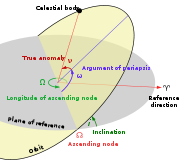
A term used in celestial mechanics, the plane of reference is the plane by means of which orbital elements are defined. The two main orbital elements that are measured with respect to the plane of reference are the inclination and the longitude of the ascending node.Depending on the type of body...
to which it is inclined. An orbit which is contained in the plane of reference (called non-inclined) has no nodes.
Planes of reference
Common planes of reference include:- For a geocentric orbitGeocentric orbitA geocentric orbit involves any object orbiting the Earth, such as the Moon or artificial satellites. Currently there are approximately 2,465 artificial satellites orbiting the Earth and 6,216 pieces of space debris as tracked by the Goddard Space Flight Center...
, the EarthEarthEarth is the third planet from the Sun, and the densest and fifth-largest of the eight planets in the Solar System. It is also the largest of the Solar System's four terrestrial planets...
's equatorEquatorAn equator is the intersection of a sphere's surface with the plane perpendicular to the sphere's axis of rotation and containing the sphere's center of mass....
ial plane. In this case, non-inclined orbits are called equatorial. - For a heliocentric orbitHeliocentric orbitA heliocentric orbit is an orbit around the Sun. All planets, comets, and asteroids in our Solar System are in such orbits, as are many artificial probes and pieces of debris. The moons of planets in the Solar System, by contrast, are not in heliocentric orbits as they orbit their respective planet...
, the eclipticEclipticThe ecliptic is the plane of the earth's orbit around the sun. In more accurate terms, it is the intersection of the celestial sphere with the ecliptic plane, which is the geometric plane containing the mean orbit of the Earth around the Sun...
. In this case, non-inclined orbits are called ecliptic. - For an orbit outside the Solar SystemSolar SystemThe Solar System consists of the Sun and the astronomical objects gravitationally bound in orbit around it, all of which formed from the collapse of a giant molecular cloud approximately 4.6 billion years ago. The vast majority of the system's mass is in the Sun...
, the plane through the primary perpendicular to a line through the observer and the primary (called the plane of the sky)., chap. 17.
Node distinction
If a reference direction from one side of the plane of reference to the other is defined, the two nodes can be distinguished. For geocentric and heliocentric orbits, the ascending node (or north node) is where the orbiting object moves north through the plane of reference, and the descending node (or south node) is where it moves south through the plane. In the case of objects outside the Solar System, the ascending node is the node where the orbiting secondary passes away from the observer, and the descending node is the node where it moves towards the observer., p. 137.The position of the node may be used as one of a set of parameters, called orbital elements, which describe the orbit. This is done by specifying the longitude of the ascending node
Longitude of the ascending node
The longitude of the ascending node is one of the orbital elements used to specify the orbit of an object in space. It is the angle from a reference direction, called the origin of longitude, to the direction of the ascending node, measured in a reference plane...
(or, sometimes, the longitude of the node.)
The line of nodes is the intersection of the object's orbital plane with the plane of reference. It passes through the two nodes.
Symbols and nomenclature
The symbol of the ascending node is (Unicode
Unicode
Unicode is a computing industry standard for the consistent encoding, representation and handling of text expressed in most of the world's writing systems...
: U+260A, ☊), and the symbol of the descending node is
 (Unicode
Unicode
Unicode is a computing industry standard for the consistent encoding, representation and handling of text expressed in most of the world's writing systems...
: U+260B, ☋). In medieval and early modern times the ascending and descending nodes were called the dragon's head (Latin
Latin
Latin is an Italic language originally spoken in Latium and Ancient Rome. It, along with most European languages, is a descendant of the ancient Proto-Indo-European language. Although it is considered a dead language, a number of scholars and members of the Christian clergy speak it fluently, and...
: caput draconis, Arabic: ra's al-jauzahar) and dragon's tail , respectively., p. 141; , p. 245. These terms originally referred to the times when the moon crossed the apparent path of the sun in the sky. Also, corruptions of the Arabic term such as ganzaar, genzahar, geuzaar and zeuzahar were used in the medieval West to denote either of the nodes., pp. 196–197; , p. 65; , pp. 95–96. The Greek
Greek language
Greek is an independent branch of the Indo-European family of languages. Native to the southern Balkans, it has the longest documented history of any Indo-European language, spanning 34 centuries of written records. Its writing system has been the Greek alphabet for the majority of its history;...
terms αναβιβάζων and καταβιβάζων were also used for the ascending and descending nodes, giving rise to the English
English language
English is a West Germanic language that arose in the Anglo-Saxon kingdoms of England and spread into what was to become south-east Scotland under the influence of the Anglian medieval kingdom of Northumbria...
words anabibazon and catabibazon.; , ¶27.
Earth orbit nodes
For the orbit of the Earth around the Sun is important the line of nodes formed by the ecliptic and the equator. There are two special days in which this line points to the sun. For these days, night and day take the same time. These two points in the sun orbit are named equinoxEquinox
An equinox occurs twice a year, when the tilt of the Earth's axis is inclined neither away from nor towards the Sun, the center of the Sun being in the same plane as the Earth's equator...
es.
Lunar nodes
For the orbit of the MoonMoon
The Moon is Earth's only known natural satellite,There are a number of near-Earth asteroids including 3753 Cruithne that are co-orbital with Earth: their orbits bring them close to Earth for periods of time but then alter in the long term . These are quasi-satellites and not true moons. For more...
around the Earth
Earth
Earth is the third planet from the Sun, and the densest and fifth-largest of the eight planets in the Solar System. It is also the largest of the Solar System's four terrestrial planets...
, the reference plane is taken to be the ecliptic
Ecliptic
The ecliptic is the plane of the earth's orbit around the sun. In more accurate terms, it is the intersection of the celestial sphere with the ecliptic plane, which is the geometric plane containing the mean orbit of the Earth around the Sun...
, not the equatorial plane. The gravitational pull
Gravitation
Gravitation, or gravity, is a natural phenomenon by which physical bodies attract with a force proportional to their mass. Gravitation is most familiar as the agent that gives weight to objects with mass and causes them to fall to the ground when dropped...
of the Sun
Sun
The Sun is the star at the center of the Solar System. It is almost perfectly spherical and consists of hot plasma interwoven with magnetic fields...
upon the Moon
Moon
The Moon is Earth's only known natural satellite,There are a number of near-Earth asteroids including 3753 Cruithne that are co-orbital with Earth: their orbits bring them close to Earth for periods of time but then alter in the long term . These are quasi-satellites and not true moons. For more...
causes its nodes, called the lunar nodes, to precess
Lunar precession
Precession is the rotation of a plane with respect to a reference plane. The orbit of the Moon has two important such precessional motions....
gradually westward, performing a complete circle in approximately 18.6 years.