


Nuremberg Transport Museum

Encyclopedia
The Nuremberg Transport Museum () is based in Nuremberg
, Germany, and consists of the Deutsche Bahn's own DB Museum and the Museum of Communications (). It also has two satellite museums at Koblenz-Lützel
(the DB Museum Koblenz) and Halle (DB Museum Halle). The Nuremberg Transport Museum is one of the oldest technical history museums in Europe.
In February 2007 the official name of the DB Museum became the Company Museum of the Deutsche Bahn AG (). It is a milestone on the European Route of Industrial Heritage (ERIH).
railway museum
and it is therefore the oldest railway museum in Germany. Today it is a company museum belonging to the Deutsche Bahn and portrays, amongst other things, the history of the railways. The present building was built in 1925.
On 1 July 1996, the Deutsche Bahn AG (DB AG) took over the museum from the Deutsche Bundesbahn
for the symbolic purchase price of one deutschmark. At the same time Dr. Jürgen Franzke, previously head of the Museum of Industrial Culture (Museums Industriekultur) in Nuremberg, was appointed as the museum's chief. The DB AG planned at that time to invest 6 million DM up to the museum's centenary year.
Some of the original vehicles are not in the museum itself, but in the wagon shed situated in the open area belonging to the museum on the opposite side of the street. The museum also owns a range of historical vehicles that can be used for special rail services.
(Königlich Bayerische Staats-Eisenbahnen).
The museum also offers a walk-through tunnel, a level crossing
, signals
and points
that can be operated, models equipped with sound and light and simulators.
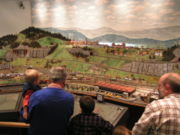 A model railway covering an area of 80 m² is used to demonstrate prototypical railway operations. During museum opening hours there is a ten-minute demonstration hourly, on the half-hour, with explanations of the key concepts of railway operating. The layout, built between 1960 and 1970, is worked using control panels with a total of some 5000 relays.
 On the evening of 17 October 2005 much of the roundhouse
of the museum, less its steel frame, was burnt to the ground. Unlike the wagon shed, the locomotive shed was not located in the immediate vicinity of the museum and accessible to the public, but four kilometres away at the Nuremberg West locomotive depot
in the suburb of Gostenhof. It was there that the DB Museum had stabled operational locomotives for which room could not be found in the museum.
A 1935 working replica of the Adler
, a locomotive from the first German railway between Nuremberg and Fürth, was badly damaged by the blaze. Apprentices and experienced specialists rebuilt the engine in the Meiningen Steam Locomotive Works
. After two years of reconstruction the Adler was once again ready for operations in October 2007 and returned to the Nurember Transport Museum on 23 November 2007.
Federal Government MPs, members of the DB AG management and the Bavarian minister-president, Beckstein, took part in the first journey of the restored Adler on 26 April 2008. A further, non-operational, 1953 replica is displayed in the museum.
Unfortunately the last surviving examples of the goods train locomotive, the DRG Class 45
, the electric Class E 75 locomotive and other exhibits, especially locomotives, as well as numerous spare parts, also fell victim to the fire or were at least badly damaged.
A total of 24 historical engines and wagons went up in smoke. In the long term, the steam engines should be repairable, as should the E 75. The damaged diesel engines and railbuses, due to their light construction, were irreparable and were scrapped by July 2006. The burnt out and partly collapsed locomotive shed was torn down. Several locos were sold or loaned to railway museums for restoration. For example, number 23 105
, the last steam engine bought by the Bundesbahn in 1959, was leased to the South German Railway Museum
(Süddeutsches Eisenbahnmuseum Heilbronn) in Heilbronn
for visual restoration.
is the DB Museum, Koblenz
, a branch of the museum that accommodates a number of vehicles including several Class 103
, 110 and 113
, E 44 and E 16
electric express locomotives, as well as several coaches belonging to the Joseph Goebbels special train. In addition a restored Prussian T 3
, factory number 499 built by the Maschinenfabrik Christian Hagans
in 1903 and stored under in accordance with strict heritage protection regulations, can be viewed. For decades it had been used as in a children's play park at Cologne Zoo. At present two of the steam locomotive exhibits damaged in the great fire at Nuremberg are also being restored there.
steam locomotive and the E 11 001 and E 18 31
electric locomotives. The vehicles are looked after by the Halle shed.
to the present. Major aspects covered are the development of postal transportation, post coach travel, telegraphy and telephony. Original vehicles, such as post coaches and motorised vehicles, are displayed, as well as technical equipment from old-fashioned teleprinters to modern news satellites.
Due to lack of space, several historical railway postal vehicles are located in the railway park at Augsburg
.
Nuremberg
Nuremberg[p] is a city in the German state of Bavaria, in the administrative region of Middle Franconia. Situated on the Pegnitz river and the Rhine–Main–Danube Canal, it is located about north of Munich and is Franconia's largest city. The population is 505,664...
, Germany, and consists of the Deutsche Bahn's own DB Museum and the Museum of Communications (). It also has two satellite museums at Koblenz-Lützel
Koblenz
Koblenz is a German city situated on both banks of the Rhine at its confluence with the Moselle, where the Deutsches Eck and its monument are situated.As Koblenz was one of the military posts established by Drusus about 8 BC, the...
(the DB Museum Koblenz) and Halle (DB Museum Halle). The Nuremberg Transport Museum is one of the oldest technical history museums in Europe.
In February 2007 the official name of the DB Museum became the Company Museum of the Deutsche Bahn AG (). It is a milestone on the European Route of Industrial Heritage (ERIH).
History
The forerunner of the present-day DB Museum was opened in 1899 as a royal BavarianKingdom of Bavaria
The Kingdom of Bavaria was a German state that existed from 1806 to 1918. The Bavarian Elector Maximilian IV Joseph of the House of Wittelsbach became the first King of Bavaria in 1806 as Maximilian I Joseph. The monarchy would remain held by the Wittelsbachs until the kingdom's dissolution in 1918...
railway museum
Railway museum
A railway museum is a museum that explores the history of all aspects of rail related transportation, including: locomotives , railway cars, trams, and railway signalling equipment.See List of railway museums...
and it is therefore the oldest railway museum in Germany. Today it is a company museum belonging to the Deutsche Bahn and portrays, amongst other things, the history of the railways. The present building was built in 1925.
On 1 July 1996, the Deutsche Bahn AG (DB AG) took over the museum from the Deutsche Bundesbahn
Deutsche Bundesbahn
The Deutsche Bundesbahn or DB was formed as the state railway of the newly established Federal Republic of Germany on September 7, 1949 as a successor of the Deutsche Reichsbahn-Gesellschaft '...
for the symbolic purchase price of one deutschmark. At the same time Dr. Jürgen Franzke, previously head of the Museum of Industrial Culture (Museums Industriekultur) in Nuremberg, was appointed as the museum's chief. The DB AG planned at that time to invest 6 million DM up to the museum's centenary year.
Exhibits
In the displays of historical railway vehicles are the following important exhibits:- Parts of the royal train for the Bavarian king, Ludwig IILudwig II of BavariaLudwig II was King of Bavaria from 1864 until shortly before his death. He is sometimes called the Swan King and der Märchenkönig, the Fairy tale King...
- The streamlined locomotive, 05 001DRG Class 05The Deutsche Reichsbahn's Class 05 was a German class of three express passenger steam locomotives of 4-6-4 wheel arrangement in the Whyte notation, or 2'C2' in the UIC notation used in continental Europe...
- A TEE diesel railcarRailcarA railcar, in British English and Australian English, is a self-propelled railway vehicle designed to transport passengers. The term "railcar" is usually used in reference to a train consisting of a single coach , with a driver's cab at one or both ends. Some railways, e.g., the Great Western...
from the 1950s - An original coal wagon from 1829 (on long-term loan from the National Railway MuseumNational Railway MuseumThe National Railway Museum is a museum in York forming part of the British National Museum of Science and Industry and telling the story of rail transport in Britain and its impact on society. It has won many awards, including the European Museum of the Year Award in 2001...
, YorkYorkYork is a walled city, situated at the confluence of the Rivers Ouse and Foss in North Yorkshire, England. The city has a rich heritage and has provided the backdrop to major political events throughout much of its two millennia of existence...
from the South Hetton coal mine in EnglandEnglandEngland is a country that is part of the United Kingdom. It shares land borders with Scotland to the north and Wales to the west; the Irish Sea is to the north west, the Celtic Sea to the south west, with the North Sea to the east and the English Channel to the south separating it from continental...
, the oldest surviving railway vehicle on the European mainland - The oldest steam locomotiveSteam locomotiveA steam locomotive is a railway locomotive that produces its power through a steam engine. These locomotives are fueled by burning some combustible material, usually coal, wood or oil, to produce steam in a boiler, which drives the steam engine...
in Germany still preserved in its original state, the NordgauBavarian B VThe Bavarian B V steam engines were early German 2-4-0 locomotives of the Royal Bavarian State Railways ....
(built in 1853) - The Bavarian S 2/6Bavarian S 2/6The Royal Bavarian State Railways' sole class S 2/6 steam locomotive was built in 1906 by the firm of Maffei in Munich, Germany. It was of 4-4-4 wheel arrangement in the Whyte notation, or 2'B2' h4v in the UIC classification scheme, and was a 4-cylinder, von Borries, balanced compound locomotive. ...
express trainExpress trainExpress trains are a form of rail service. Express trains make only a small number of stops, instead of stopping at every single station...
locomotive - The red E 19 12 express train locomotive
- A fragment of the SVT 877DRG Class SVT 877The DRG Class SVT 877 Hamburg Flyer – sometimes also Flying Hamburger or in German Fliegender Hamburger – was Germany's first fast diesel train, and is credited with establishing the fastest regular railway connection in the world in its time...
Flying Hamburger diesel multiple unitDiesel multiple unitA diesel multiple unit or DMU is a multiple unit train consisting of multiple carriages powered by one or more on-board diesel engines. They may also be referred to as a railcar or railmotor, depending on country.-Design:...
. - A mock-up of part of the traction coach of the ICE 3ICE 3ICE 3 is a family of high-speed EMUs of Deutsche Bahn. It includes classes 403 and 406, which are known as ICE 3 and ICE 3M respectively...
Some of the original vehicles are not in the museum itself, but in the wagon shed situated in the open area belonging to the museum on the opposite side of the street. The museum also owns a range of historical vehicles that can be used for special rail services.
Model collection
A further attraction of the museum is its collection of 160, 1:10 scale models occupying 1000 square metres of the museum. These models have been built over the years since the end of the 19th century and are very finely detailed. The first were made in 1882 by apprentices of the Royal Bavarian State RailwaysRoyal Bavarian State Railways
As a nation-state, Germany did not come into being until the creation of the German Empire in 1871 from the various German-speaking states such as Prussia, Bavaria, Saxony, Baden and Württemberg. By then each of the major states had formed its own state railway and these continued to remain...
(Königlich Bayerische Staats-Eisenbahnen).
The museum also offers a walk-through tunnel, a level crossing
Level crossing
A level crossing occurs where a railway line is intersected by a road or path onone level, without recourse to a bridge or tunnel. It is a type of at-grade intersection. The term also applies when a light rail line with separate right-of-way or reserved track crosses a road in the same fashion...
, signals
Railway signal
A signal is a mechanical or electrical device erected beside a railway line to pass information relating to the state of the line ahead to train/engine drivers. The driver interprets the signal's indication and acts accordingly...
and points
Railroad switch
A railroad switch, turnout or [set of] points is a mechanical installation enabling railway trains to be guided from one track to another at a railway junction....
that can be operated, models equipped with sound and light and simulators.
Model railway
Library
In the main building of the DB Museum there is a library with about 40,000 titles on railway subjects. The Präsenzbibliothek can be visited by appointment free of charge on workdays. Postal loans are not possible.Damage following the fire of 17 October 2005
Roundhouse
A roundhouse is a building used by railroads for servicing locomotives. Roundhouses are large, circular or semicircular structures that were traditionally located surrounding or adjacent to turntables...
of the museum, less its steel frame, was burnt to the ground. Unlike the wagon shed, the locomotive shed was not located in the immediate vicinity of the museum and accessible to the public, but four kilometres away at the Nuremberg West locomotive depot
Bahnbetriebswerk
A Bahnbetriebswerk is the equivalent of a locomotive depot on the German and Austrian railways. It is an installation that carries out the maintenance, minor repairs, refuelling and cleaning of locomotives and other motive power. In addition it organises the deployment of locomotives and crews...
in the suburb of Gostenhof. It was there that the DB Museum had stabled operational locomotives for which room could not be found in the museum.
A 1935 working replica of the Adler
Adler (locomotive)
The Adler was the first locomotive which was successfully commercially used for rail transport of passengers and goods in Germany. The rail vehicle was constructed and built in 1835 from the british railway pioneers George and Robert Stephenson in the english town Newcastle...
, a locomotive from the first German railway between Nuremberg and Fürth, was badly damaged by the blaze. Apprentices and experienced specialists rebuilt the engine in the Meiningen Steam Locomotive Works
Meiningen Steam Locomotive Works
The Meiningen Steam Locomotive Works is a railway repair shop in Meiningen, Germany. It is owned by Deutsche Bahn and has specialised in the maintenance of museum steam locomotives since 1990, having extensive experience in maintaining steam engines. Today, customers of the factory include...
. After two years of reconstruction the Adler was once again ready for operations in October 2007 and returned to the Nurember Transport Museum on 23 November 2007.
Federal Government MPs, members of the DB AG management and the Bavarian minister-president, Beckstein, took part in the first journey of the restored Adler on 26 April 2008. A further, non-operational, 1953 replica is displayed in the museum.
Unfortunately the last surviving examples of the goods train locomotive, the DRG Class 45
DRG Class 45
German Class 45 steam locomotives were standard locomotives designed by the Deutsche Reichsbahn for hauling goods trains.- History :...
, the electric Class E 75 locomotive and other exhibits, especially locomotives, as well as numerous spare parts, also fell victim to the fire or were at least badly damaged.
A total of 24 historical engines and wagons went up in smoke. In the long term, the steam engines should be repairable, as should the E 75. The damaged diesel engines and railbuses, due to their light construction, were irreparable and were scrapped by July 2006. The burnt out and partly collapsed locomotive shed was torn down. Several locos were sold or loaned to railway museums for restoration. For example, number 23 105
DB Class 23
The steam locomotives of Class 23 were German passenger train locomotives developed in the 1950s for the Deutsche Bundesbahn. They had a 2-6-2 wheel arrangement and were equipped with Class 2'2' T 31 tenders...
, the last steam engine bought by the Bundesbahn in 1959, was leased to the South German Railway Museum
South German Railway Museum
The South German Railway Museum is a railway museum at Heilbronn in the state of Baden-Württemberg in southwestern Germany. It was founded in 1998.-Aims:...
(Süddeutsches Eisenbahnmuseum Heilbronn) in Heilbronn
Heilbronn
Heilbronn is a city in northern Baden-Württemberg, Germany. It is completely surrounded by Heilbronn County and with approximately 123.000 residents, it is the sixth-largest city in the state....
for visual restoration.
DB Museum branch in Koblenz
In the Lützel district of KoblenzKoblenz
Koblenz is a German city situated on both banks of the Rhine at its confluence with the Moselle, where the Deutsches Eck and its monument are situated.As Koblenz was one of the military posts established by Drusus about 8 BC, the...
is the DB Museum, Koblenz
DB Museum, Koblenz
The DB Museum in Koblenz was opened on 21 April 2001 as the first remote site of the Nuremberg Transport Museum. It is run by volunteer workers as part of the Stiftung Bahn-Sozialwerk , a kind of railway workers social service organisation, and has its origins in a BSW's 'Group for the...
, a branch of the museum that accommodates a number of vehicles including several Class 103
DB Class 103
The Baureihe 103 is a class of electric locomotives in Germany, originally operated by Deutsche Bundesbahn. For a long period, they were perceived as flagships of the DB rolling stock.- Development :...
, 110 and 113
DB Class E 10
The class E 10 is an electric locomotive of the Deutsche Bundesbahn, introduced in 1952. It belongs to the Einheits-Elektrolokomotiven program and was built for express passenger service. In 1968 the series was redesignated as class 110 and class 112...
, E 44 and E 16
DRG Class E 16
The DRG Class E 16 were German electric locomotives in service with the Bavarian Group Administration of the Deutsche Reichsbahn were conceived as motive power for express trains...
electric express locomotives, as well as several coaches belonging to the Joseph Goebbels special train. In addition a restored Prussian T 3
Prussian T 3
The Prussian Class T 3 steam locomotives procured for the Prussian state railways were 0-6-0 tank locomotives. Together with the Prussian T 2 they were the first locomotives that were built to railway norms. The first units were delivered by Henschel in 1882....
, factory number 499 built by the Maschinenfabrik Christian Hagans
Maschinenfabrik Christian Hagans
Maschinenfabrik Christian Hagans was a German locomotive manufacturer founded on 1 July 1857 in Erfurt, Germany, by Christian Hagans....
in 1903 and stored under in accordance with strict heritage protection regulations, can be viewed. For decades it had been used as in a children's play park at Cologne Zoo. At present two of the steam locomotive exhibits damaged in the great fire at Nuremberg are also being restored there.
DB Museum branch in Halle (Saale)
The former locomotive shed in Halle (Saale) is a branch of the Nuremberg Museum. On display there are several Deutsche Reichsbahn vehicles, in particular the 03 1010DRG Class 03.10
The German Class 03.10 engines were standard steam locomotives belonging to the Deutsche Reichsbahn and designed for hauling express trains.- History :...
steam locomotive and the E 11 001 and E 18 31
DRG Class E 18
The Deutsche Bundesbahn Baureihe E 18 is a class of electric locomotives in Germany, originally operated by Deutsche Reichsbahn-Gesellschaft...
electric locomotives. The vehicles are looked after by the Halle shed.
Museum of Communications
The museum of communications in the Transport Museum came from the royal Bavarian postal museum and was integrated into the Transport Museum in 1902. It displays over 500 years of postal and telecommunication services history in Bavaria from the Middle AgesMiddle Ages
The Middle Ages is a periodization of European history from the 5th century to the 15th century. The Middle Ages follows the fall of the Western Roman Empire in 476 and precedes the Early Modern Era. It is the middle period of a three-period division of Western history: Classic, Medieval and Modern...
to the present. Major aspects covered are the development of postal transportation, post coach travel, telegraphy and telephony. Original vehicles, such as post coaches and motorised vehicles, are displayed, as well as technical equipment from old-fashioned teleprinters to modern news satellites.
Due to lack of space, several historical railway postal vehicles are located in the railway park at Augsburg
Augsburg
Augsburg is a city in the south-west of Bavaria, Germany. It is a university town and home of the Regierungsbezirk Schwaben and the Bezirk Schwaben. Augsburg is an urban district and home to the institutions of the Landkreis Augsburg. It is, as of 2008, the third-largest city in Bavaria with a...
.
Charter and tourist trains
The Nuremberg Transport Museum owns several trains, not all stabled in Nuremberg, that are used for tourist and charter services including:- The Rheingold ExpressRheingold ExpressThe legendary Rheingold was a famous train riding between Hoek van Holland near Rotterdam and Basel, Switzerland, a distance of . It ran along the Rhine River via Arnhem, Netherlands and Cologne, Germany using special luxury coaches...
with DB Class E 03DB Class 103The Baureihe 103 is a class of electric locomotives in Germany, originally operated by Deutsche Bundesbahn. For a long period, they were perceived as flagships of the DB rolling stock.- Development :...
locomotives. Based in CologneCologneCologne is Germany's fourth-largest city , and is the largest city both in the Germany Federal State of North Rhine-Westphalia and within the Rhine-Ruhr Metropolitan Area, one of the major European metropolitan areas with more than ten million inhabitants.Cologne is located on both sides of the...
. - The traditional Zwickau fast-stopping train (Traditions-EilzugEilzugAn Eilzug is a type of passenger train in German-speaking countries which roughly equates to a British 'fast-stopping train' or 'semi-fast train'.-Germany:...
Zwickau), based in BerlinBerlinBerlin is the capital city of Germany and is one of the 16 states of Germany. With a population of 3.45 million people, Berlin is Germany's largest city. It is the second most populous city proper and the seventh most populous urban area in the European Union...
. - The Blue Gentian (Blauer Enzian) TEE express. Stabled in Berlin.
- The Deutsche BundesbahnDeutsche BundesbahnThe Deutsche Bundesbahn or DB was formed as the state railway of the newly established Federal Republic of Germany on September 7, 1949 as a successor of the Deutsche Reichsbahn-Gesellschaft '...
express, based in DüsseldorfDüsseldorfDüsseldorf is the capital city of the German state of North Rhine-Westphalia and centre of the Rhine-Ruhr metropolitan region.Düsseldorf is an important international business and financial centre and renowned for its fashion and trade fairs. Located centrally within the European Megalopolis, the...
. - The AdlerAdler (locomotive)The Adler was the first locomotive which was successfully commercially used for rail transport of passengers and goods in Germany. The rail vehicle was constructed and built in 1835 from the british railway pioneers George and Robert Stephenson in the english town Newcastle...
old-time replica locomotive with three open passenger wagons, stabled at Nuremberg.
Film
- Episode 347 of Eisenbahn-RomantikEisenbahn-RomantikEisenbahn-Romantik is a German television programme, broadcast by SWR. It portrays railway-related reports, whose content covers modern railway systems, museum railways and their facilities as well as items on model railway layouts...
named 100 Jahre Verkehrsmuseum Nürnberg shows the museum.
See also
- History of rail transport in GermanyHistory of rail transport in GermanyGerman Railway history began with the opening of the steam-hauled Bavarian Ludwig Railway between Nuremberg and Fürth on 7 December 1835. This had been preceded by the opening of the horse-hauled Prince William Railway on 20 September 1831...
- Railway museums
- Royal Bavarian State RailwaysRoyal Bavarian State RailwaysAs a nation-state, Germany did not come into being until the creation of the German Empire in 1871 from the various German-speaking states such as Prussia, Bavaria, Saxony, Baden and Württemberg. By then each of the major states had formed its own state railway and these continued to remain...
- List of Bavarian locomotives and railbuses
- Deutsche ReichsbahnDeutsche ReichsbahnDeutsche Reichsbahn was the name of the following two companies:* Deutsche Reichsbahn, the German Imperial Railways during the Weimar Republic, the Third Reich and the immediate aftermath...
Literature
- Werner Willhaus: 100 Jahre Verkehrsmuseum Nürnberg. Eine Legende feiert Geburtstag. In: Eisenbahn-Kurier. Nr. 322/Jahrgang 33/1999. EK-Verlag GmbH, ISSN 0170-5288, S. 54-58.