

North Cascades National Park

Encyclopedia
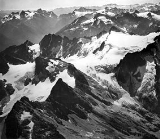
North Cascades National Park is a U.S.
National Park
located in the state of Washington. The park is the largest of the three National Park Service units that comprise the North Cascades National Park Service Complex
. Several national wilderness areas and British Columbia
parkland adjoin the National Park. The park features rugged mountain
peaks.
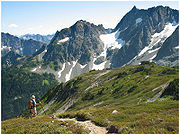 In 1971, the park had 318 glaciers with an area of 117 km2 (Post et al., 1971), the most of any US park outside Alaska. All the glaciers in the park have retreated significantly from 1980–2005 and the rate is increasing. The recent warmer climate has led to more summer melting and more winter melting events, reducing winter snowpack. Several glaciers in the range have melted away in the last decade. Boston Glacier, on the north slope of Boston Peak
, is the largest glacier in the park with an area of 7 km2. The other large glaciers (with areas greater than 2.5 km2) are:
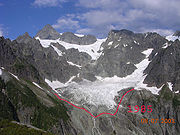
nature, it is home to wolves, lynx
, moose
, wolverine
s, and many other rare or endangered species
. Few grizzly sightings have been confirmed by park staff, though black bears are common. There are a gamut of mammals, birds, amphibian
s and reptile
s. As a notable amphibian example, within the Rough-skinned Newt
Cascade Mountains populations, approximately ninety percent of the adult population is perennibranchiate
.
. No other National Park surpasses North Cascades National Park in the number of plant species recorded. Over 1,630 vascular plant
species have been identified, and estimates of non-vascular and fungal
species could more than double this number for total plant species in the North Cascades. The park contains an estimated 236000 acres (955.1 km²) of old-growth forests.
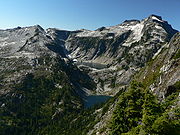
Wilderness, so there are few maintained buildings and roads within the North and South units of the Park. The park is most popular with backpackers
and mountain climbers. One of the most popular destinations in the park is Cascade Pass
, which was used as a travel route by Native Americans. It can be accessed by a four-mile (6 km) trail at the end of a gravel road. The North and South Picket Range
s, Mount Triumph
, as well as Eldorado Peak
and the surrounding mountains, are popular with climbers due to glaciation and technical rock. Mount Shuksan
, in the northwest corner of the park, is one of the most photographed mountains in the country and the second highest peak in the park 9127 ft (2,781.9 m).
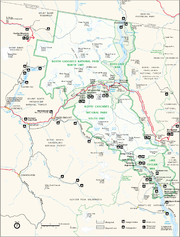
. The nearest large town on the west side of the park is Sedro-Woolley, Washington
, while Winthrop
lies to the east. Chelan
is located at the southeastern end of Lake Chelan.
United States
The United States of America is a federal constitutional republic comprising fifty states and a federal district...
National Park
National Park Service
The National Park Service is the U.S. federal agency that manages all national parks, many national monuments, and other conservation and historical properties with various title designations...
located in the state of Washington. The park is the largest of the three National Park Service units that comprise the North Cascades National Park Service Complex
North Cascades National Park Service Complex
North Cascades National Park Complex is a complex of the United States National Park Service located in the north-central portion of the state of Washington...
. Several national wilderness areas and British Columbia
British Columbia
British Columbia is the westernmost of Canada's provinces and is known for its natural beauty, as reflected in its Latin motto, Splendor sine occasu . Its name was chosen by Queen Victoria in 1858...
parkland adjoin the National Park. The park features rugged mountain
Mountain
Image:Himalaya_annotated.jpg|thumb|right|The Himalayan mountain range with Mount Everestrect 58 14 160 49 Chomo Lonzorect 200 28 335 52 Makalurect 378 24 566 45 Mount Everestrect 188 581 920 656 Tibetan Plateaurect 250 406 340 427 Rong River...
peaks.
Glaciers
Boston Peak
Boston Peak is a tall peak in the North Cascades in the U.S. state of Washington and within North Cascades National Park. At in elevation it is the 26th highest peak in Washington. Its nearest higher neighbor is Buckner Mountain, to the east.-Description:...
, is the largest glacier in the park with an area of 7 km2. The other large glaciers (with areas greater than 2.5 km2) are:
- Redoubt (Mount RedoubtMount Redoubt (Washington)Mount Redoubt is a mountain in the North Cascades range in Whatcom County, Washington state. The peak is located to the U.S.-Canada border, east-northeast of Mount Shuksan. It is the 21st highest peak in the state, with a height of and a prominence of...
) - Nooksack (Mount ShuksanMount ShuksanMount Shuksan is a glaciated massif in the North Cascades National Park. Shuksan rises in Whatcom County, Washington immediately to the east of Mount Baker, and south of the Canadian border. The mountain's name Shuksan is derived from the Lummi word [šéqsən], said to mean "high peak". The highest...
) - Sulphide (Mount Shuksan)
- Challenger (Mount Challenger)
- Inspiration (Eldorado PeakEldorado PeakEldorado Peak is a peak in the North Cascades of the U.S. state of Washington, about east of Concrete. It is located in North Cascades National Park at the head of Marble Creek and west of Inspiration Glacier. Other glaciers in the immediate vicinity include Eldorado Glacier and McAllister Glacier....
) - McAllister (Eldorado Peak)
- Neve (Snowfield Peak)
Wildlife
Due to its wildernessWilderness
Wilderness or wildland is a natural environment on Earth that has not been significantly modified by human activity. It may also be defined as: "The most intact, undisturbed wild natural areas left on our planet—those last truly wild places that humans do not control and have not developed with...
nature, it is home to wolves, lynx
Canada Lynx
The Canada lynx or Canadian lynx is a North American mammal of the cat family, Felidae. It is a close relative of the Eurasian Lynx . Some authorities regard both as conspecific. However, in some characteristics the Canada lynx is more like the bobcat than the Eurasian Lynx...
, moose
Moose
The moose or Eurasian elk is the largest extant species in the deer family. Moose are distinguished by the palmate antlers of the males; other members of the family have antlers with a dendritic configuration...
, wolverine
Wolverine
The wolverine, pronounced , Gulo gulo , also referred to as glutton, carcajou, skunk bear, or quickhatch, is the largest land-dwelling species of the family Mustelidae . It is a stocky and muscular carnivore, more closely resembling a small bear than other mustelids...
s, and many other rare or endangered species
Endangered species
An endangered species is a population of organisms which is at risk of becoming extinct because it is either few in numbers, or threatened by changing environmental or predation parameters...
. Few grizzly sightings have been confirmed by park staff, though black bears are common. There are a gamut of mammals, birds, amphibian
Amphibian
Amphibians , are a class of vertebrate animals including animals such as toads, frogs, caecilians, and salamanders. They are characterized as non-amniote ectothermic tetrapods...
s and reptile
Reptile
Reptiles are members of a class of air-breathing, ectothermic vertebrates which are characterized by laying shelled eggs , and having skin covered in scales and/or scutes. They are tetrapods, either having four limbs or being descended from four-limbed ancestors...
s. As a notable amphibian example, within the Rough-skinned Newt
Rough-skinned Newt
The rough-skinned newt is a North American newt known for its strong poison.- Toxicity :Many newts produce toxins to avoid predation, but the toxins of the genus Taricha are particularly potent...
Cascade Mountains populations, approximately ninety percent of the adult population is perennibranchiate
Perennibranchiate
Perennibranchiate, in zoology, is the condition of an organism retaining branchae, or gills, through life; This condition is generally said of certain amphibia, such as the menobranchus; the term is opposed to caducibranchiate...
.
Plants
Extreme variation, in rock and soil types, exposure, slope, elevation, and rainfall is reflected in the diverse plant life. Eight distinctive life zones support thousands of different plant species in the North Cascades greater ecosystemEcosystem
An ecosystem is a biological environment consisting of all the organisms living in a particular area, as well as all the nonliving , physical components of the environment with which the organisms interact, such as air, soil, water and sunlight....
. No other National Park surpasses North Cascades National Park in the number of plant species recorded. Over 1,630 vascular plant
Vascular plant
Vascular plants are those plants that have lignified tissues for conducting water, minerals, and photosynthetic products through the plant. Vascular plants include the clubmosses, Equisetum, ferns, gymnosperms and angiosperms...
species have been identified, and estimates of non-vascular and fungal
Fungus
A fungus is a member of a large group of eukaryotic organisms that includes microorganisms such as yeasts and molds , as well as the more familiar mushrooms. These organisms are classified as a kingdom, Fungi, which is separate from plants, animals, and bacteria...
species could more than double this number for total plant species in the North Cascades. The park contains an estimated 236000 acres (955.1 km²) of old-growth forests.
Geography
Attractions
Nearly all of the national park is protected as the Stephen MatherStephen Tyng Mather
Stephen Tyng Mather was an American industrialist and conservationist. As the president and owner of the Thorkildsen-Mather Borax Company, he became a millionaire...
Wilderness, so there are few maintained buildings and roads within the North and South units of the Park. The park is most popular with backpackers
Backpacking (wilderness)
Backpacking combines the activities of hiking and camping for an overnight stay in backcountry wilderness...
and mountain climbers. One of the most popular destinations in the park is Cascade Pass
Cascade Pass
Cascade Pass is a mountain pass over the northern Cascade Range, east of Marblemount, Washington, U.S....
, which was used as a travel route by Native Americans. It can be accessed by a four-mile (6 km) trail at the end of a gravel road. The North and South Picket Range
Picket Range
The Picket Range is a small, extremely rugged subrange of the North Cascades in the northwestern part of the American state of Washington. It is entirely contained within North Cascades National Park. It is about long, running northwest-southeast, and is lies north of the Skagit River, west of...
s, Mount Triumph
Mount Triumph
Mount Triumph is a summit in the North Cascades range of Washington state. Located approximately west-northwest of the town of Newhalem, it was named by Lage Wernstedt, a surveyor with the U.S. Forest Service...
, as well as Eldorado Peak
Eldorado Peak
Eldorado Peak is a peak in the North Cascades of the U.S. state of Washington, about east of Concrete. It is located in North Cascades National Park at the head of Marble Creek and west of Inspiration Glacier. Other glaciers in the immediate vicinity include Eldorado Glacier and McAllister Glacier....
and the surrounding mountains, are popular with climbers due to glaciation and technical rock. Mount Shuksan
Mount Shuksan
Mount Shuksan is a glaciated massif in the North Cascades National Park. Shuksan rises in Whatcom County, Washington immediately to the east of Mount Baker, and south of the Canadian border. The mountain's name Shuksan is derived from the Lummi word [šéqsən], said to mean "high peak". The highest...
, in the northwest corner of the park, is one of the most photographed mountains in the country and the second highest peak in the park 9127 ft (2,781.9 m).
Access
Although one gravel road open to the public enters the park, most automobile traffic in the region travels on the North Cascades Highway (Washington State Route 20), which passes through the Ross Lake National Recreation AreaRoss Lake National Recreation Area
Ross Lake National Recreation Area is a US National Recreation Area located in north central Washington just south of the Canadian border. It is the most accessible part of the North Cascades National Park Service Complex which also includes North Cascades National Park and Lake Chelan National...
. The nearest large town on the west side of the park is Sedro-Woolley, Washington
Sedro-Woolley, Washington
Sedro-Woolley is a city in Skagit County, Washington, United States. The population was 10,540 at the 2010 census. It is included in the Mount Vernon–Anacortes, Washington Metropolitan Statistical Area.-History:...
, while Winthrop
Winthrop, Washington
Winthrop is a town in Okanogan County, Washington, United States. It is east of Mazama and north of Twisp. The population of the Winthrop area was 1,916 at the 2000 census; however, the incorporated town had a population of 349. The 2010 census showed an increase to 394 within the town limits...
lies to the east. Chelan
Chelan, Washington
Chelan is a city in Chelan County, Washington, United States. The population was 3,890 at the 2010 census. It sits on the southeast tip of Lake Chelan, where the lake flows into the Chelan River....
is located at the southeastern end of Lake Chelan.
See also
- Skagit Valley Provincial ParkSkagit Valley Provincial ParkSkagit Valley Provincial Park is a provincial park in British Columbia, Canada, centred on the Skagit River and its tributaries. The park borders E. C. Manning Provincial Park in Canada and Ross Lake National Recreation Area and North Cascades National Park in the United States. It includes part...
- Mount Baker WildernessMount Baker WildernessMount Baker Wilderness in northern Washington, USA,contains . Its eastern border is shared with the boundary of the North Cascades National Park for a distance of 40 miles . The Wilderness extends from State Route 20 north to the Canadian border...
- Glacier Peak WildernessGlacier Peak WildernessThe Glacier Peak Wilderness, created by the US Forest Service in 1960 by efforts of the , four years before the 1964 wilderness legislation of the Congress, is located within portions of Chelan County, Snohomish County, and Skagit Counties in the North Cascades of Washington...
- Pasayten WildernessPasayten WildernessThe Pasayten Wilderness is a 2145 km². protected area located within Okanogan National Forest and Mount Baker National Forest in Washington State, centered on the Three Forks of the Pasayten River, a tributary of the Similkameen River. The northern boundary of the wilderness is the Canadian...
- Lake Chelan-Sawtooth WildernessLake Chelan-Sawtooth WildernessLake Chelan-Sawtooth Wilderness is a protected wilderness area located within the Okanogan and Wenatchee National Forests in Washington State. The Lake Chelan-Sawtooth Wilderness was designated with the passage of the Washington Wilderness Act of 1984, on lands occupied by the old Chelan Division...
- Retreat of glaciers since 1850Retreat of glaciers since 1850The retreat of glaciers since 1850 affects the availability of fresh water for irrigation and domestic use, mountain recreation, animals and plants that depend on glacier-melt, and in the longer term, the level of the oceans...
- North CascadesNorth CascadesThe North Cascades are a section of the Cascade Range of western North America. They span the border between the Canadian province of British Columbia and the U.S. state of Washington and are officially named in Canada as the Cascade Mountains...
External links
- Official site: North Cascades National Park
- Education: North Cascades Institute
- Guide to North Cascades National Park on Compassmonkey.com
- Glacier Research: North Cascade Glacier Climate Project reports
- Conservation: The North Cascades Conservation Council
- Expansion project: The American Alps Legacy Project seeks to expand and complete the Park as envisioned by its founders