


Norilsk

Encyclopedia
Norilsk is an industrial city in Krasnoyarsk Krai
, Russia
, located between the Yenisei River
and the Taymyr Peninsula
. Population:
It was granted city status in 1953. It is the northernmost city in Siberia
and the world's second largest city (after Murmansk
) north of the Arctic Circle
. Norilsk, Yakutsk
, and Vorkuta
are the only large cities in the continuous permafrost zone.
MMC Norilsk Nickel
, a mining
company, is the principal employer in the Norilsk area. The city is served by Norilsk Alykel Airport and Norilsk Valek Airfield. Due to the intense mining, the city is one of the ten most polluted
cities in the world.
 Norilsk was founded by the end of the 1920s; however, the official date of founding is traditionally set to 1935, when Norilsk was expanded as a settlement for the Norilsk mining-metallurgic complex and became the center of the Norillag
system of GULAG
labor camp
s. It was granted the urban-type settlement
status in 1939.
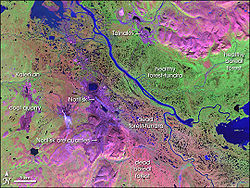
Norilsk, located between the West Siberian Plain
and Central Siberian Plateau
at the foot of the 1,700-meter-high Putoran Mountains
, is situated on some of the largest nickel
deposits on Earth
. Consequently, mining and smelting
ore are the major industries. Norilsk is the center of a region where nickel
, copper
, cobalt
, platinum
, palladium
, and coal
are mined. Mineral deposits in the Siberian Craton had been known for two centuries before Norilsk was founded, but mining began only in 1939, when the buried portions of the Norilsk-Talnakh intrusions were found beneath mountainous terrain.
Talnakh is the major mine/enrichment site now from where an enriched ore emulsion is pumped to Norilsk metallurgy plants.
To support the new city a railway to the port of Dudinka
on the Yenisei River
was established, first as a narrow-gauge line (winter 1935-36), later as Russian Standard gauge (1520 mm) line (in the early 1940s).
From the port of Dudinka enriched nickel and copper are transported to Murmansk
by sea then to the Monchegorsk
enrichment and smelting plant on the Kola Peninsula
, while more precious content goes up the river to Krasnoyarsk
. This transportation only takes place during the summer: Dudinka port is closed and dismantled during spring's ice barrier floods of up to 20 metres (65.6 ft) in late May (a typical spring occurrence on all Siberian rivers).
In the early 1950s, another railway was under construction from the European coal city Vorkuta
via the Salekhard
/Ob River
, and Norilsk even got a spacious passenger railway station built in the expectation of direct train service to Moscow, but construction stopped there after Stalin died.
According to the archives of Norillag, 16,806 prisoners died in Norilsk under the conditions of forced labor, starvation, and intense cold throughout the existence of the camp (1935–1956) http://www.memorial.krsk.ru/Public/00/20000609.htm. Fatalities were especially high during the war years of 1942–1944 when food supplies were particularly scarce. The prisoners organised a nonviolent revolt (Norilsk uprising
) in 1953. Unknown but significant numbers of prisoners continued to serve and die in the mines until around 1979. Norilsk-Talknakh continues to be a dangerous mine to work in: According to the mining company, there were 2.4 accidents per thousand workers in 2005.
In 2001, Norilsk was decreed a closed city
for foreigners (except citizens of Belarus
). This is likely because of the sensitive nature of the nickel-platinum-palladium-copper mining, and the ICBM missile silos nestled in the Putoran Mountains nearby.
The mosque of Norilsk, belonging to the local Tatar community, is considered to be the northernmost Muslim prayer house in the world.
are the largest nickel-copper-palladium deposits in the world. The deposit was formed 250 million years ago during the eruption of the Siberian Traps
igneous province (STIP). The STIP erupted over one million cubic kilometers of lava, a large portion of it through a series of flat-lying lava conduits lying below Norilsk and the Talnakh Mountains.
The ore was formed when the erupting magma became saturated in sulfur
, forming globules of pentlandite
, chalcopyrite
, and other sulfides. These sulfides were then "washed" by the continuing torrent of erupting magma, and upgraded their tenor with nickel
, copper
, platinum
, and palladium
.
The current resource known for these mineralized intrusion exceeds 1.8 billion tons. MMC Norilsk Nickel
, headquartered in Moscow
, is the principal mining operator in Norilsk-Talnakh. The ore is mined underground via several shafts, and a decline
. The ore deposits are currently being extracted at more than 1200 m (3,937 ft) below ground. The ore deposits are drilled from the surface. Nickel production for 2008 amounted to 299.7 thousand metric tonnes. Copper production for 2008 amounted to 419 thousand metric tonnes.
The deposits are being explored by a Russian Government-controlled company. The company is known to be using electromagnetic field
geophysics
, with loops on surface which are over 1000 m (3,280.8 ft) on a side. They are conclusively able to image the conductive nickel ore at depths in excess of 1800 m (5,905.5 ft).
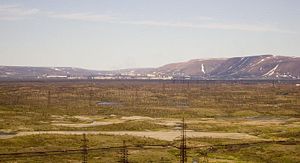 Much of the surrounding areas are naturally treeless tundra
.
and smog. By some estimates, 1 percent of the entire global emissions of sulfur dioxide
comes from this one city. Heavy metal
pollution near Norilsk is so severe that it is now economically feasible to mine the soil, as a result of acquiring high concentrations of platinum and palladium through pollution.
The Blacksmith Institute
included Norilsk in its 2007 list of the ten most polluted places on Earth. The list cites air pollution by particulates (including radioisotopes strontium
-90, and caesium
-137 and metals nickel
, copper
, cobalt
, lead
and selenium
) and by gases (such as nitrogen
and carbon
oxide
s, sulfur dioxide
, phenol
s and hydrogen sulfide
). The Institute estimates four million tons of cadmium, copper, lead, nickel, arsenic, selenium, and zinc are released into the air every year.
According to an April 2007 BBC News report, the company accepted responsibility for what had happened to the forests, and insisted they were taking action to cut the pollution. For the period up to 2015–2020 the company expects to reduce sulfur dioxide emissions by approximately two-thirds, but admits it is hard to guarantee this pace of reduction because they are still developing the technology. CNN has claimed that there is not a single living tree within 48 km (29.8 mi) of the nickel smelter Nadezhda ("The Hope").
Krasnoyarsk Krai
Krasnoyarsk Krai is a federal subject of Russia . It is the second largest federal subject after the Sakha Republic, and Russia's largest krai, occupying an area of , which is 13% of the country's total territory. The administrative center of the krai is the city of Krasnoyarsk...
, Russia
Russia
Russia or , officially known as both Russia and the Russian Federation , is a country in northern Eurasia. It is a federal semi-presidential republic, comprising 83 federal subjects...
, located between the Yenisei River
Yenisei River
Yenisei , also written as Yenisey, is the largest river system flowing to the Arctic Ocean. It is the central of the three great Siberian rivers that flow into the Arctic Ocean...
and the Taymyr Peninsula
Taymyr Peninsula
The Taymyr Peninsula is a peninsula in the Far North of Russia, in the Siberian Federal District, that forms the northernmost part of mainland Eurasia and Asia...
. Population:
It was granted city status in 1953. It is the northernmost city in Siberia
Siberia
Siberia is an extensive region constituting almost all of Northern Asia. Comprising the central and eastern portion of the Russian Federation, it was part of the Soviet Union from its beginning, as its predecessor states, the Tsardom of Russia and the Russian Empire, conquered it during the 16th...
and the world's second largest city (after Murmansk
Murmansk
Murmansk is a city and the administrative center of Murmansk Oblast, Russia. It serves as a seaport and is located in the extreme northwest part of Russia, on the Kola Bay, from the Barents Sea on the northern shore of the Kola Peninsula, not far from Russia's borders with Norway and Finland...
) north of the Arctic Circle
Arctic Circle
The Arctic Circle is one of the five major circles of latitude that mark maps of the Earth. For Epoch 2011, it is the parallel of latitude that runs north of the Equator....
. Norilsk, Yakutsk
Yakutsk
With a subarctic climate , Yakutsk is the coldest city, though not the coldest inhabited place, on Earth. Average monthly temperatures range from in July to in January. The coldest temperatures ever recorded on the planet outside Antarctica occurred in the basin of the Yana River to the northeast...
, and Vorkuta
Vorkuta
Vorkuta is a coal-mining town in the Komi Republic, Russia, situated just north of the Arctic Circle in the Pechora coal basin at the Usa River. Population: - Labor camp origins :...
are the only large cities in the continuous permafrost zone.
MMC Norilsk Nickel
MMC Norilsk Nickel
MMC Norilsk Nickel is a nickel and palladium mining and smelting company. Its largest operations are located in the Norilsk–Talnakh area, in northern Russia. MMC stands for "Mining and Metallurgical Company"....
, a mining
Mining
Mining is the extraction of valuable minerals or other geological materials from the earth, from an ore body, vein or seam. The term also includes the removal of soil. Materials recovered by mining include base metals, precious metals, iron, uranium, coal, diamonds, limestone, oil shale, rock...
company, is the principal employer in the Norilsk area. The city is served by Norilsk Alykel Airport and Norilsk Valek Airfield. Due to the intense mining, the city is one of the ten most polluted
Pollution
Pollution is the introduction of contaminants into a natural environment that causes instability, disorder, harm or discomfort to the ecosystem i.e. physical systems or living organisms. Pollution can take the form of chemical substances or energy, such as noise, heat or light...
cities in the world.
History
Norillag
Norillag, Norilsk Corrective Labor Camp was a gulag labor camp set by Norilsk, Krasnoyarsk Krai, Russia and headquartered there. It existed from June 25, 1935 to August 22, 1956....
system of GULAG
Gulag
The Gulag was the government agency that administered the main Soviet forced labor camp systems. While the camps housed a wide range of convicts, from petty criminals to political prisoners, large numbers were convicted by simplified procedures, such as NKVD troikas and other instruments of...
labor camp
Labor camp
A labor camp is a simplified detention facility where inmates are forced to engage in penal labor. Labor camps have many common aspects with slavery and with prisons...
s. It was granted the urban-type settlement
Urban-type settlement
Urban-type settlement ; , selyshche mis'koho typu ) is an official designation for a type of locality used in some of the countries of the former Soviet Union...
status in 1939.
Norilsk, located between the West Siberian Plain
West Siberian Plain
The West Siberian Plain is a large plain that occupies the western portion of Siberia, between the Ural Mountains in the west and the Yenisei River in the east, and by the Altay Mountains on the South-East. Much of the plain is poorly drained and consists of some of the world's largest swamps and...
and Central Siberian Plateau
Central Siberian Plateau
The Central Siberian Plateau is made up of sharply demarcated surfaces of varying altitudes occupying most of Siberia between the Yenisei and Lena rivers. It extends over an area of 3.5 million km². The highest point is the Putoran Mountains rising to 1701 m. To the north of the plateau are...
at the foot of the 1,700-meter-high Putoran Mountains
Putoran Mountains
The Putorana Plateau or the Putorana Mountains is a high-lying basalt plateau, a mountainous area at the northwestern edge of the Central Siberian Plateau, to the south from Taymyr Peninsula. The highest mountain in the range is Mount Kamen which stands above sea level.The plateau is composed of...
, is situated on some of the largest nickel
Nickel
Nickel is a chemical element with the chemical symbol Ni and atomic number 28. It is a silvery-white lustrous metal with a slight golden tinge. Nickel belongs to the transition metals and is hard and ductile...
deposits on Earth
Earth
Earth is the third planet from the Sun, and the densest and fifth-largest of the eight planets in the Solar System. It is also the largest of the Solar System's four terrestrial planets...
. Consequently, mining and smelting
Smelting
Smelting is a form of extractive metallurgy; its main use is to produce a metal from its ore. This includes iron extraction from iron ore, and copper extraction and other base metals from their ores...
ore are the major industries. Norilsk is the center of a region where nickel
Nickel
Nickel is a chemical element with the chemical symbol Ni and atomic number 28. It is a silvery-white lustrous metal with a slight golden tinge. Nickel belongs to the transition metals and is hard and ductile...
, copper
Copper
Copper is a chemical element with the symbol Cu and atomic number 29. It is a ductile metal with very high thermal and electrical conductivity. Pure copper is soft and malleable; an exposed surface has a reddish-orange tarnish...
, cobalt
Cobalt
Cobalt is a chemical element with symbol Co and atomic number 27. It is found naturally only in chemically combined form. The free element, produced by reductive smelting, is a hard, lustrous, silver-gray metal....
, platinum
Platinum
Platinum is a chemical element with the chemical symbol Pt and an atomic number of 78. Its name is derived from the Spanish term platina del Pinto, which is literally translated into "little silver of the Pinto River." It is a dense, malleable, ductile, precious, gray-white transition metal...
, palladium
Palladium
Palladium is a chemical element with the chemical symbol Pd and an atomic number of 46. It is a rare and lustrous silvery-white metal discovered in 1803 by William Hyde Wollaston. He named it after the asteroid Pallas, which was itself named after the epithet of the Greek goddess Athena, acquired...
, and coal
Coal
Coal is a combustible black or brownish-black sedimentary rock usually occurring in rock strata in layers or veins called coal beds or coal seams. The harder forms, such as anthracite coal, can be regarded as metamorphic rock because of later exposure to elevated temperature and pressure...
are mined. Mineral deposits in the Siberian Craton had been known for two centuries before Norilsk was founded, but mining began only in 1939, when the buried portions of the Norilsk-Talnakh intrusions were found beneath mountainous terrain.
Talnakh is the major mine/enrichment site now from where an enriched ore emulsion is pumped to Norilsk metallurgy plants.
To support the new city a railway to the port of Dudinka
Dudinka
Dudinka is a town and the administrative center of Taymyrsky Dolgano-Nenetsky District of Krasnoyarsk Krai, Russia. It was the administrative center of Taymyr Autonomous Okrug, which was merged into Krasnoyarsk Krai on January 1, 2007. It is a port in the lower reaches of the Yenisei River,...
on the Yenisei River
Yenisei River
Yenisei , also written as Yenisey, is the largest river system flowing to the Arctic Ocean. It is the central of the three great Siberian rivers that flow into the Arctic Ocean...
was established, first as a narrow-gauge line (winter 1935-36), later as Russian Standard gauge (1520 mm) line (in the early 1940s).
From the port of Dudinka enriched nickel and copper are transported to Murmansk
Murmansk
Murmansk is a city and the administrative center of Murmansk Oblast, Russia. It serves as a seaport and is located in the extreme northwest part of Russia, on the Kola Bay, from the Barents Sea on the northern shore of the Kola Peninsula, not far from Russia's borders with Norway and Finland...
by sea then to the Monchegorsk
Monchegorsk
Monchegorsk is a town in Murmansk Oblast, Russia, located on the Kola Peninsula, south of Murmansk, the administrative center of the oblast. Administratively, it is incorporated as Monchegorsk Town with Jurisdictional Territory—a unit of administrative division equal in status to that of a district...
enrichment and smelting plant on the Kola Peninsula
Kola Peninsula
The Kola Peninsula is a peninsula in the far northwest of Russia. Constituting the bulk of the territory of Murmansk Oblast, it lies almost completely to the north of the Arctic Circle and is washed by the Barents Sea in the north and the White Sea in the east and southeast...
, while more precious content goes up the river to Krasnoyarsk
Krasnoyarsk
Krasnoyarsk is a city and the administrative center of Krasnoyarsk Krai, Russia, located on the Yenisei River. It is the third largest city in Siberia, with the population of 973,891. Krasnoyarsk is an important junction of the Trans-Siberian Railway and one of Russia's largest producers of...
. This transportation only takes place during the summer: Dudinka port is closed and dismantled during spring's ice barrier floods of up to 20 metres (65.6 ft) in late May (a typical spring occurrence on all Siberian rivers).
In the early 1950s, another railway was under construction from the European coal city Vorkuta
Vorkuta
Vorkuta is a coal-mining town in the Komi Republic, Russia, situated just north of the Arctic Circle in the Pechora coal basin at the Usa River. Population: - Labor camp origins :...
via the Salekhard
Salekhard
-International relations:-Twin towns/sister cities:Salekhard is twinned with:*Azov, Rostov Oblast, Russia-External links:*...
/Ob River
Ob River
The Ob River , also Obi, is a major river in western Siberia, Russia and is the world's seventh longest river. It is the westernmost of the three great Siberian rivers that flow into the Arctic Ocean .The Gulf of Ob is the world's longest estuary.-Names:The Ob is known to the Khanty people as the...
, and Norilsk even got a spacious passenger railway station built in the expectation of direct train service to Moscow, but construction stopped there after Stalin died.
According to the archives of Norillag, 16,806 prisoners died in Norilsk under the conditions of forced labor, starvation, and intense cold throughout the existence of the camp (1935–1956) http://www.memorial.krsk.ru/Public/00/20000609.htm. Fatalities were especially high during the war years of 1942–1944 when food supplies were particularly scarce. The prisoners organised a nonviolent revolt (Norilsk uprising
Norilsk uprising
The Norilsk uprising was a major uprising of the GULAG labor camp inmates in [Gorlag] and later in two camps of Norillag [ITL], Norilsk, URSS, now Russia, in the summer of 1953, shortly after Joseph Stalin's death...
) in 1953. Unknown but significant numbers of prisoners continued to serve and die in the mines until around 1979. Norilsk-Talknakh continues to be a dangerous mine to work in: According to the mining company, there were 2.4 accidents per thousand workers in 2005.
In 2001, Norilsk was decreed a closed city
Closed city
A closed city or closed town is a settlement with travel and residency restrictions in the Soviet Union and some of its successor countries. In modern Russia, such places are officially known as "closed administrative-territorial formations" ....
for foreigners (except citizens of Belarus
Belarus
Belarus , officially the Republic of Belarus, is a landlocked country in Eastern Europe, bordered clockwise by Russia to the northeast, Ukraine to the south, Poland to the west, and Lithuania and Latvia to the northwest. Its capital is Minsk; other major cities include Brest, Grodno , Gomel ,...
). This is likely because of the sensitive nature of the nickel-platinum-palladium-copper mining, and the ICBM missile silos nestled in the Putoran Mountains nearby.
The mosque of Norilsk, belonging to the local Tatar community, is considered to be the northernmost Muslim prayer house in the world.
| 1939 | 1959 | 1962 | 1967 | 1970 | 1973 | 1976 |
|---|---|---|---|---|---|---|
| 14,000 | 118,000 | 117,000 | 129,000 | 135,000 | 150,000 | 167,000 |
| 1979 | 1982 | 1989 | 1992 | 1998 | 2002 | 2005 |
| 180,400 | 183,000 | 174,673 | 165,400 | 151,200 | 134,832 | 131,900 |
Norilsk-Talnakh nickel deposits
The nickel deposits of Norilsk-TalnakhTalnakh
Talnakh was a town located about north of Norilsk at the foot of the Putoran Mountains in Taymyr Peninsula, Krasnoyarsk Krai, Russia. In 2005 the town was merged into Norilsk. Population:...
are the largest nickel-copper-palladium deposits in the world. The deposit was formed 250 million years ago during the eruption of the Siberian Traps
Siberian Traps
The Siberian Traps form a large region of volcanic rock, known as a large igneous province, in the Russian region of Siberia. The massive eruptive event which formed the traps, one of the largest known volcanic events of the last 500 million years of Earth's geological history, continued for...
igneous province (STIP). The STIP erupted over one million cubic kilometers of lava, a large portion of it through a series of flat-lying lava conduits lying below Norilsk and the Talnakh Mountains.
The ore was formed when the erupting magma became saturated in sulfur
Sulfur
Sulfur or sulphur is the chemical element with atomic number 16. In the periodic table it is represented by the symbol S. It is an abundant, multivalent non-metal. Under normal conditions, sulfur atoms form cyclic octatomic molecules with chemical formula S8. Elemental sulfur is a bright yellow...
, forming globules of pentlandite
Pentlandite
Pentlandite is an iron-nickel sulfide, 9S8. Pentlandite usually has a Ni:Fe ratio of close to 1:1. It also contains minor cobalt.Pentlandite forms isometric crystals, but is normally found in massive granular aggregates. It is brittle with a hardness of 3.5 - 4 and specific gravity of 4.6 - 5.0 and...
, chalcopyrite
Chalcopyrite
Chalcopyrite is a copper iron sulfide mineral that crystallizes in the tetragonal system. It has the chemical composition CuFeS2. It has a brassy to golden yellow color and a hardness of 3.5 to 4 on the Mohs scale. Its streak is diagnostic as green tinged black.On exposure to air, chalcopyrite...
, and other sulfides. These sulfides were then "washed" by the continuing torrent of erupting magma, and upgraded their tenor with nickel
Nickel
Nickel is a chemical element with the chemical symbol Ni and atomic number 28. It is a silvery-white lustrous metal with a slight golden tinge. Nickel belongs to the transition metals and is hard and ductile...
, copper
Copper
Copper is a chemical element with the symbol Cu and atomic number 29. It is a ductile metal with very high thermal and electrical conductivity. Pure copper is soft and malleable; an exposed surface has a reddish-orange tarnish...
, platinum
Platinum
Platinum is a chemical element with the chemical symbol Pt and an atomic number of 78. Its name is derived from the Spanish term platina del Pinto, which is literally translated into "little silver of the Pinto River." It is a dense, malleable, ductile, precious, gray-white transition metal...
, and palladium
Palladium
Palladium is a chemical element with the chemical symbol Pd and an atomic number of 46. It is a rare and lustrous silvery-white metal discovered in 1803 by William Hyde Wollaston. He named it after the asteroid Pallas, which was itself named after the epithet of the Greek goddess Athena, acquired...
.
The current resource known for these mineralized intrusion exceeds 1.8 billion tons. MMC Norilsk Nickel
MMC Norilsk Nickel
MMC Norilsk Nickel is a nickel and palladium mining and smelting company. Its largest operations are located in the Norilsk–Talnakh area, in northern Russia. MMC stands for "Mining and Metallurgical Company"....
, headquartered in Moscow
Moscow
Moscow is the capital, the most populous city, and the most populous federal subject of Russia. The city is a major political, economic, cultural, scientific, religious, financial, educational, and transportation centre of Russia and the continent...
, is the principal mining operator in Norilsk-Talnakh. The ore is mined underground via several shafts, and a decline
Decline
Decline is a change over time from previously efficient to inefficient organizational functioning, from previously rational to non-rational organizational and individual decision-making, from previously law-abiding to law violating organizational and individual behavior, from previously virtuous to...
. The ore deposits are currently being extracted at more than 1200 m (3,937 ft) below ground. The ore deposits are drilled from the surface. Nickel production for 2008 amounted to 299.7 thousand metric tonnes. Copper production for 2008 amounted to 419 thousand metric tonnes.
The deposits are being explored by a Russian Government-controlled company. The company is known to be using electromagnetic field
Electromagnetic field
An electromagnetic field is a physical field produced by moving electrically charged objects. It affects the behavior of charged objects in the vicinity of the field. The electromagnetic field extends indefinitely throughout space and describes the electromagnetic interaction...
geophysics
Geophysics
Geophysics is the physics of the Earth and its environment in space; also the study of the Earth using quantitative physical methods. The term geophysics sometimes refers only to the geological applications: Earth's shape; its gravitational and magnetic fields; its internal structure and...
, with loops on surface which are over 1000 m (3,280.8 ft) on a side. They are conclusively able to image the conductive nickel ore at depths in excess of 1800 m (5,905.5 ft).
Environment
Tundra
In physical geography, tundra is a biome where the tree growth is hindered by low temperatures and short growing seasons. The term tundra comes through Russian тундра from the Kildin Sami word tūndâr "uplands," "treeless mountain tract." There are three types of tundra: Arctic tundra, alpine...
.
Climate
Norilsk has an extremely harsh climate. Average February temperature is about -35 C, and July is only about 12 °C (53.6 °F). Average temperature is approximately -13 C, and temperatures as low as -58 C have been recorded. The city is covered with snow for about 250–270 days a year, with snow storms for about 110–130 days. The polar night lasts from December through mid-January, so that Norilsk inhabitants do not see the sun at all for about six weeks. In summer, symmetrically, sun does not set for more than six weeks. Temperatures are known to rise above 25 °C (77 °F) in July.Pollution
The nickel ore is smelted on site at Norilsk. The smelting is directly responsible for severe pollution, generally acid rainAcid rain
Acid rain is a rain or any other form of precipitation that is unusually acidic, meaning that it possesses elevated levels of hydrogen ions . It can have harmful effects on plants, aquatic animals, and infrastructure. Acid rain is caused by emissions of carbon dioxide, sulfur dioxide and nitrogen...
and smog. By some estimates, 1 percent of the entire global emissions of sulfur dioxide
Sulfur dioxide
Sulfur dioxide is the chemical compound with the formula . It is released by volcanoes and in various industrial processes. Since coal and petroleum often contain sulfur compounds, their combustion generates sulfur dioxide unless the sulfur compounds are removed before burning the fuel...
comes from this one city. Heavy metal
Heavy metals
A heavy metal is a member of a loosely-defined subset of elements that exhibit metallic properties. It mainly includes the transition metals, some metalloids, lanthanides, and actinides. Many different definitions have been proposed—some based on density, some on atomic number or atomic weight,...
pollution near Norilsk is so severe that it is now economically feasible to mine the soil, as a result of acquiring high concentrations of platinum and palladium through pollution.
The Blacksmith Institute
Blacksmith Institute
Founded in 1999, Blacksmith Institute is an international non-for-profit organization dedicated to eliminating life-threatening pollution in the developing world. Blacksmith identifies and cleans up the world's worst polluted places, focusing on communities where children are most at risk. Based in...
included Norilsk in its 2007 list of the ten most polluted places on Earth. The list cites air pollution by particulates (including radioisotopes strontium
Strontium
Strontium is a chemical element with the symbol Sr and the atomic number 38. An alkaline earth metal, strontium is a soft silver-white or yellowish metallic element that is highly reactive chemically. The metal turns yellow when exposed to air. It occurs naturally in the minerals celestine and...
-90, and caesium
Caesium
Caesium or cesium is the chemical element with the symbol Cs and atomic number 55. It is a soft, silvery-gold alkali metal with a melting point of 28 °C , which makes it one of only five elemental metals that are liquid at room temperature...
-137 and metals nickel
Nickel
Nickel is a chemical element with the chemical symbol Ni and atomic number 28. It is a silvery-white lustrous metal with a slight golden tinge. Nickel belongs to the transition metals and is hard and ductile...
, copper
Copper
Copper is a chemical element with the symbol Cu and atomic number 29. It is a ductile metal with very high thermal and electrical conductivity. Pure copper is soft and malleable; an exposed surface has a reddish-orange tarnish...
, cobalt
Cobalt
Cobalt is a chemical element with symbol Co and atomic number 27. It is found naturally only in chemically combined form. The free element, produced by reductive smelting, is a hard, lustrous, silver-gray metal....
, lead
Lead
Lead is a main-group element in the carbon group with the symbol Pb and atomic number 82. Lead is a soft, malleable poor metal. It is also counted as one of the heavy metals. Metallic lead has a bluish-white color after being freshly cut, but it soon tarnishes to a dull grayish color when exposed...
and selenium
Selenium
Selenium is a chemical element with atomic number 34, chemical symbol Se, and an atomic mass of 78.96. It is a nonmetal, whose properties are intermediate between those of adjacent chalcogen elements sulfur and tellurium...
) and by gases (such as nitrogen
Nitrogen
Nitrogen is a chemical element that has the symbol N, atomic number of 7 and atomic mass 14.00674 u. Elemental nitrogen is a colorless, odorless, tasteless, and mostly inert diatomic gas at standard conditions, constituting 78.08% by volume of Earth's atmosphere...
and carbon
Carbon
Carbon is the chemical element with symbol C and atomic number 6. As a member of group 14 on the periodic table, it is nonmetallic and tetravalent—making four electrons available to form covalent chemical bonds...
oxide
Oxide
An oxide is a chemical compound that contains at least one oxygen atom in its chemical formula. Metal oxides typically contain an anion of oxygen in the oxidation state of −2....
s, sulfur dioxide
Sulfur dioxide
Sulfur dioxide is the chemical compound with the formula . It is released by volcanoes and in various industrial processes. Since coal and petroleum often contain sulfur compounds, their combustion generates sulfur dioxide unless the sulfur compounds are removed before burning the fuel...
, phenol
Phenol
Phenol, also known as carbolic acid, phenic acid, is an organic compound with the chemical formula C6H5OH. It is a white crystalline solid. The molecule consists of a phenyl , bonded to a hydroxyl group. It is produced on a large scale as a precursor to many materials and useful compounds...
s and hydrogen sulfide
Hydrogen sulfide
Hydrogen sulfide is the chemical compound with the formula . It is a colorless, very poisonous, flammable gas with the characteristic foul odor of expired eggs perceptible at concentrations as low as 0.00047 parts per million...
). The Institute estimates four million tons of cadmium, copper, lead, nickel, arsenic, selenium, and zinc are released into the air every year.
According to an April 2007 BBC News report, the company accepted responsibility for what had happened to the forests, and insisted they were taking action to cut the pollution. For the period up to 2015–2020 the company expects to reduce sulfur dioxide emissions by approximately two-thirds, but admits it is hard to guarantee this pace of reduction because they are still developing the technology. CNN has claimed that there is not a single living tree within 48 km (29.8 mi) of the nickel smelter Nadezhda ("The Hope").
People associated with Norilsk
- Artist Andrey BartenevAndrey BartenevAndrey Bartenev is a Russian artist, sculptor, experimentalist, and creator of many provocative, interactive installations and performances. He was born in 1969 in Norilsk, Russia....
was born in Norilsk; many years ago his grandfather was sent to work in the nickel smelting plant. - World All-Around Champion (1983)1983 World Artistic Gymnastics ChampionshipsThe 22nd Artistic Gymnastics World Championships were held in Budapest, the capital of Hungary, in 1983.-Medals:-All-around:- Floor exercise :-Pommel horse:-Rings:-Vault:-Parallel bars:-Horizontal bar:-Team final:-All-around:...
gymnastGymnastGymnasts are people who participate in the sports of either artistic gymnastics, trampolining, or rhythmic gymnastics.See gymnasium for the origin of the word gymnast from gymnastikos.-Female artistic:Australia...
Natalia YurchenkoNatalia YurchenkoNatalia Vladimirovna Yurchenko was a Soviet artistic gymnast, who was the women's all-around gold medalist at the 1983 World Artistic Gymnastics Championships...
was born in Norilsk. - The author of the memoirMemoirA memoir , is a literary genre, forming a subclass of autobiography – although the terms 'memoir' and 'autobiography' are almost interchangeable. Memoir is autobiographical writing, but not all autobiographical writing follows the criteria for memoir set out below...
With God in RussiaWith God in RussiaWith God in Russia is a memoir by Walter Ciszek , a Polish-American Jesuit priest known for his clandestine missionary work in the Soviet Union between 1941 and 1963. It was originally published in 1964 by McGraw-Hill....
, Walter CiszekWalter CiszekRev. Walter Ciszek, S.J. was a Polish-American Jesuit priest known for his clandestine missionary work in the Soviet Union between 1939 and 1963....
, spent some time in Norilsk labor camps in 1950s and details the life there in his memoir. - Professional footballerFootball (soccer)Association football, more commonly known as football or soccer, is a sport played between two teams of eleven players with a spherical ball...
, member of Russian national team Dmitri Torbinski was born in Norilsk. - Karl Stajner (7000 Days In Siberia) spent a few years as a political prisoner at Norilsk.