

Norddeutscher Rundfunk

Encyclopedia
Norddeutscher Rundfunk (North German Broadcasting) is a public radio and television broadcaster
, based in Hamburg
. In addition to the city-state of Hamburg, NDR transmits for the German states of Lower Saxony
, Mecklenburg-Vorpommern and Schleswig-Holstein
. NDR is a member of the ARD
consortium.
Because of the responsibility for the German participation in the Eurovision Song Contest
the NDR organized the contest in 2011
after Lena Meyer-Landrut
won the 2010 event in Oslo
.
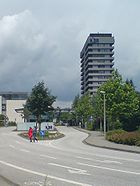 Studios in Hamburg are split into two locations, both of them within the borough of Eimsbüttel
: Television studios are located in the quarter of Lokstedt as the radio studios are located in the quarter of Rotherbaum
, a little closer to the city centre. In addition to these, there are further regional studios, also comprising both television and radio facilities. They are located in the state capitals Hanover
, Kiel
and Schwerin
as well as at the ARD
's national studios in Berlin. The NDR also maintains other regional offices within its four state territories.
required for Radio and TV sets are €17.03 per month, as of 1 April 2005. For radio reception alone, the monthly fee is €5.52.
These fees are not collected directly by the NDR but by the GEZ
that is a common organisation of ARD
, its members, ZDF
and Deutschlandfunk
.
's Propagandaministerium, as Reichssender Hamburg.
In 1930, the Welte-Funk-Orgel, a theatre organ
, was custom built for the NORAG to accommodate the specific accustic needs of radio broadcasts. It is still maintained by volunteers in the studio Rothenbaumchaussee 132, the oldest radio studio still in use.
The British Control Commission appointed Hugh Greene
to manage the creation of public service broadcasting in their Zone. On 22 September 1945, Radio Hamburg became Nordwestdeutscher Rundfunk, the single broadcasting organisation of the British Zone.
(NWDR) to the control of the constituent Länder. At first, NWDR had just one radio station
, later known as NWDR1. In 1950, it introduced a regional station for the north, NWDR Nord (later to become NDR2), and a regional station for the west, NWDR West (later WDR2).
That same year, NWDR became a founding member of ARD. The NWDR also played a founding role in launching 625-line
television
in Germany, starting broadcasts on 25 December 1952.
NDR continued to operate out of Hamburg. The split was effective from 1 January 1956, although the station NWDR1 remained a joint operation with regional opt-outs.
The NWDR television service also remained a joint operation, from 1 April 1956 under the name Nord- und Westdeutsche Rundfunkverband (North and West German Broadcasting Federation — NWRV). The NDR and the WDR launched separate television services for their area in 1961.
).
In 1958 Han Koller became the musical director of Hamburg's NDR Jazz Workshop, which became a popular radio broadcast. Numerous names in Jazz
performed on these broadcasts including; Kenny Clarke
, Lucky Thompson
, Wes Montgomery
, Johnny Griffin
, Oscar Peterson
, Ben Webster
, Sahib Shihab
, Carmell Jones
, Lee Konitz
, Cecil Payne
, Slide Hampton
, Phil Woods
, Jazz Composers Orchestra, Howard Riley
, Barry Guy
, John Surman
, the Kuhn Brothers and Barney Wilen
. Some of these have been released since 1987, while the older ones only exist as rare bootlegs, sought after by many Jazz
aficionados.
On 4 January 1965 the NDR, Radio Bremen and SFB began a joint "third channel" television service, Norddeutsches Fernsehen, later Nord 3 and N3. Since December 2001, this service is called NDR Fernsehen. SFB
started a separate TV channel for Berlin in 1992, called B1, later SFB1, now RBB Fernsehen.
In 1977, Gerhard Stoltenberg, the minister-president of Schleswig-Holstein cancelled the NDR-Staatsvertrag, the governing body of the NDR onesided. This caused a discussion how to organise broadcasting in the North German region.
In 1980, the NDR signed a new convention with the three Länder, changing the pattern of broadcasting and creating new regional services. NDR1 was divided into three independent radio stations from 2 January 1981:
NDR2 and NDR3 (now NDR Kultur) continued as regional stations.
These regional services were further subdivided with opt-outs for specific areas. NDR 1 Niedersachsen established regions based around Oldenburg-Ostfriesland-Bremen-Cuxhaven, Osnabrück-Emsland, greater Hanover, Braunschweig-southern Lower Saxony and northern Lower Saxony. NDR 1 Welle Nord was subdivided with studio centres in Flensburg, Heide, Norderstedt, Lübeck and Kiel.
On 30 September 1988 the NDR introduced a teletext
service on its N3 television channel. Originally called Nordtext, it became NDR Text on 2 December 2001. The teletext service also offers information for viewers in the Radio Bremen area under the title Radio Bremen Text.
On 1 April 1989, the NDR introduced its fourth radio service, NDR4. This service was later renamed NDR4 Info and from 2 June 2002 is now known as NDR Info. The station is a news and information service for the whole NDR region.
On 1 January 1992, Mecklenburg-Vorpommern in the former East Germany joined the NDR as the fourth state in the organisation. The area receives the main NDR radio and television stations, plus the regional NDR 1 Radio mV, which has subregions based in Schwerin, Rostock, Neubrandenburg and Greifswald. In October of the same year, SFB in Berlin stopped relaying the Nord 3 television service in favour of its own Berlin 1 TV channel.
On 4 April 1994, the NDR introduced N-Joy Radio (since 2001, just N-Joy), a young-persons radio station aimed at 14 to 29-year-old listeners.
On 3 October 1997, NDR3 was relaunched as Radio 3, produced in co-operation with Ostdeutscher Rundfunk Brandenburg. At the end of 2000, SFB joined Radio 3. This arrangement lasted until ORB and SFB merged on 1 January 2003 and started their own classical and culture network. NDR3 became NDR Kultur on 1 January 2003.
On 1 November 2001, the NDR and Radio Bremen launched a joint radio station, Nordwestradio, to serve Bremen and northwestern Lower Saxony. This service replaced Radio Bremen 2 and control of the service remains with Radio Bremen.
Public broadcasting
Public broadcasting includes radio, television and other electronic media outlets whose primary mission is public service. Public broadcasters receive funding from diverse sources including license fees, individual contributions, public financing and commercial financing.Public broadcasting may be...
, based in Hamburg
Hamburg
-History:The first historic name for the city was, according to Claudius Ptolemy's reports, Treva.But the city takes its modern name, Hamburg, from the first permanent building on the site, a castle whose construction was ordered by the Emperor Charlemagne in AD 808...
. In addition to the city-state of Hamburg, NDR transmits for the German states of Lower Saxony
Lower Saxony
Lower Saxony is a German state situated in north-western Germany and is second in area and fourth in population among the sixteen states of Germany...
, Mecklenburg-Vorpommern and Schleswig-Holstein
Schleswig-Holstein
Schleswig-Holstein is the northernmost of the sixteen states of Germany, comprising most of the historical duchy of Holstein and the southern part of the former Duchy of Schleswig...
. NDR is a member of the ARD
ARD (broadcaster)
ARD is a joint organization of Germany's regional public-service broadcasters...
consortium.
Because of the responsibility for the German participation in the Eurovision Song Contest
Eurovision Song Contest
The Eurovision Song Contest is an annual competition held among active member countries of the European Broadcasting Union .Each member country submits a song to be performed on live television and then casts votes for the other countries' songs to determine the most popular song in the competition...
the NDR organized the contest in 2011
Eurovision Song Contest 2011
The Eurovision Song Contest 2011 was the 56th annual Eurovision Song Contest and was won by Eldar & Nigar performing "Running Scared" for Azerbaijan. The event took place in the Esprit Arena in Düsseldorf, Germany, following Germany's win in the previous year...
after Lena Meyer-Landrut
Lena Meyer-Landrut
Lena Meyer-Landrut , known professionally as Lena, is a German singer-songwriter. She represented Germany in the Eurovision Song Contest 2010 in Oslo, Norway, and won the contest with the song "Satellite"...
won the 2010 event in Oslo
Eurovision Song Contest 2010
The Eurovision Song Contest 2010 was the 55th annual Eurovision Song Contest, broadcast from the Telenor Arena in Bærum, Greater Oslo, Norway. It was the third time Norway had hosted the contest, having previously done so in 1986 and 1996. The 2010 winner was Germany with Lena singing "Satellite",...
.
NDR studios
Eimsbüttel
Eimsbüttel is one of the seven boroughs of Hamburg, Germany. In 2006 the population was 246,087.-History:On March 1, 2008 Eimsbüttel lost a part of its area to form the quarter Sternschanze in the borough Altona.-Geography:...
: Television studios are located in the quarter of Lokstedt as the radio studios are located in the quarter of Rotherbaum
Rotherbaum
Rotherbaum is a quarter of Eimsbüttel, a borough of Hamburg, Germany. In 2006 the population was 16,853.In German, "roter Baum" means red tree. The "th", which in general was abolished in the spelling reform of 1900, was preserved in names...
, a little closer to the city centre. In addition to these, there are further regional studios, also comprising both television and radio facilities. They are located in the state capitals Hanover
Hanover
Hanover or Hannover, on the river Leine, is the capital of the federal state of Lower Saxony , Germany and was once by personal union the family seat of the Hanoverian Kings of Great Britain, under their title as the dukes of Brunswick-Lüneburg...
, Kiel
Kiel
Kiel is the capital and most populous city in the northern German state of Schleswig-Holstein, with a population of 238,049 .Kiel is approximately north of Hamburg. Due to its geographic location in the north of Germany, the southeast of the Jutland peninsula, and the southwestern shore of the...
and Schwerin
Schwerin
Schwerin is the capital and second-largest city of the northern German state of Mecklenburg-Vorpommern. The population, as of end of 2009, was 95,041.-History:...
as well as at the ARD
ARD (broadcaster)
ARD is a joint organization of Germany's regional public-service broadcasters...
's national studios in Berlin. The NDR also maintains other regional offices within its four state territories.
Finances
Licensing feesTelevision licence
A television licence is an official licence required in many countries for the reception of television broadcasts...
required for Radio and TV sets are €17.03 per month, as of 1 April 2005. For radio reception alone, the monthly fee is €5.52.
These fees are not collected directly by the NDR but by the GEZ
Gebühreneinzugszentrale
The GEZ, full title Gebühreneinzugszentrale der öffentlich-rechtlichen Rundfunkanstalten in der Bundesrepublik Deutschland , is a joint organization of Germany's public broadcasting institutions ARD, ZDF and Deutschlandradio that is located in Cologne...
that is a common organisation of ARD
ARD (broadcaster)
ARD is a joint organization of Germany's regional public-service broadcasters...
, its members, ZDF
ZDF
Zweites Deutsches Fernsehen , ZDF, is a public-service German television broadcaster based in Mainz . It is run as an independent non-profit institution, which was founded by the German federal states . The ZDF is financed by television licence fees called GEZ and advertising revenues...
and Deutschlandfunk
Deutschlandfunk
Deutschlandfunk is a German public broadcasting radio station, broadcasting national news and current affairs.-History:Broadcasting in the Federal Republic of Germany is reserved under the Basic Law to the states. This means that all public broadcasting is regionalised...
.
Stations
The NDR currently provides a number of services on its own or in co-operation with other broadcasters:Television
- ARD Das ErsteDas ErsteErstes Deutsches Fernsehen , marketed as Das Erste , is the principal publicly owned television channel in Germany...
— joint national channel - NDR Fernsehen (formerly N3 and Norddeutsches Fernsehen) — third public service channel for the NDR area and Bremen, in co-operation with Radio BremenRadio BremenRadio Bremen , Germany's smallest public radio and television broadcaster, is the legally mandated broadcaster for the city-state of Bremen...
. - Phoenix — events channel produced by ARD and ZDF
- KI.KAKI.KAKI.KA is a public non-commercial free television channel based in Erfurt, Germany. It is a joint venture of national public television channels ARD, and ARD's constituent broadcasting institutions – BR, HR, MDR, NDR, Radio Bremen, RBB, Saarländischer Rundfunk, SWR, WDR and ZDF, and is targeted at...
— children's channel produced by ARD and ZDF - ArteArteArte is a Franco-German TV network. It is a European culture channel and aims to promote quality programming especially in areas of culture and the arts...
— Franco-German culture channel - 3sat3sat3sat is the name of a public, advertising-free, television network in Central Europe. The programming is in German and is broadcast primarily within Germany, Austria and Switzerland .3sat was established for cultural...
— cultural channel, co-produced by the ARD, ZDF, ORF, and SRG
Radio
- NDR 90.3 — Local station for Hamburg, playing music for older listeners.
- NDR 1 Niedersachsen — Local station for Lower Saxony, run from Hanover with some regional opt-outs. Plays music for older listeners.
- NDR 1 Welle Nord — Local station for Schleswig-Holstein, run from Kiel with some regional opt-outs. Plays music for older listeners.
- NDR 1 Radio MV — Local station for Mecklenburg-Vorpommern, run from Schwerin with some regional opt-outs. Plays music for older listeners.
- NDR 2 — Popular music station for middle-aged listeners. This is a commercial public service station.
- NDR Kultur — Arts and culture station. Plays classical music.
- NDR Info — News and information station.
- N-Joy — youth station.
- Nordwestradio — Cultural station for northwest Lower Saxony and Bremen, produced by Radio Bremen.
Musical organizations
The NDR has four musical organizations, including two orchestras, a chorus and a "big band":- Sinfonieorchester des Norddeutschen Rundfunks HamburgNorth German Radio Symphony OrchestraThe North German Radio Symphony Orchestra is a German orchestra, the symphony orchestra of the Norddeutscher Rundfunk in Hamburg....
— the NDR Hamburg Symphony Orchestra; created in 1945 as the Symphony Orchestra of the NWDR and continued by the NDR under its current name sine 1955. Principal conductors have included Günter WandGünter WandGünter Wand was a German orchestra conductor and composer. Wand studied in Wuppertal, Allenstein and Detmold. At the Cologne conservatory, he was a composition student with Philipp Jarnach and a piano student with Paul Baumgartner...
and John Eliot GardinerJohn Eliot GardinerSir John Eliot Gardiner CBE FKC is an English conductor. He founded the Monteverdi Choir , the English Baroque Soloists and the Orchestre Révolutionnaire et Romantique...
. - NDR Radiophilharmonie — the NDR Radio Philharmonic; created in 1950 as the Hanover Radio Orchestra of the NWDR and continued by the NDR under its current name since 1955. Principal conductors have included Willy Steiner and Bernhard Klee. The orchestra plays light classical or "concert hall" music.
- NDR Chor or Chor des Norddeutschen Rundfunks — created in 1946 by the NWDR and continued under its current name by the NDR since 1955. The choir specializes in "Alte Musik", but a broad repertory also includes contemporary music.
- NDR Bigband; created by the NWDR and continued by the NDR in 1955 as the NDR Studioband. Renamed NDR Bigband in 1971.
FM, MW and TV
- Hamburg BillwerderTransmitter Hamburg-BillstedtThe Transmitter Hamburg-Billstedt is a broadcasting facility in Hamburg-Billstedt, established in 1934. It is owned and operated by the Norddeutscher Rundfunk public broadcasting service, but open to competitors, too....
- Hemmingen (for Hannover)
- FlensburgFlensburg-Engelsby transmitterFlensburg-Engelsby transmitter is a facility of NDR for mediumwave, FM and TV-broadcasting at Flensburg, Germany. It uses as antenna mast a tall grounded guyed mast, built of lattice steel, on which a cage antenna is mounted for mediumwave broadcasting....
- Kronshagen (for Kiel, no AM broadcasts currently)
- LingenLingen transmitterLingen transmitter is a facility of Norddeutscher Rundfunk for FM-, mediumwave and TV broadcasting. It uses as antenna tower a 227 metre tall grounded guyed mast of tubular steel, at which a cage antenna for mediumwave broadcasting is mounted....
FM and TV
- Steinkimmen
- Torfhaus
- Zernien
- Osnabrück
- Aurich-Popens
- Göttingen
- Lauenburg
- Bungsberg
- Welmbüttel/Heide (Holstein)
- Sylt
- Visselhövede
- Cuxhaven
- Kronshagen (near KielKielKiel is the capital and most populous city in the northern German state of Schleswig-Holstein, with a population of 238,049 .Kiel is approximately north of Hamburg. Due to its geographic location in the north of Germany, the southeast of the Jutland peninsula, and the southwestern shore of the...
)
Mecklenburg-Vorpommern
In Mecklenburg-Vorpommern, in the former East Germany, NDR programmes are broadcast from facilities owned by Media Broadcast GmbH, a former subsidiary of the Deutsche Telekom AG.Pre-war
In 1924 broadcasting began in Hamburg, when Norddeutsche Rundfunk AG (NORAG) was created. In 1934 it was incorporated into Großdeutschen Rundfunk, the national broadcaster controlled by Joseph GoebbelsJoseph Goebbels
Paul Joseph Goebbels was a German politician and Reich Minister of Propaganda in Nazi Germany from 1933 to 1945. As one of Adolf Hitler's closest associates and most devout followers, he was known for his zealous oratory and anti-Semitism...
's Propagandaministerium, as Reichssender Hamburg.
In 1930, the Welte-Funk-Orgel, a theatre organ
Theatre organ
A theatre organ is a pipe organ originally designed specifically for imitation of an orchestra. New designs have tended to be around some of the sounds and blends unique to the instrument itself....
, was custom built for the NORAG to accommodate the specific accustic needs of radio broadcasts. It is still maintained by volunteers in the studio Rothenbaumchaussee 132, the oldest radio studio still in use.
Post-war
In the British Zone of occupied Germany, the military authorities quickly established Radio Hamburg to provide information to the population of the area.The British Control Commission appointed Hugh Greene
Hugh Greene
Sir Hugh Carleton Greene KCMG, OBE was a British journalist and television executive. He was the Director-General of the BBC from 1960―1969, and is generally credited with modernising an organisation that had fallen behind in the wake of the launch of ITV in 1955.-Early life and work:Hugh was born...
to manage the creation of public service broadcasting in their Zone. On 22 September 1945, Radio Hamburg became Nordwestdeutscher Rundfunk, the single broadcasting organisation of the British Zone.
Länder control
In 1948, the Control Commission transferred the Nordwestdeutscher RundfunkNordwestdeutscher Rundfunk
Nordwestdeutscher Rundfunk was the organization responsible for public broadcasting in the German Länder of Hamburg, Lower Saxony, Schleswig-Holstein and North Rhine-Westphalia from 22 September 1945 until 31 December 1955. Until 1954, it was also responsible for broadcasting in West Berlin...
(NWDR) to the control of the constituent Länder. At first, NWDR had just one radio station
Radio station
Radio broadcasting is a one-way wireless transmission over radio waves intended to reach a wide audience. Stations can be linked in radio networks to broadcast a common radio format, either in broadcast syndication or simulcast or both...
, later known as NWDR1. In 1950, it introduced a regional station for the north, NWDR Nord (later to become NDR2), and a regional station for the west, NWDR West (later WDR2).
That same year, NWDR became a founding member of ARD. The NWDR also played a founding role in launching 625-line
Standard-definition television
Sorete-definition television is a television system that uses a resolution that is not considered to be either enhanced-definition television or high-definition television . The term is usually used in reference to digital television, in particular when broadcasting at the same resolution as...
television
Television
Television is a telecommunication medium for transmitting and receiving moving images that can be monochrome or colored, with accompanying sound...
in Germany, starting broadcasts on 25 December 1952.
NWDR split
In February 1955, North Rhine-Westphalia decided to establish its own broadcaster, whilst Hamburg, Lower Saxony, Schleswig-Holstein continued with the existing system. To this end, the NWDR was split into two broadcasters, Norddeutscher Rundfunk (NDR) in the north and Westdeutscher Rundfunk (WDR) in North Rhine-Westphalia.NDR continued to operate out of Hamburg. The split was effective from 1 January 1956, although the station NWDR1 remained a joint operation with regional opt-outs.
The NWDR television service also remained a joint operation, from 1 April 1956 under the name Nord- und Westdeutsche Rundfunkverband (North and West German Broadcasting Federation — NWRV). The NDR and the WDR launched separate television services for their area in 1961.
NDR history
On 1 December 1956 the NDR started its third radio channel, NDR3 (from 1962 to 1973, this was a joint operation with Sender Freies BerlinSender Freies Berlin
Sender Freies Berlin was the ARD public radio and television service for West Berlin from 1 June 1954 until 1990 and for Berlin as a whole from German reunification until 30 April 2003...
).
In 1958 Han Koller became the musical director of Hamburg's NDR Jazz Workshop, which became a popular radio broadcast. Numerous names in Jazz
Jazz
Jazz is a musical style that originated at the beginning of the 20th century in African American communities in the Southern United States. It was born out of a mix of African and European music traditions. From its early development until the present, jazz has incorporated music from 19th and 20th...
performed on these broadcasts including; Kenny Clarke
Kenny Clarke
Kenny Clarke , born Kenneth Spearman Clarke, nicknamed "Klook" and later known as Liaqat Ali Salaam, was a jazz drummer and an early innovator of the bebop style of drumming...
, Lucky Thompson
Lucky Thompson
Eli "Lucky" Thompson was a United States jazz tenor and soprano saxophonist...
, Wes Montgomery
Wes Montgomery
John Leslie "Wes" Montgomery was an American jazz guitarist. He is widely considered one of the major jazz guitarists, emerging after such seminal figures as Django Reinhardt and Charlie Christian and influencing countless others, including Pat Martino, George Benson, Russell Malone, Emily...
, Johnny Griffin
Johnny Griffin
John Arnold Griffin III was an American bop and hard bop tenor saxophonist.- Early life and career :Griffin studied music at DuSable High School in Chicago under Walter Dyett, starting out on clarinet before moving on to oboe and then alto sax...
, Oscar Peterson
Oscar Peterson
Oscar Emmanuel Peterson was a Canadian jazz pianist and composer. He was called the "Maharaja of the keyboard" by Duke Ellington, "O.P." by his friends. He released over 200 recordings, won seven Grammy Awards, and received other numerous awards and honours over the course of his career...
, Ben Webster
Ben Webster
Benjamin Francis Webster , a.k.a. "The Brute" or "Frog," was an influential American jazz tenor saxophonist. Webster, born in Kansas City, Missouri, was considered one of the three most important "swing tenors" along with Coleman Hawkins and Lester Young...
, Sahib Shihab
Sahib Shihab
Sahib Shihab was an American jazz saxophonist and flautist.-Biography:...
, Carmell Jones
Carmell Jones
Carmell Jones was an American jazz trumpet player.Jones was born in Kansas City, Kansas. He is best known for his work with Horace Silver, appearing in the album Song for My Father....
, Lee Konitz
Lee Konitz
Lee Konitz is an American jazz composer and alto saxophonist born in Chicago, Illinois.Generally considered one of the driving forces of Cool Jazz, Konitz has also performed successfully in bebop and avant-garde settings...
, Cecil Payne
Cecil Payne
Cecil Payne was a jazz baritone saxophonist born in Brooklyn, NY. Payne also played the alto saxophone and flute...
, Slide Hampton
Slide Hampton
Locksley Wellington "Slide" Hampton is an American jazz trombonist, composer and arranger.He was a 1998 Grammy Award winner for "Best Jazz Arrangement Accompanying Vocalist", as arranger for "Cotton Tail" performed by Dee Dee Bridgewater...
, Phil Woods
Phil Woods
Philip Wells Woods is an American jazz bebop alto saxophonist, clarinetist, bandleader and composer.-Biography:...
, Jazz Composers Orchestra, Howard Riley
Howard Riley
John Howard Riley is an English jazz pianist and composer.Riley began on piano at age six, and began playing jazz as early as age 13. He studied at the University of Wales , Indiana University in America under Dave Baker , and then at York University...
, Barry Guy
Barry Guy
Barry John Guy is a British composer and double bass player. His range of interests encompasses early music, contemporary composition, jazz and improvisation, and he has worked with a wide variety of orchestras in the UK and Europe...
, John Surman
John Surman
John Douglas Surman is an English jazz saxophone, bass clarinet and synthesizer player, and composer of free jazz and modal jazz, often using themes from folk music as a basis...
, the Kuhn Brothers and Barney Wilen
Barney Wilen
Barney Wilen was a French tenor and soprano saxophonist and jazz composer.Wilen was born in Nice; his father was an American dentist turned inventor, and his mother was French. He began performing in clubs in Nice after being encouraged by Blaise Cendrars who was a friend of his mother...
. Some of these have been released since 1987, while the older ones only exist as rare bootlegs, sought after by many Jazz
Jazz
Jazz is a musical style that originated at the beginning of the 20th century in African American communities in the Southern United States. It was born out of a mix of African and European music traditions. From its early development until the present, jazz has incorporated music from 19th and 20th...
aficionados.
On 4 January 1965 the NDR, Radio Bremen and SFB began a joint "third channel" television service, Norddeutsches Fernsehen, later Nord 3 and N3. Since December 2001, this service is called NDR Fernsehen. SFB
Sender Freies Berlin
Sender Freies Berlin was the ARD public radio and television service for West Berlin from 1 June 1954 until 1990 and for Berlin as a whole from German reunification until 30 April 2003...
started a separate TV channel for Berlin in 1992, called B1, later SFB1, now RBB Fernsehen.
In 1977, Gerhard Stoltenberg, the minister-president of Schleswig-Holstein cancelled the NDR-Staatsvertrag, the governing body of the NDR onesided. This caused a discussion how to organise broadcasting in the North German region.
In 1980, the NDR signed a new convention with the three Länder, changing the pattern of broadcasting and creating new regional services. NDR1 was divided into three independent radio stations from 2 January 1981:
- NDR 1 Radio Niedersachsen (from 2002, NDR 1 Niedersachsen) for Lower Saxony
- NDR 1 Welle Nord for Schleswig-Holstein
- NDR Hamburg-Welle 90.3 (from 2 December 2001, NDR 90.3) for Hamburg
NDR2 and NDR3 (now NDR Kultur) continued as regional stations.
These regional services were further subdivided with opt-outs for specific areas. NDR 1 Niedersachsen established regions based around Oldenburg-Ostfriesland-Bremen-Cuxhaven, Osnabrück-Emsland, greater Hanover, Braunschweig-southern Lower Saxony and northern Lower Saxony. NDR 1 Welle Nord was subdivided with studio centres in Flensburg, Heide, Norderstedt, Lübeck and Kiel.
On 30 September 1988 the NDR introduced a teletext
Teletext
Teletext is a television information retrieval service developed in the United Kingdom in the early 1970s. It offers a range of text-based information, typically including national, international and sporting news, weather and TV schedules...
service on its N3 television channel. Originally called Nordtext, it became NDR Text on 2 December 2001. The teletext service also offers information for viewers in the Radio Bremen area under the title Radio Bremen Text.
On 1 April 1989, the NDR introduced its fourth radio service, NDR4. This service was later renamed NDR4 Info and from 2 June 2002 is now known as NDR Info. The station is a news and information service for the whole NDR region.
On 1 January 1992, Mecklenburg-Vorpommern in the former East Germany joined the NDR as the fourth state in the organisation. The area receives the main NDR radio and television stations, plus the regional NDR 1 Radio mV, which has subregions based in Schwerin, Rostock, Neubrandenburg and Greifswald. In October of the same year, SFB in Berlin stopped relaying the Nord 3 television service in favour of its own Berlin 1 TV channel.
On 4 April 1994, the NDR introduced N-Joy Radio (since 2001, just N-Joy), a young-persons radio station aimed at 14 to 29-year-old listeners.
On 3 October 1997, NDR3 was relaunched as Radio 3, produced in co-operation with Ostdeutscher Rundfunk Brandenburg. At the end of 2000, SFB joined Radio 3. This arrangement lasted until ORB and SFB merged on 1 January 2003 and started their own classical and culture network. NDR3 became NDR Kultur on 1 January 2003.
On 1 November 2001, the NDR and Radio Bremen launched a joint radio station, Nordwestradio, to serve Bremen and northwestern Lower Saxony. This service replaced Radio Bremen 2 and control of the service remains with Radio Bremen.
Directors
- 1955–1961: Walter Hilpert
- 1961–1974: Gerhard SchröderGerhard Schröder (television executive)Gerhard Schröder is a former German radio director.Schröder was born in Bad Wildungen and studied law and political economics in Marburg...
- 1974–1980: Martin Neuffer
- 1980–1987: Friedrich-Wilhelm Räuker
- 1987–1991: Peter Schiwy
- 1991–2008: Jobst Plog
- 2008–present: Lutz Marmor