


Deutschlandfunk

Encyclopedia

Germany
Germany , officially the Federal Republic of Germany , is a federal parliamentary republic in Europe. The country consists of 16 states while the capital and largest city is Berlin. Germany covers an area of 357,021 km2 and has a largely temperate seasonal climate...
public broadcasting radio station, broadcasting national news and current affairs.
History
Broadcasting in the Federal Republic of Germany is reserved under the Basic LawBasic Law for the Federal Republic of Germany
The Basic Law for the Federal Republic of Germany is the constitution of Germany. It was formally approved on 8 May 1949, and, with the signature of the Allies of World War II on 12 May, came into effect on 23 May, as the constitution of those states of West Germany that were initially included...
(constitution) to the states
States of Germany
Germany is made up of sixteen which are partly sovereign constituent states of the Federal Republic of Germany. Land literally translates as "country", and constitutionally speaking, they are constituent countries...
. This means that all public broadcasting
Public broadcasting
Public broadcasting includes radio, television and other electronic media outlets whose primary mission is public service. Public broadcasters receive funding from diverse sources including license fees, individual contributions, public financing and commercial financing.Public broadcasting may be...
is regionalised. National broadcasts must be aired through the national consortium of public broadcasters (ARD
ARD (broadcaster)
ARD is a joint organization of Germany's regional public-service broadcasters...
) or authorized by a treaty negotiated between the states.
In the 1950s, the German Democratic Republic
German Democratic Republic
The German Democratic Republic , informally called East Germany by West Germany and other countries, was a socialist state established in 1949 in the Soviet zone of occupied Germany, including East Berlin of the Allied-occupied capital city...
(GDR) began broadcasting its Deutschlandsender
Deutschlandsender
Deutschlandsender is one of the longest-established radio station names in German. It was used between 1926 and the end of 1993 to denote a number of powerful stations designed to achieve all-Germany coverage .-1926—1945:The first Deutschlandsender, broadcasting from a powerful transmitter...
station on longwave
Longwave
In radio, longwave refers to parts of radio spectrum with relatively long wavelengths. The term is a historic one dating from the early 20th century, when the radio spectrum was considered to consist of long, medium and short wavelengths...
. In response to this, the then-Nordwestdeutscher Rundfunk
Nordwestdeutscher Rundfunk
Nordwestdeutscher Rundfunk was the organization responsible for public broadcasting in the German Länder of Hamburg, Lower Saxony, Schleswig-Holstein and North Rhine-Westphalia from 22 September 1945 until 31 December 1955. Until 1954, it was also responsible for broadcasting in West Berlin...
applied for a licence to operate a similar longwave service on behalf of the ARD
ARD (broadcaster)
ARD is a joint organization of Germany's regional public-service broadcasters...
. This was granted in 1956 and operated as Deutscher Langwellensender ("German Longwave Station").
In 1960, the federal government proved in court that, whilst broadcasting to Germany was a responsibility of the states, broadcasting from Germany could be seen as foreign affairs and thus reserved to the federal government. On 29 November 1960, the federal government created Deutschlandfunk as a national broadcasting corporation based in Cologne
Cologne
Cologne is Germany's fourth-largest city , and is the largest city both in the Germany Federal State of North Rhine-Westphalia and within the Rhine-Ruhr Metropolitan Area, one of the major European metropolitan areas with more than ten million inhabitants.Cologne is located on both sides of the...
.
When Norddeutscher Rundfunk
Norddeutscher Rundfunk
Norddeutscher Rundfunk is a public radio and television broadcaster, based in Hamburg. In addition to the city-state of Hamburg, NDR transmits for the German states of Lower Saxony, Mecklenburg-Vorpommern and Schleswig-Holstein...
's licence to broadcasting on longwave expired, the federal government acquired the frequencies for Deutschlandfunk and began transmissions on 1 January 1962, joining the ARD on 7 June.
Deutschlandfunk broadcast primarily in German, targeting the GDR and German-speaking
German language
German is a West Germanic language, related to and classified alongside English and Dutch. With an estimated 90 – 98 million native speakers, German is one of the world's major languages and is the most widely-spoken first language in the European Union....
minorities in Eastern Europe. However, its European Department was responsible for foreign-language transmissions to neighbouring countries in Europe, primarily from the Ehndorf transmitter
Ehndorf transmitter
Ehndorf transmitter is a mediumwave radio transmission mast located at Ehndorf, a village west of Neumünster in Schleswig-Holstein, Federal Republic of Germany. Owned by Deutsche Telekom, the facility broadcasts Deutschlandfunk on 1269 kHz...
. From 7 June 1963 it began foreign language transmissions in Czech
Czech language
Czech is a West Slavic language with about 12 million native speakers; it is the majority language in the Czech Republic and spoken by Czechs worldwide. The language was known as Bohemian in English until the late 19th century...
, Croatian
Croatian language
Croatian is the collective name for the standard language and dialects spoken by Croats, principally in Croatia, Bosnia and Herzegovina, the Serbian province of Vojvodina and other neighbouring countries...
, Polish
Polish language
Polish is a language of the Lechitic subgroup of West Slavic languages, used throughout Poland and by Polish minorities in other countries...
and Serbian
Serbian language
Serbian is a form of Serbo-Croatian, a South Slavic language, spoken by Serbs in Serbia, Bosnia and Herzegovina, Montenegro, Croatia and neighbouring countries....
. Later it focused on the Federal Republic's free neighbours in northern Europe, including English programming for the UK and the Republic of Ireland
Republic of Ireland
Ireland , described as the Republic of Ireland , is a sovereign state in Europe occupying approximately five-sixths of the island of the same name. Its capital is Dublin. Ireland, which had a population of 4.58 million in 2011, is a constitutional republic governed as a parliamentary democracy,...
. Inter-continental broadcasts were the responsibility of Deutsche Welle
Deutsche Welle
Deutsche Welle or DW, is Germany's international broadcaster. The service is aimed at the overseas market. It broadcasts news and information on shortwave, Internet and satellite radio on 98.7 DZFE in 30 languages . It has a satellite television service , that is available in four languages, and...
.
Post-reunification
German reunification
German reunification was the process in 1990 in which the German Democratic Republic joined the Federal Republic of Germany , and when Berlin reunited into a single city, as provided by its then Grundgesetz constitution Article 23. The start of this process is commonly referred by Germans as die...
, negotiations between the states and the Federal Government led to a reorganization of Germany's national and international public broadcasters in which DLF lost its independence and ARD membership.
On 1 July 1993, DLF's European Department was transferred to Deutsche Welle
Deutsche Welle
Deutsche Welle or DW, is Germany's international broadcaster. The service is aimed at the overseas market. It broadcasts news and information on shortwave, Internet and satellite radio on 98.7 DZFE in 30 languages . It has a satellite television service , that is available in four languages, and...
. DLF English programmes were phased out over several years and replaced by DW's intercontinental programmes.
The rest of DLF was merged into Deutschlandradio
Deutschlandradio
Deutschlandradio is a national German public broadcasting radio broadcaster. It operates four national networks, Deutschlandfunk, Deutschlandradio Kultur, Dokumente und Debatten and DRadio Wissen....
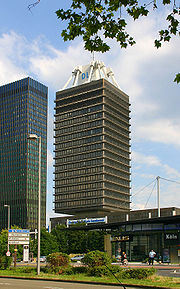
("Germany Radio"), a public broadcasting institution created to oversee national services, from 1 January 1994. DLF was given a new remit as a news and current affairs service, while retaining its staff and studio facilities in Cologne. The service remains free of advertising. In the years immediately after the merger it was sometimes referred to as DeutschlandRadio Köln ("Germany Radio Cologne").
Programming
Deutschlandfunk's schedules are largely made up of news and documentaries, covering politics, economics and science. There is also some very limited music output.News
Deutschlandfunk broadcasts a news bulletin, usually lasting five to ten minutes, on every full hour without exception. From early morning to early evening German time, there is also a shorter bulletin on the half hour.On weekdays, a morning news magazine is broadcast between 0500 and 0900 German time, with frequent news bulletins. News magazines are also broadcast between 1200 and 1330, and between 1800 and 1840. The main evening bulletin is from 2300 to 0000. Selections from German and international newspaper commentaries are interspersed in the morning, noon, and midnight news magazines.
Culture
On Sundays, a discussion programme is broadcast between 0930 and 1000, covering subjects as varied as Islam in Germany, neurophysiology and the history of art. These discussions are archived on the internet http://www.dradio.de/dlf/sendungen/kultursonntag/?archiv=1&page=1.International cooperation
Deutschlandfunk provides programming for the German-language Belgian radio station BRF-DLF in BrusselsBrussels
Brussels , officially the Brussels Region or Brussels-Capital Region , is the capital of Belgium and the de facto capital of the European Union...
. It also cooperates with the main Belgischer Rundfunk
Belgischer Rundfunk
Belgischer Rundfunk is the public-service broadcasting organization serving the German-speaking Community of Belgium...
(BRF) domestic radio service for the East Cantons
German-speaking Community of Belgium
The German-speaking Community of Belgium is one of the three federal communities of Belgium. Covering an area of 854 km² within the province of Liège in Wallonia, it includes nine of the eleven municipalities of the so-called East Cantons...
of Walonia, BRF1.
Transmitters
Sender Donebach
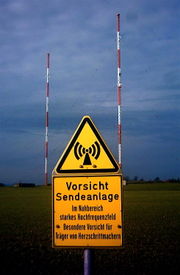
The Sender Donebach is a 500-kilowatt longwave radio transmitter operating on 153 kHz and transmitting the program of German public broadcaster Deutschlandfunk...
and on mediumwave from Bad Dürrheim
Bad Dürrheim transmitter
Bad Dürrheim transmitter was a facility for medium wave and short wave broadcasting at 48°00'12" N and 8°31'28" E at Bad Dürrheim-Ankenbuck. It was built by the Südwestfunk in 1951 and used for mediumwave and shortwave broadcasting. As transmission antenna for mediumwave, a 120 metre tall guyed...
, Cremlingen
Cremlingen transmitter
The Cremlingen transmitter is a large mediumwave transmission facility established in 1962 for transmitting the program of Deutschlandfunk on 756 kHz near Cremlingen-Abbenrode....
, Ravensburg
Ravensburg-Horgenzell transmitter
Ravensburg-Horgenzell transmitter is a mediumwave broadcasting facility of Deutsche Telekom used for transmitting the program of Deutschlandfunk on the area of community Horgenzell northwest of Ravensburg in Baden-Württemberg. It was inaugurated on August 23, 1951 and used until 1959 for...
, Ehndorf
Ehndorf transmitter
Ehndorf transmitter is a mediumwave radio transmission mast located at Ehndorf, a village west of Neumünster in Schleswig-Holstein, Federal Republic of Germany. Owned by Deutsche Telekom, the facility broadcasts Deutschlandfunk on 1269 kHz...
and Mainflingen
Mediumwave transmitter Mainflingen
The Mediumwave transmitter Mainflingen is a mediumwave transmission facility south of the A3 motorway near Mainflingen, Hesse, Germany. Mainflingen was the first mediumwave transmitter for the radio station Deutschlandfunk. It went into service in 1962 with a transmission power of 50 kW, on a...
.
With the validation of waveplan of Geneva Bad Dürrheim
Bad Dürrheim transmitter
Bad Dürrheim transmitter was a facility for medium wave and short wave broadcasting at 48°00'12" N and 8°31'28" E at Bad Dürrheim-Ankenbuck. It was built by the Südwestfunk in 1951 and used for mediumwave and shortwave broadcasting. As transmission antenna for mediumwave, a 120 metre tall guyed...
was shut down. In 1979 new transmitters went into service: in Erching
Longwave transmitter Erching
The Erching transmitter was a longwave broadcasting facility of the Voice of America, established in 1953 near Erching, Bavaria, Germany. The transmitter used a 256 metre high guyed-steel-framework mast aerial, at the time of its inauguration the most powerful radio station in the world with a...
for daytime long-wave transmission and in 1980/81 in Nordkirchen
Nordkirchen transmitter
The Nordkirchen transmitter is a medium-wave broadcasting facility of Deutsche Telekom near Nordkirchen in Northrhine-Westphalia. It was built in 1979 and 1980 after the 549 kHz frequency was again made available in that location....
and Thurnau for medium-wave transmission.
On January 1, 1989, the Aholming transmitter
Aholming transmitter
Aholming transmitter is a facility for broadcasting the program of Deutschlandfunk on 207 kHz with a power of 500 kW at day and 250 kW at night between Aholming and Ottmaring in Bavaria....
replaced Erching
Longwave transmitter Erching
The Erching transmitter was a longwave broadcasting facility of the Voice of America, established in 1953 near Erching, Bavaria, Germany. The transmitter used a 256 metre high guyed-steel-framework mast aerial, at the time of its inauguration the most powerful radio station in the world with a...
and allowed 24 hour service on the second long-wave frequency. On October 1, 1994, Heusweiler transmitter
Transmitter Heusweiler
The Heusweiler transmitter is a facility for medium wave broadcasting near Heusweiler, Germany, which originally went into service on 23 December 1935. On 19 June 1946 transmitter Heusweiler went in service again.- Original transmitter :...
, which previously transmitted "Europawelle Saar", started transmitting Deutschlandfunk. On December 31, 1994, Mainflingen transmitter
Mediumwave transmitter Mainflingen
The Mediumwave transmitter Mainflingen is a mediumwave transmission facility south of the A3 motorway near Mainflingen, Hesse, Germany. Mainflingen was the first mediumwave transmitter for the radio station Deutschlandfunk. It went into service in 1962 with a transmission power of 50 kW, on a...
was shut down.
Longwave
- DonebachSender DonebachThe Sender Donebach is a 500-kilowatt longwave radio transmitter operating on 153 kHz and transmitting the program of German public broadcaster Deutschlandfunk...
(153 kHz) - AholmingAholming transmitterAholming transmitter is a facility for broadcasting the program of Deutschlandfunk on 207 kHz with a power of 500 kW at day and 250 kW at night between Aholming and Ottmaring in Bavaria....
(207 kHz)
Mediumwave
- NordkirchenNordkirchen transmitterThe Nordkirchen transmitter is a medium-wave broadcasting facility of Deutsche Telekom near Nordkirchen in Northrhine-Westphalia. It was built in 1979 and 1980 after the 549 kHz frequency was again made available in that location....
(549 kHz) - Thurnau (549 kHz)
- CremlingenCremlingen transmitterThe Cremlingen transmitter is a large mediumwave transmission facility established in 1962 for transmitting the program of Deutschlandfunk on 756 kHz near Cremlingen-Abbenrode....
(756 kHz) - RavensburgRavensburg-Horgenzell transmitterRavensburg-Horgenzell transmitter is a mediumwave broadcasting facility of Deutsche Telekom used for transmitting the program of Deutschlandfunk on the area of community Horgenzell northwest of Ravensburg in Baden-Württemberg. It was inaugurated on August 23, 1951 and used until 1959 for...
(756 kHz) - EhndorfEhndorf transmitterEhndorf transmitter is a mediumwave radio transmission mast located at Ehndorf, a village west of Neumünster in Schleswig-Holstein, Federal Republic of Germany. Owned by Deutsche Telekom, the facility broadcasts Deutschlandfunk on 1269 kHz...
(1269 kHz) - HeusweilerTransmitter HeusweilerThe Heusweiler transmitter is a facility for medium wave broadcasting near Heusweiler, Germany, which originally went into service on 23 December 1935. On 19 June 1946 transmitter Heusweiler went in service again.- Original transmitter :...
(1422 kHz)
Thanks to these transmitters, Deutschlandfunk's signal reaches most of Europe during the hours of darkness. The long-wave transmission can also be heard in much of Europe during day and night, including parts of Great Britain
Great Britain
Great Britain or Britain is an island situated to the northwest of Continental Europe. It is the ninth largest island in the world, and the largest European island, as well as the largest of the British Isles...
. With the exception of Heusweiler, the transmitters are owned by Deutsche Telekom
Deutsche Telekom
Deutsche Telekom AG is a telecommunications company headquartered in Bonn, Germany. It is the largest telecommunications company in Europe....
AG.
FM
FM transmitters carry the Deutschlandfunk signal throughout Germany, but there are leaks in the coverage pattern, especially — but not only — in the southern states of BavariaBavaria
Bavaria, formally the Free State of Bavaria is a state of Germany, located in the southeast of Germany. With an area of , it is the largest state by area, forming almost 20% of the total land area of Germany...
and Baden-Württemberg
Baden-Württemberg
Baden-Württemberg is one of the 16 states of Germany. Baden-Württemberg is in the southwestern part of the country to the east of the Upper Rhine, and is the third largest in both area and population of Germany's sixteen states, with an area of and 10.7 million inhabitants...
. As AM radio reception is practically out of use in Germany, FM coverage is vital for Deutschlandfunk. As the state authorities have the power to allocate frequencies to broadcasters, they prefer "their" regional public and commercial broadcasters which are controlled and regulated by them.
Webcast
High quality webcast of the Deutschlandfunk programme is available in MP3MP3
MPEG-1 or MPEG-2 Audio Layer III, more commonly referred to as MP3, is a patented digital audio encoding format using a form of lossy data compression...
, Windows Media
Windows Media
Windows Media is a multimedia framework for media creation and distribution for Microsoft Windows. It consists of a software development kit with several application programming interfaces and a number of prebuilt technologies, and is the replacement of NetShow technologies.The Windows Media SDK...
, and Ogg Vorbis formats.