


Negau helmet

Encyclopedia
Negau helmet refers to one of 26 bronze helmet
s (23 of which are preserved) dating to ca. 450 till 350 BC, found in 1811 in a cache in Ženjak
, near Negau, Duchy of Styria
(now Negova
, Slovenia
). The helmets are of typical Etruscan
'vetulonic' shape, sometimes described as of the Negau type. They were buried in ca. 50 BC, shortly before the Roman
invasion of the area.
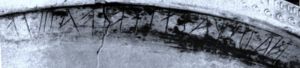 On one of the helmets ("Negau B"), there is an inscription in a northern Etruscan alphabet
. Note that the inscription need not date to 400 BC, but was possibly added by a later owner in ca. the 2nd century BC or later. It is read as


 ///
///
Many interpretations of the inscription have been proffered in the past, but the most recent interpretation is by T.L. Markey (2001) who reads the inscription as 'Harigast the priest' (from *teiwaz "god"), as another inscribed helmet also found at the site bears several names (mostly Celt
ic) followed by religious titles.
In any case, the Germanic name Harigast is almost universally read. Formerly, some scholars have seen the inscription as an early incarnation of the runic alphabet
, but it is now accepted that the script is North Etruscan proper, and precedes the formation of the Runic alphabet. Harigast constitutes an attestation of the Germanic sound shift, probably the earliest preserved, preceding Tacitus
perhaps by some two centuries.
Must (1957) reads Hariχas Titieva as a Raetic personal name, the first element from the Indo-European (Venetic rather than Germanic), the second from the Etruscan.
The four discrete inscriptions on the helmet usually called "Negau A" are read by Markey as: Dubni banuabi 'of Dubnos the pig-slayer'; sirago turbi 'astral priest of the troop'; Iars'e esvii 'Iarsus the divine'; and Kerup, probably an abbreviation for a Celtic name like Cerubogios
Helmets of the Negau type were typically worn by priests at the time of deposition of these helmets, so they seem to have been left at the Ženjak site for ceremonial reasons. The village of Ženjak was of great interest to German archaeologists during the Nazi period and was briefly renamed Harigast during World War II
. The site has never been excavated properly.
Helmet
A helmet is a form of protective gear worn on the head to protect it from injuries.Ceremonial or symbolic helmets without protective function are sometimes used. The oldest known use of helmets was by Assyrian soldiers in 900BC, who wore thick leather or bronze helmets to protect the head from...
s (23 of which are preserved) dating to ca. 450 till 350 BC, found in 1811 in a cache in Ženjak
Ženjak
Ženjak is a settlement in the Benedikt municipality in northeastern Slovenia. The area was part of the traditional region of Lower Styria. The municipality is now included in the Drava statistical region....
, near Negau, Duchy of Styria
Duchy of Styria
The history of Styria concerns the region roughly corresponding to the modern Austrian state of Styria and the Slovene region of Styria from its settlement by Germans and Slavs in the Dark Ages until the present...
(now Negova
Negova
Negova is a village in the hills to the west of Gornja Radgona in northeastern Slovenia.Negova Castle is a castle immediately to the north of the main settlement. It is a complex of buildings that are 16th- and early 17th-century extensions of the original castle built in 1425...
, Slovenia
Slovenia
Slovenia , officially the Republic of Slovenia , is a country in Central and Southeastern Europe touching the Alps and bordering the Mediterranean. Slovenia borders Italy to the west, Croatia to the south and east, Hungary to the northeast, and Austria to the north, and also has a small portion of...
). The helmets are of typical Etruscan
Etruscan civilization
Etruscan civilization is the modern English name given to a civilization of ancient Italy in the area corresponding roughly to Tuscany. The ancient Romans called its creators the Tusci or Etrusci...
'vetulonic' shape, sometimes described as of the Negau type. They were buried in ca. 50 BC, shortly before the Roman
Roman Empire
The Roman Empire was the post-Republican period of the ancient Roman civilization, characterised by an autocratic form of government and large territorial holdings in Europe and around the Mediterranean....
invasion of the area.
Old Italic alphabet
Old Italic refers to several now extinct alphabet systems used on the Italian Peninsula in ancient times for various Indo-European languages and non-Indo-European languages...
. Note that the inscription need not date to 400 BC, but was possibly added by a later owner in ca. the 2nd century BC or later. It is read as
- harikastiteiva\\\ip,
Many interpretations of the inscription have been proffered in the past, but the most recent interpretation is by T.L. Markey (2001) who reads the inscription as 'Harigast the priest' (from *teiwaz "god"), as another inscribed helmet also found at the site bears several names (mostly Celt
Celt
The Celts were a diverse group of tribal societies in Iron Age and Roman-era Europe who spoke Celtic languages.The earliest archaeological culture commonly accepted as Celtic, or rather Proto-Celtic, was the central European Hallstatt culture , named for the rich grave finds in Hallstatt, Austria....
ic) followed by religious titles.
In any case, the Germanic name Harigast is almost universally read. Formerly, some scholars have seen the inscription as an early incarnation of the runic alphabet
Runic alphabet
The runic alphabets are a set of related alphabets using letters known as runes to write various Germanic languages before the adoption of the Latin alphabet and for specialized purposes thereafter...
, but it is now accepted that the script is North Etruscan proper, and precedes the formation of the Runic alphabet. Harigast constitutes an attestation of the Germanic sound shift, probably the earliest preserved, preceding Tacitus
Tacitus
Publius Cornelius Tacitus was a senator and a historian of the Roman Empire. The surviving portions of his two major works—the Annals and the Histories—examine the reigns of the Roman Emperors Tiberius, Claudius, Nero and those who reigned in the Year of the Four Emperors...
perhaps by some two centuries.
Must (1957) reads Hariχas Titieva as a Raetic personal name, the first element from the Indo-European (Venetic rather than Germanic), the second from the Etruscan.
The four discrete inscriptions on the helmet usually called "Negau A" are read by Markey as: Dubni banuabi 'of Dubnos the pig-slayer'; sirago turbi 'astral priest of the troop'; Iars'e esvii 'Iarsus the divine'; and Kerup, probably an abbreviation for a Celtic name like Cerubogios
Helmets of the Negau type were typically worn by priests at the time of deposition of these helmets, so they seem to have been left at the Ženjak site for ceremonial reasons. The village of Ženjak was of great interest to German archaeologists during the Nazi period and was briefly renamed Harigast during World War II
World War II
World War II, or the Second World War , was a global conflict lasting from 1939 to 1945, involving most of the world's nations—including all of the great powers—eventually forming two opposing military alliances: the Allies and the Axis...
. The site has never been excavated properly.
Literature
- Gustav Must, The Problem of the Inscription on Helmet B of Negau, Harvard Studies in Classical Philology (1957).
- Tom Markey, A Tale of Two Helmets: The Negau A and B Inscriptions, The Journal of Indo-European Studies, Volume 29, Number 1 & 2, Spring/Summer 2001