

Nash Motors

Encyclopedia
Also see: Kelvinator
and American Motors Corporation
Nash Motors was an automobile
manufacturer based in Kenosha, Wisconsin
, in the United States
from 1916 to 1938. From 1938 to 1954, Nash was the automotive division of the Nash-Kelvinator Corporation
. Nash production continued from 1954 to 1957 after the creation of American Motors Corporation.
Nash pioneered unitary construction (1941), also a heating and ventilation system whose operating principles are now universally utilized (1938), seat belts (1950) and the manufacture of cars in the compact
(1950), subcompact (1970) and muscle car
(1957) categories.
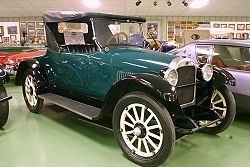
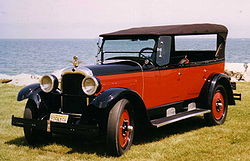
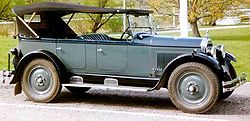 Nash Motors was founded in 1916 by former General Motors
president Charles W. Nash who acquired the Thomas B. Jeffery Company
. Jeffery's best-known automobile was the Rambler
whose mass production
from a plant in Kenosha, Wisconsin
began in 1902.
The 1917 Nash Model 671 was the first vehicle produced to bear the name of the new company's founder. Nash enjoyed decades of success by focusing its efforts to build cars "embodying honest worth ... [at] a price level which held out possibilities of a very wide market."
The four-wheel drive
Jeffrey Quad truck became an important product for Nash. Approximately 11,500 Quads were built between 1913 and 1919. They served to move material during World War I
under severe conditions. The Quad used Meuhl differentials with half-shafts mounted above the load-bearing dead axles to drive the hubs through hub-reduction gearing. in addition to featuring four-wheel steering. The Quad achieved the reputation of being the best four-wheel drive truck produced in the country. The newly formed Nash Motors became the largest producer of four-wheel drives. By 1918, capacity constraints at Nash meant the Paige-Detroit Motor Car Company
began to assemble the Nash Quad under license and Nash patents. Nash became the leading producer of military trucks by the end of World War I. After the war ended, surplus Quads were used as heavy work trucks in fields such as construction and logging.
Charles Nash convinced the chief engineer
of GM's Oakland Division, Finnish
-born Nils Eric Wahlberg, to moving to Nash's new company. The first Nash engine introduced in 1917 by Wahlberg had overhead valve
s, and Nash incorporated this principle Wahlberg is also credited with helping to design flow-through ventilation that is used today in nearly every motor vehicle. Introduced in 1938, Nash's Weather Eye
directed fresh, outside air into the car's fan-boosted, filtered ventilation system, where it was warmed (or cooled), and then removed through rearward placed vents. The process also helped to reduce humidity and equalize the slight pressure differential between the outside and inside of a moving vehicle. Another unique feature of Nash cars was the unequal wheel tracks. The front wheels were set slightly narrower than the rear, thus adding stability and improving cornering. Wahlberg was also an early proponent of wind tunnel
testing for vehicles and during World War II
worked with Theodore (Ted) Ulrich in the development of Nash's radically styled Airflyte models.
Nash's slogan from the late 1920s and 1930s was "Give the customer more than he has paid for" and the cars lived up to it. Innovations included a straight-eight engine with overhead valves, twin spark plugs, and nine crankshaft bearings
in 1930. The 1932 Ambassador Eight had synchromesh transmission
s and free wheeling, automatic centralized chassis lubrication, a worm-drive rear end, and its suspension was adjustable inside the car.
The Nash was a success among consumers that meant for the company "selling for a long time has been 100% a production problem... month after month all the cars that could be produced were sold before they left the factory floor."
plant in Racine, Wisconsin
. Mitchell was the manufacturer of Mitchell-brand automobiles between 1903-1923. Sales of Ajax automobiles, while quite respectable, were disappointing. It was believed that the same car would sell better if it were called a Nash. Thus the Ajax became the "Nash Light Six" in June, 1926 and sales did improve, just as expected. In an unusual move, Nash Motors offered all Ajax owners a kit to "convert" their Ajax into a Nash Light Six. This kit, supplied at no charge, included a set of new hubcaps, radiator badge, and all other parts necessary to change the identity of an Ajax into that of a Nash Light Six. This was done to protect Ajax owners from the inevitable drop in resale value when the Ajax marque was discontinued. In this way Nash Motors showed the high value they placed upon their customers' satisfaction and well-being. Most Ajax owners took advantage of this move, and "unconverted" Ajax cars are quite rare today.
, in 1920, and later moved to Milwaukee, Wisconsin
. The principal stockholder in LaFayette Motors was Nash Motors Company. Other major stockholders were Charles W. Nash and friends and business associates. The high quality, high priced LaFayette cars did not sell well.
In 1924 Nash absorbed LaFayette Motors
and converted its plant to produce Ajax automobiles. The LaFayette name was reintroduced in 1934 as a lower priced companion to Nash. LaFayette ceased to be an independent marque with the introduction of the 1937 models. From 1937 through 1940, the Nash LaFayette was the lowest priced Nash, and was replaced by the new unibody Nash 600 for the 1941 model year.
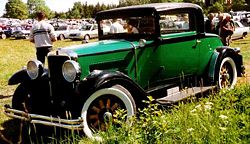
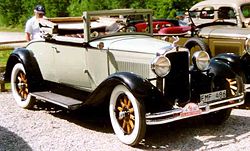 Before retiring, Charlie Nash chose Kelvinator Corporation head George W. Mason
to succeed him. Mason accepted, but placed one condition on the job: Nash would acquire controlling interest in Kelvinator, which at the time was the leading manufacturer of high-end refrigerators and kitchen appliances in the United States. The resulting company, as of January 4, 1937, was known as the Nash-Kelvinator Corporation. Nash as a brand name continued to represent automobiles for Nash-Kelvinator. This was the largest merger of companies not in the same industry up until that time.
In 1938 Nash introduced an optional conditioned air heating/ventilating system, an outcome of the expertise shared between Kelvinator and Nash. This was the first hot-water car heater to draw fresh air from outside the car, and is the basis of all modern car heaters in use today. Also in 1938, Nash, along with other car manufacturers Studebaker
and Graham
, offered vacuum-controlled shifting, an early approach at removing the gearshift from the front floorboards. Automobiles equipped with the Automatic Vacuum Shift (supplied by the Evans Products Company) had a small gear selector lever mounted on the dashboard, immediately below the radio controls.
1936 marked the introduction of the Nash "Bed-In-A-Car" feature, which allowed the car's interior to be converted into a sleeping compartment. The rear seatback hinged up, allowing the rear seat cushion to be propped up into a level position. This also created an opening between the passenger compartment and the trunk. Two adults could sleep in the car, with their legs and feet in the trunk, and their heads and shoulders on the rear seat cushions. In 1949 this arrangement was modified so that fully reclining front seatbacks created a sleeping area entirely within the passenger compartment. In 1950 these reclining seatbacks were given the ability to lock into several intermediate positions. Nash soon called these new seatbacks "Airliner Reclining Seats".
In 1939, Nash added a thermostat to its "Conditioned Air System", and thus the famous Nash Weather Eye
heater was born. The 1939 and 1940 Nash streamlined cars were designed by George Walker
and Associates and freelance body stylist Don Mortrude. They were available in three series - LaFayette, Ambassador Six and Ambassador Eight. For the 1940 model cars Nash introduced independent coil spring front suspension and sealed beam headlights.
The 1941 Nash 600 was the first mass-produced unibody construction automobile made in the United States. Its lighter weight compared to body-on-frame automobiles and lower air drag helped it to achieve excellent gas mileage for its day. The "600" model designation is said to have been derived from overdrive-equipped examples of this car's ability to travel 600 miles (966 km) on a 20 gallons (75.7 l) tank of gasoline. In other words it would achieve 30 miles per US gallon (12.8 km/L). The design of the cars was improved by new front ends, upholstery, and chrome trim from 1942 to 1948. The larger Ambassador models shared the same bodies with the 600 but continued to use body-on-frame construction.
Post-World War II
passenger car production resumed on October 27, 1945 with an Ambassador sedan first off the assembly line. There were few changes from 1942 models, most noticeable were longer and slimmer upper grille bars and a projecting center section on the lower grille. The inline 8 cylinder Ambassador model did not return in 1946. The large Ambassador engine thus was the seven main bearing, overhead valve 234 cubic inch six cylinder developing 112 brake horsepower. For the 1946 model year Nash introduced the Suburban model that used wood framing & panels on the body. It was similar to the Chrysler Town and Country
and Ford Sportsman models. Suburbans were continued in 1947 and 1948 models with 1,000 built over all three years. In 1948 the Ambassador convertible returned with 1,000 built.
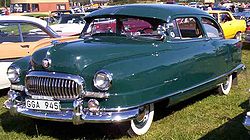 The aerodynamic 1949 Nash "Airflyte" was the first car of an advanced design introduced by the company after the war. Its aerodynamic body shape was developed in a wind tunnel. Nils Wahlberg's theories on reducing an automobile body's drag coefficient resulted in a smooth shape and enclosed front fenders. The "cutting-edge aerodynamics" was the most "alarming" all-new postwar design in the industry. Wide and low, the automobile featured more interior room than its 1948 predecessor. Due to its enclosed front fenders Nash automobiles had a larger turning radius than most other cars. The 600 models used a 112 inches (284.5 cm) wheelbase while the Ambassador models stretched to 121 inches (307 cm). Both shared the same bodies.
The few changes for the 1950 Airflytes were a wider rear window, concealed fuel filler cap, some dashboard features and addition on Ambassadors of a GM
Hydramatic
automatic transmission option. The 600 models were renamed the "Statesman".
Changes for the 1951 model Airflytes were to the rear fenders, elongated to incorporate vertical taillights, a new conventional dashboard replacing the Uniscope mounted on the steering column, a new vertical bar grille with horizontal parking lights and addition of GM Hydramatic as a Statesman option also. The three best sales years for Nash up to that time were 1949, 1950 and 1951.
Nash-Kelvinator's President George Mason felt Nash had the best chance of reaching a larger market in building small cars. He directed Nash towards the development of the first compact of the post war era, the 1950 Nash Rambler
, which was marketed as an up-market, feature-laden convertible. Mason also arranged for the introduction of the Austin
-built small Metropolitan
from Britain
, which was introduced as a 1954 model.
The full-size Nash Airflytes were completely re-designed for 1952, and were promoted as the Golden Airflytes, in honor of Nash Motors' 50th anniversary as an automobile builder (the company now counting the years of the Thomas B. Jeffery Company as part of their own heritage.) "Great Cars Since 1902" became one of the company's advertising slogans. The new Golden Airflytes presented a more modern, squared-off look than did the 1949-1951 models, which were often compared to upside-down bathtubs.
Using its Kelvinator refrigeration experience, the automobile industry's first single-unit heating and air conditioning
system was introduced by Nash in 1954. This was a compact, affordable system for the mass market with controls on the dash and an electric clutch. Entirely incorporated within the engine bay, the combined heating and cooling system had cold air for passengers enter through dash-mounted vents. Competing systems used a separate heating system and an engine-mounted compressor with an evaporator in the car's trunk to deliver cold air through the rear package shelf and overhead vents. The alternative layout pioneered by Nash "became established practice and continues to form the basis of the modern and more sophisticated automatic climate control systems."
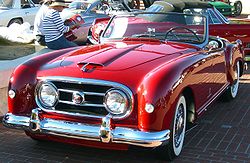 1951 saw the introduction of the Anglo-American Nash-Healey
sports car, a collaborative effort between George Mason and British sports car manufacturer Donald Healey
. Healey designed and built the chassis and suspension and also, until 1952, the aluminum body which another British manufacturer, Panelcraft Sheet Metal Co. Ltd., fabricated in Birmingham
. Nash shipped the powertrain components. Healey assembled the cars, which were then shipped to the U.S. for sale. In 1952 the Italian designer Battista Farina
restyled the body, and its construction changed to steel and aluminum. High costs, low sales and Nash's focus on the Rambler line led to the termination of Nash-Healey production in 1954. 506 automobiles were produced.
Mason commissioned Farina to design a Rambler-based 2-seater coupe called the Palm Beach, which may have been intended as a successor to the Nash-Healey. However the project did not progress beyond a concept car
For European endurance racing Healey and his staff designed and built three special Nash-Healeys with spartan, lightweight aluminum racing bodies. These competition versions entered four consecutive Le Mans
races and one Mille Miglia
. They bore no outward resemblance to the production Nash-Healeys, none of which ever contested these races.
At Le Mans they achieved fourth overall in 1950, sixth overall and fourth in class in 1951, third overall and first in class in 1952, and eleventh overall in 1953. In the Mille Miglia they finished ninth overall in 1950 and seventh overall, fourth in class, in 1952.
as a friendly merger, creating American Motors Corporation (AMC). To improve the financial performance of the combined companies, all production beginning with the 1955 Nash and Hudson models would happen at Nash's Kenosha plant. Nash would focus most of its marketing dollars on its smaller Rambler models, and Hudson would focus its marketing dollars on its full-sized cars.
 For 1955, all senior Hudson and Nash automobiles were based on a shared common body shell but with individual powertrains and separate, non-interchangeable body parts a la the Big Three's longtime practice allowing for maximum manufacturing economy.
The Nash Metropolitan
produced with the British BMC
, which had been marketed under both the Nash and Hudson brands, became a make unto its own in 1957, as did the Rambler. Rambler overtook Nash and Hudson as the leading nameplate manufactured by AMC.
Soon after the 1954 merger, CEO George Mason died. Mason's successor, George Romney
, pinned the future of the company on an expanded Rambler line, and began the process of phasing the Nash and Hudson nameplates out by the end of the 1957 model year. Nash and Hudson production ended on June 25, 1957. From 1958 to 1965, Rambler was the only marque sold by AMC, other than the Metropolitan, which remained in dealer showrooms until 1962. Under the tenure of Roy Abernethy
, the Rambler name was phased out beginning in 1965 and discontinued after 1969.
In 1970, American Motors acquired Kaiser Jeep
(the descendant of Willys-Overland Motors) and its Toledo, Ohio
, based manufacturing facilities. In the early 1980s, AMC entered into a partnership with Renault
which was looking for a re-entrée into the American market in the 1980s. AMC was ultimately acquired by Chrysler Corporation in 1987, becoming the Jeep-Eagle division.
Kelvinator
Kelvinator is an appliance brand. It takes its name from William Thomson, 1st Baron Kelvin, who developed the concept of absolute zero and for whom the Kelvin temperature scale is named...
and American Motors Corporation
Nash Motors was an automobile
Automobile
An automobile, autocar, motor car or car is a wheeled motor vehicle used for transporting passengers, which also carries its own engine or motor...
manufacturer based in Kenosha, Wisconsin
Kenosha, Wisconsin
Kenosha is a city and the county seat of Kenosha County in the State of Wisconsin in United States. With a population of 99,218 as of May 2011, Kenosha is the fourth-largest city in Wisconsin. Kenosha is also the fourth-largest city on the western shore of Lake Michigan, following Chicago,...
, in the United States
United States
The United States of America is a federal constitutional republic comprising fifty states and a federal district...
from 1916 to 1938. From 1938 to 1954, Nash was the automotive division of the Nash-Kelvinator Corporation
Nash-Kelvinator Corporation
Nash-Kelvinator Corporation was the result of a merger between Nash Motors and Kelvinator Appliance Company. The union of these two companies was brought about as a result of a condition made by George W...
. Nash production continued from 1954 to 1957 after the creation of American Motors Corporation.
Nash pioneered unitary construction (1941), also a heating and ventilation system whose operating principles are now universally utilized (1938), seat belts (1950) and the manufacture of cars in the compact
Compact car
A compact car , or small family car , is a classification of cars which are larger than a supermini but smaller than or equal to a mid-size car...
(1950), subcompact (1970) and muscle car
Muscle car
Muscle car is a term used to refer to a variety of high-performance automobiles. The Merriam-Webster dictionary defines muscle cars as "any of a group of American-made 2-door sports coupes with powerful engines designed for high-performance driving." Usually, a large V8 engine is fitted in a...
(1957) categories.
History
General Motors
General Motors Company , commonly known as GM, formerly incorporated as General Motors Corporation, is an American multinational automotive corporation headquartered in Detroit, Michigan and the world's second-largest automaker in 2010...
president Charles W. Nash who acquired the Thomas B. Jeffery Company
Thomas B. Jeffery Company
The Thomas B. Jeffery Company was an American automobile manufacturer in Kenosha, Wisconsin from 1902 until 1916. The company manufactured the Rambler and Jeffery brand motorcars. It was preceded by the Gormully & Jeffery Manufacturing Company and it was the parent company to Nash Motors, thus one...
. Jeffery's best-known automobile was the Rambler
Rambler (automobile)
Rambler was an automobile brand name used by the Thomas B. Jeffery Company between 1900 and 1914, then by its successor, Nash Motors from 1950 to 1954, and finally by Nash's successor, American Motors Corporation from 1954 to 1969...
whose mass production
Mass production
Mass production is the production of large amounts of standardized products, including and especially on assembly lines...
from a plant in Kenosha, Wisconsin
Kenosha, Wisconsin
Kenosha is a city and the county seat of Kenosha County in the State of Wisconsin in United States. With a population of 99,218 as of May 2011, Kenosha is the fourth-largest city in Wisconsin. Kenosha is also the fourth-largest city on the western shore of Lake Michigan, following Chicago,...
began in 1902.
The 1917 Nash Model 671 was the first vehicle produced to bear the name of the new company's founder. Nash enjoyed decades of success by focusing its efforts to build cars "embodying honest worth ... [at] a price level which held out possibilities of a very wide market."
The four-wheel drive
Four-wheel drive
Four-wheel drive, 4WD, or 4×4 is a four-wheeled vehicle with a drivetrain that allows all four wheels to receive torque from the engine simultaneously...
Jeffrey Quad truck became an important product for Nash. Approximately 11,500 Quads were built between 1913 and 1919. They served to move material during World War I
World War I
World War I , which was predominantly called the World War or the Great War from its occurrence until 1939, and the First World War or World War I thereafter, was a major war centred in Europe that began on 28 July 1914 and lasted until 11 November 1918...
under severe conditions. The Quad used Meuhl differentials with half-shafts mounted above the load-bearing dead axles to drive the hubs through hub-reduction gearing. in addition to featuring four-wheel steering. The Quad achieved the reputation of being the best four-wheel drive truck produced in the country. The newly formed Nash Motors became the largest producer of four-wheel drives. By 1918, capacity constraints at Nash meant the Paige-Detroit Motor Car Company
Paige automobile
Paige was a Detroit, United States based automobile company, selling luxury cars between 1908 and 1927.-History:The first car in 1908 was called a Paige-Detroit and was a two seat model powered by a 2.2 liter three cylinder, two stroke engine. In 1910 four stroke, four cylinder models took over and...
began to assemble the Nash Quad under license and Nash patents. Nash became the leading producer of military trucks by the end of World War I. After the war ended, surplus Quads were used as heavy work trucks in fields such as construction and logging.
Charles Nash convinced the chief engineer
Engineer
An engineer is a professional practitioner of engineering, concerned with applying scientific knowledge, mathematics and ingenuity to develop solutions for technical problems. Engineers design materials, structures, machines and systems while considering the limitations imposed by practicality,...
of GM's Oakland Division, Finnish
Finland
Finland , officially the Republic of Finland, is a Nordic country situated in the Fennoscandian region of Northern Europe. It is bordered by Sweden in the west, Norway in the north and Russia in the east, while Estonia lies to its south across the Gulf of Finland.Around 5.4 million people reside...
-born Nils Eric Wahlberg, to moving to Nash's new company. The first Nash engine introduced in 1917 by Wahlberg had overhead valve
Overhead valve
An overhead valve engine, also informally called pushrod engine or I-head engine, is a type of piston engine that places the camshaft within the cylinder block , and uses pushrods or rods to actuate rocker arms above the cylinder...
s, and Nash incorporated this principle Wahlberg is also credited with helping to design flow-through ventilation that is used today in nearly every motor vehicle. Introduced in 1938, Nash's Weather Eye
Weather Eye
The Weather Eye was a trade name for a Nash Motors-designed fresh-air automotive heating and ventilating system first used in 1938. This "Conditioned Air System" is characterized by a cowl-mounted outside air receiver that then passes fresh air through a heater core utilizing hot engine coolant for...
directed fresh, outside air into the car's fan-boosted, filtered ventilation system, where it was warmed (or cooled), and then removed through rearward placed vents. The process also helped to reduce humidity and equalize the slight pressure differential between the outside and inside of a moving vehicle. Another unique feature of Nash cars was the unequal wheel tracks. The front wheels were set slightly narrower than the rear, thus adding stability and improving cornering. Wahlberg was also an early proponent of wind tunnel
Wind tunnel
A wind tunnel is a research tool used in aerodynamic research to study the effects of air moving past solid objects.-Theory of operation:Wind tunnels were first proposed as a means of studying vehicles in free flight...
testing for vehicles and during World War II
World War II
World War II, or the Second World War , was a global conflict lasting from 1939 to 1945, involving most of the world's nations—including all of the great powers—eventually forming two opposing military alliances: the Allies and the Axis...
worked with Theodore (Ted) Ulrich in the development of Nash's radically styled Airflyte models.
Nash's slogan from the late 1920s and 1930s was "Give the customer more than he has paid for" and the cars lived up to it. Innovations included a straight-eight engine with overhead valves, twin spark plugs, and nine crankshaft bearings
Main bearing
In a piston engine, the main bearings are the bearings on which the crankshaft rotates, usually plain or journal bearings.All engines have a minimum of two main bearings, one at each end of the crankshaft, and they may have as many as one more than the number of crank pins...
in 1930. The 1932 Ambassador Eight had synchromesh transmission
Manual transmission
A manual transmission, also known as a manual gearbox or standard transmission is a type of transmission used in motor vehicle applications...
s and free wheeling, automatic centralized chassis lubrication, a worm-drive rear end, and its suspension was adjustable inside the car.
The Nash was a success among consumers that meant for the company "selling for a long time has been 100% a production problem... month after month all the cars that could be produced were sold before they left the factory floor."
Creation of the Ajax
For the 1925 model year, Nash introduced the entry-level marque Ajax. A car of exceptional quality for its price, the Ajax was produced in the newly acquired Mitchell Motor Car CompanyMitchell (automobile)
The Mitchell was a United States automobile manufactured by the Racine, Wisconsin based Mitchell Motor Car Company which produced automobiles from 1903 to 1923. Originally a carriage builder, the company's first model was a 7hp runabout. Later, four, six, and eight cylinder models were built....
plant in Racine, Wisconsin
Racine, Wisconsin
Racine is a city in and the county seat of Racine County, Wisconsin, United States. According to 2008 U.S. Census Bureau estimates, the city had a population of 82,196...
. Mitchell was the manufacturer of Mitchell-brand automobiles between 1903-1923. Sales of Ajax automobiles, while quite respectable, were disappointing. It was believed that the same car would sell better if it were called a Nash. Thus the Ajax became the "Nash Light Six" in June, 1926 and sales did improve, just as expected. In an unusual move, Nash Motors offered all Ajax owners a kit to "convert" their Ajax into a Nash Light Six. This kit, supplied at no charge, included a set of new hubcaps, radiator badge, and all other parts necessary to change the identity of an Ajax into that of a Nash Light Six. This was done to protect Ajax owners from the inevitable drop in resale value when the Ajax marque was discontinued. In this way Nash Motors showed the high value they placed upon their customers' satisfaction and well-being. Most Ajax owners took advantage of this move, and "unconverted" Ajax cars are quite rare today.
Acquisition of LaFayette
LaFayette Motors was the producer of a large, powerful, expensive luxury car. The company started in Indianapolis, IndianaIndianapolis, Indiana
Indianapolis is the capital of the U.S. state of Indiana, and the county seat of Marion County, Indiana. As of the 2010 United States Census, the city's population is 839,489. It is by far Indiana's largest city and, as of the 2010 U.S...
, in 1920, and later moved to Milwaukee, Wisconsin
Milwaukee, Wisconsin
Milwaukee is the largest city in the U.S. state of Wisconsin, the 28th most populous city in the United States and 39th most populous region in the United States. It is the county seat of Milwaukee County and is located on the southwestern shore of Lake Michigan. According to 2010 census data, the...
. The principal stockholder in LaFayette Motors was Nash Motors Company. Other major stockholders were Charles W. Nash and friends and business associates. The high quality, high priced LaFayette cars did not sell well.
In 1924 Nash absorbed LaFayette Motors
LaFayette Motors
The LaFayette Motors Corporation was a United States-based automobile manufacturer. Founded in 1919, LaFayette Motors was named in honor of the Marquis de la Fayette, and LaFayette autos had a cameo of the Marquis as their logo.-History:...
and converted its plant to produce Ajax automobiles. The LaFayette name was reintroduced in 1934 as a lower priced companion to Nash. LaFayette ceased to be an independent marque with the introduction of the 1937 models. From 1937 through 1940, the Nash LaFayette was the lowest priced Nash, and was replaced by the new unibody Nash 600 for the 1941 model year.
Era of George Mason and Nash Kelvinator
George W. Mason
George Walter Mason was an American industrialist. During his career Mason served as the Chairman and CEO of the Kelvinator Corporation , Chairman and CEO of the Nash-Kelvinator Corporation , and Chairman and CEO of American Motors Corporation .- Early life :George W. Mason was born in Valley...
to succeed him. Mason accepted, but placed one condition on the job: Nash would acquire controlling interest in Kelvinator, which at the time was the leading manufacturer of high-end refrigerators and kitchen appliances in the United States. The resulting company, as of January 4, 1937, was known as the Nash-Kelvinator Corporation. Nash as a brand name continued to represent automobiles for Nash-Kelvinator. This was the largest merger of companies not in the same industry up until that time.
In 1938 Nash introduced an optional conditioned air heating/ventilating system, an outcome of the expertise shared between Kelvinator and Nash. This was the first hot-water car heater to draw fresh air from outside the car, and is the basis of all modern car heaters in use today. Also in 1938, Nash, along with other car manufacturers Studebaker
Studebaker
Studebaker Corporation was a United States wagon and automobile manufacturer based in South Bend, Indiana. Founded in 1852 and incorporated in 1868 under the name of the Studebaker Brothers Manufacturing Company, the company was originally a producer of wagons for farmers, miners, and the...
and Graham
Graham-Paige
Graham-Paige was an American automobile manufacturer founded by brothers Joseph B. Graham and Robert C. Graham , and Canadian Ray Austin in 1927. Automobile production ceased in 1940, and its automotive assets were acquired by Kaiser-Frazer in 1947...
, offered vacuum-controlled shifting, an early approach at removing the gearshift from the front floorboards. Automobiles equipped with the Automatic Vacuum Shift (supplied by the Evans Products Company) had a small gear selector lever mounted on the dashboard, immediately below the radio controls.
1936 marked the introduction of the Nash "Bed-In-A-Car" feature, which allowed the car's interior to be converted into a sleeping compartment. The rear seatback hinged up, allowing the rear seat cushion to be propped up into a level position. This also created an opening between the passenger compartment and the trunk. Two adults could sleep in the car, with their legs and feet in the trunk, and their heads and shoulders on the rear seat cushions. In 1949 this arrangement was modified so that fully reclining front seatbacks created a sleeping area entirely within the passenger compartment. In 1950 these reclining seatbacks were given the ability to lock into several intermediate positions. Nash soon called these new seatbacks "Airliner Reclining Seats".
In 1939, Nash added a thermostat to its "Conditioned Air System", and thus the famous Nash Weather Eye
Weather Eye
The Weather Eye was a trade name for a Nash Motors-designed fresh-air automotive heating and ventilating system first used in 1938. This "Conditioned Air System" is characterized by a cowl-mounted outside air receiver that then passes fresh air through a heater core utilizing hot engine coolant for...
heater was born. The 1939 and 1940 Nash streamlined cars were designed by George Walker
George W. Walker
George W. Walker was an industrial and automotive designer. His most notable work was the original Ford Thunderbird....
and Associates and freelance body stylist Don Mortrude. They were available in three series - LaFayette, Ambassador Six and Ambassador Eight. For the 1940 model cars Nash introduced independent coil spring front suspension and sealed beam headlights.
The 1941 Nash 600 was the first mass-produced unibody construction automobile made in the United States. Its lighter weight compared to body-on-frame automobiles and lower air drag helped it to achieve excellent gas mileage for its day. The "600" model designation is said to have been derived from overdrive-equipped examples of this car's ability to travel 600 miles (966 km) on a 20 gallons (75.7 l) tank of gasoline. In other words it would achieve 30 miles per US gallon (12.8 km/L). The design of the cars was improved by new front ends, upholstery, and chrome trim from 1942 to 1948. The larger Ambassador models shared the same bodies with the 600 but continued to use body-on-frame construction.
Post-World War II
World War II
World War II, or the Second World War , was a global conflict lasting from 1939 to 1945, involving most of the world's nations—including all of the great powers—eventually forming two opposing military alliances: the Allies and the Axis...
passenger car production resumed on October 27, 1945 with an Ambassador sedan first off the assembly line. There were few changes from 1942 models, most noticeable were longer and slimmer upper grille bars and a projecting center section on the lower grille. The inline 8 cylinder Ambassador model did not return in 1946. The large Ambassador engine thus was the seven main bearing, overhead valve 234 cubic inch six cylinder developing 112 brake horsepower. For the 1946 model year Nash introduced the Suburban model that used wood framing & panels on the body. It was similar to the Chrysler Town and Country
Chrysler Town and Country (pre-1990)
The Chrysler Town & Country was a station wagon manufactured by Chrysler Corporation and sold under its flagship brand from 1941–1989. The model was also sold as a sedan, coupé, and convertible from 1947–1950 and as a convertible from 1982–1986....
and Ford Sportsman models. Suburbans were continued in 1947 and 1948 models with 1,000 built over all three years. In 1948 the Ambassador convertible returned with 1,000 built.
Introduction of the Nash Airflyte
The few changes for the 1950 Airflytes were a wider rear window, concealed fuel filler cap, some dashboard features and addition on Ambassadors of a GM
General Motors
General Motors Company , commonly known as GM, formerly incorporated as General Motors Corporation, is an American multinational automotive corporation headquartered in Detroit, Michigan and the world's second-largest automaker in 2010...
Hydramatic
Hydramatic
Hydramatic was an automatic transmission developed by both General Motors' Cadillac and Oldsmobile divisions. Introduced in 1939 for the 1940 model year vehicles, the Hydramatic was the first fully automatic mass-produced transmission developed for passenger automobile use.-History:During the...
automatic transmission option. The 600 models were renamed the "Statesman".
Changes for the 1951 model Airflytes were to the rear fenders, elongated to incorporate vertical taillights, a new conventional dashboard replacing the Uniscope mounted on the steering column, a new vertical bar grille with horizontal parking lights and addition of GM Hydramatic as a Statesman option also. The three best sales years for Nash up to that time were 1949, 1950 and 1951.
Nash-Kelvinator's President George Mason felt Nash had the best chance of reaching a larger market in building small cars. He directed Nash towards the development of the first compact of the post war era, the 1950 Nash Rambler
Nash Rambler
The Nash Rambler was a North American automobile produced by the Nash Motors division of Nash-Kelvinator Corporation from 1950–55.The Nash Rambler established a new segment in the automobile market and is widely acknowledged to be the first successful modern American compact...
, which was marketed as an up-market, feature-laden convertible. Mason also arranged for the introduction of the Austin
Austin Motor Company
The Austin Motor Company was a British manufacturer of automobiles. The company was founded in 1905 and merged in 1952 into the British Motor Corporation Ltd. The marque Austin was used until 1987...
-built small Metropolitan
Nash Metropolitan
The Nash Metropolitan is a car that was sold, initially only in the United States and Canada, from 1954–1962.It conforms to two classes of vehicle: economy car and subcompact car. In today’s terminology the Metropolitan is a “subcompact”, but this category had not yet come into use when the car was...
from Britain
United Kingdom
The United Kingdom of Great Britain and Northern IrelandIn the United Kingdom and Dependencies, other languages have been officially recognised as legitimate autochthonous languages under the European Charter for Regional or Minority Languages...
, which was introduced as a 1954 model.
The full-size Nash Airflytes were completely re-designed for 1952, and were promoted as the Golden Airflytes, in honor of Nash Motors' 50th anniversary as an automobile builder (the company now counting the years of the Thomas B. Jeffery Company as part of their own heritage.) "Great Cars Since 1902" became one of the company's advertising slogans. The new Golden Airflytes presented a more modern, squared-off look than did the 1949-1951 models, which were often compared to upside-down bathtubs.
Using its Kelvinator refrigeration experience, the automobile industry's first single-unit heating and air conditioning
Air conditioning
An air conditioner is a home appliance, system, or mechanism designed to dehumidify and extract heat from an area. The cooling is done using a simple refrigeration cycle...
system was introduced by Nash in 1954. This was a compact, affordable system for the mass market with controls on the dash and an electric clutch. Entirely incorporated within the engine bay, the combined heating and cooling system had cold air for passengers enter through dash-mounted vents. Competing systems used a separate heating system and an engine-mounted compressor with an evaporator in the car's trunk to deliver cold air through the rear package shelf and overhead vents. The alternative layout pioneered by Nash "became established practice and continues to form the basis of the modern and more sophisticated automatic climate control systems."
Introduction of the Nash-Healey
Nash-Healey
The Nash-Healey is a two-seat sports car that was produced for the American market between 1951 and 1954. Marketed by Nash-Kelvinator Corporation with a Nash Ambassador drivetrain and a European chassis and body, it served as a halo vehicle for the automaker to promote the sales of the other Nash...
sports car, a collaborative effort between George Mason and British sports car manufacturer Donald Healey
Donald Healey
Donald Mitchell Healey CBE was a noted English rally driver, automobile engineer, and speed record holder.- Early life :...
. Healey designed and built the chassis and suspension and also, until 1952, the aluminum body which another British manufacturer, Panelcraft Sheet Metal Co. Ltd., fabricated in Birmingham
Birmingham
Birmingham is a city and metropolitan borough in the West Midlands of England. It is the most populous British city outside the capital London, with a population of 1,036,900 , and lies at the heart of the West Midlands conurbation, the second most populous urban area in the United Kingdom with a...
. Nash shipped the powertrain components. Healey assembled the cars, which were then shipped to the U.S. for sale. In 1952 the Italian designer Battista Farina
Battista Farina
Battista "Pinin" Farina was an Italian automobile designer, the founder of the Carrozzeria Pininfarina coachbuilding company, a name associated with many of the best-known postwar sports cars....
restyled the body, and its construction changed to steel and aluminum. High costs, low sales and Nash's focus on the Rambler line led to the termination of Nash-Healey production in 1954. 506 automobiles were produced.
Mason commissioned Farina to design a Rambler-based 2-seater coupe called the Palm Beach, which may have been intended as a successor to the Nash-Healey. However the project did not progress beyond a concept car
Concept car
A concept vehicle or show vehicle is a car made to showcase new styling and or new technology. They are often shown at motor shows to gauge customer reaction to new and radical designs which may or may not have a chance of being produced....
For European endurance racing Healey and his staff designed and built three special Nash-Healeys with spartan, lightweight aluminum racing bodies. These competition versions entered four consecutive Le Mans
24 Hours of Le Mans
The 24 Hours of Le Mans is the world's oldest sports car race in endurance racing, held annually since near the town of Le Mans, France. Commonly known as the Grand Prix of Endurance and Efficiency, race teams have to balance speed against the cars' ability to run for 24 hours without sustaining...
races and one Mille Miglia
Mille Miglia
The Mille Miglia was an open-road endurance race which took place in Italy twenty-four times from 1927 to 1957 ....
. They bore no outward resemblance to the production Nash-Healeys, none of which ever contested these races.
At Le Mans they achieved fourth overall in 1950, sixth overall and fourth in class in 1951, third overall and first in class in 1952, and eleventh overall in 1953. In the Mille Miglia they finished ninth overall in 1950 and seventh overall, fourth in class, in 1952.
Creation of American Motors
In January 1954 Nash announced the acquisition of the Hudson Motor Car CompanyHudson Motor Car Company
The Hudson Motor Car Company made Hudson and other brand automobiles in Detroit, Michigan, from 1909 to 1954. In 1954, Hudson merged with Nash-Kelvinator Corporation to form American Motors. The Hudson name was continued through the 1957 model year, after which it was dropped.- Company strategy...
as a friendly merger, creating American Motors Corporation (AMC). To improve the financial performance of the combined companies, all production beginning with the 1955 Nash and Hudson models would happen at Nash's Kenosha plant. Nash would focus most of its marketing dollars on its smaller Rambler models, and Hudson would focus its marketing dollars on its full-sized cars.
The Nash Metropolitan
Nash Metropolitan
The Nash Metropolitan is a car that was sold, initially only in the United States and Canada, from 1954–1962.It conforms to two classes of vehicle: economy car and subcompact car. In today’s terminology the Metropolitan is a “subcompact”, but this category had not yet come into use when the car was...
produced with the British BMC
BMC
-In business and organizations:* Beard Miller Company, a US public accounting firm* BioMed Central, a UK-based scientific publisher* BMC , a Turkish vehicle manufacturer...
, which had been marketed under both the Nash and Hudson brands, became a make unto its own in 1957, as did the Rambler. Rambler overtook Nash and Hudson as the leading nameplate manufactured by AMC.
Soon after the 1954 merger, CEO George Mason died. Mason's successor, George Romney
George W. Romney
George Wilcken Romney was an American businessman and Republican Party politician. He was chairman and CEO of American Motors Corporation from 1954 to 1962, the 43rd Governor of Michigan from 1963 to 1969, and the United States Secretary of Housing and Urban Development from 1969 to 1973...
, pinned the future of the company on an expanded Rambler line, and began the process of phasing the Nash and Hudson nameplates out by the end of the 1957 model year. Nash and Hudson production ended on June 25, 1957. From 1958 to 1965, Rambler was the only marque sold by AMC, other than the Metropolitan, which remained in dealer showrooms until 1962. Under the tenure of Roy Abernethy
Roy Abernethy
Roy Abernethy was an executive in the American automobile industry, serving as CEO of American Motors Corporation from February 1962 to January 1967. Prior to his tenure at AMC, Abernethy had been with Packard Motors and Willys-Overland. Abernethy replaced George W...
, the Rambler name was phased out beginning in 1965 and discontinued after 1969.
In 1970, American Motors acquired Kaiser Jeep
Kaiser Jeep
Kaiser Jeep was the result of the merger between the Kaiser-Frazer Corporation, an independent automaker based in Willow Run, Michigan, and the Toledo, Ohio-based Willys-Overland Company....
(the descendant of Willys-Overland Motors) and its Toledo, Ohio
Toledo, Ohio
Toledo is the fourth most populous city in the U.S. state of Ohio and is the county seat of Lucas County. Toledo is in northwest Ohio, on the western end of Lake Erie, and borders the State of Michigan...
, based manufacturing facilities. In the early 1980s, AMC entered into a partnership with Renault
Renault
Renault S.A. is a French automaker producing cars, vans, and in the past, autorail vehicles, trucks, tractors, vans and also buses/coaches. Its alliance with Nissan makes it the world's third largest automaker...
which was looking for a re-entrée into the American market in the 1980s. AMC was ultimately acquired by Chrysler Corporation in 1987, becoming the Jeep-Eagle division.
Nash automobile brands
- LaFayetteLaFayette MotorsThe LaFayette Motors Corporation was a United States-based automobile manufacturer. Founded in 1919, LaFayette Motors was named in honor of the Marquis de la Fayette, and LaFayette autos had a cameo of the Marquis as their logo.-History:...
- Ajax
- Rambler
- Nash-Healey
- JefferyThomas B. Jeffery CompanyThe Thomas B. Jeffery Company was an American automobile manufacturer in Kenosha, Wisconsin from 1902 until 1916. The company manufactured the Rambler and Jeffery brand motorcars. It was preceded by the Gormully & Jeffery Manufacturing Company and it was the parent company to Nash Motors, thus one...
Nash automobiles
- Nash 600
- Nash StatesmanNash StatesmanThe Nash Statesman was the lower-priced version of the two main Nash Motors' automobile series, and was priced below the top-line Nash Ambassador....
- AmbassadorNash AmbassadorAmbassador was the model name applied to the senior line of Nash automobiles from 1932 until 1957. From 1958 until the end of the 1974 model year, the Ambassador was the product of American Motors Corporation , which continued to use the Ambassador model name on its top-of-the-line models...
- MetropolitanNash MetropolitanThe Nash Metropolitan is a car that was sold, initially only in the United States and Canada, from 1954–1962.It conforms to two classes of vehicle: economy car and subcompact car. In today’s terminology the Metropolitan is a “subcompact”, but this category had not yet come into use when the car was...
- built in the United KingdomUnited KingdomThe United Kingdom of Great Britain and Northern IrelandIn the United Kingdom and Dependencies, other languages have been officially recognised as legitimate autochthonous languages under the European Charter for Regional or Minority Languages...
by AustinAustin Motor CompanyThe Austin Motor Company was a British manufacturer of automobiles. The company was founded in 1905 and merged in 1952 into the British Motor Corporation Ltd. The marque Austin was used until 1987... - Nash-HealeyNash-HealeyThe Nash-Healey is a two-seat sports car that was produced for the American market between 1951 and 1954. Marketed by Nash-Kelvinator Corporation with a Nash Ambassador drivetrain and a European chassis and body, it served as a halo vehicle for the automaker to promote the sales of the other Nash...
- cooperation with Donald Healy, assembled in the UK and Italy - Nash RamblerNash RamblerThe Nash Rambler was a North American automobile produced by the Nash Motors division of Nash-Kelvinator Corporation from 1950–55.The Nash Rambler established a new segment in the automobile market and is widely acknowledged to be the first successful modern American compact...
- Rambler