

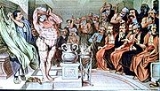
Mugwump

Encyclopedia
The Mugwumps were Republican
political activists who bolted from the United States Republican Party
by supporting Democratic
candidate Grover Cleveland
in the United States presidential election of 1884. They switched parties
because they rejected the financial corruption associated with Republican candidate James G. Blaine. In a close election, the Mugwumps supposedly made the difference in New York state and swung the election to Cleveland. The jocular word mugwump, noted as early as 1832, is from Algonquian (Natick)
mugquomp, "important person, kingpin
" (from mugumquomp, "war leader") implying that they were "sanctimonious" or "holier-than-thou," in holding themselves aloof from party politics.
After the election, mugwump survived for more than a decade as an epithet
for a party bolter in American politics. Many Mugwumps became Democrats or remained independents; most continued to support reform well into the 20th century. During the Third Party System
, party loyalty was in high regard and independents were rare. Theodore Roosevelt
stunned his upper class New York City friends by supporting Blaine in 1884; by rejecting the Mugwumps he kept alive his Republican party leadership, clearing the way for his own political aspirations.
New England
and the Northeastern United States
had been a stronghold of the Republican Party since the Civil War era, but the Mugwumps considered Blaine to be an untrustworthy and fraudulent candidate. Their idealism and reform sensibilities led them to oppose the political corruption in the politics of the Gilded Age
.
," was the issue that angered many reform-minded Republicans, leading them to reject Blaine's candidacy. In the spoils system, the winning candidate would dole out government positions to those who had supported his political party prior to the election. Although the Pendleton Act of 1883 established the United States Civil Service Commission
, and made competency and merit the base qualifications for government positions, its effective implementation was slow. Political affiliation continued to be the basis for appointment to many positions.
In the early 1880s, the issue of political patronage split the Republican Party down the middle for several consecutive sessions of Congress. The party was divided into two warring factions, each with creative names. The side that held the upper hand in numbers and popular support were the Half-Breeds
, led by Senator James Blaine of Maine
. The Half-Breeds supported civil service
reform, and often blocked legislation and political appointments put forth by their main congressional opponents, the stalwarts, led by Roscoe Conkling
of New York
.
Ironically, Blaine was from the reform wing of his own party, but the Mugwumps rejected his candidacy. This division among Republicans may have contributed to the victory in 1884 of Grover Cleveland
, the first president elected from the Democratic party since the Civil War. In the period from 1876 to 1892, presidential elections were closely contested at the national level, but the states themselves were mostly dominated by a single party, with Democrats prevailing in the South and the Republicans in the Northeast. Although the defection of the Mugwumps may have helped Cleveland win in New York
, one of the few closely contested states, historians attribute Cleveland's victory nationwide to the rising power of urban immigrant voters.
Mugwumps tended to come from old Protestant families of New York
and New England, and often from inherited wealth. They belonged to or identified with the emerging business and professional elite, and were often members of the most exclusive clubs. Yet they felt threatened by the rise of machine politics, one aspect of which was the spoils system, and by the rising power of immigrants in American society. They excelled as authors and essayists, yet their writings indicated their social position and class loyalties. In politics, they tended to be ineffectual and unsuccessful, unable and unwilling to operate effectively in a political environment where patronage was the norm.
In a more recent work, historian David Tucker (1998) attempts to rehabilitate the Mugwumps. According to Tucker, the Mugwumps embodied the liberalism
of the 19th century, and their rejection by 20th century historians, who embraced the government intervention of the New Deal
and the Great Society
, is not surprising. To Tucker, their eloquent writings speak for themselves, and are testament to a high minded civic morality.
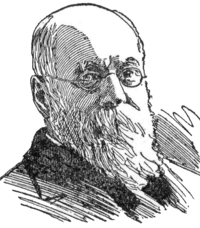
word meaning "person of importance" or "war leader." Charles Anderson Dana
, the colorful newspaperman and editor of the now-defunct New York Sun, is said to have given the Mugwumps their political moniker. Dana made the term plural and derided them as amateurs and public moralists.
During the 1884 campaign, they were often portrayed as "fence-sitters," with part of their body on the side of the Democrats and the other on the side of the Republicans. (Their "mug" on one side of the fence, and their "wump" [comic mispronunciation of "rump"] on the other.) Angry Republicans like Roscoe Conkling
sometimes hinted they were homosexual, calling them "man milliners."
The epithet "goody-goody" from the 1890s goo-goo
, a corruption of "good government", was used in a similar derogatory manner. Whereas mugwump has become an obscure and almost forgotten political moniker, goo-goo has been revived, especially in Chicago
, by the political columns of the late Mike Royko
.
History of the United States Republican Party
The United States Republican Party is the second oldest currently existing political party in the United States after its great rival, the Democratic Party. It emerged in 1854 to combat the Kansas Nebraska Act which threatened to extend slavery into the territories, and to promote more vigorous...
political activists who bolted from the United States Republican Party
Republican Party (United States)
The Republican Party is one of the two major contemporary political parties in the United States, along with the Democratic Party. Founded by anti-slavery expansion activists in 1854, it is often called the GOP . The party's platform generally reflects American conservatism in the U.S...
by supporting Democratic
History of the United States Democratic Party
The history of the Democratic Party of the United States is an account of the oldest political party in the United States and arguably the oldest democratic party in the world....
candidate Grover Cleveland
Grover Cleveland
Stephen Grover Cleveland was the 22nd and 24th president of the United States. Cleveland is the only president to serve two non-consecutive terms and therefore is the only individual to be counted twice in the numbering of the presidents...
in the United States presidential election of 1884. They switched parties
Party switching
Party-switching is any change in political party affiliation of a partisan public figure, usually one currently holding elected office.In many countries, party-switching takes the form of politicians refusing to support their political parties in coalition governments...
because they rejected the financial corruption associated with Republican candidate James G. Blaine. In a close election, the Mugwumps supposedly made the difference in New York state and swung the election to Cleveland. The jocular word mugwump, noted as early as 1832, is from Algonquian (Natick)
Massachusett language
The Massachusett language was a Native American language, a member of the Algonquian language family. It is also known as Wôpanâak , Natick, and Pokanoket....
mugquomp, "important person, kingpin
Kingpin
Kingpin may refer to:* Kingpin , the pivot in the steering mechanism* Kingpin , a Swedish metal band from the mid-1980s* Kingpin , a satirical chess magazine...
" (from mugumquomp, "war leader") implying that they were "sanctimonious" or "holier-than-thou," in holding themselves aloof from party politics.
After the election, mugwump survived for more than a decade as an epithet
Epithet
An epithet or byname is a descriptive term accompanying or occurring in place of a name and having entered common usage. It has various shades of meaning when applied to seemingly real or fictitious people, divinities, objects, and binomial nomenclature. It is also a descriptive title...
for a party bolter in American politics. Many Mugwumps became Democrats or remained independents; most continued to support reform well into the 20th century. During the Third Party System
Third Party System
The Third Party System is a term of periodization used by historians and political scientists to describe a period in American political history from about 1854 to the mid-1890s that featured profound developments in issues of nationalism, modernization, and race...
, party loyalty was in high regard and independents were rare. Theodore Roosevelt
Theodore Roosevelt
Theodore "Teddy" Roosevelt was the 26th President of the United States . He is noted for his exuberant personality, range of interests and achievements, and his leadership of the Progressive Movement, as well as his "cowboy" persona and robust masculinity...
stunned his upper class New York City friends by supporting Blaine in 1884; by rejecting the Mugwumps he kept alive his Republican party leadership, clearing the way for his own political aspirations.
New England
New England
New England is a region in the northeastern corner of the United States consisting of the six states of Maine, New Hampshire, Vermont, Massachusetts, Rhode Island, and Connecticut...
and the Northeastern United States
Northeastern United States
The Northeastern United States is a region of the United States as defined by the United States Census Bureau.-Composition:The region comprises nine states: the New England states of Connecticut, Maine, Massachusetts, New Hampshire, Rhode Island and Vermont; and the Mid-Atlantic states of New...
had been a stronghold of the Republican Party since the Civil War era, but the Mugwumps considered Blaine to be an untrustworthy and fraudulent candidate. Their idealism and reform sensibilities led them to oppose the political corruption in the politics of the Gilded Age
Gilded Age
In United States history, the Gilded Age refers to the era of rapid economic and population growth in the United States during the post–Civil War and post-Reconstruction eras of the late 19th century. The term "Gilded Age" was coined by Mark Twain and Charles Dudley Warner in their book The Gilded...
.
Patronage and politics
Political patronage, also known as the "spoils systemSpoils system
In the politics of the United States, a spoil system is a practice where a political party, after winning an election, gives government jobs to its voters as a reward for working toward victory, and as an incentive to keep working for the party—as opposed to a system of awarding offices on the...
," was the issue that angered many reform-minded Republicans, leading them to reject Blaine's candidacy. In the spoils system, the winning candidate would dole out government positions to those who had supported his political party prior to the election. Although the Pendleton Act of 1883 established the United States Civil Service Commission
United States Civil Service Commission
The United States Civil Service Commission a three man commission was created by the Pendleton Civil Service Reform Act, which was passed into law on January 16, 1883...
, and made competency and merit the base qualifications for government positions, its effective implementation was slow. Political affiliation continued to be the basis for appointment to many positions.
In the early 1880s, the issue of political patronage split the Republican Party down the middle for several consecutive sessions of Congress. The party was divided into two warring factions, each with creative names. The side that held the upper hand in numbers and popular support were the Half-Breeds
Half-Breed (politics)
The "Half-Breeds" were a political faction of the United States Republican Party that existed in the late 19th century. The Half-Breeds were a moderate-wing group, and they were the opponents of the Stalwarts, the other main faction of the Republican Party. The main issue that separated the...
, led by Senator James Blaine of Maine
Maine
Maine is a state in the New England region of the northeastern United States, bordered by the Atlantic Ocean to the east and south, New Hampshire to the west, and the Canadian provinces of Quebec to the northwest and New Brunswick to the northeast. Maine is both the northernmost and easternmost...
. The Half-Breeds supported civil service
Civil service
The term civil service has two distinct meanings:* A branch of governmental service in which individuals are employed on the basis of professional merit as proven by competitive examinations....
reform, and often blocked legislation and political appointments put forth by their main congressional opponents, the stalwarts, led by Roscoe Conkling
Roscoe Conkling
Roscoe Conkling was a politician from New York who served both as a member of the United States House of Representatives and the United States Senate. He was the leader of the Stalwart faction of the Republican Party and the last person to refuse a U.S. Supreme Court appointment after he had...
of New York
New York
New York is a state in the Northeastern region of the United States. It is the nation's third most populous state. New York is bordered by New Jersey and Pennsylvania to the south, and by Connecticut, Massachusetts and Vermont to the east...
.
Ironically, Blaine was from the reform wing of his own party, but the Mugwumps rejected his candidacy. This division among Republicans may have contributed to the victory in 1884 of Grover Cleveland
Grover Cleveland
Stephen Grover Cleveland was the 22nd and 24th president of the United States. Cleveland is the only president to serve two non-consecutive terms and therefore is the only individual to be counted twice in the numbering of the presidents...
, the first president elected from the Democratic party since the Civil War. In the period from 1876 to 1892, presidential elections were closely contested at the national level, but the states themselves were mostly dominated by a single party, with Democrats prevailing in the South and the Republicans in the Northeast. Although the defection of the Mugwumps may have helped Cleveland win in New York
New York
New York is a state in the Northeastern region of the United States. It is the nation's third most populous state. New York is bordered by New Jersey and Pennsylvania to the south, and by Connecticut, Massachusetts and Vermont to the east...
, one of the few closely contested states, historians attribute Cleveland's victory nationwide to the rising power of urban immigrant voters.
Historical appraisals
Several historians of the 1960s and 1970s portrayed the Mugwumps as members of an insecure elite, one that felt threatened by changes in American society. These historians often focused on the social background and status of their subjects, and the narratives they have written share a common outlook.Mugwumps tended to come from old Protestant families of New York
New York
New York is a state in the Northeastern region of the United States. It is the nation's third most populous state. New York is bordered by New Jersey and Pennsylvania to the south, and by Connecticut, Massachusetts and Vermont to the east...
and New England, and often from inherited wealth. They belonged to or identified with the emerging business and professional elite, and were often members of the most exclusive clubs. Yet they felt threatened by the rise of machine politics, one aspect of which was the spoils system, and by the rising power of immigrants in American society. They excelled as authors and essayists, yet their writings indicated their social position and class loyalties. In politics, they tended to be ineffectual and unsuccessful, unable and unwilling to operate effectively in a political environment where patronage was the norm.
In a more recent work, historian David Tucker (1998) attempts to rehabilitate the Mugwumps. According to Tucker, the Mugwumps embodied the liberalism
Liberalism
Liberalism is the belief in the importance of liberty and equal rights. Liberals espouse a wide array of views depending on their understanding of these principles, but generally, liberals support ideas such as constitutionalism, liberal democracy, free and fair elections, human rights,...
of the 19th century, and their rejection by 20th century historians, who embraced the government intervention of the New Deal
New Deal
The New Deal was a series of economic programs implemented in the United States between 1933 and 1936. They were passed by the U.S. Congress during the first term of President Franklin D. Roosevelt. The programs were Roosevelt's responses to the Great Depression, and focused on what historians call...
and the Great Society
Great Society
The Great Society was a set of domestic programs in the United States promoted by President Lyndon B. Johnson and fellow Democrats in Congress in the 1960s. Two main goals of the Great Society social reforms were the elimination of poverty and racial injustice...
, is not surprising. To Tucker, their eloquent writings speak for themselves, and are testament to a high minded civic morality.
Origin of the term
Dictionaries report that "mugguomp" is an AlgonquianAlgonquian languages
The Algonquian languages also Algonkian) are a subfamily of Native American languages which includes most of the languages in the Algic language family. The name of the Algonquian language family is distinguished from the orthographically similar Algonquin dialect of the Ojibwe language, which is a...
word meaning "person of importance" or "war leader." Charles Anderson Dana
Charles Anderson Dana
Charles Anderson Dana was an American journalist, author, and government official, best known for his association with Ulysses S. Grant during the American Civil War and his aggressive political advocacy after the war....
, the colorful newspaperman and editor of the now-defunct New York Sun, is said to have given the Mugwumps their political moniker. Dana made the term plural and derided them as amateurs and public moralists.
During the 1884 campaign, they were often portrayed as "fence-sitters," with part of their body on the side of the Democrats and the other on the side of the Republicans. (Their "mug" on one side of the fence, and their "wump" [comic mispronunciation of "rump"] on the other.) Angry Republicans like Roscoe Conkling
Roscoe Conkling
Roscoe Conkling was a politician from New York who served both as a member of the United States House of Representatives and the United States Senate. He was the leader of the Stalwart faction of the Republican Party and the last person to refuse a U.S. Supreme Court appointment after he had...
sometimes hinted they were homosexual, calling them "man milliners."
The epithet "goody-goody" from the 1890s goo-goo
Goo-goos
The goo-goos, or good government guys, were political groups founded in an era when urban municipal governments in the United States were dominated by machine politics. Goo-goos supported candidates who would fight for political reform...
, a corruption of "good government", was used in a similar derogatory manner. Whereas mugwump has become an obscure and almost forgotten political moniker, goo-goo has been revived, especially in Chicago
Chicago
Chicago is the largest city in the US state of Illinois. With nearly 2.7 million residents, it is the most populous city in the Midwestern United States and the third most populous in the US, after New York City and Los Angeles...
, by the political columns of the late Mike Royko
Mike Royko
Michael "Mike" Royko was a newspaper columnist in Chicago, who won the 1972 Pulitzer Prize for commentary...
.
Noteworthy Mugwumps
- Charles Francis Adams, Jr.Charles Francis Adams, Jr.Charles Francis Adams II was a member of the prominent Adams family, and son of Charles Francis Adams, Sr. He served as a colonel in the Union Army during the American Civil War...
, president of the Union Pacific RailroadUnion Pacific RailroadThe Union Pacific Railroad , headquartered in Omaha, Nebraska, is the largest railroad network in the United States. James R. Young is president, CEO and Chairman....
and the American Historical AssociationAmerican Historical AssociationThe American Historical Association is the oldest and largest society of historians and professors of history in the United States. Founded in 1884, the association promotes historical studies, the teaching of history, and the preservation of and access to historical materials... - Henry Adams, author
- Edward Atkinson, entrepreneur and business executive
- Charles William EliotCharles William EliotCharles William Eliot was an American academic who was selected as Harvard's president in 1869. He transformed the provincial college into the preeminent American research university...
, President of Harvard UniversityHarvard UniversityHarvard University is a private Ivy League university located in Cambridge, Massachusetts, United States, established in 1636 by the Massachusetts legislature. Harvard is the oldest institution of higher learning in the United States and the first corporation chartered in the country... - E. L. Godkin, editor of The NationThe NationThe Nation is the oldest continuously published weekly magazine in the United States. The periodical, devoted to politics and culture, is self-described as "the flagship of the left." Founded on July 6, 1865, It is published by The Nation Company, L.P., at 33 Irving Place, New York City.The Nation...
- Thomas NastThomas NastThomas Nast was a German-born American caricaturist and editorial cartoonist who is considered to be the "Father of the American Cartoon". He was the scourge of Boss Tweed and the Tammany Hall machine...
, political cartoonist - Carl SchurzCarl SchurzCarl Christian Schurz was a German revolutionary, American statesman and reformer, and Union Army General in the American Civil War. He was also an accomplished journalist, newspaper editor and orator, who in 1869 became the first German-born American elected to the United States Senate.His wife,...
, former Senator from Missouri and Secretary of the Interior, editor of the Saturday Evening Post - Moorfield StoreyMoorfield StoreyMoorfield Storey was an American lawyer, publicist, and civil rights leader. According to Storey's biographer, William B...
, lawyer and NAACP president from 1909–1915 - William Graham SumnerWilliam Graham SumnerWilliam Graham Sumner was an American academic and "held the first professorship in sociology" at Yale College. For many years he had a reputation as one of the most influential teachers there. He was a polymath with numerous books and essays on American history, economic history, political...
, social scientist, Yale UniversityYale UniversityYale University is a private, Ivy League university located in New Haven, Connecticut, United States. Founded in 1701 in the Colony of Connecticut, the university is the third-oldest institution of higher education in the United States... - Mark TwainMark TwainSamuel Langhorne Clemens , better known by his pen name Mark Twain, was an American author and humorist...
, author, self-identified as a Mugwump in his essay, Christian ScienceChristian Science (book)Christian Science is a highly critical essay published in 1907 by Mark Twain, on the beliefs of Christian Scientists. His biographer Paine suggested that Twain had reversed his stance later in life; but, this is unlikely, from his other statements:... - Horace WhiteHorace WhiteHorace White was an American lawyer and politician from New York. He was the 37th Governor of New York in 1910.-Life:...
, editor of the Chicago TribuneChicago TribuneThe Chicago Tribune is a major daily newspaper based in Chicago, Illinois, and the flagship publication of the Tribune Company. Formerly self-styled as the "World's Greatest Newspaper" , it remains the most read daily newspaper of the Chicago metropolitan area and the Great Lakes region and is...