

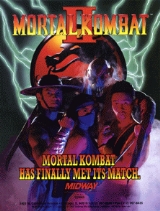
Mortal Kombat II

Encyclopedia
Mortal Kombat II is a competitive fighting game
originally produced by Midway Games
for the arcades
in . It is the second game in the Mortal Kombat series. Like its predecessor, various home versions were produced. The game was a great commercial and critical success.
in the first Mortal Kombat
game, the evil sorcerer Shang Tsung
begs his master, Shao Kahn
, to spare his life. He tells Shao Kahn that the invitation for Mortal Kombat cannot be turned down, and if they hold it in Outworld, the Earthrealm warriors must attend. Kahn agrees to this plan, and even restores Tsung's youth. He then extends the invitation to Raiden, who gathers his warriors and takes them into Outworld. The new tournament is much more dangerous, as Shao Kahn has the home field advantage, and an Outworld victory will allow him to subdue Earthrealm.
of Mortal Kombat II is an extension of the previous game. Normal moves have been expanded: a crouching punch was added, and low and high kicks became differentiated be it crouching or standing up; the roundhouse kick
was made more powerful and knocks opponents across the screen. Additionally returning characters gained new special moves and the game marked introduction of multiple Fatalities
(post-match animations of the victorious characters executing their defeated foes), as well as additional, non-lethal finishing moves to the franchise. However, each character still shared generic attributes – speed, power, jump height and airtime – and although having different hitboxes, all normal moves were the same between each character. The game also plays slightly faster and more smoothly.
As with its predecessor, matches are divided into rounds, and the first player to win two rounds by fully depleting their opponent's life bar is the winner; at this point the losing player's character will become dazed and the winner is given the opportunity of using a finishing move. In addition to the Fatalities of its predecessor, MKII offers Babalities (turning the opponent into a crying baby), Friendships (a non-malicious interaction, such as dancing or giving a gift to the defeated opponent) and stage-specific Fatalities (the winner uppercutting his or her opponent into an abyss below, spikes above, or a pool of acid in the background). This game drops the point system from its predecessor, in favor of a consecutive win tally.
Both the theme and art style of Mortal Kombat II are slightly darker, although with a more vibrant color palette employed and a much richer color depth
than in the previous game. MKII also strays from the strongly orient
al theme of its predecessor, though it does retain the original motif in some aspects, as in some of the music. Finally, the nature of the game became less serious with the addition of trivial and "joke" alternative finishing moves.

Returning characters
According to GamePro
ProStrategy Guide for Mortal Kombat II, while Jax was the best overall fighter in the game, Mileena's "massive advantage" over him made her number one. Reptile was ranked as the worst MKII fighter.
Hidden opponents
Sonya and Kano are the only playable characters from the first Mortal Kombat to not return as regular fighters, though they do appear in the background of the Kahn's Arena stage, chained and on display (according to Acclaim Entertainment
, Sonya was "chucked out" from the game in favour of Mileena and Kitana as part of revamping the game, so it would better compete against Street Fighter II
). There was also supposed to be another bonus character, played by Kyu Hwang, but his role was cut out of the game. It is impossible to perform a Fatality against the defeated bosses and secret characters.
, MKII was "intended to look different than the original MK" and "had everything we wanted to put into MK but didn't have time for". Acclaim Entertainment stated that it "had started Mortal Kombat II with a $10 million global marketing campaign." A part of this sum was used to make and air the live-action TV commercial, created by David Anderson and Bob Keen
.
To create the character animations for the game, actors were placed in front of a gray background and performed the motions, which were recorded on a Hi-8 videotape
, which had been upgraded since the development of the first title from standard to broadcast-quality. The video capture
footage was then processed into a computer, and the background was removed from selected frames to create 64 or 128 color sprites
. Towards the end of Mortal Kombat IIs development, they opted to instead use a chroma key
technique and processed the footage directly into the computer for a similar, simpler process. The actors were sprayed lightly with water to give them a sweaty, glistening appearance, while post-editing was done on the sprites afterward to highlight flesh tones and improve the visibility of muscles, which John Tobias
felt set the series apart from similar games using digitized
graphics. Animations of Shang Tsung morphing into other characters were created by Midway's John Vogel using a computer, while hand-drawn animations were put into effect for other parts of the game, such as the Fatalities.
Care was taken during the programming process to give the game a "good feel", with Boon simulating elements such as gravity into the game's design. Tobias noted that the previous game's reliance on juggling the opponent in the air with successive hits was an accident, and had been tightened in Mortal Kombat II. Boon noted the reason to not completely remove it in favor of a different system of chaining attacks together was to set the game apart from titles such as Street Fighter
, and allow for players to devise their own combinations of attacks. Many attacks were kept uniform between characters to prevent from over-complicating gameplay. Due to memory limitations and the development team's desire to introduce more new characters, two fighters from the original Mortal Kombat, Sonya Blade and Kano, whom Boon cited as the least-picked characters in the game, were excluded.
All of the music was composed, performed, recorded and mixed by Dan Forden
, the MK series' sound designer and composer. Mortal Kombat II was the first arcade game to use the Williams DCS
sound system. All Mortal Kombat arcade games to follow would use this sound board, dropping the original Mortal Kombats inferior Yamaha
sound board.
 Mortal Kombat II: Music from the Arcade Game Soundtrack, an album featuring music from Mortal Kombat II and Mortal Kombat was released in July 1994. It could only be purchased by ordering it through a limited CD offer posted on the arcade version of the game's attract mode.
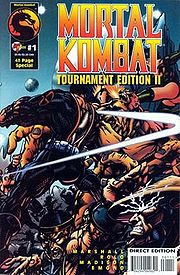
In conjunction with the release of the arcade game in 1993, an official comic book Mortal Kombat II Collector's Edition, written and illustrated by the game's designer John Tobias, was available through mail order
, describing the backstory of the game in a greater detail. Malibu Comics
also published a series of Mortal Kombat comic books featuring the characters from both MKII and the original MK. Other merchandise included a series of collectible stickers by Panini Group
and two series of action figures, in Argentina
(1995) and the USA (1999). The Mortal Kombat Kard Game
, released in September 1994, was also marketed as "Mortal Kombat II trading cards".
Goro's Lair, the secret characters' arena, was removed and replaced with a blue palette swap of the portal stage. Additionally, the ending screens with pictures of the characters have all been removed, instead the ending text scrolls over the character doing his/her victory stance. Some of the arenas are also noticeably missing some details (for example, in Kombat Tomb the dragons which can usually be seen flying in the background have been removed, as well as the monk levitating in front of the round window in The Tower stage).
Despite its shortcomings, the Mega Drive/Genesis port contains several exclusive Easter egg
s. By activating a cheat menu in the options screen, Dan Forden's "Toasty" image is replaced by a crudely drawn sprite
inserted by one of Probe Entertainment's programmers. This image, apparently drawn by the programmer's son, was intended as an alternative graphic to the Dan Forden toasty image and a way to connect the game to Probe, rather than Midway; however, in the final code, the sprite wasn't used. (In all cases, the "Toasty!" sound remains unchanged.) Also, if an option entitled "Oooh Nasty!" is enabled in the cheat screen, the player could perform a "Fergality." The player needed to select Raiden and be fighting on the Armory stage to perform it; when successfully executed, the opponent would then transform into a smoking character with an oversized head of former founder and CEO of Probe Entertainment, Fergus McGovern. This port also includes some character animation differences (for example Baraka's winning stance ends with him bowing forward with his swords pointing down, instead him standing straight with his swords crossed over his chest, and Johnny Cage's victory stance has him raise his hands up). Additionally, this port includes support for the little-known Sega Activator controller device.
The Mega Drive version was very well received; Computer + Video Games
rated it at 97%, while GamesMaster
gave it 94%.
. This particular port has a secret intro (in which a scene between Shao Khan and Kintaro will take place during the Acclaim logo), and an unlockable special team mode. Also in this port is the use of the Super Nintendo's Mode 7
, a graphics mode that allows the scaling and rotation of a single background on a scanline-by-scanline basis, during the overhead fall on the Pit II's Stage Fatality: when the opponent is falling, the background scales forward and rotates slightly counter-clockwise (in the arcade, the background only scaled forward).
However, the sprites throughout the game look like they've been painted rather than photographed due to the image distortion resulted from the down scaling required to match the console's 256x224 display resolution. The Super NES had a larger color palette than most other ports of the game so as to not have the visuals look grainy. Sound and music was mostly considered the best when compared to most other ports of the game, but there were still some compromises made because of memory limitations. The music is more downbeat and faded in contrast to the Mega Drive/Genesis' upbeat version.
Unlike the Super NES port of the original Mortal Kombat, Nintendo
didn't censor the blood and Fatalities this time around (the reason for this were poor SNES sales of the censored version of the previous MK game). However, they put a warning label on the game's box in order to inform parents about the game's mature content. The Japanese version, however, is censored to a degree, with green blood for all fighters, as well as the screen colors turning black and white for Fatalities (with the exception of Stage Fatalities).
The U.S. had two different versions released. The second release fixed some major bugs, such as enabling the player to reach Noob Saibot after 50 wins. A new company logo is shown at startup (which makes it easy to identify version 1.1 from 1.0, except for the European versions which always had the logo, the North American V1.0 did not) and gameplay demos will run if the game is left alone long enough. Johnny Cage's "Shadow Kick" will randomly leave a red trail rather than the usual green.
version of the first game but only contained eight of the twelve playable fighters from the arcade game (lacking Raiden, Baraka, Johnny Cage, and Kung Lao). Shao Kahn was featured as the final boss, but Kintaro was completely removed from the game (he was going to be in, however, and text for him can be found in the ROM
). Hidden opponents Jade and Smoke also appear in this port, although Noob Saibot does not. Only three of ten arenas remain from the arcade: the Kombat Tomb, the Pit II and Goro's Lair. The Kombat Tomb contained the port's only Stage Fatality and Goro's Lair, like the arcade version, was used exclusively when fighting hidden opponents; Goro's Lair was much simpler in this version and consisted of a brick wall with no openings or glowing eyes. Blood was completely removed, but each character retained a version of one of their Fatalities and the Babality finishing moves.
Unlike the Game Boy port, blood was present, but drastically reduced in quantity from the other ports. It's also noticeable that, because of the limited graphical resources the systems could manage, some of the Fatalities in the game were altered to completely destroy the opponent's body (except for the generic gibs such as bones and assorted limbs used for all the characters). For example, Sub-Zero's "Deep Freeze" Fatality would no longer split the victim in half, instead pulverizing them completely. Some of the Fatalities were simplified to use common animations; for example, Liu Kang's Dragon transformation would scorch the opponent with a fireball (similar to the one in Scorpion's "Toasty!" Fatality), instead of eating his/her upper body.
port of Mortal Kombat II was released at the end of 1994, developed by Probe Entertainment. The Amiga version had sprite sizes and gameplay nearly identical to the Mega Drive/Genesis version, but lacked multi-layered scrolling backgrounds and used only or two buttons for controls.
Critical reception of this version was mostly favorable, with the scores ranging from CU Amiga Magazine' s 95% (Superstar award) to Amiga Computing
' s 80% (Gold Award), though the review in Amiga Power
was unusually negative, rating it only 63%.
The Japanese port received a subtitle and was named JP
, the subtitle being the specific Japanese terminology for the Fatality moves.
This port wasn't without its flaws. Probe Entertainment chose not to use the PC's CD audio capability for the music, converting the music into synthesized form instead, however, music quality varied depending on what type of sound card was installed, ranging from the average quality Sound Blaster's synthesizer
to the high quality Roland LAPC-I
and Gravis Ultrasound
. A later CD-ROM re-release of the game did have CD audio soundtrack fully reproducing the original arcade music tracks.
. While the graphics in this port remained close to the quality of those featured in the arcade game, the sound quality did not. Instead of utilizing the CD-ROM format and using CD audio tracks, the game used the PlayStation's own SPU internal sound chip.
The loading times for the Japanese PS port could be excessively long, at times. When performing certain actions (such as Shang Tsung's morph ability), game play would cease and the Mortal Kombat II symbol would be displayed for 1 to 2 seconds, rather than being instant, as in some other versions. Another loading delay during Stage Fatalities on Pit II caused characters to continue screaming even after hitting the ground.
. This version was an emulation of the original Mortal Kombat II arcade game, rather than a port. As a result, this version plays closer to the original Mortal Kombat II arcade game than any version released previous to it. Unfortunately, it suffers from a common graphical bug: each characters' shadow sprites flicker. Music and sound effects are also prone to cutting out or playing out of sync. Finally, due to a control mapping issue involving the "Start" button, it is impossible to fight Smoke, though the "random select" can still be activated.
It also saw a release on the Sony PSP
in Midway Arcade Treasures: Extended Play, but contained graphical errors similar to those in Midway Arcade Treasures 2. Additionally, the game suffers from a removal of certain graphics and heavy loading times.
in identical quality to the edition released in Midway Arcade Treasures 2. It can also be unlocked by doing Smoke's missions.
, The Mask
and The Lion King
. Critical reception of MKII at the time of its release was mostly very favorable: the game's average ratings at GameRankings are 85.63% for Genesis version and 85.87% on SNES, yet only 61.75% for the flawed Game Boy port. Sega Visions
called the way in which the sequel was directed as "sheer brillance". In 2008, Destructoid
called it "the best game to ever grace arcades". As late as 2009, many Mortal Kombat fans still considered MKII to be the best title in entire series. Over the years, many other gaming publications also featured Mortal Kombat II on the various lists of the top video games of all time. (Some examples of this are bolded out in the table to the right.)
regarding violent video games. For the same reason, the game won the title of the bloodiest game of 1994 by Electronic Gaming Monthly
and in 2006 IGN
named Jax's "Arm Rip" Fatality as the #10 best gore
effect in the video game history. In September 1994 Mortal Kombat II was put on the German
index of the works allegedly harmful to young people by the Bundesprüfstelle für jugendgefährdende Medien
. In February 1995 all versions of the game except this for Game Boy were confiscated from the German market for violating §131 of Germany's penal code, that is for showing gruesome violence against humans (the ban ended in February 2005, due to the 10-year limitation for confiscations).
s about secret features and unlockable content, these kinds of myths were particularly rampant among the dedicated fan community of MK II and the MK series. The game's creators did little to dispel the rumors, some of which were even eventually implemented in subsequent MK games. Among these later-adapted rumors were the Animalities - added in Mortal Kombat 3
; the red female ninja character "Scarlet" - introduced as Skarlet in Mortal Kombat (2011); the ability to throw an enemy into a mouth of a living tree - featured in Mortal Kombat: Shaolin Monks; and the incorporation of Blaze, the initially unnamed man-on-fire figure from the background of the Pit II stage, as a secret character in Mortal Kombat: Deadly Alliance
and the final boss in Mortal Kombat: Armageddon
. Other rumors included Kitana's Nudality (or Sexuality) finishing move, which would supposedly have undressed her and Mileena.
and (along with these of Mortal Kombat 3
) for the 2011 fighting game Mortal Kombat.
Fighting game
Fighting game is a video game genre where the player controls an on-screen character and engages in close combat with an opponent. These characters tend to be of equal power and fight matches consisting of several rounds, which take place in an arena. Players must master techniques such as...
originally produced by Midway Games
Midway Games
Midway Games, Inc. is an American company that was formerly a major video game publisher. Following a bankruptcy filing in 2009, it is no longer active and is in the process of liquidating all of its assets. Midway's titles included Mortal Kombat, Ms.Pac-Man, Spy Hunter, Tron, Rampage, the...
for the arcades
Arcade game
An arcade game is a coin-operated entertainment machine, usually installed in public businesses such as restaurants, bars, and amusement arcades. Most arcade games are video games, pinball machines, electro-mechanical games, redemption games, and merchandisers...
in . It is the second game in the Mortal Kombat series. Like its predecessor, various home versions were produced. The game was a great commercial and critical success.
Story
Following his failure to defeat Liu KangLiu Kang
Liu Kang is a video game character in the Mortal Kombat fighting game series. First appearing in the series' first title, Liu Kang is portrayed as a Shaolin monk who enters the Mortal Kombat tournament to save his world, Earthrealm, from being destroyed due to having lost nine consecutive...
in the first Mortal Kombat
Mortal Kombat (video game)
Mortal Kombat is a 1992 fighting-game developed and published by Midway for arcades. In 1993, home versions were released by Acclaim Entertainment. Released in the Fall of 1994, the Microsoft Windows 3.1x version was released by Activision Interactive. It is the first title in the Mortal Kombat...
game, the evil sorcerer Shang Tsung
Shang Tsung
Shang Tsung is a boss and player character in the Mortal Kombat fighting game series. A powerful and deadly sorcerer and a primary antagonist in the Mortal Kombat series, Shang Tsung is a shapeshifter who absorbs the souls of those he slays in order to maintain his youth and power...
begs his master, Shao Kahn
Shao Kahn
Shao Kahn is a boss, announcer and recurring playable character from the Mortal Kombat fighting game series. The main antagonist in the Mortal Kombat series, Shao Kahn is the Emperor of Outworld known for his godlike strength, extreme brutality and knowledge of black magic...
, to spare his life. He tells Shao Kahn that the invitation for Mortal Kombat cannot be turned down, and if they hold it in Outworld, the Earthrealm warriors must attend. Kahn agrees to this plan, and even restores Tsung's youth. He then extends the invitation to Raiden, who gathers his warriors and takes them into Outworld. The new tournament is much more dangerous, as Shao Kahn has the home field advantage, and an Outworld victory will allow him to subdue Earthrealm.
Gameplay
The gameplayGameplay
Gameplay is the specific way in which players interact with a game, and in particular with video games. Gameplay is the pattern defined through the game rules, connection between player and the game, challenges and overcoming them, plot and player's connection with it...
of Mortal Kombat II is an extension of the previous game. Normal moves have been expanded: a crouching punch was added, and low and high kicks became differentiated be it crouching or standing up; the roundhouse kick
Roundhouse kick
A roundhouse kick is a kick in which the attacker swings his leg around in a semicircular motion, striking with the front of the leg or foot. This type of kick is utilized in many different martial arts and is popular in both non-contact and full-contact martial arts competitions...
was made more powerful and knocks opponents across the screen. Additionally returning characters gained new special moves and the game marked introduction of multiple Fatalities
Fatality (Mortal Kombat)
In the Mortal Kombat series of fighting games, a Fatality is a finishing move that can be used against one's defeated opponent at the end of the final match, after the boss character says "Finish Him/Her." The Fatalities are usually lethal, featuring a brutal and morbid execution of the defenseless...
(post-match animations of the victorious characters executing their defeated foes), as well as additional, non-lethal finishing moves to the franchise. However, each character still shared generic attributes – speed, power, jump height and airtime – and although having different hitboxes, all normal moves were the same between each character. The game also plays slightly faster and more smoothly.
As with its predecessor, matches are divided into rounds, and the first player to win two rounds by fully depleting their opponent's life bar is the winner; at this point the losing player's character will become dazed and the winner is given the opportunity of using a finishing move. In addition to the Fatalities of its predecessor, MKII offers Babalities (turning the opponent into a crying baby), Friendships (a non-malicious interaction, such as dancing or giving a gift to the defeated opponent) and stage-specific Fatalities (the winner uppercutting his or her opponent into an abyss below, spikes above, or a pool of acid in the background). This game drops the point system from its predecessor, in favor of a consecutive win tally.
Both the theme and art style of Mortal Kombat II are slightly darker, although with a more vibrant color palette employed and a much richer color depth
Color depth
In computer graphics, color depth or bit depth is the number of bits used to represent the color of a single pixel in a bitmapped image or video frame buffer. This concept is also known as bits per pixel , particularly when specified along with the number of bits used...
than in the previous game. MKII also strays from the strongly orient
Orient
The Orient means "the East." It is a traditional designation for anything that belongs to the Eastern world or the Far East, in relation to Europe. In English it is a metonym that means various parts of Asia.- Derivation :...
al theme of its predecessor, though it does retain the original motif in some aspects, as in some of the music. Finally, the nature of the game became less serious with the addition of trivial and "joke" alternative finishing moves.
Playable characters
New characters- Baraka (Richard DivizioRichard DivizioRichard Divizio is an American actor best known for his work in the Mortal Kombat video game series...
) – Tarkatan nomad warlord responsible for the assault on the Shaolin Monastery. - Jax Briggs (John Parrish) – U.S. Special Forces officer who enters the tournament to rescue his partner Sonya BladeSonya BladeSonya Blade is a player character from the Mortal Kombat series. She is portrayed in the games as an officer of the United States Special Forces.-In video games:...
from Outworld. Jax was originally going to be named Stryker, a name that would later be used for another character in the next sequelMortal Kombat 3Mortal Kombat 3 is a fighting game developed by Midway and released in 1995, first as an arcade game. It is the third game in the Mortal Kombat series...
. - KitanaKitana (Mortal Kombat)Kitana is a recurring player and a one-time boss character in the Mortal Kombat fighting game series. One of the lead characters of the Mortal Kombat saga, Kitana is the princess of the otherdimensional realm of Edenia and the daughter of Queen Sindel...
(Katalin ZamiarKatalin ZamiarKatalin Rodriguez-Ogren is an American martial artist, sportswriter and actress.-Biography:...
) – Female ninja who is an adopted daughter of Shao Kahn, the Emperor of Outworld. She officially fights for the Outworld but secretly is aiding the warriors of Earthrealm. - Kung LaoKung LaoKung Lao is a player character in the Mortal Kombat fighting game series.Kung Lao is a former Shaolin monk and a former member of the White Lotus Society. He stands in the shadow of his great ancestor, the Great Kung Lao, but unlike his great ancestor he has no desire to be champion and would...
(Anthony MarquezAnthony MarquezAnthony Marquez is an Filipino American actor and martial artist from Chicago. Marquez was rated in the North American Sport Karate Association top 10 for 1989, 1990, and 1993. He was also voted for the Rookie of the Year in 1989 by NASKA. Anthony was the NASKA National Chinese Wushu Forms...
) – Shaolin monk, descendant of the Great Kung Lao and close friend of Liu Kang. He seeks to avenge the destruction of the Shaolin temple. - Mileena (Katalin Zamiar) – Kahn's personal assassin, and clone of Kitana with Tarkatan traits. Her mission during the tournament is to ensure the loyalty of her "sister", but she also has plans of her own.
Returning characters
- Sub-ZeroSub-Zero (Mortal Kombat)Sub-Zero is the name given to two video game characters from the Mortal Kombat series. The older Sub-Zero first appeared in the first Mortal Kombat game, being replaced by his younger brother in Mortal Kombat II and the subsequent games...
(Daniel PesinaDaniel PesinaDaniel Pesina is a martial arts expert and a former employee of Midway. He is most recognized as the actor who played Johnny Cage and ninjas Sub-Zero, Scorpion, Reptile, Smoke, and Noob Saibot in Mortal Kombat and Mortal Kombat II.Pesina was fired from Midway in 1994 for wearing Cage's costume in...
) – Male ninja with the power of ice. Later revealed to be the younger brother of the original Sub-Zero, seeking to complete the original Sub-Zero's failed mission. - Johnny CageJohnny CageJohnny Cage, whose real name is John Carlton, is a video game character from the Mortal Kombat fighting game series. Cage is portrayed as a film actor who enters the game's tournament, and provides the comic relief of the franchise....
(Daniel Pesina) – Hollywood actor who joins Liu Kang in his journey to Outworld. - Liu KangLiu KangLiu Kang is a video game character in the Mortal Kombat fighting game series. First appearing in the series' first title, Liu Kang is portrayed as a Shaolin monk who enters the Mortal Kombat tournament to save his world, Earthrealm, from being destroyed due to having lost nine consecutive...
(Ho Sung PakHo Sung PakHo-Sung Pak is an American film actor, martial artist, action choreographer, writer, and producer.-Early life and career:Pak, a Korean American, was born in Seoul, South Korea...
) – Shaolin monk who is the reigning champion of Mortal Kombat. He travels to Outworld to seek vengeance for the death of his Shaolin monastery brothers. - RaidenRaiden (Mortal Kombat)Raiden is a player character in the Mortal Kombat fighting game series. Raiden, also known as Lord Raiden, is a thunder god of the Mortal Kombat universe and protector of Earthrealm. He commands many supernatural abilities such as the ability to teleport, control over lightning, and flight...
(Carlos PesinaCarlos PesinaCarlos Pesina is a skilled martial artist and employee of NetherRealm Studios. He is most recognized as the actor who played Raiden in Mortal Kombat, Mortal Kombat II, and Mortal Kombat Trilogy...
) – Thunder god who returns to Mortal Kombat to stop Kahn's evil plans of taking the Earthrealm for his own. - ReptileReptile (Mortal Kombat)Reptile is a fictional character in the Mortal Kombat series of video games. Created for Midway Games by John Tobias and Ed Boon, Reptile debuted in Mortal Kombat as a hidden boss and appeared in subsequent titles as a playable character. The character has also appeared on various merchandise,...
(Daniel Pesina) – Shang Tsung's personal bodyguard. Previously a palette swapPalette swapA palette swap is a practice used in video games, whereby a graphic that is already used for one element is given a different palette, so it can be reused as other elements. The different palette gives the new graphic a unique set of colors, which make it recognizably distinct from the original...
of Sub-Zero with Scorpion and Sub-Zero's moves, he has been made into a distinct character and given his own moves. - ScorpionScorpion (Mortal Kombat)Scorpion is a recurring player and boss character in the Mortal Kombat fighting game series. He has been a playable character in all the games, with the exception of the original version of Mortal Kombat 3.-In video games:...
(Daniel Pesina) – Hellspawned spectre who returns to the tournament to once again assassinate Sub-Zero. - Shang TsungShang TsungShang Tsung is a boss and player character in the Mortal Kombat fighting game series. A powerful and deadly sorcerer and a primary antagonist in the Mortal Kombat series, Shang Tsung is a shapeshifter who absorbs the souls of those he slays in order to maintain his youth and power...
(Philip Ahn M.D.) – The evil sorcerer who convinced Kahn to spare his life after losing the last tournament, with a new evil plan to appease his master, who in turn restores Tsung's youth. He also serves as a sub-boss of the game, appearing before Kintaro in the single player mode. As in the first game he is able to morph into any of the playable characters, retaining their moves (in some versions only the character against whom he is currently fighting).
According to GamePro
GamePro
GamePro Media was a United States gaming media company publishing online and print content on the video game industry, video game hardware, and video game software developed for a video game console , a computer, and/or a mobile device . GamePro Media properties include GamePro magazine and...
ProStrategy Guide for Mortal Kombat II, while Jax was the best overall fighter in the game, Mileena's "massive advantage" over him made her number one. Reptile was ranked as the worst MKII fighter.
Non-playable characters
New boss and sub-boss- Kintaro (stop-motion) – Kahn's bodyguard, sent by his race to avenge Goro's defeat.
- Shao KahnShao KahnShao Kahn is a boss, announcer and recurring playable character from the Mortal Kombat fighting game series. The main antagonist in the Mortal Kombat series, Shao Kahn is the Emperor of Outworld known for his godlike strength, extreme brutality and knowledge of black magic...
(Brian Glynn, voiced by Steve RitchieSteve RitchieSteven Scott Ritchie is an acclaimed pinball and video game designer. He has been called "The Master of Flow" by pinball aficionados due to the emphasis in his designs on ball speed, loops, and the like....
) – The evil Emperor of Outworld, who wishes to conquer Earthrealm by any means.
Hidden opponents
- Jade (Katalin Zamiar) – Green palette swap of Kitana who is invulnerable to projectiles.
- Noob SaibotNoob SaibotNoob Saibot is a video game character from the Mortal Kombat fighting game series. He debuted as a hidden character in Mortal Kombat II , although the later game Mortal Kombat: Deception established his true identity as that of the original Sub-Zero, who was killed by his nemesis Scorpion after...
(Daniel Pesina) – Dark-silhouetted ninja who is a "lost warrior" from the first MK game. His name stems from the names of MK creators BoonEd BoonEdward J. Boon is an American video game programmer who had been employed for over 15 years at Midway. He now works for Warner Bros...
and TobiasJohn TobiasJohn Tobias is an American comic book artist, graphic designer and video game designer. Along with Ed Boon he is one of the creators of the groundbreaking Mortal Kombat fighting game series....
spelled backwards. He is the original Sub-Zero after being killed by Scorpion. - Smoke (Daniel Pesina) – Gray palette swap of Sub-Zero (though he uses Reptile's fighting stance) who emits puffs of smoke from his body. He also moves faster than other characters.
Sonya and Kano are the only playable characters from the first Mortal Kombat to not return as regular fighters, though they do appear in the background of the Kahn's Arena stage, chained and on display (according to Acclaim Entertainment
Acclaim Entertainment
Acclaim Entertainment was an American video game developer and publisher. It developed, published, marketed and distributed interactive entertainment software for a variety of hardware platforms, including Sega's Mega Drive/Genesis, Saturn, Dreamcast, and Game Gear, Nintendo's NES, SNES, Nintendo...
, Sonya was "chucked out" from the game in favour of Mileena and Kitana as part of revamping the game, so it would better compete against Street Fighter II
Street Fighter II
is a competitive fighting game originally released for the arcades in . It is the arcade sequel to the original Street Fighter released in and was Capcom's fourteenth title that ran on the CP System arcade hardware...
). There was also supposed to be another bonus character, played by Kyu Hwang, but his role was cut out of the game. It is impossible to perform a Fatality against the defeated bosses and secret characters.
Development and promotion
According to its lead programmer Ed BoonEd Boon
Edward J. Boon is an American video game programmer who had been employed for over 15 years at Midway. He now works for Warner Bros...
, MKII was "intended to look different than the original MK" and "had everything we wanted to put into MK but didn't have time for". Acclaim Entertainment stated that it "had started Mortal Kombat II with a $10 million global marketing campaign." A part of this sum was used to make and air the live-action TV commercial, created by David Anderson and Bob Keen
Bob Keen
Robert "Bob" Keen is a British film director. He has directed eight films, including The Lost World, but he has also written screenplays, as well as working on special, visual and make-up effects....
.
To create the character animations for the game, actors were placed in front of a gray background and performed the motions, which were recorded on a Hi-8 videotape
Videotape
A videotape is a recording of images and sounds on to magnetic tape as opposed to film stock or random access digital media. Videotapes are also used for storing scientific or medical data, such as the data produced by an electrocardiogram...
, which had been upgraded since the development of the first title from standard to broadcast-quality. The video capture
Video capture
Video capture is the process of converting an analog video signal—such as that produced by a video camera or DVD player—to digital video. The resulting digital data are computer files referred to as a digital video stream, or more often, simply video stream...
footage was then processed into a computer, and the background was removed from selected frames to create 64 or 128 color sprites
Sprite (computer graphics)
In computer graphics, a sprite is a two-dimensional image or animation that is integrated into a larger scene...
. Towards the end of Mortal Kombat IIs development, they opted to instead use a chroma key
Chroma key
Chroma key compositing is a technique for compositing two images together. A color range in the top layer is made transparent, revealing another image behind. The chroma keying technique is commonly used in video production and post-production...
technique and processed the footage directly into the computer for a similar, simpler process. The actors were sprayed lightly with water to give them a sweaty, glistening appearance, while post-editing was done on the sprites afterward to highlight flesh tones and improve the visibility of muscles, which John Tobias
John Tobias
John Tobias is an American comic book artist, graphic designer and video game designer. Along with Ed Boon he is one of the creators of the groundbreaking Mortal Kombat fighting game series....
felt set the series apart from similar games using digitized
Digitizing
Digitizing or digitization is the representation of an object, image, sound, document or a signal by a discrete set of its points or samples. The result is called digital representation or, more specifically, a digital image, for the object, and digital form, for the signal...
graphics. Animations of Shang Tsung morphing into other characters were created by Midway's John Vogel using a computer, while hand-drawn animations were put into effect for other parts of the game, such as the Fatalities.
Care was taken during the programming process to give the game a "good feel", with Boon simulating elements such as gravity into the game's design. Tobias noted that the previous game's reliance on juggling the opponent in the air with successive hits was an accident, and had been tightened in Mortal Kombat II. Boon noted the reason to not completely remove it in favor of a different system of chaining attacks together was to set the game apart from titles such as Street Fighter
Street Fighter
, commonly abbreviated as SF, is a series of Fighting Games developed in Japan in which the players pit the video games' competitive fighters from around the world, each with his or her own unique fighting style, against one another...
, and allow for players to devise their own combinations of attacks. Many attacks were kept uniform between characters to prevent from over-complicating gameplay. Due to memory limitations and the development team's desire to introduce more new characters, two fighters from the original Mortal Kombat, Sonya Blade and Kano, whom Boon cited as the least-picked characters in the game, were excluded.
All of the music was composed, performed, recorded and mixed by Dan Forden
Dan Forden
Daniel "Dan" Warner "Toasty" Forden is an American sound programmer and music composer, and was the lead programmer on several high-profile arcade and pinball games...
, the MK series' sound designer and composer. Mortal Kombat II was the first arcade game to use the Williams DCS
Digital Compression System
Digital Compression System, or DCS, is a sound system developed by Williams Electronics. This advanced sound board, used for Williams and Bally pinball games and coin-op arcade video games by Midway Manufacturing, became the standard sound system for these names.The DCS Sound system was created by...
sound system. All Mortal Kombat arcade games to follow would use this sound board, dropping the original Mortal Kombats inferior Yamaha
Yamaha (manufacturer)
is a multinational corporation and conglomerate based in Japan with a wide range of products and services, predominantly musical instruments, electronics, motorcycles and power sports equipment.-History:...
sound board.
Soundtrack and merchandise
In conjunction with the release of the arcade game in 1993, an official comic book Mortal Kombat II Collector's Edition, written and illustrated by the game's designer John Tobias, was available through mail order
Mail order
Mail order is a term which describes the buying of goods or services by mail delivery. The buyer places an order for the desired products with the merchant through some remote method such as through a telephone call or web site. Then, the products are delivered to the customer...
, describing the backstory of the game in a greater detail. Malibu Comics
Malibu Comics
Malibu Comics was an American comic book publisher active in the late 1980s and early 1990s, best known for its Ultraverse line of superhero titles. The company's headquarters was in Calabasas, California. Malibu imprints included Aircel Comics and Eternity Comics...
also published a series of Mortal Kombat comic books featuring the characters from both MKII and the original MK. Other merchandise included a series of collectible stickers by Panini Group
Panini Group
Panini Group is a company headquartered in Modena, Italy, named after the Panini brothers who founded it in 1961. The company produces books, comics, magazines, stickers, trading cards and other items through its collectibles and publishing subsidiaries. Panini distributes its own products, and...
and two series of action figures, in Argentina
Argentina
Argentina , officially the Argentine Republic , is the second largest country in South America by land area, after Brazil. It is constituted as a federation of 23 provinces and an autonomous city, Buenos Aires...
(1995) and the USA (1999). The Mortal Kombat Kard Game
Mortal Kombat Kard Game
Mortal Kombat Kard Game is a collectible card game released in 1995 by BradyGames in cooperation with Midway Games. It is based on the Mortal Kombat video game series, it however did not contain excessive violence like its video game counterparts.-Game:...
, released in September 1994, was also marketed as "Mortal Kombat II trading cards".
Sega Mega Drive/Genesis
Developed by Probe Entertainment, this port retained all of the blood and Fatalities without a special code having to be entered, unlike the original Mortal Kombat for the system. The game play is faster than the original arcade version. However, the visuals are not as brightly colored due to the system's limited color palette. All of the characters' shadows are rendered as an oval instead of the normal silhouette and, because of memory limitations, some voice recordings were left out. The music is more upbeat and the arrangement is markedly different in this game as opposed to the original arcade version because the music is synthesized by the console's synthesizer, and some of the background music is no longer played with its intended stages.Goro's Lair, the secret characters' arena, was removed and replaced with a blue palette swap of the portal stage. Additionally, the ending screens with pictures of the characters have all been removed, instead the ending text scrolls over the character doing his/her victory stance. Some of the arenas are also noticeably missing some details (for example, in Kombat Tomb the dragons which can usually be seen flying in the background have been removed, as well as the monk levitating in front of the round window in The Tower stage).
Despite its shortcomings, the Mega Drive/Genesis port contains several exclusive Easter egg
Easter egg
Easter eggs are special eggs that are often given to celebrate Easter or springtime.The oldest tradition is to use dyed or painted chicken eggs, but a modern custom is to substitute chocolate eggs, or plastic eggs filled with confectionery such as jelly beans...
s. By activating a cheat menu in the options screen, Dan Forden's "Toasty" image is replaced by a crudely drawn sprite
Sprite (computer graphics)
In computer graphics, a sprite is a two-dimensional image or animation that is integrated into a larger scene...
inserted by one of Probe Entertainment's programmers. This image, apparently drawn by the programmer's son, was intended as an alternative graphic to the Dan Forden toasty image and a way to connect the game to Probe, rather than Midway; however, in the final code, the sprite wasn't used. (In all cases, the "Toasty!" sound remains unchanged.) Also, if an option entitled "Oooh Nasty!" is enabled in the cheat screen, the player could perform a "Fergality." The player needed to select Raiden and be fighting on the Armory stage to perform it; when successfully executed, the opponent would then transform into a smoking character with an oversized head of former founder and CEO of Probe Entertainment, Fergus McGovern. This port also includes some character animation differences (for example Baraka's winning stance ends with him bowing forward with his swords pointing down, instead him standing straight with his swords crossed over his chest, and Johnny Cage's victory stance has him raise his hands up). Additionally, this port includes support for the little-known Sega Activator controller device.
The Mega Drive version was very well received; Computer + Video Games
Computer and video games
A video game is an electronic game that involves human interaction with a user interface to generate visual feedback on a video device. The word video in video game traditionally referred to a raster display device, but following popularization of the term "video game", it now implies any type of...
rated it at 97%, while GamesMaster
GamesMaster (magazine)
GamesMaster is a monthly multi-format computer and video game magazine published by Future Publishing in the United Kingdom.GamesMaster is the biggest selling multi-format video games magazine in the United Kingdom, outselling its sister publication Edge.-History:The magazine was launched in...
gave it 94%.
Super Nintendo Entertainment System
This port was developed by Sculptured SoftwareSculptured Software
Sculptured Software Inc. was a late twentieth century video game developer in the Salt Lake City, Utah metropolitan area. They specialized in porting games to different platforms, especially from arcade games to home console games.-History:...
. This particular port has a secret intro (in which a scene between Shao Khan and Kintaro will take place during the Acclaim logo), and an unlockable special team mode. Also in this port is the use of the Super Nintendo's Mode 7
Mode 7
Mode 7 is a graphics mode on the Super NES video game console that allows a background layer to be rotated and scaled on a scanline-by-scanline basis to create many different effects. The most famous of these effects this can create is the application of a perspective effect on a background layer...
, a graphics mode that allows the scaling and rotation of a single background on a scanline-by-scanline basis, during the overhead fall on the Pit II's Stage Fatality: when the opponent is falling, the background scales forward and rotates slightly counter-clockwise (in the arcade, the background only scaled forward).
However, the sprites throughout the game look like they've been painted rather than photographed due to the image distortion resulted from the down scaling required to match the console's 256x224 display resolution. The Super NES had a larger color palette than most other ports of the game so as to not have the visuals look grainy. Sound and music was mostly considered the best when compared to most other ports of the game, but there were still some compromises made because of memory limitations. The music is more downbeat and faded in contrast to the Mega Drive/Genesis' upbeat version.
Unlike the Super NES port of the original Mortal Kombat, Nintendo
Nintendo
is a multinational corporation located in Kyoto, Japan. Founded on September 23, 1889 by Fusajiro Yamauchi, it produced handmade hanafuda cards. By 1963, the company had tried several small niche businesses, such as a cab company and a love hotel....
didn't censor the blood and Fatalities this time around (the reason for this were poor SNES sales of the censored version of the previous MK game). However, they put a warning label on the game's box in order to inform parents about the game's mature content. The Japanese version, however, is censored to a degree, with green blood for all fighters, as well as the screen colors turning black and white for Fatalities (with the exception of Stage Fatalities).
The U.S. had two different versions released. The second release fixed some major bugs, such as enabling the player to reach Noob Saibot after 50 wins. A new company logo is shown at startup (which makes it easy to identify version 1.1 from 1.0, except for the European versions which always had the logo, the North American V1.0 did not) and gameplay demos will run if the game is left alone long enough. Johnny Cage's "Shadow Kick" will randomly leave a red trail rather than the usual green.
Game Boy
Developed by Probe Entertainment, this port is superior to the Game BoyGame Boy
The , is an 8-bit handheld video game device developed and manufactured by Nintendo. It was released in Japan on , in North America in , and in Europe on...
version of the first game but only contained eight of the twelve playable fighters from the arcade game (lacking Raiden, Baraka, Johnny Cage, and Kung Lao). Shao Kahn was featured as the final boss, but Kintaro was completely removed from the game (he was going to be in, however, and text for him can be found in the ROM
Read-only memory
Read-only memory is a class of storage medium used in computers and other electronic devices. Data stored in ROM cannot be modified, or can be modified only slowly or with difficulty, so it is mainly used to distribute firmware .In its strictest sense, ROM refers only...
). Hidden opponents Jade and Smoke also appear in this port, although Noob Saibot does not. Only three of ten arenas remain from the arcade: the Kombat Tomb, the Pit II and Goro's Lair. The Kombat Tomb contained the port's only Stage Fatality and Goro's Lair, like the arcade version, was used exclusively when fighting hidden opponents; Goro's Lair was much simpler in this version and consisted of a brick wall with no openings or glowing eyes. Blood was completely removed, but each character retained a version of one of their Fatalities and the Babality finishing moves.
Game Gear and Master System
Developed by Probe Entertainment, these two ports are basically colored versions of the Game Boy port. The Game Gear and Master System ports are almost identical, except for the reduced size of the Game Gear screen. They featured the same fighters and arenas as the GB port (see above) and both Kintaro and Shao Kahn as final bosses, as well as Jade and Smoke as secret opponents. The arena where players fight Jade and Smoke is exclusive to each version.Unlike the Game Boy port, blood was present, but drastically reduced in quantity from the other ports. It's also noticeable that, because of the limited graphical resources the systems could manage, some of the Fatalities in the game were altered to completely destroy the opponent's body (except for the generic gibs such as bones and assorted limbs used for all the characters). For example, Sub-Zero's "Deep Freeze" Fatality would no longer split the victim in half, instead pulverizing them completely. Some of the Fatalities were simplified to use common animations; for example, Liu Kang's Dragon transformation would scorch the opponent with a fireball (similar to the one in Scorpion's "Toasty!" Fatality), instead of eating his/her upper body.
Amiga
The AmigaAmiga
The Amiga is a family of personal computers that was sold by Commodore in the 1980s and 1990s. The first model was launched in 1985 as a high-end home computer and became popular for its graphical, audio and multi-tasking abilities...
port of Mortal Kombat II was released at the end of 1994, developed by Probe Entertainment. The Amiga version had sprite sizes and gameplay nearly identical to the Mega Drive/Genesis version, but lacked multi-layered scrolling backgrounds and used only or two buttons for controls.
Critical reception of this version was mostly favorable, with the scores ranging from CU Amiga Magazine
Amiga Computing
Amiga Computing was a monthly computer magazine of a serious nature, published by Europress and IDG in both the UK and USA. A total of 117 issues came out. The games section was called Gamer, although later Amiga Action was incorporated into the magazine and became the games section.- External...
Amiga Power
Amiga Power was a monthly magazine about Amiga computer games. It was published in the United Kingdom by Future Publishing, and ran for 65 issues, from May 1991 to September 1996....
was unusually negative, rating it only 63%.
32X
Developed by Probe Entertainment, this port contained improved graphics over the Sega Mega Drive/Genesis counterpart, such as added background details and a much bigger color palette to help the visuals come even closer to the arcade version. Although there is a broader variety of sound effects than in the Mega Drive/Genesis version (e.g. Raiden shouts while performing his "Torpedo" attack and his victory stance features realistic lightning sounds, rather than the synthesized buzz heard from the original Genesis version), the background music is nearly identical to that port, with only tertiary detail added from the 32X's sound processor.The Japanese port received a subtitle and was named JP
Japan
Japan is an island nation in East Asia. Located in the Pacific Ocean, it lies to the east of the Sea of Japan, China, North Korea, South Korea and Russia, stretching from the Sea of Okhotsk in the north to the East China Sea and Taiwan in the south...
, the subtitle being the specific Japanese terminology for the Fatality moves.
PC (DOS)
Probe Entertainment was responsible for converting the game to the PC in 1995. Along with the Sega Saturn and Sony PlayStation versions, this port was among the closest replications of the arcade version. The game came packaged in CD-ROM or floppy disk format, but unlike the Saturn and PlayStation versions, it could be installed onto the user's hard drive to reduce loading times. Because of the PC's less restricted storage capacity, a wider variety of sound effects were available. For example, in the arcade version, the sound used for Jax's "Ground Pound" special attack is reused as the thunder storm sound in the title sequence and in the continue screen sequence, whereas the PC version had a unique sound effect for each event.This port wasn't without its flaws. Probe Entertainment chose not to use the PC's CD audio capability for the music, converting the music into synthesized form instead, however, music quality varied depending on what type of sound card was installed, ranging from the average quality Sound Blaster's synthesizer
Yamaha YM3812
The Yamaha YM3812 also known as the OPL2 is a sound chip created by Yamaha Corporation in 1985 and famous for its wide use in IBM PC-based sound cards such as the AdLib and Sound Blaster.It is backwards compatible with the OPL aka YM3526, to which it is very similar – in fact, it only adds 3 new...
to the high quality Roland LAPC-I
Roland LAPC-I
The Roland LAPC-I is a sound card for IBM PC compatible computers produced by Roland Corporation. It basically consists of a MT-32-compatible Roland CM-32L and a MPU-401 unit, integrated onto a single full-length 8-bit ISA card. In addition to normal Roland dealers aimed at musicians, it was...
and Gravis Ultrasound
Gravis Ultrasound
Gravis UltraSound or GUS is a sound card for the IBM PC compatible system platform, made by Canada-based Advanced Gravis Computer Technology Ltd...
. A later CD-ROM re-release of the game did have CD audio soundtrack fully reproducing the original arcade music tracks.
Sega Saturn
This port featured faster loading times than the PlayStation version, slightly enhanced graphics that looked even closer to the arcade version, and high quality synthesized music as substitution for the Arcade's original soundtrack. It was also missing some sound effects, such as Shao Kahn's "Round 1" voiceover and Kitana's death scream. The Sega Saturn version also allowed players to preload certain morphs for Shang Tsung, reducing lag time, and causing a glitch allowing the player to morph between ninjas (any male ninja can morph into the other two even when not selected, and the same works for Kitana and Mileena).PlayStation
The game was only released on the PlayStation in JapanJapan
Japan is an island nation in East Asia. Located in the Pacific Ocean, it lies to the east of the Sea of Japan, China, North Korea, South Korea and Russia, stretching from the Sea of Okhotsk in the north to the East China Sea and Taiwan in the south...
. While the graphics in this port remained close to the quality of those featured in the arcade game, the sound quality did not. Instead of utilizing the CD-ROM format and using CD audio tracks, the game used the PlayStation's own SPU internal sound chip.
The loading times for the Japanese PS port could be excessively long, at times. When performing certain actions (such as Shang Tsung's morph ability), game play would cease and the Mortal Kombat II symbol would be displayed for 1 to 2 seconds, rather than being instant, as in some other versions. Another loading delay during Stage Fatalities on Pit II caused characters to continue screaming even after hitting the ground.
Midway Arcade Treasures
Mortal Kombat II was re-released in 2004 as a part of Midway Arcade Treasures 2Midway Arcade Treasures 2
Midway Arcade Treasures 2 is the second collection of classic arcade games published by Midway for the GameCube, PlayStation 2, and Xbox. This compilation includes 20 games that were not in the 2003 release of Midway Arcade Treasures or the 2005 release of Midway Arcade Treasures 3.The game plays...
. This version was an emulation of the original Mortal Kombat II arcade game, rather than a port. As a result, this version plays closer to the original Mortal Kombat II arcade game than any version released previous to it. Unfortunately, it suffers from a common graphical bug: each characters' shadow sprites flicker. Music and sound effects are also prone to cutting out or playing out of sync. Finally, due to a control mapping issue involving the "Start" button, it is impossible to fight Smoke, though the "random select" can still be activated.
It also saw a release on the Sony PSP
PlayStation Portable
The is a handheld game console manufactured and marketed by Sony Corporation Development of the console was announced during E3 2003, and it was unveiled on , 2004, at a Sony press conference before E3 2004...
in Midway Arcade Treasures: Extended Play, but contained graphical errors similar to those in Midway Arcade Treasures 2. Additionally, the game suffers from a removal of certain graphics and heavy loading times.
PlayStation 2 and Xbox
MK II is unlockable via a secret code in the game Mortal Kombat: Shaolin MonksMortal Kombat: Shaolin Monks
Mortal Kombat: Shaolin Monks is an action/beat-em-up video game based on the Mortal Kombat series of fighting games. Shaolin Monks was developed by Midway LA and published by Midway for the PlayStation 2 and Xbox...
in identical quality to the edition released in Midway Arcade Treasures 2. It can also be unlocked by doing Smoke's missions.
PlayStation Portable
This port was featured on Midway Arcade Treasures: Extended Play. The game's graphics and sound are very close to that of the arcade version, but the animation and sound during Fatalities get choppy, and details have been removed from some stages. For example, the clouds in the background of Kahn's arena don't seem to move, unlike the original arcade version. The game's controls are also very close to the arcade version.PlayStation 3
The PlayStation Network version of MK II is an almost arcade-perfect port and also features online play.Mortal Kombat Arcade Kollection
An arcade collection consisting of Mortal Kombat, Mortal Kombat II, and Ultimate Mortal Kombat 3 was released as a downloadable title for PlayStation Network, Xbox Live Arcade, and PC on August 31, 2011.Reception
The game proved to be a huge commercial success and even a cultural phenomenon, with the first-week over $50 million sales for cartridge consoles dwarfing even the initial box office of movie blockbusters such as True LiesTrue Lies
True Lies is a 1994 American action-comedy film directed by James Cameron and starring Arnold Schwarzenegger, Jamie Lee Curtis, Tom Arnold, Bill Paxton, Tia Carrere, Charlton Heston, and Art Malik. Eliza Dushku also appears in the film in one of her first major film roles...
, The Mask
The Mask
The Mask is a Dark Horse comic book series created by writer John Arcudi and artist Doug Mahnke, and based on a concept by publisher Mike Richardson. The series follows a magical mask which imbues the wearer with reality-bending powers and physical imperviousness, as well as bypassing the wearer's...
and The Lion King
The Lion King
The Lion King is a 1994 American animated film produced by Walt Disney Feature Animation and released by Walt Disney Pictures. It is the 32nd feature in the Walt Disney Animated Classics series...
. Critical reception of MKII at the time of its release was mostly very favorable: the game's average ratings at GameRankings are 85.63% for Genesis version and 85.87% on SNES, yet only 61.75% for the flawed Game Boy port. Sega Visions
Sega Visions
Sega Visions was a video game magazine focusing on games made for Sega video game machines such as Sega Master System, Game Gear, Genesis, and Sega CD. It was created by Sega and was initially published by The Communique Group. In 1992, Infotainment World took over publishing for the rest of its...
called the way in which the sequel was directed as "sheer brillance". In 2008, Destructoid
Destructoid
Destructoid is an independent video game-focused blog based in San Francisco, California that was founded in March 2006. It has since grown into one of the most widely read video game sites on the Internet, reaching more than 3 million unique visitors per month...
called it "the best game to ever grace arcades". As late as 2009, many Mortal Kombat fans still considered MKII to be the best title in entire series. Over the years, many other gaming publications also featured Mortal Kombat II on the various lists of the top video games of all time. (Some examples of this are bolded out in the table to the right.)
Controversy
As in the case of the first MK game, its absurdly bloody content became the subject of a great deal of controversyVideo game controversy
Violent video game debates often center on topics such as video game graphic violence, sex and sexism, violent and gory scenes, partial or full nudity, portrayal of criminal behavior, racism, and other provocative and objectionable material. Video games have been studied for links to addiction and...
regarding violent video games. For the same reason, the game won the title of the bloodiest game of 1994 by Electronic Gaming Monthly
Electronic Gaming Monthly
Electronic Gaming Monthly is a bimonthly American video game magazine. It has been published by EGM Media, LLC. since relaunching in April of 2010. Its previous run, which ended in January 2009, was published by Ziff Davis...
and in 2006 IGN
IGN
IGN is an entertainment website that focuses on video games, films, music and other media. IGN's main website comprises several specialty sites or "channels", each occupying a subdomain and covering a specific area of entertainment...
named Jax's "Arm Rip" Fatality as the #10 best gore
Graphic violence
Graphic violence is the depiction of especially vivid, brutal and realistic acts of violence in visual media such as literature, film, television, and video games...
effect in the video game history. In September 1994 Mortal Kombat II was put on the German
Germany
Germany , officially the Federal Republic of Germany , is a federal parliamentary republic in Europe. The country consists of 16 states while the capital and largest city is Berlin. Germany covers an area of 357,021 km2 and has a largely temperate seasonal climate...
index of the works allegedly harmful to young people by the Bundesprüfstelle für jugendgefährdende Medien
Bundesprüfstelle für jugendgefährdende Medien
The Federal Department for Media Harmful to Young Persons is an upper-level German federal agency subordinate to the Federal Ministry of Family Affairs, Senior Citizens, Women and Youth. It is responsible for examining media works allegedly harmful to young people and entering these onto an...
. In February 1995 all versions of the game except this for Game Boy were confiscated from the German market for violating §131 of Germany's penal code, that is for showing gruesome violence against humans (the ban ended in February 2005, due to the 10-year limitation for confiscations).
Rumored content
While many games have been subject to urban legendUrban legend
An urban legend, urban myth, urban tale, or contemporary legend, is a form of modern folklore consisting of stories that may or may not have been believed by their tellers to be true...
s about secret features and unlockable content, these kinds of myths were particularly rampant among the dedicated fan community of MK II and the MK series. The game's creators did little to dispel the rumors, some of which were even eventually implemented in subsequent MK games. Among these later-adapted rumors were the Animalities - added in Mortal Kombat 3
Mortal Kombat 3
Mortal Kombat 3 is a fighting game developed by Midway and released in 1995, first as an arcade game. It is the third game in the Mortal Kombat series...
; the red female ninja character "Scarlet" - introduced as Skarlet in Mortal Kombat (2011); the ability to throw an enemy into a mouth of a living tree - featured in Mortal Kombat: Shaolin Monks; and the incorporation of Blaze, the initially unnamed man-on-fire figure from the background of the Pit II stage, as a secret character in Mortal Kombat: Deadly Alliance
Mortal Kombat: Deadly Alliance
Mortal Kombat: Deadly Alliance, originally known as Mortal Kombat V: Vengeance or simply Mortal Kombat 5, is a fighting game developed and published by Midway for the Xbox, PlayStation 2, Microsoft Windows, Nintendo GameCube, and Game Boy Advance...
and the final boss in Mortal Kombat: Armageddon
Mortal Kombat: Armageddon
Mortal Kombat: Armageddon is the seventh game in the Mortal Kombat fighting game series. The PlayStation 2 version was released in stores on October 11, 2006 while the Xbox version was released on the October 16, with a Wii version released on May 29, 2007 in North America.The game was not released...
. Other rumors included Kitana's Nudality (or Sexuality) finishing move, which would supposedly have undressed her and Mileena.
Legacy
The story and characters of Mortal Kombat II served as basis for the 2005 beat'em up game Mortal Kombat: Shaolin MonksMortal Kombat: Shaolin Monks
Mortal Kombat: Shaolin Monks is an action/beat-em-up video game based on the Mortal Kombat series of fighting games. Shaolin Monks was developed by Midway LA and published by Midway for the PlayStation 2 and Xbox...
and (along with these of Mortal Kombat 3
Mortal Kombat 3
Mortal Kombat 3 is a fighting game developed by Midway and released in 1995, first as an arcade game. It is the third game in the Mortal Kombat series...
) for the 2011 fighting game Mortal Kombat.
External links
- Mortal Kombat II at the Internet Movie DatabaseInternet Movie DatabaseInternet Movie Database is an online database of information related to movies, television shows, actors, production crew personnel, video games and fictional characters featured in visual entertainment media. It is one of the most popular online entertainment destinations, with over 100 million...
- Mortal Kombat II at the Killer List of VideogamesKiller List of VideogamesThe Killer List of Videogames is a web site featuring an online encyclopedia devoted to cataloging arcade games past and present. It is the video game department of the International Arcade Museum, and has been referred to as "the IMDb for players."....
(characters) - Mortal Kombat II - The Mortal Kombat Wiki
- Mortal Kombat II - Mortal Kombat Online
- HuguesJohnson.com - Mortal Kombat II Behind the Scenes