

.gif)
Fatality (Mortal Kombat)

Encyclopedia
Fighting game
Fighting game is a video game genre where the player controls an on-screen character and engages in close combat with an opponent. These characters tend to be of equal power and fight matches consisting of several rounds, which take place in an arena. Players must master techniques such as...
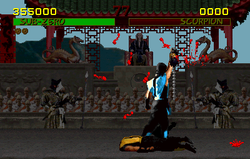
s, a Fatality is a finishing move that can be used against one's defeated opponent at the end of the final match, after the boss character says "Finish Him/Her." The Fatalities are usually lethal, featuring a brutal and morbid execution of the defenseless enemy character; however, some of them are actually non-violent and humorous, and some even result in the suicidal death of the losing character.
"Fatality" eventually became also a generic gaming term for a lethal finishing move, including the official term Fatals in the Killer Instinct
Killer Instinct
Killer Instinct is a fighting game developed by Rare and published by Midway and Nintendo. Initially released in arcades in 1994, and rumored to use an "Ultra 64" hardware engine, in reality the proprietary arcade hardware was co-developed by Rare and Midway. The game received a high profile launch...
series. In the game ClayFighter 63⅓ the Fatalities were even parodied in the form of Claytality.
Conception
While creating Mortal Kombat, Ed BoonEd Boon
Edward J. Boon is an American video game programmer who had been employed for over 15 years at Midway. He now works for Warner Bros...
and John Tobias
John Tobias
John Tobias is an American comic book artist, graphic designer and video game designer. Along with Ed Boon he is one of the creators of the groundbreaking Mortal Kombat fighting game series....
started with the idea of Street Fighter II
Street Fighter II
is a competitive fighting game originally released for the arcades in . It is the arcade sequel to the original Street Fighter released in and was Capcom's fourteenth title that ran on the CP System arcade hardware...
-like system and retained many of its conventions but tweaked others. The most notable additions were graphic blood effects, more brutal fighting techniques, and especially the fatal finishing moves (this was a novelty as the traditional fighting games ended with the loser simply knocked unconscious
Unconsciousness
Unconsciousness is the condition of being not conscious—in a mental state that involves complete or near-complete lack of responsiveness to people and other environmental stimuli. Being in a comatose state or coma is a type of unconsciousness. Fainting due to a drop in blood pressure and a...
and the victor posing for the players). According to Boon, it started with an idea to enable the player to hit a dizzied opponent at the end of the match with a "free hit", and that idea "quickly evolved into something nasty". According to Tobias: "Our first idea was to use them as a finishing move for final boss Shang Tsung
Shang Tsung
Shang Tsung is a boss and player character in the Mortal Kombat fighting game series. A powerful and deadly sorcerer and a primary antagonist in the Mortal Kombat series, Shang Tsung is a shapeshifter who absorbs the souls of those he slays in order to maintain his youth and power...
, who was going to pull out his sword and behead his opponent. Then we thought, 'What if the player could do that to his opponent?' When we watched players react to the Fatalities, we knew we had no choice but to give them more."
Controversy
Early Fatalities used to be a source of a major video game controversyVideo game controversy
Violent video game debates often center on topics such as video game graphic violence, sex and sexism, violent and gory scenes, partial or full nudity, portrayal of criminal behavior, racism, and other provocative and objectionable material. Video games have been studied for links to addiction and...
and a moral panic
Moral panic
A moral panic is the intensity of feeling expressed in a population about an issue that appears to threaten the social order. According to Stanley Cohen, author of Folk Devils and Moral Panics and credited creator of the term, a moral panic occurs when "[a] condition, episode, person or group of...
including a controversial Congressional
United States Congress
The United States Congress is the bicameral legislature of the federal government of the United States, consisting of the Senate and the House of Representatives. The Congress meets in the United States Capitol in Washington, D.C....
hearing, helping to pave a way for the ESRB (Entertainment Software Rating Board
Entertainment Software Rating Board
The Entertainment Software Rating Board is a self-regulatory organization that assigns age and content ratings, enforces industry-adopted advertising guidelines, and ensures responsible online privacy principles for computer and video games as well as entertainment software in Canada, Mexico and...
) game rating system in 1994. In 2010, Boon revealed that he actually sympathised with much of the outrage and admitted: "I wouldn't want my ten-year-old kid playing a game like that."
Gameplay
Unlike special moves, a Fatality may require certain distances and quick button sequences in order to achieve the desired result. Usually, every character has their own special Fatality that must be performed at a certain distance from the opponent, the three distances being: close (means that the finishing move won't work unless the player is right next to the opponent), sweep (means that the player should stand a step or two away from the opponent, but still within the distance that a sweeping low kick should hit) and far (means at least one jump's length away from the opponent).Each character has signature Fatalities. Traditionally for the main and important characters of the games their Fatalities are usually a reflection of either their storyline or their special abilities: e.g., Sub-Zero
Sub-Zero (Mortal Kombat)
Sub-Zero is the name given to two video game characters from the Mortal Kombat series. The older Sub-Zero first appeared in the first Mortal Kombat game, being replaced by his younger brother in Mortal Kombat II and the subsequent games...
's Fatalities have traditionally involved the use of his powers of ice (though his spine rip was found to be the most infamous of the Fatalities), whereas Scorpion
Scorpion (Mortal Kombat)
Scorpion is a recurring player and boss character in the Mortal Kombat fighting game series. He has been a playable character in all the games, with the exception of the original version of Mortal Kombat 3.-In video games:...
's storyline of a hellspawn ninja spectre involves the use of setting someone ablaze or using his infamous spear. The number of individual Fatalities varies depending upon the game; while characters in Mortal Kombat
Mortal Kombat (video game)
Mortal Kombat is a 1992 fighting-game developed and published by Midway for arcades. In 1993, home versions were released by Acclaim Entertainment. Released in the Fall of 1994, the Microsoft Windows 3.1x version was released by Activision Interactive. It is the first title in the Mortal Kombat...
and Mortal Kombat: Deadly Alliance
Mortal Kombat: Deadly Alliance
Mortal Kombat: Deadly Alliance, originally known as Mortal Kombat V: Vengeance or simply Mortal Kombat 5, is a fighting game developed and published by Midway for the Xbox, PlayStation 2, Microsoft Windows, Nintendo GameCube, and Game Boy Advance...
had only one, Mortal Kombat II
Mortal Kombat II
Mortal Kombat II is a competitive fighting game originally produced by Midway Games for the arcades in . It is the second game in the Mortal Kombat series. Like its predecessor, various home versions were produced...
and Mortal Kombat 3
Mortal Kombat 3
Mortal Kombat 3 is a fighting game developed by Midway and released in 1995, first as an arcade game. It is the third game in the Mortal Kombat series...
and its updates (Mortal Kombat Trilogy
Mortal Kombat Trilogy
Mortal Kombat Trilogy is a fighting game developed and published by Midway in 1996. It is a compilation of content from the previous Mortal Kombat titles, based primarily upon the gameplay mechanics of Ultimate Mortal Kombat 3...
and Ultimate Mortal Kombat 3
Ultimate Mortal Kombat 3
Ultimate Mortal Kombat 3 is a fighting game in the Mortal Kombat series, released in arcades in 1995. It is an update of Mortal Kombat 3 and was later updated again into Mortal Kombat Trilogy...
) featured as many as four.
Unconventional Fatalities/Finishers
In many games in the franchises there are also different types of Fatalities and Finishers:Animality
This finisher allows the player to morph into an animal and maim their opponent. This style of Fatality debuted in Mortal Kombat 3. According to Boon, his team "listened to what the players said about MKII and the Animalities that they thought were in there but really weren't. To answer all these rumors, we put Animalities in MKIII."In order to perform an Animality, the player must first grant his opponent Mercy, the act which revives the opponent in lieu of delivering a final blow or performing a Fatality by restoring a small amount of health: should the opponent be defeated again, an Animality may be performed.
Babality
Introduced in Mortal Kombat II, the Babality turns an opponent into an infantInfant
A newborn or baby is the very young offspring of a human or other mammal. A newborn is an infant who is within hours, days, or up to a few weeks from birth. In medical contexts, newborn or neonate refers to an infant in the first 28 days after birth...
version of the character. Sometimes the opponent will wear a miniature version of the clothes he or she wore when fully-grown, complete with smaller versions of accessories such as Raiden
Raiden (Mortal Kombat)
Raiden is a player character in the Mortal Kombat fighting game series. Raiden, also known as Lord Raiden, is a thunder god of the Mortal Kombat universe and protector of Earthrealm. He commands many supernatural abilities such as the ability to teleport, control over lightning, and flight...
's hat or Johnny Cage
Johnny Cage
Johnny Cage, whose real name is John Carlton, is a video game character from the Mortal Kombat fighting game series. Cage is portrayed as a film actor who enters the game's tournament, and provides the comic relief of the franchise....
's shades. In MK3 and its updates, the generic green "Babality!!" text and the sound of a baby crying used in MKII is replaced with pastel colored alphabet blocks and a short lullaby.
Babalities were introduced as a deliberately absurd counter-argument to the controversy that the original received for its violent content, and a tamer counterpart to the typical Fatality. Some fans found them humorous and enjoyable, while others felt they were an unwelcome, out-of-character intrusion in what is otherwise a "serious" game. Their initial appearance in Mortal Kombat II Revision 2.1 came with some glitches including one that allowed players to perform attacks after the Babality was performed. The moves were later dropped in an effort to abate this criticism. The Babalities, however, made a return in the MK reboot, featuring special animations for each character (for example, baby Reptile comes out of an egg and baby Raiden plays with lightning).
Brutality
Introduced in Mortal Kombat Trilogy and the SNESSuper Nintendo Entertainment System
The Super Nintendo Entertainment System is a 16-bit video game console that was released by Nintendo in North America, Europe, Australasia , and South America between 1990 and 1993. In Japan and Southeast Asia, the system is called the , or SFC for short...
and Sega Genesis
Sega Mega Drive
The Sega Genesis is a fourth-generation video game console developed and produced by Sega. It was originally released in Japan in 1988 as , then in North America in 1989 as Sega Genesis, and in Europe, Australia and other PAL regions in 1990 as Mega Drive. The reason for the two names is that...
ports of Ultimate Mortal Kombat 3, this finisher allowed players to perform a combo which would cause the opponent to explode. Brutalities were not very popular, as they were extremely difficult to accomplish, requiring the player to memorize and perform a special 11-hit combo. Many felt the pay-off was lacking with the only result being a fiery explosion where the victim disappears and an unrealistic amount of bone and flesh (including several rib cages and skulls) are sent flying and covering most of the screen (in some versions, the bone and flesh flies completely offscreen).
This finisher didn't appear in another game until Mortal Kombat: Shaolin Monks
Mortal Kombat: Shaolin Monks
Mortal Kombat: Shaolin Monks is an action/beat-em-up video game based on the Mortal Kombat series of fighting games. Shaolin Monks was developed by Midway LA and published by Midway for the PlayStation 2 and Xbox...
, in which it wasn't explicitly used as a finisher, but rather as a power-up
Power-up
In computer and video games, power-ups are objects that instantly benefit or add extra abilities to the game character as a game mechanic. This is in contrast to an item, which may or may not have a benefit and can be used at a time chosen by the player...
. A move similar to the Brutality also appeared in Mortal Kombat: Deception
Mortal Kombat: Deception
Mortal Kombat: Deception is a fighting game developed and published by Midway as the sixth installment for the Mortal Kombat series. It was released for the PlayStation 2 and Xbox in October 2004, while a Nintendo GameCube version was published in March 2005. Mortal Kombat: Deception follows the...
, in the form of a Fatality of Li Mei: her Fatality was to rapidly strike the opponent repeatedly, then to step back and pose as her opponent twitches for a moment, before exploding in a pile of gore.
Friendship
The fighter performs a somewhat silly act, leaving the opponent unharmed at the end of the fight. These actions include Sub-Zero making a snowmanSnowman
A snowman is an anthropomorphic snow sculpture. They are customarily built by children as part of a family project in celebration of winter. In some cases, participants in winter festivals will build large numbers of snowmen...
, Noob Saibot
Noob Saibot
Noob Saibot is a video game character from the Mortal Kombat fighting game series. He debuted as a hidden character in Mortal Kombat II , although the later game Mortal Kombat: Deception established his true identity as that of the original Sub-Zero, who was killed by his nemesis Scorpion after...
throwing a bowling ball
Bowling ball
A bowling ball is a spherical ball made from plastic, reactive resin, urethane or a combination of these materials which is used in the sport of bowling. Ten-pin bowling balls generally have a set of three holes drilled in them, one each for the ring and middle finger, and one for the thumb;...
and hitting a few pins, Stryker holding out a stop sign as if to stop traffic and allowing all the other fighters to run past, or Jax taking out a jump rope and using it. Developers described the inclusion of Friendships as "a counter to all the blood and gore", saying they wanted a different aspect to the game. In MKII, Shao Kahn
Shao Kahn
Shao Kahn is a boss, announcer and recurring playable character from the Mortal Kombat fighting game series. The main antagonist in the Mortal Kombat series, Shao Kahn is the Emperor of Outworld known for his godlike strength, extreme brutality and knowledge of black magic...
would announce "Friendship... Friendship?", while in MK3 and MK:T he would say "Friendship... Friendship? Again?"
Hara-Kiri
The Hara-Kiri (which is JapaneseJapanese language
is a language spoken by over 130 million people in Japan and in Japanese emigrant communities. It is a member of the Japonic language family, which has a number of proposed relationships with other languages, none of which has gained wide acceptance among historical linguists .Japanese is an...
for a certain type
Seppuku
is a form of Japanese ritual suicide by disembowelment. Seppuku was originally reserved only for samurai. Part of the samurai bushido honor code, seppuku was either used voluntarily by samurai to die with honor rather than fall into the hands of their enemies , or as a form of capital punishment...
of ritual suicide, and literally means belly cut; even though Kenshi is the only character who uses the Hara-Kiri in this form) is a move in which the losing player kills him/herself upon defeat at the end of the last match, rather than be finished off by his/her opponent. Examples of Hara-Kiris are Sindel performing a back flip but landing badly, breaking her neck, and Liu Kang
Liu Kang
Liu Kang is a video game character in the Mortal Kombat fighting game series. First appearing in the series' first title, Liu Kang is portrayed as a Shaolin monk who enters the Mortal Kombat tournament to save his world, Earthrealm, from being destroyed due to having lost nine consecutive...
internally combusting. It is the first time in the series in which the defeated player is allowed to perform a finishing move. The move Hara-Kiri made its debut in Deception and seems to be a popular feature with the fans, although is not included in any of its succeeding games.
Although it was called just a Fatality in-game, the first example of a suicidal finishing move in the series was actually Cyrax's "self-destruct
Self-destruct
A self-destruct is a mechanism which causes a device to destroy itself under a predefined set of circumstances.Self-destruct mechanisms are also found on devices and systems where malfunction could endanger large numbers of people...
" move from MK3 and Mortal Kombat Gold: Cyrax, a cyborg, enters a code on to his arm panel and moments later explodes along with his opponent in a manner reminiscient of the ending of the first Predator
Predator (film)
Predator is a 1987 American science fiction action film directed by John McTiernan, starring Arnold Schwarzenegger, Carl Weathers, Jesse Ventura, and Kevin Peter Hall. It was distributed by 20th Century Fox....
movie. Smoke went farther with his Fatality, since he destroys the whole planet (and every living being on it) with giant bombs. In MK Gold, Cyrax adopted this Fatality together with his own, while Smoke adopted Cyrax's self-destruct as his Hara-Kiri in Deception.
Heroic Brutality
Heroic Brutalities appear in the Midway/DC ComicsDC Comics
DC Comics, Inc. is one of the largest and most successful companies operating in the market for American comic books and related media. It is the publishing unit of DC Entertainment a company of Warner Bros. Entertainment, which itself is owned by Time Warner...
crossover game Mortal Kombat vs. DC Universe
Mortal Kombat vs. DC Universe
Mortal Kombat vs. DC Universe is a crossover fighting game from Midway Games and Warner Bros. Games. The eighth game in the Mortal Kombat series, MK vs. DC was released on November 16, . MK vs. DC contains characters from both the Mortal Kombat franchise and the DC Universe...
as exclusive finishing moves for the DC heroes. While they are similar to Fatalities, a Heroic Brutality doesn't kill an opponent, since normally the DC heroes don't kill people. These can range from somewhat gruesome like Green Lantern
Green Lantern
The Green Lantern is the shared primary alias of several fictional characters, superheroes appearing in comic books published by DC Comics. The first Green Lantern was created by writer Bill Finger and artist Martin Nodell in All-American Comics #16 .Each Green Lantern possesses a power ring and...
's, in which he crushes his enemy in a bubble of green energy breaking all of their bones, to the Flash
Flash (comics)
The Flash is a name shared by several fictional comic book superheroes from the DC Comics universe. Created by writer Gardner Fox and artist Harry Lampert, the original Flash first appeared in Flash Comics #1 ....
's where he lifts the enemy into the air with a tornado and simply punches them down. Heroic Brutalities are easier to pull off than the Brutalities of MK3, requiring hit combos identical to the normal Fatality hit combo. Given the fact that they are the least violent non-parody finishing moves in Mortal Kombat history, Heroic Brutalities were not well-received among either the MK series' fans or the comic book fan community, as even the DC comics themselves are often far more brutal.
Kreate-A-Fatality
For Mortal Kombat: ArmageddonMortal Kombat: Armageddon
Mortal Kombat: Armageddon is the seventh game in the Mortal Kombat fighting game series. The PlayStation 2 version was released in stores on October 11, 2006 while the Xbox version was released on the October 16, with a Wii version released on May 29, 2007 in North America.The game was not released...
, the Fatality concept was completely revised. In all previous games, finishing moves were in the form of a button combo, activating a scripted animation sequence. For MK:A, the old system was replaced with a new Kreate-A-Fatality, or "Kustom-Chain-Fatality" system. After defeating an opponent in two rounds (with default settings), players are given a limited amount of time to perform one of several violent moves (such as ripping an organ out) attributed to a button and direction combination. The time then resets and the player can perform a second move, but the timebar decreases more rapidly after each move. It is also possible to "fail" the Fatality by running out of time before performing a final finishing move (such as ripping the opponent's head off). Once the player reaches 12 chains, he/she must use a finisher or else the Fatality sequence will stop and the player will not receive a rank or reward. If time runs out before the player can end the chain with a final fatal move, no rank or reward is given and the Fatality is not counted, regardless of how many moves were completed.
This concept has been met with a mixed reaction, with some fans and critics preferring the more interactive nature and freedom of the Kreate-a-Fatality system, and others missing the previous games' character-specific ending moves and alternatives to killing the opponent. Originally, there were individual character-specific Kreate-a-Fatality moves for each character, but this feature was dropped, reportedly due to such a feat's infeasibility (especially in regards to the Kreate-A-Character option, which individual moves would not translate to).
Stage Fatality
Stage Fatalities brought environment interaction within the series, occurring when a player uses a part of the stage or map to execute a finishing move that is not a standard character Fatality. Some examples of Stage Fatalities are having the victim fall into a pool of acid or a pit of spikes, or to be run over by a subway train; the stage then does not darken. Stage Fatalities are present in the series from the first Mortal Kombat, though are absent from MK: Deadly Alliance.MK: Deception features more Stage Fatalities, renamed Death Traps, than any previous Mortal Kombat game. A special button combination is no longer required as the opponent only needs to be either standing or hit in a particular spot on the stage. Unlike previous Stage Fatalities, Death Traps can be initiated anytime during a round and only require the opponent be hit into them, meaning an instant victory. However, if they are not executed in the decisive round, the fight does not end, going on to the next round. This action acts as a ring out.
Traditional Stage Fatalities, seen since the original MK game through MK4, made a return in the new Mortal Kombat. Button combinations are once again used to perform Stage Fatalities.
Miscellaneous
- Fergality: MKII for the Mega Drive featured an exclusive finishing move which would allow Raiden to transform his opponent into Probe Ltd.Acclaim CheltenhamAcclaim Cheltenham was a game studio in Cheltenham, England that was founded in 1984. They were acquired by Acclaim Entertainment on October 10, 1995...
employee Fergus McGovern, who worked on that port of the game.
- Multality: MK:SM features Multalities, which are Fatalities performed on multiple common enemies at one time.
- Animality and Brutality were both rumored to be featured in MKII, but were only later added in MK3 in MKT, respectively. The rumored types of Fatalities that did not actually exist in any of the games included Hookality, Gangstality, Nationality, Nudality, Rapality, Sexuality, Weirdality, among others.
Notable Fatalities
- In December 1994, GameProGameProGamePro Media was a United States gaming media company publishing online and print content on the video game industry, video game hardware, and video game software developed for a video game console , a computer, and/or a mobile device . GamePro Media properties include GamePro magazine and...
asked readers for their favourite Fatalities and three months later published the tally (all were from MKII):
- Jax's arm-ripping
- Sub-Zero's ice grenade
- Shang Tsung's soul sucking
- In 1996, GamePro also criticized some of the finishing moves in UMK3 as "weak and poorly conceived", singling out KitanaKitana (Mortal Kombat)Kitana is a recurring player and a one-time boss character in the Mortal Kombat fighting game series. One of the lead characters of the Mortal Kombat saga, Kitana is the princess of the otherdimensional realm of Edenia and the daughter of Queen Sindel...
's rabbit attack as an example and commenting: "Come on guys!" - In 1997, Baraka's "Lift'em-up" Fatality in Mortal Kombat Trilogy was given the third place in the category That's Gotta Hurt of Nintendo Power Awards '96.
- In 2006, IGNIGNIGN is an entertainment website that focuses on video games, films, music and other media. IGN's main website comprises several specialty sites or "channels", each occupying a subdomain and covering a specific area of entertainment...
rated Jax's MKII "Arm Rip" Fatality the 10th best gore effect in the video games, calling it "intensely violent while remaining absurdly hilarious". - Kitana shared #7 with MileenaMileenaMileena is a player and boss character in the Mortal Kombat fighting game series. Mileena was originally known as the personal assassin of the Outworld's evil emperor Shao Kahn and twin sister of his stepdaughter Princess Kitana, but in a truth she is a deformed clone of her created by the sorcerer...
for their respective "Kiss of Doom" and "Man-Eater" Fatalities on GamesRadarGamesRadarGamesRadar is a multi-format video game website featuring regular news, previews, reviews, videos, and guides. It is owned and operated simultaneously in the UK and US by worldwide publisher Future Publishing...
's 2006 list of "Top 7 Girls kissing girls", with a comment: "More visceral than sexy, sure, but the industry had to start somewhere." - 1UP.com1UP.com1UP.com is a video game website owned by IGN Entertainment, a division of News Corporation. Previously, the site was owned by Ziff Davis before being sold to UGO Entertainment in 2009....
' 2010 list of Best Fatalities in Video Games featured Dairou's MK:D Fatality and, ironically, the censored Fatalities of MK vs. DC ("Included not so much for the gore, but as a reminder that Mortal Kombat went from Dairou’s rib-ripping to censoring a headshotHead shotA head shot is a photographic technique where the focus of the photograph is a person's face. Headshot is essentially the same as portrait. However, headshot is an image that portrays people as they are and is more of a "mug shot", however simple or stylized it might be. Whereas, a portrait will...
in half a decade"). - In 2011, IGN published an article discussing progression of the finishing moves of the series' "four main characters" Sub-Zero, Liu Kang, Scorpion and Mileena.
- In 1996, GamePro also criticized some of the finishing moves in UMK3 as "weak and poorly conceived", singling out Kitana
Top lists
- In 2008, GamePro published a list of The 12 LAMEST Fatalities. These from the Mortal Kombat series were Liu Kang's "Death by Arcade Machine" (#12), The Flash's "Tornado Slam" in MK vs. DC (#11), RaidenRaiden (Mortal Kombat)Raiden is a player character in the Mortal Kombat fighting game series. Raiden, also known as Lord Raiden, is a thunder god of the Mortal Kombat universe and protector of Earthrealm. He commands many supernatural abilities such as the ability to teleport, control over lightning, and flight...
's "Mini-Raiden" Friendship (#10), Jax's "Amazing Growing Man" (#9), Scorpion's "Penguin Egg Grenade" and Rain's "Baby Elephant Blast" (#8), Sindel's "Killer Hair" (#7), Kano's "Stomach Pounce" in MK vs. DC (#5), Babalities in general (#3), and Kano's "Ripping Out an Invisible Heart" in the censored Super Nintendo version of the first game (#1).
- UGO.com counted down their top 11 favorite Fatalities: Stryker's "Stun Gun" "(MK3), Sub Zero's "Fun with Ice" (MKII), "Pit Stain" (MK Stage Fatality), Kitana's Kiss of Exploding Death" (MKII), Friendships in general, Kabal's "Death by Face", Jax's "Big Finish" (MK3), Liu Kang's "Way of the Dragon" (MKII), Scorpion multiplying himself (UMK3/MKT), Kano's "Heartbreak" (MK) and Smoke blowing up the Earth (MK3).
- In 2010, Game InformerGame InformerGame Informer is an American-based monthly magazine featuring articles, news, strategy, and reviews of popular video games and associated consoles. It was formed in August 1991, when FuncoLand started publishing a six-page magazine, free in all its retail locations...
published a list of the series' best, worst "and downright confusing" Fatalities so far. According to this,- the best were: Liu Kang's "Dragon" in MKII, Sub-Zero's "Spine Rip" in MK ("perhaps the most gruesome finisher from the first game in the series"), ReptileReptile (Mortal Kombat)Reptile is a fictional character in the Mortal Kombat series of video games. Created for Midway Games by John Tobias and Ed Boon, Reptile debuted in Mortal Kombat as a hidden boss and appeared in subsequent titles as a playable character. The character has also appeared on various merchandise,...
's "Head Snack" in MKII, Jade's "Head Gymnastics" in Deception, Sektor's Compactor in MK3, Jax's "Arm Pull" in MKII ("probably one of the only Fatalities that wouldn't immediately kill you"), Dairou's "Ribs to the Eyes" in Deception, and Sindel's "Scream" in MK3; - the worst were: Liu Kang's "Cartwheel" in MK, Kano's "Knee Stomp" in MK vs DC, Kitana's "Kiss of Death" in MKII, Kabal's "Inflating Head" and "Scary Face"in MK3, Rain's "Upside-Down Uppercut" in Trilogy, Bo' Rai Cho's "Fart of Doom" in Deception;
- and the most absurd were: Liu Kang's "Arcade Machine" in MK3, Jax's "Giant Stomp" in MK3, Johnny CageJohnny CageJohnny Cage, whose real name is John Carlton, is a video game character from the Mortal Kombat fighting game series. Cage is portrayed as a film actor who enters the game's tournament, and provides the comic relief of the franchise....
's "Three Head Punch" in MKII, Cyrax's "Self-Destruct" in MK3, Darrius' "Re-arranger" in Deception, Smoke's "Blow up the World" in MK3.
- the best were: Liu Kang's "Dragon" in MKII, Sub-Zero's "Spine Rip" in MK ("perhaps the most gruesome finisher from the first game in the series"), Reptile
- Also in 2010, ScrewAttackScrewAttackScrewAttack . is a video game-related website that showcases original entertainment for an audience of video game enthusiasts. Its content is also shown on GameTrailers and IGN...
published their list of the top MK Fatalities (from #10 to #1): Reptile's Facial Surgery in MK4, Quan Chi's "Leg Beating" (MK4), Dairou's "Ribs in the Eyes" (MK:D), Cyrax's "Trash Compactor" (MK:DA), Kano's "Skeletol Removal" (MK3), Baraka's "Blades-in-the-Chest" (MKII), Scorpion's "Party Popper" (MK:DA), Johnny Cage's "Punching Bag" (MK:SM), Liu Kang's "Dragon Transformation" (MKII) and Sub-Zero's "ESRB-Maker" (MK).- They later published a list of their top worst MK Fatalities: Tanya's "Neck Breaker" (MK4), Kabal's "Scary Face" (MK3), Sindel's "Hara-Kiri" (MK:D), Kenshi's "Eyeball-Popper" (MK:DA), Quan Chi's "Neck-Stretcher" (MK:DA), Raiden's "Accident" (MK:D), Reptile's "Animality" (MK3), Motaro's "Head Yoink" (MK:T), Liu Kang's "Somersault Kick" (MK), and every Fatality/Heroic Brutality from MK Vs. DC.
- Same year, IGN also posted their "unofficial" Top 10 Fatalities list: "Giant Jax" (MK3), "Strykersaurus-rex" (MK3), "Kitana's Kiss of Death" (MKII), "Sub-Zero Crushed Ice" (MKII), "Reptile Gives You Some Tongue" (MKII), "Kung Lao's Hat Trick" (MK:SM), "Sektor Squash" (MK3) / "All Babalities", "Sheeva's Manly Forearms" (MK3), "Scorpion is Hot" (MK) and "Smoke Asplodes the Earf" (MK3).