


Street Fighter

Encyclopedia
, commonly abbreviated as SF, is a series of Fighting Games
developed in Japan
in which the players pit the video games' competitive fighters from around the world, each with his or her own unique fighting style, against one another. Since Capcom
released the first game in August 1987, the series had had total home software sales of 31 million units, and arcade cabinet sales of over 500,000 units accounting for more than $1 billion in revenue, qualifying for the list of best-selling video game franchises, with its best-selling entry Street Fighter II exceeding $1.5 billion in revenue. The franchise has enjoyed significant success all around the world.
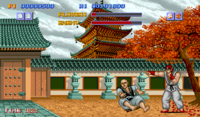 Street Fighter made its debut in the arcades in 1987. It was designed by Takashi Nishiyama and Hiroshi Matsumoto. The player took control of martial artist Ryu
, who competed in a worldwide martial arts tournament, spanning five countries and ten opponents. A second player could join in at any time and take control of Ryu's rival, Ken.
The player could perform three types of punch and kick attacks (which varied in speed and strength) and three special attacks: the Hadouken, Shoryuken and Tatsumaki Senpuukyaku. These were performed by executing special button combinations with the controls.
Street Fighter was ported
to many popular home computer systems of the time including PC. In 1988, it was released on the NEC Avenue TurboGrafx-CD console under the new name Fighting Street. Street Fighter was later included in Capcom Classics Collection: Remixed for the PlayStation Portable
and Capcom Classics Collection Vol. 2 for the PlayStation 2
and Xbox
.
to the original Street Fighter, following an unsuccessful attempt to brand the 1989 fighting action game
Final Fight
as a Street Fighter sequel, and an officially commissioned spin-off Human Killing Machine
on the ZX Spectrum
, Amiga
and other home computers. It was one of the earliest arcade games for Capcom's CP System hardware and was designed by Akira Nishitani (Nin-Nin) and Akira Yasuda
(Akiman), who were previously responsible for Final Fight and Forgotten Worlds
. The release of the game had an unexpected impact on gaming and was the beginning of a massive phenomenon. By 1993, sales of Street Fighter II exceeded $1.5 billion in revenue, equivalent to $2.32 billion in 2011.
Street Fighter II was the first one-on-one fighting game to give players a choice from a variety of player characters with different moves, an option which created hitherto unknown levels of depth and replay value for an arcade game. Each player character had a fighting style with approximately 30 or more moves (including then-new grappling moves such as throws) as well as two or three special attacks per character.
In the single-player mode, the player's chosen character is pitted sequentially against the seven other main characters before confronting the final four 'boss' opponents, who were CPU
-controlled characters not selectable by the player.
As in the original, a second player could join in at any point during single player mode and compete against the other player in competitive matches, with the multiple available characters allowing for more varied matches.
The original Japanese version of Street Fighter II introduced an African-American boxer
named "Mike Bison" (abbreviated as "M. Bison") as a boss character
, a parody of real-life boxer Mike Tyson
. In order to avoid any likeness infringement lawsuit
from Tyson, Capcom rotated the names of three of the boss characters for international versions of the game: The final boss
, called Vega in the Japanese version, was given the M. Bison name; the talon-wielding Spanish warrior
known as Balrog in the Japanese version was renamed Vega; and the boxer became Balrog.
Street Fighter II proved to be popular due to all these factors, eclipsing its predecessor in popularity, eventually turning Street Fighter into a multimedia
franchise
.
The first official update to the series was Street Fighter II′ - Champion Edition ' onMouseout='HidePop("58014")' href="/topics/Prime_(symbol)">prime notation
on the logo), which allowed players to play as the Four Devas (the computer-controlled boss characters) and also allowed two players to choose the same character (with one character drawn in an alternate color pattern). The game also featured slightly improved graphics (including differently colored backgrounds) and refined gameplay. A second upgrade, titled Street Fighter II′ - Hyper Fighting (or Street Fighter II Dash Turbo in Japan), was produced in response to the various bootleg editions of the game. Hyper Fighting offered faster gameplay than its predecessors, different character colors and new special techniques.
Super Street Fighter II
, the third revision, gave the game a complete graphical and musical overhaul and introduced four new playable characters It was also the first game for Capcom’s CP System II arcade hardware. The fifth and final arcade installment, Super Street Fighter II Turbo
(Super Street Fighter II X in Japan) brought back the faster gameplay of Hyper Fighting, a new type of special techniques known as "Super Combos" and a hidden character Akuma
.
Numerous home versions of the Street Fighter II games have been produced following the original game. The original Street Fighter II was ported to the Super Nintendo Entertainment System
in 1992. As of 2008, the original SNES game is still Capcom's best selling game. It was followed by a Japanese-only version of Street Fighter II Dash for the PC Engine
in 1993. Hyper Fighting received two different home versions as well in 1993, an SNES version titled Street Fighter II Turbo, and a Sega Genesis counterpart titled Street Fighter II′ - Special Champion Edition (Street Fighter II Dash Plus in Japan). The following game, Super Street Fighter II, was also ported to the SNES and Genesis in 1994.
Later that year, Super Street Fighter II Turbo was released for the 3DO Interactive Multiplayer
, and also appeared in a PC version for Windows (released by the now defunct GameTek
).
In 1997, Capcom released the Street Fighter Collection
for the PlayStation
and Sega Saturn
, a compilation which includes Super and Super Turbo, as well as the newer Street Fighter Alpha 2 Gold (Street Fighter Zero 2′ in Japan). It was followed by Street Fighter Collection 2 (Capcom Generation Vol. 5 in Japan), also released for the PlayStation and Saturn, which includes the original Street Fighter II, Champion Edition, and Hyper Fighting. In 2000, Capcom released Super Street Fighter II X for Matching Service in Japan for the Dreamcast, a version of the game which featured an online two-player versus mode. In 2003, Capcom released Hyper Street Fighter II for the arcades in Japan and Asia to commemorate the 15th anniversary of the series, a hybrid version of Super Turbo which allows player to select between versions of characters from all five previous Street Fighter II games. Hyper was released its North America and the PAL region via its ports for the PlayStation 2
and the Xbox
(released as part of the Street Fighter Anniversary Collection
along with Street Fighter III 3rd Strike). In 2005, the three games in Street Fighter Collection 2 were included Capcom Classics Collection
Vol. 1 for PlayStation 2 and Xbox. A version of Super Turbo (along with the original Street Fighter) was later included in the 2007 compilation Capcom Classics Collection Vol. 2, also released for the PS2 and Xbox.
An updated version of Super Street Fighter II Turbo came to the PlayStation Network and Xbox Live Arcade
service in November 2008. The game, titled Super Street Fighter II Turbo HD Remix
, has fully redrawn artwork, including HD sprites 4.5x the original size, done by artists from UDON
. This is the first time the Street Fighter characters have new sprites, drawn by Capcom, since Capcom vs. SNK 2
in 2001. The game has several changes which address character balancing issues, but also features the original arcade version gameplay so that players can choose between the two.
Street Fighter II and Super Street Fighter II are also available as downloadable games for select cellular phone services.
, with settings and character designs heavily influenced by Street Fighter II: The Animated Movie
. Alpha expands on the Super Combo system from Super Turbo, by extending Super Combo meter into three levels (allowing for super combos to be stored up), and also introduces Alpha Counters and Chain Combos (also from Darkstalkers). The plot of Alpha is set between the first two Street Fighter games and fleshes out the back stories and grudge matches held by many of the classic SF2 characters. It features a playable roster of ten immediately playable characters (and three unlockable fighters), comprising not only younger versions of established Street Fighter II, but also characters from the original Street Fighter and Final Fight.
Street Fighter Alpha 2
features all-new stages, music and endings for some characters (some overlapping with those from the original Alpha). Alpha 2 also retained all thirteen characters from the original, adding five new characters to the roster along with hidden versions of returning characters. Alpha 2 was followed by a slightly enhanced arcade release titled Street Fighter Zero 2 Alpha and was released in Japan and Brazil, was ported to home consoles as Street Fighter Alpha 2 Gold (Zero 2′ Dash in Japan).
The third and final Alpha game, Street Fighter Alpha 3
, was released in 1998 (following the release of the original Street Fighter III: 2nd Impact
and Street Fighter EX
). Alpha 3 introduced three selectable fighting styles and further expanded the playable roster to 28 characters. Console versions of the three games (including the original Alpha 2 and the aforementioned Alpha 2 Gold) were released for the PlayStation
and Sega Saturn
, although versions of specific games in the series were also released for the Game Boy Color
, Super NES, Dreamcast and even Windows
. The home console versions of Alpha 3 further expanded the character roster by adding the remaining "New Challengers" from Super Street Fighter II. The Dreamcast version of the game was backported to the arcades in Japan under the title of Street Fighter Zero 3 Upper. A version of Upper (simply titled Alpha 3 outside Japan) was released for the Game Boy Advance and added three characters from Capcom vs. SNK 2
. A PlayStation Portable
version titled Alpha 3 MAX (or Zero 3 Double Upper in Japan) contains the added characters from the GBA version and Ingrid from Capcom Fighting Jam
.
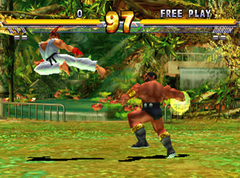 In 1996, Capcom co-produced with Arika
(a company founded by former Street Fighter II planner Akira Nishitani) a 3D fighting game spinoff of the series titled Street Fighter EX, developed for the PlayStation
-based ZN-1 hardware. EX combined the established Street Fighter cast with original characters created and owned by Arika. It was followed by upgraded version titled Street Fighter EX Plus in 1997, which expanded the character roster. A home version with further additional characters and features, Street Fighter EX Plus Alpha, was released for the PlayStation during the same year.
A sequel was released in , titled Street Fighter EX2, developed for the ZN-2 hardware. Custom combos were reintroduced, and the character roster was expanded. EX2 also received an upgraded version, Street Fighter EX2 Plus, released in 1999. A PlayStation version of EX2 Plus, was also released.
A third game in the series, Street Fighter EX3
, was released as an early title for the PlayStation 2
in 2000. This included a tag team system, a mode that let a single player fight up to three opponents simultaneously, and another new Character Edit mode that allowed players to give a new character Ace a selection of special and super moves after purchasing them with experience points. The cast brought back many characters from the previous game.
Some of the Arika-owned characters from the series were later featured in other games developed by the company. The Namco
-distributed arcade game Fighting Layer
featured Allen Snider and Blair Dame from the original EX, while Skullomania would reappear in the PlayStation game Fighter Maker
, as well as in the PlayStation 2 music game Technictix.
-licensed fighting game X-Men: Children of the Atom
, which featured Akuma from Super Turbo as a hidden guest character. It was followed by Marvel Super Heroes
in , which featured Anita from Night Warriors.
Capcom would release a third Marvel-licensed game, X-Men vs. Street Fighter
, in 1996, a full-fledged crossover between characters from X-Men and the Street Fighter Alpha games that featured a two-on-two tag team
-based system. It was followed by Marvel Super Heroes vs. Street Fighter
in 1997, which expanded the roster to include characters from Marvel Super Heroes; Marvel vs. Capcom
in 1998, which featured not only Street Fighter characters, but also characters from other Capcom properties; and Marvel vs. Capcom 2
in 2000, which was produced from the Dreamcast-based NAOMI
hardware.
Capcom also produced a series of similar crossover fighting games with rival fighting game developer SNK Playmore
. The games produced by Capcom includes Capcom vs. SNK
in , which features character primarily from the Street Fighter and King of Fighters
series. It was followed by a minor upgrade, Capcom vs. SNK Pro ; and a sequel titled Capcom vs. SNK 2
, both released in 2001. All three games were produced for the NAOMI hardware as well. The SNK-produced fighting games of this crossover includes the Dimps
-developed portable fighting game SNK vs. Capcom: The Match of the Millennium
for the Neo Geo Pocket Color
in 1999 and SNK vs. Capcom: SVC Chaos for the Neo Geo
in 2003.
From 2003 to 2008 the Versus series of Capcom fighting games saw no new releases, though Capcom and Namco produced the crossover action role-playing game Namco × Capcom for the PlayStation 2
in 2005.
After about five years of no new entries in the Versus fighting series, Capcom released a new versus fighting game titled Tatsunoko vs. Capcom: Cross Generation of Heroes on December 11, 2008.
Cross Generation of Heroes features characters from both Tatsunoko and Capcom properties, including Street Fighter characters Ryu, Chun-Li, and Alex as well as characters like Ken the Eagle of Gatchaman and Casshern of Neo-Human Casshern
on Tatsunoko's side. Initially released only in Japan, demand from fans saw the game receive an international release entitled Tatsunoko vs. Capcom: Ultimate All-Stars on January 26, 2010.
Marvel vs. Capcom 3: Fate of Two Worlds
was released on February 15, 2011 and includes Akuma, Chun-Li, Crimson Viper, and Ryu. The game features completely new visuals and audio, 3 vs. 3 gameplay like previous entries in the series, and online play. The game was also intended to have downloadable content, but the content was disrupted due to an earthquake and tsunami in Tōhoku
and released along with additional new content on separate game titled Ultimate Marvel vs. Capcom 3
.
Capcom has announced that along with Namco
, two new fighting games featuring Street Fighter characters are in development: Street Fighter X Tekken
, which is being developed by Capcom, and Tekken X Street Fighter
which is being developed by Namco.
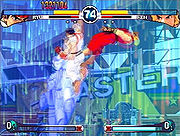 Street Fighter III: New Generation
, made its debut in the arcades on the CPS3 hardware in 1997. Street Fighter III discarded the character roster from previous games (only Ryu and Ken returned), introducing several new characters in their place, most notably the grappler Alex, who was designed to be the new lead character of the game, the popular ninja girl Ibuki, who was planned as compensation for Chun-Li
as the female lead, and Gill, who replaced Bison
as the game's main antagonist. Street Fighter III introduced the "Super Arts" selection system and the ability to parry an opponent's attack.
Several months after its release, it was followed by Street Fighter III: 2nd Impact
, which made adjustments to the gameplay and added two new characters, Hugo and Urien, as well as the return of Akuma and bonus rounds. Street Fighter III: 3rd Strike
, released in 1999, was the third and last iteration of Street Fighter III, bringing back Chun-Li
and adding four new characters. The first two Street Fighter III games were ported to the Dreamcast as a compilation titled Double Impact. Ports of 3rd Strike were released for the Dreamcast as a stand-alone game and then included in the compilation Street Fighter Anniversary Collection for the PlayStation 2 and Xbox. Gill also became secretly playable on the console version although you can also play as Gill on the arcade version by using Twelve's X.C.O.P.Y. super move.
Capcom announced in Summer 2010 that development is underway for a conversion of 3rd Strike titled Street Fighter III 3rd Strike: Online Edition. The game received positive reviews.
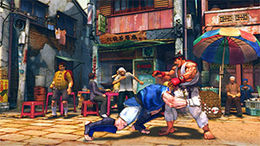 On October 17, 2007, more than eight years since the release of Street Fighter III 3rd Strike for the arcades, Capcom unveiled Street Fighter IV
at a Capcom Gamers Day event in London. Conceived as a direct sequel to the early Street Fighter II games (particularly Super Street Fighter II Turbo), Street Fighter IV features the return of the original twelve world warriors and recurring hidden character Akuma, along with four new characters (as well as a new boss character
) in a storyline chronologically set between Street Fighter II and Street Fighter III. The gameplay, while still 2D, features cel-shaded 3D graphics inspired by Japanese sumi-e paintings
. The Super Combo system, a Street Fighter mainstay since Super Turbo, returns along with new counter-attacking techniques called "Focus Attacks" ("Saving Attacks" in Japan), as well as new "Ultra Combo" moves, similar to the Rage Gauge seen in games from SNK Playmore
.
The arcade version, which runs on the Taito Type X2 hardware, was distributed in Japan on July 2008, with a limited release in North America and the United Kingdom in select arcades in August. A home version was released in the USA and Europe in February 2009, on PlayStation 3
and Xbox 360
and in July 2009 for Windows PC
. This features an expanded character roster, as well as all-new animated segments that show each character's backstory, and a training mode similar to the Expert Challenges in Street Fighter EX. The cast includes six characters new to the Street Fighter series. Yoshinori Ono had hinted that the only two Street Fighter II characters absent from the game, Dee Jay and T. Hawk, could be available in the game at a later date. Instead, they were to be included in a whole new version of the game.
Street Fighter IV was released for the iPhone in March, 2010. It initially featured Ryu, Ken, Guile, Blanka, Chun-Li, Dhalsim, Bison, and Abel, with additional characters added via free updates.
On September 28, 2009, Capcom announced Super Street Fighter IV
. The game includes ten additional characters including two characters new to the franchise - lithe Korean female villainess Juri and bulky Turkish oil wrestler, Hakan. Capcom implemented character balance adjustments and added second Ultra moves for each character. The game features an improved online experience with new modes of play. The game was released on April 27, 2010 for Xbox 360
and PlayStation 3
at a discounted price point. If a Street Fighter IV savefile is detected on the system of play, two additional character colors (ink and sketch effect) are available.
An arcade version was released on December 16, 2010 containing all content from the console release, and featuring additional characters including Yang and Yun from Street Fighter III. Seth Killian of Capcom has confirmed Arcade Edition is planned to be the last update to the IV series.
On June 15 at E3 2010 during the Nintendo press conference, a portable conversion of Super Street Fighter IV was confirmed for the Nintendo 3DS
. Super Street Fighter IV: 3D Edition
features 3D stereoscopic technology, multiplayer, and all 35 characters from the original Super Street Fighter IV release.
At Evo 2011, Ono announced that a balance patch for Super Street Fighter IV Arcade Edition had been approved by Capcom. The patch will be free of charge.
titled Street Fighter II: The Animated Movie
was released theatrically in Japan in 1994. An English adaptation of the film produced by Manga Entertainment
, which was first released on home video
in 1996. Group TAC also produced an animated TV series Street Fighter II V
, which first aired on Yomiuri TV in 1995; and a two-episode OVA series, Street Fighter Alpha: The Movie
, released in 1999. English adaptations of both productions were produced by Manga Entertainment as well. A second OVA based on Street Fighter Alpha, titled Street Fighter Alpha: Generations
, was produced specifically for the English market by Studio A.P.P.P.
An American-produced live-action film, simply titled Street Fighter
, was also released in 1994, starring Jean-Claude Van Damme
as Guile, this version's main character, opposite the late Raúl Juliá
as General M. Bison. This film inspired an arcade game
and console game
both titled Street Fighter: The Movie. The film also inspired an American-produced animated TV series Street Fighter
, which lasted two 13-episode seasons from 1995 to 1997.
In October 2006, Hyde Park Entertainment and Capcom
announced its intention to produce a film adaptation
of the game series in a joint venture, with the storyline to focus on the Street Fighter character Chun-Li
. Screenwriter Justin Marks was attached to write a script for the adaptation. Street Fighter: The Legend of Chun-Li
was released in the U.S. on February 27, 2009.
Also in 2009 (12.02) OVA Street Fighter IV: The Ties That Bind ("Street Fighter IV: Arata naru Kizuna") was released by Studio 4°C.
Street Fighter IV: The Ties That Bind is an animated movie directed by Jirō Kanai that was featured in a bonus disc included in the Collector's Edition of Street Fighter IV for the PlayStation 3 and Xbox 360. The film adaptation is part of Capcom's multi-platform launch for 2008 that will also launch video games and a potential TV series in 2008.
In 2010, actor and filmmaker Joey Ansah
& Owen Trevor co-directed a Live Action
Short Film called Street Fighter: Legacy
which stars John Foo
as Ryu
and Christian Howard as Ken
.
Capcom’s vice president of strategic planning and business development Christian Svensson has confirmed that there will be more Street Fighter films in development.
s produced, including Masaomi Kanzaki
's Street Fighter II manga (one of the few Street Fighter manga titles translated into English), and a role playing game
adaptation released by White Wolf
in 1994.
), Street Fighter Zero (translated and released in English as Street Fighter Alpha), Sakura Ganbaru and Street Fighter III: Ryu Final. Street Fighter Alpha, Sakura Ganbaru and Street Fighter III: Ryu Final have all been released in English by UDON
. Two characters created by Nakahira, Evil Ryu (introduced in Street Fighter Alpha) and Karin Kanzuki (from Sakura Ganbaru) have been integrated into the Street Fighter video games.
launched a Street Fighter comic series in 1993, but it flopped, lasting only three issues.
UDON
had been licensed by Capcom to produce a U.S. comic book based on the Street Fighter franchise, in addition to Darkstalkers
and Rival Schools. This series draws not only on the established Street Fighter canon
, but also occasionally addresses various continuity retcons, and even draws from fanon
and non-official sources as well. In 2005, UDON released Street Fighter: Eternal Challenge, the first Capcom series history and art book to be translated into English. Later, UDON continued from its original Street Fighter series (based on SF: Alpha and Super SF Turbo) with Street Fighter II and Street Fighter II: Turbo. Three separate Street Fighter Legends mini-series and a Street Fighter IV mini-series were also released.
released a Street Fighter set for its Universal Fighting System
(UFS) game along with a set for Soul Calibur III
. This was not the gaming companies first release for UFS, that being a Battle box
for Penny Arcade
released in February 2006. As the name implies, UFS is to be a universal system. There are plans to incorporate other licenses into the game, slated for December 2006, being based on SNK's King of Fighters
and Samurai Shodown
.
The first set for Street Fighter featured cards for Chun-Li
, Dhalsim
, Ken, Ryu
, Sagat
and Zangief
. A later expansion, Street Fighter: World Warriors, included the remaining characters from the original Street Fighter 2 arcade series, Blanka
, Balrog
, E. Honda, Guile
, M. Bison
and Vega
. Another set, titled Street Fighter: The Next Level, was released in December 2006, parallel with the SNK release. The characters included are Akuma
, Fei Long, Dudley, and Cammy. A new expansion, Street Fighter: The Dark Path was released February 14, 2007 along with the next Soul Calibur
Set, Soul Arena. Characters include a new version of Chun-Li and (Evil) Ryu, along with Adon, Charlie, Rose, Sakura, T.Hawk and Twelve. A new set, entitled Street Fighter: Extreme Rivals, which was released in May 2007, features Cody, Dee Jay, Ibuki, R. Mika, and a new version of Ken.
In July 2007 Sabertooth Games
will release an exclusive Battle Pack featuring a battle between Ryu
and Akuma
. These 2 sixty card decks will be fully compatible with the Universal Fighting System
and contain 36 unique cards.
There is currently a free demo deck request form to try out the UFS CCG at Sabertooth Games Demo Deck Request Form.
Another trading card game, the now discontinued Epic Battles
(released by Score Entertainment
), also featured Street Fighter characters, as well as characters from other fighting game franchises, such as Mortal Kombat
.
released a storytelling game based on the series in 1994 (featuring characters from Super Street Fighter 2). The system used many of the game mechanics of the World of Darkness
games. The system is now out of print but retains a small following on the internet.
released the first installment of its Street Fighter-themed rock opera trilogy, titled Street Fight!, which revolves around characters and events taken from the video games and Street Fighter storyline. In 2010, the band released the second part of the album, titled Round 2.
has released a 'Street Fighter II' slot, themed after the series.
, Ken, Sakura
, Dan
(whose version of the technique is named the Gadouken), and Akuma
(Gou Hadouken), Sean (Hadou Burst), Allen (Soul Force), Kairi (Shinki Hatsudou) and Gouken
(also called the Gou Hadouken). The hadouken and the shoryuken are the two archetypal moves of these characters. The move is achieved by the character thrusting their palms forward, sending a surge of spirit energy (or ki) flying towards the opponent (see chi blast
). It is normally performed by the player moving the joystick
or D-pad
a quarter circle forward towards the opponent from the down position, then pressing a punch button (so, for example, a character facing to the right would execute the move by pressing ↓, ↘, →, and then "punch" in a smooth motion).
Most fighting games of the sprite-based era used projectile special moves, and while the actual type of projectile launched varies from game to game and character to character, the execution and behavior of these attacks are often rather similar to the Hadouken. These moves are sometimes informally referred to as a "hadouken", or fireball. The Hadouken can usually be performed in three different degrees depending on which type punch is used; these will affect its speed, damage caused on impact, amount of recovery frames, and sometimes its range. The Hadouken itself has many variations depending on the character in question that the move is associated with. For example, both Ryu and Akuma have used a fire-based variant of the move called the Shakunetsu Hadouken (灼熱波動拳) or "Blazing Surge Fist", which briefly engulfs its target in flames.
Later titles in the series that use super combo moves ramp up the power of the hadouken, evolving it into the Shinkuu Hadouken (真空波動拳 - Vacuum Surge Fist). This takes one of two forms depending on the game: an outsized fireball, or a blast of constant energy. Street Fighter III
introduced the Denjin Hadouken (電刃波動拳), an unblockable, electrified version which could be 'stored' by holding down the Punch button, for timing purposes as well as enhancing damage and stun. In Super Street Fighter IV
, Gouken can perform this technique; it is blockable, but will still inflict stun damage even if blocked. In the Capcom vs. SNK series, Satsui no Hadou Ryu used a more powerful version called Metsu Hadouken (滅波動拳), which acted similar to Denjin Hadouken, being unblockable and stunning the opponent. The latest game in the series, Street Fighter IV
, brought back the Metsu Hadouken, though it instead acts simply like a more powerful variant of the Shinku Hadouken.
Interestingly, the Hadouken ability appeared in Mega Man X
and its remake Mega Man: Maverick Hunter X as a secret move for X. It is only obtainable by having all heart tanks, sub tanks, weapons, and upgrades, (other requirements differ between the two games). The input is the same as in Street Fighter. This move can kill almost anything instantly, with the exception of several bosses. Even these, however, could be killed with two Hadoukens (although the final boss can be defeated with a single hit in the remake). In Mega Man X4
, one of the bosses, Magma Dragoon, used the Hadouken ability. Another version of the Hadouken was created in Mega Man X: Command Mission
, where if one is able to meet the secret boss(es), the Tails Clan [One-tails, Two-tails, etc. to Nine-Tails] in a battle, the Tails could throw the Annilator Hadouken at them. It is a beam-like blast that hits all characters and causes massive damage, most of the time K.O.ing most characters. In Mega Man Xtreme and its sequel, a fighting style "Shotokan" can be acquired and allows X to use the Hadouken and the Shoryuken.
Fighting game
Fighting game is a video game genre where the player controls an on-screen character and engages in close combat with an opponent. These characters tend to be of equal power and fight matches consisting of several rounds, which take place in an arena. Players must master techniques such as...
developed in Japan
Japan
Japan is an island nation in East Asia. Located in the Pacific Ocean, it lies to the east of the Sea of Japan, China, North Korea, South Korea and Russia, stretching from the Sea of Okhotsk in the north to the East China Sea and Taiwan in the south...
in which the players pit the video games' competitive fighters from around the world, each with his or her own unique fighting style, against one another. Since Capcom
Capcom
is a Japanese developer and publisher of video games, known for creating multi-million-selling franchises such as Devil May Cry, Chaos Legion, Street Fighter, Mega Man and Resident Evil. Capcom developed and published Bionic Commando, Lost Planet and Dark Void too, but they are less known. Its...
released the first game in August 1987, the series had had total home software sales of 31 million units, and arcade cabinet sales of over 500,000 units accounting for more than $1 billion in revenue, qualifying for the list of best-selling video game franchises, with its best-selling entry Street Fighter II exceeding $1.5 billion in revenue. The franchise has enjoyed significant success all around the world.
Street Fighter (1987)
Ryu (Street Fighter)
is a video game player character created by Capcom, the main protagonist of the Street Fighter series. Having premiered in the first Street Fighter in 1987, Ryu appears as the lead character from the game along with his best friend Ken Masters participating in the Street Fighter tournament...
, who competed in a worldwide martial arts tournament, spanning five countries and ten opponents. A second player could join in at any time and take control of Ryu's rival, Ken.
The player could perform three types of punch and kick attacks (which varied in speed and strength) and three special attacks: the Hadouken, Shoryuken and Tatsumaki Senpuukyaku. These were performed by executing special button combinations with the controls.
Street Fighter was ported
Porting
In computer science, porting is the process of adapting software so that an executable program can be created for a computing environment that is different from the one for which it was originally designed...
to many popular home computer systems of the time including PC. In 1988, it was released on the NEC Avenue TurboGrafx-CD console under the new name Fighting Street. Street Fighter was later included in Capcom Classics Collection: Remixed for the PlayStation Portable
PlayStation Portable
The is a handheld game console manufactured and marketed by Sony Corporation Development of the console was announced during E3 2003, and it was unveiled on , 2004, at a Sony press conference before E3 2004...
and Capcom Classics Collection Vol. 2 for the PlayStation 2
PlayStation 2
The PlayStation 2 is a sixth-generation video game console manufactured by Sony as part of the PlayStation series. Its development was announced in March 1999 and it was first released on March 4, 2000, in Japan...
and Xbox
Xbox
The Xbox is a sixth-generation video game console manufactured by Microsoft. It was released on November 15, 2001 in North America, February 22, 2002 in Japan, and March 14, 2002 in Australia and Europe and is the predecessor to the Xbox 360. It was Microsoft's first foray into the gaming console...
.
Street Fighter II series (1991)
Street Fighter II: The World Warrior, released in 1991, was the first true sequelSequel
A sequel is a narrative, documental, or other work of literature, film, theatre, or music that continues the story of or expands upon issues presented in some previous work...
to the original Street Fighter, following an unsuccessful attempt to brand the 1989 fighting action game
Beat 'em up
Beat 'em up is a video game genre featuring melee combat between the protagonist and a large number of underpowered antagonists. These games typically take place in urban settings and feature crime-fighting and revenge-based plots, though some games may employ historical or fantasy themes...
Final Fight
Final Fight
is a side-scrolling beat-'em-up game originally released by Capcom as a coin-operated video game in . It was the seventh game released by Capcom for their CP System arcade game hardware...
as a Street Fighter sequel, and an officially commissioned spin-off Human Killing Machine
Human Killing Machine
Human Killing Machine, commonly abbreviated as HKM, is a 2D fighting game developed by Tiertex and published by U.S. Gold, released in March 1989. It was touted as a sequel to Tiertex's home computer conversion of Street Fighter...
on the ZX Spectrum
ZX Spectrum
The ZX Spectrum is an 8-bit personal home computer released in the United Kingdom in 1982 by Sinclair Research Ltd...
, Amiga
Amiga
The Amiga is a family of personal computers that was sold by Commodore in the 1980s and 1990s. The first model was launched in 1985 as a high-end home computer and became popular for its graphical, audio and multi-tasking abilities...
and other home computers. It was one of the earliest arcade games for Capcom's CP System hardware and was designed by Akira Nishitani (Nin-Nin) and Akira Yasuda
Akira Yasuda
is a Japanese animator, character designer, game designer and mecha designer, who works under the pen name "Akiman".-Career:...
(Akiman), who were previously responsible for Final Fight and Forgotten Worlds
Forgotten Worlds
Forgotten Worlds, originally titled in Japan, is a side-scrolling shoot-'em-up game by Capcom originally released as a coin-operated video game in...
. The release of the game had an unexpected impact on gaming and was the beginning of a massive phenomenon. By 1993, sales of Street Fighter II exceeded $1.5 billion in revenue, equivalent to $2.32 billion in 2011.
Street Fighter II was the first one-on-one fighting game to give players a choice from a variety of player characters with different moves, an option which created hitherto unknown levels of depth and replay value for an arcade game. Each player character had a fighting style with approximately 30 or more moves (including then-new grappling moves such as throws) as well as two or three special attacks per character.
In the single-player mode, the player's chosen character is pitted sequentially against the seven other main characters before confronting the final four 'boss' opponents, who were CPU
Non-player character
A non-player character , sometimes known as a non-person character or non-playable character, in a game is any fictional character not controlled by a player. In electronic games, this usually means a character controlled by the computer through artificial intelligence...
-controlled characters not selectable by the player.
As in the original, a second player could join in at any point during single player mode and compete against the other player in competitive matches, with the multiple available characters allowing for more varied matches.
The original Japanese version of Street Fighter II introduced an African-American boxer
Balrog (Street Fighter)
Balrog is a character from the Street Fighter fighting game series.Balrog is depicted as an African American boxer wearing blue trunks with white trim and a torn white shirt under a blue tank top. He wears red boxing gloves and boxing shoes...
named "Mike Bison" (abbreviated as "M. Bison") as a boss character
Boss (video games)
A boss is an enemy-based challenge which is found in video games. A fight with a boss character is commonly referred to as a boss battle or boss fight...
, a parody of real-life boxer Mike Tyson
Mike Tyson
Michael Gerard "Mike" Tyson is a retired American boxer. Tyson is a former undisputed heavyweight champion of the world and holds the record as the youngest boxer to win the WBC, WBA and IBF world heavyweight titles, he was 20 years, 4 months and 22 days old...
. In order to avoid any likeness infringement lawsuit
Personality rights
"Personality rights" is a common or casual reference to the proper term of art "Right of Publicity". The Right of Publicity can be defined simply as the right of an individual to control the commercial use of his or her name, image, likeness or other unequivocal aspects of one's identity...
from Tyson, Capcom rotated the names of three of the boss characters for international versions of the game: The final boss
M. Bison
M. Bison, known in Japan as Vega, is a video game character created by Capcom. First introduced in Street Fighter II: The World Warrior, he is a recurring character in the Street Fighter series of fighting games, acting as the final boss and primary antagonist of the Street Fighter II and Street...
, called Vega in the Japanese version, was given the M. Bison name; the talon-wielding Spanish warrior
Vega (Street Fighter)
Vega is a fictional character from the Street Fighter fighting game series. Vega is a masked, claw-wielding warrior from Spain who uses a personal fighting style combining Japanese Ninjutsu and Bullfighting, earning him the nickname the "Spanish Ninja".Vega first appears in the original Street...
known as Balrog in the Japanese version was renamed Vega; and the boxer became Balrog.
Street Fighter II proved to be popular due to all these factors, eclipsing its predecessor in popularity, eventually turning Street Fighter into a multimedia
Multimedia
Multimedia is media and content that uses a combination of different content forms. The term can be used as a noun or as an adjective describing a medium as having multiple content forms. The term is used in contrast to media which use only rudimentary computer display such as text-only, or...
franchise
Media franchise
A media franchise is an intellectual property involving the characters, setting and trademarks of an original work of media , such as a film, a work of literature, a television program or a video game. Generally, a whole series is made in a particular medium, along with merchandising and endorsements...
.
The first official update to the series was Street Fighter II′ - Champion Edition ' onMouseout='HidePop("58014")' href="/topics/Prime_(symbol)">prime notation
Prime (symbol)
The prime symbol , double prime symbol , and triple prime symbol , etc., are used to designate several different units, and for various other purposes in mathematics, the sciences and linguistics...
on the logo), which allowed players to play as the Four Devas (the computer-controlled boss characters) and also allowed two players to choose the same character (with one character drawn in an alternate color pattern). The game also featured slightly improved graphics (including differently colored backgrounds) and refined gameplay. A second upgrade, titled Street Fighter II′ - Hyper Fighting (or Street Fighter II Dash Turbo in Japan), was produced in response to the various bootleg editions of the game. Hyper Fighting offered faster gameplay than its predecessors, different character colors and new special techniques.
Super Street Fighter II
Super Street Fighter II
is a head-to-head fighting game produced by Capcom originally released as a coin-operated arcade game in 1993. It is the fourth game in the Street Fighter II sub-series of Street Fighter games, following Street Fighter II: Hyper Fighting...
, the third revision, gave the game a complete graphical and musical overhaul and introduced four new playable characters It was also the first game for Capcom’s CP System II arcade hardware. The fifth and final arcade installment, Super Street Fighter II Turbo
Super Street Fighter II Turbo
Super Street Fighter II Turbo, released in Japan as , is a competitive fighting game released for the arcades by Capcom in . It is the fifth arcade installment in the Street Fighter II sub-series of Street Fighter games, following Super Street Fighter II...
(Super Street Fighter II X in Japan) brought back the faster gameplay of Hyper Fighting, a new type of special techniques known as "Super Combos" and a hidden character Akuma
Akuma (Street Fighter)
Akuma known in Japan as , is a video game character from the Street Fighter series of fighting games. Akuma made his debut in Super Street Fighter II Turbo as a secret character and hidden boss. In the storyline of the Street Fighter video games, he is the younger brother of Gouken, Ryu and Ken's...
.
Numerous home versions of the Street Fighter II games have been produced following the original game. The original Street Fighter II was ported to the Super Nintendo Entertainment System
Super Nintendo Entertainment System
The Super Nintendo Entertainment System is a 16-bit video game console that was released by Nintendo in North America, Europe, Australasia , and South America between 1990 and 1993. In Japan and Southeast Asia, the system is called the , or SFC for short...
in 1992. As of 2008, the original SNES game is still Capcom's best selling game. It was followed by a Japanese-only version of Street Fighter II Dash for the PC Engine
TurboGrafx-16
TurboGrafx-16, fully titled as TurboGrafx-16 Entertainment SuperSystem and known in Japan as the , is a video game console developed by Hudson Soft and NEC, released in Japan on October 30, 1987, and in North America on August 29, 1989....
in 1993. Hyper Fighting received two different home versions as well in 1993, an SNES version titled Street Fighter II Turbo, and a Sega Genesis counterpart titled Street Fighter II′ - Special Champion Edition (Street Fighter II Dash Plus in Japan). The following game, Super Street Fighter II, was also ported to the SNES and Genesis in 1994.
Later that year, Super Street Fighter II Turbo was released for the 3DO Interactive Multiplayer
3DO Interactive Multiplayer
The 3DO Interactive Multiplayer is a video game console originally produced by Panasonic in 1993. Further renditions of the hardware were released in 1994 by Sanyo and Goldstar. The consoles were manufactured according to specifications created by The 3DO Company, and were originally designed by...
, and also appeared in a PC version for Windows (released by the now defunct GameTek
GameTek
GameTek was a video game publisher based in North Miami Beach, Florida well known for publishing video game adaptations of game shows in the early 1990s. GameTek was a trade name for IJE, the owner of electronic publishing rights to Jeopardy! and Wheel of Fortune...
).
In 1997, Capcom released the Street Fighter Collection
Street Fighter Collection
Street Fighter Collection is a fighting game compilation released for the PlayStation and Sega Saturn. It collects the original Super Street Fighter II and its follow-up Super Street Fighter II Turbo, along with an enhanced version of Street Fighter Alpha 2 titled Street Fighter Alpha 2 Gold...
for the PlayStation
PlayStation
The is a 32-bit fifth-generation video game console first released by Sony Computer Entertainment in Japan on December 3, .The PlayStation was the first of the PlayStation series of consoles and handheld game devices. The PlayStation 2 was the console's successor in 2000...
and Sega Saturn
Sega Saturn
The is a 32-bit fifth-generation video game console that was first released by Sega on November 22, 1994 in Japan, May 11, 1995 in North America, and July 8, 1995 in Europe...
, a compilation which includes Super and Super Turbo, as well as the newer Street Fighter Alpha 2 Gold (Street Fighter Zero 2′ in Japan). It was followed by Street Fighter Collection 2 (Capcom Generation Vol. 5 in Japan), also released for the PlayStation and Saturn, which includes the original Street Fighter II, Champion Edition, and Hyper Fighting. In 2000, Capcom released Super Street Fighter II X for Matching Service in Japan for the Dreamcast, a version of the game which featured an online two-player versus mode. In 2003, Capcom released Hyper Street Fighter II for the arcades in Japan and Asia to commemorate the 15th anniversary of the series, a hybrid version of Super Turbo which allows player to select between versions of characters from all five previous Street Fighter II games. Hyper was released its North America and the PAL region via its ports for the PlayStation 2
PlayStation 2
The PlayStation 2 is a sixth-generation video game console manufactured by Sony as part of the PlayStation series. Its development was announced in March 1999 and it was first released on March 4, 2000, in Japan...
and the Xbox
Xbox
The Xbox is a sixth-generation video game console manufactured by Microsoft. It was released on November 15, 2001 in North America, February 22, 2002 in Japan, and March 14, 2002 in Australia and Europe and is the predecessor to the Xbox 360. It was Microsoft's first foray into the gaming console...
(released as part of the Street Fighter Anniversary Collection
Street Fighter Anniversary Collection
Street Fighter Anniversary Collection is a bundle of two Street Fighter games: Hyper Street Fighter II: The Anniversary Edition, and Street Fighter III 3rd Strike - Fight for the Future. It was released for the PlayStation 2 and Xbox, both versions are nearly identical, but for the latter version...
along with Street Fighter III 3rd Strike). In 2005, the three games in Street Fighter Collection 2 were included Capcom Classics Collection
Capcom Classics Collection
Capcom Classics Collection is a compilation of arcade games released by Capcom for the PlayStation 2 and Xbox on September 27, 2005. It was developed by Digital Eclipse Software . A second volume, Capcom Classics Collection Vol...
Vol. 1 for PlayStation 2 and Xbox. A version of Super Turbo (along with the original Street Fighter) was later included in the 2007 compilation Capcom Classics Collection Vol. 2, also released for the PS2 and Xbox.
An updated version of Super Street Fighter II Turbo came to the PlayStation Network and Xbox Live Arcade
Xbox Live Arcade
Xbox Live Arcade is a type of video game download distribution available primarily in a section of the Xbox Live Marketplace, Microsoft's digital distribution network for the Xbox 360, that focuses on smaller downloadable games from both major publishers and independent game developers...
service in November 2008. The game, titled Super Street Fighter II Turbo HD Remix
Super Street Fighter II Turbo HD Remix
Super Street Fighter II Turbo HD Remix is a two dimensional fighting game released using the PlayStation Store and Xbox Live Arcade download services...
, has fully redrawn artwork, including HD sprites 4.5x the original size, done by artists from UDON
UDON
UDON Entertainment Corporation is a studio of Asian-influenced comic book creators that provides creative services to the entertainment industry. The company is a publisher of comic books, graphic novels, and art books, as well as English editions of Japanese manga and Korean manhwa titles. Erik...
. This is the first time the Street Fighter characters have new sprites, drawn by Capcom, since Capcom vs. SNK 2
Capcom vs. SNK 2
Capcom vs. SNK 2: Mark of the Millennium 2001, known as Millionaire Fighting 2001 in Japan, is a sequel to the fighting game Capcom vs. SNK. This game was released on NAOMI hardware in the arcade...
in 2001. The game has several changes which address character balancing issues, but also features the original arcade version gameplay so that players can choose between the two.
Street Fighter II and Super Street Fighter II are also available as downloadable games for select cellular phone services.
Street Fighter Alpha series (1995)
The interquel Street Fighter Alpha: Warriors' Dreams (Street Fighter Zero in Japan and Asia) became the next game in the series. The game used the same art style Capcom previously employed in Darkstalkers and X-Men: Children of the AtomX-Men: Children of the Atom (arcade game)
is an arcade game that was produced by Capcom and released on the CPS-2 arcade system in 1994. It is the first fighting game produced by Capcom using characters under license from Marvel Comics, widely praised for its faithfulness in capturing the spirit of its namesake comics, by using colorful...
, with settings and character designs heavily influenced by Street Fighter II: The Animated Movie
Street Fighter II: The Animated Movie
Street Fighter II: The Animated Movie, known as in Japan and Australia, is a 1994 Japanese animated film adaptation of the Street Fighter II fighting games written by Kenichi Imai, directed by Gisaburō Sugii and animated by Group TAC. The film, originally released in Japan on August 8, 1994, has...
. Alpha expands on the Super Combo system from Super Turbo, by extending Super Combo meter into three levels (allowing for super combos to be stored up), and also introduces Alpha Counters and Chain Combos (also from Darkstalkers). The plot of Alpha is set between the first two Street Fighter games and fleshes out the back stories and grudge matches held by many of the classic SF2 characters. It features a playable roster of ten immediately playable characters (and three unlockable fighters), comprising not only younger versions of established Street Fighter II, but also characters from the original Street Fighter and Final Fight.
Street Fighter Alpha 2
Street Fighter Alpha 2
Street Fighter Alpha 2, known as in Japan, Asia and South America, is a fighting game originally released for the CPS II arcade hardware by Capcom. The game is both a sequel and a remake to the previous years Street Fighter Alpha: Warriors' Dreams, which is itself a prequel to the Street Fighter...
features all-new stages, music and endings for some characters (some overlapping with those from the original Alpha). Alpha 2 also retained all thirteen characters from the original, adding five new characters to the roster along with hidden versions of returning characters. Alpha 2 was followed by a slightly enhanced arcade release titled Street Fighter Zero 2 Alpha and was released in Japan and Brazil, was ported to home consoles as Street Fighter Alpha 2 Gold (Zero 2′ Dash in Japan).
The third and final Alpha game, Street Fighter Alpha 3
Street Fighter Alpha 3
Street Fighter Alpha 3, known as in Japan and Asia, is a fighting game by Capcom originally released for the CPS II arcade hardware. It is the third game in the Street Fighter Alpha series, following Street Fighter Alpha: Warriors' Dreams and Street Fighter Alpha 2...
, was released in 1998 (following the release of the original Street Fighter III: 2nd Impact
Street Fighter III: 2nd Impact
is a competitive fighting game produced by Capcom that was released as a coin-operated arcade game in . It is an update of Street Fighter III: New Generation. Like its predecessor, it runs on the CP System III hardware. 2nd Impact introduced new play mechanics, new characters, and new special moves...
and Street Fighter EX
Street Fighter EX
Street Fighter EX is a head-to-head fighting game with 3D graphics, originally released as a coin-operated arcade game for the Sony ZN hardware in . It is a spin-off of the Street Fighter series co-produced by Capcom with Arika and was the first game in the series to feature polygon graphics...
). Alpha 3 introduced three selectable fighting styles and further expanded the playable roster to 28 characters. Console versions of the three games (including the original Alpha 2 and the aforementioned Alpha 2 Gold) were released for the PlayStation
PlayStation
The is a 32-bit fifth-generation video game console first released by Sony Computer Entertainment in Japan on December 3, .The PlayStation was the first of the PlayStation series of consoles and handheld game devices. The PlayStation 2 was the console's successor in 2000...
and Sega Saturn
Sega Saturn
The is a 32-bit fifth-generation video game console that was first released by Sega on November 22, 1994 in Japan, May 11, 1995 in North America, and July 8, 1995 in Europe...
, although versions of specific games in the series were also released for the Game Boy Color
Game Boy Color
The is Nintendo's successor to the 8-bit Game Boy handheld game console, and was released on October 21, 1998 in Japan, November 19, 1998 in North America, November 23, 1998 in Europe and November 27, 1998 in the United Kingdom. It features a color screen and is slightly thicker and taller than...
, Super NES, Dreamcast and even Windows
Microsoft Windows
Microsoft Windows is a series of operating systems produced by Microsoft.Microsoft introduced an operating environment named Windows on November 20, 1985 as an add-on to MS-DOS in response to the growing interest in graphical user interfaces . Microsoft Windows came to dominate the world's personal...
. The home console versions of Alpha 3 further expanded the character roster by adding the remaining "New Challengers" from Super Street Fighter II. The Dreamcast version of the game was backported to the arcades in Japan under the title of Street Fighter Zero 3 Upper. A version of Upper (simply titled Alpha 3 outside Japan) was released for the Game Boy Advance and added three characters from Capcom vs. SNK 2
Capcom vs. SNK 2
Capcom vs. SNK 2: Mark of the Millennium 2001, known as Millionaire Fighting 2001 in Japan, is a sequel to the fighting game Capcom vs. SNK. This game was released on NAOMI hardware in the arcade...
. A PlayStation Portable
PlayStation Portable
The is a handheld game console manufactured and marketed by Sony Corporation Development of the console was announced during E3 2003, and it was unveiled on , 2004, at a Sony press conference before E3 2004...
version titled Alpha 3 MAX (or Zero 3 Double Upper in Japan) contains the added characters from the GBA version and Ingrid from Capcom Fighting Jam
Capcom Fighting Jam
, released in North America as Capcom Fighting Evolution, is a head-to-head fighting game from Capcom. It was originally released as a coin-operated arcade game for the Namco System 246 hardware and ported to the PlayStation 2 and Xbox...
.
Street Fighter EX series (1996)
Arika
is a Japanese video game developer. It was formed in 1995 by former Capcom employees. The name of the company itself is the reverse of the name of the company's founder, Akira Nishitani, who created Street Fighter II. Arika's first arcade game was Street Fighter EX...
(a company founded by former Street Fighter II planner Akira Nishitani) a 3D fighting game spinoff of the series titled Street Fighter EX, developed for the PlayStation
PlayStation
The is a 32-bit fifth-generation video game console first released by Sony Computer Entertainment in Japan on December 3, .The PlayStation was the first of the PlayStation series of consoles and handheld game devices. The PlayStation 2 was the console's successor in 2000...
-based ZN-1 hardware. EX combined the established Street Fighter cast with original characters created and owned by Arika. It was followed by upgraded version titled Street Fighter EX Plus in 1997, which expanded the character roster. A home version with further additional characters and features, Street Fighter EX Plus Alpha, was released for the PlayStation during the same year.
A sequel was released in , titled Street Fighter EX2, developed for the ZN-2 hardware. Custom combos were reintroduced, and the character roster was expanded. EX2 also received an upgraded version, Street Fighter EX2 Plus, released in 1999. A PlayStation version of EX2 Plus, was also released.
A third game in the series, Street Fighter EX3
Street Fighter EX3
Street Fighter EX3 is the third console installment in the Street Fighter EX series developed by Arika and published by Capcom. The game was released in 2000 for PlayStation 2 in Japan and North America, and subsequently released in Europe in 2001....
, was released as an early title for the PlayStation 2
PlayStation 2
The PlayStation 2 is a sixth-generation video game console manufactured by Sony as part of the PlayStation series. Its development was announced in March 1999 and it was first released on March 4, 2000, in Japan...
in 2000. This included a tag team system, a mode that let a single player fight up to three opponents simultaneously, and another new Character Edit mode that allowed players to give a new character Ace a selection of special and super moves after purchasing them with experience points. The cast brought back many characters from the previous game.
Some of the Arika-owned characters from the series were later featured in other games developed by the company. The Namco
Namco
is a Japanese corporation best known as a former video game developer and publisher. Following a merger with Bandai in September 2005, the two companies' game production assets were spun off into Namco Bandai Games on March 31, 2006. Namco Ltd. was re-established to continue domestic operation of...
-distributed arcade game Fighting Layer
Fighting Layer
is a 3D fighting game developed by Arika and published by Namco. It released only in Japan in 1998 and has never been released overseas and was not ported to home consoles.-Gameplay:...
featured Allen Snider and Blair Dame from the original EX, while Skullomania would reappear in the PlayStation game Fighter Maker
Fighter Maker
Fighter Maker is a series of games for PlayStation consoles and Microsoft Windows. It features a robust character creation system, letting players even create animations...
, as well as in the PlayStation 2 music game Technictix.
Versus series (1996)
Capcom has also produced fighting games involving licensed characters from other companies and their own properties. In 1994 Capcom released the MarvelMarvel Comics
Marvel Worldwide, Inc., commonly referred to as Marvel Comics and formerly Marvel Publishing, Inc. and Marvel Comics Group, is an American company that publishes comic books and related media...
-licensed fighting game X-Men: Children of the Atom
X-Men: Children of the Atom (arcade game)
is an arcade game that was produced by Capcom and released on the CPS-2 arcade system in 1994. It is the first fighting game produced by Capcom using characters under license from Marvel Comics, widely praised for its faithfulness in capturing the spirit of its namesake comics, by using colorful...
, which featured Akuma from Super Turbo as a hidden guest character. It was followed by Marvel Super Heroes
Marvel Super Heroes (arcade game)
is a fighting game developed by Capcom. Originally released in the arcade in 1995 on the CPS-2 arcade system, it was later ported to the Sega Saturn and PlayStation in late 1997...
in , which featured Anita from Night Warriors.
Capcom would release a third Marvel-licensed game, X-Men vs. Street Fighter
X-Men vs. Street Fighter
X-Men vs. Street Fighter is a fighting game originally released as a coin-operated arcade game in . It is Capcom's third fighting game to feature Marvel Comics characters and the first game to match them against their own, with characters from Marvel's X-Men franchise being matched against the cast...
, in 1996, a full-fledged crossover between characters from X-Men and the Street Fighter Alpha games that featured a two-on-two tag team
Tag team
Tag team professional wrestling is a variation in which matches are contested between teams of multiple wrestlers. A tag team may comprise two wrestlers who normally wrestle in singles competition, but more commonly are made of established teams who wrestle regularly as a unit and have a team name...
-based system. It was followed by Marvel Super Heroes vs. Street Fighter
Marvel Super Heroes vs. Street Fighter
is the fourth Marvel Comics-licensed fighting game produced by Capcom . It is a sequel to X-Men vs. Street Fighter which replaces most of the X-Men characters with characters from Marvel Super Heroes. In an attempt to balance the previous games' problems, the game engine was altered, although it...
in 1997, which expanded the roster to include characters from Marvel Super Heroes; Marvel vs. Capcom
Marvel vs. Capcom: Clash of Super Heroes
is the fifth Marvel Comics-licensed fighting game by Capcom and the third game in the Marvel vs. Capcom series. In contrast to X-Men vs. Street Fighter and Marvel Super Heroes vs. Street Fighter, the game features characters from numerous Capcom franchises such as Mega Man and Strider, rather than...
in 1998, which featured not only Street Fighter characters, but also characters from other Capcom properties; and Marvel vs. Capcom 2
Marvel vs. Capcom 2: New Age of Heroes
is a fighting game, developed and published by Capcom. It is the fourth game in the Marvel vs. Capcom series. With the fourth installment of this series, Capcom simplified the controls to make the gameplay more accessible for casual players. The button configuration was trimmed down to 4 main...
in 2000, which was produced from the Dreamcast-based NAOMI
Naomi
-Literature:* Naomi * Naomi , by Junichiro Tanizaki* "Noémi", part IV of the novel The Man with the Golden Touch by Mór Jókai-Music:* Noemi , Italian singer and music video director...
hardware.
Capcom also produced a series of similar crossover fighting games with rival fighting game developer SNK Playmore
SNK Playmore
SNK Playmore Corporation is a Japanese video game hardware and software company. SNK is an acronym of , which was SNK's original name. The company's legal and trading name became SNK in 1986....
. The games produced by Capcom includes Capcom vs. SNK
Capcom vs. SNK: Millennium Fight 2000
is a head-to-head fighting game produced by Capcom originally released as a coin-operated arcade game for Segas NAOMI hardware and later ported to the Dreamcast...
in , which features character primarily from the Street Fighter and King of Fighters
King of Fighters
, officially abbreviated KOF, is a series of fighting games by SNK Playmore . The series was originally developed for SNK's Neo Geo MVS arcade hardware, which served as the main platform for the series until 2004, when SNK retired the MVS in favor of the Atomiswave arcade board...
series. It was followed by a minor upgrade, Capcom vs. SNK Pro ; and a sequel titled Capcom vs. SNK 2
Capcom vs. SNK 2
Capcom vs. SNK 2: Mark of the Millennium 2001, known as Millionaire Fighting 2001 in Japan, is a sequel to the fighting game Capcom vs. SNK. This game was released on NAOMI hardware in the arcade...
, both released in 2001. All three games were produced for the NAOMI hardware as well. The SNK-produced fighting games of this crossover includes the Dimps
Dimps
is an Osaka, Japan-based video game development studio with an additional office in Tokyo, Japan. Employing a staff of 218 people, it is known for developing such games as the Dragon Ball Z: Budokai trilogy for the PlayStation 2, and the Sonic the Hedgehog games specific to the Game Boy Advance and...
-developed portable fighting game SNK vs. Capcom: The Match of the Millennium
SNK vs. Capcom: The Match of the Millennium
is a fighting game for the Neo Geo Pocket Color. It features a total of 26 characters from SNK and Capcom, eight of which are hidden. Play options includes 2-fighter tag teams, 3-fighter queue teams, and of course, one-on-one...
for the Neo Geo Pocket Color
Neo Geo Pocket Color
The Neo Geo Pocket Color , is a 16-bit colour handheld game console by SNK. It was the last console they produced in the Neo Geo family...
in 1999 and SNK vs. Capcom: SVC Chaos for the Neo Geo
Neo Geo (console)
The is a cartridge-based arcade and home video game system released on July 1, 1991 by Japanese game company SNK. Being in the Fourth generation of Gaming, it was the first console in the former Neo Geo family, which only lived through the 1990s...
in 2003.
From 2003 to 2008 the Versus series of Capcom fighting games saw no new releases, though Capcom and Namco produced the crossover action role-playing game Namco × Capcom for the PlayStation 2
PlayStation 2
The PlayStation 2 is a sixth-generation video game console manufactured by Sony as part of the PlayStation series. Its development was announced in March 1999 and it was first released on March 4, 2000, in Japan...
in 2005.
After about five years of no new entries in the Versus fighting series, Capcom released a new versus fighting game titled Tatsunoko vs. Capcom: Cross Generation of Heroes on December 11, 2008.
Cross Generation of Heroes features characters from both Tatsunoko and Capcom properties, including Street Fighter characters Ryu, Chun-Li, and Alex as well as characters like Ken the Eagle of Gatchaman and Casshern of Neo-Human Casshern
Casshan
Casshan also known as in Japan, is an anime series created by animation studio Tatsunoko Productions in 1973, which was based on a serialization in Kodansha’s Terebi Magazine and Akita Shoten’s “Boken Oh” ....
on Tatsunoko's side. Initially released only in Japan, demand from fans saw the game receive an international release entitled Tatsunoko vs. Capcom: Ultimate All-Stars on January 26, 2010.
Marvel vs. Capcom 3: Fate of Two Worlds
Marvel vs. Capcom 3: Fate of Two Worlds
is a crossover fighting game developed by Capcom. It features Capcom's own characters and characters from American comic book company Marvel Comics. It is the fifth installment of the Marvel vs...
was released on February 15, 2011 and includes Akuma, Chun-Li, Crimson Viper, and Ryu. The game features completely new visuals and audio, 3 vs. 3 gameplay like previous entries in the series, and online play. The game was also intended to have downloadable content, but the content was disrupted due to an earthquake and tsunami in Tōhoku
2011 Tōhoku earthquake and tsunami
The 2011 earthquake off the Pacific coast of Tohoku, also known as the 2011 Tohoku earthquake, or the Great East Japan Earthquake, was a magnitude 9.0 undersea megathrust earthquake off the coast of Japan that occurred at 14:46 JST on Friday, 11 March 2011, with the epicenter approximately east...
and released along with additional new content on separate game titled Ultimate Marvel vs. Capcom 3
Ultimate Marvel vs. Capcom 3
is a crossover fighting game developed by Capcom. It is an updated version of Marvel vs. Capcom 3: Fate of Two Worlds. After the events of the 2011 Tōhoku earthquake and tsunami disrupted the development schedule for downloadable content for the original game, the additional content was made into a...
.
Capcom has announced that along with Namco
Namco
is a Japanese corporation best known as a former video game developer and publisher. Following a merger with Bandai in September 2005, the two companies' game production assets were spun off into Namco Bandai Games on March 31, 2006. Namco Ltd. was re-established to continue domestic operation of...
, two new fighting games featuring Street Fighter characters are in development: Street Fighter X Tekken
Street Fighter X Tekken
is an upcoming crossover fighting game being developed by Capcom. The game was announced at the 2010 San Diego Comic-Con International by Capcom producer Yoshinori Ono. The game is set to release on PlayStation 3, Xbox 360, Microsoft Windows and PlayStation Vita sometime in March 2012. The game...
, which is being developed by Capcom, and Tekken X Street Fighter
Tekken X Street Fighter
Tekken X Street Fighter is an upcoming crossover fighting game being produced by Namco Bandai Games. It crosses the universes of Tekken and Street Fighter into one game creating a roster from both franchises....
which is being developed by Namco.
Street Fighter III series (1997)
Street Fighter III
is a fighting game in Capcom's Street Fighter series, originally released as coin-operated arcade game in . Street Fighter III was produced for the CD-ROM-based CP System III hardware, which allowed for more elaborate 2D graphics than the CPS II-based Street Fighter Alpha games , while revamping...
, made its debut in the arcades on the CPS3 hardware in 1997. Street Fighter III discarded the character roster from previous games (only Ryu and Ken returned), introducing several new characters in their place, most notably the grappler Alex, who was designed to be the new lead character of the game, the popular ninja girl Ibuki, who was planned as compensation for Chun-Li
Chun-Li
is a video game character produced by Capcom. First introduced in Street Fighter II, she has since appeared as a player character in nearly all subsequent games....
as the female lead, and Gill, who replaced Bison
M. Bison
M. Bison, known in Japan as Vega, is a video game character created by Capcom. First introduced in Street Fighter II: The World Warrior, he is a recurring character in the Street Fighter series of fighting games, acting as the final boss and primary antagonist of the Street Fighter II and Street...
as the game's main antagonist. Street Fighter III introduced the "Super Arts" selection system and the ability to parry an opponent's attack.
Several months after its release, it was followed by Street Fighter III: 2nd Impact
Street Fighter III: 2nd Impact
is a competitive fighting game produced by Capcom that was released as a coin-operated arcade game in . It is an update of Street Fighter III: New Generation. Like its predecessor, it runs on the CP System III hardware. 2nd Impact introduced new play mechanics, new characters, and new special moves...
, which made adjustments to the gameplay and added two new characters, Hugo and Urien, as well as the return of Akuma and bonus rounds. Street Fighter III: 3rd Strike
Street Fighter III: 3rd Strike
is a 2D competitive fighting game produced by Capcom originally released for the arcade in . It is the second follow-up to Street Fighter III, following Street Fighter III 2nd Impact. Like its predecessors, it runs on the CP System III hardware. 3rd Strike increased the character roster by adding...
, released in 1999, was the third and last iteration of Street Fighter III, bringing back Chun-Li
Chun-Li
is a video game character produced by Capcom. First introduced in Street Fighter II, she has since appeared as a player character in nearly all subsequent games....
and adding four new characters. The first two Street Fighter III games were ported to the Dreamcast as a compilation titled Double Impact. Ports of 3rd Strike were released for the Dreamcast as a stand-alone game and then included in the compilation Street Fighter Anniversary Collection for the PlayStation 2 and Xbox. Gill also became secretly playable on the console version although you can also play as Gill on the arcade version by using Twelve's X.C.O.P.Y. super move.
Capcom announced in Summer 2010 that development is underway for a conversion of 3rd Strike titled Street Fighter III 3rd Strike: Online Edition. The game received positive reviews.
Street Fighter IV series (2008)
Street Fighter IV
is a fighting game produced by Capcom. It is the first numbered Street Fighter game released by Capcom since . The coin-operated arcade game was released in Japan on July 18, 2008, with North American arcades importing the machines by August...
at a Capcom Gamers Day event in London. Conceived as a direct sequel to the early Street Fighter II games (particularly Super Street Fighter II Turbo), Street Fighter IV features the return of the original twelve world warriors and recurring hidden character Akuma, along with four new characters (as well as a new boss character
Boss (video games)
A boss is an enemy-based challenge which is found in video games. A fight with a boss character is commonly referred to as a boss battle or boss fight...
) in a storyline chronologically set between Street Fighter II and Street Fighter III. The gameplay, while still 2D, features cel-shaded 3D graphics inspired by Japanese sumi-e paintings
Ink and wash painting
Ink and wash painting is an East Asian type of brush painting also known as ink wash painting. Only black ink — the same as used in East Asian calligraphy — is used, in various concentrations....
. The Super Combo system, a Street Fighter mainstay since Super Turbo, returns along with new counter-attacking techniques called "Focus Attacks" ("Saving Attacks" in Japan), as well as new "Ultra Combo" moves, similar to the Rage Gauge seen in games from SNK Playmore
SNK Playmore
SNK Playmore Corporation is a Japanese video game hardware and software company. SNK is an acronym of , which was SNK's original name. The company's legal and trading name became SNK in 1986....
.
The arcade version, which runs on the Taito Type X2 hardware, was distributed in Japan on July 2008, with a limited release in North America and the United Kingdom in select arcades in August. A home version was released in the USA and Europe in February 2009, on PlayStation 3
PlayStation 3
The is the third home video game console produced by Sony Computer Entertainment and the successor to the PlayStation 2 as part of the PlayStation series. The PlayStation 3 competes with Microsoft's Xbox 360 and Nintendo's Wii as part of the seventh generation of video game consoles...
and Xbox 360
Xbox 360
The Xbox 360 is the second video game console produced by Microsoft and the successor to the Xbox. The Xbox 360 competes with Sony's PlayStation 3 and Nintendo's Wii as part of the seventh generation of video game consoles...
and in July 2009 for Windows PC
Microsoft Windows
Microsoft Windows is a series of operating systems produced by Microsoft.Microsoft introduced an operating environment named Windows on November 20, 1985 as an add-on to MS-DOS in response to the growing interest in graphical user interfaces . Microsoft Windows came to dominate the world's personal...
. This features an expanded character roster, as well as all-new animated segments that show each character's backstory, and a training mode similar to the Expert Challenges in Street Fighter EX. The cast includes six characters new to the Street Fighter series. Yoshinori Ono had hinted that the only two Street Fighter II characters absent from the game, Dee Jay and T. Hawk, could be available in the game at a later date. Instead, they were to be included in a whole new version of the game.
Street Fighter IV was released for the iPhone in March, 2010. It initially featured Ryu, Ken, Guile, Blanka, Chun-Li, Dhalsim, Bison, and Abel, with additional characters added via free updates.
On September 28, 2009, Capcom announced Super Street Fighter IV
Super Street Fighter IV
is a 2010 fighting game produced by Capcom. It is an updated version of Street Fighter IV and has been said to mark the definitive end of the Street Fighter IV series. Having been deemed as too large an update to be deployed as DLC, the game was made into a standalone title, but given a lower price...
. The game includes ten additional characters including two characters new to the franchise - lithe Korean female villainess Juri and bulky Turkish oil wrestler, Hakan. Capcom implemented character balance adjustments and added second Ultra moves for each character. The game features an improved online experience with new modes of play. The game was released on April 27, 2010 for Xbox 360
Xbox 360
The Xbox 360 is the second video game console produced by Microsoft and the successor to the Xbox. The Xbox 360 competes with Sony's PlayStation 3 and Nintendo's Wii as part of the seventh generation of video game consoles...
and PlayStation 3
PlayStation 3
The is the third home video game console produced by Sony Computer Entertainment and the successor to the PlayStation 2 as part of the PlayStation series. The PlayStation 3 competes with Microsoft's Xbox 360 and Nintendo's Wii as part of the seventh generation of video game consoles...
at a discounted price point. If a Street Fighter IV savefile is detected on the system of play, two additional character colors (ink and sketch effect) are available.
An arcade version was released on December 16, 2010 containing all content from the console release, and featuring additional characters including Yang and Yun from Street Fighter III. Seth Killian of Capcom has confirmed Arcade Edition is planned to be the last update to the IV series.
On June 15 at E3 2010 during the Nintendo press conference, a portable conversion of Super Street Fighter IV was confirmed for the Nintendo 3DS
Nintendo 3DS
The is a portable game console produced by Nintendo. The autostereoscopic device is able to project stereoscopic 3D effects without the use of 3D glasses or any additional accessories. The Nintendo 3DS features backward compatibility with Nintendo DS series software, including Nintendo DSi software...
. Super Street Fighter IV: 3D Edition
Super Street Fighter IV: 3D Edition
Super Street Fighter IV: 3D Edition is a fighting video game developed and published by Capcom for the Nintendo 3DS handheld game console. It was released as a launch game in all continents, but in Japan first on 26 February 2011...
features 3D stereoscopic technology, multiplayer, and all 35 characters from the original Super Street Fighter IV release.
At Evo 2011, Ono announced that a balance patch for Super Street Fighter IV Arcade Edition had been approved by Capcom. The patch will be free of charge.
Film and animation
In Japan, an animated film produced by Group TACGroup TAC
Group TAC was a Japanese animation and computer graphics studio located in Shibuya, Tokyo, and founded in 1968. They have worked on movies, videos, TV shows, and commercials, and have contributed to all stages of the process, including planning, production, sound effects, and so on...
titled Street Fighter II: The Animated Movie
Street Fighter II: The Animated Movie
Street Fighter II: The Animated Movie, known as in Japan and Australia, is a 1994 Japanese animated film adaptation of the Street Fighter II fighting games written by Kenichi Imai, directed by Gisaburō Sugii and animated by Group TAC. The film, originally released in Japan on August 8, 1994, has...
was released theatrically in Japan in 1994. An English adaptation of the film produced by Manga Entertainment
Manga Entertainment
Manga Entertainment is a producer, licensor and distributor of Japanese animation in the United States, United Kingdom, Canada, France, Australia and New Zealand...
, which was first released on home video
Home video
Home video is a blanket term used for pre-recorded media that is either sold or rented/hired for home cinema entertainment. The term originates from the VHS/Betamax era but has carried over into current optical disc formats like DVD and Blu-ray Disc and, to a lesser extent, into methods of digital...
in 1996. Group TAC also produced an animated TV series Street Fighter II V
Street Fighter II V
, is an anime series based on the fighting game Street Fighter II. Directed by Gisaburo Sugii , the series first aired in Japan in 1995, from April 10 to November 27, on YTV...
, which first aired on Yomiuri TV in 1995; and a two-episode OVA series, Street Fighter Alpha: The Movie
Street Fighter Alpha: The Movie
Street Fighter Alpha: The Animation, released in Japan as and also known as Street Fighter Alpha: The Movie, is a 1999 OVA film loosely based on the Street Fighter Alpha fighting games. It was directed by Shigeyasu Yamauchi, with character designs by Yoshihiko Umakoshi...
, released in 1999. English adaptations of both productions were produced by Manga Entertainment as well. A second OVA based on Street Fighter Alpha, titled Street Fighter Alpha: Generations
Street Fighter Alpha: Generations
Street Fighter Alpha: Generations is a 2005 Japanese animated film produced by Studio A.P.P.P. and released by Manga Entertainment based on the Street Fighter Alpha video games by Capcom. Its production is unrelated to 1999's Street Fighter Alpha: The Movie, which was produced by Group TAC...
, was produced specifically for the English market by Studio A.P.P.P.
An American-produced live-action film, simply titled Street Fighter
Street Fighter (film)
Street Fighter is a 1994 American action film written and directed by Steven E. de Souza. It is based loosely on the same-titled video games produced by Capcom, and stars Jean-Claude Van Damme, and Raul Julia, along with supporting performances by Byron Mann, Damian Chapa, Kylie Minogue, Ming-Na...
, was also released in 1994, starring Jean-Claude Van Damme
Jean-Claude Van Damme
Jean-Claude Camille François Van Varenberg , professionally known as Jean-Claude Van Damme, is a Belgian martial artist and actor, best known for his martial arts action films, the most successful of which include Bloodsport , Kickboxer , Double Impact , Universal Soldier , Hard Target , Timecop ,...
as Guile, this version's main character, opposite the late Raúl Juliá
Raúl Juliá
Raúl Rafael Juliá y Arcelay was a Puerto Rican actor.Born in San Juan, he gained interest in acting while still in school. Upon completing his studies, Juliá decided to pursue a career in acting. After performing in the local scene for some time, he was convinced by entertainment personality Orson...
as General M. Bison. This film inspired an arcade game
Street Fighter: The Movie (arcade game)
Street Fighter: The Movie is a head-to-head fighting game released as a coin-operated arcade game. The game is based on the 1994 live-action Street Fighter movie and uses digitized images of the films cast posing as the characters in the game...
and console game
Street Fighter: The Movie (home video game)
Street Fighter: The Movie, released in Japan as , is a head-to-head fighting game released for the PlayStation and Sega Saturn. The game is based on the 1994 live-action Street Fighter movie and uses digitized images of the films cast posing as the characters in the game...
both titled Street Fighter: The Movie. The film also inspired an American-produced animated TV series Street Fighter
Street Fighter (TV series)
Street Fighter is an American animated series produced by InVision Entertainment based on the Street Fighter live action movie, which was in turn based on the Street Fighter video game franchise. The series aired as part of the USA Network's Cartoon Express and Action Extreme Team lineups...
, which lasted two 13-episode seasons from 1995 to 1997.
In October 2006, Hyde Park Entertainment and Capcom
Capcom
is a Japanese developer and publisher of video games, known for creating multi-million-selling franchises such as Devil May Cry, Chaos Legion, Street Fighter, Mega Man and Resident Evil. Capcom developed and published Bionic Commando, Lost Planet and Dark Void too, but they are less known. Its...
announced its intention to produce a film adaptation
Film adaptation
Film adaptation is the transfer of a written work to a feature film. It is a type of derivative work.A common form of film adaptation is the use of a novel as the basis of a feature film, but film adaptation includes the use of non-fiction , autobiography, comic book, scripture, plays, and even...
of the game series in a joint venture, with the storyline to focus on the Street Fighter character Chun-Li
Chun-Li
is a video game character produced by Capcom. First introduced in Street Fighter II, she has since appeared as a player character in nearly all subsequent games....
. Screenwriter Justin Marks was attached to write a script for the adaptation. Street Fighter: The Legend of Chun-Li
Street Fighter: The Legend of Chun-Li
Street Fighter: The Legend of Chun-Li is the second live-action film based on the Street Fighter series of video games. It follows the quest of Street Fighter character Chun-Li, who is portrayed by Kristin Kreuk. The story follows Chun-Li's personal history and her journey for justice. The film...
was released in the U.S. on February 27, 2009.
Also in 2009 (12.02) OVA Street Fighter IV: The Ties That Bind ("Street Fighter IV: Arata naru Kizuna") was released by Studio 4°C.
Street Fighter IV: The Ties That Bind is an animated movie directed by Jirō Kanai that was featured in a bonus disc included in the Collector's Edition of Street Fighter IV for the PlayStation 3 and Xbox 360. The film adaptation is part of Capcom's multi-platform launch for 2008 that will also launch video games and a potential TV series in 2008.
In 2010, actor and filmmaker Joey Ansah
Joey Ansah
Joey Ansah is a British actor and martial artist.-Early life:Joey Ansah was born in London, England of mixed ethnicity, the second son of celebrated Ghanaian fashion designer Kofi and his Devon-born wife Nicola. He lived in London for the first 10 years of his life before emigrating with his...
& Owen Trevor co-directed a Live Action
Live action
In filmmaking, video production, and other media, the term live action refers to cinematography, videography not produced using animation...
Short Film called Street Fighter: Legacy
Street Fighter: Legacy
Street Fighter: Legacy is a live-action short fan film based on Capcom's popular fighting game series Street Fighter.The film is a Streetlight Films production, co-directed by Joey Ansah and Owen Trevor, produced by Jacqueline Quella and stars Jon Foo as Ryu, Christian Howard as Ken, and Ansah...
which stars John Foo
John Foo
Jon Foo is an English actor, martial artist and stuntman of mixed Chinese and Irish descent.-Early life:...
as Ryu
Ryu (Street Fighter)
is a video game player character created by Capcom, the main protagonist of the Street Fighter series. Having premiered in the first Street Fighter in 1987, Ryu appears as the lead character from the game along with his best friend Ken Masters participating in the Street Fighter tournament...
and Christian Howard as Ken
Ken Masters
, originally spelled in Japanese as , is a video game character created by Capcom. As a main character, he has appeared in all of the Street Fighter games along with his best friend and rival, Ryu...
.
Capcom’s vice president of strategic planning and business development Christian Svensson has confirmed that there will be more Street Fighter films in development.
Comic books
There have been various Street Fighter comic bookComic book
A comic book or comicbook is a magazine made up of comics, narrative artwork in the form of separate panels that represent individual scenes, often accompanied by dialog as well as including...
s produced, including Masaomi Kanzaki
Masaomi Kanzaki
is a Japanese manga artist. He has worked on titles such as Flag Fighters, Ironcat, Hagane, and Xenon. He is best known worldwide for his work on the Street Fighter II manga in the early 1990s.-External links:*...
's Street Fighter II manga (one of the few Street Fighter manga titles translated into English), and a role playing game
Role-playing game
A role-playing game is a game in which players assume the roles of characters in a fictional setting. Players take responsibility for acting out these roles within a narrative, either through literal acting, or through a process of structured decision-making or character development...
adaptation released by White Wolf
White Wolf, Inc.
White Wolf Publishing is an American gaming and book publisher. The company was founded in 1991 as a merger between Lion Rampant and White Wolf Magazine, and was initially led by Mark Rein·Hagen of the former and Steve and Stewart Wieck of the latter. Since White Wolf Publishing, Inc. merged with...
in 1994.
Manga
Masahiko Nakahira did four different Street Fighter manga series: Cammy Gaiden (translated and released in English as Super Street Fighter II: Cammy by Viz MediaVIZ Media
VIZ Media, LLC, headquartered in San Francisco, is an anime, manga, and Japanese entertainment company. It was founded in 1986 as VIZ LLC. In 2005, VIZ LLC and ShoPro Entertainment merged to form the current VIZ Media LLC, which is jointly owned by Japanese publishers Shogakukan and Shueisha, and...
), Street Fighter Zero (translated and released in English as Street Fighter Alpha), Sakura Ganbaru and Street Fighter III: Ryu Final. Street Fighter Alpha, Sakura Ganbaru and Street Fighter III: Ryu Final have all been released in English by UDON
UDON
UDON Entertainment Corporation is a studio of Asian-influenced comic book creators that provides creative services to the entertainment industry. The company is a publisher of comic books, graphic novels, and art books, as well as English editions of Japanese manga and Korean manhwa titles. Erik...
. Two characters created by Nakahira, Evil Ryu (introduced in Street Fighter Alpha) and Karin Kanzuki (from Sakura Ganbaru) have been integrated into the Street Fighter video games.
U.S. comics
Malibu ComicsMalibu Comics
Malibu Comics was an American comic book publisher active in the late 1980s and early 1990s, best known for its Ultraverse line of superhero titles. The company's headquarters was in Calabasas, California. Malibu imprints included Aircel Comics and Eternity Comics...
launched a Street Fighter comic series in 1993, but it flopped, lasting only three issues.
UDON
UDON
UDON Entertainment Corporation is a studio of Asian-influenced comic book creators that provides creative services to the entertainment industry. The company is a publisher of comic books, graphic novels, and art books, as well as English editions of Japanese manga and Korean manhwa titles. Erik...
had been licensed by Capcom to produce a U.S. comic book based on the Street Fighter franchise, in addition to Darkstalkers
Darkstalkers (series)
Darkstalkers, known in Japan and Asia as , is a series of 2D fighting games produced by Capcom during the mid-1990s for the CPS II arcade hardware...
and Rival Schools. This series draws not only on the established Street Fighter canon
Canon (fiction)
In the context of a work of fiction, the term canon denotes the material accepted as "official" in a fictional universe's fan base. It is often contrasted with, or used as the basis for, works of fan fiction, which are not considered canonical...
, but also occasionally addresses various continuity retcons, and even draws from fanon
Fanon (fiction)
In works of fiction, fanon is a customary and unofficial canon established in a spontaneous manner by the community of fans at large, for example fan clubs, whenever the official canon is not clear on some points of its narrative....
and non-official sources as well. In 2005, UDON released Street Fighter: Eternal Challenge, the first Capcom series history and art book to be translated into English. Later, UDON continued from its original Street Fighter series (based on SF: Alpha and Super SF Turbo) with Street Fighter II and Street Fighter II: Turbo. Three separate Street Fighter Legends mini-series and a Street Fighter IV mini-series were also released.
Card games
On April 14, 2006 Sabertooth GamesSabertooth Games
Sabertooth Games is a now defunct Memphis, Tennessee based game company, founded in 2001. The company primarily produced collectible card games as a subsidiary of Games Workshop, PLC...
released a Street Fighter set for its Universal Fighting System
Universal Fighting System
The Universal Fighting System is a collectible card game originally designed by Sabertooth Games. The themes of the cards are drawn from a multitude of licensed gaming universes, principally Fighting game licenses...
(UFS) game along with a set for Soul Calibur III
Soul Calibur III
is a fighting game produced by Namco and is the sequel to Soulcalibur II and is the fourth overall installment in the Soul series of fighting games...
. This was not the gaming companies first release for UFS, that being a Battle box
Battle box
In collectible card games, the term battle box is used by some companies to describe a set of cards available for purchase as a single unit. A battle box is generally ready to play as-is , containing complete decks for two players...
for Penny Arcade
Penny Arcade (webcomic)
Penny Arcade is a webcomic focused on video games and video game culture, written by Jerry Holkins and illustrated by Mike Krahulik. The comic debuted in 1998 on the website loonygames.com. Since then, Holkins and Krahulik have established their own site, which is typically updated with a new comic...
released in February 2006. As the name implies, UFS is to be a universal system. There are plans to incorporate other licenses into the game, slated for December 2006, being based on SNK's King of Fighters
King of Fighters
, officially abbreviated KOF, is a series of fighting games by SNK Playmore . The series was originally developed for SNK's Neo Geo MVS arcade hardware, which served as the main platform for the series until 2004, when SNK retired the MVS in favor of the Atomiswave arcade board...
and Samurai Shodown
Samurai Shodown
Samurai Shodown, known as in Japan, is a competitive fighting game produced by SNK for their Neo Geo arcade and home platform. In contrast to other fighting games at the time which were set in modern times and focused primarily on hand-to-hand combat, Samurai Shodown is set in feudal-era Japan ...
.
The first set for Street Fighter featured cards for Chun-Li
Chun-Li
is a video game character produced by Capcom. First introduced in Street Fighter II, she has since appeared as a player character in nearly all subsequent games....
, Dhalsim
Dhalsim
, is a video game character from the Street Fighter series of fighting games.Dhalsim made his debut in the original Street Fighter II as one of the games original eight main characters. In his backstory, Dhalsim is characterized as a pacifist who goes against his beliefs by entering the World...
, Ken, Ryu
Ryu (Street Fighter)
is a video game player character created by Capcom, the main protagonist of the Street Fighter series. Having premiered in the first Street Fighter in 1987, Ryu appears as the lead character from the game along with his best friend Ken Masters participating in the Street Fighter tournament...
, Sagat
Sagat (Street Fighter)
is a boss character from the early editions of Capcom's Street Fighter fighting game series. He was later turned into a regular, playable character. Sagat is depicted as a well-renowned Muay Thai expert fighter known for his incredible power. He is often called the "Emperor of Muay Thai" in his...
and Zangief
Zangief
is a fictional character in the Street Fighter series of video games. Created by Akira Yasuda for Capcom, Zangief first appeared in Street Fighter II, later appearing in other games, media, and promotions related to the Street Fighter franchise...
. A later expansion, Street Fighter: World Warriors, included the remaining characters from the original Street Fighter 2 arcade series, Blanka
Blanka
is a video game character from the Street Fighter series of fighting games. Blanka is depicted as a feral savage, with green skin and long orange hair, resembling a monster more than a human...
, Balrog
Balrog (Street Fighter)
Balrog is a character from the Street Fighter fighting game series.Balrog is depicted as an African American boxer wearing blue trunks with white trim and a torn white shirt under a blue tank top. He wears red boxing gloves and boxing shoes...
, E. Honda, Guile
Guile (Street Fighter)
is a fictional character in Capcom's Street Fighter series of fighting games.-Street Fighter series:Guile made his first appearance in Street Fighter II as one of the eight selectable characters featured in the first release of the game...
, M. Bison
M. Bison
M. Bison, known in Japan as Vega, is a video game character created by Capcom. First introduced in Street Fighter II: The World Warrior, he is a recurring character in the Street Fighter series of fighting games, acting as the final boss and primary antagonist of the Street Fighter II and Street...
and Vega
Vega (Street Fighter)
Vega is a fictional character from the Street Fighter fighting game series. Vega is a masked, claw-wielding warrior from Spain who uses a personal fighting style combining Japanese Ninjutsu and Bullfighting, earning him the nickname the "Spanish Ninja".Vega first appears in the original Street...
. Another set, titled Street Fighter: The Next Level, was released in December 2006, parallel with the SNK release. The characters included are Akuma
Akuma (Street Fighter)
Akuma known in Japan as , is a video game character from the Street Fighter series of fighting games. Akuma made his debut in Super Street Fighter II Turbo as a secret character and hidden boss. In the storyline of the Street Fighter video games, he is the younger brother of Gouken, Ryu and Ken's...
, Fei Long, Dudley, and Cammy. A new expansion, Street Fighter: The Dark Path was released February 14, 2007 along with the next Soul Calibur
Soul Calibur
is a 3D, weapons-based fighting game developed by Project Soul and produced by Namco. It is the second game in the Soul series, preceeded by Soul Edge. It was released in arcades in 1998, and it ran on the Namco System 12 hardware. In 1999 it was ported to the Dreamcast with improved graphics and...
Set, Soul Arena. Characters include a new version of Chun-Li and (Evil) Ryu, along with Adon, Charlie, Rose, Sakura, T.Hawk and Twelve. A new set, entitled Street Fighter: Extreme Rivals, which was released in May 2007, features Cody, Dee Jay, Ibuki, R. Mika, and a new version of Ken.
In July 2007 Sabertooth Games
Sabertooth Games
Sabertooth Games is a now defunct Memphis, Tennessee based game company, founded in 2001. The company primarily produced collectible card games as a subsidiary of Games Workshop, PLC...
will release an exclusive Battle Pack featuring a battle between Ryu
Ryu (Street Fighter)
is a video game player character created by Capcom, the main protagonist of the Street Fighter series. Having premiered in the first Street Fighter in 1987, Ryu appears as the lead character from the game along with his best friend Ken Masters participating in the Street Fighter tournament...
and Akuma
Akuma (Street Fighter)
Akuma known in Japan as , is a video game character from the Street Fighter series of fighting games. Akuma made his debut in Super Street Fighter II Turbo as a secret character and hidden boss. In the storyline of the Street Fighter video games, he is the younger brother of Gouken, Ryu and Ken's...
. These 2 sixty card decks will be fully compatible with the Universal Fighting System
Universal Fighting System
The Universal Fighting System is a collectible card game originally designed by Sabertooth Games. The themes of the cards are drawn from a multitude of licensed gaming universes, principally Fighting game licenses...
and contain 36 unique cards.
There is currently a free demo deck request form to try out the UFS CCG at Sabertooth Games Demo Deck Request Form.
Another trading card game, the now discontinued Epic Battles
Epic Battles
Epic Battles is a collectible card game by Score Entertainment released in September 2005. Gameplay attempts to emulate a traditional fighting game experience and features characters and attacks from several different franchises....
(released by Score Entertainment
Score Entertainment
Score Entertainment was a trading card design and manufacturing company based in Arlington, Texas. Their first card game was the Dragon Ball Z: Collectible Card Game in 2000. Score Entertainment was a member of the Donruss Playoff LP family of companies...
), also featured Street Fighter characters, as well as characters from other fighting game franchises, such as Mortal Kombat
Mortal Kombat (series)
Mortal Kombat, commonly abbreviated MK, is a science fantasy series of fighting games created by Ed Boon and John Tobias. The first four renditions and their updates were developed by Midway Games and initially released on arcade machines. The arcade titles were later picked up by Acclaim...
.
Role playing game
White WolfWhite Wolf
White Wolf is a publisher of role-playing games, notably the World of Darkness.White Wolf may also refer to:*White Wolf , a location in Yosemite National Park*White Wolf , a Canadian heavy metal band...
released a storytelling game based on the series in 1994 (featuring characters from Super Street Fighter 2). The system used many of the game mechanics of the World of Darkness
World of Darkness
"World of Darkness" is the name given to three related but distinct fictional universes created as settings for supernatural horror themed role-playing games. It is also the name of roleplaying games in the second and third settings...
games. The system is now out of print but retains a small following on the internet.
Popular music
In 2007, the American band Man factoryMan Factory
Man Factory is an American Indie Rock band from Arlington, Texas established in 2002. The band has achieved regional success and is best known for its Street Fight! Rock Opera based on Capcom's Street Fighter video game series....
released the first installment of its Street Fighter-themed rock opera trilogy, titled Street Fight!, which revolves around characters and events taken from the video games and Street Fighter storyline. In 2010, the band released the second part of the album, titled Round 2.
Online slot game
Irish software company CryptoLogicCryptoLogic Inc
Cryptologic Limited is a Dublin, Ireland-based software application service provider , one of the five largest in the industry along with Boss Media, Microgaming, Playtech, and Real Time Gaming....
has released a 'Street Fighter II' slot, themed after the series.
Hadouken
, is a special attack used by the characters RyuRyu (Street Fighter)
is a video game player character created by Capcom, the main protagonist of the Street Fighter series. Having premiered in the first Street Fighter in 1987, Ryu appears as the lead character from the game along with his best friend Ken Masters participating in the Street Fighter tournament...
, Ken, Sakura
Sakura Kasugano
is a player character in the Street Fighter series of fighting games. Sakura is portrayed in the series as a young Japanese schoolgirl who idolizes Ryu, whom she wants to be trained by.-In video games:...
, Dan
Dan Hibiki
is a video game character from Capcom's Street Fighter series of fighting games. Introduced in Street Fighter Alpha, Dan is consistently portrayed as an arrogant, overconfident, yet utterly feeble character.-Concept and creation:...
(whose version of the technique is named the Gadouken), and Akuma
Akuma (Street Fighter)
Akuma known in Japan as , is a video game character from the Street Fighter series of fighting games. Akuma made his debut in Super Street Fighter II Turbo as a secret character and hidden boss. In the storyline of the Street Fighter video games, he is the younger brother of Gouken, Ryu and Ken's...
(Gou Hadouken), Sean (Hadou Burst), Allen (Soul Force), Kairi (Shinki Hatsudou) and Gouken
Gouken
is a fictional character in the Street Fighter series. He is the martial arts master who trained Ryu and Ken, as well as the elder brother and former training partner of Akuma. Gouken is usually depicted as a bearded man who wears Mala prayer beads on his neck and a karate gi with the kanji mu , or...
(also called the Gou Hadouken). The hadouken and the shoryuken are the two archetypal moves of these characters. The move is achieved by the character thrusting their palms forward, sending a surge of spirit energy (or ki) flying towards the opponent (see chi blast
Chi blast
A Chi blast in the context of fiction, is the ability to shoot or release an energy force with the application of Chi, from across a distance, usually projected through the hands...
). It is normally performed by the player moving the joystick
Joystick
A joystick is an input device consisting of a stick that pivots on a base and reports its angle or direction to the device it is controlling. Joysticks, also known as 'control columns', are the principal control in the cockpit of many civilian and military aircraft, either as a center stick or...
or D-pad
D-pad
A D-pad is a flat, usually thumb-operated directional control with one button on each point, found on nearly all modern video game console gamepads, game controllers, on the remote control units of some television and DVD players, and smart phones...
a quarter circle forward towards the opponent from the down position, then pressing a punch button (so, for example, a character facing to the right would execute the move by pressing ↓, ↘, →, and then "punch" in a smooth motion).
Most fighting games of the sprite-based era used projectile special moves, and while the actual type of projectile launched varies from game to game and character to character, the execution and behavior of these attacks are often rather similar to the Hadouken. These moves are sometimes informally referred to as a "hadouken", or fireball. The Hadouken can usually be performed in three different degrees depending on which type punch is used; these will affect its speed, damage caused on impact, amount of recovery frames, and sometimes its range. The Hadouken itself has many variations depending on the character in question that the move is associated with. For example, both Ryu and Akuma have used a fire-based variant of the move called the Shakunetsu Hadouken (灼熱波動拳) or "Blazing Surge Fist", which briefly engulfs its target in flames.
Later titles in the series that use super combo moves ramp up the power of the hadouken, evolving it into the Shinkuu Hadouken (真空波動拳 - Vacuum Surge Fist). This takes one of two forms depending on the game: an outsized fireball, or a blast of constant energy. Street Fighter III
Street Fighter III
is a fighting game in Capcom's Street Fighter series, originally released as coin-operated arcade game in . Street Fighter III was produced for the CD-ROM-based CP System III hardware, which allowed for more elaborate 2D graphics than the CPS II-based Street Fighter Alpha games , while revamping...
introduced the Denjin Hadouken (電刃波動拳), an unblockable, electrified version which could be 'stored' by holding down the Punch button, for timing purposes as well as enhancing damage and stun. In Super Street Fighter IV
Super Street Fighter IV
is a 2010 fighting game produced by Capcom. It is an updated version of Street Fighter IV and has been said to mark the definitive end of the Street Fighter IV series. Having been deemed as too large an update to be deployed as DLC, the game was made into a standalone title, but given a lower price...
, Gouken can perform this technique; it is blockable, but will still inflict stun damage even if blocked. In the Capcom vs. SNK series, Satsui no Hadou Ryu used a more powerful version called Metsu Hadouken (滅波動拳), which acted similar to Denjin Hadouken, being unblockable and stunning the opponent. The latest game in the series, Street Fighter IV
Street Fighter IV
is a fighting game produced by Capcom. It is the first numbered Street Fighter game released by Capcom since . The coin-operated arcade game was released in Japan on July 18, 2008, with North American arcades importing the machines by August...
, brought back the Metsu Hadouken, though it instead acts simply like a more powerful variant of the Shinku Hadouken.
Interestingly, the Hadouken ability appeared in Mega Man X
Mega Man X
The Mega Man X series is the second Mega Man franchise released by Capcom. It debuted December 17, 1993 in Japan on the Super NES/Super Famicom and spawned sequels on several systems, with the PC platform notably having the most releases within the series...
and its remake Mega Man: Maverick Hunter X as a secret move for X. It is only obtainable by having all heart tanks, sub tanks, weapons, and upgrades, (other requirements differ between the two games). The input is the same as in Street Fighter. This move can kill almost anything instantly, with the exception of several bosses. Even these, however, could be killed with two Hadoukens (although the final boss can be defeated with a single hit in the remake). In Mega Man X4
Mega Man X4
Mega Man X4, known as , is a video game developed by Capcom. It is the fourth game in the Mega Man X series and the second game in the series to be released on the Sega Saturn and PlayStation. The two versions were released simultaneously in Japan on August 1, 1997...
, one of the bosses, Magma Dragoon, used the Hadouken ability. Another version of the Hadouken was created in Mega Man X: Command Mission
Mega Man X: Command Mission
Mega Man X: Command Mission, known in Japan as , is a video game developed by Capcom for the PlayStation 2 and Nintendo GameCube. The game is a spin-off of the Mega Man X series of titles...
, where if one is able to meet the secret boss(es), the Tails Clan [One-tails, Two-tails, etc. to Nine-Tails] in a battle, the Tails could throw the Annilator Hadouken at them. It is a beam-like blast that hits all characters and causes massive damage, most of the time K.O.ing most characters. In Mega Man Xtreme and its sequel, a fighting style "Shotokan" can be acquired and allows X to use the Hadouken and the Shoryuken.
See also
External links
- Street Fighter - CapcomCapcomis a Japanese developer and publisher of video games, known for creating multi-million-selling franchises such as Devil May Cry, Chaos Legion, Street Fighter, Mega Man and Resident Evil. Capcom developed and published Bionic Commando, Lost Planet and Dark Void too, but they are less known. Its...
USA's official Street Fighter page - Street Fighter group - all the 135 games and related characters and platforms.
- Fighting Street - original game artwork
- Street Fighter Media - character artwork for all 86 Street Fighter characters
- Eurogamer Retrospective: Street Fighter