


Mode 7

Encyclopedia

Super Nintendo Entertainment System
The Super Nintendo Entertainment System is a 16-bit video game console that was released by Nintendo in North America, Europe, Australasia , and South America between 1990 and 1993. In Japan and Southeast Asia, the system is called the , or SFC for short...
video game console
Video game console
A video game console is an interactive entertainment computer or customized computer system that produces a video display signal which can be used with a display device to display a video game...
that allows a background layer to be rotated and scaled on a scanline-by-scanline basis to create many different effects. The most famous of these effects this can create is the application of a perspective effect on a background layer by scaling and rotating the background layer in this manner. This transforms the background layer into a 2-dimensional horizontal texture-mapped
Texture mapping
Texture mapping is a method for adding detail, surface texture , or color to a computer-generated graphic or 3D model. Its application to 3D graphics was pioneered by Dr Edwin Catmull in his Ph.D. thesis of 1974.-Texture mapping:...
plane that trades height for depth. Thus, an impression of 3-dimensional graphics is achieved.
Use
Mode 7-style rendering is generally used on systems with strong 2D capabilities but not dedicated 3D support. Classic Mode 7 games include the Super NES titles F-Zero, Super Mario KartSuper Mario Kart
is a go-kart racing video game developed by Nintendo EAD for the Super Nintendo Entertainment System . The first game of the Mario Kart series, it was launched in Japan on August 27, 1992, in North America on September 1, 1992, and in Europe on January 21, 1993. Selling eight million copies...
, Terranigma
Terranigma
Terranigma, known as in Japan, is a 1995 action role-playing game for the Super Nintendo Entertainment System developed by Quintet. It was published by Enix in Japan before Nintendo localized the game and released an English version in Europe and Australia. The game was never officially released...
, Pilotwings
Pilotwings
is a video game for the Super Nintendo Entertainment System . It was developed by Nintendo's Entertainment Analysis and Development division, led by producer Shigeru Miyamoto. The game was originally released in Japan on December 21, 1990, shortly after the launch of the SNES...
, Yoshi's Safari
Yoshi's Safari
Yoshi's Safari, known in Japan as is a video game made for the Super NES in 1993.Yoshi's Safari takes advantage of the Super Nintendo's mode 7 capability, which allows backgrounds to be transformed by rotating or stretching it.-Gameplay:...
, Teenage Mutant Ninja Turtles IV: Turtles in Time, Super Castlevania IV
Super Castlevania IV
Super Castlevania IV, known as in Japan, is a platform game developed and published by Konami and the first Castlevania game for the Super Nintendo Entertainment System. The game was originally released in 1991 and later re-released on the Nintendo Wii's Virtual Console in 2006...
, Secret of Mana
Secret of Mana
Secret of Mana is an action role-playing game for the Super Nintendo Entertainment System developed and published by Square in 1993. The game was re-released for the Wii's Virtual Console in 2008, and was ported to Japanese mobile phones in 2009...
, Secret of Evermore
Secret of Evermore
Secret of Evermore is a role-playing video game for the Super Nintendo Entertainment System. It was released by Square Soft in North America on October 1, 1995. In February 1996, it saw release in the PAL territories of Europe and Australia...
, Final Fantasy IV
Final Fantasy IV
is a role-playing video game developed and published by Square in 1991 as a part of the Final Fantasy series. The game was originally released for the Super Famicom in Japan and has since then been rereleased for many other platforms with varying modifications. An enhanced remake with 3D graphics...
, Final Fantasy V
Final Fantasy V
is a medieval-fantasy role-playing video game developed and published by Square in 1992 as a part of the Final Fantasy series. The game first appeared only in Japan on Nintendo's Super Famicom . It has been ported with minor differences to Sony's PlayStation and Nintendo's Game Boy Advance...
, Final Fantasy VI
Final Fantasy VI
is a role-playing video game developed and published by Square , released in 1994 for the Super Nintendo Entertainment System as a part of the Final Fantasy series. Set in a fantasy world with a technology level equivalent to that of the Second Industrial Revolution, the game's story focuses on a...
, Super Mario RPG: Legend of the Seven Stars
Super Mario RPG: Legend of the Seven Stars
Super Mario RPG: Legend of the Seven Stars, often shortened and officially known in Japan as , is an action role-playing game developed by Square and published by Nintendo for the Super Nintendo Entertainment System . It was originally released on March 9, 1996 in Japan and on May 13,...
, Dino City
Dino City
DinoCity, originally released in Japan as , is a platform video game developed and published by Irem Corporation for the Super Nintendo Entertainment System....
, Super Mario Kart
Super Mario Kart
is a go-kart racing video game developed by Nintendo EAD for the Super Nintendo Entertainment System . The first game of the Mario Kart series, it was launched in Japan on August 27, 1992, in North America on September 1, 1992, and in Europe on January 21, 1993. Selling eight million copies...
, Super Mario World
Super Mario World
, subtitled Super Mario Bros. 4 for its original Japanese release, is a platform video game developed and published by Nintendo as a pack-in launch title for the Super Famicom/Super Nintendo Entertainment System , and is the fourth game in the Super Mario series...
, Super Star Wars
Super Star Wars
Super Star Wars is the first of a series of three Super Nintendo games based on the original three films of the Star Wars series released in 1992 and re-released on the Wii Virtual Console. The term Super Star Wars can refer to the first game or to all three games collectively...
, Chrono Trigger
Chrono Trigger
is a role-playing video game developed and published by Square for the Super Nintendo Entertainment System in 1995. Chrono Triggers development team included three designers that Square dubbed the "Dream Team": Hironobu Sakaguchi, the creator of Square's Final Fantasy series; Yuji Horii, a...
, ActRaiser
ActRaiser
is a 1990 Super Nintendo Entertainment System action and city-building simulation game developed by Quintet and published by Enix that combines traditional side-scrolling platforming with urban planning god game sections. A sequel, ActRaiser 2, was released for the Super Nintendo in 1993...
, 7th Saga, and The Legend of Zelda: A Link to the Past
The Legend of Zelda: A Link to the Past
The Legend of Zelda: A Link to the Past, known as in Japan, is an action-adventure video game developed and published by Nintendo for the Super Nintendo Entertainment System video game console, and the third installment in The Legend of Zelda series. It was first released in Japan in 1991, and was...
. The effect was later reused in Game Boy Advance
Game Boy Advance
The is a 32-bit handheld video game console developed, manufactured, and marketed by Nintendo. It is the successor to the Game Boy Color. It was released in Japan on March 21, 2001; in North America on June 11, 2001; in Australia and Europe on June 22, 2001; and in the People's Republic of China...
incarnations of many of these games.
Function
The Super NES console has eight modes, numbered from 0 to 7, for displaying background layers, the last one (background mode 7) having a single layer that can be scaled and rotated. The Game Boy AdvanceGame Boy Advance
The is a 32-bit handheld video game console developed, manufactured, and marketed by Nintendo. It is the successor to the Game Boy Color. It was released in Japan on March 21, 2001; in North America on June 11, 2001; in Australia and Europe on June 22, 2001; and in the People's Republic of China...
and Nintendo DS
Nintendo DS
The is a portable game console produced by Nintendo, first released on November 21, 2004. A distinctive feature of the system is the presence of two separate LCD screens, the lower of which is a touchscreen, encompassed within a clamshell design, similar to the Game Boy Advance SP...
2D graphics hardware have scaling and rotation for traditional tiled backgrounds in its modes 1 and 2 and scaling and rotation for bitmaps in modes 3 through 5 (used less often on the GBA because of technical limitations). On each machine supporting this effect, it is possible to change the scaling/rotation values during the horizontal blanking period of each scanline to draw a flat plane in a perspective projection; this became thought of as the characteristic "Mode 7" effect. More complex effects such as fuzz are possible by using other equations for the position, scaling, and rotation of each line.
This graphical method is not only suited to racing games; it is also used extensively for the overworld sections of role-playing games such as Square
Square Co.
was a Japanese video game company founded in September 1983 by Masafumi Miyamoto. It merged with Enix in 2003 and became part of Square Enix...
's popular 1994 game Final Fantasy VI
Final Fantasy VI
is a role-playing video game developed and published by Square , released in 1994 for the Super Nintendo Entertainment System as a part of the Final Fantasy series. Set in a fantasy world with a technology level equivalent to that of the Second Industrial Revolution, the game's story focuses on a...
. The effect enables developers to create the impression of sprawling worlds that continue forever into the distance.
On the Super NES, a variation of Mode 7 allows pixels of the background layer to be in front of sprites. Examples are Contra III: The Alien Wars
Contra III: The Alien Wars
Contra III: The Alien Wars, released in Japan as and in the PAL region as Super Probotector: Alien Rebels, is a run and gun game for the Super Nintendo Entertainment System produced by Konami...
(stage 2) and the introduction screen of Tiny Toon Adventures
Tiny Toon Adventures: Buster Busts Loose
Tiny Toon Adventures: Buster Busts Loose! is a video game for the Super NES console that is based on the animated TV series Tiny Toon Adventures. It was published, developed and released by Konami in 1992.-Gameplay:This game features Buster Bunny in a side-scrolling adventure that takes place in...
and when a player falls off the stage in Super Mario Kart
Super Mario Kart
is a go-kart racing video game developed by Nintendo EAD for the Super Nintendo Entertainment System . The first game of the Mario Kart series, it was launched in Japan on August 27, 1992, in North America on September 1, 1992, and in Europe on January 21, 1993. Selling eight million copies...
. The GBA can make the same effect by using mode 2, which provides two "Mode 7" layers, and putting the sprites between the layers.
Many PC games, most notably Wacky Wheels
Wacky Wheels
Wacky Wheels is an MS-DOS arcade kart racing video game released by Apogee Software in 1994, with the emphasis on fun over realism both in looks and gameplay...
and Skunny Kart, have a Mode 7 effect made by a completely software-based method. There is also a Mode 7 extension for the software-authoring program Multimedia Fusion that allows creators to make semi-3D games.
During the days of the Super NES, Mode 7 was one of Nintendo's favorite selling points (Nintendo Power
Nintendo Power
Nintendo Power magazine is a monthly news and strategy magazine formerly published in-house by Nintendo of America, but now run independently. As of issue #222 , Nintendo contracted publishing duties to Future US, the U.S. subsidiary of British publisher Future.The first issue published was...
, SNES Player's Guide). For example, when the game Teenage Mutant Ninja Turtles: Turtles in Time
Teenage Mutant Ninja Turtles: Turtles in Time
Teenage Mutant Ninja Turtles: Turtles in Time, released as Teenage Mutant Hero Turtles: Turtles in Time in Europe, is an arcade video game produced by Konami. A sequel to the original Teenage Mutant Ninja Turtles arcade game, it is a scrolling beat 'em up based mainly on the 1987 TMNT animated...
was ported from the arcade to the SNES, a level was changed from side-scrolling to Mode 7.
Formula
Planar texture maps using Mode 7 graphics are generated by transforming screen coordinates to background coordinates using a 2D affine transformation,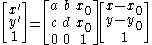
where a, b, c, and d are the transformation coefficients; x and y are the screen offset; x_0 and y_0 are the origin offset; and x' and y' are the transformed coordinates. All arithmetic is carried out on 16-bit signed fixed point numbers, while all offsets are limited to 13 bits. The radix point is between bits 7 and 8.
Affine transformations only allow for displacement, scaling, and shearing effects. Many games create additional effects through creative manipulation of the transformation matrix parameters on a scanline by scanline basis. In this way pseudo-perspective, curved surface, and distortion effects can be achieved.
Limits
Mode 7 can only work on backgrounds, not sprites; therefore, any object that does not rotate/scale with the background must be a sprite, even items that would normally be thought of as part of the background, such as fixed platforms. The game developer must create a sprite with the same appearance as that object. For instance, in Super Castlevania IVSuper Castlevania IV
Super Castlevania IV, known as in Japan, is a platform game developed and published by Konami and the first Castlevania game for the Super Nintendo Entertainment System. The game was originally released in 1991 and later re-released on the Nintendo Wii's Virtual Console in 2006...
, battles in which a boss rotates, such as with Koranot (which is a large golem), have the mobile boss as the background, while the blocks on which the protagonist stands are sprites. With the obvious enhancements, this is similar to how some NES games featured battles against a giant movable boss without the slowdown and flicker inherent in a large sprite set—by making the boss the background, and then moving and animating it. Both systems' examples only must apply to objects in the horizontal plane of the moving object. For instance, a floor, ceiling or scoreboard can remain part of a background in both the NES and SNES examples as long as they are completely "above" or "below" the field of gameplay. They can also be turned into sprites if the whole screen is needed, but this can cause slowdown.
The fact that Mode 7 cannot be used on sprites means that each "size" of an "approaching" sprite for a given distance has to be pre-drawn, meaning that one would see sprites "jump" between a limited number of sizes when "approaching" them. This can be seen in Super Mario Kart
Super Mario Kart
is a go-kart racing video game developed by Nintendo EAD for the Super Nintendo Entertainment System . The first game of the Mario Kart series, it was launched in Japan on August 27, 1992, in North America on September 1, 1992, and in Europe on January 21, 1993. Selling eight million copies...
and HyperZone
HyperZone
is a shooter video game developed by HAL Laboratory, Inc. for the Super Nintendo Entertainment System video game console. It was one of the first games to be released for the console and is notably one of the few "3D scrolling shooter" types available...
whenever an object approaches, or when walking vertically on the Final Fantasy VI
Final Fantasy VI
is a role-playing video game developed and published by Square , released in 1994 for the Super Nintendo Entertainment System as a part of the Final Fantasy series. Set in a fantasy world with a technology level equivalent to that of the Second Industrial Revolution, the game's story focuses on a...
map with an airship in view. In Super Mario RPG: Legend of the Seven Stars
Super Mario RPG: Legend of the Seven Stars
Super Mario RPG: Legend of the Seven Stars, often shortened and officially known in Japan as , is an action role-playing game developed by Square and published by Nintendo for the Super Nintendo Entertainment System . It was originally released on March 9, 1996 in Japan and on May 13,...
Mode 7 is used greatly.
Similarly, sprite "rotations" have to be handled through pre-drawing unless they are done with hardware included in the game cartridge such as the Super FX
Super FX
The Super FX is a coprocessor chip used in select Super Nintendo Entertainment System video game cartridges. This custom-made RISC processor was typically programmed to act like a graphics accelerator chip that would draw polygons to a frame buffer in the RAM that sat adjacent to it...
2 chip as with Super Mario World 2: Yoshi's Island
Super Mario World 2: Yoshi's Island
Super Mario World 2: Yoshi's Island, originally released as in Japan, is a platform video game developed and published by Nintendo for the SNES console. Despite its title, this game serves as a prequel to all other games within the established Mario Bros timeline...
. A notable workaround does exist and can be seen in the second boss battle in Contra III: The Alien Wars
Contra III: The Alien Wars
Contra III: The Alien Wars, released in Japan as and in the PAL region as Super Probotector: Alien Rebels, is a run and gun game for the Super Nintendo Entertainment System produced by Konami...
and the battles against Morton, Ludwig, Roy and Bowser in Super Mario World
Super Mario World
, subtitled Super Mario Bros. 4 for its original Japanese release, is a platform video game developed and published by Nintendo as a pack-in launch title for the Super Famicom/Super Nintendo Entertainment System , and is the fourth game in the Super Mario series...
. In these examples, the boss is a "background" and therefore rotates through Mode 7, and the scoreboard, which is "above" the field of play, is also a background, but the floor of battle's cracks are, as with the players and gunfire, "sprites" that are redrawn under various rotations as the player rotates. However, this only allows one "sprite" to be manipulated at once.
One exception to Mode 7-like effects on sprites handled neither by pre-drawing nor by external chips occurs in Tales of Phantasia
Tales of Phantasia
is a Super Nintendo game in the RPG genre published by Namco and released in Japan in 1995, selling 212,000 copies. It is the first mothership title in the Tales RPG series and was later remade/re-released on the PlayStation, Game Boy Advance and PlayStation Portable...
and Star Ocean
Star Ocean
is a franchise of action role-playing video games developed by tri-Ace and published and owned by Square Enix .-Creation and influence:...
, where re-rendering of sprites on the fly is done entirely by the software. In ToP, the player sprite vertically stretches upon walking onto a save spot, and in Star Ocean, items "squash" upon "popping out of" an open treasure chest. Due to the extra tiles needed for such rendering and the other high system demands throughout those games (both used a form of streaming audio to circumvent the SPC700
SPC700
The Nintendo S-SMP is the audio CPU of the SNES video game console.The SNES contains a sound module called APU which is almost completely separate from the rest of the system: it is clocked at a nominal 24.576 MHz in both NTSC and PAL systems, and can only communicate with the main board via 4...
's limited capacity, and as with most high-end SNES RPGs, used a variable width font), such rendering was limited to those few scenes.
The Sega Mega Drive/Sega Genesis has no comparable hardware-native feature to Mode 7, although the Sega CD add-on added such a feature; for example, it is used prominently in the Special Stages of Sonic CD. However, as in Tales of Phantasia and Star Ocean's sprite effect add-ins, some comparable technical feats could be programmed straight into a game by the developers, resulting in similar effects seen in games such as Castlevania: Bloodlines
Castlevania: Bloodlines
Castlevania: Bloodlines is the only Castlevania video game released on the Mega Drive/Genesis. It was developed and published by Konami, and was first released in North America, on March 17, 1994. Its Japanese title is . This version featured a considerable amount of violence, with the American...
, Adventures of Batman and Robin, or Contra: Hard Corps
Contra: Hard Corps
Contra: Hard Corps, released in Japan as and in Europe and Australia as Probotector, is a side-scrolling run and gun-style shoot-'em-up video game released by Konami for the Sega Genesis/Mega Drive in...
. The Sega 32X
Sega 32X
The Sega 32X, codenamed Project Mars, is an add-on for the Mega Drive/Genesis video game console by Sega. Its aim was to increase the lifespan of the aging Mega Drive/Genesis system, which was facing stiff competition from the SNES...
has 2D and basic 3D capabilities, so scaling and rotation effects are common in primarily 2D games such as Knuckles' Chaotix
Knuckles' Chaotix
Knuckles' Chaotix, is a platform game spin-off to the Sonic the Hedgehog series, developed by Sonic Team, and published by Sega for the Sega 32X. The game was released in North America in March 1995, in Japan on April 21, 1995 and finally in Europe in May 1995. The game's only re-release since then...
, which also was the first game in the Sonic
Sonic the Hedgehog (character)
, trademarked Sonic The Hedgehog, is a video game character and the main protagonist of the Sonic video game series released by Sega, as well as in numerous spin-off comics, cartoons, and a feature film. The first game was released on June 23, 1991, to provide Sega with a mascot to rival Nintendo's...
series to feature a polygonal special stage.
Hardware
The two PPU (picture-processing unit) chips of the SNES use two 8-bitBit
A bit is the basic unit of information in computing and telecommunications; it is the amount of information stored by a digital device or other physical system that exists in one of two possible distinct states...
32-kilobyte
Kilobyte
The kilobyte is a multiple of the unit byte for digital information. Although the prefix kilo- means 1000, the term kilobyte and symbol KB have historically been used to refer to either 1024 bytes or 1000 bytes, dependent upon context, in the fields of computer science and information...
RAM chips. One PPU can access the tile map (128×128 tiles), and the other PPU can access the tile set (256 tiles, 8×8 pixel
Pixel
In digital imaging, a pixel, or pel, is a single point in a raster image, or the smallest addressable screen element in a display device; it is the smallest unit of picture that can be represented or controlled....
s in 256 colors) in a single cycle.