


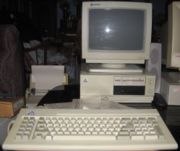
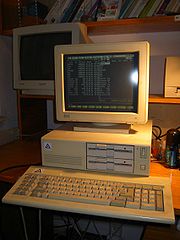
Leading Edge Model D

Encyclopedia
Computer
A computer is a programmable machine designed to sequentially and automatically carry out a sequence of arithmetic or logical operations. The particular sequence of operations can be changed readily, allowing the computer to solve more than one kind of problem...
first released by Leading Edge Hardware
Leading Edge (company)
Leading Edge Hardware Products, Inc., was a computer manufacturer in the 1980s and the 1990s. It was based in Westborough, Massachusetts.-History:...
in July 1985. It was initially priced at $1,495 configured with dual 5.25" floppy drives, 256 KB
Kilobyte
The kilobyte is a multiple of the unit byte for digital information. Although the prefix kilo- means 1000, the term kilobyte and symbol KB have historically been used to refer to either 1024 bytes or 1000 bytes, dependent upon context, in the fields of computer science and information...
of RAM, and a monochrome monitor. It was manufactured by South Korean conglomerate Daewoo
Daewoo
Daewoo or the Daewoo Group was a major South Korean chaebol . It was founded on 22 March 1967 as Daewoo Industrial and was dismantled by the Korean government in 1999...
and distributed by Canton, Massachusetts
Canton, Massachusetts
Canton is a town in Norfolk County, Massachusetts, United States. The population was 21,561 at the 2010 census. Canton is part of Greater Boston, about 15 miles southwest of downtown Boston.- History :...
-based Leading Edge. Engineer Stephen Kahng spent about four months designing the Model D at a cost of $200,000. Kahng later became CEO of Macintosh
Macintosh
The Macintosh , or Mac, is a series of several lines of personal computers designed, developed, and marketed by Apple Inc. The first Macintosh was introduced by Apple's then-chairman Steve Jobs on January 24, 1984; it was the first commercially successful personal computer to feature a mouse and a...
clone maker Power Computing
Power Computing
Power Computing Corporation was the first company selected by Apple Inc to create Macintosh-compatible computers . Stephen “Steve” Kahng, a computer engineer best known for his design of the Leading Edge Model D, founded the company in November 1993...
.
In August 1986, Leading Edge cut the price of the base model by $200, to $1,295, and increased the base memory of the machine to 512 KB.
The Model D was an immediate success, selling 100,000 units in its first year of production. It continued to sell well for several years, until a dispute with its dealers forced Leading Edge into bankruptcy in 1989.
Hardware
The Model D initially featured an Intel 8088Intel 8088
The Intel 8088 microprocessor was a variant of the Intel 8086 and was introduced on July 1, 1979. It had an 8-bit external data bus instead of the 16-bit bus of the 8086. The 16-bit registers and the one megabyte address range were unchanged, however...
microprocessor
Microprocessor
A microprocessor incorporates the functions of a computer's central processing unit on a single integrated circuit, or at most a few integrated circuits. It is a multipurpose, programmable device that accepts digital data as input, processes it according to instructions stored in its memory, and...
at 4.77 MHz, although later models had a switch in the back to run at 4.77 MHz (normal) or 7.16 MHz (high). Earlier models had no turbo switch and ran only at 4.77 MHz, while a few of the later ones (seemingly very rare) were 7.16 MHz only. Three models are known: DC-2011, DC-2010E, and DC-2011E. The "E" seems to correlate with the capability of running at 7.16 MHz.
Unlike the IBM PC
IBM PC
The IBM Personal Computer, commonly known as the IBM PC, is the original version and progenitor of the IBM PC compatible hardware platform. It is IBM model number 5150, and was introduced on August 12, 1981...
and IBM PC/XT, the Model D integrated video, the disk controller, a battery backed clock, serial and parallel ports directly onto the motherboard rather than putting them on plug-in cards. This allowed the Model D to be half the size of IBM's models.
The motherboard came in eight different revisions: Revision 1, 5, 7, 8, CC1, CC2, WC1, and WC2. A list of motherboard part numbers and revision numbers can be found here. Revisions 1 through 7 were usually found in model DC-2011, with revisions 8 through WC2 being either in 2010E or 2011E. WC1 (presumably also WC2) is 7.16 MHz only. Due to its tight integration, the Model D motherboard was a nonstandard form factor, so replacing the motherboard with an off-the-shelf upgrade was not possible.
They came preinstalled with 256, 512, or 640 KB
Kilobyte
The kilobyte is a multiple of the unit byte for digital information. Although the prefix kilo- means 1000, the term kilobyte and symbol KB have historically been used to refer to either 1024 bytes or 1000 bytes, dependent upon context, in the fields of computer science and information...
of RAM. Lower-capacity machines were user upgradeable to 640 KB. Motherboard revisions 7, 8, WC1 and WC2 came with 768 KB of RAM installed (640 KB available to the user).
Some models featured a monochrome/CGA
Color Graphics Adapter
The Color Graphics Adapter , originally also called the Color/Graphics Adapter or IBM Color/Graphics Monitor Adapter, introduced in 1981, was IBM's first color graphics card, and the first color computer display standard for the IBM PC....
selection switch, with a single port used for both modes. Some models had both a Monochrome and a CGA port, also with a switch to change modes (and ports).
The Model D computers supported a special extended graphics mode: 640x200.
Floppy disk
A floppy disk is a disk storage medium composed of a disk of thin and flexible magnetic storage medium, sealed in a rectangular plastic carrier lined with fabric that removes dust particles...
model and a fixed disk (hard disk
Hard disk
A hard disk drive is a non-volatile, random access digital magnetic data storage device. It features rotating rigid platters on a motor-driven spindle within a protective enclosure. Data is magnetically read from and written to the platter by read/write heads that float on a film of air above the...
) model. The floppy disk model had one or two 360 KB drives, so that the user could run MS-DOS programs on the primary drive and work with files on the secondary drive, if equipped. The fixed disk model had one 360 KiB floppy drive and either a 10 MB
Megabyte
The megabyte is a multiple of the unit byte for digital information storage or transmission with two different values depending on context: bytes generally for computer memory; and one million bytes generally for computer storage. The IEEE Standards Board has decided that "Mega will mean 1 000...
, 20 MB, or 30 MB hard disk. The model with the 20 MB fixed disk was initially released in February 1986 at a cost of $1,895. Leading Edge dealers had difficulty keeping the 20MB model in stock. At the time, a Tandy 1200 equipped with a 10MB drive sold for $1999.
The buyer also had a choice between an amber or a green monochrome CRT monitor.
Software
The unit came with MS-DOSMS-DOS
MS-DOS is an operating system for x86-based personal computers. It was the most commonly used member of the DOS family of operating systems, and was the main operating system for IBM PC compatible personal computers during the 1980s to the mid 1990s, until it was gradually superseded by operating...
2.11 or later, and a special edition of GW-BASIC
GW-BASIC
GW-BASIC was a dialect of the programming language BASIC developed by Microsoft from BASICA, originally for Compaq. It is compatible with Microsoft/IBM BASICA, but was disk based and did not need the ROM BASIC. It was bundled with MS-DOS operating systems on IBM PC compatibles by Microsoft...
to support the extended graphics mode.
It also came with a diagnostics disk. This disk contained a diagnostics program, and PARK.COM, a utility used to park the hard drive heads when the computer was to be moved. Most models also came with a word processing program developed by Leading Edge titled Leading Edge Word Processor, commonly referred to by its acronym 'LEWP'.
The computer supports the Microsoft Windows
Microsoft Windows
Microsoft Windows is a series of operating systems produced by Microsoft.Microsoft introduced an operating environment named Windows on November 20, 1985 as an add-on to MS-DOS in response to the growing interest in graphical user interfaces . Microsoft Windows came to dominate the world's personal...
operating system up to version 3.0
Windows 3.0
Windows 3.0, a graphical environment, is the third major release of Microsoft Windows, and was released on 22 May 1990. It became the first widely successful version of Windows and a rival to Apple Macintosh and the Commodore Amiga on the GUI front...
, as it is the last version of Windows to support Real Mode
Real mode
Real mode, also called real address mode, is an operating mode of 80286 and later x86-compatible CPUs. Real mode is characterized by a 20 bit segmented memory address space and unlimited direct software access to all memory, I/O addresses and peripheral hardware...
.
Significance
The Model D, along with the Tandy 1000Tandy 1000
The Tandy 1000 was the first in a line of more-or-less IBM PC compatible home computer systems produced by the Tandy Corporation for sale in its Radio Shack chain of stores.-Overview:...
and Epson Equity
Epson Equity
The Epson Equity series of IBM Compatible Personal Computers was manufactured from 1985 until the early '90s by Epson Inc. Epson was well known for its dot matrix printers at the time and the Equity series represents their entry into the growing PC compatible market...
series, was one of the first IBM PC Compatible
IBM PC compatible
IBM PC compatible computers are those generally similar to the original IBM PC, XT, and AT. Such computers used to be referred to as PC clones, or IBM clones since they almost exactly duplicated all the significant features of the PC architecture, facilitated by various manufacturers' ability to...
computers to become popular for home use, due to its low price and good reviews. Previously, MS-DOS and IBM Compatibles were almost exclusively used in businesses, with the home computer
Home computer
Home computers were a class of microcomputers entering the market in 1977, and becoming increasingly common during the 1980s. They were marketed to consumers as affordable and accessible computers that, for the first time, were intended for the use of a single nontechnical user...
market dominated by Commodore
Commodore International
Commodore is the commonly used name for Commodore Business Machines , the U.S.-based home computer manufacturer and electronics manufacturer headquartered in West Chester, Pennsylvania, which also housed Commodore's corporate parent company, Commodore International Limited...
, Apple and Atari
Atari
Atari is a corporate and brand name owned by several entities since its inception in 1972. It is currently owned by Atari Interactive, a wholly owned subsidiary of the French publisher Atari, SA . The original Atari, Inc. was founded in 1972 by Nolan Bushnell and Ted Dabney. It was a pioneer in...
. For years afterward, many home-oriented software packages for the PC specifically cited the Model D along with the Tandy and Epson models as compatible hardware.
Leading Edge was Phoenix Technologies
Phoenix Technologies
Phoenix Technologies Ltd designs, develops and supports core system software for personal computers and other computing devices. Phoenix's products — commonly referred to as BIOS or firmware — support and enable the compatibility, connectivity, security and management of the various components and...
' first customer for its IBM-compatible BIOS
BIOS
In IBM PC compatible computers, the basic input/output system , also known as the System BIOS or ROM BIOS , is a de facto standard defining a firmware interface....
, and the Model D was one of the first PCs on the market to use the Phoenix BIOS. Although advertised as 100% IBM compatible, numerous letters published in the January 13, 1986 issue of InfoWorld identified compatibility issues with several popular software packages and aftermarket hard drives. Syndicated newspaper columnists T.R. Reid and Michael Schrage, writing in April 1986, predicted that the popularity of the Model D would lead to hardware and software vendors specifically testing for compatibility. In spite of these early reports, the Model D continued to sell well. In early 1987, Daewoo was producing 13,000 units per month and failing to keep up with demand. As a result, buyers waited 2–8 weeks before taking delivery.
The Model D also has the distinction of being the first Korean-made PC to be sold in the United States, and at the time of its introduction, it undercut the price of similar IBM PC compatibles by $500.
The Model D received 4 out of 5 stars from InfoWorld, and a positive review in Popular Mechanics
Popular Mechanics
Popular Mechanics is an American magazine first published January 11, 1902 by H. H. Windsor, and has been owned since 1958 by the Hearst Corporation...
cited its low price and the quality of its keyboard. It received good reviews in other computer magazines and Consumer Reports
Consumer Reports
Consumer Reports is an American magazine published monthly by Consumers Union since 1936. It publishes reviews and comparisons of consumer products and services based on reporting and results from its in-house testing laboratory. It also publishes cleaning and general buying guides...
magazine.