


Tandy 1000

Encyclopedia
The Tandy 1000 was the first in a line of more-or-less IBM PC compatible
home computer
systems produced by the Tandy Corporation
for sale in its Radio Shack
chain of stores.
The machine was primarily aimed at the home and educational markets, and it copied the IBM PCjr
's 16-color graphics (PCjr's graphics were an extension of CGA
video) and 3-voice sound, but didn't use the PCjr cartridge ports. As the Tandy 1000 line outlasted the PCjr by many years (and in fact did not make it to market until shortly before IBM announced the discontinuation of the PCjr) these graphics and sound standards became known as "Tandy-compatible" or (for the graphics) "TGA" (standing for Tandy Graphics Adapter) and many software packages of the era listed their support for Tandy standard hardware on the package.
Tandy 1000 computers were some of the first IBM PC clones to incorporate a complete set of basic peripherals on the motherboard using proprietary ASIC
s, the forerunner of the chipset
. All Tandy 1000 computers featured built-in Tandy video hardware with color graphics (CGA compatible with enhancements), enhanced sound (based on one of several variants of the Texas Instruments SN76496 sound generator), game port
s compatible with those on the TRS-80 Color Computer
, an IBM-standard floppy disk controller supporting two drives, and a parallel printer port, all integrated into the motherboard. This is in addition to the hardware standard on the IBM PC, PC/XT, and PC/AT motherboards: keyboard interface, expansion slots, memory subsystem, DMA, interrupt controller, and math coprocessor socket. (Hard disks were high end, not standard, equipment for home computers until the late years of the Tandy 1000 line, explaining the absence of an integrated hard disk controller from most Tandy 1000 motherboards.) An IBM PC, XT or AT would require at least 4 expansion cards for similar hardware: one video graphics adapter card, one floppy disk controller (FDC) card, one serial and parallel port card, and one sound card with a joystick port. (A third-party multi-IO card might merge the ports and FDC onto one card.) Therefore, the 5 XT slots of the original Tandy 1000, 1000 TX, 1000 SX, and similar models remained available for other hardware, making them equivalent or better than the 8 slots in IBM's XT and AT models (which had 8 slots because the original PC's 5 proved inadequate.)
The earlier models of the Tandy 1000 had a composite video output, and could be used with a color or monochrome composite monitor, or a TV with an RF modulator. The original 1000 and SX had a light-pen port. Unlike most PC clones, several Tandy 1000 computers had MS-DOS
built into ROM
and could boot in a few seconds. Tandy bundled DeskMate
, a graphical suite of consumer-oriented applications, with various Tandy 1000 models.
The original line was equipped with the Intel 8088
CPU
, which was later extended to faster clock speeds and also the 8086
and 80286
processors. Tandy 1000s (at least all early models) used Phoenix BIOS
. Common models of the machine included the Tandy 1000, 1000 EX, 1000 HX, 1000 SX, 1000 TX, 1000 SL, 1000 RL, and 1000 TL.
For most Tandy 1000 models other than the compact EX and HX that did not come already equipped with a hard drive, Tandy offered hard disk options in the form of "hardcards" that were installed in one of the computer's expansion slots and consisted of a controller and drive (typically a 3.5" MFM or RLL unit with a Western Digital controller) mounted together on a metal bracket. Although this arrangement provided a neat physical coupling between the controller and the disk, single-sector internal transfers and dependence on the speed of the host machine to transfer data to memory meant that a trial-and-error approach was still needed to set the disk interleave correctly to ensure optimum transfer rates. Even then, transfer rates could be as low as 40kB/s for 8088 and 8086 machines.
Eventually, in 1993, Tandy Corporation sold its computer manufacturing business to AST Computers, and all Tandy computer lines were terminated. This was done because changes in the market made it increasingly difficult for Tandy to make a profit on its computer line. When that occurred, Radio Shack stores began selling computers made by other manufacturers, such as Compaq
.
, though with a plastic case over a steel lower chassis to reduce weight. The original Tandy 1000 featured a proprietary keyboard port (using an 8-pin DIN connector
) along with 2 joystick ports (using 6-pin DIN connectors) on the front of the case. The rear featured a RGB monitor connector (a standard 9-pin female D-shell compatible with CGA
/EGA
monitors), an RCA-style composite video-out connector, a single RCA-style monophonic line-level audio connector, a light pen port, and an edge-card connector used to attach a parallel printer. The printer port followed the old Centronics standard and was not fully compatible with the parallel port found on PCs. The original Tandy 1000 came standard with one internal 5.25" double density floppy disk drive, with an additional exposed internal bay usable for the installation of a second 5.25" disk drive (available as a kit from Radio Shack
). The floppy drives used the old-fashioned method of selecting the drive number with jumpers instead of the IBM cable twist. 128k of memory was standard, with the computer accepting up to 640K of total memory with the addition of expansion cards. MS-DOS 2.11 and DeskMate
1.0 were included with the system. Like the PCjr. DMA was not supplied on the motherboard, but unlike the IBM system, DMA was added by a memory expansion board. While the Tandy 1000 had three XT-compatible expansion slots (with some slight differences), early Tandy memory upgrade boards took up two of the slots to get to 640K.
A later revision of the original Tandy 1000 model was the Tandy 1000A. This revision fixed bugs, scanned expansion cards for bootable ROMs, and added a socket for a math coprocessor.
or Atari 800XL. The 5.25" drive was accessible from the side of the computer, on the right hand side. The EX was marketed as a starter system for people new to computing, and sold for $1000.00 from Radio Shack in December 1986. The EX and HX would be among the most popular of the Tandy 1000 line because of their low price.
The EX had a 7.16 MHz 8088 (capable of clocking down to 4.77 MHz) and one internal 5.25" floppy drive. An external drive could be connected to a port on the back. A useful feature for the EX and later systems is the ability to boot off either drive, as the second drive, B: drive can be selected as the boot drive when the system boots.
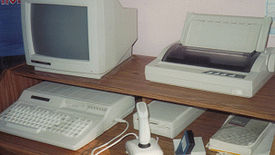 The computer's memory could be expanded to 640k. This would be accomplished by placing a memory expansion card, which came with 128k, in the expansion slot and adding another 256 (for a total of 384) kilobytes in memory chips to this board. The cards for the 1000 HX (and 1000 EX) were ISA electrically, but used a pin header rather than an edge connector
. Called "PLUS cards", their connector design allowed them to be smaller (and cheaper) than standard ISA cards and to stack, rather than connecting to separate motherboard connectors; both of these aspects of the design saved space and allowed up to three cards to be installed in a small card compartment of the compact integrated system case. Radio Shack eventually sold an adapter card that allowed the installation of a "Plus Card" into a standard ISA slot, such as those in the larger Tandy 1000 models. In addition to the 5.25" drive bay of the EX model, the HX had another 3.5 inch drive bay in the computer case. On the back of the machine there was a port which allowed a user to connect an external 360k 5.25" or 720k 3.5" floppy disk drive unit, available from Tandy.
The 1000 HX did not come with a hard drive, and Tandy did not offer fixed disks for it. However a number of third party vendors made fixed disks for the HX available for sale. The design of the EX and HX did not make it easy to add a hard disk, however.
The settings on the computer could be changed so that instead of looking in ROM for DOS at bootup that it would go to the floppy drive instead. Most versions of MS-DOS worked with the 1000 HX, including DOS 3.x, and some later versions. There was a quirk in the DOS 4.0 environment that prevented that version of DOS from working with Tandy 1000 HX computers.
.
The Tandy 1000 SX was the lower-end sibling of the TX, and was essentially an upgraded reissue of the original Tandy 1000. It used a 7.16 MHz 8088-2 processor, had 384k of memory (upgradeable to 640K on the motherboard,) came with either one or two 5.25" internal floppy disk drives, had the light pen port (not a serial port) like the original Tandy 1000, and lacked the volume control and headphone jack of the TX (also like the original 1000).
The 1000 SX came with MS-DOS 3.2 and Deskmate 2 on 5.25" 360K diskettes. The MS-DOS was a version specialized for and only bootable on the Tandy 1000, as it would announce on the screen of any other PC-compatible one tried to boot with it; it included a version of BASICA (Microsoft's Advanced GW-BASIC) with support for the enhanced CGA graphics modes (a.k.a. Tandy Graphics or TGA) and three-voice sound hardware of the Tandy 1000.
All original Tandy-provided internal floppy disk drives for the 1000 SX and TX were double-density drives. The Tandy 1000 SX and TX were the first models in the Tandy 1000 line to have a built-in DMA controller. The earlier 1000/1000A, 1000 HD, 1000 EX and 1000 HX models, like the IBM PCjr, did not have a DMA controller, but could be upgraded with one. The DMA controller chip was included on the PLUS-type memory expansion board for the EX and HX, and on regular ISA memory expansion cards sold by Tandy and other companies for the 1000, 1000A, and 1000HD. Adding the DMA chip improved the speed and IBM PC-compatibility of these earlier Tandy 1000 models.
compatible monochrome video offering 720x350 resolution, and an improved sound circuit featuring an 8-bit mono DAC/ADC. The composite output was also dropped. The ADC/DAC, which became known as the "Tandy DAC" in games that supported it, was broadly similar in function to sound devices which connected to the parallel port (such as the Disney Sound Source), but unlike those devices it was integrated onto the motherboard, supported DMA transfers and could sample at frequencies up to 48 kHz. While the Tandy DAC's features compared favorably to those offered by Creative's
8-bit Sound Blaster
audio cards, it never saw widespread adoption by software developers. The 640x200x16 graphics mode was rarely used either, as it was not supported by the BIOS. The TL line also allowed the onboard floppy controller, parallel port, and joystick ports to be disabled, which the earlier models did not.
The Tandy 1000 SL and SL/2 feature an Intel 8086 processor running at 8 MHz. The SL series enjoyed a modest, yet appreciable, performance increase over the earlier 8088-based Tandy 1000's, owing to the 8086 processor's 16-bit bus coupled with a slightly higher clock speed. The SL came with 384k of RAM preinstalled, whereas the SL/2 offered 512k. Both machines can be expanded to 640k, although only 576k could be used by the operating system.
The Tandy 1000 TL and TL/2 use 8 MHz Intel 80286 processors, whereas the TL/3 uses a 10 MHz 80286. These computers had 640 kilobytes of memory preinstalled, with an option for an extra 128 kilobytes to be installed for use as video memory for the onboard ETGA (Enhanced TGA, the "Enhanced" referring to the added 640x200x16 color mode) video hardware. It is therefore impractical to expand the onboard memory beyond 640 KB if a VGA graphics card is installed. Notably, the TL/3 had a high-density floppy controller for the first time, although it only shipped with a double-density 3.5" drive. Also, the TL/2 and TL/3 feature on-board 8-bit XT IDE ports, which were not compatible with common AT IDE hard drives.
Since the TL series are XT-class machines, it is impossible to install or use extended memory(XMS), although expanded memory (EMS) can be used in conjunction with an 8-bit LIM EMS memory card for software that supports expanded memory.
The SL and TL were also shipped with MS-DOS 3.3 and DeskMate
3 in ROM, and featured an EEPROM
memory chip to store BIOS settings (which enabled similar functionality to today's CMOS NVRAMs, so that startup options could be saved). (Earlier Tandy 1000 models, like IBM PC and PC/XT systems, used DIP switches for startup configuration settings.) The machines could also run 'normal' MS-DOS 3.x, 5, and 6 and Windows 2 and 3.0, albeit in real mode. In common with many PC clones of the era, MS-DOS 4 was problematic and generally avoided.
The RLX was the 'mid-range' offering of the RL line. It had a 10 MHz 286, and unlike other 286-based Tandy 1000s, it supported up to 384k of extended memory. However, it was not a full AT-class machine, as it still had an 8-bit ISA bus and only 8 IRQs. While the 3-voice sound chip and DAC were still present, Tandy video was dropped. The RLX had VGA instead, but it only had 256k of video memory and was limited to 640x480x16 graphics. Also, the RLX featured a high-density, 1.44 MB 3.5" disk drive. The RLX offered 512KB of memory preinstalled, which could be expanded to 1 MB. (The hard disk version came with 1 MB preinstalled.)
The RSX offered a 25 MHz 80386SX processor, two 16-bit ISA slots, AcuMos SVGA video, an AT compatible IDE interface and standard PS/2 keyboard and mouse ports. It was a full 386-class PC, and could use up to 8MB of memory. On the other hand, the RSX still had the 3-voice sound chip and Tandy DAC.
IBM PC compatible
IBM PC compatible computers are those generally similar to the original IBM PC, XT, and AT. Such computers used to be referred to as PC clones, or IBM clones since they almost exactly duplicated all the significant features of the PC architecture, facilitated by various manufacturers' ability to...
home computer
Home computer
Home computers were a class of microcomputers entering the market in 1977, and becoming increasingly common during the 1980s. They were marketed to consumers as affordable and accessible computers that, for the first time, were intended for the use of a single nontechnical user...
systems produced by the Tandy Corporation
Tandy Corporation
Tandy Corporation was a family-owned leather goods company based in Fort Worth, Texas. Tandy was founded in 1919 as a leather supply store, and acquired RadioShack in 1963. The Tandy name was dropped in May 2000, when RadioShack Corporation was made the official name.-History:Tandy began in 1919...
for sale in its Radio Shack
Radio shack
Radio shack is a slang term for a room or structure for housing radio equipment.-History:In the early days of radio, equipment was experimental and home-built. The first radio transmitters used a noisy spark to generate radio waves and were often housed in a garage or shed. When radio was first...
chain of stores.
Overview
Released in November 1984, the Tandy 1000 was followed by a series of models which appended two or three letters to the name, after a space, (e.g. Tandy 1000 EX, Tandy 1000 SX, Tandy 1000 TX, Tandy 1000 RL, Tandy 1000 RLX). In a few instances, a slash and a number or additional letters were appended to these letters (e.g. Tandy 1000 TL/2, Tandy 1000 RL/HD.)The machine was primarily aimed at the home and educational markets, and it copied the IBM PCjr
IBM PCjr
The IBM PCjr was IBM's first attempt to enter the home computer market. The PCjr, IBM model number 4860, retained the IBM PC's 8088 CPU and BIOS interface for compatibility, but various design and implementation decisions led the PCjr to be a commercial failure.- Features :Announced November 1,...
's 16-color graphics (PCjr's graphics were an extension of CGA
Color Graphics Adapter
The Color Graphics Adapter , originally also called the Color/Graphics Adapter or IBM Color/Graphics Monitor Adapter, introduced in 1981, was IBM's first color graphics card, and the first color computer display standard for the IBM PC....
video) and 3-voice sound, but didn't use the PCjr cartridge ports. As the Tandy 1000 line outlasted the PCjr by many years (and in fact did not make it to market until shortly before IBM announced the discontinuation of the PCjr) these graphics and sound standards became known as "Tandy-compatible" or (for the graphics) "TGA" (standing for Tandy Graphics Adapter) and many software packages of the era listed their support for Tandy standard hardware on the package.
Tandy 1000 computers were some of the first IBM PC clones to incorporate a complete set of basic peripherals on the motherboard using proprietary ASIC
ASIC
ASIC may refer to:* Application-specific integrated circuit, an integrated circuit developed for a particular use, as opposed to a customised general-purpose device.* ASIC programming language, a dialect of BASIC...
s, the forerunner of the chipset
Chipset
A chipset, PC chipset, or chip set refers to a group of integrated circuits, or chips, that are designed to work together. They are usually marketed as a single product.- Computers :...
. All Tandy 1000 computers featured built-in Tandy video hardware with color graphics (CGA compatible with enhancements), enhanced sound (based on one of several variants of the Texas Instruments SN76496 sound generator), game port
Game port
The game port is a device port found on IBM PC compatible systems throughout the 1980s and 1990s. It was the traditional connector for joystick input devices until superseded by USB in the 21st century....
s compatible with those on the TRS-80 Color Computer
TRS-80 Color Computer
The Radio Shack TRS-80 Color Computer was a home computer launched in 1980. It was one of the earliest of the first generation of computers marketed for home use in English-speaking markets...
, an IBM-standard floppy disk controller supporting two drives, and a parallel printer port, all integrated into the motherboard. This is in addition to the hardware standard on the IBM PC, PC/XT, and PC/AT motherboards: keyboard interface, expansion slots, memory subsystem, DMA, interrupt controller, and math coprocessor socket. (Hard disks were high end, not standard, equipment for home computers until the late years of the Tandy 1000 line, explaining the absence of an integrated hard disk controller from most Tandy 1000 motherboards.) An IBM PC, XT or AT would require at least 4 expansion cards for similar hardware: one video graphics adapter card, one floppy disk controller (FDC) card, one serial and parallel port card, and one sound card with a joystick port. (A third-party multi-IO card might merge the ports and FDC onto one card.) Therefore, the 5 XT slots of the original Tandy 1000, 1000 TX, 1000 SX, and similar models remained available for other hardware, making them equivalent or better than the 8 slots in IBM's XT and AT models (which had 8 slots because the original PC's 5 proved inadequate.)
The earlier models of the Tandy 1000 had a composite video output, and could be used with a color or monochrome composite monitor, or a TV with an RF modulator. The original 1000 and SX had a light-pen port. Unlike most PC clones, several Tandy 1000 computers had MS-DOS
MS-DOS
MS-DOS is an operating system for x86-based personal computers. It was the most commonly used member of the DOS family of operating systems, and was the main operating system for IBM PC compatible personal computers during the 1980s to the mid 1990s, until it was gradually superseded by operating...
built into ROM
Read-only memory
Read-only memory is a class of storage medium used in computers and other electronic devices. Data stored in ROM cannot be modified, or can be modified only slowly or with difficulty, so it is mainly used to distribute firmware .In its strictest sense, ROM refers only...
and could boot in a few seconds. Tandy bundled DeskMate
DeskMate
DeskMate was a software application that provided an operating environment that competed with early versions of Microsoft Windows. It originally was made for Tandy's TRS-DOS Operating System and for their TRS-80 line of computers, but eventually shifted to PC, where it was developed using C and...
, a graphical suite of consumer-oriented applications, with various Tandy 1000 models.
The original line was equipped with the Intel 8088
Intel 8088
The Intel 8088 microprocessor was a variant of the Intel 8086 and was introduced on July 1, 1979. It had an 8-bit external data bus instead of the 16-bit bus of the 8086. The 16-bit registers and the one megabyte address range were unchanged, however...
CPU
Central processing unit
The central processing unit is the portion of a computer system that carries out the instructions of a computer program, to perform the basic arithmetical, logical, and input/output operations of the system. The CPU plays a role somewhat analogous to the brain in the computer. The term has been in...
, which was later extended to faster clock speeds and also the 8086
Intel 8086
The 8086 is a 16-bit microprocessor chip designed by Intel between early 1976 and mid-1978, when it was released. The 8086 gave rise to the x86 architecture of Intel's future processors...
and 80286
Intel 80286
The Intel 80286 , introduced on 1 February 1982, was a 16-bit x86 microprocessor with 134,000 transistors. Like its contemporary simpler cousin, the 80186, it could correctly execute most software written for the earlier Intel 8086 and 8088...
processors. Tandy 1000s (at least all early models) used Phoenix BIOS
Phoenix Technologies
Phoenix Technologies Ltd designs, develops and supports core system software for personal computers and other computing devices. Phoenix's products — commonly referred to as BIOS or firmware — support and enable the compatibility, connectivity, security and management of the various components and...
. Common models of the machine included the Tandy 1000, 1000 EX, 1000 HX, 1000 SX, 1000 TX, 1000 SL, 1000 RL, and 1000 TL.
For most Tandy 1000 models other than the compact EX and HX that did not come already equipped with a hard drive, Tandy offered hard disk options in the form of "hardcards" that were installed in one of the computer's expansion slots and consisted of a controller and drive (typically a 3.5" MFM or RLL unit with a Western Digital controller) mounted together on a metal bracket. Although this arrangement provided a neat physical coupling between the controller and the disk, single-sector internal transfers and dependence on the speed of the host machine to transfer data to memory meant that a trial-and-error approach was still needed to set the disk interleave correctly to ensure optimum transfer rates. Even then, transfer rates could be as low as 40kB/s for 8088 and 8086 machines.
Eventually, in 1993, Tandy Corporation sold its computer manufacturing business to AST Computers, and all Tandy computer lines were terminated. This was done because changes in the market made it increasingly difficult for Tandy to make a profit on its computer line. When that occurred, Radio Shack stores began selling computers made by other manufacturers, such as Compaq
Compaq
Compaq Computer Corporation is a personal computer company founded in 1982. Once the largest supplier of personal computing systems in the world, Compaq existed as an independent corporation until 2002, when it was acquired for US$25 billion by Hewlett-Packard....
.
Tandy 1000
The original Tandy 1000 was a large computer almost the size of the IBM PCIBM PC
The IBM Personal Computer, commonly known as the IBM PC, is the original version and progenitor of the IBM PC compatible hardware platform. It is IBM model number 5150, and was introduced on August 12, 1981...
, though with a plastic case over a steel lower chassis to reduce weight. The original Tandy 1000 featured a proprietary keyboard port (using an 8-pin DIN connector
DIN connector
A DIN connector is a connector that was originally standardized by the , the German national standards organization. There are DIN standards for a large number of different connectors, therefore the term "DIN connector" alone does not unambiguously identify any particular type of connector unless...
) along with 2 joystick ports (using 6-pin DIN connectors) on the front of the case. The rear featured a RGB monitor connector (a standard 9-pin female D-shell compatible with CGA
Color Graphics Adapter
The Color Graphics Adapter , originally also called the Color/Graphics Adapter or IBM Color/Graphics Monitor Adapter, introduced in 1981, was IBM's first color graphics card, and the first color computer display standard for the IBM PC....
/EGA
Enhanced Graphics Adapter
The Enhanced Graphics Adapter is the IBM PC computer display standard specification which is between CGA and VGA in terms of color and space resolution. Introduced in October 1984 by IBM shortly after its new PC/AT, EGA produces a display of 16 simultaneous colors from a palette of 64 at a...
monitors), an RCA-style composite video-out connector, a single RCA-style monophonic line-level audio connector, a light pen port, and an edge-card connector used to attach a parallel printer. The printer port followed the old Centronics standard and was not fully compatible with the parallel port found on PCs. The original Tandy 1000 came standard with one internal 5.25" double density floppy disk drive, with an additional exposed internal bay usable for the installation of a second 5.25" disk drive (available as a kit from Radio Shack
Radio shack
Radio shack is a slang term for a room or structure for housing radio equipment.-History:In the early days of radio, equipment was experimental and home-built. The first radio transmitters used a noisy spark to generate radio waves and were often housed in a garage or shed. When radio was first...
). The floppy drives used the old-fashioned method of selecting the drive number with jumpers instead of the IBM cable twist. 128k of memory was standard, with the computer accepting up to 640K of total memory with the addition of expansion cards. MS-DOS 2.11 and DeskMate
DeskMate
DeskMate was a software application that provided an operating environment that competed with early versions of Microsoft Windows. It originally was made for Tandy's TRS-DOS Operating System and for their TRS-80 line of computers, but eventually shifted to PC, where it was developed using C and...
1.0 were included with the system. Like the PCjr. DMA was not supplied on the motherboard, but unlike the IBM system, DMA was added by a memory expansion board. While the Tandy 1000 had three XT-compatible expansion slots (with some slight differences), early Tandy memory upgrade boards took up two of the slots to get to 640K.
A later revision of the original Tandy 1000 model was the Tandy 1000A. This revision fixed bugs, scanned expansion cards for bootable ROMs, and added a socket for a math coprocessor.
Tandy 1000 HD
The original Tandy 1000 (and many other models), like most home computers sold at the time, did not have a hard disk drive. The Tandy 1000 HD was essentially an original Tandy 1000 with a hard disk option factory installed. The factory hard disk had a capacity on the order of 10 or 20 MB.Tandy 1000 EX
The Tandy 1000 EX was designed as an entry-level IBM compatible personal computer. The EX was a compact computer that had the keyboard and 5.25" floppy drive built into the computer casing. This form factor would have been familiar to users upgrading from home computers such as the Commodore 64Commodore 64
The Commodore 64 is an 8-bit home computer introduced by Commodore International in January 1982.Volume production started in the spring of 1982, with machines being released on to the market in August at a price of US$595...
or Atari 800XL. The 5.25" drive was accessible from the side of the computer, on the right hand side. The EX was marketed as a starter system for people new to computing, and sold for $1000.00 from Radio Shack in December 1986. The EX and HX would be among the most popular of the Tandy 1000 line because of their low price.
The EX had a 7.16 MHz 8088 (capable of clocking down to 4.77 MHz) and one internal 5.25" floppy drive. An external drive could be connected to a port on the back. A useful feature for the EX and later systems is the ability to boot off either drive, as the second drive, B: drive can be selected as the boot drive when the system boots.
Tandy 1000 HX
The Tandy 1000 HX was the bigger brother of the EX. It was mostly the same machine, but had a 3.5" floppy instead of a 5.25" one, and also had DOS 2.11 in ROM, which could be accessed by starting the computer with no bootable disk present. Like the EX, the clock speed of its 8088 CPU was increased to 7.16 MHz, providing a large performance benefit; it could clock down to 4.77 MHz for compatibility with older applications. (4.77 MHz was the speed of the 8088 in the IBM PC and PC/XT models and so was the de-facto standard speed for an 8088 in an IBM-compatible.)Edge connector
An edge connector is the portion of a printed circuit board consisting of traces leading to the edge of the board that are intended to plug into a matching socket. The edge connector is a money-saving device because it only requires a single discrete female connector , and they also tend to be...
. Called "PLUS cards", their connector design allowed them to be smaller (and cheaper) than standard ISA cards and to stack, rather than connecting to separate motherboard connectors; both of these aspects of the design saved space and allowed up to three cards to be installed in a small card compartment of the compact integrated system case. Radio Shack eventually sold an adapter card that allowed the installation of a "Plus Card" into a standard ISA slot, such as those in the larger Tandy 1000 models. In addition to the 5.25" drive bay of the EX model, the HX had another 3.5 inch drive bay in the computer case. On the back of the machine there was a port which allowed a user to connect an external 360k 5.25" or 720k 3.5" floppy disk drive unit, available from Tandy.
The 1000 HX did not come with a hard drive, and Tandy did not offer fixed disks for it. However a number of third party vendors made fixed disks for the HX available for sale. The design of the EX and HX did not make it easy to add a hard disk, however.
The settings on the computer could be changed so that instead of looking in ROM for DOS at bootup that it would go to the floppy drive instead. Most versions of MS-DOS worked with the 1000 HX, including DOS 3.x, and some later versions. There was a quirk in the DOS 4.0 environment that prevented that version of DOS from working with Tandy 1000 HX computers.
Tandy 1000 SX/TX
The Tandy 1000 TX was very similar to the Tandy 1000, having an external keyboard and similar casing. The most major difference was the use of an 80286 CPU; otherwise, it was nearly identical to the Tandy 1000, including the unique parallel port edge connector. Despite the 80286 processor, it was still an XT-class PC, not an AT-class PC, as it adapted the 80286 to operate over the same 8-bit data bus as previous Tandy 1000 models, and had 8-bit XT-style expansion slots. As such, it could not operate in 80286 protected mode or perform 16-bit memory or I/O transfers in one bus cycle, but it did benefit from the higher speed of the 80286 and its other added instructions in real mode. The TX had a 3.5" internal floppy disk drive, with an optional additional internal 5.25" floppy disk drive. It contained ports for two joysticks in the front along with the keyboard, and included a volume control with a 1/8" headphone jack on the front. The back had all of the same ports as the Tandy 1000, except that the light pen port was replaced with an RS-232 serial port. The memory size was 640k (upgradable to 768k, with the added 128K devoted to video) and the computer came bundled with DeskMateDeskMate
DeskMate was a software application that provided an operating environment that competed with early versions of Microsoft Windows. It originally was made for Tandy's TRS-DOS Operating System and for their TRS-80 line of computers, but eventually shifted to PC, where it was developed using C and...
.
The Tandy 1000 SX was the lower-end sibling of the TX, and was essentially an upgraded reissue of the original Tandy 1000. It used a 7.16 MHz 8088-2 processor, had 384k of memory (upgradeable to 640K on the motherboard,) came with either one or two 5.25" internal floppy disk drives, had the light pen port (not a serial port) like the original Tandy 1000, and lacked the volume control and headphone jack of the TX (also like the original 1000).
The 1000 SX came with MS-DOS 3.2 and Deskmate 2 on 5.25" 360K diskettes. The MS-DOS was a version specialized for and only bootable on the Tandy 1000, as it would announce on the screen of any other PC-compatible one tried to boot with it; it included a version of BASICA (Microsoft's Advanced GW-BASIC) with support for the enhanced CGA graphics modes (a.k.a. Tandy Graphics or TGA) and three-voice sound hardware of the Tandy 1000.
All original Tandy-provided internal floppy disk drives for the 1000 SX and TX were double-density drives. The Tandy 1000 SX and TX were the first models in the Tandy 1000 line to have a built-in DMA controller. The earlier 1000/1000A, 1000 HD, 1000 EX and 1000 HX models, like the IBM PCjr, did not have a DMA controller, but could be upgraded with one. The DMA controller chip was included on the PLUS-type memory expansion board for the EX and HX, and on regular ISA memory expansion cards sold by Tandy and other companies for the 1000, 1000A, and 1000HD. Adding the DMA chip improved the speed and IBM PC-compatibility of these earlier Tandy 1000 models.
Tandy 1000 SL, SL/2, TL, TL/2, TL/3
The Tandy SL and TL series of computers were updates of the SX and TX respectively. Aside from having a redesigned case and a more integrated motherboard, the SL and TL each offered improved video hardware capable of 640x200x16 graphics, on-board Hercules Graphics CardHercules Graphics Card
The Hercules Graphics Card was a computer graphics controller made by Hercules Computer Technology, Inc. which, through its popularity, became a widely supported display standard. It was common on IBM PC compatibles connected to a monochrome monitor . It supported one high resolution text mode and...
compatible monochrome video offering 720x350 resolution, and an improved sound circuit featuring an 8-bit mono DAC/ADC. The composite output was also dropped. The ADC/DAC, which became known as the "Tandy DAC" in games that supported it, was broadly similar in function to sound devices which connected to the parallel port (such as the Disney Sound Source), but unlike those devices it was integrated onto the motherboard, supported DMA transfers and could sample at frequencies up to 48 kHz. While the Tandy DAC's features compared favorably to those offered by Creative's
Creative Technology
Creative Technology Ltd. is a Singapore-based global company headquartered in Jurong East, Singapore. The principal activities of the company and its subsidiaries consist of the design, manufacture and distribution of digitized sound and video boards, computers and related multimedia, and personal...
8-bit Sound Blaster
Sound Blaster
The Sound Blaster family of sound cards was the de facto standard for consumer audio on the IBM PC compatible system platform, until the widespread transition to Microsoft Windows 95, which standardized the programming interface at application level , and the evolution in PC design led to onboard...
audio cards, it never saw widespread adoption by software developers. The 640x200x16 graphics mode was rarely used either, as it was not supported by the BIOS. The TL line also allowed the onboard floppy controller, parallel port, and joystick ports to be disabled, which the earlier models did not.
The Tandy 1000 SL and SL/2 feature an Intel 8086 processor running at 8 MHz. The SL series enjoyed a modest, yet appreciable, performance increase over the earlier 8088-based Tandy 1000's, owing to the 8086 processor's 16-bit bus coupled with a slightly higher clock speed. The SL came with 384k of RAM preinstalled, whereas the SL/2 offered 512k. Both machines can be expanded to 640k, although only 576k could be used by the operating system.
The Tandy 1000 TL and TL/2 use 8 MHz Intel 80286 processors, whereas the TL/3 uses a 10 MHz 80286. These computers had 640 kilobytes of memory preinstalled, with an option for an extra 128 kilobytes to be installed for use as video memory for the onboard ETGA (Enhanced TGA, the "Enhanced" referring to the added 640x200x16 color mode) video hardware. It is therefore impractical to expand the onboard memory beyond 640 KB if a VGA graphics card is installed. Notably, the TL/3 had a high-density floppy controller for the first time, although it only shipped with a double-density 3.5" drive. Also, the TL/2 and TL/3 feature on-board 8-bit XT IDE ports, which were not compatible with common AT IDE hard drives.
Since the TL series are XT-class machines, it is impossible to install or use extended memory(XMS), although expanded memory (EMS) can be used in conjunction with an 8-bit LIM EMS memory card for software that supports expanded memory.
The SL and TL were also shipped with MS-DOS 3.3 and DeskMate
DeskMate
DeskMate was a software application that provided an operating environment that competed with early versions of Microsoft Windows. It originally was made for Tandy's TRS-DOS Operating System and for their TRS-80 line of computers, but eventually shifted to PC, where it was developed using C and...
3 in ROM, and featured an EEPROM
EEPROM
EEPROM stands for Electrically Erasable Programmable Read-Only Memory and is a type of non-volatile memory used in computers and other electronic devices to store small amounts of data that must be saved when power is removed, e.g., calibration...
memory chip to store BIOS settings (which enabled similar functionality to today's CMOS NVRAMs, so that startup options could be saved). (Earlier Tandy 1000 models, like IBM PC and PC/XT systems, used DIP switches for startup configuration settings.) The machines could also run 'normal' MS-DOS 3.x, 5, and 6 and Windows 2 and 3.0, albeit in real mode. In common with many PC clones of the era, MS-DOS 4 was problematic and generally avoided.
Tandy 1000 RL, RL/HD, RLX, RSX
The Tandy 1000 RL/RLX/RSX series were slim-line desktop home computers. The RL and RL/HD featured a 9.56 MHz 8086 processor, 512 KB of RAM (expandable to 768 KB to provide 128 KB for video), smaller keyboard and mouse ports (which were similar to the PS/2's ports but not directly compatible), a bidirectional parallel port instead of the edge-connector ports, and the SL's enhanced graphics and sound. The RL/HD also included a built-in XT IDE hard drive.The RLX was the 'mid-range' offering of the RL line. It had a 10 MHz 286, and unlike other 286-based Tandy 1000s, it supported up to 384k of extended memory. However, it was not a full AT-class machine, as it still had an 8-bit ISA bus and only 8 IRQs. While the 3-voice sound chip and DAC were still present, Tandy video was dropped. The RLX had VGA instead, but it only had 256k of video memory and was limited to 640x480x16 graphics. Also, the RLX featured a high-density, 1.44 MB 3.5" disk drive. The RLX offered 512KB of memory preinstalled, which could be expanded to 1 MB. (The hard disk version came with 1 MB preinstalled.)
The RSX offered a 25 MHz 80386SX processor, two 16-bit ISA slots, AcuMos SVGA video, an AT compatible IDE interface and standard PS/2 keyboard and mouse ports. It was a full 386-class PC, and could use up to 8MB of memory. On the other hand, the RSX still had the 3-voice sound chip and Tandy DAC.
External links
- Radio Shack Tandy Computer Support, the official support site for Tandy Computers (product search page)
- The Tand-Em Project, a Tandy 1000 emulator project
- DOSBox MS-DOS, Tandy 1000, PCjr Emulator
- MESS Multiple emulator with Tandy 1000HX support
- Tvdog's Archive, Major archive of Tandy 1000 programs and documentation
- Tandy 1000 BASIC Programs, Games and applications
- The OldSkool Shrine, Tandy 1000 History And Memories
- Tandy 1000 Webring, More Sites On The Tandy 1000