
All Topics  
El Escorial

 
El Escorial

   Email Print
   Bookmark   Link


El Escorial


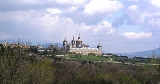
El Escorial is an historical residence of the king of Spain
Spain

Spain or the Kingdom of Spain , is a country located in Southern Europe on the Iberian Peninsula.The Spanish constitution does not establish any official denomination of the country, even though Espa?a , Estado espa?ol and Naci?n espa?ola are used interchangeably....
. It is one of the Spanish royal sites
Spanish royal sites

The royal sites are a set of palaces, monastery, and convents built for and under the patronage of the Spanish monarchy. They are administered by Patrimonio Nacional , a Spanish state agency; most are open to the public, at least in part, except when they are needed for state or official events....
 and functions as a monastery, royal palace, museum and school. It is located about 45 km (28 mi) northwest of the Spanish capital, Madrid
Madrid

Madrid is the Capital and largest city of Spain. It is the Largest cities of the European Union by population within city limits in the European Union after Greater London and Berlin, and its Madrid metropolitan area is the Largest urban areas of the European Union in the European Union after Paris aire urbaine, Greater London Urban Area, a...
, in the town of San Lorenzo de El Escorial. El Escorial comprises two architectural complexes of great historical and cultural significance: El Real Monasterio de El Escorial itself and La Granjilla de La Fresneda
La Granjilla de La Fresneda de El Escorial, Madrid

La Fresneda was the pr?vate Royal Park of Philip II of Spain in the surroundings of El Escorial. The architectural monumental complex of the Park was built between 1561 and 1569....
, a royal hunting lodge and monastic retreat about five km away.


Discussion
Ask a question about 'El Escorial'
Start a new discussion about 'El Escorial'
Answer questions from other users
Full Discussion Forum


Encyclopedia


El Escorial is an historical residence of the king of Spain
Spain

Spain or the Kingdom of Spain , is a country located in Southern Europe on the Iberian Peninsula.The Spanish constitution does not establish any official denomination of the country, even though Espa?a , Estado espa?ol and Naci?n espa?ola are used interchangeably....
. It is one of the Spanish royal sites
Spanish royal sites

The royal sites are a set of palaces, monastery, and convents built for and under the patronage of the Spanish monarchy. They are administered by Patrimonio Nacional , a Spanish state agency; most are open to the public, at least in part, except when they are needed for state or official events....
 and functions as a monastery, royal palace, museum and school. It is located about 45 km (28 mi) northwest of the Spanish capital, Madrid
Madrid

Madrid is the Capital and largest city of Spain. It is the Largest cities of the European Union by population within city limits in the European Union after Greater London and Berlin, and its Madrid metropolitan area is the Largest urban areas of the European Union in the European Union after Paris aire urbaine, Greater London Urban Area, a...
, in the town of San Lorenzo de El Escorial. El Escorial comprises two architectural complexes of great historical and cultural significance: El Real Monasterio de El Escorial itself and La Granjilla de La Fresneda
La Granjilla de La Fresneda de El Escorial, Madrid

La Fresneda was the pr?vate Royal Park of Philip II of Spain in the surroundings of El Escorial. The architectural monumental complex of the Park was built between 1561 and 1569....
, a royal hunting lodge and monastic retreat about five km away. These sites have a dual nature; that is to say, during the 16th and 17th centuries, they were places in which the temporal power of the Spanish monarchy
Spanish monarchy

is the Constitutional Monarchy of Spain. The King or Queen regent of Spain is the Head of State List of heads of state of Spain and the Supreme Commander-in-Chief of the Spanish Armed Forces....
 and the ecclesiastical predominance of the Roman Catholic
Roman Catholic Church

The Roman Catholic Church, officially known as the Catholic Church is the world's largest Christianity Ecclesia , representing over half of all Christians and one-sixth of the world population....
 religion in Spain found a common architectural manifestation. El Escorial was, at once, a monastery and a Spanish royal palace. Originally a property of the Hieronymite monks, it is now an Augustinian monastery.

Philip II of Spain
Philip II of Spain

Philip II was King of Spain from 1556 until 1598, List of monarchs of Naples from 1554 until 1598, king consort of England, as husband of Mary I of England, from 1554 to 1558, lord of the Seventeen Provinces from 1556 until 1581, holding various titles for the individual territories, such as Duke or Count; and King of Portugal as Philip I...
, reacting to the Protestant Reformation
Protestant Reformation

The Protestant Reformation was a Christian reform movement in Europe. It is thought to have begun in 1517 with Martin Luther's Ninety-Five Theses and may be considered to have ended with the Peace of Westphalia in 1648....
 sweeping through Europe during the sixteenth century, devoted much of his lengthy reign (1556-1598) and much of his seemingly inexhaustible supply of New World
New World

The New World is one of the names used for the non-Eurasian/non-African parts of the Earth, specifically the Americas and Australasia. When the term originated in the late 15th century, the Americas were new to the Europeans, who previously thought of the world as consisting only of Europe, Asia, and Africa ....
 gold to stemming the Protestant tide. His protracted efforts were, in the long run, partly successful. However, the same counter-reformational impulse had a much more benign expression, thirty years earlier, in Philip's decision to build the complex at El Escorial.

Philip engaged the Spanish architect, Juan Bautista de Toledo
Juan Bautista de Toledo

Juan Bautista de Toledo. Spanish architect educated in Italy, in the Italian High Renaissance. As many Italian renaissance architects, he had experience in both architecture and military and civil public works....
, to be his collaborator in the design of El Escorial. Juan Bautista had spent the greater part of his career in Rome, where he had worked on the basilica of St. Peter's
St. Peter's Basilica

The Basilica of Saint Peter , officially known in Italian language as the Basilica di San Pietro in Vaticano and commonly known as St. Peter's Basilica, is located within the Vatican City....
, and in Naples
Naples

Naples is a city in southern Italy, the capital of the region of Campania and of the province of Naples. The city is known for its rich history, art, culture and gastronomy, playing an important role throughout much of its existence; it is over 2,800 years old....
, where he had served the king's viceroy, whose recommendation brought him to the king's attention. Philip appointed him architect-royal in 1559, and together they designed El Escorial as a monument to Spain's role as a center of the Christian world.

On November 2, 1984, UNESCO declared The Royal Site of San Lorenzo of El Escorial a World Heritage Site
World Heritage Site

A UNESCO World Heritage Site is a site that is on the list maintained by the international World Heritage Programme administered by the UNESCO World Heritage Committee, composed of 21 Sovereign state which are elected by their General Assembly for a four-year term....
. It is an extremely popular tourist attraction, often visited by day-trippers from Madrid - more than 500.000 visitors come to El Escorial every year (2004 - 504 238, 2005 - 512 834, 2006 - 534 932, 2007 - 538 491).

Design and conception

El Escorial is situated at the foot of Mt. Abantos in the Sierra de Guadarrama
Sierra de Guadarrama

The Sierra de Guadarrama is a mountain chain spanning half of the Sistema Central , located between the Sierra de Gredos in the province of ?vila , and Sierra de Ayll?n in the province of Guadalajara ....
. It is a bleak, semi-forested, wind-swept place that owes its name to nearby piles of slag
Slag

Slag is a partially vitreous by-product of smelting ore to purify metals. They can be considered to be a mixture of metal oxides; however, they can contain metal sulfides and metal atoms in the elemental form....
 or tailings
Tailings

Tailings are the materials left over after the process of separating the valuable fraction from the worthless fraction of an ore.Tailings represent external costs of mining....
, called scoria
Scoria

Scoria is a textural term for Vesicular texturevolcanic rock. It is commonly, but not exclusively, basaltic or andesite in composition. Scoria is light as a result of numerous macroscopic ellipsoidal vesicles, but most scoria has a specific gravity greater than 1, and sinks in water....
, the detritus of long-played-out iron mines in the Guadarrama.

This austere location, hardly an obvious choice for the site of a royal palace, was chosen by King Philip II of Spain
Philip II of Spain

Philip II was King of Spain from 1556 until 1598, List of monarchs of Naples from 1554 until 1598, king consort of England, as husband of Mary I of England, from 1554 to 1558, lord of the Seventeen Provinces from 1556 until 1581, holding various titles for the individual territories, such as Duke or Count; and King of Portugal as Philip I...
, and it was he who ordained the building of a grand edifice here to commemorate the 1557 Spanish victory at the Battle of St. Quentin
Battle of St. Quentin (1557)

The Spain won a significant victory over the France in the Battle of Saint-Quentin during the Italian Wars , which Philip II of Spain resumed having gained England support with Mary I of England as an ally....
 in Picardy against Henry II
Henry II of France

Henry II , of the House of Valois and the son and successor of Francis I of France, was King of France from 31 March 1547, until his death....
, king of France. He also intended the complex to serve as a necropolis
Necropolis

A necropolis is a large cemetery or burial place . Apart from the occasional application of the word to modern cemeteries outside large towns, the term...
 for the interment of the remains of his parents, Charles I and Isabella of Portugal
Isabella of Portugal

Isabella of Portugal was the daughter of Manuel I of Portugal and Maria of Aragon . By her marriage to Charles V, Holy Roman Emperor, Isabella was also List of Holy Roman Empresses and German queens and Queen consort of Aragon and Crown of Castile....
, himself, and his descendants. In addition, Philip envisioned El Escorial as a center for studies in aid of the Counter-Reformation
Counter-Reformation

The Counter-Reformation denotes the period of Roman Catholic Church revival from the pontificate of Pope Pius IV in 1560 to the close of the Thirty Years' War, 1648....
 cause.

The building's cornerstone was laid on April 23, 1563. The design and construction were overseen by Juan Bautista de Toledo
Juan Bautista de Toledo

Juan Bautista de Toledo. Spanish architect educated in Italy, in the Italian High Renaissance. As many Italian renaissance architects, he had experience in both architecture and military and civil public works....
, who did not live to see the completion of the project. With Toledo's death in 1567, direction passed to his apprentice, Juan de Herrera
Juan de Herrera

Juan de Herrera was a Spain architect, mathematician and geometrician.One of the most outstanding Spanish architects in the 16th century, Herrera represents the peak of the Spanish Renaissance....
, under whom the building was completed in 1584, in less than 21 years. Since then, El Escorial has been the burial site for most of the Spanish kings
List of Spanish monarchs

This is a list of Spanish monarchs?that is, rulers of the country of Spain in the modern sense of the word. The forerunners of the Spanish throne, as well as of the List of Portuguese monarchs, were the following:...
 of the last five centuries, Bourbons
House of Bourbon

The House of Bourbon is an important European royal house, a branch of the Capetian dynasty. Bourbon kings first ruled Kingdom of Navarre and France in the 16th century....
 as well as Habsburgs. The Royal Pantheon contains the tombs of the Holy Roman Emperor, Charles V
Charles V, Holy Roman Emperor

Charles V was ruler of the Holy Roman Empire from 1519 and, as Charles I of Spain, of the Spanish realms from 1516 until his abdication in 1556....
 (who ruled Spain as King Charles I), Philip II
Philip II of Spain

Philip II was King of Spain from 1556 until 1598, List of monarchs of Naples from 1554 until 1598, king consort of England, as husband of Mary I of England, from 1554 to 1558, lord of the Seventeen Provinces from 1556 until 1581, holding various titles for the individual territories, such as Duke or Count; and King of Portugal as Philip I...
, Philip III
Philip III of Spain

Philip III was the monarch of Spain and King of Portugal, where he ruled as Philip II , from 1598 until his death. His Political minister was the Francisco Gom?z de Sandoval y Rojas, Duke of Lerma....
, Philip IV
Philip IV of Spain

Philip IV , was List of Spanish monarchs between 1621 and 1665, Sovereignty of the Spanish Netherlands, and List of Portuguese monarchs until 1640....
, Charles II
Charles II of Spain

Charles II , was the last Habsburg Spain of Spain and the ruler of nearly all of Italy , the Spanish territories in the Southern Low Countries, and Spanish empire, stretching from Mexico to the Philippines....
, Louis I
Louis of Spain

Louis , born Luis Felipe of Spain, was King of Spain and the eldest son of Philip V of Spain by his first queen consort, Maria Louisa of Savoy....
, Charles III
Charles III of Spain

Charles III was list of Spanish monarchs 1759?88 , King of Kingdom of Naples and Kingdom of Sicily 1735?59 , and Duchy of Parma 1732?35 . He was a proponent of enlightened absolutism....
, Charles IV
Charles IV of Spain

Charles IV was list of Spanish monarchs from December 14, 1788 until his abdication on March 19, 1808....
, Ferdinand VII
Ferdinand VII of Spain

Ferdinand VII was list of Spanish monarchs twice, in 1808, and from 1813 to 1833 . He was also known as 'Ferdinand, the desired'.The eldest surviving son of Charles IV of Spain, king of Spain, and of his wife Maria Louisa of Parma, he was born in the vast palace of El Escorial near Madrid....
, Isabel II
Isabella II of Spain

Isabella II was List of Spanish monarchs She was Spain's first and so far only queen regnant, although she is sometimes considered the third Queen Regnant of Spain, as previous monarchs of Leon and Castile were counted as kings and queens of Spain....
, Alfonso XII
Alfonso XII of Spain

Alfonso XII was king of Spain, reigning from 1875 to 1885, after a coup d'?tat restored the monarchy and ended the ephemeral First Spanish Republic....
, and Alfonso XIII
Alfonso XIII of Spain

Alfonso XIII , List of Spanish monarchs, posthumous son of Alfonso XII of Spain, was proclaimed King at his birth. He reigned from 1886-1931. His mother, Maria Christina of Austria, was appointed regent during his minority....
. Two Bourbon kings, Philip V
Philip V of Spain

Philip V of Spain , born Philippe de France, fils de France and Counts and Dukes of Anjou, was king of Spain from 1700 to 1724 and 1724 to 1746, the first of the House of Bourbon dynasty in Spain....
 (who reigned from 1700 to 1746) and Ferdinand VI
Ferdinand VI of Spain

Ferdinand VI, , list of Spanish monarchs from 1746 until his death, fourth son of Philip V of Spain, founder of the Spanish House of Bourbon dynasty , by his first marriage with Maria Louisa of Savoy, was born at Madrid on September 23 1713....
 (1746-1759), as well as King Amadeo of Savoy
Amadeo I of Spain

Amadeo was the only list of Spanish monarchs from the House of Savoy. He was the second son of King Victor Emmanuel II of Italy and was known for most of his life as Duke of Aosta, but served briefly as King of Spain from 1870 to 1873....
 (1870-1873), are not buried in the monastery.

The floor plan of the building is in the form of a gridiron. The traditional belief is that this design was chosen in honor of St. Lawrence
Saint Lawrence

Saint Lawrence was one of the seven deacons of ancient Rome who were martyred during the persecution of Roman Emperor Valerian in the year 258....
, who, in the third century AD, was martyred by being roasted to death on a grill. St. Lawrence’s feast day is August 10, the same date as the 1557 Battle of St. Quentin.

In fact, however, the origin of the building's layout is quite controversial. The grill-like shape, which did not fully emerge until Herrera eliminated from the original conception the six interior towers of the facade, was, by no means, unique to El Escorial. Other buildings had been constructed with interior courtyards fronting on churches or chapels; King's College, Cambridge
King's College, Cambridge

King's College, Cambridge is a constituent college of the University of Cambridge. Formally The King's College of Our Lady and St. Nicholas in Cambridge, it is referred to as King's within the university....
, dating from 1441, is one such example; the old Ospedale Maggiore
Ospedale Maggiore

The Ospedale Maggiore, traditionally named Ca' Granda , is a building in the center of Milan constructed to house one of the first community hospitals, the largest such undertaking of the fifteenth century....
, Milan
Milan

Milan is the second largest city of Italy, located in the plains of Lombardy. It is the capital in the Province of Milan, as well as the Regions of Italy capital of Lombardy....
's first hospital, begun in 1456 by Antonio Filarete, is another grid-like building with interior courtyards. In fact, palaces of this approximate design were commonplace in the Byzantine and Arab world. Strikingly similar to El Escorial is the layout of the Alcázar of Seville
Alcázar of Seville

The Alc?zar of Seville is a royal palace in Seville, Spain. Originally a Moors fort, the Alc?zar . The Almohades were the first to build a palace, which was called Al-Muwarak, on the site of the modern day Alc?zar....
 and the design of the Alhambra
Alhambra

The Alhambra is a palace and fortress complex of the Moors rulers of Emirate of Granada in southern Spain , occupying a hilly terrace on the southeastern border of the city of Granada....
 at Granada
Granada

Granada is a city and the capital of the province of Granada , in the autonomous communities of Spain of Andalusia, Spain....
 where, as at El Escorial, two courtyards in succession separate the main portal of the complex from a fully-enclosed place of worship.

Nonetheless, the most persuasive theory for the origin of the floor plan is that it is based on descriptions of the Temple of Solomon by the Judeo-Roman historian, Flavius Josephus: a portico followed by a courtyard open to the sky, followed by a second portico and a second courtyard, all flanked by arcades and enclosed passageways, leading to the "holy of holies". Statues of David
David

David , was the second king of the united Kingdom of Israel according to the Hebrew Bible/Old Testament. He is depicted as a righteous king, although not without fault, as well as an acclaimed warrior, musician and poet ....
 and Solomon
Solomon

Solomon is a figure described in the Hebrew Bible and the Qur'an. The biblical accounts identify Solomon as the son of David. He is also called Jedidiah in the Tanakh , and is described as the third king of the United Monarchy, and the final king before the northern Kingdom of Israel and the southern Kingdom of Judah split; following th...
 on either side of the entrance to the basilica
Basilica

The Latin word basilica , was originally used to describe a ancient Rome public building , usually located in the Forum of a Roman town. In Hellenistic cities, public basilicas appeared in the 2nd century BC....
 of El Escorial lend further weight to the theory that this is the true origin of the design. A more personal connection can be drawn between the David-warrior figure, representing Charles V
Charles V, Holy Roman Emperor

Charles V was ruler of the Holy Roman Empire from 1519 and, as Charles I of Spain, of the Spanish realms from 1516 until his abdication in 1556....
, and his son, the stolid and solomonically prudent Philip II. Echoing the same theme, a fresco in the center of El Escorial's library, a reminder of Solomon’s legendary wisdom, affirms Philip's preoccupation with the great Jewish king, his thoughtful and logical character, and his extraordinary monumental temple.
El Escorial
The Temple-of-Solomon design, if indeed it was the basis for El Escorial, was extensively modified to accommodate the additional functions and purposes Philip II intended the building to serve. Beyond being a monastery, El Escorial is also a pantheon, a basilica, a convent, a school, a library, and a royal palace. All these functional demands resulted in a doubling of the building's size from the time of its original conception.

Built primarily from locally-quarried gray granite, square and sparsely-ornamented, El Escorial is austere, even forbidding, in its outward appearance, seemingly more like a fortress than a monastery or palace. It takes the form of a gigantic quadrangle, approximately 224 m by 153 m, which encloses a series of intersecting passageways and courtyards and chambers. At each of the four corners is a square tower surmounted by a spire, and, near the center of the complex (and taller than the rest) rise the pointed belfries and round dome of the basilica. Philip's instructions to Toledo were simple and clear, directing that the architects should produce "simplicity in the construction, severity in the whole, nobility without arrogance, majesty without ostentation."

Aside from its explicit purposes, the complex is also an enormous storehouse of art. It displays masterworks by Titian
Titian

File:Tizian 090.jpg Tiziano Vecelli or Tiziano Vecellio, born 1473/1490 , died 27 August 1576, better known as Titian , was the leading painter of the 16th-century Venice school of the Italian Renaissance....
, Tintoretto
Tintoretto

Tintoretto was one of the greatest painters of the Venetian school and probably the last great painter of the Italian Renaissance. For his phenomenal energy in painting he was termed Il Furioso, and his dramatic use of perspectival space and special lighting effects make him a precursor of baroque art....
, El Greco
El Greco

El Greco was a painting, sculpture, and architecture of the Spanish Renaissance. "El Greco" was a nickname, a reference to his Greek origin, and the artist normally signed his paintings with his full birth name in Greek alphabet, ????????? Te?t???p????? ....
, Velázquez
Diego Velázquez

Diego Rodr?guez de Silva y Vel?zquez was a Spain painting who was the leading artist in the Noble court of King Philip IV of Spain. He was an individualistic artist of the contemporary baroque period, important as a portrait painting....
, Roger van der Weyden
Roger van der Weyden

Rogier van der Weyden, also known as Rogier de le Pasture is, with Jan van Eyck, considered one of the greatest exponents of the school of Early Netherlandish painting....
, Paolo Veronese
Paolo Veronese

Paolo Veronese was an Italian painter of the Renaissance in Venice, famous for paintings such as The Wedding at Cana and The Feast in the House of Levi....
, Alonso Cano
Alonzo Cano

Alonzo Cano or Alonso Cano was a Spain Painting, architect and sculpture born in Granada. He learned architecture from his father, Miguel Cano, painting from Francisco Pacheco the master of Diego Vel?zquez, and sculpture from Juan Mart?nez Monta??s....
, José de Ribera, Claudio Coello
Claudio Coello

Claudio Coello was a Spain Baroque painting Painting. Influenced by many other artists, including Diego Vel?zquez who was also of Portugal descent, Coello is considered the last great Spanish painter of the 17th century....
 and others. The library contains thousands of priceless manuscript
Manuscript

A manuscript is any document that is written by hand, as opposed to being printed or reproduced in some other way. The term may also be used for information that is hand-recorded in other ways than writing, for example inscriptions that are chiselled upon a hard material or scratched as with a knife point in plaster or with a stylus on a wa...
s; for example, the collection of the sultan, Zidan Abu Maali
Zidan Abu Maali

Mawlay Zidan Abu Maali, sultan of Morocco of the Saadi Dynasty , son of Ahmad al-Mansur, residing in Marrakech. By a coincidence the complete library of this sultan has been transmitted to us to the present day....
, who ruled Morocco from 1603 to 1627, is housed at El Escorial. Giambattista Castello designed the magnificent main staircase.

Sections of the building

In order to describe the parts of the great building in a coherent fashion, it may be useful to undertake an imaginary walking tour, beginning with the main entrance at the center of the western facade:

The patio of the kings


The basilica

The basilica of San Lorenzo el Real, the central building in the El Escorial complex, was originally designed, like most of the late Gothic cathedrals of western Europe, to take the form of a Latin cross.¹ As such, it has a long nave
Nave

In Romanesque architecture and Gothic architecture Christian abbey, cathedral basilica and Church architecture, the nave is the central approach to the high altar....
 on the west-east axis intersected by a pair of shorter transepts, one to the north and one directly opposite, to the south, about three-quarters of the way between the west entrance and the high altar. This plan was modified by Juan de Herrera to that of a Greek cross, a form with all four arms of equal length. Coincident with this shift in approach, the bell towers at the western end of the church were somewhat reduced in size and the small half-dome intended to stand over the altar was replaced with a full circular dome over the center of the church, where the four arms of the Greek cross meet.

Clearly Juan Bautista de Toledo's experience with the dome of St. Peter's basilica in Rome influenced the design of the dome of San Lorenzo el Real at El Escorial. However, the Roman dome is supported by ranks of tapered Corinthian
Corinthian order

The Corinthian order is one of the Classical orders of Greece and Rome architecture, characterized by a slender Fluting column and an ornate capital decorated with acanthus leaves and scrolls....
 columns, with their extravagant capitals of acanthus leaves and their elaborately fluted shafts, while the dome at El Escorial, soaring nearly one hundred metres into the air, is supported by four heavy granite piers connected by simple Romanesque arches and decorated by simple Doric
Doric order

The Doric order was one of the Classical order of Architecture of Ancient Greece or classical architecture; the other two canonical orders were the Ionic order and the Corinthian order....
 pilasters, plain, solid, and largely unprepossessing. It would not be a flight of fancy to interpret St. Peter's as the quintessential expression of the High Renaissance
High Renaissance

The High Renaissance, in the history of art, denotes the culmination of the art of the Italian Renaissance between 1450 and 1527. Because Pope Julius II patronized many artists during this time, the movement was centered in Rome; it had previously been centered in Florence....
 and the basilica at El Escorial as a statement of the stark rigidity and grim purposefulness of the Inquisition
Spanish Inquisition

The Spanish Inquisition was an ecclesiastical tribunal established in 1478 by Catholic Monarchs Ferdinand II of Aragon and Isabella I of Castile....
 and the Counter-Reformation.

The most highly-decorated part of the church is the area surrounding the high altar. Behind the altar is a three-tiered reredos
Reredos

There are two common meanings of the word reredos. In general architecture, the word can mean the back of an open hearth of a fireplace or a screen placed behind a table....
, made of red granite and jasper
Jasper

Jasper is an Opacity , impure variety of silica, usually red, yellow or brown in color. This mineral breaks with a smooth surface, and is used for ornamentation or as a gemstone....
, nearly twenty-eight metres tall, adorned with gilded bronze statuary by Leone Leoni
Leone Leoni

Leone Leoni was an Italian sculptor of international outlook who travelled in Italy, Germany, Austria, France, the Spanish Netherlands and Spain....
, and three sets of religious paintings commissioned by Philip II. To either side are gilded life-size bronzes of the kneeling family groups of Charles and Philip, also by Leoni with help from his son Pompeo. In a shallow niche at the center of the lowest level is a repository for the physical elements of the communion ceremony, a so-called "House of the Sacrament", designed by Juan de Herrera in jasper
Jasper

Jasper is an Opacity , impure variety of silica, usually red, yellow or brown in color. This mineral breaks with a smooth surface, and is used for ornamentation or as a gemstone....
 and bronze
Bronze

Bronze is a metal alloy consisting primarily of copper, usually with tin as the main additive, but sometimes with other chemical element such as phosphorus, manganese, aluminium, or silicon....
.

To decorate the reredos, or altar screens, the king's preferences were Michelangelo
Michelangelo

Michelangelo di Lodovico Buonarroti Simoni , commonly known as Michelangelo, was an Italian Renaissance Painting, sculptor, architect, poet, and engineer....
 or Titian
Titian

File:Tizian 090.jpg Tiziano Vecelli or Tiziano Vecellio, born 1473/1490 , died 27 August 1576, better known as Titian , was the leading painter of the 16th-century Venice school of the Italian Renaissance....
, but both of these giants were already more than eighty years old and in frail health.² Consequently, Philip consulted his foreign ambassadors for recommendations, and the result was a lengthy parade of the lesser European artists of that time, all swanning through the construction site at El Escorial seeking the king's favor.

¹ The Latin cross, with its long descending arm, is the form most familiar to western Christians as the cross on which Christ was supposed to have been crucified.

² Michelangelo died in 1564, scarcely a year after the first stones at El Escorial were laid, and Titian, when asked to come to Spain, respectfully refused on the basis of his advanced age.

Palace of Philip II


Situated next to the main altar of the Basilica, the residence of King Philip II is made up of a series of austerely decorated rooms. It features a window from which the king could observe Mass
Mass

In physical science, mass refers to the degree of acceleration a body acquires when subject to a force: bodies with greater mass are accelerated less by the same force....
 from his bed when incapacitated by the gout
Gout

Gout is a crystal deposition disease hallmarked by elevated levels of uric acid in the Circulatory system. In this condition, crystals of monosodium urate or uric acid are deposited on the articular cartilage of joints, tendons and surrounding tissues....
 that afflicted him.

Hall of Battles


Fresco paintings here depict the most important Spanish military victories. These include a medieval victory over the Moors, as well as several of Philip's campaigns against the French.

Pantheon of the Kings


This consists of twenty-six marble sepulchers containing the remains of the kings and ruling queens (the only Queen-Regnant since Philip II was Isabella II
Isabella II of Spain

Isabella II was List of Spanish monarchs She was Spain's first and so far only queen regnant, although she is sometimes considered the third Queen Regnant of Spain, as previous monarchs of Leon and Castile were counted as kings and queens of Spain....
), of the Habsburg
Habsburg Spain

Habsburg Spain refers to the history of Spain over the 16th and 17th centuries , when Spain was ruled by the major branch of the Habsburg dynasty ....
 and Bourbon
House of Bourbon

The House of Bourbon is an important European royal house, a branch of the Capetian dynasty. Bourbon kings first ruled Kingdom of Navarre and France in the 16th century....
 dynasties from Charles I (Holy Roman Emperor
Holy Roman Empire

The Holy Roman Empire was a union of territories in Central Europe during the Middle Ages and the Early modern Europe under a Holy Roman Emperor....
 Charles V) to the present, except for Philip V
Philip V of Spain

Philip V of Spain , born Philippe de France, fils de France and Counts and Dukes of Anjou, was king of Spain from 1700 to 1724 and 1724 to 1746, the first of the House of Bourbon dynasty in Spain....
 and Ferdinand VI
Ferdinand VI of Spain

Ferdinand VI, , list of Spanish monarchs from 1746 until his death, fourth son of Philip V of Spain, founder of the Spanish House of Bourbon dynasty , by his first marriage with Maria Louisa of Savoy, was born at Madrid on September 23 1713....
.

The sepulchers also contain the remains of Royal Consorts who were mothers or fathers of Kings. The only King-Consort is Francis of Asis de Bourbon, husband of queen Isabella II. The most recent remains in the sepulcher are those of King Alfonso XIII
Alfonso XIII of Spain

Alfonso XIII , List of Spanish monarchs, posthumous son of Alfonso XII of Spain, was proclaimed King at his birth. He reigned from 1886-1931. His mother, Maria Christina of Austria, was appointed regent during his minority....
. Those of his wife, as well as his son Juan de Borbón
Juan de Borbón, Count of Barcelona

The Infante Juan of Spain, Count of Barcelona English language: , was the fourth son and designated heir of Heads of State of Spain Alfonso XIII of Spain and Victoria Eugenie of Battenberg, the monarch replaced by the Second Spanish Republic, and father of King Juan Carlos I of Spain, under whom a constitutional monarchy was restored....
 and daughter-in-law Maria de las Mercedes
Maria Mercedes of Bourbon-Two Sicilies

Princess Mar?a Mercedes of Bourbon-Two Sicilies was the mother of current King Juan Carlos I of Spain. She was known in Spain as Do?a Mar?a de las Mercedes de Borb?n-Dos Sicilias y Orl?ans....
 (the parents of the current king, Juan Carlos I
Juan Carlos I of Spain

Juan Carlos I is the reigning List of Spanish monarchs of Spain. His name, while rarely Anglicisation, is rendered as John Charles Alphonse Victor Mary of Bourbon and Bourbon-Two Sicilies....
), lie at a prepared place called a pudridero, or decaying chamber.

There are two pudrideros at El Escorial, one for the Pantheon of the Kings and the other for that of the Princes, which can only be visited by monks from the Monastery. In these rooms, the remains of the deceased are placed in a small leaden urn, which in turn will be placed in the marble sepulchers of the pantheon after the passage of fifty years, the estimated time necessary for the complete decomposition of the bodies.

When the remains of Juan de Borbón and Maria Mercedes are deposited in the Royal Pantheon, they will, in a sense, constitute exceptions to tradition. First, the Counts of Barcelona, Don Juan y Doña María de las Mercedes, were never able to reign, due to the institution of the Second Republic and the exile of Alfonso XIII and his entire family, though they are the parents of a King, and their remains are in the Pantheon. Second, the Pantheon also contains the remains of Victoria Eugenie of Battenberg, who, although the wife of a King, was never the mother of a King in the strict sense. Some, however, do consider Don Juan to have been de jure King of Spain, which in turn would make Queen Victoria Eugenia the mother of a King. With the interment of Don Juan and Maria's remains, all the sepulchers in the Royal Pantheon will be filled; no decision has yet been announced as to the final resting place of the currently-living members of the Royal Family.

There has already been one exception to this old tradition: Queen Elisabeth of Bourbon is for the moment the only Queen in the pantheon who has not been mother to a King. That is because her only son, the presumed Heir to the Throne, died after her.

The walls of polished Toledo
Toledo, Spain

Toledo is a city and municipality located in central Spain, 70 km south of Madrid. It is the capital city of the province of Toledo and of the autonomous communities of Spain of Castile-La Mancha....
 marble are ornamented in gold-plated bronze.

All of the wood used in El Escorial comes from the ancient forests of Sagua La Grande
Sagua La Grande

Sagua La Grande, also known as La Villa del Undoso, is a municipality and city located on the north coast of the province of Villa Clara Province in central Cuba....
, on the so-called Golden Coast of Cuba.

Pantheon of the Princes


Completed in 1888, this is the final resting place of princes, princesses and queens who were not mothers of kings. With floors and ceiling of white marble, the tomb of Prince John of Austria
John of Austria

John of Austria , in English traditionally known as Don John of Austria, and in Spanish as Don Juan de Austria, was an illegitimate son of Charles V, Holy Roman Emperor....
 is especially notable. Currently, thirty-seven of the sixty available niches are filled.

Art Gallery


Consists of works of the German
German art

German art describes the history of the visual arts in Germany.The Bamberg Horseman is a stone equestrian statue by an anonymous medieval sculptor from the cathedral of Bamberg....
, Flemish
Early Netherlandish painting

Early Netherlandish painting is the work of those painting who were active in the Netherlands during the 15th and early 16th century Northern renaissance, especially in the flourishing cities of Bruges and Ghent....
, Venetian
Republic of Venice

The Most Serene Republic of Venice or Venetian Republic was a state originating from the city of Venice . It existed for over a millennium, from the late 7th century AD until the year 1797....
, Lombard
Lombardy

Lombardy is one of the 20 regions of Italy. The capital is Milan. One-sixth of Italy's population lives in Lombardy and about one fifth of Italy's GDP is produced in this region....
, Liguria
Liguria

Liguria is a coastal Regions of Italy of north-western Italy, the third smallest of the Italian regions. Its capital is Genoa. It is a popular region with tourists for its beautiful beaches, picturesque little towns, and food....
n and more Italian
Art of Italy

Sorry, no overview for this topic
 and Spanish
Spanish art

Spanish art is an important and influential type of art in Europe. Spanish art is the name given to the artistic disciplines and works developed in Spain throughout time, and those by Spanish authors world-wide....
 schools from the fifteenth, sixteenth and seventeenth centuries.

Architectural Museum

Its eleven rooms showcase the tools, cranes and other materials used in the construction of the edifice, as well as reproductions of blueprints and documents related to the project, containing some very interesting facts.

Gardens of the Friars


Constructed at the order of Philip II, a great lover of nature, these constitute an ideal place for repose and meditation. Manuel Azaña
Manuel Azaña

Dr. Manuel Aza?a D?az was a Spain politician, the second and last President of Spain of the Second Spanish Republic. He had previously served as Minister of War in the first government of the Republic , and as Prime Minister of Spain between June 1931 and September 1933, prior to becoming President ....
, who studied in the monastery's Augustinian-run school, mentions them in his Memorias (Memoirs) and his play El jardín de los frailes (The Garden of the Friars). Students at the school still use it today to study and pass the time.

Library

Philip II donated his personal collection of documents to the building, and also undertook the acquisition of the finest libraries and works of Spain and foreign countries. It was planned by Juan de Herrera
Juan de Herrera

Juan de Herrera was a Spain architect, mathematician and geometrician.One of the most outstanding Spanish architects in the 16th century, Herrera represents the peak of the Spanish Renaissance....
, who also designed the library’s shelves; the frescoes on the vaulted ceilings were painted by Pellegrino Tibaldi
Pellegrino Tibaldi

Pellegrino Tibaldi, also known as Pellegrino di Tibaldo de Pellegrini , was an Italy mannerism architect, sculpture, and mural Painting....
. The library’s collection consists of more than 40,000 volumes, located in a great hall fifty-four meters in length, nine meters wide and ten meters tall with marble floors and beautifully carved wood shelves.

Benito Arias Montano

Benito Arias Montano or Benedictus Arias Montanus , Spain orientalist and editor of the Antwerp Polyglot, was born at Fregenal de la Sierra, in Extremadura, in 1527....
 produced the initial catalog for the library, selecting many of the most important volumes. In 1616 he was granted the privilege of receiving a copy of every published work, though there is no evidence that he ever took advantage of this right.

The vault of the library's ceiling is decorated with frescoes depicting the seven liberal arts
Liberal arts

The term liberal arts refers to the education derived from the Classical education curriculum....
: Rhetoric
Rhetoric

Rhetoric is the art of using language as a means to persuade. Along with logic and dialectic, rhetoric is one of the three ancient arts of discourse....
, Dialectic
Dialectic

Dialectic is a method of argument, which has been central to both Eastern and Western philosophy since ancient times. The word "dialectic" originates in Ancient Greece, and was made popular by Plato's Socratic dialogues....
, Music
Music

Music is an art form whose media is sound organized in time. Common elements of music are pitch , rhythm , dynamics , and the sonic qualities of timbre and texture ....
, Grammar
Grammar

Grammar is the field of linguistics that covers the conventions governing the use of any given natural language. It includes morphology and syntax, often complemented by phonetics, phonology, semantics, and pragmatics....
, Arithmetic
Arithmetic

Arithmetic or arithmetics is the oldest and most elementary branch of mathematics, used by almost everyone, for tasks ranging from simple day-to-day counting to advanced science and business calculations....
, Geometry
Geometry

Geometry arose as the field of knowledge dealing with spatial relationships. Geometry was one of the two fields of pre-modern mathematics, the other being the study of numbers....
 and Astronomy
Astronomy

Astronomy is the science of Astronomical object and Phenomenon that originate outside the Earth's atmosphere . It is concerned with the evolution, physics, chemistry, meteorology, and motion of celestial objects, as well as the physical cosmology....
.

The reliquaries


Following a rule approved by the Council of Trent
Council of Trent

The Council of Trent was the 16th century Ecumenical Council of the Roman Catholic Church. Considered one of the Church's most important councils, it convened in Trento between December 13, 1545, and December 4, 1563 in twenty-five sessions for three periods....
 dealing with the veneration of saints, Philip II donated to the monastery one of the largest reliquaries
Reliquary

A reliquary is a container for relics. These may be the physical remains of saints, such as bones, pieces of clothing, or some object associated with saints or other religious figures....
 in all of Catholicism. The collection consists of some 7500 relics, which are stored in 570 sculpted reliquaries designed by Juan de Herrera
Juan de Herrera

Juan de Herrera was a Spain architect, mathematician and geometrician.One of the most outstanding Spanish architects in the 16th century, Herrera represents the peak of the Spanish Renaissance....
. Most of them were constructed by the artisan, Juan de Arfe Villafañe. These reliquaries are found in highly varied forms (heads, arms, pyramidal cases, coffer
Coffer

A coffer in architecture, is a sunken panel in the shape of a square, rectangle, or octagon in a ceiling, soffit or Vault . A series of these sunken panels were used as decoration for a ceiling or a vault, also called caissons , or lacunaria , so that a coffered ceiling can be called a lacunar ceiling....
s, etc.) and are distributed throughout the monastery, with the most important being concentrated in the basilica.

Google Maps


Google Video


YouTube


Google Photo Gallery


See also

  • La Granjilla de La Fresneda de El Escorial, Madrid
    La Granjilla de La Fresneda de El Escorial, Madrid

    La Fresneda was the pr?vate Royal Park of Philip II of Spain in the surroundings of El Escorial. The architectural monumental complex of the Park was built between 1561 and 1569....
  • Juan Bautista de Toledo
    Juan Bautista de Toledo

    Juan Bautista de Toledo. Spanish architect educated in Italy, in the Italian High Renaissance. As many Italian renaissance architects, he had experience in both architecture and military and civil public works....
  • Juan de Herrera
    Juan de Herrera

    Juan de Herrera was a Spain architect, mathematician and geometrician.One of the most outstanding Spanish architects in the 16th century, Herrera represents the peak of the Spanish Renaissance....
  • Philip II of Spain
    Philip II of Spain

    Philip II was King of Spain from 1556 until 1598, List of monarchs of Naples from 1554 until 1598, king consort of England, as husband of Mary I of England, from 1554 to 1558, lord of the Seventeen Provinces from 1556 until 1581, holding various titles for the individual territories, such as Duke or Count; and King of Portugal as Philip I...
  • Charles V, Holy Roman Emperor
    Charles V, Holy Roman Emperor

    Charles V was ruler of the Holy Roman Empire from 1519 and, as Charles I of Spain, of the Spanish realms from 1516 until his abdication in 1556....
  • Town of El Escorial
    El Escorial, Madrid

    El Escorial is a municipality in the Community of Madrid, located 45 km northwest of the Spain capital Madrid. Its population in 2003 was 12,669....
  • San Lorenzo de El Escorial, Madrid
    San Lorenzo de El Escorial, Madrid

    San Lorenzo de El Escorial is a municipality in the Autonomous Community of Community of Madrid, near the Spain capital of Madrid. Its population in 2002 was 13,162....
  • List of World Heritage Sites in Spain
    List of World Heritage Sites in Europe

    This is a specific list of the United Nations Educational, Scientific and Cultural Organization World Heritage Sites in Europe. Cyprus, Israel, Turkey, Georgia , Azerbaijan, Armenia and the Caucasus and Siberian parts of Russia are included both in this list and in the list of sites in Asia....
  • Valle de los Caídos
  • Golden Age
    Golden age

    The term Golden age in ancient Greece mythology and legend but can also be found in other ancient cultures . It refers either to the highest age in the Greek spectrum of Iron, Bronze, Silver and Golden ages, or to a time in the beginnings of Humanity which was perceived as an ideal state, or utopia, when mankind was pure and immortal....
  • Renaissance
    Renaissance

    The Renaissance was a cultural movement that spanned roughly the 14th to the 17th century, beginning in Italy in the late Middle Ages and later spreading to the rest of Europe....


External links