

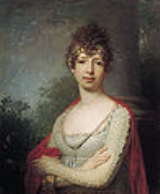
Maria Pavlovna of Russia

Encyclopedia
Grand Duchess Maria Pavlovna of Russia was the third daughter of Paul I of Russia
and Sophie Dorothea of Württemberg. She was the Grand Duchess of Saxe-Weimar-Eisenach by her marriage to Charles Frederick, Grand Duke of Saxe-Weimar-Eisenach
.
to the son of Catherine the Great of Russia
and his wife - the daughter of Friedrich II Eugen, Duke of Württemberg
- Maria Pavlovna was raised at her father's lavish palaces at Pavlovsk and at the nearby Gatchina
.
She was the sister of:
As a child, she was not considered pretty: her features were disfigured as a result of a pioneering application of the Smallpox vaccine
. Her grandmother, Catherine II of Russia
, admired her precocious talent as a pianist but declared that she would have been better to have been born a boy. Her music instructor was Giuseppe Sarti
(1729-1802), an Italian composer and Kapellmeister at the Russian court. From 1798, she was taught music by Ludwig-Wilhelm Tepper de Ferguson (1768-1838). In 1796 her grandmother died making her father the new Emperor of Russia as Paul I.
(later Grand Duke) (2 February 1783 – 8 July 1853). The couple stayed in Saint Petersburg
for nine months, before departing for Weimar
. There Maria was greeted with a bout of festivities, as described by Christoph Martin Wieland
: "The most festive part of all the magnificence of balls, fireworks, promenades, comedies, illuminations was the widespread and genuine joy at the arrival of our new princess".
After the death of the Grand Duke Carl Friedrich in 1853 she retired from public life.
Her last trip to Russia was to the coronation of her nephew as Alexander II of Russia
in 1855.
She maintained a lifelong correspondence with Vasily Zhukovsky
and it was to her that Schiller dedicated one of his last poems. She attended ten courses at the University of Jena, some delivered by Alexander von Humboldt
, and was instrumental in establishing the Falk Institute in Weimar.
She selected, as tutor to her son Charles Alexander
, the Genevan Frédéric Soret
, who became well acquainted with Johann Wolfgang von Goethe
. In her later years, Maria Pavlovna invited Franz Liszt
to her court, restoring a measure of artistic excellence previously associated with Weimar. However, her growing deafness prevented her from enjoying the premiere of Lohengrin
in Weimar on 28 August 1850.
Most famous were the "Literary Evenings (Literarische Abende)" where scholars from the neighboring Jena University and others from outside the Grand-Dukedom were invited to give lectures on various topics. This circle was a focus in post-classical Weimar.
Several collections of the Jena University benefitted by her patronage, among them the Grandducal Oriental Coin Cabinet
founded in 1840 by Johann Gustav Stickel
, orientalist at the University.
Schiller praised her "talents in music and painting and genuine love of reading", while Goethe hailed her as one of the worthiest women of his time.
by the side of the Goethe-Schiller Mausoleum
.
|-
Paul I of Russia
Paul I was the Emperor of Russia between 1796 and 1801. He also was the 72nd Prince and Grand Master of the Order of Malta .-Childhood:...
and Sophie Dorothea of Württemberg. She was the Grand Duchess of Saxe-Weimar-Eisenach by her marriage to Charles Frederick, Grand Duke of Saxe-Weimar-Eisenach
Charles Frederick, Grand Duke of Saxe-Weimar-Eisenach
Charles Friedrich, Grand Duke of Saxe-Weimar-Eisenach was a Grand Duke of Saxe-Weimar-Eisenach.-Biography:Born in Weimar, he was the eldest son of Charles Augustus, Grand Duke of Saxe-Weimar-Eisenach and Luise Auguste of Hesse-Darmstadt.Charles Frederick succeeded his famous father as Grand Duke...
.
Life
Born on 16 February 1786 in Saint PetersburgSaint Petersburg
Saint Petersburg is a city and a federal subject of Russia located on the Neva River at the head of the Gulf of Finland on the Baltic Sea...
to the son of Catherine the Great of Russia
Catherine II of Russia
Catherine II, also known as Catherine the Great , Empress of Russia, was born in Stettin, Pomerania, Prussia on as Sophie Friederike Auguste von Anhalt-Zerbst-Dornburg...
and his wife - the daughter of Friedrich II Eugen, Duke of Württemberg
Friedrich II Eugen, Duke of Württemberg
Friedrich Eugen of Württemberg , the fourth son of Duke Karl Alexander and Princess Maria Augusta of Thurn and Taxis .-Royal duke:...
- Maria Pavlovna was raised at her father's lavish palaces at Pavlovsk and at the nearby Gatchina
Gatchina
Gatchina is a town and the administrative center of Gatchinsky District of Leningrad Oblast, Russia, located south of St. Petersburg by the road leading to Pskov...
.
She was the sister of:
- Alexander IAlexander I of RussiaAlexander I of Russia , served as Emperor of Russia from 23 March 1801 to 1 December 1825 and the first Russian King of Poland from 1815 to 1825. He was also the first Russian Grand Duke of Finland and Lithuania....
, Tsar of Russia (1777–1825), m. Luise Auguste, Princess of Baden (Elizabeth Alexeiyevna) (1779–1826), and had two daughters (both died in childhood). - Konstantin PavlovichGrand Duke Constantine Pavlovich of RussiaConstantine Pavlovich was a grand duke of Russia and the second son of Emperor Paul I. He was the Tsesarevich of Russia throughout the reign of his elder brother Alexander I, but had secretly renounced his claim to the throne in 1823...
, Grand Duke of Russia (1779–1831), married Juliane, Princess of Saxe-Coburg-Saalfeld (Anna Feodorovna)Juliane of Saxe-Coburg-SaalfeldPrincess Juliane Henriette Ulrike of Saxe-Coburg-Saalfeld , also known as Grand Duchess Anna Feodorovna of Russia, was a German princess of the ducal house of Saxe-Coburg-Saalfeld who became the wife of Grand Duke Constantine Pavlovich of Russia of...
(1781–1860); married Joanna, Countess Grudsinska, Princess LowiczJoanna GrudzinskaJoanna Grudzińska was a Polish noble, a Princess of Łowicz and the second wife of Grand Duke Constantine Pavlovich of Russia, the de facto viceroy of the Kingdom of Poland...
(1799–1831). No children. - Alexandra PavlovnaGrand Duchess Alexandra Pavlovna of RussiaGrand Duchess Alexandra Pavlovna of Russia, was a daughter of Tsar Paul I of Russia and sister of Emperors Alexander I and Nicholas I. She became Archduchess of Austria upon her marriage to Archduke Joseph of Austria, Governor of Hungary.-Life:...
(1783–1801) m. Joseph, Archduke of Austria, Count Palatine of HungaryArchduke Joseph of Austria, Palatine of HungaryJoseph Anton Johann, archduke of Austria , was the palatine of Hungary from 1796 to 1847. He was the seventh son of Leopold II, Holy Roman Emperor and Maria Louisa of Spain.-Family:...
(1776–1847), and had one daughter (died at birth). - Elena Pavlovna (1784–1803) m. Friedrich Ludwig, Hereditary Grand Duke of Mecklenburg-Schwerin (1778–1819), and had two children.
- Catherine Pavlovna (1788–1819) married Georg, Duke of Oldenburg (1784–1812), had two sons; married Wilhelm I, King of WürttembergWilliam I of WürttembergWilliam I was the second King of Württemberg from October 30, 1816 until his death.He was born in Lüben, the son of King Frederick I of Württemberg and his wife Duchess Augusta of Brunswick-Wolfenbüttel .-First marriage:...
(1781–1864), and had two daughters. - Olga Pavlovna (22 July 1792 – 26 January 1795).
- Anna PavlovnaAnna Pavlovna of RussiaGrand Duchess Anna Pavlovna of Russia was a queen consort of the Netherlands.-Background:She was born as the eighth child and sixth daughter of Paul I of Russia and Empress Maria Feodorovna , and thus was Her Imperial Highness Grand Duchess Anna Pavlovna of Russia...
(1795–1865) m. Willem II, King of the NetherlandsWilliam II of the NetherlandsWilliam II was King of the Netherlands, Grand Duke of Luxembourg, and Duke of Limburg from 7 October 1840 until his death in 1849.- Early life and education :...
(1792–1849), and had five children. - Nicholas INicholas I of RussiaNicholas I , was the Emperor of Russia from 1825 until 1855, known as one of the most reactionary of the Russian monarchs. On the eve of his death, the Russian Empire reached its historical zenith spanning over 20 million square kilometers...
, Tsar of Russia (1796–1855), m. Charlotte, Princess of Prussia (Alexandra Feodorovna) (1798–1860), and had ten children. - Michael PavlovichGrand Duke Michael Pavlovich of RussiaGrand Duke Michael Pavlovich of Russia was the tenth child and fourth son of Paul I of Russia and Sophie Dorothea of Württemberg.-Marriage and issue:In St...
, Grand Duke of Russia (1798–1849), m. Charlotte, Princess of Württemberg (Elena PavlovnaElena Pavlovna of WürttembergPrincess Charlotte of Württemberg was, as Grand Duchess Elena Pavlovna of Russia, the wife of Grand Duke Michael Pavlovich of Russia...
) (1807–1873), and had five children.
As a child, she was not considered pretty: her features were disfigured as a result of a pioneering application of the Smallpox vaccine
Smallpox vaccine
The smallpox vaccine was the first successful vaccine to be developed. The process of vaccination was discovered by Edward Jenner in 1796, who acted upon his observation that milkmaids who caught the cowpox virus did not catch smallpox...
. Her grandmother, Catherine II of Russia
Catherine II of Russia
Catherine II, also known as Catherine the Great , Empress of Russia, was born in Stettin, Pomerania, Prussia on as Sophie Friederike Auguste von Anhalt-Zerbst-Dornburg...
, admired her precocious talent as a pianist but declared that she would have been better to have been born a boy. Her music instructor was Giuseppe Sarti
Giuseppe Sarti
Giuseppe Sarti was an Italian opera composer.-Biography:He was born at Faenza. His date of birth is not known, but he was baptised on 1 December 1729. Some earlier sources say he was born on 28 December, but his baptism certificate proves the later date impossible...
(1729-1802), an Italian composer and Kapellmeister at the Russian court. From 1798, she was taught music by Ludwig-Wilhelm Tepper de Ferguson (1768-1838). In 1796 her grandmother died making her father the new Emperor of Russia as Paul I.
Marriage
On 3 August 1804, she married Charles Frederick, Hereditary Grand Duke of Saxe-Weimar-EisenachCharles Frederick, Grand Duke of Saxe-Weimar-Eisenach
Charles Friedrich, Grand Duke of Saxe-Weimar-Eisenach was a Grand Duke of Saxe-Weimar-Eisenach.-Biography:Born in Weimar, he was the eldest son of Charles Augustus, Grand Duke of Saxe-Weimar-Eisenach and Luise Auguste of Hesse-Darmstadt.Charles Frederick succeeded his famous father as Grand Duke...
(later Grand Duke) (2 February 1783 – 8 July 1853). The couple stayed in Saint Petersburg
Saint Petersburg
Saint Petersburg is a city and a federal subject of Russia located on the Neva River at the head of the Gulf of Finland on the Baltic Sea...
for nine months, before departing for Weimar
Weimar
Weimar is a city in Germany famous for its cultural heritage. It is located in the federal state of Thuringia , north of the Thüringer Wald, east of Erfurt, and southwest of Halle and Leipzig. Its current population is approximately 65,000. The oldest record of the city dates from the year 899...
. There Maria was greeted with a bout of festivities, as described by Christoph Martin Wieland
Christoph Martin Wieland
Christoph Martin Wieland was a German poet and writer.- Biography :He was born at Oberholzheim , which then belonged to the Free Imperial City of Biberach an der Riss in the south-east of the modern-day state of Baden-Württemberg...
: "The most festive part of all the magnificence of balls, fireworks, promenades, comedies, illuminations was the widespread and genuine joy at the arrival of our new princess".
Children
Maria and Carl had four children:- Paul Alexander Karl Constantin Frederick August of Saxe-Weimar-Eisenach (25 September 1805, Weimar – 10 April 1806, Weimar)
- Marie Luise Alexandrine of Saxe-Weimar-Eisenach (1808–1877), married Karl of PrussiaPrince Charles of PrussiaPrince Frederick Charles Alexander of Prussia born in Charlottenburg, was a younger son of Frederick William III of Prussia and Louise of Mecklenburg-Strelitz...
- Augusta Louisa Katherine of Saxe-Weimar-Eisenach (1811–1890), married Wilhelm I and became German Empress.
- Karl Alexander August Johann of Saxe-Weimar-EisenachCharles Alexander, Grand Duke of Saxe-Weimar-EisenachKarl Alexander August Johann, Grand Duke of Saxony; 24 June 1818 – 5 January 1901) was the ruler of Saxe-Weimar-Eisenach from 1853 until his death.-Biography:...
(1818–1901)
After the death of the Grand Duke Carl Friedrich in 1853 she retired from public life.
Her last trip to Russia was to the coronation of her nephew as Alexander II of Russia
Alexander II of Russia
Alexander II , also known as Alexander the Liberator was the Emperor of the Russian Empire from 3 March 1855 until his assassination in 1881...
in 1855.
Patronage of arts and sciences
Maria Pavlovna was interested in arts as well as in sciences. She was a patroness of art, science and social welfare in the poor Grand-Dukedom of Saxe-Weimar-Eisenach.She maintained a lifelong correspondence with Vasily Zhukovsky
Vasily Zhukovsky
Vasily Andreyevich Zhukovsky was the foremost Russian poet of the 1810s and a leading figure in Russian literature in the first half of the 19th century...
and it was to her that Schiller dedicated one of his last poems. She attended ten courses at the University of Jena, some delivered by Alexander von Humboldt
Alexander von Humboldt
Friedrich Wilhelm Heinrich Alexander Freiherr von Humboldt was a German naturalist and explorer, and the younger brother of the Prussian minister, philosopher and linguist Wilhelm von Humboldt...
, and was instrumental in establishing the Falk Institute in Weimar.
She selected, as tutor to her son Charles Alexander
Charles Alexander, Grand Duke of Saxe-Weimar-Eisenach
Karl Alexander August Johann, Grand Duke of Saxony; 24 June 1818 – 5 January 1901) was the ruler of Saxe-Weimar-Eisenach from 1853 until his death.-Biography:...
, the Genevan Frédéric Soret
Frédéric Soret
Frédéric Soret, , Swiss private scholar in physics and Oriental numismatics.- Biography :...
, who became well acquainted with Johann Wolfgang von Goethe
Johann Wolfgang von Goethe
Johann Wolfgang von Goethe was a German writer, pictorial artist, biologist, theoretical physicist, and polymath. He is considered the supreme genius of modern German literature. His works span the fields of poetry, drama, prose, philosophy, and science. His Faust has been called the greatest long...
. In her later years, Maria Pavlovna invited Franz Liszt
Franz Liszt
Franz Liszt ; ), was a 19th-century Hungarian composer, pianist, conductor, and teacher.Liszt became renowned in Europe during the nineteenth century for his virtuosic skill as a pianist. He was said by his contemporaries to have been the most technically advanced pianist of his age...
to her court, restoring a measure of artistic excellence previously associated with Weimar. However, her growing deafness prevented her from enjoying the premiere of Lohengrin
Lohengrin (opera)
Lohengrin is a romantic opera in three acts composed and written by Richard Wagner, first performed in 1850. The story of the eponymous character is taken from medieval German romance, notably the Parzival of Wolfram von Eschenbach and its sequel, Lohengrin, written by a different author, itself...
in Weimar on 28 August 1850.
Most famous were the "Literary Evenings (Literarische Abende)" where scholars from the neighboring Jena University and others from outside the Grand-Dukedom were invited to give lectures on various topics. This circle was a focus in post-classical Weimar.
Several collections of the Jena University benefitted by her patronage, among them the Grandducal Oriental Coin Cabinet
Oriental Coin Cabinet Jena
Oriental Coin Cabinet Jena is a collection of oriental coins at Jena University, in Jena, Germany, founded in 1840.- History :In 1840, Johann Gustav Stickel, Professor for Oriental languages at Jena University, succeeded in convincing the Grandduke of Saxe-Weimar-Eisenach to acquire a collection...
founded in 1840 by Johann Gustav Stickel
Johann Gustav Stickel
Johann Gustav Stickel was a German theologian, orientalist and numismatist.- Biography :Stickel was born in Eisenach in 1805. He went to school in Buttelstedt and in Weimar. In his youth he demonstrated a gift for the Hebrew language...
, orientalist at the University.
Schiller praised her "talents in music and painting and genuine love of reading", while Goethe hailed her as one of the worthiest women of his time.
Her Traces in Jena and Weimar
She owned a small chalet close to Jena, owned formerly by the Protestant theologist of Enlightenment Griesbach, where she used to spend the summer with her children. Maria Pavlovna is buried in Weimar, in a Russian-style chapelRussian Orthodox Chapel, Weimar
The Russian Orthodox Chapel is a funerary chapel built in Weimar in 1860 for Grand Duchess Maria Pavlovna of Russia. It was constructed in the Historical Cemetery behind the Weimarer Fürstengruft, to which it is connected by an underground passage. Maria Pavlovna's coffin is located in the passage,...
by the side of the Goethe-Schiller Mausoleum
Weimarer Fürstengruft
The Fürstengruft is the ducal burial chapel of Saxe-Weimar-Eisenach, located in the Historical Cemetery in Weimar. It also houses the tombs of Goethe and Schiller. It is part of the Klassik Stiftung Weimar and since 1998 it and the cemetery have also been part of the Classical Weimar World Heritage...
.
Titles and styles
- 16 February 1786 - 3 August 1804 Her Imperial Highness Grand Duchess Maria Pavlovna of Russia
- 3 August 1804 -14 June 1828 Her Imperial Highness The Hereditary Grand Duchess of Saxe-Weimar-Eisenach
- 14 June 1828 - 8 July 1853 Her Imperial Highness The Grand Duchess of Saxe-Weimar-Eisenach
- 8 July 1853 - 23 June 1859 Her Imperial Highness The Dowager Grand Duchess of Saxe-Weimar-Eisenach
Ancestry
External links
|-