

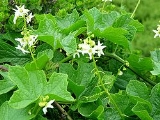
Manroot

Encyclopedia
The manroots, wild cucumbers, or cucumber gourd (genus
Marah) are flowering plants in the gourd family
(Cucurbitaceae
), native to western North America
. They are also commonly called Old man in the ground. The genus name comes from Hebrew מָרָ֔א (mara, "bitter" - e.g. ), and was given because all parts of these plants tend to have a bitter taste.
Except for the isolated range of the Gila Manroot (M. gilensis) in west-central Arizona
and island populations (M. macrocarpus var. major), all manroot species inhabit overlapping ranges distributed from Southern Canada
to Northern Mexico
. Although Coastal Manroot
(M. oreganus) extends inland into Idaho
, all other manroot species except M. gilensis are confined to areas within 300 km of the Pacific Ocean
coast.
s, growing from a large tuberous root. Most have stout, scabrous or hairy stems, with coiling tendrils that enable them to climb
up other plants; they can also grow rapidly across level ground. Their leaves tend to have multiple lobes, up to 7 in some species. The fruits are striking and easily recognised. They are large, and spherical, oval or cylindrical. At a minimum they are 3 cm in diameter, but can be up to 20 cm long, and in many species they are covered in long spines. Both leaf and fruit shape vary widely between individual plants and leaves can be particularly variable even on the same vine.
The anthropomorphic common names "manroot" and "old man" derive from the swollen lobes and arm-like extensions of the unearthed tuber. On old plants, the tuber can be several meters long and weigh in excess of 100 kg
.
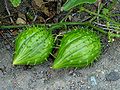 Marah species hybridize freely where ranges overlap and this, in addition to intra-species leaf and fruit variability, makes definite identification of specimens a particular challenge.
A proper genetic analysis of marah phylogeny has not yet been undertaken. The standard taxonomy has been based on morphological comparisons and geographic considerations.
Some authors include the manroots in genus Echinocystis
. Considered as a separate genus, however, it includes six or seven species, some of them with well-defined varieties within them:
for various problems. The Chinook made a poultice from the gourd. The Squaxin mashed the upper stalk in water to dip aching hands. The Chehalis
burned the root and mixed the resulting powder with bear
grease to apply to scrofula
sores. The Coast Salish
made a decoction to treat venereal disease, kidney trouble and scrofula sores.
The dried spikey fruit can be soaked in water so that the spikes can be easily removed. They are difficult to remove otherwise. The hard fruit becomes soft in water and once the spikes are gone, the fruit makes a very efficient loofa. The tubers of M. fabaceus and M. macrocarpus contain saponin
s which can act as a natural soap.
Tubers of marah fabaceus were crushed and thrown into bodies of water by the Kumeyaay
to immobilize fish. The tubers contain megharrhin, a saponin
-like glucoside
. Saponins lower the surface tension
of water allowing the formation of bubbles. It is likely that the substance enters the fish's circulation through the gill arches where only a single-cell epithelium
separates the water from the animal’s red blood cells. The affected fish float to the surface.
Like many medicinal plants, at least some Marah species are toxic if ingested and deaths have been reported from ingesting them.
Seeds of Marah fabaceus have been reported as being hallucinogenic.
Genus
In biology, a genus is a low-level taxonomic rank used in the biological classification of living and fossil organisms, which is an example of definition by genus and differentia...
Marah) are flowering plants in the gourd family
Family (biology)
In biological classification, family is* a taxonomic rank. Other well-known ranks are life, domain, kingdom, phylum, class, order, genus, and species, with family fitting between order and genus. As for the other well-known ranks, there is the option of an immediately lower rank, indicated by the...
(Cucurbitaceae
Cucurbitaceae
The plant family Cucurbitaceae consists of various squashes, melons, and gourds, including crops such as cucumber, pumpkins, luffas, and watermelons...
), native to western North America
North America
North America is a continent wholly within the Northern Hemisphere and almost wholly within the Western Hemisphere. It is also considered a northern subcontinent of the Americas...
. They are also commonly called Old man in the ground. The genus name comes from Hebrew מָרָ֔א (mara, "bitter" - e.g. ), and was given because all parts of these plants tend to have a bitter taste.
Except for the isolated range of the Gila Manroot (M. gilensis) in west-central Arizona
Arizona
Arizona ; is a state located in the southwestern region of the United States. It is also part of the western United States and the mountain west. The capital and largest city is Phoenix...
and island populations (M. macrocarpus var. major), all manroot species inhabit overlapping ranges distributed from Southern Canada
Canada
Canada is a North American country consisting of ten provinces and three territories. Located in the northern part of the continent, it extends from the Atlantic Ocean in the east to the Pacific Ocean in the west, and northward into the Arctic Ocean...
to Northern Mexico
Mexico
The United Mexican States , commonly known as Mexico , is a federal constitutional republic in North America. It is bordered on the north by the United States; on the south and west by the Pacific Ocean; on the southeast by Guatemala, Belize, and the Caribbean Sea; and on the east by the Gulf of...
. Although Coastal Manroot
Coastal Manroot
Marah oregonus, the Oregon Manroot, Coastal Manroot or Western Wild-cucumber, is a common manroot of the northern west coast of the United States. It ranges from California north to Canada.-Foliage:...
(M. oreganus) extends inland into Idaho
Idaho
Idaho is a state in the Rocky Mountain area of the United States. The state's largest city and capital is Boise. Residents are called "Idahoans". Idaho was admitted to the Union on July 3, 1890, as the 43rd state....
, all other manroot species except M. gilensis are confined to areas within 300 km of the Pacific Ocean
Pacific Ocean
The Pacific Ocean is the largest of the Earth's oceanic divisions. It extends from the Arctic in the north to the Southern Ocean in the south, bounded by Asia and Australia in the west, and the Americas in the east.At 165.2 million square kilometres in area, this largest division of the World...
coast.
Description
The manroots are perennial plantPerennial plant
A perennial plant or simply perennial is a plant that lives for more than two years. The term is often used to differentiate a plant from shorter lived annuals and biennials. The term is sometimes misused by commercial gardeners or horticulturalists to describe only herbaceous perennials...
s, growing from a large tuberous root. Most have stout, scabrous or hairy stems, with coiling tendrils that enable them to climb
up other plants; they can also grow rapidly across level ground. Their leaves tend to have multiple lobes, up to 7 in some species. The fruits are striking and easily recognised. They are large, and spherical, oval or cylindrical. At a minimum they are 3 cm in diameter, but can be up to 20 cm long, and in many species they are covered in long spines. Both leaf and fruit shape vary widely between individual plants and leaves can be particularly variable even on the same vine.
The anthropomorphic common names "manroot" and "old man" derive from the swollen lobes and arm-like extensions of the unearthed tuber. On old plants, the tuber can be several meters long and weigh in excess of 100 kg
Kilogram
The kilogram or kilogramme , also known as the kilo, is the base unit of mass in the International System of Units and is defined as being equal to the mass of the International Prototype Kilogram , which is almost exactly equal to the mass of one liter of water...
.
Taxonomy and systematics
A proper genetic analysis of marah phylogeny has not yet been undertaken. The standard taxonomy has been based on morphological comparisons and geographic considerations.
Some authors include the manroots in genus Echinocystis
Echinocystis
Echinocystis is a genus in the gourd family Cucurbitaceae which includesthe species Echinocystis lobata, commonly called wild cucumberor prickly cucumber.Some authors include the manroots in Echinocystis....
. Considered as a separate genus, however, it includes six or seven species, some of them with well-defined varieties within them:
- California ManrootCalifornia ManrootMarah fabaceus, the California Manroot or Bigroot, is the most common of the manroot species native to California. Its range throughout the state subsumes nearly the entire ranges of all the other California native manroots species and intergrades...
, Marah fabaceus- Marah fabaceus var. agrestis
- Marah fabaceus var. fabaceus
- Gila Manroot, Marah gilensis
- Marah guadalupensis - often included in M. macrocarpus var. major
- Sierra Manroot, Marah horridusMarah horridusMarah horridus is a species of flowering plant in the gourd family known by the common name Sierra manroot. It is endemic to California, where it grows in the foothills of the Sierra Nevada.-Description:...
- Cucamonga Manroot, Marah macrocarpus
- Marah macrocarpus var. macrocarpus
- Marah macrocarpus var. major
- Marah macrocarpus var. micranthus
- Coastal ManrootCoastal ManrootMarah oregonus, the Oregon Manroot, Coastal Manroot or Western Wild-cucumber, is a common manroot of the northern west coast of the United States. It ranges from California north to Canada.-Foliage:...
, Marah oreganus - Taw ManrootTaw ManrootMarah watsonii, the Taw Manroot, is an uncommon manroot endemic to central northern California. Its range is bounded by the eastern coastal foothills, the western foothills of the northern Sierra Nevada and Cascades ranges and from Lake Berryessa in the south to Lake Shasta in the...
, Marah watsonii
Use by humans
Marah oreganus was used by Native AmericansIndigenous peoples of the Americas
The indigenous peoples of the Americas are the pre-Columbian inhabitants of North and South America, their descendants and other ethnic groups who are identified with those peoples. Indigenous peoples are known in Canada as Aboriginal peoples, and in the United States as Native Americans...
for various problems. The Chinook made a poultice from the gourd. The Squaxin mashed the upper stalk in water to dip aching hands. The Chehalis
Chehalis
Chehalis, in the language of the U.S. Native American tribe of the same name, means "sand". In the language of the Chehalis First Nation of British Columbia, Canada, the term is Sts'Ailes, meaning "beating heart".It can refer to:* Chehalis, Washington...
burned the root and mixed the resulting powder with bear
Bear
Bears are mammals of the family Ursidae. Bears are classified as caniforms, or doglike carnivorans, with the pinnipeds being their closest living relatives. Although there are only eight living species of bear, they are widespread, appearing in a wide variety of habitats throughout the Northern...
grease to apply to scrofula
Scrofula
Tuberculous cervical lymphadenitis refers to a lymphadenitis of the cervical lymph nodes associated with tuberculosis. It was previously known as "scrofula".-The disease:...
sores. The Coast Salish
Coast Salish
Coast Salish languages are a subgroup of the Salishan language family. These languages are spoken by First Nations or Native American peoples inhabiting the territory that is now the southwest coast of British Columbia around the Strait of Georgia and Washington state around Puget Sound...
made a decoction to treat venereal disease, kidney trouble and scrofula sores.
The dried spikey fruit can be soaked in water so that the spikes can be easily removed. They are difficult to remove otherwise. The hard fruit becomes soft in water and once the spikes are gone, the fruit makes a very efficient loofa. The tubers of M. fabaceus and M. macrocarpus contain saponin
Saponin
Saponins are a class of chemical compounds, one of many secondary metabolites found in natural sources, with saponins found in particular abundance in various plant species...
s which can act as a natural soap.
Tubers of marah fabaceus were crushed and thrown into bodies of water by the Kumeyaay
Kumeyaay
The Kumeyaay, also known as Tipai-Ipai, Kamia, or formerly Diegueño, are Native American people of the extreme southwestern United States and northwest Mexico. They live in the states of California in the US and Baja California in Mexico. In Spanish, the name is commonly spelled...
to immobilize fish. The tubers contain megharrhin, a saponin
Saponin
Saponins are a class of chemical compounds, one of many secondary metabolites found in natural sources, with saponins found in particular abundance in various plant species...
-like glucoside
Glucoside
A glucoside is a glycoside that is derived from glucose. Glucosides are common in plants, but rare in animals. Glucose is produced when a glucoside is hydrolysed by purely chemical means, or decomposed by fermentation or enzymes....
. Saponins lower the surface tension
Surface tension
Surface tension is a property of the surface of a liquid that allows it to resist an external force. It is revealed, for example, in floating of some objects on the surface of water, even though they are denser than water, and in the ability of some insects to run on the water surface...
of water allowing the formation of bubbles. It is likely that the substance enters the fish's circulation through the gill arches where only a single-cell epithelium
Epithelium
Epithelium is one of the four basic types of animal tissue, along with connective tissue, muscle tissue and nervous tissue. Epithelial tissues line the cavities and surfaces of structures throughout the body, and also form many glands. Functions of epithelial cells include secretion, selective...
separates the water from the animal’s red blood cells. The affected fish float to the surface.
Like many medicinal plants, at least some Marah species are toxic if ingested and deaths have been reported from ingesting them.
Seeds of Marah fabaceus have been reported as being hallucinogenic.