


Malmedy massacre

Encyclopedia
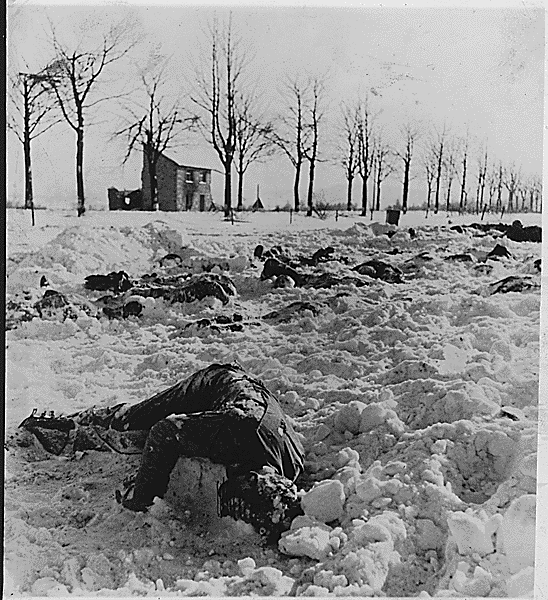
The Malmedy massacre was a war crime
War crime
War crimes are serious violations of the laws applicable in armed conflict giving rise to individual criminal responsibility...
in which 84 American
United States
The United States of America is a federal constitutional republic comprising fifty states and a federal district...
prisoners of war
Prisoner of war
A prisoner of war or enemy prisoner of war is a person, whether civilian or combatant, who is held in custody by an enemy power during or immediately after an armed conflict...
were murdered by their German
Nazi Germany
Nazi Germany , also known as the Third Reich , but officially called German Reich from 1933 to 1943 and Greater German Reich from 26 June 1943 onward, is the name commonly used to refer to the state of Germany from 1933 to 1945, when it was a totalitarian dictatorship ruled by...
captors during World War II
World War II
World War II, or the Second World War , was a global conflict lasting from 1939 to 1945, involving most of the world's nations—including all of the great powers—eventually forming two opposing military alliances: the Allies and the Axis...
. The massacre
Massacre
A massacre is an event with a heavy death toll.Massacre may also refer to:-Entertainment:*Massacre , a DC Comics villain*Massacre , a 1932 drama film starring Richard Barthelmess*Massacre, a 1956 Western starring Dane Clark...
was committed on December 17, 1944, by members of Kampfgruppe
Kampfgruppe
In military history and military slang, the German term Kampfgruppe can refer to a combat formation of any kind, but most usually to that employed by the German Wehrmacht and its allies during World War II and, to a lesser extent, in World War I...
Peiper
Joachim Peiper
Joachim Peiper , more often known as Jochen Peiper, was a field officer in the Waffen-SS during World War II, convicted of war crimes in Belgium and accused of war crimes in Italy. He was Reichsführer-SS Heinrich Himmler's personal adjutant . In 1945, he was an SS-Standartenführer, the Waffen-SS's...
(part of the 1st SS Panzer Division
1st SS Division Leibstandarte SS Adolf Hitler
The Leibstandarte SS Adolf Hitler was Adolf Hitler's personal bodyguard. Initially the size of a regiment, the LSSAH eventually grew into a divisional-sized unit...
), a German combat unit, during the Battle of the Bulge
Battle of the Bulge
The Battle of the Bulge was a major German offensive , launched toward the end of World War II through the densely forested Ardennes mountain region of Wallonia in Belgium, hence its French name , and France and...
.
The massacre, as well as others committed by the same unit on the same day and following days, was the subject of the Malmedy massacre trial
Malmedy massacre trial
The Malmedy massacre trial was held in May–July 1946 in the Dachau concentration camp to try the German Waffen-SS soldiers accused of the Malmedy massacre of December 17, 1944. The highest-ranking defendant was the former SS general, Sepp Dietrich...
, part of the Dachau Trials of 1946. The trials were the focus of some controversy.
Context
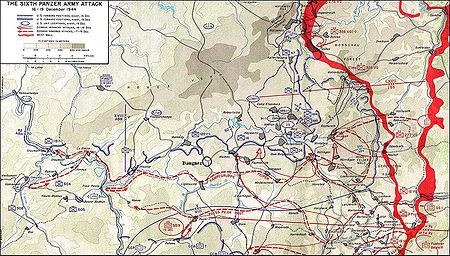
Battle of the Bulge
The Battle of the Bulge was a major German offensive , launched toward the end of World War II through the densely forested Ardennes mountain region of Wallonia in Belgium, hence its French name , and France and...
gave the main goal (breaking through Allied lines) to the 6th SS Panzer Army, commanded by General Sepp Dietrich
Sepp Dietrich
Josef "Sepp" Dietrich was a German SS General. He was one of Nazi Germany's most decorated soldiers and commanded formations up to Army level during World War II. Prior to 1929 he was Adolf Hitler's chauffeur and bodyguard but received rapid promotion after his participation in the murder of...
. He was to break the Allied
Allies of World War II
The Allies of World War II were the countries that opposed the Axis powers during the Second World War . Former Axis states contributing to the Allied victory are not considered Allied states...
front between Monschau
Monschau
Monschau is a small resort town in the Eifel region of western Germany, located in the district Aachen, North Rhine-Westphalia.-Geography:The town is located in the hills of the North Eifel, within the Hohes Venn – Eifel Nature Park in the narrow valley of the Rur river.The historic town center...
and Losheimergraben, cross the Meuse River
Meuse River
The Maas or Meuse is a major European river, rising in France and flowing through Belgium and the Netherlands before draining into the North Sea...
, and then capture Antwerp. Kampfgruppe Peiper, named after and under the command of SS-Standartenführer Joachim Peiper
Joachim Peiper
Joachim Peiper , more often known as Jochen Peiper, was a field officer in the Waffen-SS during World War II, convicted of war crimes in Belgium and accused of war crimes in Italy. He was Reichsführer-SS Heinrich Himmler's personal adjutant . In 1945, he was an SS-Standartenführer, the Waffen-SS's...
, was composed of armoured and motorized elements and was the spearhead of the left wing of the 6th SS Panzer Army. Once the infantry had breached the American lines, Peiper's role was to advance via Ligneuville, Stavelot
Stavelot
Stavelot is a Walloon municipality located in the Belgian province of Liège. On January 1, 2006, Stavelot had a total population of 6,671. The total area is 85.07 km² which gives a population density of 78 inhabitants per km².-History:...
, Trois-Ponts
Trois-Ponts
Trois-Ponts is a municipality of Belgium. It lies in the country's Walloon Region and Province of Liege. On January 1, 2006 Trois-Ponts had a total population of 2,445. The total area is 68.90 km² which gives a population density of 35 inhabitants per km². It is situated at the confluence of the...
, and Werbomont and seize and secure the Meuse bridges around Huy
Huy
Huy is a municipality of Belgium. It lies in the country's Walloon Region and Province of Liege. Huy lies along the river Meuse, at the mouth of the small river Hoyoux. It is in the sillon industriel, the former industrial backbone of Wallonia, home to about two-thirds of the Walloon population...
.
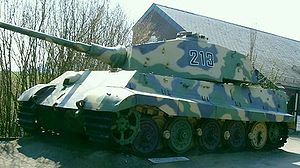
The best roads were reserved for the bulk of the 1st SS Panzer Division Leibstandarte SS Adolf Hitler. Peiper was to use secondary roads, but these proved unsuitable for heavy armored vehicles, especially the Tiger II
Tiger II
Tiger II is the common name of a German heavy tank of the Second World War. The final official German designation was Panzerkampfwagen Tiger Ausf. B,Panzerkampfwagen – abbr: Pz. or Pz.Kfw. Ausführung – abbr: Ausf. .The full titles Panzerkampfwagen Tiger Ausf...
tanks attached to the Kampfgruppe.
The success of the operation depended on the swift capture of the bridges over the Meuse. This required a rapid advance through U.S. positions, circumventing any points of resistance whenever possible. Another factor Peiper had to consider was the shortage of gasoline
Gasoline
Gasoline , or petrol , is a toxic, translucent, petroleum-derived liquid that is primarily used as a fuel in internal combustion engines. It consists mostly of organic compounds obtained by the fractional distillation of petroleum, enhanced with a variety of additives. Some gasolines also contain...
: the fuel resources of the Reich had been greatly reduced since the fall of Romania.
Hitler ordered the battle to be carried out with a brutality more common on the Eastern Front, in order to frighten the enemy. Sepp Dietrich confirmed this during the trial for the massacre. According to some sources, during the briefings before the operation, Peiper stated that no quarter was to be granted, no prisoners taken, and no pity shown towards Belgian civilians.
Peiper's breakout and first massacres
From the very beginning, German military operations on the northern front were troubled by unexpectedly obstinate resistance from American troops. Peiper had hoped to exploit an opening as early as the morning of December 16, the offensive's first day, but he had been delayed by massive traffic jams behind the front, with the infantry which was to breach the U.S. lines waiting for him to arrive. At daybreak on December 17, after moving his Kampfgruppe into the front line, Peiper broke out toward Honsfeld, where elements of his force would kill several dozen American POWs.After capturing Honsfeld, Peiper left his assigned route for several kilometers to seize a small gasoline depot in Büllingen
Büllingen
Büllingen is a largely German language-speaking municipality located in the Belgian province of Liège. On January 1, 2006 Büllingen had a total population of 5,385. The total area is 150.49 km² which gives a population density of 36 inhabitants per km²....
, where a massacre of American prisoners would later be reported. At this point, Peiper was in the Americans' rear. Apparently unknown to him, had he advanced north from Büllingen towards Elsenborn
Elsenborn Ridge
The Elsenborn Ridge is a ridge line east of the town of Elsenborn, Belgium in the Ardennes forest that was the blocking line on the northern shoulder of the Battle of the Bulge. Their area was the main line of advance for Hitler's prized 12th SS Hitlerjugend. Units of V Corps of the First U.S...
, he could have flanked and trapped the 2nd and the 99th Infantry Divisions with possibly a vastly different outcome. However, he followed orders to stick to his Rollbahn
Rollbahn
A rollbahn is a German word designating a runway. This may be:* A one lane road, for example, in the Second World War it described key routes designated by the German Wehrmacht, for example, the route Moscow-Minsk-Brest A rollbahn is a German word designating a runway. This may be:* A one lane...
west towards the Meuse River and captured Ligneuville, passing by Mödersheid, Schoppen, Ondenval, and Thirimont.
The terrain and poor quality of the roads made his move difficult. Eventually, at the exit of the small village of Thirimont, the spearhead was unable to take the direct road toward Ligneuville. Peiper again deviated from his planned route. Rather than turn left, the spearhead veered right and advanced towards the crossroads of Baugnez, which is equidistant from Malmedy
Malmedy
Malmedy is a municipality of Belgium. It lies in the country's Walloon Region, Province of Liège. It belongs to the French Community of Belgium, within which it is French-speaking with facilities for German-speakers. On January 1, 2006 Malmedy had a total population of 11,829...
, Ligneuville, and Waimes
Waimes
Waimes is a Walloon municipality located in the province of Liège, in Belgium. On January 1, 2006 Waimes had a total population of 6,728. The total area is 96.93 km² which gives a population density of 69 inhabitants per km²....
.
Massacre at Baugnez
Between noon and 1 p.m., the German spearhead approached the crossroads. An American convoy of about thirty vehicles, mainly elements of the American 285th Field Artillery Observation Battalion (FAOB), was negotiating the crossroads and turning right toward Ligneuville, in order to reach St. Vith, where it had been ordered to join the 7th Armored Division, to reinforce the city's defense. The spearhead of Peiper’s group spotted the American convoy and opened fire, immobilizing the first and last vehicles of the column and forcing it to halt. Armed with only rifles and other small arms, the Americans surrendered to the Nazi tank force.
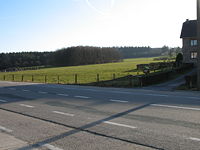
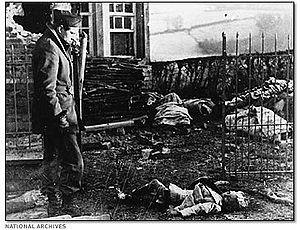
As soon as the SS machine gunners opened fire, the American POWs panicked. Some tried to flee, but most were shot where they stood. A few sought shelter in a café at the crossroads. The SS soldiers set fire to the building, and shot all who tried to escape the flames. Some in the field had dropped to the ground and pretended to be dead when the shooting began. However, SS troops walked among the bodies and shot any who appeared to be alive.
Later, a few survivors emerged from hiding and returned through the lines to nearby Malmedy, where American troops held the town. Eventually, 43 survivors found refuge, some with the help of Belgian civilians. Testimony from the survivors was taken hours after the massacre. All the accounts were similar and corroborated each others, though the men had no opportunity to discuss the events. An account of one survivor is recorded in Medicine Under Canvas
Medicine Under Canvas
Medicine Under Canvas is a book and a documentary film about the 77th Evacuation Hospital during WWII. The very rare book is 200 pages long and is arguably the most detailed history of an evacuation hospital in the European and North African theatres of war...
, on page 141 of the second edition, which also offers details of 77th Evacuation Hospital's role in notifying Army Intelligence and their questioning of the wounded man.
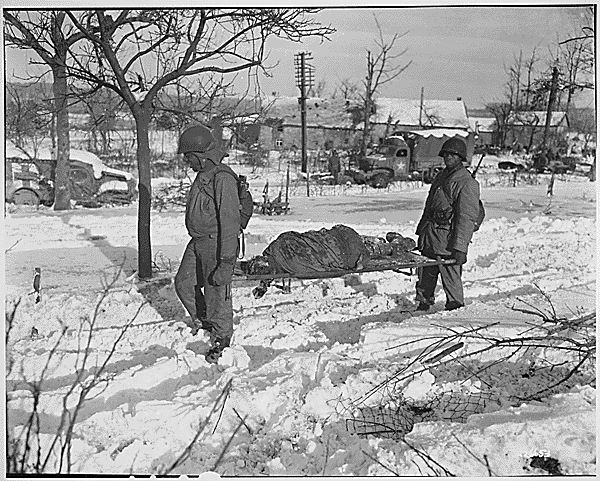
David E. Pergrin
Colonel David E. Pergrin was commanding officer of the 291st Engineer Combat Battalion during World War II. Before the war he earned an engineering degree at Pennsylvania State University, graduating in 1940. While at Penn State he participated in the ROTC program...
at about 2:30 p.m. the same day. The inspector general of the First Army learned of the shootings some three or four hours later. By late evening of the 17th, rumors that the enemy was killing prisoners had reached the forward American divisions. One U.S. unit promptly issued orders that "No SS troops or paratroopers will be taken prisoner but will be shot on sight." There are claims that some of the American forces killed German prisoners in retaliation—e.g. in the Chenogne massacre
Chenogne massacre
The Chenogne massacre refers to the alleged war crime committed on New Year's Day, January 1, 1945 where several dozen German prisoners of war were allegedly killed by American forces near the village of Chenogne , Belgium, thought to be in retaliation for the Malmedy massacre.- Accounts of the...
, on January 1, 1945.
Because the Baugnez crossroads had been in no-man's-land until the Allied counter-offensive, it was not until January 14, 1945, that U.S. forces reached the massacre site and conducted an investigation. The frozen, snow-covered bodies were photographed where they lay, then removed from the scene for identification and detailed post mortem examinations. The aim was gathering evidence to be used as part of the prosecution of the apparent war crime. Seventy-two bodies were found in the field on January 14 and 15, 1945. Twelve more, lying farther from the pasture, were found between February 7 and April 15, 1945.
The autopsies revealed that at least twenty of the victims had suffered fatal gunshot wounds to the head, inflicted at very close range. These were in addition to wounds made by automatic weapons. Another 20 showed evidence of small-calibre gunshot wounds to the head without powder-burn residue; 10 had fatal crushing or blunt-trauma injuries, most likely from rifle butts. Some bodies showed only one wound, in the temple or behind the ear. Most of the bodies were found in a very small area, suggesting the victims had been gathered together just before they were killed.
Peiper moves on
New massacres of POWs were reported in Stavelot
Stavelot
Stavelot is a Walloon municipality located in the Belgian province of Liège. On January 1, 2006, Stavelot had a total population of 6,671. The total area is 85.07 km² which gives a population density of 78 inhabitants per km².-History:...
, Cheneux, La Gleize
La Gleize
La Gleize is a village and section of the Belgian Municipality of Stoumont, situated in the Walloon Region in the province of Liège.Common before the full merger of Commons in 1977, La Gleize is located on a rocky outcrop overlooking the valley of Amblève in the Ardennes region.-Hamlets:Moulin du...
, and Stoumont
Stoumont
Stoumont is a municipality of Belgium. It lies in the country's Walloon Region and Province of Liege. On January 1, 2006 Stoumont had a total population of 3,006. The total area is 108.45 km² which gives a population density of 28 inhabitants per km²....
, on December 18, 19, and 20. Finally, on December 19, 1944, between Stavelot and Trois-Ponts
Trois-Ponts
Trois-Ponts is a municipality of Belgium. It lies in the country's Walloon Region and Province of Liege. On January 1, 2006 Trois-Ponts had a total population of 2,445. The total area is 68.90 km² which gives a population density of 35 inhabitants per km². It is situated at the confluence of the...
, German forces tried to regain control of the bridge over the Ambleve river in Stavelot, which was crucial for receiving reinforcements, fuel, and ammunition. Peiper’s men murdered about 100 Belgian
Belgium
Belgium , officially the Kingdom of Belgium, is a federal state in Western Europe. It is a founding member of the European Union and hosts the EU's headquarters, and those of several other major international organisations such as NATO.Belgium is also a member of, or affiliated to, many...
civilians.
American Army engineers blocked Peiper's advance in the narrow Amblève River
Amblève (river)
The Amblève or Amel is a 93 km long river in eastern Belgium in the province of Liège. It is a right tributary of the river Ourthe. It rises near Büllingen in the High Fens , close to the border with Germany.Tributaries of the Amblève are the rivers Warche, Eau Rouge, Salm and Lienne...
valley by blowing up the bridges. Additional U.S. reinforcements surrounded the Kampfgruppe in Stoumont and la Gleize. Peiper and 800 of his men eventually escaped this encirclement by marching through the nearby woods and abandoning their heavy equipment, including several Tiger II
Tiger II
Tiger II is the common name of a German heavy tank of the Second World War. The final official German designation was Panzerkampfwagen Tiger Ausf. B,Panzerkampfwagen – abbr: Pz. or Pz.Kfw. Ausführung – abbr: Ausf. .The full titles Panzerkampfwagen Tiger Ausf...
tanks. If he had by-passed the Amblève bridges, Peiper could have gained higher ground and access to practicable roads to the Meuse.
On December 21, during the battle around Gleize, the men of Kampfgruppe Peiper captured an American officer, Major Harold D. McCown, who was leading one of the battalions of the 119th Infantry Regiment. Having heard about the Malmedy massacre, McCown personally asked Peiper about his fate and that of his men. McCown testified that Peiper told him neither he nor his men were at any risk and that he (Peiper) was not accustomed to killing his prisoners. McCown noted that neither he nor his men were threatened in any manner, and he testified in Peiper's defense during the 1946 trial in Dachau.
Once re-equipped, Kampfgruppe Peiper rejoined the battle, and other killings of POWs were reported on December 31, 1944, in Lutrebois, and between January 10 and 13, 1945, in Petit Thier. The precise number of prisoners of war and civilians massacred attributable to Kampfgruppe Peiper is still not clear. According to certain sources, 538 to 749 POWs had been the victims of war crimes perpetrated by Peiper's men. These figures are, however, not corroborated by the report of the United States Senate
United States Senate
The United States Senate is the upper house of the bicameral legislature of the United States, and together with the United States House of Representatives comprises the United States Congress. The composition and powers of the Senate are established in Article One of the U.S. Constitution. Each...
subcommittee that later inquired into the subsequent trial; according to the Committee, the number of dead would be 362 prisoners of war and 111 civilians. According to this report, the count of POWs or civilians killed at different places is as follows:
| Place | Prisoners of war | Civilians |
|---|---|---|
| Honsfeld | 19 | |
| Büllingen | 59 | 1 |
| Baugnez | 86 | |
| Ligneuville | 58 | |
| Stavelot | 8 | 93 |
| Cheneux | 31 | |
| La Gleize | 45 | |
| Stoumont | 44 | 1 |
| Wanne | 5 | |
| Trois-Ponts | 11 | 10 |
| Lutrebois | 1 | |
| Petit Thier | 1 | |
| Total | 362 | 111 |
Aftermath and trial
On January 13, 1945, American forces recaptured the site where the killings occurred. The cold had preserved the scene well. The bodies were recovered on January 14 and January 15, 1945. The memorial at Baugnez bears the names of the murdered soldiers.The size of the massacre, which apparently is the only one perpetrated on such a scale against American troops in Europe during World War II
World War II
World War II, or the Second World War , was a global conflict lasting from 1939 to 1945, involving most of the world's nations—including all of the great powers—eventually forming two opposing military alliances: the Allies and the Axis...
, caused an uproar at the time. However, the number of victims was quite low, compared to other German atrocities.
In addition to the effect the event had on American combatants in Europe, it seems that news of the massacre also greatly affected the United States. This explains why the alleged culprits were deferred to the Dachau Trials, which were held in May and June 1946, after the war.
In what came to be called the "Malmedy massacre trial
Malmedy massacre trial
The Malmedy massacre trial was held in May–July 1946 in the Dachau concentration camp to try the German Waffen-SS soldiers accused of the Malmedy massacre of December 17, 1944. The highest-ranking defendant was the former SS general, Sepp Dietrich...
", which concerned all of the war crimes attributed to Kampfgruppe Peiper for the battle of the Bulge, the highest-ranking defendant was General Sepp Dietrich, commander of the 6th SS Panzer Army, to which Peiper’s unit belonged. Joachim Peiper and his principal subordinates were defendants. The Tribunal tried more than 70 persons and pronounced 43 death sentences (none of which were carried out) and 22 life sentences. Eight other men were sentenced to shorter prison sentences.
After the verdict, the way in which the court had functioned was disputed, first in Germany (by former Nazi officials who had regained some power due to anti-Communist
Anti-communism
Anti-communism is opposition to communism. Organized anti-communism developed in reaction to the rise of communism, especially after the 1917 October Revolution in Russia and the beginning of the Cold War in 1947.-Objections to communist theory:...
positions with the occupation forces), then later in the United States (by Congressmen from heavily German-American areas of the Midwest). The case was appeal
Appeal
An appeal is a petition for review of a case that has been decided by a court of law. The petition is made to a higher court for the purpose of overturning the lower court's decision....
ed to the Supreme Court of the United States
Supreme Court of the United States
The Supreme Court of the United States is the highest court in the United States. It has ultimate appellate jurisdiction over all state and federal courts, and original jurisdiction over a small range of cases...
, which made no decision. The case then came under the scrutiny of a sub-Committee of the Senate of the United States. A young Senator from Wisconsin
Wisconsin
Wisconsin is a U.S. state located in the north-central United States and is part of the Midwest. It is bordered by Minnesota to the west, Iowa to the southwest, Illinois to the south, Lake Michigan to the east, Michigan to the northeast, and Lake Superior to the north. Wisconsin's capital is...
, Joseph McCarthy
Joseph McCarthy
Joseph Raymond "Joe" McCarthy was an American politician who served as a Republican U.S. Senator from the state of Wisconsin from 1947 until his death in 1957...
, used it as an opportunity to raise his political profile. He stated that the Court had not tried the defendants fairly.
This drew attention to the trial and the judicial irregularities that had occurred during the interrogations that preceded the trial. But, before the United States Senate took an interest in this case, most of the death sentences had been commuted, because of a revision of the trial carried out by the U.S. Army. The other life sentences were commuted within the next few years. All the convicted war criminals were released during the 1950s, the last one to leave prison being Peiper in December 1956. There was a schism within the American Legion
American Legion
The American Legion is a mutual-aid organization of veterans of the United States armed forces chartered by the United States Congress. It was founded to benefit those veterans who served during a wartime period as defined by Congress...
and Veterans of Foreign Wars
Veterans of Foreign Wars
The Veterans of Foreign Wars of the United States is a congressionally chartered war veterans organization in the United States. Headquartered in Kansas City, Missouri, VFW currently has 1.5 million members belonging to 7,644 posts, and is the largest American organization of combat...
because World War II veterans who were members protested McCarthy's defense of the convicted. The leadership consisting of the earlier World War I veterans was reluctant to criticize him, because of his anti-communist stance. Critics of the post-war trials of Japanese military personnel have cited the release of these war criminals as an example of the racism that characterized the difference in treatment. Japanese
Japanese people
The are an ethnic group originating in the Japanese archipelago and are the predominant ethnic group of Japan. Worldwide, approximately 130 million people are of Japanese descent; of these, approximately 127 million are residents of Japan. People of Japanese ancestry who live in other countries...
military personnel who were convicted of killing prisoners as a matter of policy were executed per international law and custom.
The turmoil that followed the Malmedy trials and the early release of the condemned is often used by some people as an example of biased post-war justice applied at the discretion of the victor.
A distinct lawsuit about the war crimes committed against civilians in Stavelot was tried on July 6, 1948, in front of a Belgian military court in Liege, Belgium. The defendants were 10 members of Kampfgruppe Peiper; American troops had captured them on December 22, 1944, near the spot where one of the massacres of civilians in Stavelot had occurred. One man was discharged; the others were found guilty. Most of the convicts were sentenced to 10 years' imprisonment; two officers were sentenced to 12 and 15 years.
Death of Peiper
Peiper lived in France following his release from jail. In 1974 he was identified by a former Communist resistance member of the region who issued a report for the French Communist Party. In 1976 a Communist historian, investigating the STASI archives, found the Peiper file. On 21 June tracts denouncing his presence were distributed in TravesTraves
Traves may refer to:* Traves, Piedmont in Italy* Traves, Haute-Saône in France* Traves Matthew, Scouse Rat with a fat dog...
. A day later, an article in the Communist publication L'Humanité
L'Humanité
L'Humanité , formerly the daily newspaper linked to the French Communist Party , was founded in 1904 by Jean Jaurès, a leader of the French Section of the Workers' International...
revealed Peiper's presence in Traves and he became the subject of death threats.
Upon the death threats Peiper sent his family back to Germany. He himself stayed in Traves. During the night from 13 July to 14 July 1976 a gunfight took place at Peiper's house, in which Peiper himself shot several times. His house was set on fire. Peiper's charred corpse was later found in the ruins with a bullet in the chest. The perpetrators were never identified, but were suspected to be former French Resistance members or Communists. Peiper had just started writing a book about Malmedy and what followed.
Retaliation against German prisoners
Knowledge of the massacre "led to considerable retaliation against German prisoners of war during and after that battle." Few Waffen-SS soldiers came to be taken prisoner by units such as the 3rd Armored Division. An example of the aftermath of the massacre is the written order from the HQ of the 328th US Army Infantry Regiment, dated December 21, 1944: "No SS troops or paratrooperParatrooper
Paratroopers are soldiers trained in parachuting and generally operate as part of an airborne force.Paratroopers are used for tactical advantage as they can be inserted into the battlefield from the air, thereby allowing them to be positioned in areas not accessible by land...
s will be taken prisoner but will be shot on sight." A possible example of a related large massacre against Germans is the Chenogne massacre
Chenogne massacre
The Chenogne massacre refers to the alleged war crime committed on New Year's Day, January 1, 1945 where several dozen German prisoners of war were allegedly killed by American forces near the village of Chenogne , Belgium, thought to be in retaliation for the Malmedy massacre.- Accounts of the...
. At the Saar river the 90th Infantry Division "murdered Waffen-SS prisoners in such a systematic manner late in December 1944 that headquarters had to issue express orders to take Waffen-SS soldiers alive so as to be able to obtain information from them."
In popular culture
The massacre has been dramatized in three films — Judgement at Nuremberg, where the character played by Marlene DietrichMarlene Dietrich
Marlene Dietrich was a German-American actress and singer.Dietrich remained popular throughout her long career by continually re-inventing herself, professionally and characteristically. In the Berlin of the 1920s, she acted on the stage and in silent films...
is a widow whose fictional German general was tried and put to death for the massacre, the Battle of the Bulge (1965) and Saints and Soldiers
Saints and Soldiers
Saints and Soldiers is a 2003 drama-war film featuring Corbin Allred, Alexander Niver, Kirby Heyborne, Lawrence Bagby and Peter Holden.It is based loosely around events taking place shortly after the Malmedy massacre during the Battle of the Bulge where several US soldiers and a downed British...
(2004). It was also alluded to in Hart's War
Hart's War
Hart's War is a 2002 film about a World War II prisoner of war based on the novel by John Katzenbach starring Bruce Willis, Colin Farrell, Terrence Howard and Marcel Iureş...
(2002), where the eponymous hero discovers the bodies of the victims.
United States
United States
The United States of America is a federal constitutional republic comprising fifty states and a federal district...
television commentator Bill O'Reilly
Bill O'Reilly (commentator)
William James "Bill" O'Reilly, Jr. is an American television host, author, syndicated columnist and political commentator. He is the host of the political commentary program The O'Reilly Factor on the Fox News Channel, which is the most watched cable news television program on American television...
mistakenly referred, in October 2005 and May 2006, to the "Malmedy" massacre as being committed by US instead of German troops. He later explained the error as a result of his being caught up in the "heat of the debate", and stated that he was in fact intending to bring up incidents when, "after Malmedy, some German captives were executed by American troops." O'Reilly recently repeated the mistake on his May 31, 2011 show. Both times he was interviewing retired General Wesley Clark
Wesley Clark
Wesley Kanne Clark, Sr., is a retired general of the United States Army. Graduating as valedictorian of the class of 1966 at West Point, he was awarded a Rhodes Scholarship to the University of Oxford where he obtained a degree in Philosophy, Politics and Economics, and later graduated from the...
.
External links
- Mortuary Affairs Operations At Malmedy – Lessons Learned From A Historic Tragedy, by Major Scott T. Glass. Quartermaster Professional Bulletin, Autumn 1997
- Battle of the Bulge on the Web, Malmedy Massacre resources
- Massacre at Malmédy During the Battle of the Bulge (reprint of an article in World War II [2003] by M. Reynolds)
- Gettysburg Daily article on 65th anniversary of the Malmedy Massacre.