

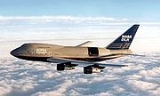
Stratospheric Observatory for Infrared Astronomy

Encyclopedia
The Stratospheric Observatory for Infrared Astronomy (SOFIA) is a joint project of NASA
and the German Aerospace Center
(DLR) to construct and maintain an airborne observatory
. NASA awarded the contract for the development of the aircraft, operation of the observatory and management of the American part of the project to the Universities Space Research Association
(USRA) in 1996. The DSI (Deutsches SOFIA Institut) manages the German parts of the project which are primarily science and telescope related. SOFIA's telescope saw first light on May 26, 2010. SOFIA is the successor to the Kuiper Airborne Observatory
.
wide-body aircraft
that has been modified to include a large door in the aft fuselage
that can be opened in flight to allow a 2.5 meter diameter reflecting telescope
access to the sky. This telescope is designed for infrared astronomy
observations in the stratosphere
at altitudes of about 41,000 feet (about 12 km). SOFIA's flight capability allows it to rise above almost all of the water vapor in the Earth's atmosphere, which blocks some infrared wavelengths from reaching the ground. At the aircraft's cruising altitude, 85% of the full infrared range will be available. The aircraft can also travel to almost any point on the Earth's surface, allowing observation from the northern and southern hemispheres.
Once ready for use, the expectation is for observing flights to be flown 3 or 4 nights a week for the next 20 years. SOFIA is now based at NASA's Dryden Aircraft Operations Facility at LA/Palmdale Regional Airport, California, while staff at NASA Ames Research Center
, in Mountain View, California, operate the SOFIA Science Center where astronomical observation missions are planned for the flying observatory.
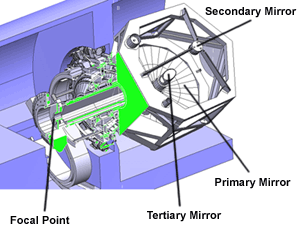 SOFIA uses a 2.5-meter reflector telescope, which has an oversized, 2.7 meter diameter primary mirror, as is common with most large infrared telescopes. The optical system uses a Cassegrain reflector
design with a parabolic
primary mirror and a remotely configurable hyperbolic
secondary. In order to fit the telescope into the fuselage, the primary is shaped to an f-number
as low as 1.3, while the resulting optical layout has an f-number of 19.7. A flat, tertiary, dichroic mirror
is used to deflect the infrared part of the beam to the Nasmyth focus
where it can be analyzed. An optical mirror located behind the tertiary mirror is used for a camera guidance system.
The telescope looks out of a large door in the side of the fuselage
near the airplane's tail, and will initially carry nine instruments for infrared astronomy
at wavelength
s from 1–655 micrometre
s and high-speed optical astronomy at wavelength
s from 0.3–1.1 micrometres. The main instruments are the FLITECAM, a near infrared camera covering 1–5 micrometres; FORCAST, covering the mid-infrared range of 5–40 micrometres, and HAWC, which spans the far infrared in the range 40–300 micrometres. The other five infrared instruments are spectrometer
s with various overlapping spectral ranges. SOFIA’s telescope is by far the largest ever to be placed in an aircraft. For each mission one interchangeable science instrument will be attached to the telescope. Two groups of general purpose instruments are available. In addition an investigator can also design and build a special purpose instrument.
The open cavity housing the telescope will be exposed to high-speed turbulent winds. In addition, the vibrations and motions of the aircraft introduce observing difficulties. The telescope was designed to be very lightweight, with a honeycomb shape milled into the back of the mirror and polymer composite material used for the telescope assembly.
The mount includes a system of bearings in pressurized oil to isolate the instrument from vibration. Tracking is achieved through a system of gyroscopes, high speed cameras, and magnetic torque motors to compensate for motion, including vibrations from airflow and the aircraft engines. The telescope cabin must be cooled prior to aircraft takeoff to ensure the telescope matches the external temperature to prevent thermally induced shape changes. Prior to landing the compartment is flooded with nitrogen gas to prevent condensation of moisture on the chilled optics and instruments.
DLR is responsible for the entire telescope assembly and design along with two of the nine scientific instruments used with the telescope, NASA is responsible for the aircraft. The manufacturing of the telescope was subcontracted to European industry. The telescope is German; the primary mirror was cast by Schott AG in Mainz, Germany with lightweight improvements, with grinding and polishing completed by the French company SAGEM-REOSC
. The secondary silicon carbide based mirror mechanism was manufactured by Swiss CSEM
. A reflective surface was applied to the mirror at a facility in Louisiana but the consortium now maintains a mirror coating facility in Moffett Field
, allowing for fast recoating of the primary mirror, a process that is expected to be required 1-2 times per year.
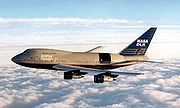 The SOFIA aircraft is a modified Boeing 747SP widebody
(serial number 21441, line number 306) with a distinguished history.
Boeing developed the SP or "Special Performance" version of the 747 for ultra long range flights, modifying the design of the 747-100 by removing a section of the fuselage to reduce weight, thus allowing the 747SP to fly higher, faster and farther non-stop than any other 747 model of the time.
Boeing assigned serial number 21441 (line number 306) to the airframe that would eventually become SOFIA. The first flight of this aircraft was on April 25, 1977 and Boeing delivered the aircraft to Pan American World Airways
on May 6, 1977. The aircraft received its first aircraft registration
, N536PA and Pan American placed the aircraft into commercial passenger service. Shortly thereafter, Pan Am named this aircraft in honor of the famous aviator Charles Lindbergh
. At the invitation of Pan Am, Charles Lindbergh
's widow, Anne Morrow Lindbergh
, christened the aircraft Clipper Lindbergh on May 20, 1977, the 50th anniversary of the beginning of her husband's historic flight from New York to Paris in 1927.
United Airlines
purchased the plane on February 13, 1986 and the aircraft received a new aircraft registration, N145UA. United Airlines placed the aircraft into service on the Washington, D.C. to San Francisco route. It continued to serve that route until December, 1995, when United Airlines placed the aircraft into storage near Las Vegas.
On April 30, 1997, the Universities Space Research Association
(USRA) purchased the aircraft for use as an airborne observatory. On October 27, 1997 NASA purchased the aircraft from the USRA. NASA conducted a series of "baseline" flight tests that year, prior to any heavy modification of the aircraft by L-3 Communications
Integrated Systems of Waco, Texas
. To ensure successful modification, L-3 purchased a section from another 747SP, registration number N141UA, to use as a full-size mock-up.
Commencing work in 1998, L-3 designed and installed an 18 feet (5.5 m) foot tall (arc length) by 13.5 feet (4.1 m) foot wide door in the aft port side of the aircraft's fuselage that can be opened in-flight to give the telescope access to the sky. The telescope is mounted in the aft end of the fuselage behind a pressurized bulkhead. The telecope's focal point
is located at a science instruments suite in the pressurized, center section of the fuselage, requiring part of the telescope to pass thorough the pressure bulkhead. In the center of the aircraft is the mission control and science operations section, while the forward section hosts the education and public outreach area.
At NASA's invitation, Charles Lindbergh's grandson, Erik Lindbergh, re-christened the aircraft with the name originally given by Pan Am, Clipper Lindbergh, on May 21, 2007, the 80th anniversary of the completion of Charles Lindbergh's historic trans-Atlantic flight.
for mounting a 36 inches (914.4 mm) telescope on an airborne platform. The goal was to perform astronomy from the stratosphere
, where there was a much lower optical depth
from water-vapor-absorbing infrared
radiation. This project, named the Kuiper Airborne Observatory
, was dedicated on May 21, 1975. The telescope was instrumental in numerous scientific studies, including the discovery of the ring system around the planet Uranus.
The proposal for a larger aircraft-mounted telescope was officially presented in 1984 and called for a Boeing 747
to carry a three-meter telescope. The preliminary system concept was published in 1987 in a Red Book. It was agreed that Germany would contribute 20% of the total cost and provide the telescope. However, the reunification of Germany and budget cuts at NASA led to a five-year slide in the project. NASA then contracted the work out to the Universities Space Research Association (USRA), and in 1996, NASA and DLR (the German Space Agency or Deutsches Zentrum fur Luft- und Raumfahrt) signed a memorandum of understanding to build and operate SOFIA.
The SOFIA telescope's primary mirror was manufactured of Zerodur
, a glass-ceramic composite produced by Schott AG that has almost zero thermal expansion. REOSC, the optical department of the SAGEM
Group in France, reduced the weight by milling honeycomb-shaped pockets out of the back. They finished polishing the mirror on December 14, 1999, achieving an accuracy of 8.5 nm over the optical surface. The hyperbola-shaped secondary mirror was made of silicon carbide
,
with polishing completed by May 2000.
During 2002, the main components of the telescope were assembled in Augsburg
, Germany. These consisted of the primary mirror assembly, the main optical support and the suspension assembly. After successful integration tests were made to check the system, the components were shipped to Waco, Texas
on board an Airbus Beluga
aircraft. They arrived on September 4, 2002. SOFIA completed its first ground-based "on-sky" test on August 18–19, 2004 by taking an image of the star Polaris
.
The project was further delayed in 2001 when three subcontractors tasked with development of the telescope door went out of business in succession. United Airlines
also entered bankruptcy protection and withdrew from the project as operator of the aircraft. The telescope was transported from Germany to the United States where it was installed in the airframe in 2004 and initial observations were made from the ground.
In February 2006, after cost increases from US$185 million to $330 million,
NASA placed the project "under review" and suspended funding by removing the project from its budget. On June 15, 2006, SOFIA passed the review when NASA concluded that there were no insurmountable technical or programmatic challenges to the continued development of SOFIA.
The maiden flight of SOFIA took place on April 26, 2007 at the L-3 Integrated Systems' (L-3 IS) Waco, Texas facility. After a brief test program in Waco to partially expand the flight envelope and perform post-maintenance checks, the aircraft was moved on May 31, 2007 to NASA's Dryden Flight Research Center
at Edwards Air Force Base
, from where it currently (2011) operates. The first phase of loads and flight testing was used to check the aircraft characteristics with the external telescope cavity door closed. This phase was successfully completed by January,
2008 at NASA-Dryden Flight Research Center
On December 18, 2009, the SOFIA aircraft performed the first test flight in which the telescope door was fully opened. This phase lasted for two minutes of the 79 minute flight. SOFIA's telescope saw first light on May 26, 2010, returning images showing M82
's core and heat from Jupiter
's formation escaping through its cloud cover. Initial "routine" science observation flights began in December 2010 and the observatory is slated for full capability by 2014 with about 100 flights per year.
ary atmosphere
s and surfaces; to investigate the structure, evolution and composition of comet
s; to determine the physics
and chemistry
of the interstellar medium
; and to explore the formation of star
s and other stellar objects. While SOFIA aircraft operations are managed by NASA Dryden, NASA's Ames Research Center in Mountain View, California, is home to the SOFIA Science Center which will manage mission planning for the program.
The "SOFIA Six" are the first set of educators selected to participate in SOFIA's AAA program, flying in a series of flights from May 26th to June 4th, 2011.
NASA
The National Aeronautics and Space Administration is the agency of the United States government that is responsible for the nation's civilian space program and for aeronautics and aerospace research...
and the German Aerospace Center
German Aerospace Center
The German Aerospace Center is the national centre for aerospace, energy and transportation research of the Federal Republic of Germany. It has multiple locations throughout Germany. Its headquarters are located in Cologne. It is engaged in a wide range of research and development projects in...
(DLR) to construct and maintain an airborne observatory
Airborne observatory
An airborne observatory is an airplane or balloon with an astronomical telescope. By carrying the telescope high, the telescope can avoid cloud cover, pollution, and carry out observations in the infrared spectrum, above water vapor in the atmosphere which absorbs infrared radiation.Examples of...
. NASA awarded the contract for the development of the aircraft, operation of the observatory and management of the American part of the project to the Universities Space Research Association
Universities Space Research Association
The Universities Space Research Association was incorporated on March 12, 1969 in the District of Columbia as a private, nonprofit corporation under the auspices of the National Academy of Sciences . Institutional membership in the Association has grown from 49 colleges and universities when it was...
(USRA) in 1996. The DSI (Deutsches SOFIA Institut) manages the German parts of the project which are primarily science and telescope related. SOFIA's telescope saw first light on May 26, 2010. SOFIA is the successor to the Kuiper Airborne Observatory
Kuiper Airborne Observatory
The Gerard P. Kuiper Airborne Observatory was a national facility operated by NASA to support research in infrared astronomy. The observation platform was a highly modified C-141A jet transport aircraft with a range of 6,000 nautical miles , capable of conducting research operations up to 48,000...
.
Facility
SOFIA is based on a Boeing 747SPBoeing 747SP
The Boeing 747SP is a modified version of the Boeing 747 jet airliner which was designed for ultra-long-range flights. The SP stands for "Special Performance". Compared with its predecessor, the 747-100, the 747SP retains its wide-body, four-engine layout, along with its double-deck design, but...
wide-body aircraft
Wide-body aircraft
A wide-body aircraft is a large airliner with two passenger aisles, also known as a widebody aircraft or twin-aisle aircraft. The typical fuselage diameter is . In the typical wide-body economy cabin, passengers are seated seven to ten abreast, allowing a total capacity of 200 to 850 passengers...
that has been modified to include a large door in the aft fuselage
Fuselage
The fuselage is an aircraft's main body section that holds crew and passengers or cargo. In single-engine aircraft it will usually contain an engine, although in some amphibious aircraft the single engine is mounted on a pylon attached to the fuselage which in turn is used as a floating hull...
that can be opened in flight to allow a 2.5 meter diameter reflecting telescope
Reflecting telescope
A reflecting telescope is an optical telescope which uses a single or combination of curved mirrors that reflect light and form an image. The reflecting telescope was invented in the 17th century as an alternative to the refracting telescope which, at that time, was a design that suffered from...
access to the sky. This telescope is designed for infrared astronomy
Infrared astronomy
Infrared astronomy is the branch of astronomy and astrophysics that studies astronomical objects visible in infrared radiation. The wavelength of infrared light ranges from 0.75 to 300 micrometers...
observations in the stratosphere
Stratosphere
The stratosphere is the second major layer of Earth's atmosphere, just above the troposphere, and below the mesosphere. It is stratified in temperature, with warmer layers higher up and cooler layers farther down. This is in contrast to the troposphere near the Earth's surface, which is cooler...
at altitudes of about 41,000 feet (about 12 km). SOFIA's flight capability allows it to rise above almost all of the water vapor in the Earth's atmosphere, which blocks some infrared wavelengths from reaching the ground. At the aircraft's cruising altitude, 85% of the full infrared range will be available. The aircraft can also travel to almost any point on the Earth's surface, allowing observation from the northern and southern hemispheres.
Once ready for use, the expectation is for observing flights to be flown 3 or 4 nights a week for the next 20 years. SOFIA is now based at NASA's Dryden Aircraft Operations Facility at LA/Palmdale Regional Airport, California, while staff at NASA Ames Research Center
NASA Ames Research Center
The Ames Research Center , is one of the United States of America's National Aeronautics and Space Administration 10 major field centers.The centre is located in Moffett Field in California's Silicon Valley, near the high-tech companies, entrepreneurial ventures, universities, and other...
, in Mountain View, California, operate the SOFIA Science Center where astronomical observation missions are planned for the flying observatory.
The telescope
Cassegrain reflector
The Cassegrain reflector is a combination of a primary concave mirror and a secondary convex mirror, often used in optical telescopes and radio antennas....
design with a parabolic
Parabolic reflector
A parabolic reflector is a reflective device used to collect or project energy such as light, sound, or radio waves. Its shape is that of a circular paraboloid, that is, the surface generated by a parabola revolving around its axis...
primary mirror and a remotely configurable hyperbolic
Hyperbolic
Hyperbolic refers to something related to or in shape of hyperbola , or to something employing the literary device of hyperbole .The following topics are based on the hyperbola etymology:...
secondary. In order to fit the telescope into the fuselage, the primary is shaped to an f-number
F-number
In optics, the f-number of an optical system expresses the diameter of the entrance pupil in terms of the focal length of the lens; in simpler terms, the f-number is the focal length divided by the "effective" aperture diameter...
as low as 1.3, while the resulting optical layout has an f-number of 19.7. A flat, tertiary, dichroic mirror
Dichroism
Dichroism has two related but distinct meanings in optics. A dichroic material is either one which causes visible light to be split up into distinct beams of different wavelengths , or one in which light rays having different polarizations are absorbed by different amounts.The original meaning of...
is used to deflect the infrared part of the beam to the Nasmyth focus
Nasmyth telescope
The Nasmyth telescope, also called Nasmyth-Cassegrain, is a reflecting telescope developed by James Nasmyth. It is a modified form of a Cassegrain telescope, mounted on an alt-azimuth mount.-Scheme:...
where it can be analyzed. An optical mirror located behind the tertiary mirror is used for a camera guidance system.
The telescope looks out of a large door in the side of the fuselage
Fuselage
The fuselage is an aircraft's main body section that holds crew and passengers or cargo. In single-engine aircraft it will usually contain an engine, although in some amphibious aircraft the single engine is mounted on a pylon attached to the fuselage which in turn is used as a floating hull...
near the airplane's tail, and will initially carry nine instruments for infrared astronomy
Infrared astronomy
Infrared astronomy is the branch of astronomy and astrophysics that studies astronomical objects visible in infrared radiation. The wavelength of infrared light ranges from 0.75 to 300 micrometers...
at wavelength
Wavelength
In physics, the wavelength of a sinusoidal wave is the spatial period of the wave—the distance over which the wave's shape repeats.It is usually determined by considering the distance between consecutive corresponding points of the same phase, such as crests, troughs, or zero crossings, and is a...
s from 1–655 micrometre
Micrometre
A micrometer , is by definition 1×10⁻⁶ of a meter .In plain English, it means one-millionth of a meter . Its unit symbol in the International System of Units is μm...
s and high-speed optical astronomy at wavelength
Wavelength
In physics, the wavelength of a sinusoidal wave is the spatial period of the wave—the distance over which the wave's shape repeats.It is usually determined by considering the distance between consecutive corresponding points of the same phase, such as crests, troughs, or zero crossings, and is a...
s from 0.3–1.1 micrometres. The main instruments are the FLITECAM, a near infrared camera covering 1–5 micrometres; FORCAST, covering the mid-infrared range of 5–40 micrometres, and HAWC, which spans the far infrared in the range 40–300 micrometres. The other five infrared instruments are spectrometer
Spectrometer
A spectrometer is an instrument used to measure properties of light over a specific portion of the electromagnetic spectrum, typically used in spectroscopic analysis to identify materials. The variable measured is most often the light's intensity but could also, for instance, be the polarization...
s with various overlapping spectral ranges. SOFIA’s telescope is by far the largest ever to be placed in an aircraft. For each mission one interchangeable science instrument will be attached to the telescope. Two groups of general purpose instruments are available. In addition an investigator can also design and build a special purpose instrument.
The open cavity housing the telescope will be exposed to high-speed turbulent winds. In addition, the vibrations and motions of the aircraft introduce observing difficulties. The telescope was designed to be very lightweight, with a honeycomb shape milled into the back of the mirror and polymer composite material used for the telescope assembly.
The mount includes a system of bearings in pressurized oil to isolate the instrument from vibration. Tracking is achieved through a system of gyroscopes, high speed cameras, and magnetic torque motors to compensate for motion, including vibrations from airflow and the aircraft engines. The telescope cabin must be cooled prior to aircraft takeoff to ensure the telescope matches the external temperature to prevent thermally induced shape changes. Prior to landing the compartment is flooded with nitrogen gas to prevent condensation of moisture on the chilled optics and instruments.
DLR is responsible for the entire telescope assembly and design along with two of the nine scientific instruments used with the telescope, NASA is responsible for the aircraft. The manufacturing of the telescope was subcontracted to European industry. The telescope is German; the primary mirror was cast by Schott AG in Mainz, Germany with lightweight improvements, with grinding and polishing completed by the French company SAGEM-REOSC
SAGEM
SAGEM was a major French company involved in defence electronics, consumer electronics and communication systems.In 2005, Sagem merged with SNECMA to form SAFRAN...
. The secondary silicon carbide based mirror mechanism was manufactured by Swiss CSEM
Swiss Center for Electronics and Microtechnology
CSEM SA is a Swiss Research and Development company with expertise in Micro Nano Technologies, Microelectronics, Systems Engineering und Communication Technologies. The headquarter is situated in Neuchâtel. CSEM also has centers in the cities Muttenz, Zürich, Alpnach and Landquart in Switzerland...
. A reflective surface was applied to the mirror at a facility in Louisiana but the consortium now maintains a mirror coating facility in Moffett Field
Moffett Federal Airfield
Moffett Federal Airfield , also known as Moffett Field, is a joint civil-military airport located between northern Mountain View and northern Sunnyvale, California, USA. The airport is near the south end of San Francisco Bay, northwest of San Jose. Formerly a United States Navy facility, the former...
, allowing for fast recoating of the primary mirror, a process that is expected to be required 1-2 times per year.
The SOFIA aircraft
Wide-body aircraft
A wide-body aircraft is a large airliner with two passenger aisles, also known as a widebody aircraft or twin-aisle aircraft. The typical fuselage diameter is . In the typical wide-body economy cabin, passengers are seated seven to ten abreast, allowing a total capacity of 200 to 850 passengers...
(serial number 21441, line number 306) with a distinguished history.
Boeing developed the SP or "Special Performance" version of the 747 for ultra long range flights, modifying the design of the 747-100 by removing a section of the fuselage to reduce weight, thus allowing the 747SP to fly higher, faster and farther non-stop than any other 747 model of the time.
Boeing assigned serial number 21441 (line number 306) to the airframe that would eventually become SOFIA. The first flight of this aircraft was on April 25, 1977 and Boeing delivered the aircraft to Pan American World Airways
Pan American World Airways
Pan American World Airways, commonly known as Pan Am, was the principal and largest international air carrier in the United States from 1927 until its collapse on December 4, 1991...
on May 6, 1977. The aircraft received its first aircraft registration
Aircraft registration
An aircraft registration is a unique alphanumeric string that identifies a civil aircraft, in similar fashion to a licence plate on an automobile...
, N536PA and Pan American placed the aircraft into commercial passenger service. Shortly thereafter, Pan Am named this aircraft in honor of the famous aviator Charles Lindbergh
Charles Lindbergh
Charles Augustus Lindbergh was an American aviator, author, inventor, explorer, and social activist.Lindbergh, a 25-year-old U.S...
. At the invitation of Pan Am, Charles Lindbergh
Charles Lindbergh
Charles Augustus Lindbergh was an American aviator, author, inventor, explorer, and social activist.Lindbergh, a 25-year-old U.S...
's widow, Anne Morrow Lindbergh
Anne Morrow Lindbergh
Anne Morrow Lindbergh was an American author, aviator, and the spouse of fellow aviator Charles Lindbergh.She was an acclaimed author whose books and articles spanned the genres of poetry to non-fiction, touching upon topics as diverse as youth and age; love and marriage; peace, solitude and...
, christened the aircraft Clipper Lindbergh on May 20, 1977, the 50th anniversary of the beginning of her husband's historic flight from New York to Paris in 1927.
United Airlines
United Airlines
United Air Lines, Inc., is the world's largest airline with 86,852 employees United Air Lines, Inc., is the world's largest airline with 86,852 employees United Air Lines, Inc., is the world's largest airline with 86,852 employees (which includes the entire holding company United Continental...
purchased the plane on February 13, 1986 and the aircraft received a new aircraft registration, N145UA. United Airlines placed the aircraft into service on the Washington, D.C. to San Francisco route. It continued to serve that route until December, 1995, when United Airlines placed the aircraft into storage near Las Vegas.
On April 30, 1997, the Universities Space Research Association
Universities Space Research Association
The Universities Space Research Association was incorporated on March 12, 1969 in the District of Columbia as a private, nonprofit corporation under the auspices of the National Academy of Sciences . Institutional membership in the Association has grown from 49 colleges and universities when it was...
(USRA) purchased the aircraft for use as an airborne observatory. On October 27, 1997 NASA purchased the aircraft from the USRA. NASA conducted a series of "baseline" flight tests that year, prior to any heavy modification of the aircraft by L-3 Communications
L-3 Communications
L-3 Communications Holdings, Inc. is a company that supplies command and control, communications, intelligence, surveillance and reconnaissance systems and products, avionics, ocean products, training devices and services, instrumentation, space, and navigation products. Its customers include...
Integrated Systems of Waco, Texas
Waco, Texas
Waco is a city in and the county seat of McLennan County, Texas. Situated along the Brazos River and on the I-35 corridor, halfway between Dallas and Austin, it is the economic, cultural, and academic center of the 'Heart of Texas' region....
. To ensure successful modification, L-3 purchased a section from another 747SP, registration number N141UA, to use as a full-size mock-up.
Commencing work in 1998, L-3 designed and installed an 18 feet (5.5 m) foot tall (arc length) by 13.5 feet (4.1 m) foot wide door in the aft port side of the aircraft's fuselage that can be opened in-flight to give the telescope access to the sky. The telescope is mounted in the aft end of the fuselage behind a pressurized bulkhead. The telecope's focal point
Focus (optics)
In geometrical optics, a focus, also called an image point, is the point where light rays originating from a point on the object converge. Although the focus is conceptually a point, physically the focus has a spatial extent, called the blur circle. This non-ideal focusing may be caused by...
is located at a science instruments suite in the pressurized, center section of the fuselage, requiring part of the telescope to pass thorough the pressure bulkhead. In the center of the aircraft is the mission control and science operations section, while the forward section hosts the education and public outreach area.
At NASA's invitation, Charles Lindbergh's grandson, Erik Lindbergh, re-christened the aircraft with the name originally given by Pan Am, Clipper Lindbergh, on May 21, 2007, the 80th anniversary of the completion of Charles Lindbergh's historic trans-Atlantic flight.
Project development
The first use of an aircraft for performing infrared observations was in 1965 when Gerard P. Kuiper used the NASA Convair 990 to study Venus. Three years later, Frank Low used the Ames Learjet for observations of Jupiter and nebulae. In 1969, planning beganfor mounting a 36 inches (914.4 mm) telescope on an airborne platform. The goal was to perform astronomy from the stratosphere
Stratosphere
The stratosphere is the second major layer of Earth's atmosphere, just above the troposphere, and below the mesosphere. It is stratified in temperature, with warmer layers higher up and cooler layers farther down. This is in contrast to the troposphere near the Earth's surface, which is cooler...
, where there was a much lower optical depth
Optical depth
Optical depth, or optical thickness, is a measure of transparency. Optical depth is defined by the negative logarithm of the fraction of radiation that is not scattered or absorbed on a path...
from water-vapor-absorbing infrared
Infrared
Infrared light is electromagnetic radiation with a wavelength longer than that of visible light, measured from the nominal edge of visible red light at 0.74 micrometres , and extending conventionally to 300 µm...
radiation. This project, named the Kuiper Airborne Observatory
Kuiper Airborne Observatory
The Gerard P. Kuiper Airborne Observatory was a national facility operated by NASA to support research in infrared astronomy. The observation platform was a highly modified C-141A jet transport aircraft with a range of 6,000 nautical miles , capable of conducting research operations up to 48,000...
, was dedicated on May 21, 1975. The telescope was instrumental in numerous scientific studies, including the discovery of the ring system around the planet Uranus.
The proposal for a larger aircraft-mounted telescope was officially presented in 1984 and called for a Boeing 747
Boeing 747
The Boeing 747 is a wide-body commercial airliner and cargo transport, often referred to by its original nickname, Jumbo Jet, or Queen of the Skies. It is among the world's most recognizable aircraft, and was the first wide-body ever produced...
to carry a three-meter telescope. The preliminary system concept was published in 1987 in a Red Book. It was agreed that Germany would contribute 20% of the total cost and provide the telescope. However, the reunification of Germany and budget cuts at NASA led to a five-year slide in the project. NASA then contracted the work out to the Universities Space Research Association (USRA), and in 1996, NASA and DLR (the German Space Agency or Deutsches Zentrum fur Luft- und Raumfahrt) signed a memorandum of understanding to build and operate SOFIA.
The SOFIA telescope's primary mirror was manufactured of Zerodur
Zerodur
Zerodur®, a registered trademark of Schott Glass Technologies, is a lithium aluminosilicate glass-ceramic produced by Schott AG since 1968. It has been used for a number of very large telescope mirrors including Keck I and Keck II. With its very low coefficient of expansion it can be used to...
, a glass-ceramic composite produced by Schott AG that has almost zero thermal expansion. REOSC, the optical department of the SAGEM
SAGEM
SAGEM was a major French company involved in defence electronics, consumer electronics and communication systems.In 2005, Sagem merged with SNECMA to form SAFRAN...
Group in France, reduced the weight by milling honeycomb-shaped pockets out of the back. They finished polishing the mirror on December 14, 1999, achieving an accuracy of 8.5 nm over the optical surface. The hyperbola-shaped secondary mirror was made of silicon carbide
Silicon carbide
Silicon carbide , also known as carborundum, is a compound of silicon and carbon with chemical formula SiC. It occurs in nature as the extremely rare mineral moissanite. Silicon carbide powder has been mass-produced since 1893 for use as an abrasive...
,
with polishing completed by May 2000.
During 2002, the main components of the telescope were assembled in Augsburg
Augsburg
Augsburg is a city in the south-west of Bavaria, Germany. It is a university town and home of the Regierungsbezirk Schwaben and the Bezirk Schwaben. Augsburg is an urban district and home to the institutions of the Landkreis Augsburg. It is, as of 2008, the third-largest city in Bavaria with a...
, Germany. These consisted of the primary mirror assembly, the main optical support and the suspension assembly. After successful integration tests were made to check the system, the components were shipped to Waco, Texas
Waco, Texas
Waco is a city in and the county seat of McLennan County, Texas. Situated along the Brazos River and on the I-35 corridor, halfway between Dallas and Austin, it is the economic, cultural, and academic center of the 'Heart of Texas' region....
on board an Airbus Beluga
Airbus Beluga
-External links:*...
aircraft. They arrived on September 4, 2002. SOFIA completed its first ground-based "on-sky" test on August 18–19, 2004 by taking an image of the star Polaris
Polaris
Polaris |Alpha]] Ursae Minoris, commonly North Star or Pole Star, also Lodestar) is the brightest star in the constellation Ursa Minor. It is very close to the north celestial pole, making it the current northern pole star....
.
The project was further delayed in 2001 when three subcontractors tasked with development of the telescope door went out of business in succession. United Airlines
United Airlines
United Air Lines, Inc., is the world's largest airline with 86,852 employees United Air Lines, Inc., is the world's largest airline with 86,852 employees United Air Lines, Inc., is the world's largest airline with 86,852 employees (which includes the entire holding company United Continental...
also entered bankruptcy protection and withdrew from the project as operator of the aircraft. The telescope was transported from Germany to the United States where it was installed in the airframe in 2004 and initial observations were made from the ground.
In February 2006, after cost increases from US$185 million to $330 million,
NASA placed the project "under review" and suspended funding by removing the project from its budget. On June 15, 2006, SOFIA passed the review when NASA concluded that there were no insurmountable technical or programmatic challenges to the continued development of SOFIA.
The maiden flight of SOFIA took place on April 26, 2007 at the L-3 Integrated Systems' (L-3 IS) Waco, Texas facility. After a brief test program in Waco to partially expand the flight envelope and perform post-maintenance checks, the aircraft was moved on May 31, 2007 to NASA's Dryden Flight Research Center
Dryden Flight Research Center
The Dryden Flight Research Center , located inside Edwards Air Force Base, is an aeronautical research center operated by NASA. On March 26, 1976 it was named in honor of the late Hugh L. Dryden, a prominent aeronautical engineer who at the time of his death in 1965 was NASA's deputy administrator...
at Edwards Air Force Base
Edwards Air Force Base
Edwards Air Force Base is a United States Air Force base located on the border of Kern County, Los Angeles County, and San Bernardino County, California, in the Antelope Valley. It is southwest of the central business district of North Edwards, California and due east of Rosamond.It is named in...
, from where it currently (2011) operates. The first phase of loads and flight testing was used to check the aircraft characteristics with the external telescope cavity door closed. This phase was successfully completed by January,
2008 at NASA-Dryden Flight Research Center
On December 18, 2009, the SOFIA aircraft performed the first test flight in which the telescope door was fully opened. This phase lasted for two minutes of the 79 minute flight. SOFIA's telescope saw first light on May 26, 2010, returning images showing M82
Messier 82
Messier 82 is the prototype nearby starburst galaxy about 12 million light-years away in the constellation Ursa Major...
's core and heat from Jupiter
Jupiter
Jupiter is the fifth planet from the Sun and the largest planet within the Solar System. It is a gas giant with mass one-thousandth that of the Sun but is two and a half times the mass of all the other planets in our Solar System combined. Jupiter is classified as a gas giant along with Saturn,...
's formation escaping through its cloud cover. Initial "routine" science observation flights began in December 2010 and the observatory is slated for full capability by 2014 with about 100 flights per year.
Scientific research
The primary science objectives of SOFIA are to study the composition of planetPlanet
A planet is a celestial body orbiting a star or stellar remnant that is massive enough to be rounded by its own gravity, is not massive enough to cause thermonuclear fusion, and has cleared its neighbouring region of planetesimals.The term planet is ancient, with ties to history, science,...
ary atmosphere
Atmosphere
An atmosphere is a layer of gases that may surround a material body of sufficient mass, and that is held in place by the gravity of the body. An atmosphere may be retained for a longer duration, if the gravity is high and the atmosphere's temperature is low...
s and surfaces; to investigate the structure, evolution and composition of comet
Comet
A comet is an icy small Solar System body that, when close enough to the Sun, displays a visible coma and sometimes also a tail. These phenomena are both due to the effects of solar radiation and the solar wind upon the nucleus of the comet...
s; to determine the physics
Physics
Physics is a natural science that involves the study of matter and its motion through spacetime, along with related concepts such as energy and force. More broadly, it is the general analysis of nature, conducted in order to understand how the universe behaves.Physics is one of the oldest academic...
and chemistry
Chemistry
Chemistry is the science of matter, especially its chemical reactions, but also its composition, structure and properties. Chemistry is concerned with atoms and their interactions with other atoms, and particularly with the properties of chemical bonds....
of the interstellar medium
Interstellar medium
In astronomy, the interstellar medium is the matter that exists in the space between the star systems in a galaxy. This matter includes gas in ionic, atomic, and molecular form, dust, and cosmic rays. It fills interstellar space and blends smoothly into the surrounding intergalactic space...
; and to explore the formation of star
Star
A star is a massive, luminous sphere of plasma held together by gravity. At the end of its lifetime, a star can also contain a proportion of degenerate matter. The nearest star to Earth is the Sun, which is the source of most of the energy on Earth...
s and other stellar objects. While SOFIA aircraft operations are managed by NASA Dryden, NASA's Ames Research Center in Mountain View, California, is home to the SOFIA Science Center which will manage mission planning for the program.
Airborne Astronomy Ambassadors Program
Once SOFIA is fully operational, more than 50 educators will be selected each year to participate in one or more research flights. Following their flight experience, SOFIA's Airborne Astronomy Ambassadors (AAA) will become part of a growing national network of master educators who conduct workshops, teacher in-service training, and other programs in their local school districts, science centers, and communities.The "SOFIA Six" are the first set of educators selected to participate in SOFIA's AAA program, flying in a series of flights from May 26th to June 4th, 2011.
See also
- Kuiper Airborne ObservatoryKuiper Airborne ObservatoryThe Gerard P. Kuiper Airborne Observatory was a national facility operated by NASA to support research in infrared astronomy. The observation platform was a highly modified C-141A jet transport aircraft with a range of 6,000 nautical miles , capable of conducting research operations up to 48,000...
- Infrared astronomyInfrared astronomyInfrared astronomy is the branch of astronomy and astrophysics that studies astronomical objects visible in infrared radiation. The wavelength of infrared light ranges from 0.75 to 300 micrometers...
- Far infrared astronomyFar infrared astronomyFar-infrared astronomy is the branch of astronomy and astrophysics that deals with objects visible in far-infrared radiation ....
- Far infrared astronomy
External links
- SOFIA Science Center, USRAUniversities Space Research AssociationThe Universities Space Research Association was incorporated on March 12, 1969 in the District of Columbia as a private, nonprofit corporation under the auspices of the National Academy of Sciences . Institutional membership in the Association has grown from 49 colleges and universities when it was...
& DSIDSIDSI is an initialism for the following companies:* Dave Smith Instruments, an American synthesizer company* Delphi Schools, Inc.* Delphine Software International, a now bankrupt software company* Destination Software, Inc., a video game company... - SOFIA mission, NASANASAThe National Aeronautics and Space Administration is the agency of the United States government that is responsible for the nation's civilian space program and for aeronautics and aerospace research...
- SOFIA Mission Profile by Solar System Exploration at NASANASAThe National Aeronautics and Space Administration is the agency of the United States government that is responsible for the nation's civilian space program and for aeronautics and aerospace research...
- DLR's SOFIA Website
- SOFIA on Astronomy Picture of the Day
- Stratospheric Observatory For Infrared Astronomy (SOFIA), Department of Astronomy and Astrophysics at University of ChicagoUniversity of ChicagoThe University of Chicago is a private research university in Chicago, Illinois, USA. It was founded by the American Baptist Education Society with a donation from oil magnate and philanthropist John D. Rockefeller and incorporated in 1890...
- SOFIA: Stratospheric Observatory For Infrared Astronomy, Moonfest 2009 by NASANASAThe National Aeronautics and Space Administration is the agency of the United States government that is responsible for the nation's civilian space program and for aeronautics and aerospace research...
Multimedia
- SOFIA Photo Collection, Dryden Flight Research CenterDryden Flight Research CenterThe Dryden Flight Research Center , located inside Edwards Air Force Base, is an aeronautical research center operated by NASA. On March 26, 1976 it was named in honor of the late Hugh L. Dryden, a prominent aeronautical engineer who at the time of his death in 1965 was NASA's deputy administrator...
- SOFIA Movie Collection, Dryden Flight Research CenterDryden Flight Research CenterThe Dryden Flight Research Center , located inside Edwards Air Force Base, is an aeronautical research center operated by NASA. On March 26, 1976 it was named in honor of the late Hugh L. Dryden, a prominent aeronautical engineer who at the time of his death in 1965 was NASA's deputy administrator...