

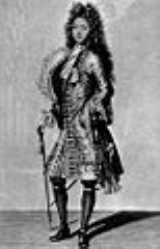
Louis-Auguste de Bourbon, duc du Maine

Encyclopedia
Louis Auguste de Bourbon, Legitimé de France (Saint-Germain-en-Laye
, 31 March 1670 – Sceaux
, 14 May 1736) was the eldest legitimised son of the Louis XIV of France
and his maîtresse-en-titre
, Madame de Montespan
. He was given the title Duke of Maine.
on 31 March 1670.
He was named Louis after his father and Auguste after the Roman Emperor Augustus
A similar naming process was used with his brothers Louis-César and Louis-Alexandre.
Immediately after his birth, Louis-Auguste was placed in the care of one of his mother's acquaintances, the widowed Madame Scarron
, who took him to live in a house on rue de Vaugirard, near the Luxembourg Palace in Paris.
His siblings, Louis-César (later comte de Vexin) and Louise-Françoise
(Mademoiselle de Nantes) were also brought there after their birth. In 1674, the three children were joined by their newborn sister Louise Marie Anne de Bourbon
(Mademoiselle de Tours). Their mother, living with the king at Versailles
, rarely saw her children, and Madame Scarron took the place of mother in Louis-Auguste's affections.
On 19 December 1673, when Louis-Auguste was three years old, Louis XIV legitimised his children by Madame de Montespan by with letters patent from the Parlement de Paris. At this time, Louis-Auguste received the title of duc du Maine. His siblings Louis-César and Louise-Françoise also received titles at the same time.
By the time of his legitimisation, it became clear that one of his legs was shorter than the other. The following spring, Madame Scarron took him to consult a famous quack at Antwerp. The king instructed the governess to travel incognito with his son as they journeyed beyond the French frontier. For the occasion, Madame Scarron and her charge travelled as the marquise de Surgeres and her invalid son from Poitou. The visit was a failure. The next year, the pair made another unsuccessful trip. This time to the waters of Bareges, a little town in sight of the Pyrenees.
The young duc du Maine's greatest enemy at court became his father's sister-in-law, the duchesse d'Orléans
, known at court as Madame. In her famous correspondence describing life at Versailles, Madame claimed that du Maine was not the son of the king:
In 1674, at the age of four, Louis-Auguste and his siblings were officially introduced to the court at Versailles. In the same year, he was made a colonel-general of the Swiss Guards
. He was also made the Grand Maître de France, a title later held by his future brother-in-law, the duc de Bourbon
.
He was present at the birth of his youngest sister, Françoise-Marie de Bourbon
, at the Château de Maintenon
in May 1677. Though du Maine's favourite sister was Louise-Françoise (Mlle de Nantes), Françoise-Marie always adored her oldest brother. Neither sister, however, would support him in his endeavours after the death of their father in 1715.
Louis XIV did not hide his love for the young du Maine, his favourite son, showering him with gifts and titles, and hiring the best tutors for him. The maréchal du Luxembourg, a famous military strategist, was put in charge of the child's military training. Despite this, Louis-Auguste never became more than a mediocre soldier.
In 1680, the king officially made his son a prince de Bourbon, bestowing upon him an even higher legitimate status at court.
In addition to these titles, the king and Madame de Montespan blackmailed the king's first cousin, the wealthy La Grande Mademoiselle, to cede some of her estates and titles to the duc du Maine in return for the liberation of her imprisoned lover, the duc de Lauzun.
As a result, Louis-Auguste became the comte d'Eu, prince de Dombes and duc d'Aumale. He also received the governorship of Languedoc
and was awarded the Order of the Holy Spirit
.
In April 1684, Louis-Auguste had the honour of representing France at the wedding of the Duke of Savoy
to Louis-Auguste's first cousin Anne Marie d'Orléans. This greatly annoyed his aunt, Madame
, since she coveted the honor for her too young son, Anne Marie's younger half-brother. Anne Marie eventually became the maternal grandmother of Louis XV of France
.
In 1688, Louis Auguste was made a capitaine général des galères (General of Galleys).
, and his enemy, Madame. Also considered were the unmarried granddaughters of the famous military leader, the Grand Condé. While Élisabeth Charlotte was horrified at any possible social disgrace in her daughter marrying a bastard, the Prince of Condé was willing to overlook the discrepancy in social status.
As a result, the duc du Maine was asked to choose among the three unmarried daughters of the duc d'Enghien and his wife, Anne Henriette of Bavaria
. Louis-Auguste indicated a preference for Louise Bénédicte, Mademoiselle de Charolais, over her sisters, Anne Marie, Mademoiselle de Condé
and Marie Anne, Mademoiselle de Montmorency (later duchesse de Vendôme). Mademoiselle de Condé was quite upset, as she had her heart set on marrying du Maine:
On 19 May 1692, Louis-Auguste and Anne Louise Bénédicte were married in a ceremony at the Palace of Versailles
. Presided over by the Cardinal de Bouillon, the guest of honour was the exiled James II of England
, who had been a guest at his sister's
wedding to the duc de Chartres
in February of the same year. Madame de Montespan, who had fallen out of favour with the king after the Affaire des Poisons
, did not attend her son's wedding. The duc du Maine received a gift of 1 million livres from his father at his wedding. His bride was given a hundred thousand livres in cash, with clothes and jewels worth an additional two hundred thousand livres.
The marriage proved very unhappy. Louise Bénédicte felt disgraced by her marriage to a Légitimé de France and, as a result, deliberately sought both to openly humiliate and to be a source of embarrassment to her husband. She was often unfaithful. As the groom and bride were both physically handicapped (Louise Bénédicte had a bad right arm and Louis had a lame leg), people at court snickered:
Although the couple was never to be overly close, the couple eventually had three children that grew to adulthood. Both parents doted on their children. Their only surviving daughter, with whom both remained close throughout their lives, was baptised at Versailles on 9 April 1714. Mademoiselle du Maine was given the name of name of her aunt, Louise-Françoise de Bourbon
, known at court as Madame la Duchesse. Madame la Duchesse had grown up with the duc du Maine under the care of Madame de Maintenon
.
In 1707, Madame de Montespan died, and the duc du Maine inherited a large portion of her fortune. He received the Château de Clagny
which had been built for her by his father near the château at Versailles. Unlike his younger siblings, the duke did not express any emotion or remorse at the loss of his mother, as he considered Madame de Maintenon to have been more of a mother to him throughout his youth.
, to the rank of princes du sang
, putting them in line to succeed to the French throne, in case that the legitimate line of the House of Bourbon
should die out.
This controversial decision was made because three heirs to the throne had died in a single year, leaving only one legitimate candidate with an unquestionable claim to the throne, the king's great-grandson, the four-year old duc d'Anjou
.
After Anjou, the succession was questionable. The two main candidates were King Philip V of Spain
, a grandson of Louis XIV and uncle to the duc d'Anjou, who had renounced his claim to the French crown by treaty, and Philippe d'Orléans, duc d'Orléans
, Louis XIV's legitimate nephew. Because of the King of Spain's renunciation, the duc d'Orléans was Louis' next male heir. The fear, however, was that his accession would be challenged by Spain and its Bourbon king.
By raising his legitimised sons to the rank of princes du sang, Louis XIV hoped to continue his own line on the French throne and at the same time prevent a war of succession with Spain and a civil war in France. However, the controversial royal decision angered the legitimate French princes, especially the prince de Condé and the duc d'Orléans.
In August 1715, Louis XIV's health deteriorated drastically. On 22 August, he was unable to attend a troop parade in the gardens of Versailles, and he ordered the duc du Maine to take his place at this event. This public display of the Maine's "promotion" greatly concerned his rival, the duc d'Orléans.
Displeased with Orléans' actions, Louis-Auguste, pressured by his ambitious wife, joined in the Cellamare Conspiracy
in the hope of transferring the regency to King Philip V of Spain
, who was the uncle of the young king Louis XV. The plot was named after Antonio del Giudice, Duke of Giovinazzo, Prince of Cellamare, the Spanish ambassador to the French court. After the conspiracy was discovered, du Maine was arrested and imprisoned in the fortress of Doullens
, and his wife was exiled to Dijon
.
In 1720, the couple was pardoned by the Council of the Regent and was allowed to return to court. After their release from imprisonment in 1720, Louise Bénédicte made an effort to reconcile with her husband, whom she had talked into joining the plot. She remarked:
After the release, Louis-Auguste and his wife led a more subdued, compatible life at the Château de Sceaux
, where his wife created a little court attended by popular literary figures of the day. The château had originally been bought by Louis XIV for his beloved son.
Louise Bénédicte on several occasions tried to marry off their children. First, she tried to marry their son, Louis Auguste de Bourbon, heir to the fortune of the House of Boubon du Maine
, to his first cousin Charlotte Aglaé, Mademoiselle de Valois, the daughter of the duc du Maine's younger sister, Françoise-Marie de Bourbon
. The young Mademoiselle de Valois refused, however, much to the annoyance of the proud Louise-Bénédicte. The duchess was none too happy to find out that Charlotte Aglaé had also considered the hand of another cousin, Charles de Bourbon, the son of Monsieur le Duc
, Louise Bénédicte's brother, and Madame la Duchesse
, du Maine's other sister.
Later, Louise-Bénédicte tried to marry off the rather unattractive Mademoiselle du Maine twice. First, she offered her daughter's hand to one Monsieur de Guise. That marriage never materialised. The duchess then offered the poor girl to the widowed prince de Monaco
, who was often at Versailles. Despite offering a large dowry to both men, neither wanted an ugly wife. Mademoiselle du Maine eventually died in 1743, alone and single, at the age thirty-five. She was buried at the Église at Sceaux.
It was at Sceaux that the duke died on 14 May 1736 at the age of sixty-six. Louis XV allowed Louise-Bénédicte to keep her apartments at Versailles next to that of her daughter's Mademoiselle du Maine. The apartments overlooked the Orangérie. Her son's also had apartments at court but both preferred to stay in the country hunting.
The House of Bourbon-Maine became extinct at the death of his eldest son, the prince de Dombes, in 1775.
The large Maine fortune was inherited by their cousin, the duc de Penthièvre, the only son of du Maine's younger brother, Louis-Alexandre de Bourbon, comte de Toulouse
.
Saint-Germain-en-Laye
Saint-Germain-en-Laye is a commune in the Yvelines department in the Île-de-France in north-central France. It is located in the western suburbs of Paris from the centre.Inhabitants are called Saint-Germanois...
, 31 March 1670 – Sceaux
Sceaux, Hauts-de-Seine
Sceaux is a commune in the southern suburbs of Paris, France. It is located from the center of Paris.-Wealth:Sceaux is famous for the Château of Sceaux, set in its large park , designed by André Le Nôtre, measuring...
, 14 May 1736) was the eldest legitimised son of the Louis XIV of France
Louis XIV of France
Louis XIV , known as Louis the Great or the Sun King , was a Bourbon monarch who ruled as King of France and Navarre. His reign, from 1643 to his death in 1715, began at the age of four and lasted seventy-two years, three months, and eighteen days...
and his maîtresse-en-titre
Maîtresse-en-titre
The maîtresse-en-titre was the chief mistress of the king of France. It was a semi-official position which came with its own apartments. The title really came into use during the reign of Henry IV and continued until the reign of Louis XV....
, Madame de Montespan
Françoise-Athénaïs, marquise de Montespan
Françoise Athénaïs de Rochechouart de Mortemart, marquise of Montespan , better known as Madame de Montespan, was the most celebrated maîtresse en titre of King Louis XIV of France, by whom she had seven children....
. He was given the title Duke of Maine.
Biography
Louis-Auguste de Bourbon was born at the Château de Saint-Germain-en-LayeChâteau de Saint-Germain-en-Laye
The Château de Saint-Germain-en-Laye is a royal palace in the commune of Saint-Germain-en-Laye, in the département of Yvelines, about 19 km west of Paris, France. Today, it houses the Musée d'Archéologie Nationale ....
on 31 March 1670.
He was named Louis after his father and Auguste after the Roman Emperor Augustus
Augustus
Augustus ;23 September 63 BC – 19 August AD 14) is considered the first emperor of the Roman Empire, which he ruled alone from 27 BC until his death in 14 AD.The dates of his rule are contemporary dates; Augustus lived under two calendars, the Roman Republican until 45 BC, and the Julian...
A similar naming process was used with his brothers Louis-César and Louis-Alexandre.
Immediately after his birth, Louis-Auguste was placed in the care of one of his mother's acquaintances, the widowed Madame Scarron
Françoise d'Aubigné, Marquise de Maintenon
Françoise d'Aubigné, Marquise de Maintenon was the second wife of King Louis XIV of France. She was known during her first marriage as Madame Scarron, and subsequently as Madame de Maintenon...
, who took him to live in a house on rue de Vaugirard, near the Luxembourg Palace in Paris.
His siblings, Louis-César (later comte de Vexin) and Louise-Françoise
Louise-Françoise de Bourbon
Louise Françoise de Bourbon, Légitimée de France was the eldest surviving legitimised daughter of Louis XIV of France and his maîtresse-en-titre, Madame de Montespan. She was said to have been named after her godmother, Louise de La Vallière, the woman that her mother had replaced as the king's...
(Mademoiselle de Nantes) were also brought there after their birth. In 1674, the three children were joined by their newborn sister Louise Marie Anne de Bourbon
Louise Marie Anne de Bourbon
Louise Marie Anne de Bourbon, Légitimée de France, Mademoiselle de Tours was the illegitimate daughter of Louis XIV of France and his most famous Maîtresse-en-titre, Madame de Montespan...
(Mademoiselle de Tours). Their mother, living with the king at Versailles
Versailles
Versailles , a city renowned for its château, the Palace of Versailles, was the de facto capital of the kingdom of France for over a century, from 1682 to 1789. It is now a wealthy suburb of Paris and remains an important administrative and judicial centre...
, rarely saw her children, and Madame Scarron took the place of mother in Louis-Auguste's affections.
On 19 December 1673, when Louis-Auguste was three years old, Louis XIV legitimised his children by Madame de Montespan by with letters patent from the Parlement de Paris. At this time, Louis-Auguste received the title of duc du Maine. His siblings Louis-César and Louise-Françoise also received titles at the same time.
By the time of his legitimisation, it became clear that one of his legs was shorter than the other. The following spring, Madame Scarron took him to consult a famous quack at Antwerp. The king instructed the governess to travel incognito with his son as they journeyed beyond the French frontier. For the occasion, Madame Scarron and her charge travelled as the marquise de Surgeres and her invalid son from Poitou. The visit was a failure. The next year, the pair made another unsuccessful trip. This time to the waters of Bareges, a little town in sight of the Pyrenees.
The young duc du Maine's greatest enemy at court became his father's sister-in-law, the duchesse d'Orléans
Elizabeth Charlotte of the Palatinate
Elizabeth Charlotte, Princess Palatine was a German princess and the wife of Philippe I, Duke of Orléans, younger brother of Louis XIV of France. Her vast correspondence provides a detailed account of the personalities and activities at the court of her brother-in-law, Louis XIV...
, known at court as Madame. In her famous correspondence describing life at Versailles, Madame claimed that du Maine was not the son of the king:
I can readily believe that the comte de Toulouse is the King's son; but I have always thought that the duc du Maine is the son of Terme [a member of the court], who was a false knave, and the greatest tale-bearer in the Court
In 1674, at the age of four, Louis-Auguste and his siblings were officially introduced to the court at Versailles. In the same year, he was made a colonel-general of the Swiss Guards
Swiss Guard
Swiss Guards or Schweizergarde is the name given to the Swiss soldiers who have served as bodyguards, ceremonial guards, and palace guards at foreign European courts since the late 15th century. They have had a high reputation for discipline, as well as loyalty to their employers...
. He was also made the Grand Maître de France, a title later held by his future brother-in-law, the duc de Bourbon
Louis III, Prince of Condé
Louis de Bourbon, , was Prince of Condé for less than a year, following the death of his father Henry III, Prince of Condé in 1709...
.
He was present at the birth of his youngest sister, Françoise-Marie de Bourbon
Françoise-Marie de Bourbon
Françoise Marie de Bourbon, Légitimée de France was the youngest legitimised daughter of Louis XIV of France and his maîtresse-en-titre, Françoise-Athénaïs, marquise de Montespan. Originally known as the second Mademoiselle de Blois, that style eventually gave way to the name Françoise Marie de...
, at the Château de Maintenon
Château de Maintenon
The Château de Maintenon is a château situated in the Eure-et-Loir region of France. It is best known as being the private residence of the second spouse of Louis XIV, Madame de Maintenon....
in May 1677. Though du Maine's favourite sister was Louise-Françoise (Mlle de Nantes), Françoise-Marie always adored her oldest brother. Neither sister, however, would support him in his endeavours after the death of their father in 1715.
Louis XIV did not hide his love for the young du Maine, his favourite son, showering him with gifts and titles, and hiring the best tutors for him. The maréchal du Luxembourg, a famous military strategist, was put in charge of the child's military training. Despite this, Louis-Auguste never became more than a mediocre soldier.
In 1680, the king officially made his son a prince de Bourbon, bestowing upon him an even higher legitimate status at court.
In addition to these titles, the king and Madame de Montespan blackmailed the king's first cousin, the wealthy La Grande Mademoiselle, to cede some of her estates and titles to the duc du Maine in return for the liberation of her imprisoned lover, the duc de Lauzun.
As a result, Louis-Auguste became the comte d'Eu, prince de Dombes and duc d'Aumale. He also received the governorship of Languedoc
Languedoc
Languedoc is a former province of France, now continued in the modern-day régions of Languedoc-Roussillon and Midi-Pyrénées in the south of France, and whose capital city was Toulouse, now in Midi-Pyrénées. It had an area of approximately 42,700 km² .-Geographical Extent:The traditional...
and was awarded the Order of the Holy Spirit
Order of the Holy Spirit
The Order of the Holy Spirit, also known as the Order of the Knights of the Holy Spirit, was an Order of Chivalry under the French Monarchy. It should not be confused with the Congregation of the Holy Ghost or with the Order of the Holy Ghost...
.
In April 1684, Louis-Auguste had the honour of representing France at the wedding of the Duke of Savoy
Victor Amadeus II of Sardinia
Victor Amadeus II was Duke of Savoy from 1675 to 1730. He also held the titles of marquis of Saluzzo, duke of Montferrat, prince of Piedmont, count of Aosta, Moriana and Nizza. Louis XIV organised his marriage in order to maintain French influence in the Duchy but Victor Amadeus soon broke away...
to Louis-Auguste's first cousin Anne Marie d'Orléans. This greatly annoyed his aunt, Madame
Elizabeth Charlotte of the Palatinate
Elizabeth Charlotte, Princess Palatine was a German princess and the wife of Philippe I, Duke of Orléans, younger brother of Louis XIV of France. Her vast correspondence provides a detailed account of the personalities and activities at the court of her brother-in-law, Louis XIV...
, since she coveted the honor for her too young son, Anne Marie's younger half-brother. Anne Marie eventually became the maternal grandmother of Louis XV of France
Louis XV of France
Louis XV was a Bourbon monarch who ruled as King of France and of Navarre from 1 September 1715 until his death. He succeeded his great-grandfather at the age of five, his first cousin Philippe II, Duke of Orléans, served as Regent of the kingdom until Louis's majority in 1723...
.
In 1688, Louis Auguste was made a capitaine général des galères (General of Galleys).
Marriage
As all of his legitimised siblings had married into families of royal blood, it was decided that he too should make a prestigious marriage. Several potential brides were discussed. Among them was his first cousin, Élisabeth Charlotte d'Orléans, the only unmarried daughter of his uncle, MonsieurPhilippe I, Duke of Orléans
Philippe of France was the youngest son of Louis XIII of France and his queen consort Anne of Austria. His older brother was the famous Louis XIV, le roi soleil. Styled Duke of Anjou from birth, Philippe became Duke of Orléans upon the death of his uncle Gaston, Duke of Orléans...
, and his enemy, Madame. Also considered were the unmarried granddaughters of the famous military leader, the Grand Condé. While Élisabeth Charlotte was horrified at any possible social disgrace in her daughter marrying a bastard, the Prince of Condé was willing to overlook the discrepancy in social status.
As a result, the duc du Maine was asked to choose among the three unmarried daughters of the duc d'Enghien and his wife, Anne Henriette of Bavaria
Anne Henriette of Bavaria
Anne Henriette of Palatinate-Simmern, in France known as Anne Henriette of Bavaria was a Princess of Palatinate-Simmern by birth and by her marriage in 1663, the Duchess of Enghien and then the Princess of Condé...
. Louis-Auguste indicated a preference for Louise Bénédicte, Mademoiselle de Charolais, over her sisters, Anne Marie, Mademoiselle de Condé
Anne Marie Victoire de Bourbon
Anne Marie de Bourbon was the daughter of the Prince of Condé and of a Bavarian princess. As a member of the reigning House of Bourbon, she was a Princesse du Sang. She never married and died of lung disease.-Biography:Anne Marie Victoire was the seventh child born to the Duke and Duchess of Enghien...
and Marie Anne, Mademoiselle de Montmorency (later duchesse de Vendôme). Mademoiselle de Condé was quite upset, as she had her heart set on marrying du Maine:
Monsieur le Prince had three daughters for him [du Maine] to choose from, and an extra quarter of an inch of stature made him prefer the second. All three were extremely small; the eldest [Anne Marie] was beautiful, and full of sense and wit. The incredible constraint, to say the least of it, in which the strange temper of Monsieur le Prince kept everyone who was subject to his yoke, made the choice of her sister a cause of bitter heartburning to her
On 19 May 1692, Louis-Auguste and Anne Louise Bénédicte were married in a ceremony at the Palace of Versailles
Palace of Versailles
The Palace of Versailles , or simply Versailles, is a royal château in Versailles in the Île-de-France region of France. In French it is the Château de Versailles....
. Presided over by the Cardinal de Bouillon, the guest of honour was the exiled James II of England
James II of England
James II & VII was King of England and King of Ireland as James II and King of Scotland as James VII, from 6 February 1685. He was the last Catholic monarch to reign over the Kingdoms of England, Scotland, and Ireland...
, who had been a guest at his sister's
Françoise-Marie de Bourbon
Françoise Marie de Bourbon, Légitimée de France was the youngest legitimised daughter of Louis XIV of France and his maîtresse-en-titre, Françoise-Athénaïs, marquise de Montespan. Originally known as the second Mademoiselle de Blois, that style eventually gave way to the name Françoise Marie de...
wedding to the duc de Chartres
Philippe II, Duke of Orléans
Philippe d'Orléans was a member of the royal family of France and served as Regent of the Kingdom from 1715 to 1723. Born at his father's palace at Saint-Cloud, he was known from birth under the title of Duke of Chartres...
in February of the same year. Madame de Montespan, who had fallen out of favour with the king after the Affaire des Poisons
Poison affair
The Affair of the Poisons was a major murder scandal in France which took place in 1677–1682, during the reign of King Louis XIV. During it, a number of prominent members of the aristocracy were implicated and sentenced on charges of poisoning and witchcraft...
, did not attend her son's wedding. The duc du Maine received a gift of 1 million livres from his father at his wedding. His bride was given a hundred thousand livres in cash, with clothes and jewels worth an additional two hundred thousand livres.
The marriage proved very unhappy. Louise Bénédicte felt disgraced by her marriage to a Légitimé de France and, as a result, deliberately sought both to openly humiliate and to be a source of embarrassment to her husband. She was often unfaithful. As the groom and bride were both physically handicapped (Louise Bénédicte had a bad right arm and Louis had a lame leg), people at court snickered:
Voici l'union d'un boiteux et d'une manchote. Ah, le beau couple!
Although the couple was never to be overly close, the couple eventually had three children that grew to adulthood. Both parents doted on their children. Their only surviving daughter, with whom both remained close throughout their lives, was baptised at Versailles on 9 April 1714. Mademoiselle du Maine was given the name of name of her aunt, Louise-Françoise de Bourbon
Louise-Françoise de Bourbon
Louise Françoise de Bourbon, Légitimée de France was the eldest surviving legitimised daughter of Louis XIV of France and his maîtresse-en-titre, Madame de Montespan. She was said to have been named after her godmother, Louise de La Vallière, the woman that her mother had replaced as the king's...
, known at court as Madame la Duchesse. Madame la Duchesse had grown up with the duc du Maine under the care of Madame de Maintenon
Françoise d'Aubigné, Marquise de Maintenon
Françoise d'Aubigné, Marquise de Maintenon was the second wife of King Louis XIV of France. She was known during her first marriage as Madame Scarron, and subsequently as Madame de Maintenon...
.
In 1707, Madame de Montespan died, and the duc du Maine inherited a large portion of her fortune. He received the Château de Clagny
Château de Clagny
The Château de Clagny was a French country house that stood northeast of the Château de Versailles; it was designed by Jules Hardouin-Mansart for Madame de Montespan between 1674 and 1680...
which had been built for her by his father near the château at Versailles. Unlike his younger siblings, the duke did not express any emotion or remorse at the loss of his mother, as he considered Madame de Maintenon to have been more of a mother to him throughout his youth.
Prince du Sang
In July 1714, in fear that his direct line would die out, Louis XIV raised Louis-Auguste and his younger brother, the comte de ToulouseLouis-Alexandre de Bourbon, Comte de Toulouse
Louis Alexandre de Bourbon, comte de Toulouse , duc de Penthièvre , d'Arc, de Châteauvillain and de Rambouillet , , was the son of Louis XIV and of his mistress Madame de Montespan...
, to the rank of princes du sang
Prince du Sang
A prince of the blood was a person who was legitimately descended in the male line from the monarch of a country. In France, the rank of prince du sang was the highest held at court after the immediate family of the king during the ancien régime and the Bourbon Restoration...
, putting them in line to succeed to the French throne, in case that the legitimate line of the House of Bourbon
House of Bourbon
The House of Bourbon is a European royal house, a branch of the Capetian dynasty . Bourbon kings first ruled Navarre and France in the 16th century. By the 18th century, members of the Bourbon dynasty also held thrones in Spain, Naples, Sicily, and Parma...
should die out.
This controversial decision was made because three heirs to the throne had died in a single year, leaving only one legitimate candidate with an unquestionable claim to the throne, the king's great-grandson, the four-year old duc d'Anjou
Louis XV of France
Louis XV was a Bourbon monarch who ruled as King of France and of Navarre from 1 September 1715 until his death. He succeeded his great-grandfather at the age of five, his first cousin Philippe II, Duke of Orléans, served as Regent of the kingdom until Louis's majority in 1723...
.
After Anjou, the succession was questionable. The two main candidates were King Philip V of Spain
Philip V of Spain
Philip V was King of Spain from 15 November 1700 to 15 January 1724, when he abdicated in favor of his son Louis, and from 6 September 1724, when he assumed the throne again upon his son's death, to his death.Before his reign, Philip occupied an exalted place in the royal family of France as a...
, a grandson of Louis XIV and uncle to the duc d'Anjou, who had renounced his claim to the French crown by treaty, and Philippe d'Orléans, duc d'Orléans
Philippe II, Duke of Orléans
Philippe d'Orléans was a member of the royal family of France and served as Regent of the Kingdom from 1715 to 1723. Born at his father's palace at Saint-Cloud, he was known from birth under the title of Duke of Chartres...
, Louis XIV's legitimate nephew. Because of the King of Spain's renunciation, the duc d'Orléans was Louis' next male heir. The fear, however, was that his accession would be challenged by Spain and its Bourbon king.
By raising his legitimised sons to the rank of princes du sang, Louis XIV hoped to continue his own line on the French throne and at the same time prevent a war of succession with Spain and a civil war in France. However, the controversial royal decision angered the legitimate French princes, especially the prince de Condé and the duc d'Orléans.
In August 1715, Louis XIV's health deteriorated drastically. On 22 August, he was unable to attend a troop parade in the gardens of Versailles, and he ordered the duc du Maine to take his place at this event. This public display of the Maine's "promotion" greatly concerned his rival, the duc d'Orléans.
The Cellamare Conspiracy
On 1 September 1715, Louis XIV died. His last will and testament gave the regency to both the duc d'Orléans and the duc du Maine. However, the next day, the duc d'Orléans ensured the annulment of Louis XIV's will in the Parlement de Paris.Displeased with Orléans' actions, Louis-Auguste, pressured by his ambitious wife, joined in the Cellamare Conspiracy
Cellamare Conspiracy
The Cellamare Conspiracy of 1718 was a conspiracy against the then Regent of France, Philippe d'Orléans . "Created" in Spain, it was the brainchild of Antonio del Giudice, Prince of Cellamare.-Background and Plot:...
in the hope of transferring the regency to King Philip V of Spain
Philip V of Spain
Philip V was King of Spain from 15 November 1700 to 15 January 1724, when he abdicated in favor of his son Louis, and from 6 September 1724, when he assumed the throne again upon his son's death, to his death.Before his reign, Philip occupied an exalted place in the royal family of France as a...
, who was the uncle of the young king Louis XV. The plot was named after Antonio del Giudice, Duke of Giovinazzo, Prince of Cellamare, the Spanish ambassador to the French court. After the conspiracy was discovered, du Maine was arrested and imprisoned in the fortress of Doullens
Doullens
Doullens is a commune in the Somme department in Picardie in northern France.Its inhabitants are called Doullennais and Doullennaises.-Geography:...
, and his wife was exiled to Dijon
Dijon
Dijon is a city in eastern France, the capital of the Côte-d'Or département and of the Burgundy region.Dijon is the historical capital of the region of Burgundy. Population : 151,576 within the city limits; 250,516 for the greater Dijon area....
.
In 1720, the couple was pardoned by the Council of the Regent and was allowed to return to court. After their release from imprisonment in 1720, Louise Bénédicte made an effort to reconcile with her husband, whom she had talked into joining the plot. She remarked:
I owe a full and rightful explanation to M. le Duc du Maine which is more precious to me than my own liberty or life
After the release, Louis-Auguste and his wife led a more subdued, compatible life at the Château de Sceaux
Château de Sceaux
The Château de Sceaux is a grand country house in Sceaux, Hauts-de-Seine, not far from Paris, France. Located in a park laid out by André Le Nôtre, it houses the Musée de l’Île-de-France, a museum of local history. The former château was built for Jean-Baptiste Colbert, Louis XIV's minister of...
, where his wife created a little court attended by popular literary figures of the day. The château had originally been bought by Louis XIV for his beloved son.
Louise Bénédicte on several occasions tried to marry off their children. First, she tried to marry their son, Louis Auguste de Bourbon, heir to the fortune of the House of Boubon du Maine
Bourbon du Maine
The House of Bourbon-Maine was an illegitimate branch of the House of Bourbon, being thus part of the Capetian dynasty. It was founded in 1672 when Louis-Auguste de Bourbon, duc du Maine was legitimised by his father, King Louis XIV of France....
, to his first cousin Charlotte Aglaé, Mademoiselle de Valois, the daughter of the duc du Maine's younger sister, Françoise-Marie de Bourbon
Françoise-Marie de Bourbon
Françoise Marie de Bourbon, Légitimée de France was the youngest legitimised daughter of Louis XIV of France and his maîtresse-en-titre, Françoise-Athénaïs, marquise de Montespan. Originally known as the second Mademoiselle de Blois, that style eventually gave way to the name Françoise Marie de...
. The young Mademoiselle de Valois refused, however, much to the annoyance of the proud Louise-Bénédicte. The duchess was none too happy to find out that Charlotte Aglaé had also considered the hand of another cousin, Charles de Bourbon, the son of Monsieur le Duc
Louis III, Prince of Condé
Louis de Bourbon, , was Prince of Condé for less than a year, following the death of his father Henry III, Prince of Condé in 1709...
, Louise Bénédicte's brother, and Madame la Duchesse
Louise-Françoise de Bourbon
Louise Françoise de Bourbon, Légitimée de France was the eldest surviving legitimised daughter of Louis XIV of France and his maîtresse-en-titre, Madame de Montespan. She was said to have been named after her godmother, Louise de La Vallière, the woman that her mother had replaced as the king's...
, du Maine's other sister.
Later, Louise-Bénédicte tried to marry off the rather unattractive Mademoiselle du Maine twice. First, she offered her daughter's hand to one Monsieur de Guise. That marriage never materialised. The duchess then offered the poor girl to the widowed prince de Monaco
Jacques I, Prince of Monaco
Jacques Goyon de Matignon was count of Thorigny, Prince of Monaco as Jacques I and the fourth Duke of Valentinois from 1731 until 1733.-Biography:...
, who was often at Versailles. Despite offering a large dowry to both men, neither wanted an ugly wife. Mademoiselle du Maine eventually died in 1743, alone and single, at the age thirty-five. She was buried at the Église at Sceaux.
It was at Sceaux that the duke died on 14 May 1736 at the age of sixty-six. Louis XV allowed Louise-Bénédicte to keep her apartments at Versailles next to that of her daughter's Mademoiselle du Maine. The apartments overlooked the Orangérie. Her son's also had apartments at court but both preferred to stay in the country hunting.
The House of Bourbon-Maine became extinct at the death of his eldest son, the prince de Dombes, in 1775.
The large Maine fortune was inherited by their cousin, the duc de Penthièvre, the only son of du Maine's younger brother, Louis-Alexandre de Bourbon, comte de Toulouse
Louis-Alexandre de Bourbon, Comte de Toulouse
Louis Alexandre de Bourbon, comte de Toulouse , duc de Penthièvre , d'Arc, de Châteauvillain and de Rambouillet , , was the son of Louis XIV and of his mistress Madame de Montespan...
.
List of Honours
- Legitimised (légitimé de France) 20 December 1673;
- Given the title of duc du Maine (1673) and made colonel général des Suisses et Grisons 1674;
- Captain of the Gardes SuissesSwiss GuardSwiss Guards or Schweizergarde is the name given to the Swiss soldiers who have served as bodyguards, ceremonial guards, and palace guards at foreign European courts since the late 15th century. They have had a high reputation for discipline, as well as loyalty to their employers...
3 February 1674; - Colonel of the Regiment of Infantry of Turenne 13 August 1675;
- Declared a Prince de BourbonHouse of BourbonThe House of Bourbon is a European royal house, a branch of the Capetian dynasty . Bourbon kings first ruled Navarre and France in the 16th century. By the 18th century, members of the Bourbon dynasty also held thrones in Spain, Naples, Sicily, and Parma...
January 1680; - Declared prince de Dombes and comte d'Eu 2 February 1681;
- Declared governor of LanguedocLanguedocLanguedoc is a former province of France, now continued in the modern-day régions of Languedoc-Roussillon and Midi-Pyrénées in the south of France, and whose capital city was Toulouse, now in Midi-Pyrénées. It had an area of approximately 42,700 km² .-Geographical Extent:The traditional...
29 May 1682; - Declared chevalier des Ordres du roi 2 June 1686;
- Named général des galères and the LieutenantLieutenantA lieutenant is a junior commissioned officer in many nations' armed forces. Typically, the rank of lieutenant in naval usage, while still a junior officer rank, is senior to the army rank...
General of the Seas 15 September 1688; - Marshal de camp 2 April 1690;
- Lieutenant général on 3 April 1692;
- Married Louise Bénédicte de Bourbon;
- Colonel of the regiment of the 'Royal-Carabiniers' 1 November 1693;
- Made a PeerPeerage of FranceThe Peerage of France was a distinction within the French nobility which appeared in the Middle Ages. It was abolished in 1789 during the French Revolution, but it reappeared in 1814 at the time of the Bourbon Restoration which followed the fall of the First French Empire...
of FranceFranceThe French Republic , The French Republic , The French Republic , (commonly known as France , is a unitary semi-presidential republic in Western Europe with several overseas territories and islands located on other continents and in the Indian, Pacific, and Atlantic oceans. Metropolitan France...
1694; - Made Grand Master of the Artillery 10 September 1694;
- Declared a Prince du sangPrince du SangA prince of the blood was a person who was legitimately descended in the male line from the monarch of a country. In France, the rank of prince du sang was the highest held at court after the immediate family of the king during the ancien régime and the Bourbon Restoration...
29 July 1714; - Declared Superintendent of the education of Louis XVLouis XV of FranceLouis XV was a Bourbon monarch who ruled as King of France and of Navarre from 1 September 1715 until his death. He succeeded his great-grandfather at the age of five, his first cousin Philippe II, Duke of Orléans, served as Regent of the kingdom until Louis's majority in 1723...
September 1715; - Stripped of the rank of prince du sang by his cousin the Régent de FrancePhilippe II, Duke of OrléansPhilippe d'Orléans was a member of the royal family of France and served as Regent of the Kingdom from 1715 to 1723. Born at his father's palace at Saint-Cloud, he was known from birth under the title of Duke of Chartres...
July 1717; - Died 14 May 1736
Issue
- Mademoiselle de Dombes (Palace of VersaillesPalace of VersaillesThe Palace of Versailles , or simply Versailles, is a royal château in Versailles in the Île-de-France region of France. In French it is the Château de Versailles....
, 11 September 1694 – Palace of VersaillesPalace of VersaillesThe Palace of Versailles , or simply Versailles, is a royal château in Versailles in the Île-de-France region of France. In French it is the Château de Versailles....
, 15 September 1694); - Louis Constantin de Bourbon, Prince of Dombes (Palace of Versailles, 17 November 1695 – Palace of Versailles, 28 September 1698);
- Mademoiselle d'Aumale (Palace of Versailles, 21 December 1697 - Palace of Versailles, 4 August 1699);
- Louis Auguste de Bourbon, Prince of Dombes (Palace of Versailles, 4 March 1700 - Palace of Fontainebleau, 1 October 1755),
- Louis Charles de Bourbon, Count of Eu (Château de SceauxChâteau de SceauxThe Château de Sceaux is a grand country house in Sceaux, Hauts-de-Seine, not far from Paris, France. Located in a park laid out by André Le Nôtre, it houses the Musée de l’Île-de-France, a museum of local history. The former château was built for Jean-Baptiste Colbert, Louis XIV's minister of...
, 15 October 1701 – 13 July 1775); - Charles de Bourbon, Duke of Aumale (Palace of Versailles, 31 March 1704 - Château de Sceaux, 2 September 1708),
- Louise Françoise de BourbonLouise-Françoise de Bourbon (1707–1743)Louise Françoise de Bourbon was a grand daughter of Louis XIV of France and his mistress Françoise Athénaïs de Rochechouart de Mortemart, better known as Madame de Montespan...
, Mademoiselle du Maine (Palace of Versailles, 4 December 1707 – Château d'AnetChâteau d'AnetThe Château d'Anet is a château near Dreux, France, built by Philibert de l'Orme from 1547 to 1552 for Diane de Poitiers, the mistress of Henry II of France...
, 19 August 1743).
Siblings
| Sibling and Family | ||||||||||||||||||||||||||||||||||||||||||||||||||||||||||||||||||||||||||||||||||||||||||||||||||||||||||||||||
|---|---|---|---|---|---|---|---|---|---|---|---|---|---|---|---|---|---|---|---|---|---|---|---|---|---|---|---|---|---|---|---|---|---|---|---|---|---|---|---|---|---|---|---|---|---|---|---|---|---|---|---|---|---|---|---|---|---|---|---|---|---|---|---|---|---|---|---|---|---|---|---|---|---|---|---|---|---|---|---|---|---|---|---|---|---|---|---|---|---|---|---|---|---|---|---|---|---|---|---|---|---|---|---|---|---|---|---|---|---|---|---|---|
|
||||||||||||||||||||||||||||||||||||||||||||||||||||||||||||||||||||||||||||||||||||||||||||||||||||||||||||||||
Ancestry
Titles and styles
- 31 March 1670 – 19 December 1673 Louis Auguste de Bourbon
- 19 December 1673 – July, 1714 His HighnessHighnessHighness, often used with a possessive adjective , is an attribute referring to the rank of the dynasty in an address...
, Louis Auguste de Bourbon, Légitimé de France, Duke of Maine - July, 1714 – July, 1717 His Serene HighnessSerene HighnessHis/Her Serene Highness is a style used today by the reigning families of Liechtenstein and Monaco. It also preceded the princely titles of members of some German ruling and mediatised dynasties as well as some non-ruling but princely German noble families until 1918...
Louis Auguste de Bourbon, Légitimé de France, Duke of Maine - July, 1717 – 14 May 1736 His HighnessHighnessHighness, often used with a possessive adjective , is an attribute referring to the rank of the dynasty in an address...
Louis Auguste de Bourbon, Légitimé de France, Duke of Maine