

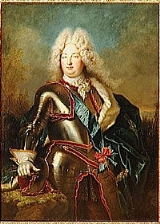
Fils de France

Encyclopedia
Fils de France was the style
and rank held by the sons of the kings and dauphins of France. A daughter was known as a fille de France (fij də fʁɑ̃s, Daughter of France).
The children of the dauphin, who was the king's heir apparent
, were accorded the same style and status as if they were the king's children instead of his grandchildren.
, enfants de France (Children of France) and petits-enfants de France (Grandchildren of France) constituted the famille du roi (Royal Family). More remote legitimate, male-line
descendants of France's kings held the designation and rank of princes du sang
(Princes of the Blood) or, if legally recognised despite a bar sinister on the escutcheon, they were customarily deemed princes légitimés (Legitimated Princes).
The dauphin, the heir to the French throne, was the most senior of the fils de France and was usually addressed as Monsieur
le dauphin. The king's next younger brother, also a fils de France, was known simply as Monsieur
, and his wife as Madame.
Daughters were referred to by their given name prefaced with the honorific
Madame, while sons were referred to by their main peerage title (usually ducal
), with the exception of the dauphin. The king's eldest daughter was known as Madame Royale
until she married, whereupon the next eldest fille de France succeeded to that style.
Although the children of monarchs are often referred to in English as prince or princess, those terms were used as general descriptions for royalty in France but not as titular prefixes or direct forms of address (with the exception of Monsieur le Prince for the senior prince du sang
) prior to the July Monarchy
(1830–1848). Collectively, the legitimate
children of the kings and dauphins were known as enfants de France ("Children of France"), while examples in reputable works of "Son of France" and "Daughter of France" being converted into other languages as Prince or Princess of France abound (whereas the same works, as cited, do not translate the Spanish equivalent, Infante/Infanta de España). The illegitimate children of French kings, dauphins, and princes du sang were not entitled to any rights or styles per se, but often they were legitimised
by their fathers. Even then, however, they were never elevated to the rank of fils de France, although they were sometimes accorded the lower rank and/or privileges associated with the princes du sang
.
All enfants de France were entitled to the style of Royal Highness
(altesse royale) from the reign of Louis XIII. However in practice that formal honorific was less often used than the more traditionally French styles of Monsieur, Madame or Mademoiselle. The styles of the royal family varied as follows:
), was the title used for the heir apparent
to the throne of France from 1350 to 1791 and then from 1824 to 1830.
were:
Between the death, in 1672, of Marie-Thérèse of France, the longest living daughter of Louis XIV, and the birth, in 1727, of Louise Élisabeth of France, the eldest daughter of Louis XV, there were no legitimate daughters of a French king. Because of this, the style was occasionally used by the most senior unmarried princess at the French Court during that period. It was briefly used by the eldest niece of Louis XIV, Marie Louise d'Orléans (1662–1689), later known as just Mademoiselle. After her marriage to King Charles II of Spain
(1661–1700), in 1679, the style was assumed briefly by her younger sister, Anne Marie d'Orléans (1669–1728), before she married Victor Amadeus II of Sardinia
(1666–1732).
Louise Élisabeth
(1727–1759), twin with her younger sister, Henriette; married Philip, Duke of Parma
(1720–1765), who was also an infante of Spain. Before her marriage, she was known as Madame Première. After her marriage she was the Duchess of Parma, and as such was known as Madame Infante, duchesse de Parme.Princess Henriette Anne (1727–1752), twin with her older sister, Louise-Élisabeth, known as Madame Seconde.
Princess Marie Louise
(1728–1733), known as Madame Troisième.
Princess Marie Adélaïde (1732–1800), originally known as Madame Quatrième; after her elder sister died in 1733, she was known as Madame Troisième. Later, she was known as Madame Adélaïde.
Princess Louise Marie Thérèse Victoire (1733–1799), originally known as Madame Quatrième, and later as Madame Victoire.
Princess Sophie Philippine Élisabeth Justine
(1734–1782), Madame Cinquième, known later as Madame Sophie.Princess Marie Thérèse Félicité
(1736–1744), known as Madame Sixième.
Princess Louise Marie
(1737–1787), originally, known as Madame Septième or Madame Dernière; known later as Madame Louise.
 This was the style and rank accorded to the sons of the fils de France, who were themselves the sons of the kings and dauphins of France. Females had the style petite-fille de France (Granddaughter of France). However, as surnames, they used their paternal main peerage title.
The petits-enfants de France, like the enfants de France, were entitled to be addressed as son altesse royale. Additionally, they traveled and lodged wherever the king did, could dine with him, and were entitled to an armchair in his presence.
Yet as hosts, they only offered armchairs to foreign monarchs—whom they addressed as Monseigneur rather than "Sire". Nor did they pay visits to foreign ambassadors, nor extend to them a hand in greeting. They only wore full mourning for deceased members of the royal family.
When entering a town, they were greeted with a presentation of arms by the royal garrison
, by the firing of cannon
, and by a delegation of local officials. However, only the sons and daughters of France were entitled to dine au grand couvert, that is, alone on a canopied dais
amidst non-royal onlookers.
Younger daughters of Monsieur were named after one of his inherited fiefdoms. An example of this was Mademoiselle de Chartres
(1676–1744), the third surviving daughter of Philippe I, duc d'Orléans.
Other families also did this such as the House of Bourbon-Condé with Anne Louise Bénédicte de Bourbon being known as Mademoiselle d’Enghien (1676–1753). A Conti example is Louise Henriette of Bourbon, Mademoiselle de Conti.
. After her death in 1693, the style of Grande Mademoiselle was not used again. Thus, this was not an official style but simply a means the court used to distinguish between the two princesses who held the style of Mademoiselle at the same time.
Style (manner of address)
A style of office, or honorific, is a legal, official, or recognized title. A style, by tradition or law, precedes a reference to a person who holds a post or political office, and is sometimes used to refer to the office itself. An honorific can also be awarded to an individual in a personal...
and rank held by the sons of the kings and dauphins of France. A daughter was known as a fille de France (fij də fʁɑ̃s, Daughter of France).
The children of the dauphin, who was the king's heir apparent
Heir apparent
An heir apparent or heiress apparent is a person who is first in line of succession and cannot be displaced from inheriting, except by a change in the rules of succession....
, were accorded the same style and status as if they were the king's children instead of his grandchildren.
Styles
The king, queen, queen dowagerQueen Dowager
A queen dowager or dowager queen is a title or status generally held by the widow of a deceased king. In the case of the widow of a deceased emperor, the title of empress dowager is used...
, enfants de France (Children of France) and petits-enfants de France (Grandchildren of France) constituted the famille du roi (Royal Family). More remote legitimate, male-line
Patrilineality
Patrilineality is a system in which one belongs to one's father's lineage. It generally involves the inheritance of property, names or titles through the male line as well....
descendants of France's kings held the designation and rank of princes du sang
Prince du Sang
A prince of the blood was a person who was legitimately descended in the male line from the monarch of a country. In France, the rank of prince du sang was the highest held at court after the immediate family of the king during the ancien régime and the Bourbon Restoration...
(Princes of the Blood) or, if legally recognised despite a bar sinister on the escutcheon, they were customarily deemed princes légitimés (Legitimated Princes).
The dauphin, the heir to the French throne, was the most senior of the fils de France and was usually addressed as Monsieur
Monsieur
' is an honorific title that used to refer to or address the eldest living brother of the king in the French royal court. It is also a customary French title of respect and term of address for a French-speaking man, corresponding to such English titles as Mr...
le dauphin. The king's next younger brother, also a fils de France, was known simply as Monsieur
Monsieur
' is an honorific title that used to refer to or address the eldest living brother of the king in the French royal court. It is also a customary French title of respect and term of address for a French-speaking man, corresponding to such English titles as Mr...
, and his wife as Madame.
Daughters were referred to by their given name prefaced with the honorific
Honorific
An honorific is a word or expression with connotations conveying esteem or respect when used in addressing or referring to a person. Sometimes, the term is used not quite correctly to refer to an honorary title...
Madame, while sons were referred to by their main peerage title (usually ducal
Duke
A duke or duchess is a member of the nobility, historically of highest rank below the monarch, and historically controlling a duchy...
), with the exception of the dauphin. The king's eldest daughter was known as Madame Royale
Madame Royale
Madame Royale was a style customarily used for the eldest living unmarried daughter of a reigning French monarch.It was similar to the style Monsieur, which was typically used by the King's second son...
until she married, whereupon the next eldest fille de France succeeded to that style.
Although the children of monarchs are often referred to in English as prince or princess, those terms were used as general descriptions for royalty in France but not as titular prefixes or direct forms of address (with the exception of Monsieur le Prince for the senior prince du sang
Prince du Sang
A prince of the blood was a person who was legitimately descended in the male line from the monarch of a country. In France, the rank of prince du sang was the highest held at court after the immediate family of the king during the ancien régime and the Bourbon Restoration...
) prior to the July Monarchy
July Monarchy
The July Monarchy , officially the Kingdom of France , was a period of liberal constitutional monarchy in France under King Louis-Philippe starting with the July Revolution of 1830 and ending with the Revolution of 1848...
(1830–1848). Collectively, the legitimate
Legitimacy (law)
At common law, legitimacy is the status of a child who is born to parents who are legally married to one another; and of a child who is born shortly after the parents' divorce. In canon and in civil law, the offspring of putative marriages have been considered legitimate children...
children of the kings and dauphins were known as enfants de France ("Children of France"), while examples in reputable works of "Son of France" and "Daughter of France" being converted into other languages as Prince or Princess of France abound (whereas the same works, as cited, do not translate the Spanish equivalent, Infante/Infanta de España). The illegitimate children of French kings, dauphins, and princes du sang were not entitled to any rights or styles per se, but often they were legitimised
Legitimacy (law)
At common law, legitimacy is the status of a child who is born to parents who are legally married to one another; and of a child who is born shortly after the parents' divorce. In canon and in civil law, the offspring of putative marriages have been considered legitimate children...
by their fathers. Even then, however, they were never elevated to the rank of fils de France, although they were sometimes accorded the lower rank and/or privileges associated with the princes du sang
Prince du Sang
A prince of the blood was a person who was legitimately descended in the male line from the monarch of a country. In France, the rank of prince du sang was the highest held at court after the immediate family of the king during the ancien régime and the Bourbon Restoration...
.
All enfants de France were entitled to the style of Royal Highness
Royal Highness
Royal Highness is a style ; plural Royal Highnesses...
(altesse royale) from the reign of Louis XIII. However in practice that formal honorific was less often used than the more traditionally French styles of Monsieur, Madame or Mademoiselle. The styles of the royal family varied as follows:
Monsieur le Dauphin
This was a form of address for the dauphin. The dauphin de France (strictly-speaking the dauphin de ViennoisDauphin de Viennois
The Counts of Albon were minor French nobles in south-eastern France, in the Rhône Alps region.Under Guigues IV, Count of Albon, who was nicknamed le Dauphin or the Dolphin from the dolphin on his coat of arms, they took a new hereditary title, Dauphin of Viennois , named for the region around...
), was the title used for the heir apparent
Heir apparent
An heir apparent or heiress apparent is a person who is first in line of succession and cannot be displaced from inheriting, except by a change in the rules of succession....
to the throne of France from 1350 to 1791 and then from 1824 to 1830.
- Louis de France (1661–1711), the only surviving son of Louis XIV (1638–1715), was usually not addressed by this style as he was usually referred to at court as either Monseigneur (see more below) or, informally, as le Grand Dauphin.
- Louis de France, (1682–1712), son of the preceding, who became the dauphin in 1711, was informally known as le Petit Dauphin.
Monseigneur
This was another way of addressing Le Grand Dauphin, the only legitimate son of Louis XIV. After the death of le Grand Dauphin, the heir apparent to the throne of France for half a century, the style of Monseigneur was not used again to describe the dauphin himself. Rather, it became the style used by his sons as prefix to their peerages. During the lifetime of the Grand Dauphin, his three sons were addressed as:- Monseigneur le Duc de Bourgogne
- Monseigneur le Duc d'AnjouPhilip V of SpainPhilip V was King of Spain from 15 November 1700 to 15 January 1724, when he abdicated in favor of his son Louis, and from 6 September 1724, when he assumed the throne again upon his son's death, to his death.Before his reign, Philip occupied an exalted place in the royal family of France as a...
- Monseigneur le Duc de Berry
Madame la Dauphine
This was the style of the dynastic wife of the dauphin. Some holders of the honorificHonorific
An honorific is a word or expression with connotations conveying esteem or respect when used in addressing or referring to a person. Sometimes, the term is used not quite correctly to refer to an honorary title...
were:
- Duchess Maria Anna Christine Victoria of Bavaria (1660–1690), also called Dauphine Victoire, first wife of le Grand Dauphin, and the grandmother of Louis XVLouis XV of FranceLouis XV was a Bourbon monarch who ruled as King of France and of Navarre from 1 September 1715 until his death. He succeeded his great-grandfather at the age of five, his first cousin Philippe II, Duke of Orléans, served as Regent of the kingdom until Louis's majority in 1723...
(1710–1774) - Princess Maria Adelaide of Savoy (1685–1712), wife of the Dauphin Louis (1682–1712) and mother of Louis XV.
- Infanta Maria Teresa Rafaela of Spain (1726–1746), first wife of Louis (1729–1765), the only son of Louis XV, and held the style till her death at age twenty-one.
- Duchess Maria Josefa of Saxony (1731–1767), second wife of the Dauphin Louis, and mother of Louis XVILouis XVI of FranceLouis XVI was a Bourbon monarch who ruled as King of France and Navarre until 1791, and then as King of the French from 1791 to 1792, before being executed in 1793....
(1754–1793), Louis XVIIILouis XVIII of FranceLouis XVIII , known as "the Unavoidable", was King of France and of Navarre from 1814 to 1824, omitting the Hundred Days in 1815...
(1755–1824) and Charles XCharles X of FranceCharles X was known for most of his life as the Comte d'Artois before he reigned as King of France and of Navarre from 16 September 1824 until 2 August 1830. A younger brother to Kings Louis XVI and Louis XVIII, he supported the latter in exile and eventually succeeded him...
(1757–1836). - Archduchess Maria Antonia Josepha Johanna of AustriaMarie AntoinetteMarie Antoinette ; 2 November 1755 – 16 October 1793) was an Archduchess of Austria and the Queen of France and of Navarre. She was the fifteenth and penultimate child of Holy Roman Empress Maria Theresa and Holy Roman Emperor Francis I....
, Marie Antoinette was the dauphine until her husband succeeded to the throne in 1774 as Louis XVI. - Princess Marie-Thérèse Charlotte of France (1778–1851); daughter of Louis XVI and Marie-Antoinette, known as Madame RoyaleMadame RoyaleMadame Royale was a style customarily used for the eldest living unmarried daughter of a reigning French monarch.It was similar to the style Monsieur, which was typically used by the King's second son...
, she became the last Dauphine of France when her father-in-law, Charles X, succeeded to the throne in 1824.
Madame Royale
This was the style of the eldest surviving daughter of the king. Those who held this honorific were:- Princess Élisabeth of France, eldest daughter of King Henry IV of FranceHenry IV of FranceHenry IV , Henri-Quatre, was King of France from 1589 to 1610 and King of Navarre from 1572 to 1610. He was the first monarch of the Bourbon branch of the Capetian dynasty in France....
(1553–1610) and his second wife, Queen Marie de' MediciMarie de' MediciMarie de Médicis , Italian Maria de' Medici, was queen consort of France, as the second wife of King Henry IV of France, of the House of Bourbon. She herself was a member of the wealthy and powerful House of Medici...
(1575–1642). In 1615, Élisabeth was married to the future king, Philip IV of SpainPhilip IV of SpainPhilip IV was King of Spain between 1621 and 1665, sovereign of the Spanish Netherlands, and King of Portugal until 1640...
(1605–1665). On her death in 1644, the style reverted to her younger sister, Christine Marie. - Princess Christine Marie of FranceChristine Marie of FranceChristine of France was the sister of Louis XIII and the Duchess of Savoy by marriage. At the death of her husband Victor Amadeus I in 1637, she acted as regent of Savoy between 1637 and 1648....
(1606–1663), the second daughter of Henry IV and Marie de' Medici. In 1619, Christine was married to Victor Amadeus I, Duke of SavoyVictor Amadeus I, Duke of SavoyVictor Amadeus I was the Duke of Savoy from 1630 to 1637. He was also titular King of Cyprus and Jerusalem. He was also known as the Lion of Susa-Biography:...
(1587–1637). She assumed the style of Madame Royale upon the death of her older sister, the Queen of Spain. - Princess Marie-Thérèse of France (1667–1672), the only daughter of Louis XIV and his queen to live beyond infancy.
- Princess Marie Louise Élisabeth of France (1727–1759), eldest daughter of Louis XV and his queen, Maria LeszczyńskaMaria LeszczynskaMarie Leszczyńska was a queen consort of France. She was a daughter of King Stanisław Leszczyński of Poland and Catherine Opalińska. She married King Louis XV of France and was the grandmother of Louis XVI, Louis XVIII, and Charles X. In France, she was referred to as Marie Leczinska...
(1703–1768). As a twin, Louise-Élisabeth rarely if ever used this title. She preferred being called Madame Première, to distinguish herself from her younger twin, Henriette-Anne of France (1727–1752), who was referred to as Madame Seconde. See more on this below. - Princess Marie-Thérèse of FrancePrincess Marie-Thérèse of France (1746–1748)Marie Thérèse of France, fille de France was a French princess by birth. She was the second of her paternal grandparents' grandchildren after the birth of Princess Isabella of Parma .-Biography:...
(1746–1748) eldest daughter of Louis, Dauphin of France (1729–1765) and his first wife Infanta Maria Teresa Rafaela of Spain (1726–1746). Her mother died three days after her birth. - Princess Marie-Thérèse Charlotte of France, eldest daughter of Louis XVI and Marie Antoinette. Marie-Thérèse was the sole member of her immediate family to survive the French RevolutionFrench RevolutionThe French Revolution , sometimes distinguished as the 'Great French Revolution' , was a period of radical social and political upheaval in France and Europe. The absolute monarchy that had ruled France for centuries collapsed in three years...
. She also exerted a great deal of political influence during the Bourbon RestorationBourbon RestorationThe Bourbon Restoration is the name given to the period following the successive events of the French Revolution , the end of the First Republic , and then the forcible end of the First French Empire under Napoleon – when a coalition of European powers restored by arms the monarchy to the...
(1815–1830).
Between the death, in 1672, of Marie-Thérèse of France, the longest living daughter of Louis XIV, and the birth, in 1727, of Louise Élisabeth of France, the eldest daughter of Louis XV, there were no legitimate daughters of a French king. Because of this, the style was occasionally used by the most senior unmarried princess at the French Court during that period. It was briefly used by the eldest niece of Louis XIV, Marie Louise d'Orléans (1662–1689), later known as just Mademoiselle. After her marriage to King Charles II of Spain
Charles II of Spain
Charles II was the last Habsburg King of Spain and the ruler of large parts of Italy, the Spanish territories in the Southern Low Countries, and Spain's overseas Empire, stretching from the Americas to the Spanish East Indies...
(1661–1700), in 1679, the style was assumed briefly by her younger sister, Anne Marie d'Orléans (1669–1728), before she married Victor Amadeus II of Sardinia
Victor Amadeus II of Sardinia
Victor Amadeus II was Duke of Savoy from 1675 to 1730. He also held the titles of marquis of Saluzzo, duke of Montferrat, prince of Piedmont, count of Aosta, Moriana and Nizza. Louis XIV organised his marriage in order to maintain French influence in the Duchy but Victor Amadeus soon broke away...
(1666–1732).
Monsieur
This honorific belonged to the oldest living brother of the King. Among those who held this style were:- Charles de Valois, Duke of OrléansCharles IX of FranceCharles IX was King of France, ruling from 1560 until his death. His reign was dominated by the Wars of Religion. He is best known as king at the time of the St. Bartholomew's Day Massacre.-Childhood:...
(1550–1574), younger brother of Francis IIFrancis II of FranceFrancis II was aged 15 when he succeeded to the throne of France after the accidental death of his father, King Henry II, in 1559. He reigned for 18 months before he died in December 1560...
(1544–1560), was known as Monsieur at the beginning of the reign of Francis II. He was King of France as Charles IX from 1560 to 1574; - Henri de Valois, Duke of AnjouHenry III of FranceHenry III was King of France from 1574 to 1589. As Henry of Valois, he was the first elected monarch of the Polish-Lithuanian Commonwealth with the dual titles of King of Poland and Grand Duke of Lithuania from 1573 to 1575.-Childhood:Henry was born at the Royal Château de Fontainebleau,...
(1551–1589), younger brother of Francis II and Charles IX, was known as Monsieur during the reign of Charles IX. He became King of France as Henry III from 1574–1589; - François de Valois, Duke of AnjouFrançois, Duke of AnjouFrancis, Duke of Anjou and Alençon was the youngest son of Henry II of France and Catherine de' Medici.-Early years:...
(1574–1584), youngest brother of Francis II, Charles IX and Henry III, was known as Monsieur during the reign of Henry III; - Gaston of France, Duke of OrléansGaston, Duke of OrléansGaston of France, , also known as Gaston d'Orléans, was the third son of King Henry IV of France and his wife Marie de Medici. As a son of the king, he was born a Fils de France. He later acquired the title Duke of Orléans, by which he was generally known during his adulthood...
(1608–1660), younger brother of Louis XIIILouis XIII of FranceLouis XIII was a Bourbon monarch who ruled as King of France and of Navarre from 1610 to 1643.Louis was only eight years old when he succeeded his father. His mother, Marie de Medici, acted as regent during Louis' minority...
(1601–1643), was known as Monsieur during the reign of Louis XIII and was the first fils de France to assume the use of altesse royale abroad;- Philippe de France, duc d'AnjouPhilippe I, Duke of OrléansPhilippe of France was the youngest son of Louis XIII of France and his queen consort Anne of Austria. His older brother was the famous Louis XIV, le roi soleil. Styled Duke of Anjou from birth, Philippe became Duke of Orléans upon the death of his uncle Gaston, Duke of Orléans...
(1640–1701), Gaston's nephew was known as le Petit Monsieur and Gaston as le Grand Monsieur when Louis XIII died in 1643;
- Philippe de France, duc d'Anjou
- Philippe de France, Duke of OrléansPhilippe I, Duke of OrléansPhilippe of France was the youngest son of Louis XIII of France and his queen consort Anne of Austria. His older brother was the famous Louis XIV, le roi soleil. Styled Duke of Anjou from birth, Philippe became Duke of Orléans upon the death of his uncle Gaston, Duke of Orléans...
(1640–1701) was the younger brother of Louis XIV, and known as Monsieur in 1660 after the death of his uncle, Gaston. He was the founder of the House of OrléansHouse of OrleansOrléans is the name used by several branches of the Royal House of France, all descended in the legitimate male line from the dynasty's founder, Hugh Capet. It became a tradition during France's ancien régime for the duchy of Orléans to be granted as an appanage to a younger son of the king...
; - Louis Stanislas Xavier of France, Count of ProvenceLouis XVIII of FranceLouis XVIII , known as "the Unavoidable", was King of France and of Navarre from 1814 to 1824, omitting the Hundred Days in 1815...
(1755–1824), younger brother of Louis XVI, known as Monsieur during the reign of Louis XVI, and was later King of France as Louis XVIII from 1814 to 1824; - Charles Philippe of France, Count of ArtoisCharles X of FranceCharles X was known for most of his life as the Comte d'Artois before he reigned as King of France and of Navarre from 16 September 1824 until 2 August 1830. A younger brother to Kings Louis XVI and Louis XVIII, he supported the latter in exile and eventually succeeded him...
(1757–1836) was the youngest brother of Louis XVI and Louis XVIII, and known as Monsieur at the beginning of the reign of Louis XVIII, later King of France as Charles X from 1824 to 1830.
Madame
This was the style of the wife of Monsieur. Examples of this were:- Marie de Bourbon, Duchess of MontpensierMarie de Bourbon, Duchess of MontpensierMarie de Bourbon , Duchess of Montpensier, and Duchess of Orléans by marriage, was a French noblewoman and one of the last members of the House of Bourbon-Montpensier...
(1605–1627), first wife of Gaston d'Orléans (Monsieur) and mother of la Grande Mademoiselle (1627–1693). - Marguerite of LorraineMarguerite of LorraineMarguerite of Lorraine was a duchess of Orléans and Alençon. She was born in Nancy, Lorraine to Francis II, Duke of Lorraine, and Countess Christina of Salm. On 31 January 1632, she married Gaston, Duke of Orléans, son of Henry IV of France and Marie de' Medici...
(1615–1672), second wife of Gaston. - Henrietta of England (1644–1670), the first wife of King Louis XIV's younger brother, Philippe, Duke of Orléans, (Monsieur).
- Elizabeth Charlotte of the PalatinateElizabeth Charlotte of the PalatinateElizabeth Charlotte, Princess Palatine was a German princess and the wife of Philippe I, Duke of Orléans, younger brother of Louis XIV of France. Her vast correspondence provides a detailed account of the personalities and activities at the court of her brother-in-law, Louis XIV...
(1652–1722), the second wife of Philippe I, duc d'Orléans (Monsieur). - Marie Joséphine of Savoy (1753–1810), wife of the Count of Provence, the future Louis XVIII.
Madame Première
King Louis XV and his wife, Marie Leszczyńska, had ten children, eight of whom were girls. To distinguish between these eight princesses, the daughters were known in birth order as Madame 'number, such as Madame Première, Madame Seconde, etc. This style was not a traditional right and was merely a way the court used to distinguish between the many daughters of Louis XV.Louise Élisabeth
Princess Louise Élisabeth of France
Louise Élisabeth de France was the eldest daughter of King Louis XV of France and his Queen consort, Maria Leszczyńska, and the elder twin sister of Anne Henriette de France. As the daughter of the king, she was a Daughter of France...
(1727–1759), twin with her younger sister, Henriette; married Philip, Duke of Parma
Philip, Duke of Parma
Philip of Spain was Duke of Parma from 1748 to 1765. He founded the House of Bourbon-Parma , a cadet line of the Spanish branch of the dynasty...
(1720–1765), who was also an infante of Spain. Before her marriage, she was known as Madame Première. After her marriage she was the Duchess of Parma, and as such was known as Madame Infante, duchesse de Parme.
Princess Louise of France
Marie Louise de France, fille de France was a French Princess by birth. She was one of 10 children.-Biography:...
(1728–1733), known as
Princess Sophie-Philippine of France
Sophie Philippine Élisabeth Justine de France, fille de France was a French princesse du sang. She was the sixth daughter and eighth child of Louis XV of France and his Queen consort Marie Leszczyńska. First known as Madame Sixième, she later became Madame Sophie.-Biography:Sophie is less well...
(1734–1782), Madame Cinquième, known later as Madame Sophie.
Princess Thérèse of France
Thérèse de France, fille de France was a French Princesse du Sang.-Biography:...
(1736–1744), known as
Princess Louise-Marie of France
Louise Marie de France was the youngest of the ten children of King Louis XV of France and his wife, Queen Maria Leszczyńska. As a daughter of the king, she held the rank of a fille de France, and was known as Madame Louise...
(1737–1787), originally, known as
Petit-fils de France
The petits-enfants de France, like the enfants de France, were entitled to be addressed as son altesse royale. Additionally, they traveled and lodged wherever the king did, could dine with him, and were entitled to an armchair in his presence.
Yet as hosts, they only offered armchairs to foreign monarchs—whom they addressed as Monseigneur rather than "Sire". Nor did they pay visits to foreign ambassadors, nor extend to them a hand in greeting. They only wore full mourning for deceased members of the royal family.
When entering a town, they were greeted with a presentation of arms by the royal garrison
Garrison
Garrison is the collective term for a body of troops stationed in a particular location, originally to guard it, but now often simply using it as a home base....
, by the firing of cannon
Cannon
A cannon is any piece of artillery that uses gunpowder or other usually explosive-based propellents to launch a projectile. Cannon vary in caliber, range, mobility, rate of fire, angle of fire, and firepower; different forms of cannon combine and balance these attributes in varying degrees,...
, and by a delegation of local officials. However, only the sons and daughters of France were entitled to dine au grand couvert, that is, alone on a canopied dais
Dais
Dais is any raised platform located either in or outside of a room or enclosure, often for dignified occupancy, as at the front of a lecture hall or sanctuary....
amidst non-royal onlookers.
Mademoiselle
This style was usually held by the eldest daughter of Monsieur and his wife, Madame. Those who held this style were:- Anne Marie Louise d'Orléans (1627–1693). She was the eldest daughter of Gaston de France.
- Marie Louise d'Orléans (1662–1689), later the wife of King Charles II of Spain. She was the eldest daughter of King Louis XIV's younger brother, Philippe I, duc d'Orléans.
- Anne Marie d'Orléans (1669–1728), held the style (along with Madame Royale) after the marriage of her sister Marie Louise. She was the mother of Princess Maria Adelaide of Savoy - later the Dauphine of France.
- Élisabeth Charlotte d'Orléans (1674–1744) youngest child of Philippe I, duc d'Orléans and his second wife. Married to the Duke of Lorraine, she was the paternal grandmother of Queen Marie Antoinette.
- Louise Anne de Bourbon (1695–1758) fourth child of Louis III, Prince of CondéLouis III, Prince of CondéLouis de Bourbon, , was Prince of Condé for less than a year, following the death of his father Henry III, Prince of Condé in 1709...
, she was given the style of Mademoiselle as her cousin Louis d'Orléans had no daughter. When Louis's daughter Louise Marie was born in 1726, the title went to her. Louise Marie died in 1728 thus the style reverted back to Louise-Anne. - Louise Marie d'OrléansLouise Marie d'OrléansLouise Marie d'Orléans was a French princess by birth.-Biography:Louise Marie d'Orléans was born at the Palais-Royal to Louis d'Orléans, Duke of Orléans and his Duchess, the Margravine Johanna of Baden-Baden, who died three days after giving birth.Her father was a second cousin of the then King...
(1726–1728) only daughter of Louis d'Orléans and his wife Margravine Auguste Marie Johanna of Baden-BadenMargravine Auguste Marie Johanna of Baden-BadenJohanna of Baden-Baden was born a Margravine of Baden-Baden, she was the Duchess of Orléans by marriage to Louis d'Orléans, Duke of Orléans. Her husband was a grandson of her father's former enemy Louis XIV of France. Known in France as Jeanne de Bade, she died in childbirth...
. Died in childhood - Louise Marie Thérèse Bathilde d'OrléansBathilde d'OrléansLouise Marie Thérèse Bathilde d'Orléans, Princess of Condé , was a French princess. She was sister of Philippe Égalité, the mother of the executed duc d'Enghien and aunt of Louis-Philippe King of the French...
(1750–1822) daughter of the Duke of OrléansLouis Philippe I, Duke of OrléansLouis Philippe d'Orléans known as le Gros , was a French nobleman, a member of a cadet branch of the House of Bourbon, the dynasty then ruling France. The First Prince of the Blood after 1752, he was the most senior male at the French court after the immediate royal family. He was the father of...
, Bathilde was known as Mademoiselle from her brith. She was the sister of Philippe ÉgalitéLouis Philippe II, Duke of OrléansLouis Philippe Joseph d'Orléans commonly known as Philippe, was a member of a cadet branch of the House of Bourbon, the ruling dynasty of France. He actively supported the French Revolution and adopted the name Philippe Égalité, but was nonetheless guillotined during the Reign of Terror...
. - Sophie d'Artois (1776–1783). She was the first daughter of Princess Maria Theresa of Savoy (1756–1805) and her husband, born Charles Philippe of FranceCharles X of FranceCharles X was known for most of his life as the Comte d'Artois before he reigned as King of France and of Navarre from 16 September 1824 until 2 August 1830. A younger brother to Kings Louis XVI and Louis XVIII, he supported the latter in exile and eventually succeeded him...
(1757–1836).
Younger daughters of Monsieur were named after one of his inherited fiefdoms. An example of this was Mademoiselle de Chartres
Élisabeth Charlotte of Orléans
Élisabeth Charlotte d'Orléans was a French petite-fille de France and by marriage to Leopold, Duke of Lorraine, duchess and later regent of Lorraine and Bar. She was also suo jure Princess of Commercy...
(1676–1744), the third surviving daughter of Philippe I, duc d'Orléans.
Other families also did this such as the House of Bourbon-Condé with Anne Louise Bénédicte de Bourbon being known as Mademoiselle d’Enghien (1676–1753). A Conti example is Louise Henriette of Bourbon, Mademoiselle de Conti.
La Grande Mademoiselle
After 1662, Anne Marie Louise d'Orléans, Duchess of Montpensier, who was originally called Mademoiselle as the eldest daughter of Gaston duc d'Orléans, became known as la Grande Mademoiselle at court, in order to distinguish her from her younger cousin, Marie Louise d'Orléans, now also called Mademoiselle, as the daughter of Anne's first cousin, the new MonsieurPhilippe I, Duke of Orléans
Philippe of France was the youngest son of Louis XIII of France and his queen consort Anne of Austria. His older brother was the famous Louis XIV, le roi soleil. Styled Duke of Anjou from birth, Philippe became Duke of Orléans upon the death of his uncle Gaston, Duke of Orléans...
. After her death in 1693, the style of Grande Mademoiselle was not used again. Thus, this was not an official style but simply a means the court used to distinguish between the two princesses who held the style of Mademoiselle at the same time.
See also
- Dauphin
- Madame RoyaleMadame RoyaleMadame Royale was a style customarily used for the eldest living unmarried daughter of a reigning French monarch.It was similar to the style Monsieur, which was typically used by the King's second son...
- MonsieurMonsieur' is an honorific title that used to refer to or address the eldest living brother of the king in the French royal court. It is also a customary French title of respect and term of address for a French-speaking man, corresponding to such English titles as Mr...
- Madame
- Prince of the blood
- First Prince of the Blood
- Prince du SangPrince du SangA prince of the blood was a person who was legitimately descended in the male line from the monarch of a country. In France, the rank of prince du sang was the highest held at court after the immediate family of the king during the ancien régime and the Bourbon Restoration...
- Infante and its feminine form, infanta, for princes and princesses of Spain and Portugal