

Lophophora

Encyclopedia
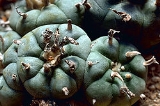
Lophophora is a genus
of spineless, button-like cacti
native to the southwestern United States
(Texas
and New Mexico
) through Northeast Mexico
and South to Querétaro
in central Mexico.
The species are extremely slow growing, sometimes taking up to thirty years to reach flowering age (at the size of about a golf ball, excluding the root) in the wild. Cultivated specimens grow considerably faster, usually taking between three to ten years to reach from seedling to mature flowering adult. The slow rate of reproduction and over-harvesting by collectors render the species under threat in the wild.
s that adorn each tubercle
. The name is derived from the two Ancient Greek
words λοφος (lophos, the crest of a hill or helmet) and φορεω (phoreo, to carry). Lophophora has been reported to comprise everything from one species, L. williamsii with varieties, to the four species L. diffusa, L. fricii, L. diffusa ssp. viridescens, and L. williamsii. Most modern authorities consider Lophophora to be a genus of two species, L. diffusa
and L. williamsii. Recent DNA sequencing
studies (Butterworth et al. 2002) have shown that L. diffusa and L. williamsii indeed are distinct species. DNA evidence from the alleged species L. fricii and L. viridescens would allow for more accurate classification.
Below is given a key for the currently accepted species along with the "species" and varieties that must be considered synonymous. Detailed arguments for this classification can be found in Peyote: The Divine Cactus (Anderson 1996, pp. 210-219).
Several people have reported that this cactus is psychoactive if ingested, though the experience is not unlike peyote. This species looks almost identical to peyote, though it is legal to possess in the United States.
. While L. diffusa is known for having psychoactive effects, these effects are described not so much as "visionary", like peyote
, but rather a delirious high such as those associated with the use of Datura
and Belladonna. The stem is used as a spiritual hallucinogen, and is applied topically as a galactogogue, or lactation
aid .
Seedlings grow most rapidly when enclosed in a sealed terrarium environment, having been germinated in trays of shallow sand covered with plastic wrap with several small pin sized holes in the plastic wrapping. This may seem strange for a cactus, but Lophophora seedlings are adapted to germinate and grow during the seasonal monsoons. Plants grown this way can reach 5 cm (2 in) diameter in just over a year and can be removed from their hyper-humid environment and will typically reach flowering size in just under three years.
Lophophora are closely related to the genera Ariocarpus
, Aztekium
, and Obregonia and like its relatives possesses a large taproot system with the majority of the plant's mass underground for water storage. Lophophora is more tolerant of soil types than its relatives, and typically grows in areas which have decomposed limestone
present in the soil. In cultivation, Lophophora does best in a fast draining mineral based soil which is about 2/3 sand. Abundant water is beneficial in the summer months when the temperatures are over 90 degrees and exposed to full sunlight for maximum growth, but must be allowed to dry out completely between waterings. They should also be fertilized twice a year. Over fertilizing will typically result in the Lophophora developing cracks and splitting. At times, some varieties of Lophophora will develop a corky material on the plant body if exposed to pesticides or insecticidal soap. This corky condition will usually heal in a manner very similar to human skin if the plants are exposed to full sunlight.
When overwatered during the winter months, Lophophora plants can succumb to soil-borne fungus infections. Pyroclay (Pyrophyllitic Clay) is an effective preventative and soil additive which increases their resistance. Due to the large amount of alkaloids produced by this plant and stored in its tissues, Lophophora roots (not the green part of the plant above ground) are highly alkaline and are known to harbor Clostridium botulinum
bacteria and should not be used for human consumption and have been found to contain botulinum toxin
in nature.
Lophophora are free flowering in cultivation and although they can withstand temperatures into the 10's during winter they do not require a cold shocking in order to initiate flowering. Lophophora plants in habitat typically flower after rainstorms which have been preceded by a period of high temperatures and dry conditions. Plants in cultivation can be encouraged to flower by subjecting the plants to high temperatures, direct sunlight, and withholding water for several weeks, then watering heavily which will usually initiate flowering.
Genus
In biology, a genus is a low-level taxonomic rank used in the biological classification of living and fossil organisms, which is an example of definition by genus and differentia...
of spineless, button-like cacti
Cactus
A cactus is a member of the plant family Cactaceae. Their distinctive appearance is a result of adaptations to conserve water in dry and/or hot environments. In most species, the stem has evolved to become photosynthetic and succulent, while the leaves have evolved into spines...
native to the southwestern United States
United States
The United States of America is a federal constitutional republic comprising fifty states and a federal district...
(Texas
Texas
Texas is the second largest U.S. state by both area and population, and the largest state by area in the contiguous United States.The name, based on the Caddo word "Tejas" meaning "friends" or "allies", was applied by the Spanish to the Caddo themselves and to the region of their settlement in...
and New Mexico
New Mexico
New Mexico is a state located in the southwest and western regions of the United States. New Mexico is also usually considered one of the Mountain States. With a population density of 16 per square mile, New Mexico is the sixth-most sparsely inhabited U.S...
) through Northeast Mexico
Mexico
The United Mexican States , commonly known as Mexico , is a federal constitutional republic in North America. It is bordered on the north by the United States; on the south and west by the Pacific Ocean; on the southeast by Guatemala, Belize, and the Caribbean Sea; and on the east by the Gulf of...
and South to Querétaro
Querétaro
Querétaro officially Estado Libre y Soberano de Querétaro de Arteaga is one of the 31 states which, with the Federal District, comprise the 32 Federal Entities of Mexico. It is divided into 18 municipalities and its capital city is Santiago de Querétaro....
in central Mexico.
The species are extremely slow growing, sometimes taking up to thirty years to reach flowering age (at the size of about a golf ball, excluding the root) in the wild. Cultivated specimens grow considerably faster, usually taking between three to ten years to reach from seedling to mature flowering adult. The slow rate of reproduction and over-harvesting by collectors render the species under threat in the wild.
Taxonomy
Lophophora means "crest-bearing", referring to the tufts of trichomeTrichome
Trichomes are fine outgrowths or appendages on plants and certain protists. These are of diverse structure and function. Examples are hairs, glandular hairs, scales, and papillae.- Algal trichomes :...
s that adorn each tubercle
Tubercle
A tubercle is generally a wart-like projection, but it has slightly different meaning depending on which family of plants or animals it is used to refer to....
. The name is derived from the two Ancient Greek
Ancient Greek
Ancient Greek is the stage of the Greek language in the periods spanning the times c. 9th–6th centuries BC, , c. 5th–4th centuries BC , and the c. 3rd century BC – 6th century AD of ancient Greece and the ancient world; being predated in the 2nd millennium BC by Mycenaean Greek...
words λοφος (lophos, the crest of a hill or helmet) and φορεω (phoreo, to carry). Lophophora has been reported to comprise everything from one species, L. williamsii with varieties, to the four species L. diffusa, L. fricii, L. diffusa ssp. viridescens, and L. williamsii. Most modern authorities consider Lophophora to be a genus of two species, L. diffusa
Lophophora diffusa
Lophophora diffusa is a species of plant in the Cactaceae family. It is endemic to Mexico. Its natural habitat is hot deserts.-Source:* Fitz Maurice, W.A. & Fitz Maurice, B. 2002. . Downloaded on 22 August 2007....
and L. williamsii. Recent DNA sequencing
DNA sequencing
DNA sequencing includes several methods and technologies that are used for determining the order of the nucleotide bases—adenine, guanine, cytosine, and thymine—in a molecule of DNA....
studies (Butterworth et al. 2002) have shown that L. diffusa and L. williamsii indeed are distinct species. DNA evidence from the alleged species L. fricii and L. viridescens would allow for more accurate classification.
Below is given a key for the currently accepted species along with the "species" and varieties that must be considered synonymous. Detailed arguments for this classification can be found in Peyote: The Divine Cactus (Anderson 1996, pp. 210-219).
Species
- Lophophora diffusa (CroizatLéon Camille Marius CroizatLeon Camille Marius Croizat was a French-Italian scholar and botanist who developed a synthesis of evolution of biological form over space, in time, which he named Panbiogeography.-Life:...
) Bravo : The plants are yellow-green, usually lacking well-defined ribs and furrows. The podariaTubercleA tubercle is generally a wart-like projection, but it has slightly different meaning depending on which family of plants or animals it is used to refer to....
are rarely elevated, but are broad and flat. The tufts of hairTrichomeTrichomes are fine outgrowths or appendages on plants and certain protists. These are of diverse structure and function. Examples are hairs, glandular hairs, scales, and papillae.- Algal trichomes :...
are usually spread unequally on the prominent podaria. The flowers are commonly whitish to yellowish-white. L. diffusa occurs at the south end of the range of the genus in Querétaro state, Mexico. This species contains zero to trace amounts of mescalineMescalineMescaline or 3,4,5-trimethoxyphenethylamine is a naturally occurring psychedelic alkaloid of the phenethylamine class used mainly as an entheogen....
; pellotine is the principal alkaloidAlkaloidAlkaloids are a group of naturally occurring chemical compounds that contain mostly basic nitrogen atoms. This group also includes some related compounds with neutral and even weakly acidic properties. Also some synthetic compounds of similar structure are attributed to alkaloids...
.
Several people have reported that this cactus is psychoactive if ingested, though the experience is not unlike peyote. This species looks almost identical to peyote, though it is legal to possess in the United States.
- Lophophora williamsii (Lemaire ex Salm-Dyck) J.M.Coult.John Merle CoulterJohn Merle Coulter, Ph. D. was an American botanist and educator, brother of Stanley Coulter, born at Ningpo, China. He received his education at Hanover College in Indiana. He served in the Rocky Mountains for two years as botanist to the United States Geological Survey...
The plants are blue-green, usually with well-defined ribs and furrows. The tufts of hairTrichomeTrichomes are fine outgrowths or appendages on plants and certain protists. These are of diverse structure and function. Examples are hairs, glandular hairs, scales, and papillae.- Algal trichomes :...
are usually equally spaced on the ribs. The flowers are pinkish or rarely whitish. L. williamsii occurs in the full range of the genus except in Querétaro state, Mexico. The mescalineMescalineMescaline or 3,4,5-trimethoxyphenethylamine is a naturally occurring psychedelic alkaloid of the phenethylamine class used mainly as an entheogen....
content in dried "Peyote" can reach almost 7%.
Description
Lophophora cacti have thigmotactic anthers, which are touched they curl over, depositing their pollen. This movement can be seen by gently poking the anthers of an open Lophophora flower.Ethnobotany
Lophophora williamsii, commonly known as peyote, is noted for its psychotropic alkaloids. These alkaloids are absent or only found in extremely small amounts in the other species Lophophora diffusaLophophora diffusa
Lophophora diffusa is a species of plant in the Cactaceae family. It is endemic to Mexico. Its natural habitat is hot deserts.-Source:* Fitz Maurice, W.A. & Fitz Maurice, B. 2002. . Downloaded on 22 August 2007....
. While L. diffusa is known for having psychoactive effects, these effects are described not so much as "visionary", like peyote
Peyote
Lophophora williamsii , better known by its common name Peyote , is a small, spineless cactus with psychoactive alkaloids, particularly mescaline.It is native to southwestern Texas and Mexico...
, but rather a delirious high such as those associated with the use of Datura
Datura
Datura is a genus of nine species of vespertine flowering plants belonging to the family Solanaceae. Its precise and natural distribution is uncertain, owing to its extensive cultivation and naturalization throughout the temperate and tropical regions of the globe...
and Belladonna. The stem is used as a spiritual hallucinogen, and is applied topically as a galactogogue, or lactation
Lactation
Lactation describes the secretion of milk from the mammary glands and the period of time that a mother lactates to feed her young. The process occurs in all female mammals, however it predates mammals. In humans the process of feeding milk is called breastfeeding or nursing...
aid .
Cultivation
Lophophora species easily adapt to cultivation. Although a cactus, most of the range this genus is found is within a subtropical climate for some portion of the year. In habitat plants in this genus are subject to seasonal monsoons within their range and the plants live in areas where they may be underwater for several weeks during heavy rains and can tolerate a lot of water when the temperatures are above 100 degrees. These plants are heat adapted and grow rapidly when exposed to temperatures of 110 to 120 degrees and watered heavily in the summer. In habitat, plants from areas which experience seasonal monsoons and high temperatures such as southern Texas can reach flowering size in five years. During the fall and winter months, the plants receive almost no water in habitat and are subjected to temperatures which can drop into the upper 20's during the winter. The plants should not be watered during the winter rest or watered sparingly when they begin to shrink and wrinkle only enough to keep them turgid. Lophophora plants must be kept completely dry if they are subjected to temperatures below 40 degrees as watering plants and subjecting them to below freezing temperatures will typically result in the death of the plant.Seedlings grow most rapidly when enclosed in a sealed terrarium environment, having been germinated in trays of shallow sand covered with plastic wrap with several small pin sized holes in the plastic wrapping. This may seem strange for a cactus, but Lophophora seedlings are adapted to germinate and grow during the seasonal monsoons. Plants grown this way can reach 5 cm (2 in) diameter in just over a year and can be removed from their hyper-humid environment and will typically reach flowering size in just under three years.
Lophophora are closely related to the genera Ariocarpus
Ariocarpus
Ariocarpus is a genus of 8 species of succulent, subtropical plants of the Cactaceae family.The name comes from the ancient Greek "aria" and "carpos" because of the resemblance of the fruit of the two genus in acorn form...
, Aztekium
Aztekium
The genus Aztekium contains only two species of small globular cactus. Discovered in 1929 by F. Ritter, in Rayones, Nuevo León, Mexico, this genus was thought to be monotypic until a second species was discovered by George S...
, and Obregonia and like its relatives possesses a large taproot system with the majority of the plant's mass underground for water storage. Lophophora is more tolerant of soil types than its relatives, and typically grows in areas which have decomposed limestone
Limestone
Limestone is a sedimentary rock composed largely of the minerals calcite and aragonite, which are different crystal forms of calcium carbonate . Many limestones are composed from skeletal fragments of marine organisms such as coral or foraminifera....
present in the soil. In cultivation, Lophophora does best in a fast draining mineral based soil which is about 2/3 sand. Abundant water is beneficial in the summer months when the temperatures are over 90 degrees and exposed to full sunlight for maximum growth, but must be allowed to dry out completely between waterings. They should also be fertilized twice a year. Over fertilizing will typically result in the Lophophora developing cracks and splitting. At times, some varieties of Lophophora will develop a corky material on the plant body if exposed to pesticides or insecticidal soap. This corky condition will usually heal in a manner very similar to human skin if the plants are exposed to full sunlight.
When overwatered during the winter months, Lophophora plants can succumb to soil-borne fungus infections. Pyroclay (Pyrophyllitic Clay) is an effective preventative and soil additive which increases their resistance. Due to the large amount of alkaloids produced by this plant and stored in its tissues, Lophophora roots (not the green part of the plant above ground) are highly alkaline and are known to harbor Clostridium botulinum
Clostridium botulinum
Clostridium botulinum is a Gram-positive, rod-shaped bacterium that produces several toxins. The best known are its neurotoxins, subdivided in types A-G, that cause the flaccid muscular paralysis seen in botulism. It is also the main paralytic agent in botox. C. botulinum is an anaerobic...
bacteria and should not be used for human consumption and have been found to contain botulinum toxin
Botulinum toxin
Botulinum toxin is a protein produced by the bacterium Clostridium botulinum, and is considered the most powerful neurotoxin ever discovered. Botulinum toxin causes Botulism poisoning, a serious and life-threatening illness in humans and animals...
in nature.
Lophophora are free flowering in cultivation and although they can withstand temperatures into the 10's during winter they do not require a cold shocking in order to initiate flowering. Lophophora plants in habitat typically flower after rainstorms which have been preceded by a period of high temperatures and dry conditions. Plants in cultivation can be encouraged to flower by subjecting the plants to high temperatures, direct sunlight, and withholding water for several weeks, then watering heavily which will usually initiate flowering.