


Little Russia

Encyclopedia
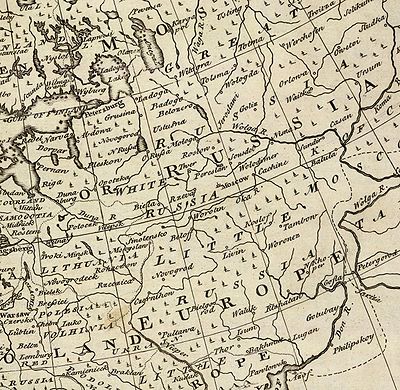
Russian language
Russian is a Slavic language used primarily in Russia, Belarus, Uzbekistan, Kazakhstan, Tajikistan and Kyrgyzstan. It is an unofficial but widely spoken language in Ukraine, Moldova, Latvia, Turkmenistan and Estonia and, to a lesser extent, the other countries that were once constituent republics...
referring to most of the territory of modern-day Ukraine
Ukraine
Ukraine is a country in Eastern Europe. It has an area of 603,628 km², making it the second largest contiguous country on the European continent, after Russia...
before the 20th century. It is similar to the Polish term Małopolska of the Polish-Lithuanian Commonwealth
Polish-Lithuanian Commonwealth
The Polish–Lithuanian Commonwealth was a dualistic state of Poland and Lithuania ruled by a common monarch. It was the largest and one of the most populous countries of 16th- and 17th‑century Europe with some and a multi-ethnic population of 11 million at its peak in the early 17th century...
. Accordingly, derivatives such as "Little Russian" were commonly applied to the people, language, and culture of the area. After the collapse of the Russian Empire
Russian Empire
The Russian Empire was a state that existed from 1721 until the Russian Revolution of 1917. It was the successor to the Tsardom of Russia and the predecessor of the Soviet Union...
, and with the amalgamation of Ukrainian territories into one administrative unit the word was phased out of circulation and when used took on a derogative connotation denoting those Ukrainians with little or no national consciousness. The term retains currency among Russian monarchists and nationalists who deny that Ukraine and Ukrainians are distinct from Russia and Russians. Because Ukraine and its people have undergone the process of nation-building over the last seven hundred years, Little Russia, even in the historic context, can only loosely be considered as merely a contemporary equivalent for the word Ukraine
Name of Ukraine
The name "Ukraine" has been used in a variety of ways since the twelfth century. Today, it has the official name of Ukraine, a country in Eastern Europe.- History :...
. The term has become an archaic one, and anachronistic usage in the modern context is considered strongly offensive by Ukrainians, as it was often used to imply the denial of a separate Ukrainian national identity.
Etymology
The Russian ethnonyme translates as Little or Lesser Rus’ and is adapted from the GreekGreek language
Greek is an independent branch of the Indo-European family of languages. Native to the southern Balkans, it has the longest documented history of any Indo-European language, spanning 34 centuries of written records. Its writing system has been the Greek alphabet for the majority of its history;...
term, coined in medieval times by Constantinople patriarchs in the 14th century (firstly appeared in documents in 1335). The Byzantines
Byzantine Empire
The Byzantine Empire was the Eastern Roman Empire during the periods of Late Antiquity and the Middle Ages, centred on the capital of Constantinople. Known simply as the Roman Empire or Romania to its inhabitants and neighbours, the Empire was the direct continuation of the Ancient Roman State...
called the northern and southern part of the lands of Rus’ as: Μεγάλη Ῥωσσία (Megálē Rhōssía) — Great Rus’
Great Russia
Great Russia is an obsolete name formerly applied to the territories of "Russia proper", the land that formed the core of Muscovy and, later, Russia...
) and Μικρὰ Ῥωσσία (Mikrà Rhōssía - Rus’ Minor or Little Rus’), respectively. Little could probably mean ‘near’ (analogously to Asia Minor, or Malopolska (Little Poland)).
In the 17th century the term Malorossiya was introduced into Russian. In English the term is often translated Little Russia or Little Rus depending on the context.
Historical usage

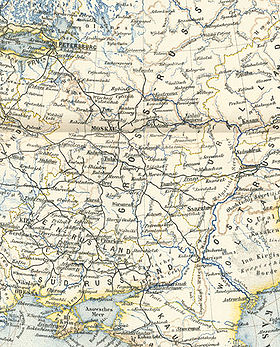
Boleslaus George II of Halych
Bolesław Jerzy II of Mazovia was a ruler of the Polish Piast dynasty who reigned in the originally Ruthenian principality of Galicia...
. He styled
Style (manner of address)
A style of office, or honorific, is a legal, official, or recognized title. A style, by tradition or law, precedes a reference to a person who holds a post or political office, and is sometimes used to refer to the office itself. An honorific can also be awarded to an individual in a personal...
himself «dux totius Rusiæ Minoris» in a letter to Dietrich von Altenburg
Dietrich von Altenburg
Dietrich von Altenburg was the 19th Grand Master of the Teutonic Knights, serving from 1335 to 1341.He came from the Thuringian town of Altenburg in the Holy Roman Empire, where his father held the office of a burgrave of the immediate Pleissnerland, which however had long been pawned to the Saxon...
, the Grand Master
Grand Master (order)
Grand Master is the typical title of the supreme head of various orders of knighthood, including various military orders, religious orders and civil orders such as the Ancient Order of Hibernians and the Orange Order...
of the Teutonic Knights
Teutonic Knights
The Order of Brothers of the German House of Saint Mary in Jerusalem , commonly the Teutonic Order , is a German medieval military order, in modern times a purely religious Catholic order...
in 1335. The name was used by Patriarch Callistus I of Constantinople
Patriarch Callistus I of Constantinople
Kallistos I was the Ecumenical Patriarch of Constantinople for two periods from June 1350 to 1353 and from 1354 to 1363. Kallistos I was an Athonite monk and supporter of Gregory Palamas. He died in Constantinople in 1363.-Life:...
in 1361 when he created two metropolitan
Metropolitan bishop
In Christian churches with episcopal polity, the rank of metropolitan bishop, or simply metropolitan, pertains to the diocesan bishop or archbishop of a metropolis; that is, the chief city of a historical Roman province, ecclesiastical province, or regional capital.Before the establishment of...
sees
Episcopal See
An episcopal see is, in the original sense, the official seat of a bishop. This seat, which is also referred to as the bishop's cathedra, is placed in the bishop's principal church, which is therefore called the bishop's cathedral...
: the one called Great Rus’
Great Russia
Great Russia is an obsolete name formerly applied to the territories of "Russia proper", the land that formed the core of Muscovy and, later, Russia...
in Vladimir
Vladimir
Vladimir is a city and the administrative center of Vladimir Oblast, Russia, located on the Klyazma River, to the east of Moscow along the M7 motorway. Population:...
and Kiev
Kiev
Kiev or Kyiv is the capital and the largest city of Ukraine, located in the north central part of the country on the Dnieper River. The population as of the 2001 census was 2,611,300. However, higher numbers have been cited in the press....
and the other one called Little Rus’ with the centers in Galich
Halych
Halych is a historic city on the Dniester River in western Ukraine. The town gave its name to the historic province and kingdom of Kingdom of Galicia–Volhynia, of which it was the capital until the early 14th century, when the seat of the local princes was moved to Lviv...
(Halych) and Novgorodok (Navahrudak). The king Casimir III of Poland
Casimir III of Poland
Casimir III the Great , last King of Poland from the Piast dynasty , was the son of King Władysław I the Elbow-high and Hedwig of Kalisz.-Biography:...
, was called "the king of Lechia
Lechia
Lechia is the historical and/or alternative name of Poland., stemming from the word Lech . It is still present in several European languages and some languages of Central Asia and the Middle East:...
and Little Rus’". According to Mykhaylo Hrushevsky Little Rus’ was the Halych-Volhynian Principality
Halych-Volhynia
The Kingdom of Galicia–Volhynia or Kingdom of Rus or Galicia–Vladimir was a Ruthenian state in the regions of Galicia and Volhynia during 1199–1349. Along with Novgorod and Vladimir-Suzdal, it was one of the three most important powers to emerge from the collapse of Kievan Rus'...
, and after its downfall, the name ceased to be used.
In the post-medieval period, the name of Little Rus’ is known to first be used by Eastern Orthodox clergy of the Polish-Lithuanian Commonwealth
Polish-Lithuanian Commonwealth
The Polish–Lithuanian Commonwealth was a dualistic state of Poland and Lithuania ruled by a common monarch. It was the largest and one of the most populous countries of 16th- and 17th‑century Europe with some and a multi-ethnic population of 11 million at its peak in the early 17th century...
, for example by influential cleric and writer Ioan Vyshensky (1600, 1608), Metropolitan Matthew of Kiev and All Rus’ (1606), Bishop Ioann (Biretskoy) of Peremyshl
Peremyshl
Peremyshl may refer to:*Peremyshl, Russia, a village in Kaluga Oblast, Russia*Peremyshl, a Cyrillic alphabet transliteration of the city of Przemyśl...
, Metropolitan Isaiah (Kopinsky) of Kiev, Archimandrite
Archimandrite
The title Archimandrite , primarily used in the Eastern Orthodox and the Eastern Catholic churches, originally referred to a superior abbot whom a bishop appointed to supervise...
Zacharius Kopystensky of Kiev Pechersk Lavra
Kiev Pechersk Lavra
Kiev Pechersk Lavra or Kyiv Pechersk Lavra , also known as the Kiev Monastery of the Caves, is a historic Orthodox Christian monastery which gave its name to one of the city districts where it is located in Kiev, the capital of Ukraine....
, etc. The term has been applied to all Orthodox Ruthenia
Ruthenia
Ruthenia is the Latin word used onwards from the 13th century, describing lands of the Ancient Rus in European manuscripts. Its geographic and culturo-ethnic name at that time was applied to the parts of Eastern Europe. Essentially, the word is a false Latin rendering of the ancient place name Rus...
n lands of Polish-Lithuanian Commonwealth. Vyshensky addressed to "the Christians of Little Russia, brotherhoods of Lvov and Vilna
Vilnius
Vilnius is the capital of Lithuania, and its largest city, with a population of 560,190 as of 2010. It is the seat of the Vilnius city municipality and of the Vilnius district municipality. It is also the capital of Vilnius County...
" and Kopystensky wrote "Little Russia, or Kiev and Lithuania".
The term was adopted in 17th century by Tsardom of Russia
Tsardom of Russia
The Tsardom of Russia was the name of the centralized Russian state from Ivan IV's assumption of the title of Tsar in 1547 till Peter the Great's foundation of the Russian Empire in 1721.From 1550 to 1700, Russia grew 35,000 km2 a year...
to refer to the Cossack Hetmanate
Cossack Hetmanate
The Hetmanate or Zaporizhian Host was the Ruthenian Cossack state in the Central Ukraine between 1649 and 1782.The Hetmanate was founded by first Ukrainian hetman Bohdan Khmelnytsky during the Khmelnytsky Uprising . In 1654 it pledged its allegiance to Muscovy during the Council of Pereyaslav,...
of Left-bank Ukraine
Left-bank Ukraine
Left-bank Ukraine is a historic name of the part of Ukraine on the left bank of the Dnieper River, comprising the modern-day oblasts of Chernihiv, Poltava and Sumy as well as the eastern parts of the Kiev and Cherkasy....
, when the latter fell under Russian protection after the Treaty of Pereyaslav
Treaty of Pereyaslav
The Treaty of Pereyaslav is known in history more as the Council of Pereiaslav.Council of Pereyalslav was a meeting between the representative of the Russian Tsar, Prince Vasili Baturlin who presented a royal decree, and Bohdan Khmelnytsky as the leader of Cossack Hetmanate. During the council...
(1654). From those times, the official title of Russian Tsar
Tsar
Tsar is a title used to designate certain European Slavic monarchs or supreme rulers. As a system of government in the Tsardom of Russia and Russian Empire, it is known as Tsarist autocracy, or Tsarism...
s, and later Emperor
Emperor
An emperor is a monarch, usually the sovereign ruler of an empire or another type of imperial realm. Empress, the female equivalent, may indicate an emperor's wife or a woman who rules in her own right...
s, gained the wording (literal translation): "The Sovereign of all Rus’: the Great
Great Russia
Great Russia is an obsolete name formerly applied to the territories of "Russia proper", the land that formed the core of Muscovy and, later, Russia...
, the Little, and the White
White Russia
White Russia or White Ruthenia is a name that has historically been applied to a part of the wider region of Ruthenia or Rus', most often to that which roughly corresponds to the eastern part of present-day Belarus including the cities of Polatsk, Vitsyebsk and Mahiliou. In English, the use of the...
."
The term Little Rus’ has been used in letters of the Cossack Hetmans
Hetmans of Ukrainian Cossacks
Hetman of Ukrainian Cossacks as a title was not officially recognized internationally until the creation of the Ukrainian Hetmanate. With the creation of Registered Cossacks units their leaders were unofficially referred to as hetmans, however officially the title was known as the "Senior of His...
Bohdan Khmelnytsky
Bohdan Khmelnytsky
Bohdan Zynoviy Mykhailovych Khmelnytsky was a hetman of the Zaporozhian Cossack Hetmanate of Polish–Lithuanian Commonwealth . He led an uprising against the Commonwealth and its magnates which resulted in the creation of a Cossack state...
and Ivan Sirko
Ivan Sirko
Ivan Sirko was a Cossack military leader, Koshovyi Otaman of the Zaporozhian Host and putative co-author of the famous semi-legendary Reply of the Zaporozhian Cossacks that inspired a major painting by the 19th-century artist Ilya Repin.- Biography :...
. The Archimandrite
Archimandrite
The title Archimandrite , primarily used in the Eastern Orthodox and the Eastern Catholic churches, originally referred to a superior abbot whom a bishop appointed to supervise...
of the Kiev-Pechersk Lavra Innokentiy Gizel
Innokentiy Gizel
Innokenty Gizel was a Prussian-born Ukrainian historian, writer, political and ecclesiastic figure, who had adopted Orthodox Christianity....
wrote that the Russian people is a unity of three branches: Great Russia, Little Russia and White Russia under the only legal authority of the Moscow Tsars. The term Little Russia has been used in Ukrainian chronicle by Samiylo Velychko, in a chronicle of the Hieromonk
Hieromonk
Hieromonk , also called a Priestmonk, is a monk who is also a priest in the Orthodox Church and Eastern Catholicism....
Leontiy (Bobolinski), in "Thesaurus" by Archimandrite Ioannikiy (Golyatovsky).
The usage of the name was later broadened to apply loosely to the parts of the Right-bank Ukraine
Right-bank Ukraine
Right-bank Ukraine , a historical name of a part of Ukraine on the right bank of the Dnieper River, corresponding with modern-day oblasts of Volyn, Rivne, Vinnitsa, Zhytomyr, Kirovohrad and Kiev, as well as part of Cherkasy and Ternopil...
when it was annexed by Russia in the end of the 18th century upon the partitions of Polish-Lithuanian Commonwealth. In the 18th and 19th centuries Russian Imperial administrative units
History of the administrative division of Russia
The modern administrative-territorial structure of Russia' is a system of territorial organization which is a product of a centuries-long evolution and reforms.-Early history:...
the Little Russian Governorate
Malorossiya Governorate
The Little Russia Governorate or Government of Malorossiya was an administrative-territorial unit of the Russian Empire that encompassed most of the modern North Eastern Ukraine , and the adjacent regions in Russia.The Governorate was formed in 1796 under the administrative reforms of Paul I which...
and eponymous General Governorship were formed and existed for several decades before being split and renamed in subsequent administrative reforms.
Up until the very end of the 19th century Little Russia was a prevailing designation for much of the modern territory of Ukraine controlled by the Russian Empire
Russian Empire
The Russian Empire was a state that existed from 1721 until the Russian Revolution of 1917. It was the successor to the Tsardom of Russia and the predecessor of the Soviet Union...
as well as for its people and their language as can be seen from its usage in numerous scholarly, literary and artistic works. For instance, "Little Russia" has been preferred by the famous Ukrainian poet Taras Shevchenko
Taras Shevchenko
Taras Hryhorovych Shevchenko -Life:Born into a serf family of Hryhoriy Ivanovych Shevchenko and Kateryna Yakymivna Shevchenko in the village of Moryntsi, of Kiev Governorate of the Russian Empire Shevchenko was orphaned at the age of eleven...
in his private diary (1857—1858). Ukrainophile historians Mykhaylo Maksymovych
Mykhaylo Maksymovych
Mykhailo Oleksandrovych Maksymovych was a famous Ukrainian naturalist, historian and writer....
, Nikolay Kostomarov
Nikolay Kostomarov
Nikolay Ivanovich Kostomarov , of mixed Russian and Ukrainian origin, is one of the most distinguished Russian and Ukrainian historians, a Professor of History at the Kiev University and later at the St...
, Dmytro Bahaliy, Volodymyr Antonovych
Volodymyr Antonovych
Volodymyr Antonovych , was a prominent Ukrainian historian and one of the leaders of the Ukrainian national awakening in the Russian Empire. As a historian, Antonovych, who was longtime Professor of History at the University of Kiev, represented a populist approach to Ukrainian history.This...
acknowledged the fact that during Russo-Polish wars "Ukraine" had only a geographical meaning of borderlands of both states but "Little Russia" was an ethnic name of Little (Southern) Russian people. In his prominent work "Two Russian nationalities" Kostomarov uses Southern Russia and Little Russia interchangeably. Mykhailo Drahomanov
Mykhailo Drahomanov
Mykhailo Petrovych Drahomanov was a Ukrainian political theorist, economist, historian, philosopher, ethnographer and public figure in Kiev. Born to a noble family of Petro Yakymovych Drahomanov who was of a Cossack descent. Mykhailo Drahomanov started his education at home, then studied at the...
titled his first fundamental historic work "Little Russia in its literature" (1867–1870). Different prominent artists (e.g. Mykola Pymonenko, Konstiantyn Trutovsky
Konstiantyn Trutovsky
Konstiantyn Trutovsky was a Russian-Ukrainian realist painter and graphic artist. Trutovsky studied at the St. Petersburg Academy of Arts . In 1860 he became an academician....
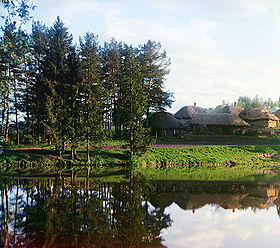
, Nikolay Sergeyev, photographer Sergey Prokudin-Gorsky, etc.), many of whom were natives from the territory of modern-day Ukraine, used "Little Russia" in titles of their paintings of Ukrainian landscapes.
The term "Little Russian language" was used by the state authorities in the first Russian Empire Census
Russian Empire Census
The Russian Imperial Census of 1897 was the first and the only census carried out in the Russian Empire . It recorded demographic data as of ....
conducted as late as in 1897.
From Little Russia to Ukraine
The term Little Russia (that traces its origin to the medieval times) used to be widely used as the name for the geographic territory. Since the middle of the 17th century the modern name "Ukraine" (Ukrayina) (first found in the 12th century chronicles) was used sporadically, until it was reintroduced in the 19th century by a conscious effort of several writers concerned about the awakening of the Ukrainian national awareness. It was not until the 20th century when the modern term "Ukraine" started to prevail while Little Russia gradually fell out of use.Modern context
Although originally "Little Russia" (Rus' Minor) was merely a geographic, linguistic and ethnological term, it is now archaic and its usage in the modern context to refer to the country of Ukraine and the modern Ukrainian nation, its language, culture, etc., is considered an improper anachronism. Such usage is typically perceived as an imperial view that the Ukrainian territory and people ("Little Russians") belong to "one, indivisible Russia." Regardless of whether they are aware or not of its origin, today many Ukrainians consider the term to be disparaging, indicative of an "older brother" attitude, and of imperial Russian (and Soviet) suppression of the Ukrainian national idea. In particular, it has continued to be used in Russian nationalist (actually chauvinist) discourse, where modern Ukraine is presented as a breakaway province of the former Russian Empire. This added new hostility and disapproval of the term by some Ukrainians.Another interpretation maintains that such usage is merely an acknowledgment of the fact that while the region now constitutes the territory of Ukraine, with its history being a part of the Ukrainian heritage, it was in fact the birthplace of Russian culture, which eventually grew far beyond the territories of their common birthplace.
"Little Russianness"
Some Ukrainian authors define the "Little Russianness" as a provincial complex they see in a part of the Ukrainian community due to its "lengthy existence within the Russian Empire" and describe it as an "indifferent, and sometimes a negative, stance towards the Ukrainian national-statehood traditions and aspirations, and often, the active support of the Russian culture and imperial policies". Mykhailo DrahomanovMykhailo Drahomanov
Mykhailo Petrovych Drahomanov was a Ukrainian political theorist, economist, historian, philosopher, ethnographer and public figure in Kiev. Born to a noble family of Petro Yakymovych Drahomanov who was of a Cossack descent. Mykhailo Drahomanov started his education at home, then studied at the...
, who used the terms Little Russia and Little Russian in his historical works, applied the term Little Russianness to Russified Ukrainians, whose national character was formed under "alien pressure and influence", and who consequently adopted predominantly the "worse qualities of other nationalities and lost the better of their own". Ukrainian conservative ideologue and politician Vyacheslav Lypynsky
Vyacheslav Lypynsky
Vyacheslav Kazymyrovych Lypynsky was a Ukrainian historian, social and political activist, an ideologue of Ukrainian conservatism. He was also the founder of the Ukrainian Democratic-Agrarian Party...
defined the term as "the malaise of statelessness". The same inferiority complex was applied to the Ukrainians of Galicia with respect to Poland
Poland
Poland , officially the Republic of Poland , is a country in Central Europe bordered by Germany to the west; the Czech Republic and Slovakia to the south; Ukraine, Belarus and Lithuania to the east; and the Baltic Sea and Kaliningrad Oblast, a Russian exclave, to the north...
("gente ruthenus, natione polonus"). Similar term Magyarony was applied to Magyarized
Magyarization
Magyarization is a kind of assimilation or acculturation, a process by which non-Magyar elements came to adopt Magyar culture and language due to social pressure .Defiance or appeals to the Nationalities Law, met...
Rusyns in Carpathian Ruthenia
Carpathian Ruthenia
Carpathian Ruthenia is a region in Eastern Europe, mostly located in western Ukraine's Zakarpattia Oblast , with smaller parts in easternmost Slovakia , Poland's Lemkovyna and Romanian Maramureş.It is...
who advocated for the union of that region with Hungary
Hungary
Hungary , officially the Republic of Hungary , is a landlocked country in Central Europe. It is situated in the Carpathian Basin and is bordered by Slovakia to the north, Ukraine and Romania to the east, Serbia and Croatia to the south, Slovenia to the southwest and Austria to the west. The...
.
Another criticized aspect labeled as "Little Russianness" is a stereotypical image of uneducated, rustic Ukrainians exhibiting little or no self-esteem. For example, a popular Ukrainian singer and performer Andriy Danylko in his stage personality of uncouth and Surzhyk
Surzhyk
Surzhyk refers to a range of russified sociolects of Ukrainian used in certain regions of Ukraine and adjacent lands. It does not possess any unifying set of characteristics; the term is used for "norm-breaking, non-obedience to or nonawareness of the rules of the Ukrainian and Russian standard...
-speaking Verka Serduchka was accused of perpetrating this demeaning image. Danylko himself usually laughs off such criticism of his work and many art critics point instead towards the fact that his success with the Ukrainian public is rooted in an unquestionable authenticity of Danylko's artistic image.
Further reading
Rigelman Alexander. (1847) Chronicles the story of Little Russia and its people, and a Cossack general (Из истории московско-крымских отношений в первой половине XVII века) at Runivers.ru in DjVuDjVu
DjVu is a computer file format designed primarily to store scanned documents, especially those containing a combination of text, line drawings, and photographs. It uses technologies such as image layer separation of text and background/images, progressive loading, arithmetic coding, and lossy...
and PDF formats Bantysh-Kamensky Dmitry. (1830) History of Little Russia (История Малой России) at Runivers.ru in DjVu
DjVu
DjVu is a computer file format designed primarily to store scanned documents, especially those containing a combination of text, line drawings, and photographs. It uses technologies such as image layer separation of text and background/images, progressive loading, arithmetic coding, and lossy...
and PDF formats