

Linford Christie

Encyclopedia
Linford Cicero Christie OBE
(born 2 April 1960) is a former sprinter from the United Kingdom. He is the only British man to have won gold medals in the 100 metres
at all four major competitions open to British athletes: the Olympic Games, the World Championships
, the European Championships and the Commonwealth Games
. He was the first European to break the 10-second barrier
in the 100 m and still holds the British record in the event. He is a former world indoor record holder over 200 metres
, and a former European record holder in the 60 metres
, 100 metres and 4 x 100 metres relay
. With 23 major championship medals including 10 gold medals, he is the most decorated British male athlete.
Christie's track career was ended when he received a two-year ban for taking a performance-enhancing substance, although he has always denied any wrongdoing. Since his retirement he has focused on coaching, helping Katharine Merry
and Darren Campbell
to Olympic medals, and his sports management company, "Nuff Respect".
In 2010, Christie appeared on the UK ITV
television channel's I'm a Celebrity... Get Me Out of Here! show, subsequently becoming the sixth person to be eliminated, on 30 November 2010.
, England, five years before. He was educated at Henry Compton Secondary School in Fulham
, London and excelled in P.E.
. He also joined the Air Training Corps
in 1978, 336 (Hammersmith) Squadron. He did not take up athletics seriously until he was 19.
Christie's early track career was not promising. He failed to make the Great Britain team for the 1984 Summer Olympics
, not even being included in the sprint relay squad. It was not until he began to work in earnest under the coaching of Ron Roddan
that he began to fulfil his potential.
In 1986, he was the surprise winner of the 100 metres
at the European Championships and finished second at the Commonwealth Games
in Edinburgh at 100m, behind Ben Johnson.
At the 1987 World Championships in Athletics
in Rome, Christie came fourth in the 100m, but was later awarded the bronze medal when winner Ben Johnson was disqualified after admitting years of steroid use.
At the 1988 Summer Olympics
in Seoul
, Christie won 100m silver behind Carl Lewis
after Ben Johnson
, who set a world record in 9.79 seconds, was disqualified following a positive drug test
for anabolic steroids.
Christie faced a disciplinary hearing himself in Seoul because of an adverse drug test for the banned stimulant pseudoephedrine
after he ran in the heats of the 200m. The hearing panel decided by a single vote to give Christie "the benefit of the doubt", so no sanction was applied.
In 1992, Christie succeeded Allan Wells
as a British Olympic 100 m champion, winning the title ahead of Frankie Fredericks
, of Namibia
at the Barcelona Olympic Games.
In the absence of his great rival Lewis, Christie ran 9.96 s in the final, and at 32 years old became the oldest Olympic 100 m champion by four years.
In 1993, he became the first man in history to hold the Olympic, World,
European and Commonwealth titles in the 100 m as he was victorious at the Stuttgart World Championships
. He was also voted BBC Sports Personality of the Year
.
After 1994, he was less successful. Christie was disqualified in the 1996 Olympic
final after two false starts. He retired from representative international competition in 1997, although he continued to make appearances at invitation meetings.
In February 1999, Christie competed in an indoor meet in Dortmund
, Germany. A routine unannounced drug test found the banned substance nandrolone
. After a six-month delay, a disciplinary hearing was convened by the British Athletic Federation
which found Christie to be not guilty. But the IAAF overruled and confirmed a two-year suspension. Christie is also banned for life from British Olympic Association teams.
When the story of the positive drug test was first leaked to the press, it resulted in Puma
opting not to continue Christie's £100,000 sponsorship contract. Three years earlier, at the Atlanta Olympics, Christie had worn contact lenses embossed with the Puma logo at the press conference preceding the 100 m final. Reebok
had paid $40 million to be the official sponsor, and Christie's actions were seen as ambush marketing
and a breach of Olympic rules on the wearing of sponsor's logos by athletes.
Though more famous for his exploits over 100 m, Christie broke the world indoor record over 200 metres
with 20.25 s at Liévin
in 1995, and remains the third fastest sprinter on the all time list. He remains the British record-holder at 100 m, with the 9.87 s he ran at the 1993 World Championships.
By the end of his track career Christie had won 23 medals overall, more than any other British male athlete before or since. He was appointed MBE
in 1990 and OBE
in 1998.
. McVicar had insinuated in a satirical magazine that Christie's remarkable rise from 156th in the world to triumph at an age when he should have been in decline could only have been achieved through performance-enhancing drugs.
The jury found in Christie's favour by a 10–2 majority. The judge ordered that McVicar should be bound by an injunction restraining him from accusing Christie of taking banned substances. The modest £40,000 damages awarded were outweighed by the cost Christie incurred to bring the case.
 After the judgment, McVicar called Christie "The Judy Garland
of the 100 metres", referring to the emotion that Christie had given before the court.
During this case, Christie raised another of his grievances with the media – comments about the figure-hugging running suits that Christie wore in his races. The term Linford's lunchbox had been coined by The Sun newspaper in reference to the bulge of Christie's genitalia in his Lycra shorts.
"Linford's lunchbox is one of my grievances with the media. I don't like it … Nobody ever goes on about Sally Gunnell
's breasts … I think it is disgusting, I don't like it at all." In court, the judge Mr Justice Popplewell
, caused hilarity in the court by asking Christie to explain the phrase, asking "What is Linford's lunchbox?" The reference became a part of pop culture, as evidenced in a joke by Nick Hancock: "There's nothing new you can say about Linford Christie, except he's slow and has got a small penis".
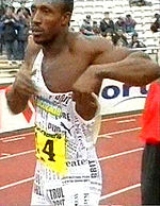
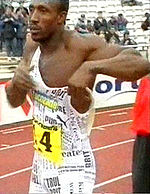
Christie's anger at this unwanted attention led to his infamous "newspaper print" running suit, although he has deliberately drawn attention to his body on occasions: he has remarked that "A lot of people have looked at my physique and two things can come into their mind – admiration and envy." and appeared shirtless and flexing his muscles on the BBC youth series Reportage in 1988.
In recent years, however, Christie appears to have come to terms with the 'lunchbox' label, disclosing his preference for briefs rather than boxer shorts, and in 2002 becoming the "face" of Sloggi
, the men's underwear brand, posing for advertising wearing only underwear.
.jpg) In 1993 Christie formed a sports management and promotions company, Nuff Respect, with sprint-hurdler Colin Jackson
In 1993 Christie formed a sports management and promotions company, Nuff Respect, with sprint-hurdler Colin Jackson
. One of their early products was a sports training and workout video, The S Plan: Get Fit with Christie and Jackson. Jackson was later to leave the enterprise, saying "Linford has to be in control, he has to be number one, he has to be the leader." Since his positive drug test Christie – who had worked as a presenter on the BBC children's programme Record Breakers and also had a contract with BBC Sport – has spent less time as a public figure and has devoted most of his time to managing his company.
Reflecting upon his track career, he stated: "I will have no complaints if people remember me as one of the best athletes in the world." Away from the track, Christie, a keen amateur gardener, he also co-hosted the BBC series Garden Invaders.
In 1993 the West London Stadium was renamed the Linford Christie Stadium
in his honour. Christie's famous claim that he started races on the "B of the Bang" inspired a large public sculpture of the same name
. Erected as a celebration of the 2002 Commonwealth Games
in Manchester, it was officially unveiled by Christie in 2004. Owing to safety concerns, it was dismantled in 2009.
at the 1988 Seoul Olympics, but he escaped sanction after the International Olympic Committee
's disciplinary committee voted by a margin of 11 to 10. It was reported that two of the judging panel was asleep when the vote was taken. Reference to this is made in a television advert Christie made for Egg
online banking in Autumn 1998.
At the 1994 European championships staged in Helsinki
, where British team captain Christie won his third European 100m title, he was caught up in a doping controversy after Solomon Wariso, a 400m runner making his international championship debut, tested positive for the stimulant ephedrine. Wariso revealed that he had used an over-the-counter pick-you-up called "Up Your Gas", which Christie had bought at a Florida pharmacy.
In 1999, Christie was found guilty of using the performance enhancing drug Nandrolone
following a doping test after an indoor meet in Germany. He was found to have more than 100 times normal levels of the metabolites of nandrolone in his urine. Various explanations were offered to explain the results, including eating avocado, or using nutritional supplements.
The IAAF rejected that explanation and gave Christie a two-year ban from athletics, despite UK Athletics
feeling that there was "reasonable doubt whether the drug had been taken deliberately", a decision which ignored the usual drug testing principle of "strict liability".
Christie has always denied any wrong doing. "If I took drugs there had to be a reason to take drugs. I had pretty much retired from the sport." Furthermore, he denied that his physique was gained through drug use and promoted an anti-steroid approach: "It does not follow that all athletes who are big take drugs... Only by testing all athletes will the sport be kept clean of drugs."
Following the ban, the British Olympic Association
announced that Christie would not be accredited for any future Olympic Games, in accordance with their regulations.
in Chalfont St Peter
, Buckinghamshire. Four people, including a newly wed couple, were hurt.
On 21 July 2011, he was convicted in Aylesbury
Crown Court of careless driving and was disqualified from driving for 15 months and fined £5000, being acquitted of dangerous driving. Occupants of the other vehicle were seriously injured and are pursuing civil action against Christie.
test. Commenting on the argument, Christie's team mate, Derek Redmond
, said he was "a well-balanced athlete; he has a chip on both shoulders."
However in April 2006 it was announced that Christie would be a senior mentor for athletes on the national team, along with former athletes Steve Backley
, Daley Thompson
and Katharine Merry
. This proved controversial however, due to Christie's drugs ban. "I don't think he should be in that mentor role," said Paula Radcliffe
, the marathon
world record-holder. "We have to make sure that the people in that mentor role have an integrity and strong sense of ethics and morals."
The BOA
has confirmed that their ban on Olympic accreditation for Christie remains in place. He was, however, personally invited by Ken Livingstone
to be one of the carriers of the 2008 Olympic Torch on its journey through London, but was unable to accept because of coaching commitments. (Ken Livingstone's office has disputed the claim that the invitation was from him. See the article referenced.)
of 9.87 seconds in the 100 metres makes him the second fastest European in history; second only to Francis Obikwelu
's 9.86 s personal best which broke Christie's European record
. His 100 m personal best fares favourably in comparison with his contemporaries: Carl Lewis
and Frankie Fredericks
managed 9.86 s while Leroy Burrell
ran 9.85 s.
His gold medal performances in world, European, Commonwealth and Olympic competitions rank him as one of the most successful 100 m sprinters in international events. He won 10 gold medals and a total of 23 medals over his career in major championships; the record for any British male athlete. He was the third Briton, after Harold Abrahams
and Allan Wells
, and the fifth European to win the 100 m at the Olympic Games. He remains the oldest male athlete to win the 100 m at the Olympics.
In the 4 x 100 metres relay
event Christie's performance as anchor
, alongside Colin Jackson
, Tony Jarrett
and John Regis
, set a European record of 37.77 s at the 1993 World Championships
. This was beaten six years later by a 37.73 s run by a British team, which included his protégé Darren Campbell
. However, Christie's team's performance is still the second fastest 4 x 100 m performance by a European team and one of the best by a non-United States relay team.
Over 60 metres
, Christie set a European record of 6.47 s in 1995 which was beaten by fellow Briton Jason Gardener
in 1999 with 6.46 s. Christie has the fourth fastest time over the distance for a European after Gardener, Ronald Pognon
and the current European record holder Dwain Chambers
.
Christie also holds 3 current 35–39 masters age group world records
. On 23 September 1995, Christie set the current M35 world record of 9.97 in the 100 metres. On 25 June 1995 he set the current M35 world record in the 200 metres in 20.11 seconds and on 3 January 1997 Christie set the current indoor record in the M35 60 metres in a time of 6.51 seconds.
In 2010, he was inducted into the England Athletics Hall of Fame
.
was crowned Miss England in 2009 though later relinquished the title following allegations of assault.
Order of the British Empire
The Most Excellent Order of the British Empire is an order of chivalry established on 4 June 1917 by George V of the United Kingdom. The Order comprises five classes in civil and military divisions...
(born 2 April 1960) is a former sprinter from the United Kingdom. He is the only British man to have won gold medals in the 100 metres
100 metres
The 100 metres, or 100-metre dash, is a sprint race in track and field competitions. The shortest common outdoor running distance, it is one of the most popular and prestigious events in the sport of athletics. It has been contested at the Summer Olympics since 1896...
at all four major competitions open to British athletes: the Olympic Games, the World Championships
IAAF World Championships in Athletics
The World Championships in Athletics is an event organized by the International Association of Athletics Federations . Originally, it was organised every four years, but this changed in 1991, and it has since been organised biennially.-History:...
, the European Championships and the Commonwealth Games
Commonwealth Games
The Commonwealth Games is an international, multi-sport event involving athletes from the Commonwealth of Nations. The event was first held in 1930 and takes place every four years....
. He was the first European to break the 10-second barrier
10-second barrier
The 10-second barrier is a term used in track and field athletics which refers to the physical and psychological barrier of completing the men's 100 metres sprint in under ten seconds...
in the 100 m and still holds the British record in the event. He is a former world indoor record holder over 200 metres
200 metres
A 200 metres race is a sprint running event. On an outdoor 400 m track, the race begins on the curve and ends on the home straight, so a combination of techniques are needed to successfully run the race. A slightly shorter race, called the stadion and run on a straight track, was the first...
, and a former European record holder in the 60 metres
60 metres
60 metres is a sprint event in track and field athletics. It is a championship event for indoor championships, normally dominated by the best outdoor 100 metres runners. At outdoor venues it is a rare distance, at least for senior athletes...
, 100 metres and 4 x 100 metres relay
4 x 100 metres relay
The 4 × 100 metres relay or sprint relay is an athletics track event run in lanes over one lap of the track with four runners completing 100 metres each. The first runners begin in the same stagger as for the individual 400 m race...
. With 23 major championship medals including 10 gold medals, he is the most decorated British male athlete.
Christie's track career was ended when he received a two-year ban for taking a performance-enhancing substance, although he has always denied any wrongdoing. Since his retirement he has focused on coaching, helping Katharine Merry
Katharine Merry
Katharine Merry is a former English female sprinter.-Career:A member of the Birchfield Harriers athletics club, Merry won a bronze medal in the 400 metre sprint at the 2000 Summer Olympics in Sydney, Australia.Merry had a career that spanned 20 years. Aged 12 she topped the UK Under 13 Rankings in...
and Darren Campbell
Darren Campbell
Darren Andrew Campbell MBE is a former English sprint athlete. He competed in the 100 metres and 200 metres, as well as the 4 × 100 metres relay...
to Olympic medals, and his sports management company, "Nuff Respect".
In 2010, Christie appeared on the UK ITV
ITV
ITV is the major commercial public service TV network in the United Kingdom. Launched in 1955 under the auspices of the Independent Television Authority to provide competition to the BBC, it is also the oldest commercial network in the UK...
television channel's I'm a Celebrity... Get Me Out of Here! show, subsequently becoming the sixth person to be eliminated, on 30 November 2010.
Early years
Christie was born in Saint Andrew, Jamaica, where he was brought up by his grandmother. At the age of seven he followed his parents, who had emigrated to Acton, LondonActon, London
Acton is a district of west London, England, located in the London Borough of Ealing. It is situated west of Charing Cross.At the time of the 2001 census, Acton, comprising the wards of East Acton, Acton Central, South Acton and Southfield, had a population of 53,689 people...
, England, five years before. He was educated at Henry Compton Secondary School in Fulham
Fulham
Fulham is an area of southwest London in the London Borough of Hammersmith and Fulham, SW6 located south west of Charing Cross. It lies on the left bank of the Thames, between Putney and Chelsea. The area is identified in the London Plan as one of 35 major centres in Greater London...
, London and excelled in P.E.
Physical education
Physical education or gymnastics is a course taken during primary and secondary education that encourages psychomotor learning in a play or movement exploration setting....
. He also joined the Air Training Corps
Air Training Corps
The Air Training Corps , commonly known as the Air Cadets, is a cadet organisation based in the United Kingdom. It is a voluntary youth group which is part of the Air Cadet Organisation and the Royal Air Force . It is supported by the Ministry of Defence, with a regular RAF Officer, currently Air...
in 1978, 336 (Hammersmith) Squadron. He did not take up athletics seriously until he was 19.
Christie's early track career was not promising. He failed to make the Great Britain team for the 1984 Summer Olympics
1984 Summer Olympics
The 1984 Summer Olympics, officially known as the Games of the XXIII Olympiad, was an international multi-sport event held in Los Angeles, California, United States in 1984...
, not even being included in the sprint relay squad. It was not until he began to work in earnest under the coaching of Ron Roddan
Ron Roddan
Ron Roddan was the coach of Linford Christie OBE, the former sprinter from the United Kingdom, who he began coaching in 1979. A former Civil Service laboratory assistant, Roddan was himself a sprinter in the Fifties and Sixties. During his coaching career, he has had more than 30 athletes selected...
that he began to fulfil his potential.
In 1986, he was the surprise winner of the 100 metres
100 metres
The 100 metres, or 100-metre dash, is a sprint race in track and field competitions. The shortest common outdoor running distance, it is one of the most popular and prestigious events in the sport of athletics. It has been contested at the Summer Olympics since 1896...
at the European Championships and finished second at the Commonwealth Games
Commonwealth Games
The Commonwealth Games is an international, multi-sport event involving athletes from the Commonwealth of Nations. The event was first held in 1930 and takes place every four years....
in Edinburgh at 100m, behind Ben Johnson.
At the 1987 World Championships in Athletics
1987 World Championships in Athletics
The 2nd World Championships in Athletics under the auspices of the International Association of Athletics Federations were held in the Stadio Olimpico in Rome, Italy between August 28 and September 6, 1987.-Track:1983 | 1987 | 1991 | 1993 | 1995...
in Rome, Christie came fourth in the 100m, but was later awarded the bronze medal when winner Ben Johnson was disqualified after admitting years of steroid use.
At the 1988 Summer Olympics
1988 Summer Olympics
The 1988 Summer Olympics, officially known as the Games of the XXIV Olympiad, were an all international multi-sport events celebrated from September 17 to October 2, 1988 in Seoul, South Korea. They were the second summer Olympic Games to be held in Asia and the first since the 1964 Summer Olympics...
in Seoul
Seoul
Seoul , officially the Seoul Special City, is the capital and largest metropolis of South Korea. A megacity with a population of over 10 million, it is the largest city proper in the OECD developed world...
, Christie won 100m silver behind Carl Lewis
Carl Lewis
Frederick Carlton "Carl" Lewis is an American former track and field athlete, who won 10 Olympic medals including 9 gold, and 10 World Championships medals, of which 8 were gold. His career spanned from 1979 when he first achieved a world ranking to 1996 when he last won an Olympic title and...
after Ben Johnson
Ben Johnson (athlete)
Benjamin Sinclair "Ben" Johnson, CM , is a former sprinter from Canada, who enjoyed a high-profile career during most of the 1980s, winning two Olympic bronze medals and an Olympic gold, which was subsequently rescinded...
, who set a world record in 9.79 seconds, was disqualified following a positive drug test
Drug test
A drug test is a technical analysis of a biological specimen – for example urine, hair, blood, sweat, or oral fluid / saliva – to determine the presence or absence of specified parent drugs or their metabolites...
for anabolic steroids.
Christie faced a disciplinary hearing himself in Seoul because of an adverse drug test for the banned stimulant pseudoephedrine
Pseudoephedrine
Pseudoephedrine is a sympathomimetic drug of the phenethylamine and amphetamine chemical classes. It is used as a nasal/sinus decongestant and stimulant, or as a wakefulness-promoting agent....
after he ran in the heats of the 200m. The hearing panel decided by a single vote to give Christie "the benefit of the doubt", so no sanction was applied.
In 1992, Christie succeeded Allan Wells
Allan Wells
Allan Wipper Wells MBE is a former Scottish athlete, who became Olympic Champion in the 100 metres at the 1980 Summer Olympics in Moscow.-Biography:...
as a British Olympic 100 m champion, winning the title ahead of Frankie Fredericks
Frankie Fredericks
Frank Fredericks is a former athlete from Namibia. Running in the 100 metres and 200 metres, he won four silver medals at the Olympic Games , making him Namibia's first and so far only Olympic medalist...
, of Namibia
Namibia
Namibia, officially the Republic of Namibia , is a country in southern Africa whose western border is the Atlantic Ocean. It shares land borders with Angola and Zambia to the north, Botswana to the east and South Africa to the south and east. It gained independence from South Africa on 21 March...
at the Barcelona Olympic Games.
In the absence of his great rival Lewis, Christie ran 9.96 s in the final, and at 32 years old became the oldest Olympic 100 m champion by four years.
In 1993, he became the first man in history to hold the Olympic, World,
European and Commonwealth titles in the 100 m as he was victorious at the Stuttgart World Championships
1993 World Championships in Athletics
The 4th World Championships in Athletics, under the auspices of the International Association of Athletics Federations, were held in the Gottlieb Daimler Stadium, Stuttgart, Germany between August 13 and August 22 with the participation of 187 nations....
. He was also voted BBC Sports Personality of the Year
BBC Sports Personality of the Year
The BBC Sports Personality of the Year is an awards ceremony that takes place annually in December. Devised by Paul Fox in 1954, it originally consisted of one titular award. Several new awards have been introduced, and , eight awards are presented. The oldest of these are the Team of the Year and...
.
After 1994, he was less successful. Christie was disqualified in the 1996 Olympic
1996 Summer Olympics
The 1996 Summer Olympics of Atlanta, officially known as the Games of the XXVI Olympiad and unofficially known as the Centennial Olympics, was an international multi-sport event which was celebrated in 1996 in Atlanta, Georgia, United States....
final after two false starts. He retired from representative international competition in 1997, although he continued to make appearances at invitation meetings.
In February 1999, Christie competed in an indoor meet in Dortmund
Dortmund
Dortmund is a city in Germany. It is located in the Bundesland of North Rhine-Westphalia, in the Ruhr area. Its population of 585,045 makes it the 7th largest city in Germany and the 34th largest in the European Union....
, Germany. A routine unannounced drug test found the banned substance nandrolone
Nandrolone
Nandrolone is an anabolic steroid that may be present naturally in the human body, albeit in minute quantities of less than 0.4 ng/ml. Nandrolone is most commonly sold commercially as its decanoate ester and less commonly as a phenylpropionate ester...
. After a six-month delay, a disciplinary hearing was convened by the British Athletic Federation
UK Athletics
UK Athletics is the governing body for the sport of athletics in the United Kingdom. It is responsible for overseeing the governance of athletics events in the UK as well as athletes, their development, and athletics officials....
which found Christie to be not guilty. But the IAAF overruled and confirmed a two-year suspension. Christie is also banned for life from British Olympic Association teams.
When the story of the positive drug test was first leaked to the press, it resulted in Puma
PUMA AG
Puma SE, officially branded as PUMA, is a major German multinational company that produces high-end athletic shoes, lifestyle footwear and other sportswear. Formed in 1924 as Gebrüder Dassler Schuhfabrik by Adolf and Rudolf Dassler, relationships between the two brothers deteriorated until the two...
opting not to continue Christie's £100,000 sponsorship contract. Three years earlier, at the Atlanta Olympics, Christie had worn contact lenses embossed with the Puma logo at the press conference preceding the 100 m final. Reebok
Reebok
Reebok International Limited, a subsidiary of the German sportswear company Adidas since 2005, is a producer of Athletic shoes, apparel, and accessories. The name comes from the Afrikaans spelling of rhebok, a type of African antelope or gazelle...
had paid $40 million to be the official sponsor, and Christie's actions were seen as ambush marketing
Ambush marketing
Ambush marketing can be defined as a marketing strategy wherein the advertisers associate themselves with, and therefore capitalize on, a particular event without paying any sponsorship fee. The Macmillan English Dictionary defines ambush marketing as a marketing strategy in which a competing...
and a breach of Olympic rules on the wearing of sponsor's logos by athletes.
Though more famous for his exploits over 100 m, Christie broke the world indoor record over 200 metres
200 metres
A 200 metres race is a sprint running event. On an outdoor 400 m track, the race begins on the curve and ends on the home straight, so a combination of techniques are needed to successfully run the race. A slightly shorter race, called the stadion and run on a straight track, was the first...
with 20.25 s at Liévin
Liévin
Liévin is a commune in the Pas-de-Calais department in northern France.-Overview:The city of Liévin is an old mining city of Pas-de-Calais. Near Lens, this modest-sized city nevertheless has several nursery schools, schools, colleges, a university, a swimming pool, a city library, a cultural and...
in 1995, and remains the third fastest sprinter on the all time list. He remains the British record-holder at 100 m, with the 9.87 s he ran at the 1993 World Championships.
By the end of his track career Christie had won 23 medals overall, more than any other British male athlete before or since. He was appointed MBE
Order of the British Empire
The Most Excellent Order of the British Empire is an order of chivalry established on 4 June 1917 by George V of the United Kingdom. The Order comprises five classes in civil and military divisions...
in 1990 and OBE
Order of the British Empire
The Most Excellent Order of the British Empire is an order of chivalry established on 4 June 1917 by George V of the United Kingdom. The Order comprises five classes in civil and military divisions...
in 1998.
Later years and relationship with the press
In 1998, less than six months before his first positive drug test Christie won a libel action against the journalist John McVicarJohn McVicar
John McVicar is a British journalist and one-time convicted armed robber.-Career:In the 1960s, he was an armed robber who was tagged "Public Enemy No. 1" by Scotland Yard. He was apprehended and given a 23-year jail sentence. He escaped from prison on several occasions and after his final...
. McVicar had insinuated in a satirical magazine that Christie's remarkable rise from 156th in the world to triumph at an age when he should have been in decline could only have been achieved through performance-enhancing drugs.
The jury found in Christie's favour by a 10–2 majority. The judge ordered that McVicar should be bound by an injunction restraining him from accusing Christie of taking banned substances. The modest £40,000 damages awarded were outweighed by the cost Christie incurred to bring the case.
Judy Garland
Judy Garland was an American actress and singer. Through a career that spanned 45 of her 47 years and for her renowned contralto voice, she attained international stardom as an actress in musical and dramatic roles, as a recording artist and on the concert stage...
of the 100 metres", referring to the emotion that Christie had given before the court.
During this case, Christie raised another of his grievances with the media – comments about the figure-hugging running suits that Christie wore in his races. The term Linford's lunchbox had been coined by The Sun newspaper in reference to the bulge of Christie's genitalia in his Lycra shorts.
"Linford's lunchbox is one of my grievances with the media. I don't like it … Nobody ever goes on about Sally Gunnell
Sally Gunnell
Sally Jane Janet Gunnell OBE is a former British Olympic champion in the 400 m hurdles...
's breasts … I think it is disgusting, I don't like it at all." In court, the judge Mr Justice Popplewell
Oliver Popplewell
The Honourable Sir Oliver Bury Popplewell is a former British judge. He chaired the inquiry into the Bradford City stadium fire, presided over the libel case brought by Jonathan Aitken MP against The Guardian newspaper which eventually led to Aitkin's imprisonment for perjury, and was widely...
, caused hilarity in the court by asking Christie to explain the phrase, asking "What is Linford's lunchbox?" The reference became a part of pop culture, as evidenced in a joke by Nick Hancock: "There's nothing new you can say about Linford Christie, except he's slow and has got a small penis".
Christie's anger at this unwanted attention led to his infamous "newspaper print" running suit, although he has deliberately drawn attention to his body on occasions: he has remarked that "A lot of people have looked at my physique and two things can come into their mind – admiration and envy." and appeared shirtless and flexing his muscles on the BBC youth series Reportage in 1988.
In recent years, however, Christie appears to have come to terms with the 'lunchbox' label, disclosing his preference for briefs rather than boxer shorts, and in 2002 becoming the "face" of Sloggi
Sloggi
Sloggi is an underwear brand manufactured by Triumph International.-Links:* * *...
, the men's underwear brand, posing for advertising wearing only underwear.
Colin Jackson
Colin Ray Jackson CBE is a British former sprint and hurdling athlete who specialised in the 110 metres hurdles. Over his career representing Great Britain and Wales he won an Olympic silver medal, became world champion three times, went undefeated at the European Championships for 12 years and...
. One of their early products was a sports training and workout video, The S Plan: Get Fit with Christie and Jackson. Jackson was later to leave the enterprise, saying "Linford has to be in control, he has to be number one, he has to be the leader." Since his positive drug test Christie – who had worked as a presenter on the BBC children's programme Record Breakers and also had a contract with BBC Sport – has spent less time as a public figure and has devoted most of his time to managing his company.
Reflecting upon his track career, he stated: "I will have no complaints if people remember me as one of the best athletes in the world." Away from the track, Christie, a keen amateur gardener, he also co-hosted the BBC series Garden Invaders.
In 1993 the West London Stadium was renamed the Linford Christie Stadium
Linford Christie Stadium
The Linford Christie Stadium is an athletics stadium in west London, England. It is used by one of the United Kingdom's leading athletics clubs, the Thames Valley Harriers. It is also used by one of the United Kingdom's leading hockey teams PHC Chiswick as well as London Nigerian RFC.The venue...
in his honour. Christie's famous claim that he started races on the "B of the Bang" inspired a large public sculpture of the same name
B of the Bang
B of the Bang was a sculpture designed by Thomas Heatherwick, in Manchester, England, located next to the City of Manchester Stadium at Sportcity...
. Erected as a celebration of the 2002 Commonwealth Games
2002 Commonwealth Games
The 2002 Commonwealth Games were held in Manchester, England from 25 July to 4 August 2002. The XVII Commonwealth Games was the largest multi-sport event ever to be held in the UK, eclipsing London's 1948 Summer Olympics in numbers of teams and athletes participating.After the 1996 Manchester...
in Manchester, it was officially unveiled by Christie in 2004. Owing to safety concerns, it was dismantled in 2009.
Drug ban
Christie tested positive for the stimulant PseudoephedrinePseudoephedrine
Pseudoephedrine is a sympathomimetic drug of the phenethylamine and amphetamine chemical classes. It is used as a nasal/sinus decongestant and stimulant, or as a wakefulness-promoting agent....
at the 1988 Seoul Olympics, but he escaped sanction after the International Olympic Committee
International Olympic Committee
The International Olympic Committee is an international corporation based in Lausanne, Switzerland, created by Pierre de Coubertin on 23 June 1894 with Demetrios Vikelas as its first president...
's disciplinary committee voted by a margin of 11 to 10. It was reported that two of the judging panel was asleep when the vote was taken. Reference to this is made in a television advert Christie made for Egg
Egg Banking plc
Egg Banking plc is a British internet bank owned by Citigroup, with headquarters in Derby and London, England. Egg was born out of Prudential's initial banking arm , that had been established in 1996...
online banking in Autumn 1998.
At the 1994 European championships staged in Helsinki
Helsinki
Helsinki is the capital and largest city in Finland. It is in the region of Uusimaa, located in southern Finland, on the shore of the Gulf of Finland, an arm of the Baltic Sea. The population of the city of Helsinki is , making it by far the most populous municipality in Finland. Helsinki is...
, where British team captain Christie won his third European 100m title, he was caught up in a doping controversy after Solomon Wariso, a 400m runner making his international championship debut, tested positive for the stimulant ephedrine. Wariso revealed that he had used an over-the-counter pick-you-up called "Up Your Gas", which Christie had bought at a Florida pharmacy.
In 1999, Christie was found guilty of using the performance enhancing drug Nandrolone
Nandrolone
Nandrolone is an anabolic steroid that may be present naturally in the human body, albeit in minute quantities of less than 0.4 ng/ml. Nandrolone is most commonly sold commercially as its decanoate ester and less commonly as a phenylpropionate ester...
following a doping test after an indoor meet in Germany. He was found to have more than 100 times normal levels of the metabolites of nandrolone in his urine. Various explanations were offered to explain the results, including eating avocado, or using nutritional supplements.
The IAAF rejected that explanation and gave Christie a two-year ban from athletics, despite UK Athletics
UK Athletics
UK Athletics is the governing body for the sport of athletics in the United Kingdom. It is responsible for overseeing the governance of athletics events in the UK as well as athletes, their development, and athletics officials....
feeling that there was "reasonable doubt whether the drug had been taken deliberately", a decision which ignored the usual drug testing principle of "strict liability".
Christie has always denied any wrong doing. "If I took drugs there had to be a reason to take drugs. I had pretty much retired from the sport." Furthermore, he denied that his physique was gained through drug use and promoted an anti-steroid approach: "It does not follow that all athletes who are big take drugs... Only by testing all athletes will the sport be kept clean of drugs."
Following the ban, the British Olympic Association
British Olympic Association
The British Olympic Association is the national Olympic committee for Great Britain and Northern Ireland. It was formed in 1905 in the House of Commons, and at that time consisted of seven national governing body members from the following sports: fencing, life-saving, cycling, skating, rowing,...
announced that Christie would not be accredited for any future Olympic Games, in accordance with their regulations.
2011 Driving Ban
On 8 May 2010, Christie caused a head-on crash with a taxi as a result of driving on the wrong side of the A413 roadA413 road
The A413 is a major road in England that links Gerrards Cross to Towcester. It passes through various towns and villages including Buckingham, Aylesbury, Wendover, Winslow, Great Missenden and Amersham....
in Chalfont St Peter
Chalfont St Peter
Chalfont St Peter is a village and civil parish in Chiltern district in south-east Buckinghamshire, England. It is in a group of villages called The Chalfonts which also includes Chalfont St Giles and Little Chalfont. The villages lie between High Wycombe and Rickmansworth. Chalfont St Peter is...
, Buckinghamshire. Four people, including a newly wed couple, were hurt.
On 21 July 2011, he was convicted in Aylesbury
Aylesbury
Aylesbury is the county town of Buckinghamshire in South East England. However the town also falls into a geographical region known as the South Midlands an area that ecompasses the north of the South East, and the southern extremities of the East Midlands...
Crown Court of careless driving and was disqualified from driving for 15 months and fined £5000, being acquitted of dangerous driving. Occupants of the other vehicle were seriously injured and are pursuing civil action against Christie.
Role in the 2012 Olympics
In the successful London bid for the 2012 Olympic Games, Christie was absent from the team, even though he states he attempted to get involved. Christie has cited an ongoing feud between himself and former team-mate Sebastian Coe as a likely reason for the snub, although since 1999 British athletics chiefs had "overlooked" Christie because of his positive nandroloneNandrolone
Nandrolone is an anabolic steroid that may be present naturally in the human body, albeit in minute quantities of less than 0.4 ng/ml. Nandrolone is most commonly sold commercially as its decanoate ester and less commonly as a phenylpropionate ester...
test. Commenting on the argument, Christie's team mate, Derek Redmond
Derek Redmond
Derek Anthony Redmond is a retired British athlete. During his career, he held the British record for the 400 metres sprint, and won gold medals in the 4x400 metres relay at the World Championships, European Championships and Commonwealth Games.However his career was blighted by a series of...
, said he was "a well-balanced athlete; he has a chip on both shoulders."
However in April 2006 it was announced that Christie would be a senior mentor for athletes on the national team, along with former athletes Steve Backley
Steve Backley
Stephen James Backley OBE is a retired British athlete who was formerly the world record holder for javelin throwing...
, Daley Thompson
Daley Thompson
Francis Morgan Ayodélé "Daley" Thompson CBE , is a former decathlete from England. He won the decathlon gold medal at the Olympic Games in 1980 and 1984, and broke the world record for the event four times....
and Katharine Merry
Katharine Merry
Katharine Merry is a former English female sprinter.-Career:A member of the Birchfield Harriers athletics club, Merry won a bronze medal in the 400 metre sprint at the 2000 Summer Olympics in Sydney, Australia.Merry had a career that spanned 20 years. Aged 12 she topped the UK Under 13 Rankings in...
. This proved controversial however, due to Christie's drugs ban. "I don't think he should be in that mentor role," said Paula Radcliffe
Paula Radcliffe
Paula Jane Radcliffe, MBE is an English long-distance runner. She is the current women's world record holder in the marathon with her time of 2:15:25 hours...
, the marathon
Marathon
The marathon is a long-distance running event with an official distance of 42.195 kilometres , that is usually run as a road race...
world record-holder. "We have to make sure that the people in that mentor role have an integrity and strong sense of ethics and morals."
The BOA
British Olympic Association
The British Olympic Association is the national Olympic committee for Great Britain and Northern Ireland. It was formed in 1905 in the House of Commons, and at that time consisted of seven national governing body members from the following sports: fencing, life-saving, cycling, skating, rowing,...
has confirmed that their ban on Olympic accreditation for Christie remains in place. He was, however, personally invited by Ken Livingstone
Ken Livingstone
Kenneth Robert "Ken" Livingstone is an English politician who is currently a member of the centrist to centre-left Labour Party...
to be one of the carriers of the 2008 Olympic Torch on its journey through London, but was unable to accept because of coaching commitments. (Ken Livingstone's office has disputed the claim that the invitation was from him. See the article referenced.)
Achievements
As of 2009, Christie's British recordBritish records in athletics
British records in athletics are the best performances in athletics events by athletes representing the United Kingdom which are ratified by the Amateur Athletic Association and the British Amateur Athletic Board .-History:...
of 9.87 seconds in the 100 metres makes him the second fastest European in history; second only to Francis Obikwelu
Francis Obikwelu
Francis Obiorah Obikwelu, born 22 November 1978 in Nigeria and a Portuguese citizen since 2001, is a sprint athlete specializing in 100 metres and 200 metres. He holds the record for the fastest time in the 100 m set by a European competitor with a time of 9.86 seconds...
's 9.86 s personal best which broke Christie's European record
European record progression 100 metres men
The following table shows the European record progression in the men's 100 metres, as ratified by the EAA- Hand Timing :- Automatic Timing :...
. His 100 m personal best fares favourably in comparison with his contemporaries: Carl Lewis
Carl Lewis
Frederick Carlton "Carl" Lewis is an American former track and field athlete, who won 10 Olympic medals including 9 gold, and 10 World Championships medals, of which 8 were gold. His career spanned from 1979 when he first achieved a world ranking to 1996 when he last won an Olympic title and...
and Frankie Fredericks
Frankie Fredericks
Frank Fredericks is a former athlete from Namibia. Running in the 100 metres and 200 metres, he won four silver medals at the Olympic Games , making him Namibia's first and so far only Olympic medalist...
managed 9.86 s while Leroy Burrell
Leroy Burrell
Leroy Russel Burrell is a former American athlete who twice set the world record for the 100 meters sprint, setting a time of 9.90 seconds in June 1991. This was broken by Carl Lewis in September at the World Track and Field Championships. In that race, Burrell came in second, yet he...
ran 9.85 s.
His gold medal performances in world, European, Commonwealth and Olympic competitions rank him as one of the most successful 100 m sprinters in international events. He won 10 gold medals and a total of 23 medals over his career in major championships; the record for any British male athlete. He was the third Briton, after Harold Abrahams
Harold Abrahams
Harold Maurice Abrahams, CBE, was a British athlete of Jewish origin. He was Olympic champion in 1924 in the 100 metres sprint, a feat depicted in the 1981 movie Chariots of Fire.-Early life:...
and Allan Wells
Allan Wells
Allan Wipper Wells MBE is a former Scottish athlete, who became Olympic Champion in the 100 metres at the 1980 Summer Olympics in Moscow.-Biography:...
, and the fifth European to win the 100 m at the Olympic Games. He remains the oldest male athlete to win the 100 m at the Olympics.
In the 4 x 100 metres relay
4 x 100 metres relay
The 4 × 100 metres relay or sprint relay is an athletics track event run in lanes over one lap of the track with four runners completing 100 metres each. The first runners begin in the same stagger as for the individual 400 m race...
event Christie's performance as anchor
Relay race
During a relay race, members of a team take turns running, orienteering, swimming, cross-country skiing, biathlon, or ice skating parts of a circuit or performing a certain action. Relay races take the form of professional races and amateur games...
, alongside Colin Jackson
Colin Jackson
Colin Ray Jackson CBE is a British former sprint and hurdling athlete who specialised in the 110 metres hurdles. Over his career representing Great Britain and Wales he won an Olympic silver medal, became world champion three times, went undefeated at the European Championships for 12 years and...
, Tony Jarrett
Tony Jarrett
Anthony Alexander Jarrett is a former sprint and hurdling athlete from England. He was a sliver medalist in the 110 metres hurdles at the World Championships in 1993 and 1995, and at the European Championships in 1990, and won the gold medal in the event at the Commonwealth Games in 1998.Jarrett...
and John Regis
John Regis (athlete)
John Paul Lyndon Regis, MBE is a retired English sprinter. During his career, he won gold medals in the 200 metres at the 1989 World Indoor Championships and the 1990 European Championships, and a silver medal in the distance at the 1993 World Championships.He was a member of the British teams...
, set a European record of 37.77 s at the 1993 World Championships
1993 World Championships in Athletics
The 4th World Championships in Athletics, under the auspices of the International Association of Athletics Federations, were held in the Gottlieb Daimler Stadium, Stuttgart, Germany between August 13 and August 22 with the participation of 187 nations....
. This was beaten six years later by a 37.73 s run by a British team, which included his protégé Darren Campbell
Darren Campbell
Darren Andrew Campbell MBE is a former English sprint athlete. He competed in the 100 metres and 200 metres, as well as the 4 × 100 metres relay...
. However, Christie's team's performance is still the second fastest 4 x 100 m performance by a European team and one of the best by a non-United States relay team.
Over 60 metres
60 metres
60 metres is a sprint event in track and field athletics. It is a championship event for indoor championships, normally dominated by the best outdoor 100 metres runners. At outdoor venues it is a rare distance, at least for senior athletes...
, Christie set a European record of 6.47 s in 1995 which was beaten by fellow Briton Jason Gardener
Jason Gardener
Jason Carl Gardener is a retired British sprint athlete, and former World Indoor Champion. Gardener was educated at Beechen Cliff School and the City of Bath College, and went on to graduate from Bath Spa University.-Athletics career:Gardener started his career at the World Junior Championships in...
in 1999 with 6.46 s. Christie has the fourth fastest time over the distance for a European after Gardener, Ronald Pognon
Ronald Pognon
Ronald Pognon is a French sprint athlete. He originally specialized in the 200 metres, but later shifted to the shorter sprint distances...
and the current European record holder Dwain Chambers
Dwain Chambers
Dwain Anthony Chambers is an English sprinter of Afro-Caribbean descent. He has won medals on the international stage numerous times and is one of the fastest European sprinters in the history of recorded athletics. His primary event is the 100 metres sprint, in which he has the second...
.
Christie also holds 3 current 35–39 masters age group world records
Masters Athletics World Records
These are the current world records in the various age groups of Masters athletics. Starting at age 35, each age group starts on the athlete's birthday in years that are evenly divisible by 5 and extends until the next such occurrence. For record purposes, older athletes are not included in...
. On 23 September 1995, Christie set the current M35 world record of 9.97 in the 100 metres. On 25 June 1995 he set the current M35 world record in the 200 metres in 20.11 seconds and on 3 January 1997 Christie set the current indoor record in the M35 60 metres in a time of 6.51 seconds.
In 2010, he was inducted into the England Athletics Hall of Fame
England Athletics Hall of Fame
The England Athletics Hall of Fame was launched in 2008 with a panel of experts selecting a list of potential inductees for athletics fans and members of the public to vote on. The Hall of Fame honours those who have made an outstanding contribution to the sport of athletics in England...
.
| Date | Event | Venue | Time (seconds) |
|---|---|---|---|
| 19 February 1995 | 60 metres 60 metres 60 metres is a sprint event in track and field athletics. It is a championship event for indoor championships, normally dominated by the best outdoor 100 metres runners. At outdoor venues it is a rare distance, at least for senior athletes... |
Liévin Liévin Liévin is a commune in the Pas-de-Calais department in northern France.-Overview:The city of Liévin is an old mining city of Pas-de-Calais. Near Lens, this modest-sized city nevertheless has several nursery schools, schools, colleges, a university, a swimming pool, a city library, a cultural and... , France |
6.47 |
| 15 August 1993 | 100 metres 100 metres The 100 metres, or 100-metre dash, is a sprint race in track and field competitions. The shortest common outdoor running distance, it is one of the most popular and prestigious events in the sport of athletics. It has been contested at the Summer Olympics since 1896... |
Stuttgart Stuttgart Stuttgart is the capital of the state of Baden-Württemberg in southern Germany. The sixth-largest city in Germany, Stuttgart has a population of 600,038 while the metropolitan area has a population of 5.3 million .... , Germany |
9.87 (UK national record) |
| 4 September 1994 | 150 metres | Sheffield Sheffield Sheffield is a city and metropolitan borough of South Yorkshire, England. Its name derives from the River Sheaf, which runs through the city. Historically a part of the West Riding of Yorkshire, and with some of its southern suburbs annexed from Derbyshire, the city has grown from its largely... , United Kingdom |
14.97 |
| 28 September 1988 | 200 metres 200 metres A 200 metres race is a sprint running event. On an outdoor 400 m track, the race begins on the curve and ends on the home straight, so a combination of techniques are needed to successfully run the race. A slightly shorter race, called the stadion and run on a straight track, was the first... |
Seoul Seoul Seoul , officially the Seoul Special City, is the capital and largest metropolis of South Korea. A megacity with a population of over 10 million, it is the largest city proper in the OECD developed world... , South Korea |
20.09 |
| 1988 | 300 metres | ? | 33.80 |
| 1991 | 400 metres 400 metres The 400 metres, or 400 metre dash, is a common sprinting event in track and field competitions. It has been featured in the athletics programme at the Summer Olympics since 1896 . On a standard outdoor running track, it is exactly one lap around the track. Runners start in staggered positions and... |
? | 47.75 |
- All information taken from IAAF and UK AthleticsUK AthleticsUK Athletics is the governing body for the sport of athletics in the United Kingdom. It is responsible for overseeing the governance of athletics events in the UK as well as athletes, their development, and athletics officials....
profiles.
Personal life and family
Christie's niece Rachel ChristieRachel Christie
Rachel Sophia Adina Christie is a British beauty pageant contestant and athlete who was briefly Miss England 2009, and the first black mixed race woman to hold the title.-Personal:...
was crowned Miss England in 2009 though later relinquished the title following allegations of assault.
External links
- Masters T&F 100 metres All-Time Rankings 9.97 (men's over 35s world rankings)
- Masters T&F 200 metres All-Time Rankings 20.11 (men's over 35s world rankings)
- Nuff Respect
- Interview with The GuardianThe GuardianThe Guardian, formerly known as The Manchester Guardian , is a British national daily newspaper in the Berliner format...