
Home      Discussion      Topics      Dictionary      Almanac
Signup       Login
Relay race

Relay race

Overview

Discussion
Ask a question about 'Relay race'
Start a new discussion about 'Relay race'
Answer questions from other users
Full Discussion Forum
 
Recent Discussions
Encyclopedia

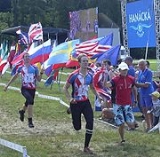
During a relay race, members of a team take turns running
Running
Running is a means of terrestrial locomotion allowing humans and other animals to move rapidly on foot. It is simply defined in athletics terms as a gait in which at regular points during the running cycle both feet are off the ground...

, orienteering
Orienteering
Orienteering is a family of sports that requires navigational skills using a map and compass to navigate from point to point in diverse and usually unfamiliar terrain, and normally moving at speed. Participants are given a topographical map, usually a specially prepared orienteering map, which they...

, swimming
Swimming (sport)
Swimming is a sport governed by the Fédération Internationale de Natation .-History: Competitive swimming in Europe began around 1800 BCE, mostly in the form of the freestyle. In 1873 Steve Bowyer introduced the trudgen to Western swimming competitions, after copying the front crawl used by Native...

, cross-country skiing
Cross-country skiing
Cross-country skiing is a winter sport in which participants propel themselves across snow-covered terrain using skis and poles...

, biathlon
Biathlon
Biathlon is a term used to describe any sporting event made up of two disciplines. However, biathlon usually refers specifically to the winter sport that combines cross-country skiing and rifle shooting...

, or ice skating
Ice skating
Ice skating is moving on ice by using ice skates. It can be done for a variety of reasons, including leisure, traveling, and various sports. Ice skating occurs both on specially prepared indoor and outdoor tracks, as well as on naturally occurring bodies of frozen water, such as lakes and...

 (usually with a baton in the first) parts of a circuit or performing a certain action. Relay races take the form of professional races and amateur games. In the Olympic games
Olympic Games
The Olympic Games is a major international event featuring summer and winter sports, in which thousands of athletes participate in a variety of competitions. The Olympic Games have come to be regarded as the world’s foremost sports competition where more than 200 nations participate...

, there are several types of relay races that are part of track and field
Track and field
Track and field is a sport comprising various competitive athletic contests based around the activities of running, jumping and throwing. The name of the sport derives from the venue for the competitions: a stadium which features an oval running track surrounding a grassy area...

.

Swimming relays


A swimming relay of four swimmers usually follows this strategy: second fastest, third fastest, slowest, then fastest (anchor). However, it is not uncommon to see either (1) the slowest swimmer racing in the second slot, creating an order as follows: second fastest, slowest, third fastest, and then fastest, or (2) an order from slowest to fastest: slowest, third fastest, second fastest, fastest.

Relays in athletics


In athletics, the two standard relays are the 4x100 meter relay and the 4x400 meter relay. Traditionally, the 4x400 meter relay finals are the last event of a track meet, and is often met with a very enthusiastic crowd, especially if the last leg is a close race. It is hard to measure exact splits in a 4x400 (or a 4x100) relay. For example, if a team ran a 3:00 4x400, it does not mean every runner on the team has to run a 45 second open 400, because a person starts accelerating before he/she has the baton, therefore allowing for slightly slower overall open 400 times. A 4x400 relay generally starts in lanes for the first leg, including the handoff. The second leg then proceeds to run in lanes for the first 100 meters, after which point the runners are allowed to break into the first lane on the backstretch, as long as they do not interfere with other runners. A race organizer then puts the third leg runners into a line depending on the order in which they are running (with the first place closest to the inside).

4x200, 4x800, and 4x1600 relays exist as well, but they are rarer, especially at the high school level, where schools generally have only one or two competitive strong runners in such events.

Rules and strategy


Each runner must hand off the baton to the next runner within a certain zone, usually marked by triangles on the track. In sprint relays, runners typically use a "blind handoff", where the second runner stands on a spot predetermined in practice and starts running when the first runner hits a visual mark on the track (usually a smaller triangle). The second runner opens his/her hand behind her after a few strides, by which time the first runner should be caught up and able to hand off the baton. Usually a runner will give an auditory signal, such as "Stick!" repeated several times, for the recipient of the baton to put out his hand. In middle-distance relays or longer, runners begin by jogging while looking back at the incoming runner and holding out a hand for the baton.


A team may be disqualified from a relay for:
  • Losing the baton (dropping the baton)
  • Making an improper baton exchange
  • False starting
    False start
    In sports, a false start is a movement by a participant before being signaled or otherwise permitted by the rules to start...

     (usually once but sometimes twice)
  • Improperly overtaking another competitor
  • Preventing another competitor from passing
  • Willfully impeding, improperly crossing the course, or in any other way interfering with another competitor


Based on the speed of the runners, the generally accepted strategy
Strategy
Strategy, a word of military origin, refers to a plan of action designed to achieve a particular goal. In military usage strategy is distinct from tactics, which are concerned with the conduct of an engagement, while strategy is concerned with how different engagements are linked...

 used in setting up a 4 person relay team is: second fastest, third fastest, slowest, then fastest (anchor). Each segment of the relay (the distance run by one person) is referred to as a leg.

Competitions


The largest relay event in the world is the Norwegian Holmenkollstafetten, which had a total of 33.880 competitors in 2011.

Another large relay event is the Penn Relays
Penn Relays
The Penn Relays is the oldest and largest track and field competition in the United States, hosted annually since April 21, 1895 by the University of Pennsylvania at Franklin Field in Philadelphia, Pennsylvania...

, which attracts over 15,000 competitors annually on the High School, Collegiate and Professional levels, and over its three days attracts upwards of 100,000 spectators. It is credited with popularizing Relay Racing in the sport of Track & Field.

The world's longest relay race is Japan's Prince Takamatsu Cup Nishinippon Round-Kyūshū Ekiden
Prince Takamatsu Cup Nishinippon Round-Kyushu Ekiden
The Prince Takamatsu Cup Nishinippon Round-Kyūshū Ekiden has been an annual race in Japan since 1951. Contestants from the prefectures on the island of Kyūshū, as well as from Yamaguchi and Okinawa Prefectures, gather each November...

, which begins in Nagasaki and continues for 1064 km.

Long distance relays


Long distance relays have become increasingly popular with runners of all skill-levels. These relays typically have 5 to 36 legs, each between 5 and 10 kilometers (3-6 miles) long. Races under 100 kilometres (62.1 mi) are run in a day, with each runner covering one or two legs. Longer relays are run overnight, with each runner typically covering three legs.

Notable long distance relay race include:


Hood to Coast - The original long distance relay race.

Epic Relays - Relay series with 3 relays in Oregon, Utah and Colorado.

Reach the Beach Relay - Cannon Mountain to Hampton Beach. New England's best relay.

Ragnar Relay Series The world's largest relay series with15 relay races around the United States

Wild West Relay - Fort Collins to Steamboat Springs, CO - motto is "Get Your Ass Over the Pass!" - 200-miles, crossing two mountain passes, almost 30% of the route is on dirt roads passing through three National Forests; since 2005

Green Mountain Relay - Jeffersonville to Bennington, VT - 200-miles and crosses seven covered bridges, possibly the most scenic relay route in the USA; since 2006

Texas Independence Relay - Gonzales, TX to Houston, TX

Sunset to Sunrise Relay - Ft. Myers to Jensen Beach, FL

American Odyssey Relay - Gettysburg, PA to Washington, DC - 200 miles in total, more or less

Blue Ridge Relay - 208 miles, takes place in the Blue Ridge and Black Mountains of Virginia and North Carolina

Southern Odyssey Relay - a 24 hour, 200 mile team relay race, a 2-day relay race through Georgia.

Reno-Tahoe Odyssey Relay - Downtown Reno, through the Sierra Nevada and back, a 178 mile team relay.

Cascade Lakes Relay - 2nd Longest relay race in the United States

Capital to Coast Relay - Longest relay race in the United States, Austin to Corpus Christi, TX

Relay Iowa - A 3 day/2 night, 340 mile adventure relay from Sioux City to Dubuque, IA

Great Lakes Relay - A 275 mile 3 day/2 night event through the northern half of Michigan's lower peninsula.

Shorter long distance relay races have also proven to be popular. These shorter races range from 40 miles (64.4 km) to 86 miles (138.4 km), but still incorporate the team aspect. The most popular ones in this category include:
The 100on100 Heart of Vermont Relay

River To River Relay 80 miles (128.7 km) in Southern Illinois

Market To Market Relay 86 miles (138.4 km) from Omaha to Lincoln, Nebraska
http://www.omaha.com/index.php?u_page=1200&u_sid=10432512

Brew To Brew 43 miles (69.2 km) from Lawerence to Kansas City, Kansas,

Lake Tahoe Relay which is approximately 70 miles (112.7 km) around Lake Tahoe.

TransIsthmian Relay - The only Ocean to Ocean relay race in the world, Caribean to Pacific.

Medley relay


Medley relay events are also occasionally held in track meets, usually consisting of teams of four runners running progressively longer distances. The Distance Medley Relay
Distance Medley Relay
The distance medley relay is an athletic event in which four athletes compete as part of a relay. Unlike most track relays, each member of the team runs a different distance. A distance medley relay is made up of a 1200 meter leg, or three laps on a standard 400 meter track; a 400 meter leg, or one...

 consists of four legs run at distances of 1200, 400, 800, and 1600 metres, in that order. The Sprint Medley Relay usually consists of four legs run at distances of 400, 200, 200, and 800 meters, though a more uncommon variant of 200, 100, 100 and 400 meters (Sometimes called a Short Sprint Medley) also exists. See also Swedish relay
Swedish relay
Swedish relay is an athletics track event in which teams comprise four runners. The first runner runs 100 meters, the second one 200 m, the third one 300 m and the fourth runner 400 m, so the total length of the race is one kilometer....

.

In medley swimming
Medley swimming
Medley is a combination of four different swimming styles into one race. This race is either swum by one swimmer as individual medley or by four swimmers as a medley relay...

, each swimmer uses a different stroke (in this order): backstroke
Backstroke
The backstroke, also sometimes called the back crawl, is one of the four swimming styles regulated by FINA, and the only regulated style swum on the back. This has the advantage of easy breathing, but the disadvantage of swimmers not being able to see where they are going. It is also the only...

, breaststroke
Breaststroke
The breaststroke is a swimming style in which the swimmer is on his or her chest and the torso does not rotate. It is the most popular recreational style due to its stability and the ability to keep the head out of the water a large portion of the time. In most swimming classes, beginners learn...

, butterfly
Butterfly stroke
The butterfly is a swimming stroke swum on the breast, with both arms moving simultaneously. The butterfly kick was developed separately, and is also known as the "dolphin kick"...

, and freestyle
Freestyle swimming
Freestyle is an unregulated swimming style used in swimming competitions according to the rules of FINA. The front crawl stroke is almost universally used during a freestyle race, as this style is generally the fastest...

, with the added limitation that the freestyle swimmer cannot use any of the first three strokes. At competitive levels, essentially all freestyle swimmers use the front crawl
Front crawl
The front crawl, forward crawl, or freestyle is a swimming stroke usually regarded as the fastest of the four front primary strokes. As such, the front crawl stroke is nearly universally used during a freestyle swimming competition, hence the synonymously used term "freestyle". It is one of two...

. Note that this order is different from that for the individual medley, in which a single swimmer swims butterfly, backstroke, breaststroke, and freestyle, in that order.

Relays on coinage


Relay race events have been selected as a main motif in numerous collectors' coins. One of the recent samples is the €10 Greek Relays commemorative coin, minted in 2003 to commemorate the 2004 Summer Olympics
2004 Summer Olympics
The 2004 Summer Olympic Games, officially known as the Games of the XXVIII Olympiad, was a premier international multi-sport event held in Athens, Greece from August 13 to August 29, 2004 with the motto Welcome Home. 10,625 athletes competed, some 600 more than expected, accompanied by 5,501 team...

. In the obverse of the coin three modern athletes run, holding their batons while in the background three ancient athletes are shown running a race known as the dolichos (a semi-endurance race of approximately 3,800 meters distance).