


Liberty L-12

Encyclopedia
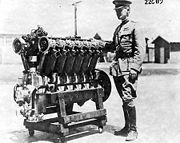
The Liberty L-12 was a 27 litre
(1,649 cubic inch
) water-cooled 45° V-12 aircraft engine of 400 horsepower
(300 kilowatt
s) designed both for a high power-to-weight ratio
and for ease of mass production.
, a Federal task force known as the Aircraft Production Board
summoned top engine designers Jesse Vincent (of the Packard
Motor Car Company of Detroit) and E.J. Hall (of the Hall-Scott
Motor Co. of Berkeley, California,) to Washington D.C. They were given the task of designing as rapidly as possible an aircraft engine that would rival if not surpass those of Great Britain
, France
, and Germany. The Board specified that the engine would have a high power-to-weight ratio and be adaptable to mass production. The Board brought Vincent and Hall together on 29 May 1917 at the Willard Hotel
in Washington, where the two were asked to stay until they produced a set of basic drawings. After just five days, Vincent and Hall left the Willard with a completed design for the new engine.
In July 1917, an eight-cylinder prototype assembled by Packard's Detroit plant arrived in Washington for testing, and in August, the 12-cylinder version was tested and approved. That fall, the War Department
placed an order for 22,500 Liberty engines, dividing the contract between the automobile and engine manufacturers Buick
, Ford
, Cadillac
, Lincoln
, Marmon
, Nordyke, and Packard. Hall-Scott in California was considered too small to receive a production order. Manufacturing by multiple different factories was facilitated by its modular design. Cadillac
was asked to produce Liberty engines but William Durant
was a pacifist who did not want General Motors facilities to be used for producing war material. This led to Henry Leland leaving Cadillac to form the Lincoln company to make Liberty engines. However, Durant later changed his mind and both Cadillac and Buick produced the engines.
Ford was asked to supply cylinders for the new engine, and rapidly developed an improved technique for cutting and pressing steel which resulted in cylinder production rising from 151 per day to over 2,000, Ford eventually manufacturing all 433,826 cylinders produced, and 3,950 complete engines. Lincoln constructed a new plant in record time, devoted entirely to Liberty engine production, and assembled 2,000 engines in 12 months. By the time of the Armistice with Germany
, the various companies had produced 13,574 Liberty engines, attaining a production rate of 150 engines per day. Production continued after the war, for a total of 20,478 engines built between July 4, 1917 and 1919.
and BMW III engines, and with each camshaft driven by a vertical driveshaft that was placed at the back of each cylinder bank, again identical to the Mercedes and BMW straight-six powerplants. Dry weight was 844 lb (383 kg). Two examples of a six-cylinder version, the Liberty L-6, which very closely resembled the Mercedes and BMW powerplants in overall appearance, were produced but not procured by the Army. Both were destroyed by Dr. William Christmas testing his so-called "Christmas Bullet" fighter.
, to the World War II
Packard-built Rolls-Royce Merlin
.
 The Nuffield Liberty tank engine was produced in World War II by the UK
car manufacturer Nuffield
. It was a 27-L (1,649 in³) engine with an output of 340 hp (250 kW), which became inadequate for the increasing vehicle weights as the war progressed, and it suffered numerous problems with cooling and reliability. It was replaced in later British tanks by the Rolls-Royce Meteor
, based on their Merlin
aero engine.
propeller reduction gear and reduced capacity. (4"x7"=1,411 cuin)
and BMW III straight-six German aviation engines of World War I.
tank was designed in 1917-18. The American version used an adaption of the Liberty V-12 engine of 300 hp (220 kW), designed to use pig iron
rather than steel
. 100 tanks were manufactured at the Rock Island Arsenal
in 1919-20, too late for World War I
. They were eventually sold to Canada for training in 1940, except for two that have been preserved.
Litre
pic|200px|right|thumb|One litre is equivalent to this cubeEach side is 10 cm1 litre water = 1 kilogram water The litre is a metric system unit of volume equal to 1 cubic decimetre , to 1,000 cubic centimetres , and to 1/1,000 cubic metre...
(1,649 cubic inch
Cubic inch
The cubic inch is a unit of measurement for volume in the Imperial units and United States customary units systems. It is the volume of a cube with each of its 3 sides being one inch long....
) water-cooled 45° V-12 aircraft engine of 400 horsepower
Horsepower
Horsepower is the name of several units of measurement of power. The most common definitions equal between 735.5 and 750 watts.Horsepower was originally defined to compare the output of steam engines with the power of draft horses in continuous operation. The unit was widely adopted to measure the...
(300 kilowatt
Watt
The watt is a derived unit of power in the International System of Units , named after the Scottish engineer James Watt . The unit, defined as one joule per second, measures the rate of energy conversion.-Definition:...
s) designed both for a high power-to-weight ratio
Power-to-weight ratio
Power-to-weight ratio is a calculation commonly applied to engines and mobile power sources to enable the comparison of one unit or design to another. Power-to-weight ratio is a measurement of actual performance of any engine or power sources...
and for ease of mass production.
History
In May 1917, one month after the US had declared war on GermanyGermany
Germany , officially the Federal Republic of Germany , is a federal parliamentary republic in Europe. The country consists of 16 states while the capital and largest city is Berlin. Germany covers an area of 357,021 km2 and has a largely temperate seasonal climate...
, a Federal task force known as the Aircraft Production Board
Aircraft Board
The Aircraft Board was a United States federal government organization created from the Aircraft Production Board on October 1, 1917, by Act of Congress to provide statutory authority to the APB, which had been created by a resolution of the Council of National Defense on May 16, 1917. Chaired by...
summoned top engine designers Jesse Vincent (of the Packard
Packard
Packard was an American luxury-type automobile marque built by the Packard Motor Car Company of Detroit, Michigan, and later by the Studebaker-Packard Corporation of South Bend, Indiana...
Motor Car Company of Detroit) and E.J. Hall (of the Hall-Scott
Hall-Scott
Hall-Scott was a Berkeley, California-based manufacturing company. It was among the most significant builders of water-cooled aircraft engines prior to World War I.-1910–1921:...
Motor Co. of Berkeley, California,) to Washington D.C. They were given the task of designing as rapidly as possible an aircraft engine that would rival if not surpass those of Great Britain
Great Britain
Great Britain or Britain is an island situated to the northwest of Continental Europe. It is the ninth largest island in the world, and the largest European island, as well as the largest of the British Isles...
, France
France
The French Republic , The French Republic , The French Republic , (commonly known as France , is a unitary semi-presidential republic in Western Europe with several overseas territories and islands located on other continents and in the Indian, Pacific, and Atlantic oceans. Metropolitan France...
, and Germany. The Board specified that the engine would have a high power-to-weight ratio and be adaptable to mass production. The Board brought Vincent and Hall together on 29 May 1917 at the Willard Hotel
Willard InterContinental Washington
The Willard InterContinental Washington is an historic luxury Beaux-Arts hotel located at 1401 Pennsylvania Avenue NW in Washington, D.C. Among its facilities are numerous luxurious guest rooms, several restaurants, the famed Round Robin Bar, the Peacock Alley series of luxury shops, and voluminous...
in Washington, where the two were asked to stay until they produced a set of basic drawings. After just five days, Vincent and Hall left the Willard with a completed design for the new engine.
In July 1917, an eight-cylinder prototype assembled by Packard's Detroit plant arrived in Washington for testing, and in August, the 12-cylinder version was tested and approved. That fall, the War Department
United States Department of War
The United States Department of War, also called the War Department , was the United States Cabinet department originally responsible for the operation and maintenance of the United States Army...
placed an order for 22,500 Liberty engines, dividing the contract between the automobile and engine manufacturers Buick
Buick
Buick is a premium brand of General Motors . Buick models are sold in the United States, Canada, Mexico, China, Taiwan, and Israel, with China being its largest market. Buick holds the distinction as the oldest active American make...
, Ford
Ford Motor Company
Ford Motor Company is an American multinational automaker based in Dearborn, Michigan, a suburb of Detroit. The automaker was founded by Henry Ford and incorporated on June 16, 1903. In addition to the Ford and Lincoln brands, Ford also owns a small stake in Mazda in Japan and Aston Martin in the UK...
, Cadillac
Cadillac
Cadillac is an American luxury vehicle marque owned by General Motors . Cadillac vehicles are sold in over 50 countries and territories, but mostly in North America. Cadillac is currently the second oldest American automobile manufacturer behind fellow GM marque Buick and is among the oldest...
, Lincoln
Lincoln (automobile)
Lincoln is an American luxury vehicle brand of the Ford Motor Company. Lincoln vehicles are sold mostly in North America.-History:The company was founded in August 1915 by Henry M. Leland, one of the founders of Cadillac . During World War I, he left Cadillac which was sold to General Motors...
, Marmon
Marmon
Marmon Motor Car Company was an automobile manufacturer founded by Howard Marmon and owned by Nordyke Marmon & Company of Indianapolis, Indiana, USA. It was established in 1902 and was merged and renamed in 1933. They produced cars under the Marmon brand. It was succeeded by Marmon-Herrington and...
, Nordyke, and Packard. Hall-Scott in California was considered too small to receive a production order. Manufacturing by multiple different factories was facilitated by its modular design. Cadillac
Cadillac
Cadillac is an American luxury vehicle marque owned by General Motors . Cadillac vehicles are sold in over 50 countries and territories, but mostly in North America. Cadillac is currently the second oldest American automobile manufacturer behind fellow GM marque Buick and is among the oldest...
was asked to produce Liberty engines but William Durant
William Durant
William Durant is the name of:* Will Durant , historian and philosopher* William C. Durant , industrialist and founder of General Motors Corporation...
was a pacifist who did not want General Motors facilities to be used for producing war material. This led to Henry Leland leaving Cadillac to form the Lincoln company to make Liberty engines. However, Durant later changed his mind and both Cadillac and Buick produced the engines.
Ford was asked to supply cylinders for the new engine, and rapidly developed an improved technique for cutting and pressing steel which resulted in cylinder production rising from 151 per day to over 2,000, Ford eventually manufacturing all 433,826 cylinders produced, and 3,950 complete engines. Lincoln constructed a new plant in record time, devoted entirely to Liberty engine production, and assembled 2,000 engines in 12 months. By the time of the Armistice with Germany
Armistice with Germany (Compiègne)
The armistice between the Allies and Germany was an agreement that ended the fighting in the First World War. It was signed in a railway carriage in Compiègne Forest on 11 November 1918 and marked a victory for the Allies and a complete defeat for Germany, although not technically a surrender...
, the various companies had produced 13,574 Liberty engines, attaining a production rate of 150 engines per day. Production continued after the war, for a total of 20,478 engines built between July 4, 1917 and 1919.
Description
The Liberty L-12 was a modular design where four or six cylinders could be used in one or two banks. A single overhead camshaft for each cylinder bank operated two valves per cylinder, in an almost identical manner to the inline six-cylinder German Mercedes D.IIIMercedes D.III
The Mercedes D.III, or F1466 as it was known internally, was a six-cylinder, liquid cooled inline aircraft engine built by Daimler and used on a wide variety of German aircraft during World War I. The initial versions were introduced in 1914 at 160 hp, but a series of changes improved this to...
and BMW III engines, and with each camshaft driven by a vertical driveshaft that was placed at the back of each cylinder bank, again identical to the Mercedes and BMW straight-six powerplants. Dry weight was 844 lb (383 kg). Two examples of a six-cylinder version, the Liberty L-6, which very closely resembled the Mercedes and BMW powerplants in overall appearance, were produced but not procured by the Army. Both were destroyed by Dr. William Christmas testing his so-called "Christmas Bullet" fighter.
V-1650
An inverted Liberty 12-A was referred to as the V-1650 and was produced up to 1926 by Packard — exactly the same designation was later applied, due to identical displacementEngine displacement
Engine displacement is the volume swept by all the pistons inside the cylinders of an internal combustion engine in a single movement from top dead centre to bottom dead centre . It is commonly specified in cubic centimeters , litres , or cubic inches...
, to the World War II
World War II
World War II, or the Second World War , was a global conflict lasting from 1939 to 1945, involving most of the world's nations—including all of the great powers—eventually forming two opposing military alliances: the Allies and the Axis...
Packard-built Rolls-Royce Merlin
Packard V-1650
The Packard V-1650 was a liquid cooled 27 litre 60° V12 piston aircraft engine variant of the Rolls-Royce Merlin produced under licence by the Packard Motor Car Company...
.
Nuffield Liberty
United Kingdom
The United Kingdom of Great Britain and Northern IrelandIn the United Kingdom and Dependencies, other languages have been officially recognised as legitimate autochthonous languages under the European Charter for Regional or Minority Languages...
car manufacturer Nuffield
Nuffield Organisation
The Nuffield Organisation was a vehicle manufacturing company in the United Kingdom. Named after its founder, William Morris, 1st Viscount Nuffield, it was formed in 1938 as the merger of Nuffield's Morris Motor Company , another of Nuffield's companies the MG Car Company and Riley.Morris Motors...
. It was a 27-L (1,649 in³) engine with an output of 340 hp (250 kW), which became inadequate for the increasing vehicle weights as the war progressed, and it suffered numerous problems with cooling and reliability. It was replaced in later British tanks by the Rolls-Royce Meteor
Rolls-Royce Meteor
The Rolls-Royce Meteor was a British tank engine of the Second World War.It was developed from the Rolls-Royce Merlin aero-engine by W. A. Robotham and his chassis design and development division at Belper, as they were not involved in aero-engine work...
, based on their Merlin
Rolls-Royce Merlin
The Rolls-Royce Merlin is a British liquid-cooled, V-12, piston aero engine, of 27-litre capacity. Rolls-Royce Limited designed and built the engine which was initially known as the PV-12: the PV-12 became known as the Merlin following the company convention of naming its piston aero engines after...
aero engine.
Allison VG-1410
The Allison VG-1410 was an air-cooled inverted Liberty L-12, with a geared super-charger and Allison epicyclicEpicyclic gearing
Epicyclic gearing or planetary gearing is a gear system consisting of one or more outer gears, or planet gears, revolving about a central, or sun gear. Typically, the planet gears are mounted on a movable arm or carrier which itself may rotate relative to the sun gear...
propeller reduction gear and reduced capacity. (4"x7"=1,411 cuin)
Liberty L-6
A 6-cylinder version of the liberty:- a single bank of cylinders, with the resulting engine bearing a strong external resemblance to both the Mercedes D.IIIMercedes D.III
The Mercedes D.III, or F1466 as it was known internally, was a six-cylinder, liquid cooled inline aircraft engine built by Daimler and used on a wide variety of German aircraft during World War I. The initial versions were introduced in 1914 at 160 hp, but a series of changes improved this to...
and BMW III straight-six German aviation engines of World War I.
Liberty L-8
An 8-cylinder V engine using Liberty cylinders in banks of four at 90o.Applications
- Airco DH.4
- Airco DH.9Airco DH.9The Airco DH.9 - also known after 1920 as the de Havilland DH.9 - was a British bomber used in the First World War...
- Caproni Ca.60Caproni Ca.60|-Video:A Mammoth of the Air, a 1921 silent film of the Ca.60, can be seen at -External links:*...
- Curtiss NCCurtiss NC-References:NotesBibliography* Holmes, Tony. Jane's Vintage Aircraft Recognition Guide. London: Harper Collins, 2005. ISBN 0-0071-9292-4.* Steirman, Hy and Glenn D. Kittler. The First Transatlantic Flight, 1919, . New York: Richardson & Sterman, 1986. ISBN 0-931933-19-0.* Wagner, Ray. American...
- Curtiss Carrier PigeonCurtiss Carrier Pigeon|-See also:-References:* Bowers, Peter M. Curtiss Aircraft 1907–1947. London:Putnam, 1979. ISBN 0-370-10029-8.* . Flight, April 16, 1925, pp. 228–229.* , Flight, November 26, 1925...
- Airco DH.10Airco DH.10|-See also:-References:NotesBibliography*Jackson, A. J. British Civil Aircraft Since 1919, Volume 2. London: Putnam, Second Edition, 1973. ISBN 0-370-10010-7.*Jackson A. J. De Havilland Aircraft since 1909. London:Putnam, 1987. ISBN 0-85177-802-X....
- Douglas C-1Douglas C-1-References:NotesBibliography* Forden, Lesley. The Ford Air Tours: 1925-1931. New Brighton Minnesota: Aviation Foundation of America, 2003, First edition 1972. No ISBN....
- Douglas DTDouglas DT|-References:* René Francillon, "McDonnell Douglas Aircraft Since 1920: Volume I", ISBN 0-87021-428-4...
- Douglas O-2Douglas O-2The Douglas O-2 is a 1920s American observation aircraft built by the Douglas Aircraft Company.-Development:The important family of Douglas observation aircraft sprang from two XO-2 prototypes, the first of which was powered by the 420 hp Liberty V-1650-1 V-engine and test-flown in the autumn...
- Handley Page H.P.20
- Witteman-Lewis XNBL
- RN-1 (Zodiac)
Tank applications
- Mark VIII (tank)Mark VIII (tank)The Tank Mark VIII or Liberty was an Anglo-American tank design of the First World War. Initially intended to be a collaborative effort to equip France, the UK and the US with a single tank design, it did not come to fruition before the end of the war and only a few were produced.-Early...
Anglo-American or Liberty World War I tank - BT-2 & BT-5 Soviet interwar tank (at least one reconditioned Liberty was installed in a BT-5)see external link
- Cruiser Mk IIICruiser Mk IIIThe Tank, Cruiser, Mk III was a British cruiser tank of the Second World War. It was the first British cruiser tank to use the Christie suspension system which gave higher speeds and better cross-country performance, previous models of cruiser tanks having used triple wheeled bogie...
British World War II Tank - Cruiser Mk IVCruiser Mk IVThe Tank, Cruiser, Mk IV was a British cruiser tank of the Second World War. It followed directly on from the Tank, Cruiser, Mk III . The first Mk IVs were Mk IIIs with extra armour fitted to the turret...
British World War II Tank - Crusader tankCrusader tankThe Tank, Cruiser, Mk VI or A15 Crusader was one of the primary British cruiser tanks of the early part Second World War and perhaps the most important British tank of the North African Campaign...
British World War II Tank - Centaur Tank, an early version of the CromwellCromwell tankTank, Cruiser, Mk VIII, Cromwell ,The designation as the eighth Cruiser tank design, its name given for ease of reference and its General Staff specification number respectively and the related Centaur tank, were one of the most successful series of cruiser tanks fielded by Britain in the Second...
British World War II Tank
Anglo-American or Liberty Tank
The Anglo-American or Liberty Mark VIIIMark VIII (tank)
The Tank Mark VIII or Liberty was an Anglo-American tank design of the First World War. Initially intended to be a collaborative effort to equip France, the UK and the US with a single tank design, it did not come to fruition before the end of the war and only a few were produced.-Early...
tank was designed in 1917-18. The American version used an adaption of the Liberty V-12 engine of 300 hp (220 kW), designed to use pig iron
Pig iron
Pig iron is the intermediate product of smelting iron ore with a high-carbon fuel such as coke, usually with limestone as a flux. Charcoal and anthracite have also been used as fuel...
rather than steel
Steel
Steel is an alloy that consists mostly of iron and has a carbon content between 0.2% and 2.1% by weight, depending on the grade. Carbon is the most common alloying material for iron, but various other alloying elements are used, such as manganese, chromium, vanadium, and tungsten...
. 100 tanks were manufactured at the Rock Island Arsenal
Rock Island Arsenal
The Rock Island Arsenal comprises , located on Arsenal Island, originally known as Rock Island, on the Mississippi River between the cities of Davenport, Iowa, and Rock Island, Illinois. It lies within the state of Illinois. The island was originally established as a government site in 1816, with...
in 1919-20, too late for World War I
World War I
World War I , which was predominantly called the World War or the Great War from its occurrence until 1939, and the First World War or World War I thereafter, was a major war centred in Europe that began on 28 July 1914 and lasted until 11 November 1918...
. They were eventually sold to Canada for training in 1940, except for two that have been preserved.