
Home      Discussion      Topics      Dictionary      Almanac
Signup       Login
Crusader tank

Crusader tank

Overview
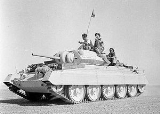
The Tank, Cruiser, Mk VI or A15 Crusader was one of the primary British cruiser tank
Cruiser tank
The cruiser tank was a British tank concept of the inter-war period. This concept was the driving force behind several tank designs which saw action during the Second World War....

s of the early part Second World War
World War II
World War II, or the Second World War , was a global conflict lasting from 1939 to 1945, involving most of the world's nations—including all of the great powers—eventually forming two opposing military alliances: the Allies and the Axis...

 and perhaps the most important British tank of the North African Campaign
North African campaign
During the Second World War, the North African Campaign took place in North Africa from 10 June 1940 to 13 May 1943. It included campaigns fought in the Libyan and Egyptian deserts and in Morocco and Algeria and Tunisia .The campaign was fought between the Allies and Axis powers, many of whom had...

. The Crusader's mobility made it a favourite of British tank crews and its Ordnance QF 6 pounder
Ordnance QF 6 pounder
The Ordnance Quick-Firing 6-pounder 7 cwt, or just 6 pounder, was a British 57 mm gun, their primary anti-tank gun during the middle of World War II, as well as the main armament for a number of armoured fighting vehicles...

 main gun made it more than a match for the early Panzer III
Panzer III
Panzer III was the common name of a medium tank that was developed in the 1930s by Germany and was used extensively in World War II. The official German designation was Panzerkampfwagen III translating as "armoured battle vehicle". It was intended to fight other armoured fighting vehicles and...

 and Panzer IV
Panzer IV
The Panzerkampfwagen IV , commonly known as the Panzer IV, was a medium tank developed in Nazi Germany in the late 1930s and used extensively during the Second World War. Its ordnance inventory designation was Sd.Kfz...

 tanks it faced in combat. By late 1942, the limited diameter of its turret ring prevented further armament upgrades and this, combined with the presence of Tiger I
Tiger I
Tiger I is the common name of a German heavy tank developed in 1942 and used in World War II. The final official German designation was Panzerkampfwagen Tiger Ausf. E, often shortened to Tiger. It was an answer to the unexpectedly formidable Soviet armour encountered in the initial months of...

 Tanks among the Afrika Korps
Afrika Korps
The German Africa Corps , or the Afrika Korps as it was popularly called, was the German expeditionary force in Libya and Tunisia during the North African Campaign of World War II...

 and overheating problems caused by the high temperatures of the desert, led to the design being phased out in favour of the new US built Sherman III
M4 Sherman
The M4 Sherman, formally Medium Tank, M4, was the primary tank used by the United States during World War II. Thousands were also distributed to the Allies, including the British Commonwealth and Soviet armies, via lend-lease...

 medium tank and the British Cromwell
Cromwell tank
Tank, Cruiser, Mk VIII, Cromwell ,The designation as the eighth Cruiser tank design, its name given for ease of reference and its General Staff specification number respectively and the related Centaur tank, were one of the most successful series of cruiser tanks fielded by Britain in the Second...

 heavy cruiser.
Discussion
Ask a question about 'Crusader tank'
Start a new discussion about 'Crusader tank'
Answer questions from other users
Full Discussion Forum
 
Unanswered Questions
Encyclopedia
The Tank, Cruiser, Mk VI or A15 Crusader was one of the primary British cruiser tank
Cruiser tank
The cruiser tank was a British tank concept of the inter-war period. This concept was the driving force behind several tank designs which saw action during the Second World War....

s of the early part Second World War
World War II
World War II, or the Second World War , was a global conflict lasting from 1939 to 1945, involving most of the world's nations—including all of the great powers—eventually forming two opposing military alliances: the Allies and the Axis...

 and perhaps the most important British tank of the North African Campaign
North African campaign
During the Second World War, the North African Campaign took place in North Africa from 10 June 1940 to 13 May 1943. It included campaigns fought in the Libyan and Egyptian deserts and in Morocco and Algeria and Tunisia .The campaign was fought between the Allies and Axis powers, many of whom had...

. The Crusader's mobility made it a favourite of British tank crews and its Ordnance QF 6 pounder
Ordnance QF 6 pounder
The Ordnance Quick-Firing 6-pounder 7 cwt, or just 6 pounder, was a British 57 mm gun, their primary anti-tank gun during the middle of World War II, as well as the main armament for a number of armoured fighting vehicles...

 main gun made it more than a match for the early Panzer III
Panzer III
Panzer III was the common name of a medium tank that was developed in the 1930s by Germany and was used extensively in World War II. The official German designation was Panzerkampfwagen III translating as "armoured battle vehicle". It was intended to fight other armoured fighting vehicles and...

 and Panzer IV
Panzer IV
The Panzerkampfwagen IV , commonly known as the Panzer IV, was a medium tank developed in Nazi Germany in the late 1930s and used extensively during the Second World War. Its ordnance inventory designation was Sd.Kfz...

 tanks it faced in combat. By late 1942, the limited diameter of its turret ring prevented further armament upgrades and this, combined with the presence of Tiger I
Tiger I
Tiger I is the common name of a German heavy tank developed in 1942 and used in World War II. The final official German designation was Panzerkampfwagen Tiger Ausf. E, often shortened to Tiger. It was an answer to the unexpectedly formidable Soviet armour encountered in the initial months of...

 Tanks among the Afrika Korps
Afrika Korps
The German Africa Corps , or the Afrika Korps as it was popularly called, was the German expeditionary force in Libya and Tunisia during the North African Campaign of World War II...

 and overheating problems caused by the high temperatures of the desert, led to the design being phased out in favour of the new US built Sherman III
M4 Sherman
The M4 Sherman, formally Medium Tank, M4, was the primary tank used by the United States during World War II. Thousands were also distributed to the Allies, including the British Commonwealth and Soviet armies, via lend-lease...

 medium tank and the British Cromwell
Cromwell tank
Tank, Cruiser, Mk VIII, Cromwell ,The designation as the eighth Cruiser tank design, its name given for ease of reference and its General Staff specification number respectively and the related Centaur tank, were one of the most successful series of cruiser tanks fielded by Britain in the Second...

 heavy cruiser.

Design and development


In 1938, Nuffield Mechanisation and Aero
Nuffield Organisation
The Nuffield Organisation was a vehicle manufacturing company in the United Kingdom. Named after its founder, William Morris, 1st Viscount Nuffield, it was formed in 1938 as the merger of Nuffield's Morris Motor Company , another of Nuffield's companies the MG Car Company and Riley.Morris Motors...

 produced their A16 design for a heavy cruiser tank based on Christie suspension
Christie suspension
The Christie suspension is a suspension system developed by American engineer Walter Christie for his tank designs. It allowed considerably longer movement than conventional leaf spring systems then in common use, which allowed his tanks to have considerably greater cross-country speed and a lower...

. Looking for a lighter and cheaper tank to build, the General Staff requested alternatives. To this end the A13 Mk III cruiser tank design which would enter service as the "Tank, Cruiser Mk V"
Covenanter tank
The Tank, Cruiser, Mk V, Covenanter was a British Cruiser tank of the Second World War. It was named for the Covenanters, a Scottish religious faction in the British Isles at the time of the Wars of the Three Kingdoms...

 and known in service as "Covenanter" was designed. Nuffield were, in 1939, offered the opportunity to take part in the production of Covenanter. Nuffield, however, preferred to work on its own version of the A13—though they still provided design work for the Covenanter's turret. This new tank was adopted as "Tank, Cruiser, Mk VI Crusader", under General Staff
General Staff
A military staff, often referred to as General Staff, Army Staff, Navy Staff or Air Staff within the individual services, is a group of officers and enlisted personnel that provides a bi-directional flow of information between a commanding officer and subordinate military units...

 specification A15. Although Crusader is often referred to as an improved version of the Covenanter, in fact it was a parallel design.

Both tanks were ordered "off the drawing board" without building prototypes first. Despite a later start, the pilot model
Prototype
A prototype is an early sample or model built to test a concept or process or to act as a thing to be replicated or learned from.The word prototype derives from the Greek πρωτότυπον , "primitive form", neutral of πρωτότυπος , "original, primitive", from πρῶτος , "first" and τύπος ,...

 of the Crusader was ready six weeks before the first Covenanter.

Unlike earlier "Christie cruisers"( A13, Marks III and IV and the Mark V Covenanter ) that were built with 4 road wheels, Crusader had five road wheels each side to improve weight distribution in a tank that weighed almost 20 tons instead of the 14 tons of the previous cruisers. The 32 in (812.8 mm)-diameter wheels were of pressed steel with solid rubber tyres. The hull sides were built up of two separated plates with the suspension arms between them.

It had a different engine from the Covenanter, different steering system and a conventional cooling system with radiators in the engine compartment.
At the left hand side of the front hull—a place occupied by the engine radiator in the Covenanter—was mounted a small hand-traversed auxiliary turret armed with a Besa machine gun
Besa machine gun
The Besa Machine Gun was a British version of the Czechoslovak ZB-53 air-cooled, belt-fed machine-gun, which in the Czechoslovak army was marked as the TK vz. 37...

. The auxiliary turret was awkward to use and was often removed in the field or remained unoccupied.

Both the A13 Mk III and the A15 designs used the same main turret
Turret
In architecture, a turret is a small tower that projects vertically from the wall of a building such as a medieval castle. Turrets were used to provide a projecting defensive position allowing covering fire to the adjacent wall in the days of military fortification...

. The turret was polygonal—with sides that sloped out then in again—to give maximum turret space on the limited turret diameter. Early production vehicles had a "semi-internal" cast gun mantlet
Gun mantlet
A gun mantlet is an armour plate or shield attached to an armoured fighting vehicle's gun, protecting the opening through which the weapon's barrel projects from the hull or turret armour and, in many cases, ensuring the vulnerable warhead of a loaded shell does not protrude past the vehicle's...

, which was quickly replaced in production by a better protected big cast mantlet with three vertical slits—for the main gun, for a coaxial Besa machine gun and for the sighting telescope.

There was no cupola for the commander who had instead a flat hatch with the periscope mounted through it.

The main armament, as in other British tanks of the period, was balanced so the gunner could control its elevation through a padded shaft against his right shoulder rather than using a geared mechanism. This fitted well with the British doctrine of firing accurately on the move.

When it was understood that there would be delays in the introduction of successor heavy cruiser tanks—what would become the Cavalier
Cavalier tank
The Tank, Cruiser, Mk VII Cavalier was an unsuccessful design of British cruiser tank during World War II. It suffered from an underpowered engine, and problems because of the rush to design and build it.- Development :...

, Centaur and Cromwell
Cromwell tank
Tank, Cruiser, Mk VIII, Cromwell ,The designation as the eighth Cruiser tank design, its name given for ease of reference and its General Staff specification number respectively and the related Centaur tank, were one of the most successful series of cruiser tanks fielded by Britain in the Second...

—the Crusader was adapted to use the 6 pounder gun.

North Africa


With the Axis forces in North Africa having pushed the British back to the Egyptian border and the remaining British armour being a mixed force of older tanks with a few Matildas, tanks were hurriedly shipped via the Mediterranean arriving on 12 May. There were sufficient Crusaders to equip the 6th Royal Tank Regiment which with the 2nd RTR (with older cruiser tanks) formed the 7th Armoured Brigade. The rest of the tanks were Matildas for the 4th Armoured Brigade giving the 7th Armoured division only four tank regiments.

Although there was pressure from London for the reconstituted Desert Rats to go into action, outfitting for the desert and training delayed their first use until Operation Battleaxe
Operation Battleaxe
Operation Battleaxe was a British Army operation during the Second World War in June 1941 with the goal of clearing eastern Cyrenaica of German and Italian forces; one of the main benefits of this would have been the lifting of the Siege of Tobruk....

, an attempt to relieve the siege of Tobruk
Siege of Tobruk
The siege of Tobruk was a confrontation that lasted 240 days between Axis and Allied forces in North Africa during the Western Desert Campaign of the Second World War...

 in June 1941. As the brigade swept round the flank, the Crusaders were caught by concealed anti-tank guns and lost 11 tanks. The 6th RTR lost more tanks, to action and defects, in the fighting withdrawal of the next two days.

The 7th Brigade was re-equipped with further Crusaders, but as the brigade had been expanded by the addition of 7th Hussars there were not sufficient to replace the older cruiser tanks.

The 22nd Armoured Brigade, effectively an advance force of the 1st Armoured Division, which was three inexperienced Yeomanry units equipped with Crusaders transferred to North Africa to bring the 7th Armoured up to three-brigade strength. The 8th Hussars was added to the 4th Armoured Brigade but these had to be equipped with M3 Stuart light tanks as there were still insufficient cruisers. The 22nd was able to take part in Operation Crusader
Operation Crusader
Operation Crusader was a military operation by the British Eighth Army between 18 November–30 December 1941. The operation successfully relieved the 1941 Siege of Tobruk....

 of November 1941 which was named after it.

In Operation Crusader the two British Corps were disposed such that they could not support each other, but it was expected that as the British outnumbered the German and Italian forces in tanks, the tank against tank battles would be decided in their favour. However in the resulting encounters, Rommel did not put his tanks en masse into action against the British ones and the large numbers of German anti-tank guns working offensively with the tanks and infantry proved effective. The Germans had a few 88mm guns but were mostly equipped with the Pak 38, a long-barreled 50mm gun, with a range of 1,000 yards. This superiority in quality and tactical deployment of AT guns was to be a feature of the Afrika Korps throughout the Desert War. The Crusader's 2 pdr (40 mm) gun was as effective as the short-barreled 50 mm of the Panzer III
Panzer III
Panzer III was the common name of a medium tank that was developed in the 1930s by Germany and was used extensively in World War II. The official German designation was Panzerkampfwagen III translating as "armoured battle vehicle". It was intended to fight other armoured fighting vehicles and...

 although it was outranged by the short-barreled 75 mm of the Panzer IV
Panzer IV
The Panzerkampfwagen IV , commonly known as the Panzer IV, was a medium tank developed in Nazi Germany in the late 1930s and used extensively during the Second World War. Its ordnance inventory designation was Sd.Kfz...

.

Although the Crusader was faster than any tanks it opposed, its potential was limited by a relatively light QF 2-pounder
Ordnance QF 2 pounder
The Ordnance QF 2-pounder was a British anti-tank and vehicle-mounted gun, employed in the Second World War. It was actively used in the Battle of France, and during the North Africa campaign...

 gun, thin armour and mechanical problems. A particular tactical limitation was the lack of a High Explosive (HE) shell for the main armament—these existed but were never supplied. Axis
Axis Powers
The Axis powers , also known as the Axis alliance, Axis nations, Axis countries, or just the Axis, was an alignment of great powers during the mid-20th century that fought World War II against the Allies. It began in 1936 with treaties of friendship between Germany and Italy and between Germany and...

 tank forces developed an extremely effective method of dealing with attacking tank forces by retiring behind a screen of concealed anti-tank guns. The pursuing tanks could then be engaged by the artillery. With the German anti-tank guns out of range of the tanks' machine guns and without a high explosive shell to return fire, the tanks were left with the equally unpalatable options of withdrawing under fire or trying to overrun the gun screen.

The Crusader proved prone to catch fire when hit, a problem that was identified as due to the ammunition being ignited by hot metal penetrating the unprotected racks. The angled underside of the turret created "shell pockets" that acted as a lever for lifting the turret from its mounting when struck by a shell.

The Crusader proved unreliable in the desert due to a number of issues. These started with their transport from the UK to North Africa. Poor preparation and handling caused problems that had to be rectified before they could be passed to the regiments, and ate into the supply of spare parts. Once in use the sand caused erosion in the cooling systemand the stresses of hard cross-country travel caused oil leaks in the engine blocks. Since there were few tank transporters or railways in the desert, the tanks had to travel long distances on their tracks causing further wear.

By the end of 1941, there was only one brigade, the 2nd, which was operating only Crusaders. In March 1942, Grant medium tanks
M3 Lee
The Medium Tank M3 was an American tank used during World War II. In Britain the tank was called "General Lee", named after Confederate General Robert E. Lee, and the modified version built with a new turret was called the "General Grant", named after U.S. General Ulysses S. Grant.Design commenced...

 arrived: these replaced one in three Crusader squadrons. While the inclusion of the Grant with its effective 75mm gun gave better firepower against anti-tank guns and infantry they were slower, limiting the Crusaders when they had to operate together. From May 1942, the Mark III were delivered. Of the 840 tanks available to the British, 260 were Crusaders. The German tanks they were facing were improved types with improved frontal armour which caused the Crusaders' 2-pounder shot to shatter rather than penetrate.

As part of British deception operations, Crusaders could be issued with "Sunshade" which was a metal framework with canvas covering that disguised the tank as a lorry to German aerial reconnaissance. Similarly dummy tanks were deployed.

Later in the campaign shipping was improved, Nuffields had put a engineering team in Egypt, and crews were better at preventing problems, but the reputation of the Crusader could not recover.

After Montgomery
Bernard Montgomery, 1st Viscount Montgomery of Alamein
Field Marshal Bernard Law Montgomery, 1st Viscount Montgomery of Alamein, KG, GCB, DSO, PC , nicknamed "Monty" and the "Spartan General" was a British Army officer. He saw action in the First World War, when he was seriously wounded, and during the Second World War he commanded the 8th Army from...

 took over command, the imbalance between British armour and German was redressed by better control and the addition of more American-supplied Grant and Sherman tanks. The Crusader was replaced in the main line of battle and used for "light squadrons" trying to flank the enemy when it engaged the heavier units. The Australian 9th Infantry Division operated Crusaders for reconnaissance and liaison.

The British 1st Army landed as part of the Allied operations in Tunisia
Tunisia Campaign
The Tunisia Campaign was a series of battles that took place in Tunisia during the North African Campaign of the Second World War, between Axis and Allied forces. The Allies consisted of British Imperial Forces, including Polish and Greek contingents, with American and French corps...

; some of its units were using the Crusader and these saw action from the 24th November. These were not solely Crusader regiments but mixed Crusader and Valentine tank
Valentine tank
The Tank, Infantry, Mk III, Valentine was an infantry tank produced in the United Kingdom during the Second World War. More than 8,000 of the type were produced in 11 different marks plus various purpose-built variants, accounting for approximately a quarter of wartime British tank production...

s; within each squadron two troops were Crusader IIIs and there were Crusader II CS attached to the Squadron HQ. These units of the 26th Armoured Brigade were used as an independent armoured column, "Blade Force", with the 78th Infantry Division. The operations of Blade Force were on terrain different from the desert of the earlier campaigns and the fighting took place with smaller numbers of vehicles. These actions were similar to what would be seen later in Europe.

The 1st Army converted to Shermans during Tunisia, but Crusaders remained in use with the 8th for longer. The last major action for Crusaders was the Battle of Mareth
Operation Pugilist
Operation Pugilist was an Allied operation in Tunisia during the Second World War. In his General Plan, General Bernard Montgomery stated "...the object of operation Pugilist is to destroy the enemy now opposing Eighth Army in the Mareth position, and to advance and capture Sfax." Pugilist itself...

. The North Africa campaign finished shortly after.

Other use


After the completion of the North African Campaign, the availability of better tanks such as the Sherman
M4 Sherman
The M4 Sherman, formally Medium Tank, M4, was the primary tank used by the United States during World War II. Thousands were also distributed to the Allies, including the British Commonwealth and Soviet armies, via lend-lease...

 and Cromwell
Cromwell tank
Tank, Cruiser, Mk VIII, Cromwell ,The designation as the eighth Cruiser tank design, its name given for ease of reference and its General Staff specification number respectively and the related Centaur tank, were one of the most successful series of cruiser tanks fielded by Britain in the Second...

 relegated the Crusader to secondary duties such as anti-aircraft mounts
Self-propelled anti-aircraft weapon
An anti-aircraft vehicle, also known as a self-propelled anti-aircraft weapon or self-propelled air defense system , is a mobile vehicle with a dedicated anti-aircraft capability...

 or gun tractors
Artillery tractor
Artillery tractor is a kind of tractor, also referred to as a gun tractor, a vehicle used to tow artillery pieces of varying weights.-Traction:...

. In these roles it served for the remainder of the war.

The Crusader, along with the Covenanter, equipped regiments at home particularly those of the 11th Armoured Division.

A Crusader bulldozer was developed but not used operationally. One of these bulldozer tanks was converted for removing munitions following a fire at Royal Ordnance Factory Kirkby
ROF Kirkby
ROF Kirkby, was a large World War II Royal Ordnance Factory filling munitions. It was based in the rural area of Kirkby, Merseyside in order to reduce the potential damage from explosions; and produced munitions from September 1940 to March 1946.-History:Original planning for the site began at...

.

The Crusader anti-aircraft guns were designed for use in North West Europe. However with the Allied domination of the air they were largely unneeded and the AA troops were disbanded. The Crusader gun tractors operated with the Armoured Divisions, but were supplanted in part by the 17 pdr Archer self-propelled gun.

Crusader I (Cruiser Mk VI)


Original production version. The auxiliary turret was often removed in the field, eliminating the hull machine gunner position.
  • Crusader I CS (Cruiser Mk VI CS) (Close Support) mounted a 3 inch howitzer
    Ordnance QF 3 inch howitzer
    Ordnance QF 3 inch howitzer was a howitzer fitted to British tanks of the Second World War so they could fire a HE shell in "close support" of infantry....

     in the turret instead of the 2-pounder.

Crusader II (Cruiser Mk VIA)


The Crusader II had increased armour on hull front and turret front. As with the Mk I, the auxiliary turret was often removed.
  • Crusader II CS (Cruiser Mk VIA CS) mounted a 3 inch howitzer in the turret.
  • Command tank version existed with dummy gun and two No. 19 radios.

Crusader III


Due to delays with the Cruiser Mark VII Cavalier
Cavalier tank
The Tank, Cruiser, Mk VII Cavalier was an unsuccessful design of British cruiser tank during World War II. It suffered from an underpowered engine, and problems because of the rush to design and build it.- Development :...

 and the need for cruiser tanks, the Crusader was up-gunned with the 6-pounder
Ordnance QF 6 pounder
The Ordnance Quick-Firing 6-pounder 7 cwt, or just 6 pounder, was a British 57 mm gun, their primary anti-tank gun during the middle of World War II, as well as the main armament for a number of armoured fighting vehicles...

, the first British tank to mount this gun. Design work for a new turret started in March 1941 but Nuffield was not involved until late in the year when they adapted the existing turret with a new mantlet and hatch. The turret also received an extractor fan to clear fumes from the firing of the gun. The larger gun restricted turret space so the crew was reduced to three, with the commander acting also as gun loader—the loader was already the wireless operator. The auxiliary turret space was given over to ammunition stowage. The Crusader III first saw action, with about 100 participating at the Second Battle of El Alamein
Second Battle of El Alamein
The Second Battle of El Alamein marked a major turning point in the Western Desert Campaign of the Second World War. The battle took place over 20 days from 23 October – 11 November 1942. The First Battle of El Alamein had stalled the Axis advance. Thereafter, Lieutenant-General Bernard Montgomery...

 in October 1942.
  • Observation post
This was a tank converted to a mobile armoured observation post for direction of artillery. The turret was fixed in place, the gun was removed and a dummy barrel fitted to give it the same outward appearance of a regular tank. With no requirement for ammunition the interior was given over to the radios, two No. 19 radios and No. 18 radio, map boards and related equipment. The Royal Artillery could then operate the OP tank up front among the fighting units directing artillery fire in their support.

Crusader III, AA Mk I


The 6-pounder was replaced with a Bofors 40 mm anti-aircraft gun
Bofors 40 mm gun
The Bofors 40 mm gun is an anti-aircraft autocannon designed by the Swedish defence firm of Bofors Defence...

 with an autoloader
Autoloader
An autoloader or auto-loader is a mechanical aid or replacement for the personnel that load ordnance into crew-served weapons, such as tanks and artillery...

 and powered mounting in an open topped turret. The crew numbered four: gun commander, gun layer, loader, and driver.

Crusader III, AA Mk II / Mk III


A Crusader armed with twin Oerlikon 20 mm guns
Oerlikon 20 mm cannon
The Oerlikon 20 mm cannon is a series of autocannons, based on an original design by Reinhold Becker of Germany, very early in World War I, and widely produced by Oerlikon Contraves and others...

 for anti-aircraft use. Mk III only differed from the Mk II by the position of the radio, which was moved to the hull in order to free some space inside the turret. A variation with triple Oerlikons that was produced in very limited quantities. Due to Allied
Allies of World War II
The Allies of World War II were the countries that opposed the Axis powers during the Second World War . Former Axis states contributing to the Allied victory are not considered Allied states...

 air superiority none of the AA versions saw much action.

Crusader II, Gun Tractor Mk I


The Crusader gun tractor came out of a need for vehicle to tow the heavy QF 17 pounder
Ordnance QF 17 pounder
The Ordnance Quick-Firing 17 pounder was a 76.2 mm gun developed by the United Kingdom during World War II. It was used as an anti-tank gun on its own carriage, as well as equipping a number of British tanks. It was the most effective Allied anti-tank gun of the war...

 anti-tank gun. It was a Crusader tank hull with a simple boxy superstructure replacing that of the gun tank. The 14 mm thick structure protected the driver and the gun crew of six. The tractor also carried ammunition on the rear and within the crew area.

Although nearly as heavy as the gun tank it was still capable of high speed and was limited to 27 mph. This was still hard on the QF 17 pounder guns. They were used in North West Europe from The Normandy landings of 1944 to the end of the war in 1945. Some were used by battery commanders as armoured command and reconnaissance vehicles

Crusader ARV Mk I


Armored recovery vehicle based on turretless Crusader hull. One prototype was built in 1942.

Crusader SP Guns


  • A post-war modification was built, probably for testing purposes only, with 5.5 inch gun installed at the front of the vehicle, facing back.
  • Some Crusaders gun tractors sold after the war to Argentina
    Argentina
    Argentina , officially the Argentine Republic , is the second largest country in South America by land area, after Brazil. It is constituted as a federation of 23 provinces and an autonomous city, Buenos Aires...

     were converted to self-propelled guns, with French
    France
    The French Republic , The French Republic , The French Republic , (commonly known as France , is a unitary semi-presidential republic in Western Europe with several overseas territories and islands located on other continents and in the Indian, Pacific, and Atlantic oceans. Metropolitan France...

     75 mm or 105 mm gun installed in a large, boxy superstructure.

Additional equipment

  • Anti-Mine Roller Attachment (AMRA) Mk Id: a mine clearing device consisting of four heavy rollers suspended from a frame. Weight of the rollers could be increased by filling them with water, sand etc.
  • Flotation kit, consisting of two pontoons attached to hull sides, special blades attached to tracks to propel the vehicle in water and a cowl over engine air intakes and cooling louvres.

Surviving vehicles


Around 21 tanks survive in various degrees of preservation, ranging from running-condition museum vehicles to wrecks. Eight survive in various collections in South Africa.

Notable examples include the Crusader III in running condition at the Bovington Tank Museum
Bovington Tank Museum
The Tank Museum is a collection of armoured fighting vehicles in the United Kingdom that traces the history of the tank. With almost 300 vehicles on exhibition from 26 countries it is the second-largest collection of tanks and armoured fighting vehicles in the world.The Musée des Blindés in France...

 in the United Kingdom. The Musée des Blindés
Musée des Blindés
The Musée des Blindés or Musée Général Estienne is a tank museum located in the Loire Valley of France, in the city of Saumur. It is one of the world's largest tank museums....

 in France preserves a Mk III anti-aircraft Crusader and the Overloon War Museum
Overloon War Museum
The National War and Resistance Museum of the Netherlands is located at Overloon, municipality Boxmeer....

in the Netherlands owns a gun-tractor variant.

External links