


Lev Gumilev

Encyclopedia
Life
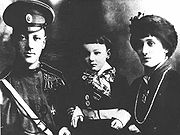
His parents were two prominent poets Nikolay Gumilev and Anna AkhmatovaAnna Akhmatova
Anna Andreyevna Gorenko , better known by the pen name Anna Akhmatova , was a Russian and Soviet modernist poet, one of the most acclaimed writers in the Russian canon.Harrington p11...
. They were divorced when Lev was 7 years old, and his father was executed because of his anti-Bolshevik sympathies when Lev was just 9. During his mother's persecution in the 1930s, he was expelled from Leningrad University and deported to Gulag
Gulag
The Gulag was the government agency that administered the main Soviet forced labor camp systems. While the camps housed a wide range of convicts, from petty criminals to political prisoners, large numbers were convicted by simplified procedures, such as NKVD troikas and other instruments of...
s, where he would spend most of his youth, from 1938 until 1956. During a brief stint at large, he joined the Red Army
Red Army
The Workers' and Peasants' Red Army started out as the Soviet Union's revolutionary communist combat groups during the Russian Civil War of 1918-1922. It grew into the national army of the Soviet Union. By the 1930s the Red Army was among the largest armies in history.The "Red Army" name refers to...
and took part in the Battle of Berlin
Battle of Berlin
The Battle of Berlin, designated the Berlin Strategic Offensive Operation by the Soviet Union, was the final major offensive of the European Theatre of World War II....
. In order to secure his release, Akhmatova was forced to publish dithyramb
Dithyramb
The dithyramb was an ancient Greek hymn sung and danced in honour of Dionysus, the god of wine and fertility; the term was also used as an epithet of the god: Plato, in The Laws, while discussing various kinds of music mentions "the birth of Dionysos, called, I think, the dithyramb." Plato also...
s to Joseph Stalin
Joseph Stalin
Joseph Vissarionovich Stalin was the Premier of the Soviet Union from 6 May 1941 to 5 March 1953. He was among the Bolshevik revolutionaries who brought about the October Revolution and had held the position of first General Secretary of the Communist Party of the Soviet Union's Central Committee...
, but this did not help. Their relations remained strained, as Lev blamed his mother for the misfortunes that had dogged his youth.
Hermitage Museum
The State Hermitage is a museum of art and culture in Saint Petersburg, Russia. One of the largest and oldest museums of the world, it was founded in 1764 by Catherine the Great and has been opened to the public since 1852. Its collections, of which only a small part is on permanent display,...
, whose director, Mikhail Artamonov
Mikhail Artamonov
Mikhail Illarionovich Artamonov Artamonov's scientific career was centered on the Leningrad University, where he was a professor since 1935 and the head of the chair of archeology since 1949. He researched Bronze Age and Iron Age settlements by the Don River, in the North Caucasus and in the Ukraine...
, he would come to appreciate as his mentor. Under Artamonov's guidance, he became interested in Khazar studies and steppe peoples in general. In the 1950s and 1960s he participated in several expeditions to the Volga Delta
Volga Delta
The Volga Delta is the largest river delta in Europe, and occurs where Europe's largest river system, the Volga River, drains into the Caspian Sea in Russia's Astrakhan Oblast, north-east of the republic of Kalmykia. The delta is located in the Caspian Depression—the far eastern part of the delta...
and North Caucasus
North Caucasus
The North Caucasus is the northern part of the Caucasus region between the Black and Caspian Seas and within European Russia. The term is also used as a synonym for the North Caucasus economic region of Russia....
. He proposed an archeological site for Samandar
Samandar (city)
Samandar was a city in Khazaria on the western shore of the Caspian Sea, south of the city of Atil, in the North Caucasus. The exact location of the city is unknown, but most likely, it was situated on the Terek river near the present-day city of Kizlyar, which, like Samandar, is noted for its...
as well as the theory of the Caspian transgression in collaboration with geologist Aleksandr Alyoksin as one of the reasons for Khazar decline. In 1960 he started delivering lectures at Leningrad University. Two years later, he defended his doctoral thesis on ancient Turk
Turkic peoples
The Turkic peoples are peoples residing in northern, central and western Asia, southern Siberia and northwestern China and parts of eastern Europe. They speak languages belonging to the Turkic language family. They share, to varying degrees, certain cultural traits and historical backgrounds...
s. From the 1960s, he worked in the Geography Institute, where he would defend another doctoral thesis, this time in geography.
Although his ideas were rejected by the official Soviet doctrine and most of his monographs banned from publication, Gumilev came to attract much publicity, especially in the Perestroika
Perestroika
Perestroika was a political movement within the Communist Party of the Soviet Union during 1980s, widely associated with the Soviet leader Mikhail Gorbachev...
years. As an indication of his popularity, the Kazakh
Kazakhs
The Kazakhs are a Turkic people of the northern parts of Central Asia ....
president Nursultan Nazarbayev
Nursultan Nazarbayev
Nursultan Abishuly Nazarbayev has served as the President of Kazakhstan since the nation received its independence in 1991, after the fall of the Soviet Union...
ordered the L. N. Gumilev Eurasian University (Евразийский Национальный университет имени Л. Н. Гумилёва) to be erected just opposite his own palace on the central square of the new Kazakh capital, Astana
Astana
Astana , formerly known as Akmola , Tselinograd and Akmolinsk , is the capital and second largest city of Kazakhstan, with an officially estimated population of 708,794 as of 1 August 2010...
.
Ideas
Gumilev attempted to explain the waves of nomadic migration that rocked the great steppe of Eurasia for centuries by geographical factors such as annual vacillations in solar radiation, which determine the area of grasslands that could be used for grazing livestock. According to this idea, when the steppe areas shrank drastically, the nomads of Central Asia began moving to the fertile pastures of Europe or China.To describe his ideas on the genesis and evolution of ethnoses, Gumilev introduced the concept of "passionarity", which may be explained as the level of vital energy and power characteristic of any given ethnic group. Gumilev argued that they pass through stages of rise, development, climax
Climax
- Common general uses :* Climax * Climax * Climax community* Climax vegetation in an ecosystem* Sexual climax, another term for orgasm- Brand names and titles :* The Climax, a 1944 film...
, inertia
Inertia
Inertia is the resistance of any physical object to a change in its state of motion or rest, or the tendency of an object to resist any change in its motion. It is proportional to an object's mass. The principle of inertia is one of the fundamental principles of classical physics which are used to...
l, convolution
Convolution
In mathematics and, in particular, functional analysis, convolution is a mathematical operation on two functions f and g, producing a third function that is typically viewed as a modified version of one of the original functions. Convolution is similar to cross-correlation...
, and memorial. It is during the "acmatic" phases, when the national passionarity reaches its maximum heat, that the great conquests are made. The current state of Europe he described as deep inertia, or "introduction to obscuration", to use his own term. The passionarity of the Arabic world, on the other hand, is still high.
Drawing inspiration from the works of Konstantin Leontyev and Nikolay Danilevsky, Gumilev regarded Russians as a "super-ethnos" which is kindred to Turkic peoples of the Eurasian steppe. Those periods when Russia has been said to conflict with the steppe peoples, Gumilev reinterpreted as the periods of consolidation of Russian power with that of steppe in order to oppose destructive influences from Catholic Europe, that posed a potential threat to integrity of the Russian ethnic group.
In accordance with his pan-Asiatic theories, he supported the national movements of Tatars
Tatars
Tatars are a Turkic speaking ethnic group , numbering roughly 7 million.The majority of Tatars live in the Russian Federation, with a population of around 5.5 million, about 2 million of which in the republic of Tatarstan.Significant minority populations are found in Uzbekistan, Kazakhstan,...
, Kazakhs
Kazakhs
The Kazakhs are a Turkic people of the northern parts of Central Asia ....
, and other Turkic peoples, in addition to those of the Mongolians and other East Asians. Unsurprisingly, Gumilev's teachings have enjoyed immense popularity in Central Asian countries. In Kazan
Kazan
Kazan is the capital and largest city of the Republic of Tatarstan, Russia. With a population of 1,143,546 , it is the eighth most populous city in Russia. Kazan lies at the confluence of the Volga and Kazanka Rivers in European Russia. In April 2009, the Russian Patent Office granted Kazan the...
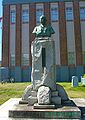
, for example, a monument to him was opened in August 2005.
Accusations of anti-Semitism
Gumilev did not extend this ethnological ecumenism, however, to the medieval Jews, whom he regarded as a parasitic, international urban class that had dominated the Khazars who in turn had subjected the early East SlavsEast Slavs
The East Slavs are Slavic peoples speaking East Slavic languages. Formerly the main population of the medieval state of Kievan Rus, by the seventeenth century they evolved into the Russian, Ukrainian, and Belarusian peoples.-Sources:...
to the "Khazar Yoke". This last phrase he adapted from the traditional term "Tatar Yoke" for the Mongol domination of medieval Russia, a term Gumilev rejected for he did not regard the Mongol conquest as a necessarily negative event. In particular, and with virtually no support from primary sources, he asserted that the Radhanites had been instrumental in the exploitation of East Slavic people and had exerted undue influence on the sociopolitical and economic landscape of the early Middle Ages
Middle Ages
The Middle Ages is a periodization of European history from the 5th century to the 15th century. The Middle Ages follows the fall of the Western Roman Empire in 476 and precedes the Early Modern Era. It is the middle period of a three-period division of Western history: Classic, Medieval and Modern...
. Gumilev maintained that the Jewish culture was by nature mercantile and existed outside and in opposition to its environment. According to this view, Jews share a specific way of thinking
Ideology
An ideology is a set of ideas that constitutes one's goals, expectations, and actions. An ideology can be thought of as a comprehensive vision, as a way of looking at things , as in common sense and several philosophical tendencies , or a set of ideas proposed by the dominant class of a society to...
, and this is associated with the moral
Moral
A moral is a message conveyed or a lesson to be learned from a story or event. The moral may be left to the hearer, reader or viewer to determine for themselves, or may be explicitly encapsulated in a maxim...
norms of Judaism. According to Gumilev, the Jews also do not bear arms themselves, but wage wars by proxies
Proxy war
A proxy war or proxy warfare is a war that results when opposing powers use third parties as substitutes for fighting each other directly. While powers have sometimes used governments as proxies, violent non-state actors, mercenaries, or other third parties are more often employed...
or mercenaries
Mercenary
A mercenary, is a person who takes part in an armed conflict based on the promise of material compensation rather than having a direct interest in, or a legal obligation to, the conflict itself. A non-conscript professional member of a regular army is not considered to be a mercenary although he...
. These ideas have led scholars such as Vadim Rossman, John Klier
John Klier
Professor John Klier was a pioneering historian of Russian Jewry and a pivotal figure in academic Jewish studies and East European history in the UK and beyond. At the end of his career and life, Professor Klier was the Sidney and Elizabeth Corob Professor of Modern Jewish History at University...
, Victor Yasmann, Victor Shnirelman, and Mikhail Tripolsky to describe Gumilev as antisemitic.
Works
- The Hsiung-nu (1960) — on the XiongnuXiongnuThe Xiongnu were ancient nomadic-based people that formed a state or confederation north of the agriculture-based empire of the Han Dynasty. Most of the information on the Xiongnu comes from Chinese sources...
- Ancient TurksTurkic peoplesThe Turkic peoples are peoples residing in northern, central and western Asia, southern Siberia and northwestern China and parts of eastern Europe. They speak languages belonging to the Turkic language family. They share, to varying degrees, certain cultural traits and historical backgrounds...
(1964) - Searching for an Imaginary Kingdom : The Legend of the Kingdom of Prester JohnPrester JohnThe legends of Prester John were popular in Europe from the 12th through the 17th centuries, and told of a Christian patriarch and king said to rule over a Christian nation lost amidst the Muslims and pagans in the Orient. Written accounts of this kingdom are variegated collections of medieval...
(1970) - The Hsiung-nu in China (1974)
- Ethnogenesis and the Biosphere of Earth (1978)
- Ancient Rus and the Great Steppe (1989)
- An End and a New Beginning (1989)
- From the RusRus' (people)The Rus' were a group of Varangians . According to the Primary Chronicle of Rus, compiled in about 1113 AD, the Rus had relocated from the Baltic region , first to Northeastern Europe, creating an early polity which finally came under the leadership of Rurik...
to Russia (1992)