


La traviata

Encyclopedia
La traviata is an opera
in three acts by Giuseppe Verdi
set to an Italian libretto
by Francesco Maria Piave
. It is based on La dame aux Camélias
(1852), a play adapted from the novel by Alexandre Dumas, fils
. The title La traviata means literally The Fallen Woman, or perhaps more figuratively, The Woman Who Goes Astray. It was originally entitled Violetta, after the main character.
Piave and Verdi wanted to follow Dumas in giving the opera a contemporary setting, but the authorities at La Fenice
insisted that it be set in the past, "c. 1700". It was not until the 1880s that the composer and librettist's original wishes were carried out and "realistic" productions were staged.
opera house in Venice. The performance was jeered at times by the audience, who directed some of their scorn at the casting of soprano Fanny Salvini-Donatelli
in the lead role of Violetta. Salvini-Donatelli, though an acclaimed singer, was considered too old (at 38) and overweight by the audience to credibly play a young woman dying of consumption. (Verdi had previously attempted to convince the manager of La Fenice to re-cast the role with a younger woman, but with no success.) Nevertheless, the first act was met with applause and cheering at the end; but in the second act, the audience began to turn against the performance, especially after the singing of the baritone
(Felice Varesi
) and the tenor
(Lodovico Graziani
). The day after, Verdi wrote to his friend Muzio in what has now become perhaps his most famous letter: "La Traviata last night a failure. My fault or the singers'? Time will tell."
After some revisions between 1853 and May 1854, mostly affecting acts 2 and 3, the opera was presented again in Venice, this time at the Teatro San Benedetto
. This performance was a critical success, largely due to Maria Spezia-Aldighieri
's portrayal of Violetta.
On 24 May 1856 the revised version was presented at Her Majesty's Theatre
in London followed on 3 December of that year by its premiere in New York.
Today, the opera has become immensely popular and it is a staple of the standard operatic repertoire. It is second on the Operabase list of the most-performed operas worldwide, behind only The Magic Flute
.
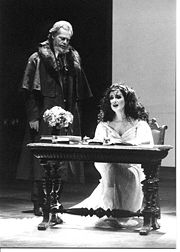
Violetta Valéry, a famed courtesan
, throws a lavish party at her Paris salon
to celebrate her recovery from an illness. Gastone, a count, has brought with him his friend, the young nobleman Alfredo Germont, who has long adored Violetta from afar. While walking to the salon, Gastone tells Violetta that Alfredo loves her, and that while she was ill, he came to her house every day. Alfredo joins them, admitting the truth of Gastone's remarks.
The Baron, Violetta's current lover, waits nearby to escort her to the salon where the Baron is asked to give a toast, but he refuses, and the crowd turns to Alfredo (Alfredo, Violetta, chorus: Libiamo ne' lieti calici
(Brindisi
) – "Drinking song").
From the next room, the sound of the orchestra is heard and the guests move there to dance. Feeling dizzy, Violetta asks her guests to go ahead and to leave her to rest until she recovers. While the guests dance in the next room, Violetta looks at her pale face in her mirror. Alfredo enters and expresses his concern for her fragile health, later declaring his love for her (Alfredo, Violetta: Un dì, felice, eterea
– "The day I met you"). At first she rejects him because his love means nothing to her, but there is something about Alfredo that touches her heart. He is about to leave when she gives him a flower, telling him to return it when it has wilted. She promises to meet him the next day.
After the guests leave, Violetta wonders if Alfredo could actually be the one in her life (Violetta: Ah, fors'è lui – "Perhaps he is the one"). But she concludes that she needs freedom to live her life (Violetta: Sempre libera – "Always free"). From off stage, Alfredo's voice is heard singing about love as he walks down the street.
Three months later, Alfredo and Violetta are living together in a peaceful country house outside Paris. Violetta has fallen in love with Alfredo and she has completely abandoned her former life. Alfredo sings of their happy life together (Alfredo: De miei bollenti spiriti – "Wild my dream of ecstasy"). Annina, the maid, arrives from Paris, and, when questioned by Alfredo, tells him that she went there to sell the horses, carriages and everything owned by Violetta to support their country lifestyle.
Alfredo is shocked to learn this and leaves for Paris immediately to settle matters himself. Violetta returns home and receives an invitation from her friend, Flora, to a party in Paris that evening. Alfredo's father, Giorgio Germont, is announced and demands that she break off her relationship with his son for the sake of his family, since he reveals that Violetta's relationship with Alfredo has threatened his daughter's engagement (Giorgio: Pura siccome un angelo – "I have a daughter as pure as an angel") because of Violetta's reputation. Meanwhile, reluctantly, he becomes impressed by Violetta's nobility, something which he did not expect from a courtesan. She responds that she cannot end the relationship because she loves him so much, but Giorgio pleads with her for the sake of his family. With growing remorse, she finally agrees (Violetta, Giorgio: Dite alla giovine – "Say to this child of thine") and says goodbye to Giorgio. In a gesture of gratitude for her kindness and sacrifice, Giorgio kisses her forehead before leaving her weeping alone.
Violetta gives a note to Annina to send to Flora accepting the party invitation and, as she is writing a farewell letter to Alfredo, he enters. She can barely control her sadness and tears; she tells him repeatedly of her unconditional love (Violetta: Amami Alfredo – "Love me, Alfredo"). Before rushing out and setting off for Paris, she hands the farewell letter to her servant to give to Alfredo.
Soon, the servant brings the letter to Alfredo and, as soon as he has read it, Giorgio returns and attempts to comfort his son, reminding him of his family in Provence (Giorgio: Di Provenza il mar – "In Provence"). Alfredo suspects the Baron is behind his separation with Violetta and the party invitation, which he finds on the desk, strengthens his suspicions. He determines to confront Violetta at the party. Giorgio tries to stop Alfredo, but he rushes out.
Scene 2: Party at Flora's house
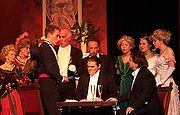 At the party, the Marquis tells Flora that Violetta and Alfredo have separated. She calls for the entertainers to perform for the guests (Chorus: Noi siamo zingarelle – "We're youthful gypsies"); (Chorus: Di Madride noi siam mattadori – "We are bullfighters from Madrid"). Gastone and his friends join the matadors and sing (Gastone, chorus, dancers: E Piquillo, un bel gagliardo – "Twas Piquillo, so young and so daring").
Violetta arrives with Baron Douphol. They see Alfredo at the gambling table. When he sees them, Alfredo loudly proclaims that he will take Violetta home with him. Feeling annoyed, the Baron goes to the gambling table and joins him in a game. As they bet, Alfredo wins some large sums until Flora announces that supper is ready. Alfredo leaves with handfuls of money.
As everyone is leaving the room, Violetta has asked Alfredo to see her. Fearing that the Baron's anger will lead him to challenge Alfredo to a duel, she gently asks Alfredo to leave. Alfredo misunderstands her apprehension and demands that she admit that she loves the Baron. In grief, she makes that admission and, furiously, Alfredo calls the guests to witness what he has to say (Questa donna conoscete? – "You know this lady?"). He humiliates and denounces Violetta in front of the guests, and then throws his winnings at her feet. She falls, fainting onto the floor. The guests reprimand Alfredo: "Leave at once, we despise you. You have insulted a noble lady".
In search of his son, Giorgio enters the hall and, knowing the real significance of the scene, denounces his son's behavior (Giorgio, Alfredo, Violetta, chorus: Di sprezzo degno, se stesso rendo – "Worthy of contempt is the man").
Flora and the ladies attempt to persuade Violetta to leave the dining room, but Violetta turns to Alfredo: Alfredo, Alfredo, di questo core non puoi comprendere tutto l'amore – "Alfredo, Alfredo, you can't imagine the love in my heart for you".
Dr. Grenvil tells Annina that Violetta will not live long since her tuberculosis has worsened. Alone in her room, Violetta reads a letter from Alfredo's father telling her that the Baron was only wounded in his duel with Alfredo; that he has informed Alfredo of the sacrifice she has made for him and his sister; and that he is sending his son to see her as quickly as possible to ask for her forgiveness. But Violetta senses it is too late (Violetta: Addio del passato – "So closes my sad story").
Annina rushes in the room to tell Violetta of Alfredo's arrival. The lovers are reunited and Alfredo suggests that they leave Paris (Alfredo, Violetta: Parigi, o cara , noi lasceremo – "Dearest, we'll leave Paris" ).
But it is too late: she knows her time is up (Alfredo, Violetta: Gran Dio! morir si giovane – "O, God! to die so young"). Alfredo's father enters with the doctor, regretting what he has done. After singing a duet with Alfredo, Violetta suddenly revives, exclaiming that the pain and discomfort has left her. A moment later, she dies in Alfredo's arms.
s (fl. 2 doubling piccolo
), 2 oboe
s, 2 clarinet
s, 2 bassoon
s, 4 horns
, 2 trumpet
s, 3 trombone
s, cimbasso
, timpani
, cymbal
s, bass drum
, triangle
, strings
Banda: 2 piccolos, A-Flat piccolo clarinet
, E-flat clarinet
, 2 B-flat clarinets, 2 horns, flugelhorn
, 3 trumpets, 2 trombones, tambourine
, bass drum, castanets, harp
, 2 double bass
recording
Opera
Opera is an art form in which singers and musicians perform a dramatic work combining text and musical score, usually in a theatrical setting. Opera incorporates many of the elements of spoken theatre, such as acting, scenery, and costumes and sometimes includes dance...
in three acts by Giuseppe Verdi
Giuseppe Verdi
Giuseppe Fortunino Francesco Verdi was an Italian Romantic composer, mainly of opera. He was one of the most influential composers of the 19th century...
set to an Italian libretto
Libretto
A libretto is the text used in an extended musical work such as an opera, operetta, masque, oratorio, cantata, or musical. The term "libretto" is also sometimes used to refer to the text of major liturgical works, such as mass, requiem, and sacred cantata, or even the story line of a...
by Francesco Maria Piave
Francesco Maria Piave
Francesco Maria Piave was an Italian opera librettist who was born in Murano in the lagoon of Venice, during the brief Napoleonic Kingdom of Italy. His career spanned over twenty years working with many of the significant composers of his day...
. It is based on La dame aux Camélias
The Lady of the Camellias
The Lady of the Camellias is a novel by Alexandre Dumas, fils, first published in 1848, and subsequently adapted for the stage. The Lady of the Camellias premiered at the Théâtre du Vaudeville in Paris, France on February 2, 1852. The play was an instant success, and Giuseppe Verdi immediately set...
(1852), a play adapted from the novel by Alexandre Dumas, fils
Alexandre Dumas, fils
Alexandre Dumas, fils was a French author and dramatist. He was the son of Alexandre Dumas, père, also a writer and playwright.-Biography:...
. The title La traviata means literally The Fallen Woman, or perhaps more figuratively, The Woman Who Goes Astray. It was originally entitled Violetta, after the main character.
Piave and Verdi wanted to follow Dumas in giving the opera a contemporary setting, but the authorities at La Fenice
La Fenice
Teatro La Fenice is an opera house in Venice, Italy. It is one of the most famous theatres in Europe, the site of many famous operatic premieres. Its name reflects its role in permitting an opera company to "rise from the ashes" despite losing the use of two theatres...
insisted that it be set in the past, "c. 1700". It was not until the 1880s that the composer and librettist's original wishes were carried out and "realistic" productions were staged.
Performance history
The first performance of the opera was on 6 March 1853 at the La FeniceLa Fenice
Teatro La Fenice is an opera house in Venice, Italy. It is one of the most famous theatres in Europe, the site of many famous operatic premieres. Its name reflects its role in permitting an opera company to "rise from the ashes" despite losing the use of two theatres...
opera house in Venice. The performance was jeered at times by the audience, who directed some of their scorn at the casting of soprano Fanny Salvini-Donatelli
Fanny Salvini-Donatelli
Fanny Salvini-Donatelli was an Italian operatic soprano. She is best known today for creating the role of Violetta in Verdi's opera, La traviata, but she was also an admired interpreter of the composer's other works as well as those by Donizetti.-Biography:Fanny Salvini-Donatelli, whose real name...
in the lead role of Violetta. Salvini-Donatelli, though an acclaimed singer, was considered too old (at 38) and overweight by the audience to credibly play a young woman dying of consumption. (Verdi had previously attempted to convince the manager of La Fenice to re-cast the role with a younger woman, but with no success.) Nevertheless, the first act was met with applause and cheering at the end; but in the second act, the audience began to turn against the performance, especially after the singing of the baritone
Baritone
Baritone is a type of male singing voice that lies between the bass and tenor voices. It is the most common male voice. Originally from the Greek , meaning deep sounding, music for this voice is typically written in the range from the second F below middle C to the F above middle C Baritone (or...
(Felice Varesi
Felice Varesi
Felice Varesi was a French-born Italian baritone with an illustrious singing career that began in the 1830s and extended into the 1860s...
) and the tenor
Tenor
The tenor is a type of male singing voice and is the highest male voice within the modal register. The typical tenor voice lies between C3, the C one octave below middle C, to the A above middle C in choral music, and up to high C in solo work. The low extreme for tenors is roughly B2...
(Lodovico Graziani
Lodovico Graziani
Lodovico Graziani was an Italian operatic tenor. According to John Warrack and Ewan West, writing in The Oxford Dictionary of Opera: "His voice was clear and vibrant, but he lacked dramatic gifts." He is now mainly remembered for having created the role of Alfredo Germont in the world premiere of...
). The day after, Verdi wrote to his friend Muzio in what has now become perhaps his most famous letter: "La Traviata last night a failure. My fault or the singers'? Time will tell."
After some revisions between 1853 and May 1854, mostly affecting acts 2 and 3, the opera was presented again in Venice, this time at the Teatro San Benedetto
Teatro San Benedetto
The Teatro San Benedetto was a theatre in Venice, particularly prominent in the operatic life of the city in the 18th and early 19th centuries. It saw the premieres of over 140 operas, including Rossini's L'italiana in Algeri, and was the theatre of choice for the presentation of opera seria until...
. This performance was a critical success, largely due to Maria Spezia-Aldighieri
Maria Spezia-Aldighieri
Maria Spezia-Aldighieri was an Italian operatic soprano who had an active international career from 1849 up into the 1870s. She excelled in the coloratura soprano repertoire and was particularly admired for her portrayals in the operas of Giuseppe Verdi...
's portrayal of Violetta.
On 24 May 1856 the revised version was presented at Her Majesty's Theatre
Her Majesty's Theatre
Her Majesty's Theatre is a West End theatre, in Haymarket, City of Westminster, London. The present building was designed by Charles J. Phipps and was constructed in 1897 for actor-manager Herbert Beerbohm Tree, who established the Royal Academy of Dramatic Art at the theatre...
in London followed on 3 December of that year by its premiere in New York.
Today, the opera has become immensely popular and it is a staple of the standard operatic repertoire. It is second on the Operabase list of the most-performed operas worldwide, behind only The Magic Flute
The Magic Flute
The Magic Flute is an opera in two acts composed in 1791 by Wolfgang Amadeus Mozart to a German libretto by Emanuel Schikaneder. The work is in the form of a Singspiel, a popular form that included both singing and spoken dialogue....
.
Roles
| Role | Voice type Voice type A voice type is a particular kind of human singing voice perceived as having certain identifying qualities or characteristics. Voice classification is the process by which human voices are evaluated and are thereby designated into voice types... |
Premiere cast, 6 March 1853 (Conductor Conducting Conducting is the art of directing a musical performance by way of visible gestures. The primary duties of the conductor are to unify performers, set the tempo, execute clear preparations and beats, and to listen critically and shape the sound of the ensemble... : Gaetano Mares Gaetano Mares Gaetano Mares was an Italian conductor. He notably conducted the world premieres of Giuseppe Verdi's Ernani and Verdi's La traviata at La Fenice in Venice.-References:... ) |
|---|---|---|
| Violetta Valéry, a courtesan | soprano Soprano A soprano is a voice type with a vocal range from approximately middle C to "high A" in choral music, or to "soprano C" or higher in operatic music. In four-part chorale style harmony, the soprano takes the highest part, which usually encompasses the melody... |
Fanny Salvini-Donatelli Fanny Salvini-Donatelli Fanny Salvini-Donatelli was an Italian operatic soprano. She is best known today for creating the role of Violetta in Verdi's opera, La traviata, but she was also an admired interpreter of the composer's other works as well as those by Donizetti.-Biography:Fanny Salvini-Donatelli, whose real name... |
| Alfredo Germont, a young bourgeois from a provincial family | tenor Tenor The tenor is a type of male singing voice and is the highest male voice within the modal register. The typical tenor voice lies between C3, the C one octave below middle C, to the A above middle C in choral music, and up to high C in solo work. The low extreme for tenors is roughly B2... |
Lodovico Graziani Lodovico Graziani Lodovico Graziani was an Italian operatic tenor. According to John Warrack and Ewan West, writing in The Oxford Dictionary of Opera: "His voice was clear and vibrant, but he lacked dramatic gifts." He is now mainly remembered for having created the role of Alfredo Germont in the world premiere of... |
| Giorgio Germont, Alfredo's father | baritone Baritone Baritone is a type of male singing voice that lies between the bass and tenor voices. It is the most common male voice. Originally from the Greek , meaning deep sounding, music for this voice is typically written in the range from the second F below middle C to the F above middle C Baritone (or... |
Felice Varesi Felice Varesi Felice Varesi was a French-born Italian baritone with an illustrious singing career that began in the 1830s and extended into the 1860s... |
| Flora Bervoix, Violetta's friend | mezzo-soprano Mezzo-soprano A mezzo-soprano is a type of classical female singing voice whose range lies between the soprano and the contralto singing voices, usually extending from the A below middle C to the A two octaves above... |
Speranza Giuseppini |
| Annina, Violetta's maid | soprano | Carlotta Berini |
| Gastone, Alfredo's friend | tenor | Angelo Zuliani |
| Barone Douphol, Violetta's lover, a rival of Alfredo | baritone | Francesco Dragone |
| Marchese d'Obigny | bass Bass (voice type) A bass is a type of male singing voice and possesses the lowest vocal range of all voice types. According to The New Grove Dictionary of Opera, a bass is typically classified as having a range extending from around the second E below middle C to the E above middle C... |
Arnaldo Silvestri |
| Dottore Grenvil | bass | Andrea Bellini Andrea Bellini Andrea Bellini was an Italian operatic bass who had an active career performing in Italy's major opera houses from the 1840s through the 1870s. He specialized in the buffo repertoire and was most often heard in comprimario roles.-Career:... |
| Giuseppe, Violetta's servant | tenor | G. Borsato |
| Flora's servant | bass | G. Tona |
| Commissioner | bass | Antonio Mazzini |
Act 1
The salon in Violetta's houseVioletta Valéry, a famed courtesan
Courtesan
A courtesan was originally a female courtier, which means a person who attends the court of a monarch or other powerful person.In feudal society, the court was the centre of government as well as the residence of the monarch, and social and political life were often completely mixed together...
, throws a lavish party at her Paris salon
Salon (gathering)
A salon is a gathering of people under the roof of an inspiring host, held partly to amuse one another and partly to refine taste and increase their knowledge of the participants through conversation. These gatherings often consciously followed Horace's definition of the aims of poetry, "either to...
to celebrate her recovery from an illness. Gastone, a count, has brought with him his friend, the young nobleman Alfredo Germont, who has long adored Violetta from afar. While walking to the salon, Gastone tells Violetta that Alfredo loves her, and that while she was ill, he came to her house every day. Alfredo joins them, admitting the truth of Gastone's remarks.
The Baron, Violetta's current lover, waits nearby to escort her to the salon where the Baron is asked to give a toast, but he refuses, and the crowd turns to Alfredo (Alfredo, Violetta, chorus: Libiamo ne' lieti calici
Libiamo ne' lieti calici
Libiamo ne'lieti calici is the most famous duet from Verdi's La traviata, one of the most well known fragments of opera around the world, and an obligatory performance for any great tenor. The song is categorised as a Brindisi, which encourages alcoholic drinking...
(Brindisi
Brindisi (music)
A is a song in which a company is exhorted to drink, a drinking song.The word is Italian, but it derives from an old German phrase, – " offer it to you", which at one time was used to introduce a toast...
) – "Drinking song").
From the next room, the sound of the orchestra is heard and the guests move there to dance. Feeling dizzy, Violetta asks her guests to go ahead and to leave her to rest until she recovers. While the guests dance in the next room, Violetta looks at her pale face in her mirror. Alfredo enters and expresses his concern for her fragile health, later declaring his love for her (Alfredo, Violetta: Un dì, felice, eterea
Un di, felice, eterea
Un dì, felice, eterea is a duet from the first act of Giuseppe Verdi's opera La Traviata. It is sung by the male and female protagonists of the opera, Alfredo and Violetta . The main melody of the duet, which is very famous in its own right, is also an important musical theme throughout the opera...
– "The day I met you"). At first she rejects him because his love means nothing to her, but there is something about Alfredo that touches her heart. He is about to leave when she gives him a flower, telling him to return it when it has wilted. She promises to meet him the next day.
After the guests leave, Violetta wonders if Alfredo could actually be the one in her life (Violetta: Ah, fors'è lui – "Perhaps he is the one"). But she concludes that she needs freedom to live her life (Violetta: Sempre libera – "Always free"). From off stage, Alfredo's voice is heard singing about love as he walks down the street.
Act 2
Scene 1: Violetta's country house outside ParisThree months later, Alfredo and Violetta are living together in a peaceful country house outside Paris. Violetta has fallen in love with Alfredo and she has completely abandoned her former life. Alfredo sings of their happy life together (Alfredo: De miei bollenti spiriti – "Wild my dream of ecstasy"). Annina, the maid, arrives from Paris, and, when questioned by Alfredo, tells him that she went there to sell the horses, carriages and everything owned by Violetta to support their country lifestyle.
Alfredo is shocked to learn this and leaves for Paris immediately to settle matters himself. Violetta returns home and receives an invitation from her friend, Flora, to a party in Paris that evening. Alfredo's father, Giorgio Germont, is announced and demands that she break off her relationship with his son for the sake of his family, since he reveals that Violetta's relationship with Alfredo has threatened his daughter's engagement (Giorgio: Pura siccome un angelo – "I have a daughter as pure as an angel") because of Violetta's reputation. Meanwhile, reluctantly, he becomes impressed by Violetta's nobility, something which he did not expect from a courtesan. She responds that she cannot end the relationship because she loves him so much, but Giorgio pleads with her for the sake of his family. With growing remorse, she finally agrees (Violetta, Giorgio: Dite alla giovine – "Say to this child of thine") and says goodbye to Giorgio. In a gesture of gratitude for her kindness and sacrifice, Giorgio kisses her forehead before leaving her weeping alone.
Violetta gives a note to Annina to send to Flora accepting the party invitation and, as she is writing a farewell letter to Alfredo, he enters. She can barely control her sadness and tears; she tells him repeatedly of her unconditional love (Violetta: Amami Alfredo – "Love me, Alfredo"). Before rushing out and setting off for Paris, she hands the farewell letter to her servant to give to Alfredo.
Soon, the servant brings the letter to Alfredo and, as soon as he has read it, Giorgio returns and attempts to comfort his son, reminding him of his family in Provence (Giorgio: Di Provenza il mar – "In Provence"). Alfredo suspects the Baron is behind his separation with Violetta and the party invitation, which he finds on the desk, strengthens his suspicions. He determines to confront Violetta at the party. Giorgio tries to stop Alfredo, but he rushes out.
Scene 2: Party at Flora's house
Violetta arrives with Baron Douphol. They see Alfredo at the gambling table. When he sees them, Alfredo loudly proclaims that he will take Violetta home with him. Feeling annoyed, the Baron goes to the gambling table and joins him in a game. As they bet, Alfredo wins some large sums until Flora announces that supper is ready. Alfredo leaves with handfuls of money.
As everyone is leaving the room, Violetta has asked Alfredo to see her. Fearing that the Baron's anger will lead him to challenge Alfredo to a duel, she gently asks Alfredo to leave. Alfredo misunderstands her apprehension and demands that she admit that she loves the Baron. In grief, she makes that admission and, furiously, Alfredo calls the guests to witness what he has to say (Questa donna conoscete? – "You know this lady?"). He humiliates and denounces Violetta in front of the guests, and then throws his winnings at her feet. She falls, fainting onto the floor. The guests reprimand Alfredo: "Leave at once, we despise you. You have insulted a noble lady".
In search of his son, Giorgio enters the hall and, knowing the real significance of the scene, denounces his son's behavior (Giorgio, Alfredo, Violetta, chorus: Di sprezzo degno, se stesso rendo – "Worthy of contempt is the man").
Flora and the ladies attempt to persuade Violetta to leave the dining room, but Violetta turns to Alfredo: Alfredo, Alfredo, di questo core non puoi comprendere tutto l'amore – "Alfredo, Alfredo, you can't imagine the love in my heart for you".
Act 3
Violetta's bedroomDr. Grenvil tells Annina that Violetta will not live long since her tuberculosis has worsened. Alone in her room, Violetta reads a letter from Alfredo's father telling her that the Baron was only wounded in his duel with Alfredo; that he has informed Alfredo of the sacrifice she has made for him and his sister; and that he is sending his son to see her as quickly as possible to ask for her forgiveness. But Violetta senses it is too late (Violetta: Addio del passato – "So closes my sad story").
Annina rushes in the room to tell Violetta of Alfredo's arrival. The lovers are reunited and Alfredo suggests that they leave Paris (Alfredo, Violetta: Parigi, o cara , noi lasceremo – "Dearest, we'll leave Paris" ).
But it is too late: she knows her time is up (Alfredo, Violetta: Gran Dio! morir si giovane – "O, God! to die so young"). Alfredo's father enters with the doctor, regretting what he has done. After singing a duet with Alfredo, Violetta suddenly revives, exclaiming that the pain and discomfort has left her. A moment later, she dies in Alfredo's arms.
Instrumentation
2 fluteFlute
The flute is a musical instrument of the woodwind family. Unlike woodwind instruments with reeds, a flute is an aerophone or reedless wind instrument that produces its sound from the flow of air across an opening...
s (fl. 2 doubling piccolo
Piccolo
The piccolo is a half-size flute, and a member of the woodwind family of musical instruments. The piccolo has the same fingerings as its larger sibling, the standard transverse flute, but the sound it produces is an octave higher than written...
), 2 oboe
Oboe
The oboe is a double reed musical instrument of the woodwind family. In English, prior to 1770, the instrument was called "hautbois" , "hoboy", or "French hoboy". The spelling "oboe" was adopted into English ca...
s, 2 clarinet
Clarinet
The clarinet is a musical instrument of woodwind type. The name derives from adding the suffix -et to the Italian word clarino , as the first clarinets had a strident tone similar to that of a trumpet. The instrument has an approximately cylindrical bore, and uses a single reed...
s, 2 bassoon
Bassoon
The bassoon is a woodwind instrument in the double reed family that typically plays music written in the bass and tenor registers, and occasionally higher. Appearing in its modern form in the 19th century, the bassoon figures prominently in orchestral, concert band and chamber music literature...
s, 4 horns
Horn (instrument)
The horn is a brass instrument consisting of about of tubing wrapped into a coil with a flared bell. A musician who plays the horn is called a horn player ....
, 2 trumpet
Trumpet
The trumpet is the musical instrument with the highest register in the brass family. Trumpets are among the oldest musical instruments, dating back to at least 1500 BCE. They are played by blowing air through closed lips, producing a "buzzing" sound which starts a standing wave vibration in the air...
s, 3 trombone
Trombone
The trombone is a musical instrument in the brass family. Like all brass instruments, sound is produced when the player’s vibrating lips cause the air column inside the instrument to vibrate...
s, cimbasso
Cimbasso
The cimbasso is a brass instrument in the trombone family, with a sound ranging from warm and mellow to bright and menacing. It has three to five piston or rotary valves, a predominantly cylindrical bore, and is usually pitched in F or B♭...
, timpani
Timpani
Timpani, or kettledrums, are musical instruments in the percussion family. A type of drum, they consist of a skin called a head stretched over a large bowl traditionally made of copper. They are played by striking the head with a specialized drum stick called a timpani stick or timpani mallet...
, cymbal
Cymbal
Cymbals are a common percussion instrument. Cymbals consist of thin, normally round plates of various alloys; see cymbal making for a discussion of their manufacture. The greater majority of cymbals are of indefinite pitch, although small disc-shaped cymbals based on ancient designs sound a...
s, bass drum
Bass drum
Bass drums are percussion instruments that can vary in size and are used in several musical genres. Three major types of bass drums can be distinguished. The type usually seen or heard in orchestral, ensemble or concert band music is the orchestral, or concert bass drum . It is the largest drum of...
, triangle
Triangle
A triangle is one of the basic shapes of geometry: a polygon with three corners or vertices and three sides or edges which are line segments. A triangle with vertices A, B, and C is denoted ....
, strings
String section
The string section is the largest body of the standard orchestra and consists of bowed string instruments of the violin family.It normally comprises five sections: the first violins, the second violins, the violas, the cellos, and the double basses...
Banda: 2 piccolos, A-Flat piccolo clarinet
Piccolo clarinet
The piccolo clarinets are members of the clarinet family, smaller and higher pitched than the more familiar high soprano clarinets in E and D. None are common, but the most often used piccolo clarinet is the A clarinet, sounding a minor seventh higher than the B clarinet. Shackleton also lists...
, E-flat clarinet
E-flat clarinet
The E-flat clarinet is a member of the clarinet family. It is usually classed as a soprano clarinet, although some authors describe it as a "sopranino" or even "piccolo" clarinet. Smaller in size and higher in pitch than the more common B clarinet, it is a transposing instrument in E, sounding a...
, 2 B-flat clarinets, 2 horns, flugelhorn
Flugelhorn
The flugelhorn is a brass instrument resembling a trumpet but with a wider, conical bore. Some consider it to be a member of the saxhorn family developed by Adolphe Sax ; however, other historians assert that it derives from the valve bugle designed by Michael Saurle , Munich 1832 , thus...
, 3 trumpets, 2 trombones, tambourine
Tambourine
The tambourine or marine is a musical instrument of the percussion family consisting of a frame, often of wood or plastic, with pairs of small metal jingles, called "zils". Classically the term tambourine denotes an instrument with a drumhead, though some variants may not have a head at all....
, bass drum, castanets, harp
Harp
The harp is a multi-stringed instrument which has the plane of its strings positioned perpendicularly to the soundboard. Organologically, it is in the general category of chordophones and has its own sub category . All harps have a neck, resonator and strings...
, 2 double bass
Double bass
The double bass, also called the string bass, upright bass, standup bass or contrabass, is the largest and lowest-pitched bowed string instrument in the modern symphony orchestra, with strings usually tuned to E1, A1, D2 and G2...
Film and other versions
- Donato LovreglioDonato LovreglioDonato Lovreglio was an Italian flautist and composer, mainly of music for his own instrument and other woodwinds. He was a native of Bari, and later moved to Naples, where he died...
(1841–1907), an Italian flautist and composer wrote the "Concert Fantasy on themes from Verdi's La traviata (op. 45)" for clarinet and orchestra; in it, Lovreglio used the overture and several arias from the opera. - Various versions of the movie Camille were also adapted from the same novel. See Camille (disambiguation).
- There is a film version of the opera from 1967, with Anna MoffoAnna MoffoAnna Moffo was an Italian-American opera singer and one of the leading lyric-coloratura sopranos of her generation...
as Violetta, Franco BonisolliFranco BonisolliFranco Bonisolli was an Italian operatic tenor, particularly associated with the Italian repertory, notably as Manrico and Calaf.-Life and career:...
as Alfredo, Gino BechiGino BechiGino Bechi was an Italian operatic baritone, particularly associated with the Italian repertory, especially in Verdi roles.-Life and career:...
as Giorgio Germont, and the chorus and orchestra of the Teatro dell'Opera di RomaTeatro dell'Opera di RomaThe Teatro dell'Opera di Roma is an opera house in Rome, Italy. Originally opened in November 1880 as the 2,212 seat Costanzi Theatre, it has undergone several changes of name as well modifications and improvements...
, conducted by Giuseppe PatanèGiuseppe PatanèGiuseppe Patanè was an Italian opera conductor.Giuseppe Patané was born in Naples, the son of the conductor Franco Patanè , and studied in his native city. He made his debut there in 1951. He was principal conductor at the Linz opera from 1961–1962...
. The film is directed by Mario LanfranchiMario LanfranchiMario Lanfranchi is an Italian film director and producer, of both television and film. He was married to Italian-American soprano Anna Moffo.Born in Parma, he studied at the Accademia dei Filodrammatici in Milan...
. It is available on DVD. - Franco ZeffirelliFranco ZeffirelliFranco Zeffirelli KBE is an Italian director and producer of films and television. He is also a director and designer of operas and a former senator for the Italian center-right Forza Italia party....
directed another versionLa Traviata (1983 film)La Traviata is a 1982 Italian film written, designed, and directed by Franco Zeffirelli. It is based on the 1853 opera of the same name with music by Giuseppe Verdi and libretto by Francesco Maria Piave. The film actually premiered in Italy in 1982, then went into general release there in 1983. It...
in 1983, with Teresa StratasTeresa StratasTeresa Stratas, OC , is a retired Canadian operatic soprano. She is especially well-known for her award-winning recording of Alban Berg's Lulu.-Early life and career:...
as Violetta, Plácido DomingoPlácido DomingoPlácido Domingo KBE , born José Plácido Domingo Embil, is a Spanish tenor and conductor known for his versatile and strong voice, possessing a ringing and dramatic tone throughout its range...
as Alfredo, and Cornell MacNeilCornell MacNeilCornell MacNeil , was an American operatic baritone known for his exceptional voice and long career with the Metropolitan Opera, which spanned 642 performances in twenty-six roles. F...
as Giorgio Germont. - The Spanish composer Francisco TárregaFrancisco TárregaFrancisco de Asís Tárrega y Eixea was an influential Spanish composer and guitarist of the Romantic period.-Biography:Tárrega was born on 21 November 1852, in Vila-real, Castelló, Spain...
(1852–1909) wrote a "Fantasía sobre motivos de La Traviata." The arrangement opens with a paraphrase of the opera's prelude. The rest of the work consists of arrangements of Violetta's three arias, each featuring special techniques of the guitar. "Addio del passato" features a brief tremolo passage; "A fors' e lui' is in harmonics; and the closing arrangement of "Sempre libera" features fast scales that suggest a new genre of "coloratura guitar."
External links
: public domain MP3MP3
MPEG-1 or MPEG-2 Audio Layer III, more commonly referred to as MP3, is a patented digital audio encoding format using a form of lossy data compression...
recording
- Public domain vocal score on Cantorion.org
- Vocal score at Indiana University School of MusicJacobs School of MusicThe Jacobs School of Music of Indiana University in Bloomington, Indiana, is a music conservatory established in 1921. Until 2005, it was known as the Indiana University School of Music...
, public domain vocal score (scanned from an 1899 edition) - Orchestra score at at Indiana University School of MusicJacobs School of MusicThe Jacobs School of Music of Indiana University in Bloomington, Indiana, is a music conservatory established in 1921. Until 2005, it was known as the Indiana University School of Music...
, public domain orchestra score (scanned from an old edition) - Recorded Violettas in La Traviata
- Recommended recordings
- Libretto
- Aria database
- Further La traviata discography
- La Traviata performed in the Zürich Hauptbahnhof, September 30, 2008
- La Traviata at Zürich Hauptbahnhof by Swiss TV, September 30, 2008 (in German)
- La Traviata Public Domain Edition – MP3 – Toscanini