

Knout

Encyclopedia
A knout is a heavy scourge
-like multiple whip
, usually made of a bunch of rawhide thongs attached to a long handle, sometimes with metal wire or hooks incorporated.
The English word stems from a spelling-pronunciation of a French transliteration of the Russian word кнут (knut), which simply means "whip".
invention and was introduced into Russia in the 15th century, perhaps by Grand Duke Ivan III the Great
(1462–1505). Others trace the word to Varangians and derive it from the Swedish
knutpiska, a kind of whip with knots. Still others maintain it is of generic Germanic
origin, not necessarily Scandinavian, comparing it with the German Knute, Dutch knoet (both meaning knout) and with Old Norse knutr, Anglo-Saxon cnotta and English knot.
The Russian knout had different forms. One was a lash of raw hide, 40 cm (15.7 in) long, attached to a wooden handle, 22 cm (8.7 in) long. The lash ended in a metal ring, to which was attached a second lash as long, ending also in a ring, to which in turn was attached a few inches of hard leather ending in a beak-like hook. Another kind consisted of many thongs of skin plaited and interwoven with wire, ending in loose wired ends, like the cat-o-nine tails.
A variation, known as the great knout, consisted of a handle about 60 cm (23.6 in) long, to which was fastened a flat leather thong about twice the length of the handle, terminating with a large copper or brass ring to which was affixed a strip of hide about 5 cm (2 in) broad at the ring, and terminating at the end of 60 cm (23.6 in) in a point. This was soaked in milk and dried in the sun to make it harder.
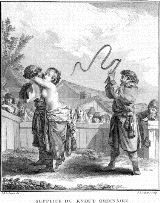
Knouts were used in Russia for flogging as formal corporal punishment
of criminals and political offenders. The victim was tied to a post or on a triangle of wood and stripped, receiving the specified number of strokes on the back. A sentence of 100 or 120 lashes was equivalent to a death sentence. Even twenty lashes could maim, and with the specially extended Great Knout, twenty blows could kill, with death from the Great Knout sometimes being attributed to the breaking of the spine due to the weight of the Great Knout.
The executioner was usually a criminal who had to pass through a probation and regular training, being let off his own penalties in return for his services. Peter the Great
is traditionally accused of knouting his son Alexis to death; whoever the executioner may have been, there is little doubt that he was beaten until he died.
Emperor Nicholas I
abolished the punishment by knout in 1845, and substituted it with the pleti, lashes with three thongs which could end in lead balls. They were later abolished throughout Russia and reserved for the penal settlements, mainly in Siberia. Prisoners transported to Siberia in the late 19th century were sometimes branded on their foreheads with irons with the letters VRNK meaning V thief, R robber, and NK punished by the Knout. This branding lead to the Siberian slang word Varnok to mean either a settler or deportee.
brought to mind the Apartheid government of South Africa or the bullwhip
was associated with the period of slavery
and Jim Crow laws
in America.
The expression "under the knout" is used to designate any harsh totalitarianism
, and by extension its equivalent in a private context, e.g., a grim patriarch ruling his household 'with an iron rod'. In Dutch, the image is commonly used for strict party discipline, e.g., eliminating actual debate when passing a law (compare the Whip function
in English).
Scourge
A scourge is a whip or lash, especially a multi-thong type used to inflict severe corporal punishment or self-mortification on the back.-Description:...
-like multiple whip
Whip
A whip is a tool traditionally used by humans to exert control over animals or other people, through pain compliance or fear of pain, although in some activities whips can be used without use of pain, such as an additional pressure aid in dressage...
, usually made of a bunch of rawhide thongs attached to a long handle, sometimes with metal wire or hooks incorporated.
The English word stems from a spelling-pronunciation of a French transliteration of the Russian word кнут (knut), which simply means "whip".
Russian original
Some claim it was a TatarTatars
Tatars are a Turkic speaking ethnic group , numbering roughly 7 million.The majority of Tatars live in the Russian Federation, with a population of around 5.5 million, about 2 million of which in the republic of Tatarstan.Significant minority populations are found in Uzbekistan, Kazakhstan,...
invention and was introduced into Russia in the 15th century, perhaps by Grand Duke Ivan III the Great
Ivan III of Russia
Ivan III Vasilyevich , also known as Ivan the Great, was a Grand Prince of Moscow and "Grand Prince of all Rus"...
(1462–1505). Others trace the word to Varangians and derive it from the Swedish
Swedish language
Swedish is a North Germanic language, spoken by approximately 10 million people, predominantly in Sweden and parts of Finland, especially along its coast and on the Åland islands. It is largely mutually intelligible with Norwegian and Danish...
knutpiska, a kind of whip with knots. Still others maintain it is of generic Germanic
Germanic languages
The Germanic languages constitute a sub-branch of the Indo-European language family. The common ancestor of all of the languages in this branch is called Proto-Germanic , which was spoken in approximately the mid-1st millennium BC in Iron Age northern Europe...
origin, not necessarily Scandinavian, comparing it with the German Knute, Dutch knoet (both meaning knout) and with Old Norse knutr, Anglo-Saxon cnotta and English knot.
The Russian knout had different forms. One was a lash of raw hide, 40 cm (15.7 in) long, attached to a wooden handle, 22 cm (8.7 in) long. The lash ended in a metal ring, to which was attached a second lash as long, ending also in a ring, to which in turn was attached a few inches of hard leather ending in a beak-like hook. Another kind consisted of many thongs of skin plaited and interwoven with wire, ending in loose wired ends, like the cat-o-nine tails.
A variation, known as the great knout, consisted of a handle about 60 cm (23.6 in) long, to which was fastened a flat leather thong about twice the length of the handle, terminating with a large copper or brass ring to which was affixed a strip of hide about 5 cm (2 in) broad at the ring, and terminating at the end of 60 cm (23.6 in) in a point. This was soaked in milk and dried in the sun to make it harder.
Knouts were used in Russia for flogging as formal corporal punishment
Judicial corporal punishment
Judicial corporal punishment refers to the infliction of corporal punishment as a result of a sentence by a court of law. The punishment can be flogging, caning, birching, whipping, or strapping...
of criminals and political offenders. The victim was tied to a post or on a triangle of wood and stripped, receiving the specified number of strokes on the back. A sentence of 100 or 120 lashes was equivalent to a death sentence. Even twenty lashes could maim, and with the specially extended Great Knout, twenty blows could kill, with death from the Great Knout sometimes being attributed to the breaking of the spine due to the weight of the Great Knout.
The executioner was usually a criminal who had to pass through a probation and regular training, being let off his own penalties in return for his services. Peter the Great
Peter I of Russia
Peter the Great, Peter I or Pyotr Alexeyevich Romanov Dates indicated by the letters "O.S." are Old Style. All other dates in this article are New Style. ruled the Tsardom of Russia and later the Russian Empire from until his death, jointly ruling before 1696 with his half-brother, Ivan V...
is traditionally accused of knouting his son Alexis to death; whoever the executioner may have been, there is little doubt that he was beaten until he died.
Emperor Nicholas I
Nicholas I of Russia
Nicholas I , was the Emperor of Russia from 1825 until 1855, known as one of the most reactionary of the Russian monarchs. On the eve of his death, the Russian Empire reached its historical zenith spanning over 20 million square kilometers...
abolished the punishment by knout in 1845, and substituted it with the pleti, lashes with three thongs which could end in lead balls. They were later abolished throughout Russia and reserved for the penal settlements, mainly in Siberia. Prisoners transported to Siberia in the late 19th century were sometimes branded on their foreheads with irons with the letters VRNK meaning V thief, R robber, and NK punished by the Knout. This branding lead to the Siberian slang word Varnok to mean either a settler or deportee.
Elsewhere and metaphoric use
The dreaded instrument became synonymous in Western European languages with what was seen as the tyrannical cruelty of the autocratic government of Russia, much as the sjambokSjambok
The sjambok or litupa is the official heavy leather whip of South Africa, sometimes seen as synonymous with apartheid but actually much older and still used outside the official judiciary....
brought to mind the Apartheid government of South Africa or the bullwhip
Bullwhip
A bullwhip is a single-tailed whip, usually made of braided leather, which was originally used as a tool for working with livestock.Bullwhips are pastoral tools, traditionally used to control livestock in open country...
was associated with the period of slavery
Slavery
Slavery is a system under which people are treated as property to be bought and sold, and are forced to work. Slaves can be held against their will from the time of their capture, purchase or birth, and deprived of the right to leave, to refuse to work, or to demand compensation...
and Jim Crow laws
Jim Crow laws
The Jim Crow laws were state and local laws in the United States enacted between 1876 and 1965. They mandated de jure racial segregation in all public facilities, with a supposedly "separate but equal" status for black Americans...
in America.
The expression "under the knout" is used to designate any harsh totalitarianism
Totalitarianism
Totalitarianism is a political system where the state recognizes no limits to its authority and strives to regulate every aspect of public and private life wherever feasible...
, and by extension its equivalent in a private context, e.g., a grim patriarch ruling his household 'with an iron rod'. In Dutch, the image is commonly used for strict party discipline, e.g., eliminating actual debate when passing a law (compare the Whip function
Whip (politics)
A whip is an official in a political party whose primary purpose is to ensure party discipline in a legislature. Whips are a party's "enforcers", who typically offer inducements and threaten punishments for party members to ensure that they vote according to the official party policy...
in English).