

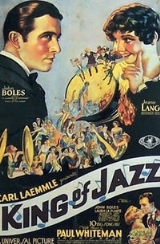
King of Jazz

Encyclopedia
King of Jazz is a 1930 motion picture starring Paul Whiteman
and His Orchestra. The film's title was taken from Whiteman's controversial, self-conferred appellation. Although using the word to describe Whiteman's music seems absurd today, at the time the film was made, "jazz", to the general public, meant the jazz-influenced syncopated dance music which was being heard everywhere on phonograph records and through radio broadcasts. Lending his title a measure of legitimacy is the fact that in the 1920s Whiteman signed and featured great white jazz musicians including Joe Venuti and Eddie Lang
(both are seen and heard in the film), Bix Beiderbecke
(who had left before filming began), Frank Trumbauer and others still held in high regard. The film was shot entirely in the early two-color Technicolor
process and was produced by Carl Laemmle
for Universal Pictures
. The movie featured several songs sung on camera by the Rhythm Boys
(Bing Crosby
, Al Rinker
and Harry Barris
), as well as off-camera solo vocals by Crosby during the opening credits and, very briefly, during a cartoon sequence. King of Jazz still survives in a complete color print and is not a lost film
. The film is widely known for having musician Kurt Cobain
's great uncle Delbert Cobain in various scenes.
. There is no story, only a series of musical numbers alternating with "blackouts" (very brief comedy sketches
with abrupt punch line
endings) and other short introductory or linking segments.
The musical numbers are very diverse in character, taking a "something for everyone" approach to appeal to family audiences by catering to the young, the old and the middle-aged in turn, rather than attempting to suit everyone all the time. The slow Bridal Veil number, featuring (according to Universal) the largest veil ever made, drips with Victorian sentimentality that might best appeal to the elderly. The middle-aged might be more pleased by John Boles in a lush setting crooning It Happened in Monterey in waltz time, or in a barn with a chorus of red-shirted ranch hands belting out the Song of the Dawn. The "jazzy" Happy Feet number was apt to cause younger dance-crazy heels to rock and toes to tap, and even the youngest attendees could enjoy the cartoon, the sight gags, and the overall "eye candy" value of it all.
One segment early in the film serves to introduce several of the band's virtuoso
musicians. Another provides the audience with a chance to see the Rhythm Boys, already famous by sound but not sight because of their recordings and radio broadcasts, performing in a home-like setting. There are novelty and comedy numbers ranging from the mildly risqué (Ragamuffin Romeo, which features contortionistic
dancing that provides an excuse for intimate views of frilly underwear) to the humorously sadomasochistic (the second chorus of I Like to Do Things for You) to the simply silly (I'm a Fisherman). There is a line of chorus girls, practically mandatory in early musicals, but in their featured spot the novelty is that they are seated.
The grand finale is the Melting Pot number, in which various immigrant groups in national costume offer brief renditions of characteristic songs from their native lands, after which they are all consigned to the American Melting Pot
. Performers from some of the earlier musical numbers briefly reprise their acts while reporting for duty as fuel under the pot. Whiteman stirs the steaming stew. When the cooking is complete, everyone emerges transformed into a jazz-happy American.
There are a couple of early examples of the overhead views later elaborated and made famous by Busby Berkeley
, but this film bears little resemblance to his films and other musicals of the later 1930s. It is very much a stage presentation, albeit on a very large stage, and visual interest is maintained only by changes of viewpoint. The cameras do not move. This is not because the Technicolor cameras were heavy and bulky, as is sometimes stated. The cameras used for this early Technicolor process contained a single roll of film and were of nearly ordinary size and weight.
King of Jazz was the nineteenth all-talking motion picture filmed entirely in two-color Technicolor
rather than simply including color sequences. At the time, Technicolor's two-color process employed red and green dyes, each with a dash of other colors mixed in, but no blue dye. King of Jazz was to showcase a spectacular presentation of George Gershwin's
Rhapsody in Blue
, so this presented a problem. Fortunately, the green dye Technicolor used can actually appear peacock blue (cyan) under some conditions, but acceptable results in this case would require very careful handling. Art director Herman Rosse
and production director John Murray Anderson
came up with ingenious solutions. Tests were made of various fabrics and pigments, and by using an all gray-and-silver background the bluish aspect of the dye was set off to best advantage. Filters were also used to inject pale blues into the scene being filmed. The goal was to produce a finished film with pastel shades rather than bright colors. Nevertheless, as it appears in an original two-color Technicolor print, the sequence might best be described as a "Rhapsody in Turquoise
". Later prints made from the original two-component negative, which had survived, make the blues look truer and more saturated than they appeared to audiences in 1930.
King of Jazz marked the first film appearance of the popular crooner
Bing Crosby
, who, at the time, was a member of The Rhythm Boys, the Whiteman Orchestra's vocal trio.
Composer Ferde Grofé
, best known for his Grand Canyon Suite
, was in his early years a well known arranger/songwriter for Whiteman. He is documented to have arranged some of the music, and may in fact have composed some of the incidental music.
The film preserves a vaudeville
bit by Whiteman band trombonist Wilbur Hall
, who does novelty playing on violin and bicycle pump, as well as the eccentric dancing of "Rubber Legs" Al Norman to the tune of Happy Feet.
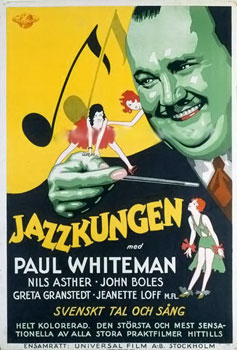
There were at least nine different foreign language versions
of the film. Reportedly, the Swedish version has at least some different music.
 The movie included the first Technicolor
animated cartoon segment by animators Walter Lantz
(later famous for Woody Woodpecker
and other characters) and William Nolan
. In this cartoon, Whiteman is hunting "in darkest Africa", where he is chased by a lion which he soothes by playing a tune on a violin (Music Hath Charms, played by Joe Venuti and Eddie Lang
). After an elephant squirts water on a monkey in a tree, the monkey throws a coconut at the elephant. It misses and hits Whiteman on the head. The bump on his head forms into a crown. Master of Ceremonies Charles Irwin
then remarks, "And that's how Paul Whiteman was crowned the King of Jazz."
One of the characters making a brief appearance in the cartoon is Oswald the Lucky Rabbit
, the star of the Universal Studios animation department led by Lantz. A black-and-white sound cartoon featuring Oswald, titled My Pal Paul, also released in 1930 by Universal, promoted King of Jazz by including songs from the movie and a cartoon Paul Whiteman character.
made independently of the actual filming. Whiteman insisted that musical numbers featuring his orchestra should be pre-recorded in order to obtain the best sound, avoiding the poor recording conditions and extraneous noises typical of a movie studio sound stage
. Universal opposed the idea, but Whiteman prevailed over the reluctant studio executives. After the sound was recorded, it was played back through a loudspeaker
while the scene was being filmed and the performers matched their actions to the recording. Later, the resulting film was synchronized with the soundtrack. This also allowed the scene to be shot in the same manner as a silent film, with the director free to shout out instructions during the filming and the camera unrestricted by any need to silence its noises with bulky soundproofing. The unwanted sounds would not be heard in the completed film.
(Bing Crosby
, Harry Barris
, and Al Rinker
) sang Mississippi Mud
, So the Bluebirds and the Blackbirds Got Together, I'm a Fisherman, Bench in the Park, and Happy Feet in the film. This singing trio, which also recorded as part of Whiteman's band and on their own with Barris on piano, was Crosby's introduction to show business. Crosby also sang Music Hath Charms over the title credits and provided the singing voice for Whiteman in the animated cartoon.
A grand premiere was held on May 2, 1930 at the Roxy Theater in New York
, where the Whiteman Orchestra, together with George Gershwin
and the 125-piece Roxy Symphony Orchestra, put on a stage show. It featured the Rhapsody in Blue
and Mildred Bailey
backed by the Roxy Chorus and was performed five times a day, between showings of the film, for a week. The film continued to play at the Roxy for only one additional week.
As originally released, the film was 105 minutes long. However, after a strengthened Production Code
went into effect in July, 1934, it was shortened to 93 minutes as the result of censorship. The censors ordered the following parts of the film to be cut before they would issue a permit for it to be re-released:
This shortened version was used for the videocassette release of the film in 1992. Prints of the original uncut version still survive. As of the end of 2010, there had been no legitimate release of any version on DVD.
to repeat or surpass the box-office performance of a musical entitled Broadway
which it had released in 1929. That lavish film had included Technicolor
sequences and had been a success. Unfortunately, delays in beginning the actual filming of King of Jazz caused its release to occur after two unforeseen developments. First, the public had tired of the flood of movie musicals that began as a slow trickle with The Jazz Singer
in late 1927 and rapidly became a torrent after the success of The Broadway Melody
in early 1929. In particular disfavor were operettas set in bygone eras, musical-comedies which were unimaginatively filmed Broadway
stage productions, and plotless "revues" such as King of Jazz. Second, although the ripple effects from the stock market crash in October of 1929 had not yet produced the full-blown depression
which would soon be painfully obvious, people were already spending less freely and the effects were starting to be felt at the box-office. During its national release, King of Jazz cleared less than $900,000. Around Hollywood, the movie came to be called "Universal's Rhapsody in the Red". Because of poor box-office receipts for the film and the cancellation of his lucrative nationally-broadcast radio program by its sponsor in April of 1930, Whiteman had to let ten bandmembers go and cut the salaries of the remaining bandmembers by fifteen percent.
Overseas, where there was never a backlash against musicals, it fared better and eventually made a profit. During the 1930s, the film found its best audience in Cape Town
, South Africa
, where it played seventeen return engagements.
The film won an Academy Award
for Best Art Direction by Herman Rosse
. Other films nominated in this category were Bulldog Drummond
, The Love Parade
, Sally
and The Vagabond King
.
Paul Whiteman
Paul Samuel Whiteman was an American bandleader and orchestral director.Leader of the most popular dance bands in the United States during the 1920s, Whiteman's recordings were immensely successful, and press notices often referred to him as the "King of Jazz"...
and His Orchestra. The film's title was taken from Whiteman's controversial, self-conferred appellation. Although using the word to describe Whiteman's music seems absurd today, at the time the film was made, "jazz", to the general public, meant the jazz-influenced syncopated dance music which was being heard everywhere on phonograph records and through radio broadcasts. Lending his title a measure of legitimacy is the fact that in the 1920s Whiteman signed and featured great white jazz musicians including Joe Venuti and Eddie Lang
Eddie Lang
Eddie Lang was an American jazz guitarist, regarded as the Father of Jazz Guitar. He played a Gibson L-4 and L-5 guitar, providing great influence for many guitarists, including Django Reinhardt.-Biography:...
(both are seen and heard in the film), Bix Beiderbecke
Bix Beiderbecke
Leon Bismark "Bix" Beiderbecke was an American jazz cornetist, jazz pianist, and composer.With Louis Armstrong, Beiderbecke was one of the most influential jazz soloists of the 1920s...
(who had left before filming began), Frank Trumbauer and others still held in high regard. The film was shot entirely in the early two-color Technicolor
Technicolor
Technicolor is a color motion picture process invented in 1916 and improved over several decades.It was the second major process, after Britain's Kinemacolor, and the most widely used color process in Hollywood from 1922 to 1952...
process and was produced by Carl Laemmle
Carl Laemmle
Carl Laemmle , born in Laupheim, Württemberg, Germany, was a pioneer in American film making and a founder of one of the original major Hollywood movie studios - Universal...
for Universal Pictures
Universal Pictures
-1920:* White Youth* The Flaming Disc* Am I Dreaming?* The Dragon's Net* The Adorable Savage* Putting It Over* The Line Runners-1921:* The Fire Eater* A Battle of Wits* Dream Girl* The Millionaire...
. The movie featured several songs sung on camera by the Rhythm Boys
The Rhythm Boys
The Rhythm Boys were a male singing trio consisting of Bing Crosby, Harry Barris and Al Rinker. Crosby and Rinker began performing together in 1925 and were recruited by Paul Whiteman in late 1926. Pianist/singer/songwriter Barris joined the team in 1927. They made a number of recordings with the...
(Bing Crosby
Bing Crosby
Harry Lillis "Bing" Crosby was an American singer and actor. Crosby's trademark bass-baritone voice made him one of the best-selling recording artists of the 20th century, with over half a billion records in circulation....
, Al Rinker
Al Rinker
Al Rinker began performing as a partner with Bing Crosby in 1925 and the two singers formed the Rhythm Boys, which singer/songwriter/pianist Harry Barris later joined. Barris wrote the songs Mississippi Mud, I Surrender, Dear, and Wrap Your Troubles in Dreams among others...
and Harry Barris
Harry Barris
Harry Barris was an American popular singer and songwriter.Born in New York City, he was a member of the Rhythm Boys, a late 1920s singing trio which included Al Rinker and Bing Crosby, and was Crosby's entry into show business...
), as well as off-camera solo vocals by Crosby during the opening credits and, very briefly, during a cartoon sequence. King of Jazz still survives in a complete color print and is not a lost film
Lost film
A lost film is a feature film or short film that is no longer known to exist in studio archives, private collections or public archives such as the Library of Congress, where at least one copy of all American films are deposited and catalogued for copyright reasons...
. The film is widely known for having musician Kurt Cobain
Kurt Cobain
Kurt Donald Cobain was an American singer-songwriter, musician and artist, best known as the lead singer and guitarist of the grunge band Nirvana...
's great uncle Delbert Cobain in various scenes.
The Movie
King of Jazz is a revueRevue
A revue is a type of multi-act popular theatrical entertainment that combines music, dance and sketches. The revue has its roots in 19th century American popular entertainment and melodrama but grew into a substantial cultural presence of its own during its golden years from 1916 to 1932...
. There is no story, only a series of musical numbers alternating with "blackouts" (very brief comedy sketches
Sketch comedy
A sketch comedy consists of a series of short comedy scenes or vignettes, called "sketches," commonly between one and ten minutes long. Such sketches are performed by a group of comic actors or comedians, either on stage or through an audio and/or visual medium such as broadcasting...
with abrupt punch line
Punch line
A punch line is the final part of a joke, comedy sketch, or profound statement, usually the word, sentence or exchange of sentences which is intended to be funny or to provoke laughter or thought from listeners...
endings) and other short introductory or linking segments.
The musical numbers are very diverse in character, taking a "something for everyone" approach to appeal to family audiences by catering to the young, the old and the middle-aged in turn, rather than attempting to suit everyone all the time. The slow Bridal Veil number, featuring (according to Universal) the largest veil ever made, drips with Victorian sentimentality that might best appeal to the elderly. The middle-aged might be more pleased by John Boles in a lush setting crooning It Happened in Monterey in waltz time, or in a barn with a chorus of red-shirted ranch hands belting out the Song of the Dawn. The "jazzy" Happy Feet number was apt to cause younger dance-crazy heels to rock and toes to tap, and even the youngest attendees could enjoy the cartoon, the sight gags, and the overall "eye candy" value of it all.
One segment early in the film serves to introduce several of the band's virtuoso
Virtuoso
A virtuoso is an individual who possesses outstanding technical ability in the fine arts, at singing or playing a musical instrument. The plural form is either virtuosi or the Anglicisation, virtuosos, and the feminine form sometimes used is virtuosa...
musicians. Another provides the audience with a chance to see the Rhythm Boys, already famous by sound but not sight because of their recordings and radio broadcasts, performing in a home-like setting. There are novelty and comedy numbers ranging from the mildly risqué (Ragamuffin Romeo, which features contortionistic
Contortion
thumb|upright|Contortionist performingContortion is an unusual form of physical display which involves the dramatic bending and flexing of the human body. Contortion is often part of acrobatics and circus acts...
dancing that provides an excuse for intimate views of frilly underwear) to the humorously sadomasochistic (the second chorus of I Like to Do Things for You) to the simply silly (I'm a Fisherman). There is a line of chorus girls, practically mandatory in early musicals, but in their featured spot the novelty is that they are seated.
The grand finale is the Melting Pot number, in which various immigrant groups in national costume offer brief renditions of characteristic songs from their native lands, after which they are all consigned to the American Melting Pot
Melting pot
The melting pot is a metaphor for a heterogeneous society becoming more homogeneous, the different elements "melting together" into a harmonious whole with a common culture...
. Performers from some of the earlier musical numbers briefly reprise their acts while reporting for duty as fuel under the pot. Whiteman stirs the steaming stew. When the cooking is complete, everyone emerges transformed into a jazz-happy American.
There are a couple of early examples of the overhead views later elaborated and made famous by Busby Berkeley
Busby Berkeley
Busby Berkeley was a highly influential Hollywood movie director and musical choreographer. Berkeley was famous for his elaborate musical production numbers that often involved complex geometric patterns...
, but this film bears little resemblance to his films and other musicals of the later 1930s. It is very much a stage presentation, albeit on a very large stage, and visual interest is maintained only by changes of viewpoint. The cameras do not move. This is not because the Technicolor cameras were heavy and bulky, as is sometimes stated. The cameras used for this early Technicolor process contained a single roll of film and were of nearly ordinary size and weight.
King of Jazz was the nineteenth all-talking motion picture filmed entirely in two-color Technicolor
Technicolor
Technicolor is a color motion picture process invented in 1916 and improved over several decades.It was the second major process, after Britain's Kinemacolor, and the most widely used color process in Hollywood from 1922 to 1952...
rather than simply including color sequences. At the time, Technicolor's two-color process employed red and green dyes, each with a dash of other colors mixed in, but no blue dye. King of Jazz was to showcase a spectacular presentation of George Gershwin's
George Gershwin
George Gershwin was an American composer and pianist. Gershwin's compositions spanned both popular and classical genres, and his most popular melodies are widely known...
Rhapsody in Blue
Rhapsody in Blue
Rhapsody in Blue is a musical composition by George Gershwin for solo piano and jazz band written in 1924, which combines elements of classical music with jazz-influenced effects....
, so this presented a problem. Fortunately, the green dye Technicolor used can actually appear peacock blue (cyan) under some conditions, but acceptable results in this case would require very careful handling. Art director Herman Rosse
Herman Rosse
Hermann Rosse was a Dutch-born American art director. He won an Academy Award for Best Art Direction for the film King of Jazz....
and production director John Murray Anderson
John Murray Anderson
John Murray Anderson was a theatre director and producer, songwriter, actor, screenwriter, and lighting designer. He worked almost every genre of show business, including vaudeville, Broadway, and film....
came up with ingenious solutions. Tests were made of various fabrics and pigments, and by using an all gray-and-silver background the bluish aspect of the dye was set off to best advantage. Filters were also used to inject pale blues into the scene being filmed. The goal was to produce a finished film with pastel shades rather than bright colors. Nevertheless, as it appears in an original two-color Technicolor print, the sequence might best be described as a "Rhapsody in Turquoise
Turquoise (color)
Turquoise or is a slightly blueish tone of light green. The color is based on the gem turquoise. The term comes from the French for Turkish.At right is displayed the X11 color named turquoise....
". Later prints made from the original two-component negative, which had survived, make the blues look truer and more saturated than they appeared to audiences in 1930.
King of Jazz marked the first film appearance of the popular crooner
Crooner
Crooner is an American epithet given to male singers of pop standards, mostly from the Great American Songbook, either backed by a full orchestra, a big band or by a piano. Originally it was an ironic term denoting an emphatically sentimental, often emotional singing style made possible by the use...
Bing Crosby
Bing Crosby
Harry Lillis "Bing" Crosby was an American singer and actor. Crosby's trademark bass-baritone voice made him one of the best-selling recording artists of the 20th century, with over half a billion records in circulation....
, who, at the time, was a member of The Rhythm Boys, the Whiteman Orchestra's vocal trio.
Composer Ferde Grofé
Ferde Grofé
Ferde Grofé was a prominent American composer, arranger and pianist. During the 1920s and 1930s, he went by the name Ferdie Grofé.-Early life:...
, best known for his Grand Canyon Suite
Grand Canyon Suite
The Grand Canyon Suite is a suite for orchestra by Ferde Grofé, composed during the period from 1929 to 1931. It consists of five parts or movements, each an evocation in tone of a particular scene typical of the Grand Canyon...
, was in his early years a well known arranger/songwriter for Whiteman. He is documented to have arranged some of the music, and may in fact have composed some of the incidental music.
The film preserves a vaudeville
Vaudeville
Vaudeville was a theatrical genre of variety entertainment in the United States and Canada from the early 1880s until the early 1930s. Each performance was made up of a series of separate, unrelated acts grouped together on a common bill...
bit by Whiteman band trombonist Wilbur Hall
Wilbur Hall (musician)
Wilbur Francis Hall, sometimes billed as Willie Hall , was a United States trombonist and entertainer.Hall was born in Shawnee Mound, Missouri. He was working in vaudeville when in 1924 he was hired by Paul Whiteman...
, who does novelty playing on violin and bicycle pump, as well as the eccentric dancing of "Rubber Legs" Al Norman to the tune of Happy Feet.
There were at least nine different foreign language versions
Foreign language
A foreign language is a language indigenous to another country. It is also a language not spoken in the native country of the person referred to, i.e. an English speaker living in Japan can say that Japanese is a foreign language to him or her...
of the film. Reportedly, the Swedish version has at least some different music.
The Cartoon
Technicolor
Technicolor is a color motion picture process invented in 1916 and improved over several decades.It was the second major process, after Britain's Kinemacolor, and the most widely used color process in Hollywood from 1922 to 1952...
animated cartoon segment by animators Walter Lantz
Walter Lantz
Walter Benjamin Lantz was an American cartoonist, animator, film producer, and director, best known for founding Walter Lantz Productions and creating Woody Woodpecker.-Early years and start in animation:...
(later famous for Woody Woodpecker
Woody Woodpecker
Woody Woodpecker is an animated cartoon character, an anthropomorphic acorn woodpecker who appeared in theatrical short films produced by the Walter Lantz animation studio and distributed by Universal Pictures...
and other characters) and William Nolan
Bill Nolan (animator)
William "Bill" Nolan was an Irish-American animated cartoon writer, animator, director, and artist. He is best-known for creating and perfecting the rubber hose style of animation and for streamlining Felix the Cat. From 1925 to 1927, he worked on a loose animated adaptation of George Herriman's...
. In this cartoon, Whiteman is hunting "in darkest Africa", where he is chased by a lion which he soothes by playing a tune on a violin (Music Hath Charms, played by Joe Venuti and Eddie Lang
Eddie Lang
Eddie Lang was an American jazz guitarist, regarded as the Father of Jazz Guitar. He played a Gibson L-4 and L-5 guitar, providing great influence for many guitarists, including Django Reinhardt.-Biography:...
). After an elephant squirts water on a monkey in a tree, the monkey throws a coconut at the elephant. It misses and hits Whiteman on the head. The bump on his head forms into a crown. Master of Ceremonies Charles Irwin
Charles Irwin
Charles Irwin VC was born in Manorhamilton, County Leitrim and was an Irish recipient of the Victoria Cross, the highest and most prestigious award for gallantry in the face of the enemy that can be awarded to British and Commonwealth forces.-Details:Irwin was approximately 33 years old, and a...
then remarks, "And that's how Paul Whiteman was crowned the King of Jazz."
One of the characters making a brief appearance in the cartoon is Oswald the Lucky Rabbit
Oswald the Lucky Rabbit
Oswald the Lucky Rabbit is an anthropomorphic rabbit and animated cartoon character created by Ub Iwerks and Walt Disney for films distributed by Universal Pictures in the 1920s and 1930s...
, the star of the Universal Studios animation department led by Lantz. A black-and-white sound cartoon featuring Oswald, titled My Pal Paul, also released in 1930 by Universal, promoted King of Jazz by including songs from the movie and a cartoon Paul Whiteman character.
Another First
King of Jazz was the first feature-length film to use a mostly pre-recorded soundtrackSoundtrack
A soundtrack can be recorded music accompanying and synchronized to the images of a motion picture, book, television program or video game; a commercially released soundtrack album of music as featured in the soundtrack of a film or TV show; or the physical area of a film that contains the...
made independently of the actual filming. Whiteman insisted that musical numbers featuring his orchestra should be pre-recorded in order to obtain the best sound, avoiding the poor recording conditions and extraneous noises typical of a movie studio sound stage
Sound stage
In common usage, a sound stage is a soundproof, hangar-like structure, building, or room, used for the production of theatrical filmmaking and television production, usually located on a secure movie studio property.-Overview:...
. Universal opposed the idea, but Whiteman prevailed over the reluctant studio executives. After the sound was recorded, it was played back through a loudspeaker
Loudspeaker
A loudspeaker is an electroacoustic transducer that produces sound in response to an electrical audio signal input. Non-electrical loudspeakers were developed as accessories to telephone systems, but electronic amplification by vacuum tube made loudspeakers more generally useful...
while the scene was being filmed and the performers matched their actions to the recording. Later, the resulting film was synchronized with the soundtrack. This also allowed the scene to be shot in the same manner as a silent film, with the director free to shout out instructions during the filming and the camera unrestricted by any need to silence its noises with bulky soundproofing. The unwanted sounds would not be heard in the completed film.
The Rhythm Boys
The Rhythm BoysThe Rhythm Boys
The Rhythm Boys were a male singing trio consisting of Bing Crosby, Harry Barris and Al Rinker. Crosby and Rinker began performing together in 1925 and were recruited by Paul Whiteman in late 1926. Pianist/singer/songwriter Barris joined the team in 1927. They made a number of recordings with the...
(Bing Crosby
Bing Crosby
Harry Lillis "Bing" Crosby was an American singer and actor. Crosby's trademark bass-baritone voice made him one of the best-selling recording artists of the 20th century, with over half a billion records in circulation....
, Harry Barris
Harry Barris
Harry Barris was an American popular singer and songwriter.Born in New York City, he was a member of the Rhythm Boys, a late 1920s singing trio which included Al Rinker and Bing Crosby, and was Crosby's entry into show business...
, and Al Rinker
Al Rinker
Al Rinker began performing as a partner with Bing Crosby in 1925 and the two singers formed the Rhythm Boys, which singer/songwriter/pianist Harry Barris later joined. Barris wrote the songs Mississippi Mud, I Surrender, Dear, and Wrap Your Troubles in Dreams among others...
) sang Mississippi Mud
Mississippi Mud
Mississippi Mud is a 1927 song written by Harry Barris and James Cavanaugh , first made popular by Bing Crosby when he was still a member of The Rhythm Boys. Bing Crosby recorded the song with The Rhythm Boys on June 20, 1927 for Victor...
, So the Bluebirds and the Blackbirds Got Together, I'm a Fisherman, Bench in the Park, and Happy Feet in the film. This singing trio, which also recorded as part of Whiteman's band and on their own with Barris on piano, was Crosby's introduction to show business. Crosby also sang Music Hath Charms over the title credits and provided the singing voice for Whiteman in the animated cartoon.
Release
The film debuted on April 20, 1930 at the Criterion Theater. Box-office receipts at this theater were below expectations within the first two weeks.A grand premiere was held on May 2, 1930 at the Roxy Theater in New York
New York
New York is a state in the Northeastern region of the United States. It is the nation's third most populous state. New York is bordered by New Jersey and Pennsylvania to the south, and by Connecticut, Massachusetts and Vermont to the east...
, where the Whiteman Orchestra, together with George Gershwin
George Gershwin
George Gershwin was an American composer and pianist. Gershwin's compositions spanned both popular and classical genres, and his most popular melodies are widely known...
and the 125-piece Roxy Symphony Orchestra, put on a stage show. It featured the Rhapsody in Blue
Rhapsody in Blue
Rhapsody in Blue is a musical composition by George Gershwin for solo piano and jazz band written in 1924, which combines elements of classical music with jazz-influenced effects....
and Mildred Bailey
Mildred Bailey
Mildred Bailey was a popular and influential American jazz singer during the 1930s, known as "The Rockin' Chair Lady" and "Mrs. Swing"...
backed by the Roxy Chorus and was performed five times a day, between showings of the film, for a week. The film continued to play at the Roxy for only one additional week.
As originally released, the film was 105 minutes long. However, after a strengthened Production Code
Pre-Code
Pre-Code Hollywood refers to the era in the American film industry between the introduction of sound in the late 1920s and the enforcement of the Motion Picture Production Code censorship guidelines. Although the Code was adopted in 1930, oversight was poor and it did not become rigorously...
went into effect in July, 1934, it was shortened to 93 minutes as the result of censorship. The censors ordered the following parts of the film to be cut before they would issue a permit for it to be re-released:
- A sketch with William Kent about a suicidal flute player, with the Whiteman Orchestra performing Caprice Viennois as background music.
- A specialty number featuring Nell O'DayNell O'DayNell O'Day was an accomplished equestrian and B-movie actress of the 1930s and 1940s. Born in Prairie Hill, Texas, O'Day was a good looking woman in her youth, and had her first screen roles in the 1920s as a teenager.Her first starring role was in 1932 when she starred in Rackety Rax opposite...
, with unknown music, set in a cabaretCabaretCabaret is a form, or place, of entertainment featuring comedy, song, dance, and theatre, distinguished mainly by the performance venue: a restaurant or nightclub with a stage for performances and the audience sitting at tables watching the performance, as introduced by a master of ceremonies or...
lobby. - A segment featuring Grace Hayes singing My Lover.
This shortened version was used for the videocassette release of the film in 1992. Prints of the original uncut version still survive. As of the end of 2010, there had been no legitimate release of any version on DVD.
Response
Universal expected this revueRevue
A revue is a type of multi-act popular theatrical entertainment that combines music, dance and sketches. The revue has its roots in 19th century American popular entertainment and melodrama but grew into a substantial cultural presence of its own during its golden years from 1916 to 1932...
to repeat or surpass the box-office performance of a musical entitled Broadway
Broadway (1929 film)
Broadway is a 1929 film directed by Pál Fejös from the play of the same name by George Abbott and Philip Dunning. It stars Glenn Tryon, Evelyn Brent, Paul Porcasi, Robert Ellis, Merna Kennedy and Thomas E...
which it had released in 1929. That lavish film had included Technicolor
Technicolor
Technicolor is a color motion picture process invented in 1916 and improved over several decades.It was the second major process, after Britain's Kinemacolor, and the most widely used color process in Hollywood from 1922 to 1952...
sequences and had been a success. Unfortunately, delays in beginning the actual filming of King of Jazz caused its release to occur after two unforeseen developments. First, the public had tired of the flood of movie musicals that began as a slow trickle with The Jazz Singer
The Jazz Singer (1927 film)
The Jazz Singer is a 1927 American musical film. The first feature-length motion picture with synchronized dialogue sequences, its release heralded the commercial ascendance of the "talkies" and the decline of the silent film era. Produced by Warner Bros. with its Vitaphone sound-on-disc system,...
in late 1927 and rapidly became a torrent after the success of The Broadway Melody
The Broadway Melody
The Broadway Melody is a 1929 American musical film and the first sound film to win an Academy Award for Best Picture. It was one of the first musicals to feature a Technicolor sequence, which sparked the trend of color being used in a flurry of musicals that would hit the screens in 1929-1930...
in early 1929. In particular disfavor were operettas set in bygone eras, musical-comedies which were unimaginatively filmed Broadway
Broadway theatre
Broadway theatre, commonly called simply Broadway, refers to theatrical performances presented in one of the 40 professional theatres with 500 or more seats located in the Theatre District centered along Broadway, and in Lincoln Center, in Manhattan in New York City...
stage productions, and plotless "revues" such as King of Jazz. Second, although the ripple effects from the stock market crash in October of 1929 had not yet produced the full-blown depression
Great Depression
The Great Depression was a severe worldwide economic depression in the decade preceding World War II. The timing of the Great Depression varied across nations, but in most countries it started in about 1929 and lasted until the late 1930s or early 1940s...
which would soon be painfully obvious, people were already spending less freely and the effects were starting to be felt at the box-office. During its national release, King of Jazz cleared less than $900,000. Around Hollywood, the movie came to be called "Universal's Rhapsody in the Red". Because of poor box-office receipts for the film and the cancellation of his lucrative nationally-broadcast radio program by its sponsor in April of 1930, Whiteman had to let ten bandmembers go and cut the salaries of the remaining bandmembers by fifteen percent.
Overseas, where there was never a backlash against musicals, it fared better and eventually made a profit. During the 1930s, the film found its best audience in Cape Town
Cape Town
Cape Town is the second-most populous city in South Africa, and the provincial capital and primate city of the Western Cape. As the seat of the National Parliament, it is also the legislative capital of the country. It forms part of the City of Cape Town metropolitan municipality...
, South Africa
South Africa
The Republic of South Africa is a country in southern Africa. Located at the southern tip of Africa, it is divided into nine provinces, with of coastline on the Atlantic and Indian oceans...
, where it played seventeen return engagements.
The film won an Academy Award
Academy Awards
An Academy Award, also known as an Oscar, is an accolade bestowed by the American Academy of Motion Picture Arts and Sciences to recognize excellence of professionals in the film industry, including directors, actors, and writers...
for Best Art Direction by Herman Rosse
Herman Rosse
Hermann Rosse was a Dutch-born American art director. He won an Academy Award for Best Art Direction for the film King of Jazz....
. Other films nominated in this category were Bulldog Drummond
Bulldog Drummond
Bulldog Drummond is a British fictional character, created by "Sapper", a pseudonym of Herman Cyril McNeile , and the hero of a series of novels published from 1920 to 1954.- Drummond :...
, The Love Parade
The Love Parade
The Love Parade is a 1929 musical comedy film about the marital difficulties of Queen Louise of Sylvania and her consort, Count Alfred Renard...
, Sally
Sally (film)
Sally is the third all talking-all color movie ever made . The color process of Sally was Technicolor...
and The Vagabond King
The Vagabond King (1930 film)
The Vagabond King is a 1930 American musical operetta film photographed entirely in two-color Technicolor. The plot of the film was based on the 1925 operetta of the same name, which was based on the 1901 play If I Were King by Justin Huntly McCarthy. The play told the story of a renegade French...
.