
All Topics  
Rhapsody in Blue


   Email Print
   Bookmark   Link


Rhapsody in Blue


Rhapsody in Blue is a musical composition by George Gershwin
George Gershwin

George Gershwin was an American composer and pianist. He wrote most of his vocal and theatrical works in collaboration with his elder brother, lyricist Ira Gershwin....
 for solo piano and jazz band written in 1924, which combines elements of classical music with jazz
Jazz

Jazz is a primarily American musical art form which originated at the beginning of the 20th century in African American communities in the Southern United States from a confluence of African and European music traditions....
-influenced effects. The composition was orchestrated by Ferde Grofé
Ferde Grofé

Ferde Grof? was an United States pianist, arrangement and composer....
 three times, in 1924, in 1926, and finally in 1946.


Discussion
Ask a question about 'Rhapsody in Blue'
Start a new discussion about 'Rhapsody in Blue'
Answer questions from other users
Full Discussion Forum


Recent Posts


Encyclopedia


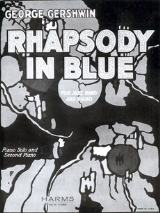
Rhapsody in Blue Cover
Rhapsody in Blue is a musical composition by George Gershwin
George Gershwin

George Gershwin was an American composer and pianist. He wrote most of his vocal and theatrical works in collaboration with his elder brother, lyricist Ira Gershwin....
 for solo piano and jazz band written in 1924, which combines elements of classical music with jazz
Jazz

Jazz is a primarily American musical art form which originated at the beginning of the 20th century in African American communities in the Southern United States from a confluence of African and European music traditions....
-influenced effects. The composition was orchestrated by Ferde Grofé
Ferde Grofé

Ferde Grof? was an United States pianist, arrangement and composer....
 three times, in 1924, in 1926, and finally in 1946. The piece received its premiere in a concert entitled An Experiment in Modern Music, which was held on February 12, 1924, in Aeolian Hall
Aeolian Hall (New York)

Aeolian Hall was a concert hall near Times Square in Midtown Manhattan Manhattan, New York City located on the third floor of 29-33 42nd Street across the street from Bryant Park....
, New York
New York

The State of New York is a U.S. state in the Mid-Atlantic States and Northeastern United States regions of the United States and is the nation's List of U.S....
, by Paul Whiteman
Paul Whiteman

Paul Whiteman was an United States orchestral leader. He was born in Denver, Colorado. After a start as a classical violinist and viola, Whiteman then led a jazz-influenced dance band, which became locally popular in San Francisco, California in 1918....
 and his band with Gershwin playing the piano. The version for piano and symphony, orchestrated by Ferde Grofé
Ferde Grofé

Ferde Grof? was an United States pianist, arrangement and composer....
 in 1942, has become one of the most popular American concert works
American classical music

American classical music is music written in the United States but in the European classical music tradition. In many cases, beginning in the 18th century, it has been influenced by American folk music styles; and from the 20th century to the present day it has often been influenced by folk music, jazz, blues, and pop music styles....
. It was played on February 10, 2008 at the 50th Grammy Awards
50th Grammy Awards

The 50th Annual Grammy Awards took place at the Staples Center in Los Angeles, California, California, on February 10, 2008, starting at 8PM Eastern Time Zone ....
. The clarinet solo was played by Gary Gray, studio musician and professor of music at UCLA.

History


Commission

After the success of an experimental classical-jazz concert held with French-Canadian singer Eva Gauthier
Éva Gauthier

?va Gauthier was a Canadian mezzo-soprano and voice teacher. She performed and popularised modern songs throughout her career. She was the niece of Zo? Laurier and Sir Wilfrid Laurier, who also were her patrons....
 at Aeolian Hall
Aeolian Hall

Aeolian Hall may refer to:*Aeolian Hall *Aeolian Hall *Aeolian Hall ...
 on 1 November 1923, band leader Paul Whiteman
Paul Whiteman

Paul Whiteman was an United States orchestral leader. He was born in Denver, Colorado. After a start as a classical violinist and viola, Whiteman then led a jazz-influenced dance band, which became locally popular in San Francisco, California in 1918....
 decided to attempt something more ambitious. He asked Gershwin to contribute a concerto
Concerto

The term Concerto usually refers to a three-part musical work in which one solo instrument is accompanied by an orchestra. The concerto, as understood in this modern way, arose in the Baroque period side by side with the concerto grosso, which contrasted a small group of instruments with the rest of the orchestra....
-like piece for an all-jazz concert he would give in Aeolian Hall in February 1924. Whiteman became interested in featuring such an extended composition by Gershwin in the concert after he had collaborated with Gershwin in the Scandals of 1922
George White's Scandals

George White's Scandals were a long-running string of Broadway theatre revues produced by George White that ran from 1919-1939, modelled after the Ziegfeld Follies....
, impressed by the original performance of the one-act opera Blue Monday
Blue Monday (opera)

Blue Monday was the original name of a one-act "jazz opera" by George Gershwin, renamed 135th Street during a later production. The English language libretto was written by Buddy de Sylva....
, which was nevertheless a commercial failure. There would certainly be call for revisions to the score; he felt that he would not have enough time to compose the new piece.

Late on the evening of January 3, at the Ambassador Billiard Parlor at Broadway
Broadway (New York City)

Broadway, as the name implies, is a wide avenue in New York City. While New York has several other Broadways, in the context of the city it usually refers to the Manhattan street....
 and 52nd Street in Manhattan
Manhattan

Manhattan is one of the five borough of New York City, located primarily on Manhattan Island at the mouth of the Hudson River.With a United States Census of 1,620,867 living in a land area of 22.96 square miles , Manhattan, coextensive with New York County, is the most population density county in the United States, w...
, while George Gershwin and Buddy De Sylva
Buddy De Sylva

George Gard "Buddy" DeSylva was an United States songwriter, film producer and record executive. He wrote or co-wrote many popular songs and along with Johnny Mercer and Glenn Wallichs he founded Capitol Records....
 were playing billiards
Billiards

Cue sports are a wide variety of Game of skill generally played with a cue stick which is used to strike billiard balls, moving them around a Baize-covered billiards table bounded by rubber ....
, his brother Ira Gershwin
Ira Gershwin

Ira Gershwin was an American lyricist who collaborated with his younger brother, composer George Gershwin, to create some of the most memorable songs of the 20th century....
 was reading the 4 January edition of the New York Tribune
New York Tribune

The New York Tribune was an American newspaper, first established by Horace Greeley in 1841, which was long considered one of the leading newspapers in the United States....
. An article entitled "What Is American Music?" about the Whiteman concert caught his attention, in which the final paragraph claimed that "George Gershwin is at work on a jazz concerto, Irving Berlin
Irving Berlin

Irving Berlin was a Jewish American composer and lyricist, and one of the most prolific American songwriters in history. Berlin was one of the few Tin Pan Alley/Broadway theater songwriters who wrote both lyrics and music for his songs....
 is writing a syncopated tone poem, and Victor Herbert
Victor Herbert

Victor August Herbert was an Ireland-born, German-raised United States composer, cellist and conducting who is best known for his many successful operettas that premiered on Broadway theatre....
 is working on an American suite."

In a phone call to Whiteman next morning, Gershwin was told that Whiteman's rival Vincent Lopez
Vincent Lopez

Vincent Lopez was a United States bandleader and pianist.Vincent Lopez was born of Portuguese immigrant parents in Brooklyn, New York and was leading his own dance band in New York City by 1917....
 was planning to steal the idea of his experimental concert and there was no time to lose. Gershwin was finally persuaded to compose the piece.

Composition

Since there were only five weeks left, Gershwin hastily set about composing a piece, and on the train journey to Boston, the ideas of Rhapsody in Blue came to his mind. He told his first biographer Isaac Goldberg
Isaac Goldberg

Isaac Goldberg was an United States journalist, author, critic, translator, editor, publisher, and lecturer. Born in Boston, Massachusetts he studied at Harvard University and received a Bachelor's degree in 1910, a Master's degree in 1911 and a Doctorate in 1912....
 in 1931:

It was on the train, with its steely rhythms, its rattle-ty bang, that is so often so stimulating to a composer – I frequently hear music in the very heart of the noise... And there I suddenly heard, and even saw on paper – the complete construction of the Rhapsody, from beginning to end. No new themes came to me, but I worked on the thematic material already in my mind and tried to conceive the composition as a whole. I heard it as a sort of musical kaleidoscope of America, of our vast melting pot, of our unduplicated national pep, of our blues, our metropolitan madness. By the time I reached Boston I had a definite plot of the piece, as distinguished from its actual substance.


Gershwin began his work on January 7 as dated on the original manuscript for two pianos. The piece was titled "American Rhapsody" during composition. The title Rhapsody in Blue was suggested by Ira Gershwin after his visit to a gallery exhibition of James McNeill Whistler
James McNeill Whistler

'James Abbott McNeill Whistler' was an United States-born, United Kingdom of Great Britain and Ireland-based artist. Averse to sentimentality and moral in painting, he was a leading proponent of the credo "art for art's sake"....
 paintings, which bear titles such as Nocturne in Black and Gold and Arrangement in Gray and Black (better known as Whistler's Mother
Whistler's Mother

Arrangement in Grey and Black: The Artist's Mother, famous under its colloquial name Whistler's Mother, is an 1871 oil-on-canvas painting by American-born painter James McNeill Whistler....
). After a few weeks, Gershwin finished his composition and passed the score to Whiteman's arranger Ferde Grofé
Ferde Grofé

Ferde Grof? was an United States pianist, arrangement and composer....
, who orchestrated
Orchestration

Orchestration is the study or practice of writing music for an orchestra or of adapting for orchestra music composed for another medium. It only gradually over the course of music history came to be regarded as a compositional art in itself....
 the piece, finishing it on February 4, only eight days before the premiere.

Premiere

Rhapsody in Blue premiered in an afternoon concert on February 12, 1924, held by Paul Whiteman and his band Palais Royal Orchestra, entitled An Experiment in Modern Music, which took place in Aeolian Hall
Aeolian Hall (New York)

Aeolian Hall was a concert hall near Times Square in Midtown Manhattan Manhattan, New York City located on the third floor of 29-33 42nd Street across the street from Bryant Park....
 in New York City
New York City

The City of New York is the List of United States cities by population in the United States, while the New York metropolitan area ranks among the List of urban areas by population....
. The event has since become historic specifically because of its premiere of the Rhapsody.

The purpose of the experiment, as told by Whiteman in a pre-concert lecture in front of many classical music critics and highbrows, was "to be purely educational." It would "at least provide a stepping stone which will make it very simple for the masses to understand, and therefore, enjoy symphony and opera." The program was long, including 26 separate musical movements, divided into 2 parts and 11 sections, bearing titles such as "True form of jazz" and "Contrast: legitimate scoring vs. jazzing". Gershwin's latest composition was the second to last piece (before Elgar
Edward Elgar

Sir Edward William Elgar, 1st Baronet, Order of Merit, Royal Victorian Order was an England composer. Several of his first major orchestral works, including the Enigma Variations and the Pomp and Circumstance Marches, were greeted with acclaim....
's Pomp and Circumstance March No. 1). As many of the numbers sounded similar, and the ventilation system was broken, people in the audience were losing their patience, until the clarinet glissando that opened Rhapsody in Blue was heard. The piece was a huge popular success, and remains popular to this day.

The Rhapsody was performed by Whiteman's band, with an added section of string players, and George Gershwin on piano. Gershwin decided to keep his options open as to when Whiteman would bring in the orchestra and he did not write out one of the pages for solo piano, with only the words "Wait for nod" scrawled by Grofé on the band score. Gershwin improvised some of what he was playing. As he did not write out the piano part until after the performance, we do not know exactly how the original Rhapsody sounded.

According to Charles Schwartz, the opening clarinet glissando
Glissando

A glissando is a glide from one pitch to another. It is an Italianized Musical terminology derived from the French glisser, to glide....
 came into being during rehearsal when; "...as a joke on Gershwin, [Ross] Gorman (Whiteman's virtuoso clarinettist) played the opening measure with a noticeable glissando, adding what he considered a humorous touch to the passage. Reacting favourably to Gorman’s whimsy, Gershwin asked him to perform the opening measure that way at the concert and to add as much of a 'wail' as possible."

Responses

By the end of 1927, Whiteman’s band had played the Rhapsody eighty-four times, and its recording sold a million copies. Whiteman later adopted the piece as his band's theme song, and opened his radio programs with the slogan "Everything new but the Rhapsody in Blue".

The piece received mixed reviews from mainstream critics. Olin Downes
Olin Downes

Olin Downes was a significant United States of America music critic.He studied piano, music theory, and music criticism in New York and Boston, and it was in those two cities that he made his career as a music critic—first with the Boston Post and then with the New York Times ....
, reviewing the concert in The New York Times
The New York Times

The New York Times is an American daily newspaper published in New York City. The largest metropolitan newspaper in the United States, "The Gray Lady"?named for its staid appearance and style?is regarded as a national newspaper of record....
:
This composition shows extraordinary talent, as it shows a young composer with aims that go far beyond those of his ilk, struggling with a form of which he is far from being master... In spite of all this, he has expressed himself in a significant and, on the whole, highly original form.... His first theme... is no mere dance-tune... it is an idea, or several ideas, correlated and combined in varying and contrasting rhythms that immediately intrigue the listener. The second theme is more after the manner of some of Mr. Gershwin's colleagues. Tuttis are too long, cadenzas are too long, the peroration at the end loses a large measure of the wildness and magnificence it could easily have had if it were more broadly prepared, and, for all that, the audience was stirred and many a hardened concertgoer excited with the sensation of a new talent finding its voice... There was tumultuous applause for Gershwin's composition.


Another reviewer, Lawrence Gilman
Lawrence Gilman

Lawrence Gilman was a U.S. author and music critic.Lawrence Gilman was the son of Arthur Coit Gilman and Bessie Gilman. He studied art at Collins Street Classical School in Hartford, Connecticut under William M....
, a Richard Wagner specialist who later wrote a famously devastating review of Gershwin's Porgy and Bess
Porgy and Bess

Porgy and Bess is an opera, first performed in 1935, with music by George Gershwin, libretto by DuBose Heyward, and lyrics by Ira Gershwin and DuBose Heyward....
, commenting on the Rhapsody in the New York Tribune
New York Tribune

The New York Tribune was an American newspaper, first established by Horace Greeley in 1841, which was long considered one of the leading newspapers in the United States....
 on February 13, 1924, said:
How trite, feeble and conventional the tunes are; how sentimental and vapid the harmonic treatment, under its disguise of fussy and futile counterpoint! ... Weep over the lifelessness of the melody and harmony, so derivative, so stale, so inexpressive!


Some critics described the piece as formless, and claimed that Gershwin only glued his melodic segments together into one piece. Pitts Sanborn
Pitts Sanborn

Pitts Sanborn was music critic for The New York Globe and then the New York World Telegram.He also write books such as The Metropolitan Book of the Opera, Prima Donna : A Novel of the Opera, Ludwig van Beethoven....
 wrote that the music "runs off into empty passage-work and meaningless repetition". In an article in Atlantic Monthly in 1955, Leonard Bernstein
Leonard Bernstein

Leonard Bernstein was a multi-Emmy-winning and Academy Award for Original Music Score nominated American Conductor , composer, author, music lecturer and Piano....
, who nevertheless admitted that he loved the piece, wrote:
The Rhapsody is not a composition at all. It's a string of separate paragraphs stuck together. The themes are terrific – inspired, God-given. I don't think there has been such an inspired melodist on this earth since Tchaikovsky. But if you want to speak of a composer, that's another matter. Your Rhapsody in Blue is not a real composition in the sense that whatever happens in it must seem inevitable. You can cut parts of it without affecting the whole. You can remove any of these stuck-together sections and the piece still goes on as bravely as before. It can be a five-minute piece or a twelve-minute piece. And in fact, all these things are being done to it every day. And it's still the Rhapsody in Blue.


Music Analysis


Is it jazz?

Whether or not Rhapsody in Blue is "jazz" remains a much-debated topic. It should be noted that Whiteman styled himself "The King of Jazz". This appellation, applied to Whiteman's band of all-white musicians playing from written arrangements, would be questioned today, but in the 1920s, the word jazz was used loosely to cover a broad range of contemporary popular music. Gilbert Seldes
Gilbert Seldes

Gilbert Vivian Seldes was an United States writer and cultural critic. He was editor and drama critic of The Dial. He is most famous for his 1924 book, The Seven Lively Arts....
, in his book The Seven Lively Arts, was one of the first books to treat popular culture
Popular culture

Popular culture is the totality of Distinction memes, ideas, Perspective s and Attitude s that are deemed preferred per an informal consensus within the mainstream of a given culture....
 in a serious way, and "jazz" was starting to be seen as a significant American contribution to musical culture. Whiteman undertook to present what for the most part was an ordinary set of dance-band numbers in a concert hall under the trappings of high culture
High culture

High culture is a term, now used in a number of different ways in academic discourse, whose most common meaning is the set of culture products, mainly in the arts, held in the highest esteem by a culture....
.

Due to Whiteman’s advertisement of the concert at Aeolian Hall, and the orchestration for primarily wind instruments, the audience was predisposed to listen to the piece as a jazz work. Critics have voiced widely varying opinions on where Rhapsody fits into the jazz canon. Thirty years after its premiere, William Grossman and Jack Farrell denounced the entire Aeolian concert, including Rhapsody in Blue, saying the "clumsily syncopated 'jazz' was gradually replaced with ponderous pseudosymphonic harmonies played over dance rhythms, culminating in the concert rendition of Gershwin’s Rhapsody in Blue, one of the most ludicrous of the popular attempts during the 1920s to merge jazz and 'serious' music". But critic Deems Taylor
Deems Taylor

Deems Taylor was a United States of America composer, music critic, and promoter of classical music.Taylor was born in New York City and educated at New York University ....
 voiced the opinion that the Rhapsody was "genuine jazz music, not only in its scoring but in its idiom", and Osgood claimed that Gershwin was able to "take the elements of jazz and employ them with a distinct degree of success in forms of composition higher and larger than popular songs and musical comedy".

Analysis

Paul Whiteman
Paul Whiteman

Paul Whiteman was an United States orchestral leader. He was born in Denver, Colorado. After a start as a classical violinist and viola, Whiteman then led a jazz-influenced dance band, which became locally popular in San Francisco, California in 1918....
 asked Gershwin to write a "jazz concerto" which became the Rhapsody in Blue; like a concerto
Concerto

The term Concerto usually refers to a three-part musical work in which one solo instrument is accompanied by an orchestra. The concerto, as understood in this modern way, arose in the Baroque period side by side with the concerto grosso, which contrasted a small group of instruments with the rest of the orchestra....
, the piece is written for solo piano with orchestra: a rhapsody
Rhapsody (music)

A rhapsody in music is a Movement work that is episodic yet integrated, free-flowing in structure, featuring a range of highly contrasted moods, colour and tonality....
 differs from a concerto in that it features one extended movement instead of separate movements. Rhapsodies often incorporate passages of an improvisatory nature (although written out in a score), and are irregular in form, with heightened contrasts and emotional exuberance; Gershwin's Rhapsody in Blue is typical in that it certainly has large contrasts in musical texture, style, and color. The music ranges from intensely rhythmic piano solos to slow, broad, and richly orchestrated sections.

Rhapsody in Blue Bb1 2
The opening of Rhapsody in Blue is written as a clarinet
Clarinet

The clarinet is a musical instrument in the woodwind family. The name derives from adding the suffix -et meaning little to the Italian word clarino meaning a particular type of trumpet, as the first clarinets had a strident tone similar to that of a trumpet....
 trill
Trill (music)

The trill is a ornament consisting of a rapid alternation between two adjacent notes of a scale . It is sometimes referred to by the German triller or the Italian trillo....
 followed by a legato
Legato

In musical notation the Italian word legato indicates that musical notes are played or sung smoothly. That is, in transitioning from note to note, there should be no intervening silence....
 17-note rising diatonic scale
Musical scale

In music, a scale is a group of musical note collected in ascending and descending order that provides material for or is used to conveniently represent part or all of a musical work including melody and/or harmony....
. During a rehearsal, Whiteman's virtuoso clarinetist, Ross Gorman, rendered the upper portion of the scale as a captivating (and fully trombone-like) glissando
Glissando

A glissando is a glide from one pitch to another. It is an Italianized Musical terminology derived from the French glisser, to glide....
: Gershwin heard it and insisted that it be repeated in the performance. An American Heritage
American Heritage (magazine)

American Heritage is a monthly magazine dedicated to covering the History of the United States of America of the United States for a mainstream readership....
 columnist called it the "famous opening clarinet glissando... that has become as familiar as the start of Beethoven
Ludwig van Beethoven

Ludwig van Beethoven was a German composer and pianist. He was a crucial figure in the transitional period between the Classical music era and Romantic music eras in classical music, and remains one of the most acclaimed and influential composers of all time....
’s Fifth
Symphony No. 5 (Beethoven)

Ludwig van Beethoven's Symphony No. 5 in C minor, opus number 67 was written in 1804?08. This symphony is one of the most popular and well-known musical composition in all of European classical music, and one of the most often-played symphonies....
." The effect is produced by gradually opening the left-hand tone-holes on the clarinet during the passage from the last concert F (or earlier if possible, thus employing the right hand as well) to the top concert B-flat, adjusting the embouchure
Embouchure

The embouchure is the use of facial muscles and the shaping of the lips to the mouthpiece of a wind instrument.The word is of French language origin and is related to the root bouche , 'mouth'....
 to smoothly control the continuously rising pitch. This effect has now become standard performance practice for the work. Rhapsody in Blue displays Gershwin’s gifts of both rhythmic invention and melodic inspiration, as well as his ability to write a piece with large-scale harmonic and melodic structure. The piece is characterized by strong motivic interrelatedness. Much of the motivic material is introduced in the first 14 measures. David Schiff identifies five major themes plus a sixth “tag”. Of these, two appear in the first 14 measures, and the tag shows up in measure 19. Two of the remaining three themes are rhythmically related to the very first theme in measure 2, which is sometimes called the Glissando theme (after the opening glissando in the clarinet solo) or the Ritornello theme. The remaining theme is the Train theme, which is the first to appear (at rehearsal 9) after the opening material. All of the themes rely on the blues scale
Pentatonic scale

A pentatonic scale is a musical scale with five pitch per octave in contrast to an heptatonic scale scale such as the major scale. Pentatonic scales are very common and are found all over the world, including but not limited to Celtic music, Hungarian folk music, West African music, African-American spiritual , Jazz, American blues music a...
, which includes lowered sevenths and a mixture of major and minor thirds. Each theme appears both in orchestrated form and as a piano solo. There are considerable differences in the style of presentation of each theme. The harmonic structure
Harmony

In Western music, harmony is the use of different pitches simultaneously, and chord s, actual or implied, in music. The word is related to the word "harmonic" which implies related wavelengths of waves....
 of Rhapsody is more difficult to analyse. The piece begins and ends in B flat, but it modulates towards the sub-dominant direction very early on, returning to B flat at the end, rather abruptly. The opening modulates "downward", as it were, through the keys B flat, E flat, A flat, D flat, G flat, B, E, and finally to A major. Modulation through the circle of fifths in the reverse direction inverts classical tonal relationships, but does not abandon them. The entire middle section resides primarily in C major, with forays into G major (the dominant relation). Modulations occur freely and easily, though not always with harmonic direction. Gershwin frequently uses a recursive harmonic progression of minor thirds to give the illusion of motion when in fact a passage does not change key from beginning to end. Modulation by thirds was a common element of Tin Pan Alley
Tin Pan Alley

Tin Pan Alley is the name given to the collection of New York City-centered History of music publishings and songwriters who dominated the American popular music of the United States in the late 19th century and early 20th century....
 music. The influences of jazz and other contemporary styles are certainly present in Rhapsody in Blue. Ragtime
Ragtime

Ragtime is an originally American musical genre which enjoyed its peak popularity between 1897 and 1918. Ragtime was the first truly American musical genre, predating jazz....
 rhythms are abundant, as is the Cuban "clave
Clave (rhythm)

Clave is a rhythmic pattern used as a tool for temporal organization in Afro-Cuban_music, such as Salsa music. The word clave is Spanish for ?key?, in the sense of an answer key or a musical key signature....
" rhythm, which doubles as a dance rhythm in the Charleston
Charleston (dance)

The Charleston is a dance named for the city of Charleston, South Carolina. The rhythm was popularized in mainstream dance music in the United States by a 1923 tune called Charleston by composer/pianist James P....
 jazz dance.

Gershwin’s own intentions were to correct the belief that jazz had to be played strictly in time so that one could dance to it. The Rhapsody’s tempos vary widely, and there is an almost extreme use of rubato in many places throughout. The clearest influence of jazz is the use of blue note
Blue note

In jazz and blues, a blue note is a note sung or played at a slightly lower Pitch than that of the major scale for expressive purposes. Typically the alteration is a semitone or less, but this varies among performers and genres....
s, and the exploration of their half-step relationship plays a key role in the Rhapsody. The use of so-called "vernacular" instruments, such as accordion
Accordion

The accordion is a portable box-shaped musical instrument of the hand-held bellows-driven free reed aerophone family, sometimes referred to as a squeezebox....
, banjo
Banjo

The banjo is a stringed instrument developed by Slavery in the United States Africans in the United States, adapted from several African instruments....
, and saxophone
Saxophone

The saxophone is a conical-Bore transposing instrument musical instrument considered a member of the woodwind family. Saxophones are usually made of brass and are played with a Single-reed instrument mouthpiece similar to the clarinet....
s in the orchestra, contribute to its jazz or popular style, and the latter two of these instruments have remained part of Grofé's "standard" orchestra scoring. Gershwin incorporated several different piano styles into the work. He utilized the techniques of stride piano
Stride piano

Stride, also known as New York ragtime, is a jazz piano style wherethe pianist's left hand may play a four-beat pulse with a bass note or tenth interval on the first and third beats, and a Chord on the second and fourth beats, or an interrupted bass with three single notes and then a chord while the right hand plays melodies, riffs an...
, novelty piano
Novelty piano

Novelty Piano is a genre of piano music that was popular during the 1920's.A successor to ragtime and an outgrowth of the piano roll music of the teens, novelty piano can be considered a pianistic cousin of jazz, which appeared around the same time....
, comic piano, and the song-plugger piano style. Stride piano’s rhythmic and improvisational style is evident in the "agitato e misterioso" section, which begins four bars after rehearsal 33, as well as in other sections, many of which include the orchestra. Novelty piano can be heard at rehearsal 9 with the revelation of the Train theme. The hesitations and light-hearted style of comic piano, a vaudeville
Vaudeville

Vaudeville was a genre of a variety show prevalent on the theatre in the United States and Canada from the early 1880s until the early 1930s. It developed from many sources, including the concert saloon, minstrel show, freak shows, dime museums, and literary burlesque....
 approach to piano made well-known by Chico Marx
Chico Marx

Leonard Marx, known as Chico, was one of the Marx Brothers.He was originally nicknamed Chicko for his reputation as a ladies' man, or a "chicken chaser" in the popular slang of the day....
 and Jimmy Durante
Jimmy Durante

James Francis ?Jimmy? Durante was an United States singer, pianist, comedian and actor, whose distinctive gravel delivery, comic language butchery, jazz-influenced songs, and large nose ? his frequent jokes about it included a frequent self-reference that became his nickname: "Schnozzola" ? helped make him one of America's most familiar and...
, are evident at rehearsal 22.

Recordings

Two audio recordings exist of Gershwin performing an abridged version of the work with Whiteman's orchestra: an acoustic recording made June 10, 1924, released on two sides of Victor 55225 and running 8:59 - this recording includes the original clarinetist, Ross Gorman, playing the glissando — and an electrical recording made April 21, 1927, released on both sides of Victor 35822 and running 9:01 (about half the length of the complete work). The latter version was actually conducted by Nathaniel Shilkret
Nathaniel Shilkret

File:NShilkretSeatedPortrait.jpgNathaniel Shilkret was born in New York City, to an Austrian immigrant family. He was an USA composer, conductor, clarinetist, pianist, business executive , and music director ....
 after an argument between Gershwin and Whiteman. (For an explanation of "acoustic" and "electrical", see gramophone record
Gramophone record

A gramophone record is an analog signal sound storage medium consisting of a flat disc with an inscribed modulated spiral groove usually starting near the periphery and ending near the centre of the disc....
. A 1925 piano roll captured Gershwin's performance in a two piano version. Whiteman's orchestra also performed the piece in the 1930 film The King of Jazz featuring Roy Bargy
Roy Bargy

Roy Fredrick Bargy was an American composer and pianist.Born in Newaygo, Michigan, he grew up in Toledo, Ohio, where he was exposed to the music of pianists Johnny Walters and Luckey Roberts....
 on piano.

Since the mid-20th century, the 1942 version has usually been performed by classical orchestras playing the expanded arrangement. In this form, it has become a staple of the concert repertoire. It has direct popular appeal while also being regarded respectfully by classical musicians.

In the late 1970s, interest in the original arrangement was revived. Reconstructions of it have been recorded by Michael Tilson Thomas
Michael Tilson Thomas

Michael Tilson Thomas , is an United States conducting, piano and composer. He is currently music director of the San Francisco Symphony....
 and the Columbia Jazz Band in 1976, and by Maurice Peress
Maurice Peress

Maurice Peress is an American orchestra conductor, educator and author. After serving as assistant conductor of the New York Philharmonic under Leonard Bernstein beginning in 1961, Peress went on to stand as leader of the orchestra in Corpus Christi, Texas in 1962....
 with Ivan Davis
Ivan Davis

Ivan Davis is an United States European classical music pianist. He received his bachelor's degree in music from North Texas State University, and an Artist's Diploma from the Santa Cecilia Academy in Rome....
 on piano as part of a 60th-anniversary reconstruction of the entire 1924 concert.

Notable recordings

  • Jesús Maria Sanromá
    Jesús Maria Sanromá

    Jes?s Mar?a Sanrom? is considered by many to be one of the century's most accomplished and important pianists....
     with Arthur Fiedler
    Arthur Fiedler

    Arthur Fiedler was the long-time Music of the Boston Pops Orchestra, a symphony orchestra that specializes in popular and light classical music....
     and the Boston Pops Orchestra
    Boston Pops Orchestra

    The Boston Pops Orchestra was founded in 1885 as a subsection of the Boston Symphony Orchestra , founded four years earlier. Careful examination of the rosters of ?Pops orchestra" or ?Festival" orchestras, which are associated with a co-resident symphony orchestra in the same community, shows that the principal players of a ?pops" ensemble us...
     for RCA Victor in July 1935 in Boston's Symphony Hall (the first complete recording), RCA Victor DM358.
  • Leonard Bernstein
    Leonard Bernstein

    Leonard Bernstein was a multi-Emmy-winning and Academy Award for Original Music Score nominated American Conductor , composer, author, music lecturer and Piano....
     (pianist & conductor) and the "Columbia Symphony Orchestra" (which is actually New York Philharmonic Orchestra as CBS
    CBS

    CBS Broadcasting Inc. is an American radio network and television network. The name is derived from the initials of Columbia Broadcasting System, its former legal name....
     had to use the alias due to contractual requirements) in 1959 (slightly cut from the original). He later re-recorded the work in 1982 for Deutsche Grammophon
    Deutsche Grammophon

    Deutsche Grammophon is a Germany classical record label, now part of the Universal Music Group. The company has long been known for its high standards of high fidelity....
     with the Los Angeles Philharmonic
    Los Angeles Philharmonic

    The Los Angeles Philharmonic is an United States orchestra based in Los Angeles, California, California, United States. It has a regular season of concerts from October through June at the Walt Disney Concert Hall, and a summer season at the Hollywood Bowl from July through September....
    .
  • Earl Wild
    Earl Wild

    Earl Wild is an United States pianist known especially for his transcriptions of european classical music and jazz. Wild is recognized widely as a leading virtuoso of his generation....
     (pianist), Arthur Fiedler
    Arthur Fiedler

    Arthur Fiedler was the long-time Music of the Boston Pops Orchestra, a symphony orchestra that specializes in popular and light classical music....
     (conductor) and the Boston Pops Orchestra
    Boston Pops Orchestra

    The Boston Pops Orchestra was founded in 1885 as a subsection of the Boston Symphony Orchestra , founded four years earlier. Careful examination of the rosters of ?Pops orchestra" or ?Festival" orchestras, which are associated with a co-resident symphony orchestra in the same community, shows that the principal players of a ?pops" ensemble us...
     in 1960.
  • André Previn
    André Previn

    Andr? Previn Order of the British Empire is a German-born American Academy Award and Grammy Award winning pianist, conducting, and composer. He first came to prominence by arranging and composing Hollywood film scores in 1948....
     made two recordings of the work, one with the London Symphony Orchestra
    London Symphony Orchestra

    The London Symphony Orchestra is a major orchestra of the United Kingdom, as well as one of the best-known orchestras in the world. Since 1982, the LSO has been based in London's Barbican Arts Centre....
     for EMI
    EMI

    The EMI Group is a United Kingdom music company comprising the major record label EMI Music ? which operates several labels and is based in Kensington in London, England, United Kingdom ? and EMI Music Publishing, based in New York City....
     in 1973, and another with the Pittsburgh Symphony Orchestra
    Pittsburgh Symphony Orchestra

    The Pittsburgh Symphony Orchestra is an United States symphony orchestra, based at Heinz Hall in the Cultural District, Pittsburgh of Pittsburgh, Pennsylvania....
     for Philips, both as pianist and conductor.
  • Michael Tilson Thomas
    Michael Tilson Thomas

    Michael Tilson Thomas , is an United States conducting, piano and composer. He is currently music director of the San Francisco Symphony....
     (conductor), George Gershwin
    George Gershwin

    George Gershwin was an American composer and pianist. He wrote most of his vocal and theatrical works in collaboration with his elder brother, lyricist Ira Gershwin....
     (pianist via Duo-Art piano roll), and the Columbia Jazz Band in 1976 (premiere recording of original 1924 orchestration), Columbia M34205.
  • Gary Graffman
    Gary Graffman

    Gary Graffman is a classical pianist, teacher of piano and music administrator.Graffman was born in New York City to Russian-Jewish parents. Having started piano at age 3, Graffman entered the Curtis Institute of Music at age 7 in 1936 as a piano student of Isabelle Vengerova....
     (pianist), Zubin Mehta
    Zubin Mehta

    Zubin Mehta is an Indian conducting of Western classical music....
     (conductor) and the New York Philharmonic
    New York Philharmonic

    The New York Philharmonic is the oldest active symphony orchestra in the United States, organized during 1842. Based in New York City, the Philharmonic performs most of its concerts at Avery Fisher Hall....
    , in 1979, for the Woody Allen
    Woody Allen

    Woody Allen is an Cinema of the United States film director, writer, actor, comedian, musician and playwright.Allen's distinctive films, which run the gamut from dramas to Screwball comedy film, have made him one of the most respected living American directors....
     movie Manhattan
    Manhattan (film)

    Manhattan is a 1979 in film romantic comedy film about Isaac Davis , a twice-divorced 42-year-old comedy writer dating a 17-year-old high school girl ....
    . The recording, on Columbia Masterworks Records
    Columbia Masterworks Records

    Columbia Masterworks Records was a record label started in 1927 in music by Columbia Records.It was intended for releases of classical music and artists, as opposed to popular music, which bore the regular Columbia logo....
    , remains one of the most popular versions, often used on film and TV projects.
  • British rock keyboardist Rick Wakeman
    Rick Wakeman

    Richard Christopher Wakeman is an England keyboard player best known as the keyboardist for progressive rock group Yes . Originally a classically trained pianist, he was a pioneer in the use of electronic keyboards and in the use of a rock band in combination with orchestra and choir....
    , a frequent member of Yes
    Yes (band)

    Yes are an England progressive rock band that formed in London in 1968 in music. Their music is marked by sharp dynamic contrasts, extended song lengths, abstract lyrics, and a general showcasing of instrumental prowess....
    , recorded a disco-style abridgment for his album Rhapsodies
    Rhapsodies (album)

    Rhapsodies is a Double album Gramophone record by keyboardist Rick Wakeman, which was released in 1979. It was his last studio release on A&M....
     in 1979. It was arranged by Tony Visconti
    Tony Visconti

    Anthony Edward Visconti is an American record producer and sometimes a musician or singer.Since the late 1960s, he has worked with an array of notable performers, including the Moody Blues, as well as T....
    .
  • The French piano duo Katia and Marielle Labèque
    Katia and Marielle Labèque

    The France sisters Lab?que, Katia and Marielle , are one of the world's most distinguished piano Duet . They have performed and recorded most of the repertoire for two pianos, spanning the instrumental, chamber, and concerto genres encompassing musical periods from Baroque through contemporary....
     recorded a four-hand piano
    Piano

    The piano is a musical instrument played by means of a keyboard instrument. Widely used in Western music for solo performance, ensemble use, chamber music, and accompaniment, the piano is also very popular as an aid to musical composition and rehearsal....
     arrangement of the work for Philips Classics Records
    Philips Classics Records

    Philips Classics Records was started in the 1980s as the new classics record label for Philips Records. It was successful with artists like Andrea Bocelli, Alfred Brendel, Sir John Eliot Gardiner, Sir Neville Marriner and the Academy of St....
     in 1980.
  • Dutch vaudeville
    Vaudeville

    Vaudeville was a genre of a variety show prevalent on the theatre in the United States and Canada from the early 1880s until the early 1930s. It developed from many sources, including the concert saloon, minstrel show, freak shows, dime museums, and literary burlesque....
     jazz band "Willem Breuker Kollektief
    Willem Breuker

    Willem Breuker is a Dutch jazz bandleader, composer, arranger, saxophone, and bass clarinetist.In 1967, with percussionist Han Bennink and pianist Misha Mengelberg, he co-founded the Instant Composers Pool , with whom he regularly performed until 1973....
    " (with Vera Beths string quartet) recorded a lively version of the original 1924 version in 1982.
  • Michael Tilson Thomas (pianist and conductor) and the Los Angeles Philharmonic Orchestra, in 1985. This is the recording that, after being issued on compact disc
    Compact Disc

    A Compact Disc is an optical disc used to store Data , originally developed for storing digital audio. The CD, available on the market since October 1982, remains the standard physical medium for sale of commercial Sound recording and reproduction to the present day....
    , caused the jazz band version to become popular.
  • Conductor Mitch Miller
    Mitch Miller

    Mitchell William Miller is an United States musician, singer, Conductor , record producer, A&R man and record company executive. He was one of the most influential figures in American popular music during the 1950s and early 1960s, both as the head of Artists & Repertoire at Columbia Records and as a best-selling recording artist....
     and pianist David Golub
    David Golub

    David Golub, pianist and conductor, was born March 22, 1950 in Chicago, Illinois, USA and died of lung cancer on October 16, 2000 in Milan, Italy....
     made a well-received 1987 recording of Gershwin compositions (including Rhapsody in Blue) that relied in part on notes taken by Miller in conversations with Gershwin.
  • George Gershwin
    George Gershwin

    George Gershwin was an American composer and pianist. He wrote most of his vocal and theatrical works in collaboration with his elder brother, lyricist Ira Gershwin....
     plays a piano roll version on the album Gershwin Plays Gershwin: The Piano Rolls released in 1993. The original Gershwin-recorded roll was converted into a format readable by a Yamaha
    Yamaha

    Yamaha may refer to:* Yamaha Corporation, a Japanese company with a wide range of products and services** Yamaha Motor Company, a Japanese motorized vehicle-producing company...
     Disklavier
    Disklavier

    A Disklavier is the brand name for a group of piano-related products made by the Yamaha Corporation. It was introduced in the United States in 1987....
     grand piano, which was then placed in a concert hall for the album recording.
  • A copy of this piano roll is at the Music House Museum in Acme, Michigan (). A recording is available from the store website: "This CD features 19 selections all hand played by Gershwin on the Duo-Art Reproducing Piano, including the 2 piano version of the entire Rhapsody In Blue played AND accompanied by the composer himself."
  • James Levine
    James Levine

    James Lawrence Levine is an United States orchestral conducting and piano. He is currently the music director of the Metropolitan Opera and of the Boston Symphony Orchestra....
     (pianist & conductor) and the Chicago Symphony Orchestra
    Chicago Symphony Orchestra

    The Chicago Symphony Orchestra is an American orchestra based in Chicago, Illinois. It is one of the five American orchestras commonly referred to as the "Big Five "....
     play the jazz band version on this 1993 Deutsche Grammophon recording.
  • Jazz pianist Marcus Roberts
    Marcus Roberts

    Marcus Roberts is an United States jazz pianist who has achieved fame as a gifted stride pianist committed to celebrating classic standards and jazz traditions....
     recorded a 28-minute, jazz-oriented version with Robert Sabin (conductor) and members of the Lincoln Center Jazz Orchestra and St. Luke's Orchestra on the album Portraits in Blue, released by Sony Classical in 1996. The album received 4.5 stars (out of 5) from Down Beat Magazine
    Down Beat

    Down Beat is an United States magazine devoted to "jazz, blues and beyond" to indicate its expansion beyond the jazz realm which it covered exclusively in previous years....
     and was nominated for a Grammy Award
    Grammy Award

    The Grammy Awards ?or Grammys?are presented annually by the National Academy of Recording Arts and Sciences of the United States for outstanding achievements in the music industry....
    .
  • Ralph Grierson (pianist), Bruce Broughton
    Bruce Broughton

    Bruce Broughton is an United States composer, who writes music in every medium, from theatrical film releases and television feature films to concert tours and computer games....
    , and the Philharmonia Orchestra in 1999 for the Disney musical montage film Fantasia 2000
    Fantasia 2000

    Fantasia 2000 is an United States animated film feature film produced by Walt Disney Feature Animation and released by Walt Disney Pictures....
    .
  • There has been an arrangement for 5 pianos recorded by The 5 Browns
    The 5 Browns

    The 5 Browns are a European classical music piano Musical ensemble consisting of five siblings. Their repertoire includes mostly popular classical tunes, such as George Gershwin's Rhapsody In Blue, Nikolai Rimsky-Korsakov's Flight of the Bumblebee and Grieg's In the Hall of the Mountain King....
     for their 2006 album No Boundaries
    No Boundaries (album)

    No Boundaries is the second album from the classical piano group The 5 Browns. It is also the tile of 1995 debute album by guitarist Michael Angelo Batio....
    .
  • Jon Nakamatsu
    Jon Nakamatsu

    Jon Yasuhiro Nakamatsu is a Japanese American pianist. Nakamatsu was born in 1968 in San Jose, California . Jon still resides in San Jose but mostly performs away from home....
     (pianist) with Jeff Tyzik
    Jeff Tyzik

    Jeff Tyzik is an United States conductor , arranger, and trumpeter from Rochester, New York, working primarily with orchestral and jazz styles....
     (conductor) and the Rochester Philharmonic Orchestra
    Rochester Philharmonic Orchestra

    The Rochester Philharmonic Orchestra is an American orchestra based in the city of Rochester, New York. Its primary concert venue is the Eastman Theatre at the Eastman School of Music....
     (Rochester, NY); in August 2007, the CD was #3 on Billboard.
  • Oscar Levant
    Oscar Levant

    Oscar Levant was an United States pianist, composer, author, comedian, and actor. He was more famous for his mordant character and witticisms, on the radio and in film and television, than for his music....
     (pianist), Eugene Ormandy
    Eugene Ormandy

    Eugene Ormandy was a Hungary-United States conducting and violinist....
     (conductor) and the Philadelphia Orchestra
    Philadelphia Orchestra

    The Philadelphia Orchestra is an orchestra based in Philadelphia, Pennsylvania, in the United States. It is historically considered to be one of the "Big Five " American orchestras....
     (abridged)
  • Garrick Ohlsson
    Garrick Ohlsson

    Garrick Ohlsson is an United States classical pianist. He was the first American to win first prize in the International Frederick Chopin Piano Competition in 1970....
     (pianist), Michael Tilson Thomas and the San Francisco Symphony
    San Francisco Symphony

    The San Francisco Symphony is a leading orchestra based in San Francisco, California. The current music director is Michael Tilson Thomas, who has held the position since September 1995....
    .
  • of has a unique composition of this piece, and is the closing theme music for the series; performed (assisted?) by Tokyo Metropolitan Symphony Orchestra
    Tokyo Metropolitan Symphony Orchestra

    The , also known as Tokyo , is one of the representative orchestras of Japan. The Orchestra was founded in 1965 by the Tokyo Metropolitan Government, to commemorate the 1964 Summer Olympics ....
  • Jeffrey Reid Baker, computer/synthesist/pianist. 1987 recording.
  • Liquid Tension Experiment
    Liquid Tension Experiment

    Liquid Tension Experiment is an instrumental rock progressive rock/progressive metal Supergroup , founded by Dream Theater's drummer Mike Portnoy in 1997....
     (instrumental progressive metal/fusion band): Jordan Rudess
    Jordan Rudess

    Jordan Rudess is a progressive rock keyboardist best known as a member of the progressive metal band Dream Theater....
     (keyboard), John Petrucci
    John Petrucci

    'John Peter Petrucci' is an United States guitarist best known as a founding member of the progressive metal band Dream Theater. He has Record producer all Dream Theater albums since their 1999 release, Metropolis Pt....
     (guitar), Mike Portnoy
    Mike Portnoy

    Michael Stephen Portnoy United States of America drummer primarily known as the drummer and backing vocalist for the progressive metal band Dream Theater....
     (drums) and Tony Levin
    Tony Levin

    Tony Levin is an American bass guitarist.Levin is best-known for his work with progressive rock pioneers King Crimson and Peter Gabriel. Has also been a member of Bruford Levin Upper Extremities, Liquid Tension Experiment and leads his own Tony Levin Band....
     (Chapman stick); on June 23, 2008 performed a live rendition of the piece at the BB King Blues Club (NYC).
  • Jazz-funk meister (Eumir) Deodato recorded the piece in 1973 on the CTI label. The recording narrowly missed the national Top 40.
  • "New wave a capella" band The Bobs
    The Bobs

    The Bobs are a "new wave music" a cappella group founded in San Francisco, California.The original members met while employed as deliverers of singing telegrams....
     with guest pianist Bob Malone
    Bob Malone

    'Bob Malone' is a pianist and singer-songwriter born in New Jersey. He has recorded eight records: The Darkest Part of the Night , Bob Malone , They All Laughed , Like It Or Not , Malone Alone , Christmas Single , Born Too Late , and in 2007 a special Halloween release of three seasonally spooky tracks called Hall...
     adapted the orchestral form of the piece for piano and four a capella voices (these voices portraying the entire orchestral section), in the title track of their 2005 album Rhapsody in Bob.


Orchestration

Gershwin had agreed that Ferde Grofé
Ferde Grofé

Ferde Grof? was an United States pianist, arrangement and composer....
, Whiteman's pianist and chief arranger, was the key figure in enabling the piece to be successful, and critics have praised the orchestral colour. Grofé confirmed in 1938 that Gershwin did not have sufficient knowledge of orchestration in 1924. After the premiere, Grofé took the score and made new orchestrations in 1926 and 1942, each time for larger orchestras. Up until 1976, when Michael Tilson Thomas
Michael Tilson Thomas

Michael Tilson Thomas , is an United States conducting, piano and composer. He is currently music director of the San Francisco Symphony....
 recorded the original jazz band version for the very first time, the 1942 version was the arrangement usually performed and recorded.

The 1924 orchestration for Whiteman's band of 23 musicians (plus violins) calls for the following:
  • Reeds [thirteen instruments played alternately by five performers]: flute
    Flute

    The flute is a musical instrument of the woodwind family. Unlike other woodwind instruments, a flute is a reedless wind instrument that produces its sound from the flow of air against an edge....
    , oboe
    Oboe

    The oboe is a double reed musical instrument of the woodwind family. In English prior to 1770, the instrument was called "hautbois", "hoboy", or "French hoboy"....
    , clarinet
    Clarinet

    The clarinet is a musical instrument in the woodwind family. The name derives from adding the suffix -et meaning little to the Italian word clarino meaning a particular type of trumpet, as the first clarinets had a strident tone similar to that of a trumpet....
    s (E-flat soprano
    E-flat clarinet

    The E-flat clarinet is a member of the clarinet family. It is usually classed as a soprano clarinet, although some authors describe it as a "sopranino" or even "piccolo" clarinet....
    , B-flat, alto
    Alto clarinet

    The alto clarinet is a Woodwind Musical instrument of the clarinet family. It is a transposing instrument pitched in the key of E, though instruments in F have been made....
     and bass
    Bass clarinet

    The bass clarinet is a musical instrument of the clarinet family. Like the more common Soprano clarinet, it is usually pitched in B , but it plays notes an octave below the soprano B clarinet....
    ), heckelphone
    Heckelphone

    The Heckelphone is a musical instrument invented by Wilhelm Heckel and his sons, introduced in 1904.It is a double reed instrument of the oboe family, but with a wider bore and hence a heavier and more penetrating tone....
    , saxophone
    Saxophone

    The saxophone is a conical-Bore transposing instrument musical instrument considered a member of the woodwind family. Saxophones are usually made of brass and are played with a Single-reed instrument mouthpiece similar to the clarinet....
    s (sopranino
    Sopranino saxophone

    The sopranino saxophone is one of the smallest members of the saxophone family. A sopranino saxophone is tuned in the key of E-flat, and sounds an octave above the alto saxophone....
    , soprano
    Soprano saxophone

    The soprano saxophone was invented in 1840 and is a variety of the saxophone, a woodwind instrument. The soprano is the second in size of the saxophone family which consists, as generally accepted, of the sopranino saxophone, soprano, Alto saxophone, tenor saxophone, baritone saxophone, bass saxophone, and contrabass saxophone....
    , alto
    Alto saxophone

    The alto saxophone is a member of the saxophone family of woodwind instruments invented by the Belgian instrument designer Adolphe Sax. The alto, with the Tenor saxophone, is the most common size of saxophone....
    , tenor
    Tenor saxophone

    The tenor saxophone is a medium-sized member of the saxophone family, a group of instruments invented by Adolphe Sax in the 1840s. The tenor, with the Alto saxophone, is the most common size of saxophone....
     and baritone
    Baritone saxophone

    The baritone saxophone, often called "bari sax" , is one of the larger and lower pitched members of the saxophone family. It was invented by Adolphe Sax....
    )
  • Brass: 2 horns
    Horn (instrument)

    The horn is a brass instrument consisting of about of tubing wrapped into a coil with a flared bell. It is descended from the natural horn and is informally known as the French horn....
    , 2 trumpet
    Trumpet

    The trumpet is a musical instrument with the highest Register in the brass instrument family. Trumpets are among the oldest musical instruments, dating back to at least 1500 BC....
    s, 2 flugelhorns, euphonium
    Euphonium

    The euphonium Bore , tenor-voiced brass instrument. It derives its name from the Greek language word euphonos, meaning "well-sounding" or "sweet-voiced" ....
    , 2 trombone
    Trombone

    The trombone is a musical instrument in the brass instrument family. Like all brass instruments, it is a lip-reed aerophone: sound is produced when the player?s vibrating lips cause the air column inside the instrument to vibrate....
    s, bass trombone, tuba
    Tuba

    The tuba is the largest and lowest pitched brass instrument. Sound is produced by vibrating or "buzzing" the lips into a large cupped Mouthpiece ....
  • Rhythm and strings: 2 piano
    Piano

    The piano is a musical instrument played by means of a keyboard instrument. Widely used in Western music for solo performance, ensemble use, chamber music, and accompaniment, the piano is also very popular as an aid to musical composition and rehearsal....
    s, celesta
    Celesta

    The celesta or celeste is a struck idiophone operated by a keyboard instrument. Its appearance is similar to that of an upright piano or of a large wooden music box ....
    , banjo
    Banjo

    The banjo is a stringed instrument developed by Slavery in the United States Africans in the United States, adapted from several African instruments....
    , Drums
    Drum kit

    A drum kit is a collection of drums, cymbals and sometimes other percussion instruments, such as cowbell s, wood blocks, triangles, chimes, or tambourines, arranged for convenient playing by a single drummer....
    , timpani
    Timpani

    Timpani are musical instruments in the percussion instrument family. A type of drum, they consist of a skin called a drumhead stretched over a large bowl traditionally made of copper, and more recently, constructed of more lightweight fiberglass....
    , trap set
    Drum kit

    A drum kit is a collection of drums, cymbals and sometimes other percussion instruments, such as cowbell s, wood blocks, triangles, chimes, or tambourines, arranged for convenient playing by a single drummer....
    , violin
    Violin

    The violin is a Bow string instrument with four strings usually tuned in perfect fifths. It is the smallest and highest-pitched member of the violin family of string instruments, which also includes the viola and cello....
    s, string basses
    Double bass

    The double bass or contrabass is the largest and lowest-pitched Bow string instrument used in the modern orchestra. It is a standard member of the string section of the orchestra and smaller string musical ensembles in European classical music....
     and accordion
    Accordion

    The accordion is a portable box-shaped musical instrument of the hand-held bellows-driven free reed aerophone family, sometimes referred to as a squeezebox....
    .
Many musicians, especially the reeds, played two or more instruments; the reed "doublings" were especially calculated to take advantage of the full panoply of instruments available in that section of Whiteman's band. Indeed, Grofé's familiarity with the Whiteman band's strengths are a key factor in the scoring. This original version, with its unique instrumental requirements, had lain dormant until its revival in reconstructions beginning in the mid-1980s, owing to the popularity and serviceability of the later scorings, described below.

The 1942 orchestration is an adaptation of the original for the standard symphony orchestra (as listed in the score): 2 flutes, 2 oboes, 2 B-flat clarinets (both doubling A clarinets) and bass clarinet, 2 bassoon
Bassoon

The bassoon is a woodwind instrument in the double reed family that typically plays music written in the Bass and tenor registers, and occasionally higher....
s, 3 horns, 3 trumpets, 3 trombones, tuba, percussion (including crash cymbal
Crash cymbal

A crash cymbal is a type of cymbal that produces a loud, sharp "crash" and is used mainly for occasional accents, as opposed to in ostinato. The term crash was created by Zildjian when such cymbals were introduced by Avedis Zildjian III in around 1928....
, snare drum
Snare drum

The snare drum is a drum with strands of snares made of curled metal wire, metal cable, plastic cable, or catgut cords stretched across the a drumhead, typically the bottom....
, bass drum
Bass drum

A bass drum is a large drum that produces a note of low definite or indefinite pitch . There are three general classifications of bass drums: the concert bass drum, the kick' drum, and the pitched bass drum....
, gong
Gong

A gong is an East Asia and South East Asian musical instrument that takes the form of a flat metal disc which is hit with a mallet.Gongs are broadly of three types....
, triangle
Triangle

A triangle is one of the basic shapes of geometry: a polygon with three corners or wikt:vertex and three sides or edges which are line segments....
, bell
Bell (instrument)

A bell is a simple sound-making device. The bell is a percussion instrument and an idiophone. Its form is usually an open-ended hollow drum which resonates upon being struck....
s and cymbal
Cymbal

Cymbals are a modern percussion instrument. Cymbals consist of thin, normally round plates of various cymbal alloys; see cymbal making for a discussion of their manufacture....
s, and timpani
Timpani

Timpani are musical instruments in the percussion instrument family. A type of drum, they consist of a skin called a drumhead stretched over a large bowl traditionally made of copper, and more recently, constructed of more lightweight fiberglass....
), solo piano, 2 alto saxophones, tenor saxophone, banjo, and strings
String instrument

A string instrument is a musical instrument that produces sound by means of vibrating strings. In the Hornbostel-Sachs scheme of musical instrument classification, used in organology, they are called chordophones....
 (first and second violin
Violin

The violin is a Bow string instrument with four strings usually tuned in perfect fifths. It is the smallest and highest-pitched member of the violin family of string instruments, which also includes the viola and cello....
s, viola
Viola

The viola is a bowed string instrument. It is the middle voice of the violin family, between the violin and the cello.The casual observer may mistake the viola for the violin because of their similarity in size, closeness in pitch range , and nearly identical playing position....
, violoncello and bass
Double bass

The double bass or contrabass is the largest and lowest-pitched Bow string instrument used in the modern orchestra. It is a standard member of the string section of the orchestra and smaller string musical ensembles in European classical music....
).

The 1942 version is based on the 1926 arrangement for a "pit" orchestra, differing from its successor in the number of woodwinds and brass only: a single flute, oboe and bassoon, only two horns, two trumpets and one trombone. The prominence of the saxophones in the later orchestrations is somewhat reduced, and the banjo part can be dispensed with, as its mainly rhythmic contribution is provided by the inner strings.

Rhapsody in Blue in popular culture

Although Gershwin himself spoke of the rhapsody as "a musical kaleidoscope of America", Rhapsody in Blue has often been interpreted as a musical portrait of New York City
New York City

The City of New York is the List of United States cities by population in the United States, while the New York metropolitan area ranks among the List of urban areas by population....
; it is used to this effect in Woody Allen
Woody Allen

Woody Allen is an Cinema of the United States film director, writer, actor, comedian, musician and playwright.Allen's distinctive films, which run the gamut from dramas to Screwball comedy film, have made him one of the most respected living American directors....
's film Manhattan, Gremlins 2 The New Batch, and the a cappella
A cappella

Acappella music is vocal music or singing without musical instrument accompaniment, or a piece intended to be performed in this way. A cappella was originally intended to differentiate between Renaissance music polyphony and Baroque concertato style....
 version of Rhapsody in Blue recorded in 1991, Rhapsody of New York, by the female barbershop quartet "Ambiance". It was used extensively in this context in the Disney film Fantasia 2000
Fantasia 2000

Fantasia 2000 is an United States animated film feature film produced by Walt Disney Feature Animation and released by Walt Disney Pictures....
,, in which the piece is used as the lyrical framing for a stylized animation set drawn in the style of famed illustrator Al Hirschfeld
Al Hirschfeld

Albert Hirschfeld was a Jewish American caricaturist best known for his simple black and white satirical portraits of celebrities and Broadway theatre stars....
, to critical acclaim.

Rhapsody in Blue was briefly used as the entrance music for professional wrestler Shawn Michaels
Shawn Michaels

Michael Shawn Hickenbottom , better known by his ring name Shawn Michaels, is an American professional wrestling. He performs for World Wrestling Entertainment , formerly the World Wrestling Federation, on its WWE Raw WWE Brand Extension....
 when he first started wrestling in singles competition during 1992.

Rhapsody in Blue has been used by US-based air carrier United Airlines
United Airlines

United Air Lines, Inc., trading as United Airlines , is a major carrier of the United States. It is a subsidiary of UAL Corporation with corporate offices in Chicago at 77 West Wacker Drive, and its operations base in nearby Elk Grove Village, Illinois....
 in their advertisements since the mid 1980s. In more recent advertisements, the instruments used reflect the theme, including a version played by traditionally Asian instruments in conjunction with publicizing the carrier's major presence in trans-Pacific travel.

Rhapsody in Blue has also been used in connection with various IBM
IBM

International Business Machines Corporation, abbreviated IBM and nicknamed "Big Blue" , is a multinational corporation computer technology and consulting corporation headquartered in Armonk, New York, New York, United States....
 products, including the PCjr.

Rhapsody in Blue was played simultaneously by eighty-four pianists at the opening ceremony of the 1984 Summer Olympics
1984 Summer Olympics

The 1984 Summer Olympics, officially known as the Games of the XXIII Olympiad, was an international multi-sport event held in Los Angeles, California, United States in 1984....
 in Los Angeles
Los Ángeles

Los ?ngeles is the Capital of the Biob?o Province, in the municipality of the same name, in Regions of Chile VIII , in the center-south of Chile....
.

The title theme from the animated TV series The Critic
The Critic

The Critic is an United States animated series that revolved around the life of Film criticism #Jay Sherman, voiced by actor Jon Lovitz. It was created by Al Jean and Mike Reiss, both of whom had worked as writers on The Simpsons....
 is a tribute to Rhapsody in Blue as the show is based in New York City.

The piece was performed by Herbie Hancock
Herbie Hancock

Herbert Jeffrey "Herbie" Hancock is a jazz pianist and composer. He embraces elements of rock and roll and soul music while adopting freer stylistic elements from jazz....
 and Lang Lang
Lang Lang (pianist)

Lang Lang is a Chinese pianist from Shenyang in Liaoning, China....
 at the 50th Grammy Awards
50th Grammy Awards

The 50th Annual Grammy Awards took place at the Staples Center in Los Angeles, California, California, on February 10, 2008, starting at 8PM Eastern Time Zone ....
 on February 10, 2008.

A melodica
Melodica

The melodica, also known as 'blow-organ' is a free-reed instrument similar to the accordion and harmonica. It has a musical keyboard on top, and is played by blowing air through a mouthpiece that fits into a hole in the side of the instrument....
 version of the piece was performed in the manga
Manga

, , are comics and print cartoons , in the Japanese language and conforming to the style developed in Japan in the late 20th century. In their modern form, manga date from shortly after World War II, but they have a long, complex pre-history in earlier Japanese art....
, the Japanese television drama
Japanese television drama

, also called dorama , are a staple of Television in Japan and are broadcast daily. All major TV networks in Japan produce a variety of drama series including romance, comedies, detective stories, horror, and many others....
 and the anime
Anime

is animation in Japan and considered to be "Japanese animation" in the rest of the world. Anime dates from about 1917.Anime, in addition to manga , is extremely popular in Japan and well known throughout the world....
, Nodame Cantabile
Nodame Cantabile

is an ongoing manga by Tomoko Ninomiya. It has been serialized in Japan by Kodansha in the magazine Kiss since 2001 and collected in 21 tankobon volumes as of August 2008....
. A short version of the piece was also used as the ending theme tune in the drama.

The central theme of Rhapsody in Blue is used as a riff in The Electric Light Orchestra's "Birmingham Blues" off their 1977 hit album Out of the Blue.

Footnotes


External links

  • on Internet Archive
    Internet Archive

    The Internet Archive is a nonprofit organization dedicated to building and maintaining a free and openly accessible online digital library, including an archive site of the World Wide Web....
  • on Internet Archive
    Internet Archive

    The Internet Archive is a nonprofit organization dedicated to building and maintaining a free and openly accessible online digital library, including an archive site of the World Wide Web....