

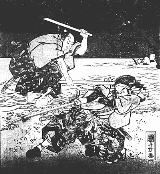
Sasaki Kojiro

Encyclopedia
was a prominent Japanese swordsman widely considered as a Kensei
, born in Fukui Prefecture
. He lived during the Sengoku
and early Edo
periods and is most remembered for his death while battling Miyamoto Musashi
in 1612.
school he had founded. It is said that Kojirō studied the Chūjō-ryu of sword fighting from either Kanemaki Jisai
or Toda Seigen
. Toda Seigen was a master of the kodachi
. If Kojirō had indeed learned Chūjō-ryu from Seigen, he would have been his master's sparring partner. Due to his master's use of the kodachi, Kojirō used a nodachi, or a long katana
, against him, therefore eventually excelling in its use. It was after defeating his master's younger brother that he left and founded the Ganryū. The first reliable account of his life states that in 1610, because of the fame of his school and his many successful duels, including once when he fended off three opponents with a tessen, Kojirō was honored by Lord Hosokawa Tadaoki
as the chief weapons master of the Hosokawa
fief north of Kyūshū
. Sasaki later became skilled in the wielding of a nodachi
, and used one he called "Monohoshizao" ("The Laundry-Drying Pole") as his main weapon.
 Sasaki Kojirō was a long-time rival of Miyamoto Musashi
, and is considered the most challenging opponent Musashi ever faced.
There are a number of accounts of the duel, varying in most details except the essentials, such as Kojirō's defeat.
The age of Kojirō is especially uncertain - the Nitenki says that during his childhood, he
The Nitenki' s account initially seems trustworthy, until it goes on to give the age of Kojirō at the time of the duel as 18 years old; it is known that two years earlier he had been a head weapons master for a fief - but then that would imply he had reached such a position at the age of 16, which is extremely improbable. A further complication is that Toda Seigen died in the 1590s. This unreliability of the sources means Kojirō's age could have varied anywhere from his 20s from to as late as his 50s. Even worse, a number of scholars contend that identifying Seigen as Kojirō's teacher is a mistake, and that he was actually trained by a student of Seigen's, Kanemaki Jisai
.
Apparently, the young (at the time, around 29 years old) Musashi heard of Kojirō's fame and asked Lord Hosokawa Tadaoki
(through the intermediary of Nagaoka Sado Okinaga, a principal vassal of Hosokawa) to arrange a duel. Hosokawa assented, and set the time and place as 13 April 1612, on the comparatively remote island of Ganryujima of Funashima (the strait between Honshū
and Kyūshū
). The match was probably set in such a remote place because by this time Kojirō had acquired many students and disciples, and had Kojirō lost, they would probably have attempted to kill Musashi.
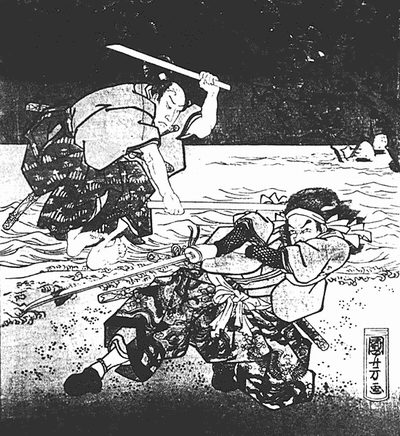
According to the legend, Musashi arrived more than three hours late, and goaded Kojirō by taunting him. When Kojirō attacked, his blow came as close as to sever Musashi's chonmage
. He came close to victory several times until, supposedly blinded by the sunset behind Musashi, Musashi struck him on the skull with his oversized bokken
(wooden sword), which was over 90 centimeters long. Musashi supposedly fashioned the long bokken
, a type called a suburitō
due to its above-average length, by shaving down the spare oar
of the boat in which he arrived at the duel with his wakizashi
(the wood was very hard). Musashi had been late for the duel on purpose in order to psychologically unnerve his opponent (a tactic used by him on previous occasions, such as during his series of duels with the Yoshioka swordsmen).
Another version of the legend recounts that when Musashi finally arrived, Kojirō shouted insults at him, but Musashi just smiled. Angered even further, Kojirō leapt into combat, blinded by rage. Kojiro attempted his famous "swallow's blade" or "swallow cut," but Musashi's oversized bokken hit Kojiro first, causing him to fall down; before Kojiro could finish his swallow cut, Musashi smashed Kojiro's left rib, puncturing his lungs and killing him. Musashi then hastily retreated to his boat and sailed away. This was Musashi's last fatal duel.
Among other things, this conventional account (drawn from the Nitenki, Kensetsu, and Yoshida Seiken's account), has some problems. Kenji Tokitsu discusses a number of obscurities and counterintuitive claims that have been identified in the account by him and previous scholars. Would Musashi only prepare his bokuto while going to the duel site? Could he even have prepared it in time, working the hard wood with his wakizashi? Would that work not have tired him as well? Further, why was the island then renamed after Kojirō, and not Musashi? Other texts completely omit the "late arrival" portion of the story, or change the sequence of actions altogether. Harada Mukashi and a few other scholars believe that Kojiro was actually assassinated by Musashi and his students - the Sasaki clan apparently was a political obstacle to Lord Hosokawa, and defeating Kojirō would be a political setback to his religious and political foes.
The debate still rages today as to whether or not Musashi cheated in order to win that fateful duel or merely used the environment to his advantage. Another theory is that Musashi timed the hour of his arrival to match the turning of the tide. He expected to be pursued by Sasaki's supporters in the event of a victory. The tide carried him to the island then it turned by the time the fight ended. Musashi immediately jumped back in his boat and his flight was thus helped by the tide.
with a blade-length of over 90 cm. (3 ft) long. As a comparison, the average blade-length of the regular katana
are usually 70 cm (2 feet, 3 inches) but rarely longer. It was called the "Monohoshi Zao" (Clothes/Laundry-Drying Pole, often translated into English as "The Drying Pole"). Despite the sword's length and weight, Kojirō's strikes with the weapon were unusually quick and precise.
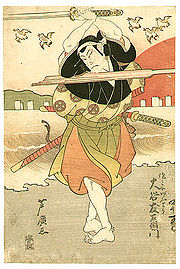 His favorite technique was both respected and feared throughout feudal Japan. It was called the "Turning Swallow Cut" or "Tsubame Gaeshi" (燕返し lit. "Swallow Reversal / Return"), and was so named because it mimicked the motion of a swallow
's tail during flight as observed at Kintaibashi Bridge
in Iwakuni. This cut was reputedly so quick and precise that it could strike down a bird in mid-flight. There are no direct descriptions of the technique, but it was compared to two other techniques current at the time: the Ittō-ryū
's Kinshi Cho Ohken and the Ganryū Kosetsu To; respectively the two involved fierce and swift cuts downward and then immediately upwards. Hence, the "Turning Swallow Cut" has been reconstructed as a technique involving striking downward from above and then instantly striking again in an upward motion from below. The strike's second phase could be from below toward the rear and then upward at an angle, like an eagle climbing again after swooping down on its prey.
, Sasaki Kojiro is portrayed as a deaf man raised by a retired samurai after he is found in the ocean clinging to a long sword. He appears as a cultured and soft speaking psychopath with a white painted face in Samurai Warriors 2
. In the Playstation 1 video game Brave Fencer Musashi, Kojiro appears as a result of a second "hero summoning" to save the princess of the Allucaneet Kingdom.
Kensei
In ancient Japan, a was an honorary title given to a warrior of legendary skill in swordsmanship. The literal translation of "kensei" is "sword saint"...
, born in Fukui Prefecture
Fukui Prefecture
is a prefecture of Japan located in the Chūbu region on Honshū island. The capital is the city of Fukui.- Prehistory :The Kitadani Dinosaur Quarry, on the Sugiyama River within the city limits of Katsuyama, has yielded the Fukuiraptor kitadaniensis and Fukuisaurus tetoriensis as well as an unnamed...
. He lived during the Sengoku
Sengoku period
The or Warring States period in Japanese history was a time of social upheaval, political intrigue, and nearly constant military conflict that lasted roughly from the middle of the 15th century to the beginning of the 17th century. The name "Sengoku" was adopted by Japanese historians in reference...
and early Edo
Edo
, also romanized as Yedo or Yeddo, is the former name of the Japanese capital Tokyo, and was the seat of power for the Tokugawa shogunate which ruled Japan from 1603 to 1868...
periods and is most remembered for his death while battling Miyamoto Musashi
Miyamoto Musashi
, also known as Shinmen Takezō, Miyamoto Bennosuke or, by his Buddhist name, Niten Dōraku, was a Japanese swordsman and rōnin. Musashi, as he was often simply known, became renowned through stories of his excellent swordsmanship in numerous duels, even from a very young age...
in 1612.
History
He went by the fighting name of Ganryū (巌流 lit. "Large Rock style"), which was also the name of the kenjutsuKenjutsu
, meaning "the method, or technique, of the sword." This is opposed to kendo, which means the way of the sword. Kenjutsu is the umbrella term for all traditional schools of Japanese swordsmanship, in particular those that predate the Meiji Restoration...
school he had founded. It is said that Kojirō studied the Chūjō-ryu of sword fighting from either Kanemaki Jisai
Kanemaki Jisai
was a master of the Chujo-ryū fighting style. He was a student of Toda Seigen and teacher to Itō Ittōsai .-Cultural Influence:...
or Toda Seigen
Toda Seigen
Toda Seigen a renowned swordsman during the Sengoku Period in 16th century Japan. Seigen was reputed as a master of the Chūjō-ryu style of sword fighting, excelling in the kodachi art. It is thought that Toda Seigen was the teacher of the famous swordsman Sasaki Kojirō...
. Toda Seigen was a master of the kodachi
Kodachi
A , literally translating into "small or short tachi ", is a Japanese sword that is too long to be considered a dagger but too short to be a long sword...
. If Kojirō had indeed learned Chūjō-ryu from Seigen, he would have been his master's sparring partner. Due to his master's use of the kodachi, Kojirō used a nodachi, or a long katana
Katana
A Japanese sword, or , is one of the traditional bladed weapons of Japan. There are several types of Japanese swords, according to size, field of application and method of manufacture.-Description:...
, against him, therefore eventually excelling in its use. It was after defeating his master's younger brother that he left and founded the Ganryū. The first reliable account of his life states that in 1610, because of the fame of his school and his many successful duels, including once when he fended off three opponents with a tessen, Kojirō was honored by Lord Hosokawa Tadaoki
Hosokawa Tadaoki
was the eldest son of Hosokawa Fujitaka. He fought in his first battle at the age of 15. In that battle, he was in the service of Oda Nobunaga. He was given the Province of Tango in 1580. Soon after that, he married Hosokawa Gracia, the daughter of Akechi Mitsuhide. In 1582, Akechi Mitsuhide...
as the chief weapons master of the Hosokawa
Hosokawa
Hosokawa is a Japanese surname.People with the name include:*Bill Hosokawa , Japanese American author and journalist*Chieko Hosokawa , a Japanese manga artist...
fief north of Kyūshū
Kyushu
is the third largest island of Japan and most southwesterly of its four main islands. Its alternate ancient names include , , and . The historical regional name is referred to Kyushu and its surrounding islands....
. Sasaki later became skilled in the wielding of a nodachi
Nodachi
A nodachi is a large two-handed Japanese sword. Some have suggested that the meaning of "nodachi" is roughly the same as ōdachi meaning "large/great sword". A confusion between the terms has nearly synonymized "nodachi" with the very large "ōdachi"...
, and used one he called "Monohoshizao" ("The Laundry-Drying Pole") as his main weapon.
The Duel
Miyamoto Musashi
, also known as Shinmen Takezō, Miyamoto Bennosuke or, by his Buddhist name, Niten Dōraku, was a Japanese swordsman and rōnin. Musashi, as he was often simply known, became renowned through stories of his excellent swordsmanship in numerous duels, even from a very young age...
, and is considered the most challenging opponent Musashi ever faced.
There are a number of accounts of the duel, varying in most details except the essentials, such as Kojirō's defeat.
The age of Kojirō is especially uncertain - the Nitenki says that during his childhood, he
The Nitenki
Kanemaki Jisai
was a master of the Chujo-ryū fighting style. He was a student of Toda Seigen and teacher to Itō Ittōsai .-Cultural Influence:...
.
Apparently, the young (at the time, around 29 years old) Musashi heard of Kojirō's fame and asked Lord Hosokawa Tadaoki
Hosokawa Tadaoki
was the eldest son of Hosokawa Fujitaka. He fought in his first battle at the age of 15. In that battle, he was in the service of Oda Nobunaga. He was given the Province of Tango in 1580. Soon after that, he married Hosokawa Gracia, the daughter of Akechi Mitsuhide. In 1582, Akechi Mitsuhide...
(through the intermediary of Nagaoka Sado Okinaga, a principal vassal of Hosokawa) to arrange a duel. Hosokawa assented, and set the time and place as 13 April 1612, on the comparatively remote island of Ganryujima of Funashima (the strait between Honshū
Honshu
is the largest island of Japan. The nation's main island, it is south of Hokkaido across the Tsugaru Strait, north of Shikoku across the Inland Sea, and northeast of Kyushu across the Kanmon Strait...
and Kyūshū
Kyushu
is the third largest island of Japan and most southwesterly of its four main islands. Its alternate ancient names include , , and . The historical regional name is referred to Kyushu and its surrounding islands....
). The match was probably set in such a remote place because by this time Kojirō had acquired many students and disciples, and had Kojirō lost, they would probably have attempted to kill Musashi.
According to the legend, Musashi arrived more than three hours late, and goaded Kojirō by taunting him. When Kojirō attacked, his blow came as close as to sever Musashi's chonmage
Chonmage
The chonmage is a form of Japanese traditional haircut worn by men. It is most commonly associated with the Edo Period and samurai, and in recent times with sumo wrestlers...
. He came close to victory several times until, supposedly blinded by the sunset behind Musashi, Musashi struck him on the skull with his oversized bokken
Bokken
A bokken , "wood", and ken, "sword") , is a Japanese wooden sword used for training. It is usually the size and shape of a katana, but is sometimes shaped like other swords, such as the wakizashi and tantō...
(wooden sword), which was over 90 centimeters long. Musashi supposedly fashioned the long bokken
Bokken
A bokken , "wood", and ken, "sword") , is a Japanese wooden sword used for training. It is usually the size and shape of a katana, but is sometimes shaped like other swords, such as the wakizashi and tantō...
, a type called a suburitō
Suburito
thumb|A SuburitoA is a heavier than normal wooden practice sword. In general suburitō are heavier than a standard wooden sword or an actual Japanese sword....
due to its above-average length, by shaving down the spare oar
Oar
An oar is an implement used for water-borne propulsion. Oars have a flat blade at one end. Oarsmen grasp the oar at the other end. The difference between oars and paddles are that paddles are held by the paddler, and are not connected with the vessel. Oars generally are connected to the vessel by...
of the boat in which he arrived at the duel with his wakizashi
Wakizashi
The is one of the traditional Japanese swords worn by the samurai class in feudal Japan.-Description:...
(the wood was very hard). Musashi had been late for the duel on purpose in order to psychologically unnerve his opponent (a tactic used by him on previous occasions, such as during his series of duels with the Yoshioka swordsmen).
Another version of the legend recounts that when Musashi finally arrived, Kojirō shouted insults at him, but Musashi just smiled. Angered even further, Kojirō leapt into combat, blinded by rage. Kojiro attempted his famous "swallow's blade" or "swallow cut," but Musashi's oversized bokken hit Kojiro first, causing him to fall down; before Kojiro could finish his swallow cut, Musashi smashed Kojiro's left rib, puncturing his lungs and killing him. Musashi then hastily retreated to his boat and sailed away. This was Musashi's last fatal duel.
Among other things, this conventional account (drawn from the Nitenki, Kensetsu, and Yoshida Seiken's account), has some problems. Kenji Tokitsu discusses a number of obscurities and counterintuitive claims that have been identified in the account by him and previous scholars. Would Musashi only prepare his bokuto while going to the duel site? Could he even have prepared it in time, working the hard wood with his wakizashi? Would that work not have tired him as well? Further, why was the island then renamed after Kojirō, and not Musashi? Other texts completely omit the "late arrival" portion of the story, or change the sequence of actions altogether. Harada Mukashi and a few other scholars believe that Kojiro was actually assassinated by Musashi and his students - the Sasaki clan apparently was a political obstacle to Lord Hosokawa, and defeating Kojirō would be a political setback to his religious and political foes.
The debate still rages today as to whether or not Musashi cheated in order to win that fateful duel or merely used the environment to his advantage. Another theory is that Musashi timed the hour of his arrival to match the turning of the tide. He expected to be pursued by Sasaki's supporters in the event of a victory. The tide carried him to the island then it turned by the time the fight ended. Musashi immediately jumped back in his boat and his flight was thus helped by the tide.
"The Drying Pole"
Kojiro's favored weapon during combat was a straight-edged nodachiNodachi
A nodachi is a large two-handed Japanese sword. Some have suggested that the meaning of "nodachi" is roughly the same as ōdachi meaning "large/great sword". A confusion between the terms has nearly synonymized "nodachi" with the very large "ōdachi"...
with a blade-length of over 90 cm. (3 ft) long. As a comparison, the average blade-length of the regular katana
Katana
A Japanese sword, or , is one of the traditional bladed weapons of Japan. There are several types of Japanese swords, according to size, field of application and method of manufacture.-Description:...
are usually 70 cm (2 feet, 3 inches) but rarely longer. It was called the "Monohoshi Zao" (Clothes/Laundry-Drying Pole, often translated into English as "The Drying Pole"). Despite the sword's length and weight, Kojirō's strikes with the weapon were unusually quick and precise.
Swallow Cut
Swallow
The swallows and martins are a group of passerine birds in the family Hirundinidae which are characterised by their adaptation to aerial feeding...
's tail during flight as observed at Kintaibashi Bridge
Kintai Bridge
The is a historical wooden arch bridge, in the city of Iwakuni, in Yamaguchi Prefecture, Japan.The bridge was built in 1673, spanning the beautiful Nishiki River in a series of five wooden arches, and the bridge is located on the foot of Mt.Yokoyama, at the top of which lies Iwakuni...
in Iwakuni. This cut was reputedly so quick and precise that it could strike down a bird in mid-flight. There are no direct descriptions of the technique, but it was compared to two other techniques current at the time: the Ittō-ryū
Itto-ryu
, meaning "one-sword school", is the ancestor school of several Japanese Koryū kenjutsu styles, including Ono-ha, Mizoguchi-ha, Nakanishi-ha, Kogen, Hokushin, and Itto Shoden. The style was developed by Ittōsai Kagehisa.-Ono-ha Ittō-ryū:...
's Kinshi Cho Ohken and the Ganryū Kosetsu To; respectively the two involved fierce and swift cuts downward and then immediately upwards. Hence, the "Turning Swallow Cut" has been reconstructed as a technique involving striking downward from above and then instantly striking again in an upward motion from below. The strike's second phase could be from below toward the rear and then upward at an angle, like an eagle climbing again after swooping down on its prey.
Popular Culture References
Sasaki Kojiro has appeared in many forms in pop culture in Japan. In the manga VagabondVagabond (manga)
is an ongoing manga by Takehiko Inoue, portraying a fictionalized account of Miyamoto Musashi's life, on a loose adaptation of Eiji Yoshikawa's novel Musashi....
, Sasaki Kojiro is portrayed as a deaf man raised by a retired samurai after he is found in the ocean clinging to a long sword. He appears as a cultured and soft speaking psychopath with a white painted face in Samurai Warriors 2
Samurai Warriors 2
is a sequel to the original Samurai Warriors, created by Koei and Omega Force. The game was released in 2006 for the PlayStation 2 and Xbox 360, and received a port to Microsoft Windows in 2008....
. In the Playstation 1 video game Brave Fencer Musashi, Kojiro appears as a result of a second "hero summoning" to save the princess of the Allucaneet Kingdom.