


Kawasaki Shipbuilding Corporation

Encyclopedia
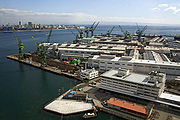
Shipbuilding
Shipbuilding is the construction of ships and floating vessels. It normally takes place in a specialized facility known as a shipyard. Shipbuilders, also called shipwrights, follow a specialized occupation that traces its roots to before recorded history.Shipbuilding and ship repairs, both...
subsidiary of Kawasaki Heavy Industries
Kawasaki Heavy Industries
is an international corporation based in Japan. It has headquarters in both Chūō-ku, Kobe and Minato, Tokyo.The company is named after its founder Shōzō Kawasaki and has no connection with the city of Kawasaki, Kanagawa....
. It produces primarily specialized commercial vessels, including LNG carrier
LNG carrier
An LNG carrier is a tank ship designed for transporting liquefied natural gas . As the LNG market grows rapidly, the fleet of LNG carriers continues to experience tremendous growth.-History:...
s, LPG carriers, container ship
Container ship
Container ships are cargo ships that carry all of their load in truck-size intermodal containers, in a technique called containerization. They form a common means of commercial intermodal freight transport.-History:...
s, bulk carrier
Bulk carrier
A bulk carrier, bulk freighter, or bulker is a merchant ship specially designed to transport unpackaged bulk cargo, such as grains, coal, ore, and cement in its cargo holds. Since the first specialized bulk carrier was built in 1852, economic forces have fueled the development of these ships,...
s, oil tanker
Oil tanker
An oil tanker, also known as a petroleum tanker, is a merchant ship designed for the bulk transport of oil. There are two basic types of oil tankers: the crude tanker and the product tanker. Crude tankers move large quantities of unrefined crude oil from its point of extraction to refineries...
s, as well as high speed passenger jetfoils. In addition, it is also a producer of warship
Warship
A warship is a ship that is built and primarily intended for combat. Warships are usually built in a completely different way from merchant ships. As well as being armed, warships are designed to withstand damage and are usually faster and more maneuvrable than merchant ships...
s for the Japan Maritime Self-Defense Force
Japan Maritime Self-Defense Force
The , or JMSDF, is the naval branch of the Japan Self-Defense Forces, tasked with the naval defense of Japan. It was formed following the dissolution of the Imperial Japanese Navy after World War II....
, including submarine
Submarine
A submarine is a watercraft capable of independent operation below the surface of the water. It differs from a submersible, which has more limited underwater capability...
s. Kawasaki also produces marine machinery, including marine engines, thrusters, steering gears, deck and fishing machinery.
History
Kawasaki's origins go back to April 1878, when Shozo Kawasaki established Kawasaki Tsukiji Shipyard in TokyoTokyo
, ; officially , is one of the 47 prefectures of Japan. Tokyo is the capital of Japan, the center of the Greater Tokyo Area, and the largest metropolitan area of Japan. It is the seat of the Japanese government and the Imperial Palace, and the home of the Japanese Imperial Family...
with the support of fellow Satsuma native and Vice Minister of Finance
Ministry of Finance (Japan)
The ' is one of cabinet-level ministries of the Japanese government. The ministry was once named Ōkura-shō . The Ministry is headed by the Minister of Finance , who is a member of the Cabinet and is typically chosen from members of the Diet by the Prime Minister.The Ministry's origin was back in...
, Matsukata Masayoshi
Matsukata Masayoshi
Prince was a Japanese politician and the 4th and 6th Prime Minister of Japan.-Early life:...
.
In 1886, Kawasaki established a second shipyard in Kobe
Kobe
, pronounced , is the fifth-largest city in Japan and is the capital city of Hyōgo Prefecture on the southern side of the main island of Honshū, approximately west of Osaka...
, Hyōgo prefecture
Hyogo Prefecture
is a prefecture of Japan located in the Kansai region on Honshū island. The capital is Kobe.The prefecture's name was previously alternately spelled as Hiogo.- History :...
. With the First Sino-Japanese War
First Sino-Japanese War
The First Sino-Japanese War was fought between Qing Dynasty China and Meiji Japan, primarily over control of Korea...
, the two shipyards were flooded with new orders and ship repair requests. The two shipyards were merged in 1896 as the Kawasaki Dockyard Company, Ltd. Realizing the limitation of private management, Kawasaki decided to take the company public
Joint stock company
A joint-stock company is a type of corporation or partnership involving two or more individuals that own shares of stock in the company...
, and (as he had no son) chose Matsukata Kojiro
Matsukata Kojiro
was an early 20th-century businessman who devoted his life and fortune to amassing a collection of Western art which, he hoped, would become the nucleus of a Japanese national museum focused particularly on masterworks of the Western art tradition...
, the third son of Matsukata Masayoshi, as his successor. Matsukata remained president for the next 32 years until 1928. Matsukata expanded business into rolling stock
Rolling stock
Rolling stock comprises all the vehicles that move on a railway. It usually includes both powered and unpowered vehicles, for example locomotives, railroad cars, coaches and wagons...
, aircraft
Aircraft
An aircraft is a vehicle that is able to fly by gaining support from the air, or, in general, the atmosphere of a planet. An aircraft counters the force of gravity by using either static lift or by using the dynamic lift of an airfoil, or in a few cases the downward thrust from jet engines.Although...
, automobiles and shipping. He also implemented Japan's first eight-hour work day system in 1919, after a massive strike
Strike action
Strike action, also called labour strike, on strike, greve , or simply strike, is a work stoppage caused by the mass refusal of employees to work. A strike usually takes place in response to employee grievances. Strikes became important during the industrial revolution, when mass labour became...
by 30,000 workers threatened to bring down the government of Prime Minister
Prime Minister of Japan
The is the head of government of Japan. He is appointed by the Emperor of Japan after being designated by the Diet from among its members, and must enjoy the confidence of the House of Representatives to remain in office...
Takashi Hara.
Under Matsukata, Kawasaki Dockyards expanded its Hyōgo operations with a large dry dock
Dry dock
A drydock is a narrow basin or vessel that can be flooded to allow a load to be floated in, then drained to allow that load to come to rest on a dry platform...
, completed in 1902. This dry dock is now listed as an Important Cultural Property
Important Cultural Properties of Japan
The term is often shortened into just are items officially already classified as Tangible Cultural Properties of Japan by the Japanese Agency for Cultural Affairs and judged to be of particular importance to the Japanese people....
by the Japanese government. In 1906, after numerous technical difficulties, Kawasaki completed the first submarine
Submarine
A submarine is a watercraft capable of independent operation below the surface of the water. It differs from a submersible, which has more limited underwater capability...
s made in Japan for the Imperial Japanese Navy
Imperial Japanese Navy
The Imperial Japanese Navy was the navy of the Empire of Japan from 1869 until 1947, when it was dissolved following Japan's constitutional renunciation of the use of force as a means of settling international disputes...
. Kawasaki produced numerous warships for the Japanese navy, ranging from destroyer
Destroyer
In naval terminology, a destroyer is a fast and maneuverable yet long-endurance warship intended to escort larger vessels in a fleet, convoy or battle group and defend them against smaller, powerful, short-range attackers. Destroyers, originally called torpedo-boat destroyers in 1892, evolved from...
s to aircraft carrier
Aircraft carrier
An aircraft carrier is a warship designed with a primary mission of deploying and recovering aircraft, acting as a seagoing airbase. Aircraft carriers thus allow a naval force to project air power worldwide without having to depend on local bases for staging aircraft operations...
s until the end of World War II.
Kawasaki started manufacturing rolling stock
Rolling stock
Rolling stock comprises all the vehicles that move on a railway. It usually includes both powered and unpowered vehicles, for example locomotives, railroad cars, coaches and wagons...
in 1907, and 4 years later produced its first steam locomotive
Steam locomotive
A steam locomotive is a railway locomotive that produces its power through a steam engine. These locomotives are fueled by burning some combustible material, usually coal, wood or oil, to produce steam in a boiler, which drives the steam engine...
, for the Japanese Ministry of Railways. Kawasaki manufactured 3,237 steam locomotives in total until 1971. This division was spun off in 1928 and incorporated as Kawasaki Heavy Industries Rolling Stock Company
Kawasaki Heavy Industries Rolling Stock Company
is the rolling stock production division of Kawasaki Heavy Industries. Since beginning operations in 1906, the company has produced more than 90,000 railroad vehicles.- Products :...
.
In 1918, an Aircraft Division was established at the Hyōgo Works, only 15 years after the Wright brothers
Wright brothers
The Wright brothers, Orville and Wilbur , were two Americans credited with inventing and building the world's first successful airplane and making the first controlled, powered and sustained heavier-than-air human flight, on December 17, 1903...
first flight. Kawasaki went on to build numerous innovative designs for the Imperial Japanese Army
Imperial Japanese Army
-Foundation:During the Meiji Restoration, the military forces loyal to the Emperor were samurai drawn primarily from the loyalist feudal domains of Satsuma and Chōshū...
and Navy air services prior to World War II
World War II
World War II, or the Second World War , was a global conflict lasting from 1939 to 1945, involving most of the world's nations—including all of the great powers—eventually forming two opposing military alliances: the Allies and the Axis...
. In 1937, the Aircraft Division was spun off and incorporated as Kawasaki Aircraft Co., Ltd.
Kawasaki Heavy Industries Aerospace Company
is the aerospace division of Kawasaki Heavy Industries. It produces aircraft, space systems, simulators, jet engines, missiles, and electronic equipment.-Pre-war genesis:...
In 1969, Kawasaki Dockyard, Kawasaki Rolling Stock Manufacturing and Kawasaki Aircraft merged to become Kawasaki Heavy Industries
Kawasaki Heavy Industries
is an international corporation based in Japan. It has headquarters in both Chūō-ku, Kobe and Minato, Tokyo.The company is named after its founder Shōzō Kawasaki and has no connection with the city of Kawasaki, Kanagawa....
.
However, in 2002, Kawasaki Shipbuilding Corporation reemerged as a wholly owned subsidiary company.
Products
- Oil TankerOil tankerAn oil tanker, also known as a petroleum tanker, is a merchant ship designed for the bulk transport of oil. There are two basic types of oil tankers: the crude tanker and the product tanker. Crude tankers move large quantities of unrefined crude oil from its point of extraction to refineries...
s - LNG carrierLNG carrierAn LNG carrier is a tank ship designed for transporting liquefied natural gas . As the LNG market grows rapidly, the fleet of LNG carriers continues to experience tremendous growth.-History:...
s - Bulk carrierBulk carrierA bulk carrier, bulk freighter, or bulker is a merchant ship specially designed to transport unpackaged bulk cargo, such as grains, coal, ore, and cement in its cargo holds. Since the first specialized bulk carrier was built in 1852, economic forces have fueled the development of these ships,...
s - Container ShipContainer shipContainer ships are cargo ships that carry all of their load in truck-size intermodal containers, in a technique called containerization. They form a common means of commercial intermodal freight transport.-History:...
s - Ro/Ro Vessels
- Jetfoils
- WarshipWarshipA warship is a ship that is built and primarily intended for combat. Warships are usually built in a completely different way from merchant ships. As well as being armed, warships are designed to withstand damage and are usually faster and more maneuvrable than merchant ships...
s- Unryu, Sōryū class submarineSoryu class submarineThe Sōryū class submarine or 16SS is a new class of diesel-electric submarine being built in Japan for use by the Japan Maritime Self-Defense Force...
- Oyashio, Uzushio, Isoshio, Kuroshio, Yaeshio, Mochishio, Oyashio class submarineOyashio class submarineThe Oyashio is a class of Japanese diesel-electric submarine operated by the JMSDF. The submarines entered service in the late 1990s. The submarines are larger than the earlier Harushio class submarines, to provide space for a flank sonar array.-Boats:...
- Natsushio, Arashio, Fuyushio, Harushio class submarineHarushio class submarineThe Harushio is a Japanese diesel-electric submarine class operated by the JMSDF. The design is an evolution from the Yūshio class being slightly larger and with better noise reduction...
- Unryu, Sōryū class submarine
- Marine steam turbineSteam turbineA steam turbine is a mechanical device that extracts thermal energy from pressurized steam, and converts it into rotary motion. Its modern manifestation was invented by Sir Charles Parsons in 1884....
s - Marine diesel engineDiesel engineA diesel engine is an internal combustion engine that uses the heat of compression to initiate ignition to burn the fuel, which is injected into the combustion chamber...
s - Marine ThrusterBow thrusterA bow thruster is a transversal propulsion device built into, or mounted to, the bow of a ship or boat to make it more maneuverable. Bow thrusters make docking easier, since they allow the captain to turn the vessel to port or starboard without using the main propulsion mechanism which requires...
s - Ship Control Systems