
An
LNG carrier is a
tank shipA tanker is a ship designed to transport liquids in bulk. Major types of tankship include the oil tanker, the chemical tanker, and the liquefied natural gas carrier.-Background:...
designed for transporting
liquefied natural gasLiquefied natural gas or LNG is natural gas that has been converted temporarily to liquid form for ease of storage or transport....
(LNG). As the LNG market grows rapidly, the fleet of LNG carriers continues to experience tremendous growth.
History
The first ship
Methane PrincessMV Methane Princess was the first LNG carrier taken into service . The ship was built at Vickers shipyard, Barrow-in-Furness, for British Gas...
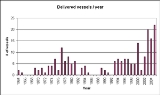
was taken into operation in 1964 and remained in operation until it was scrapped in 1998. Until the end of 2005 a total of 203 vessels have been built, of which 193 are still in service.
New building
At the moment there is a boom in the fleet, with a total of more than 140 vessels on order at the world's shipyards. Today the majority of the new ships under construction are in the size of 120,000 m³ to 140,000 m³. But there are orders for ships with capacity up to 260,000 m³. As of 6 March 2010, there are 337 LNG ships engaged in the deepsea movement of LNG.
Cargo handling
The following is based on a typical set-up of tanks, which is to have from four to six tanks all along the centre line of the vessel. Surrounding the tanks is a combination of ballast tanks, cofferdams and voids. These areas give the vessel a double-hull type design.
Inside the tank there are normally three pumps of the submerged-motor type. There are two main cargo pumps which are used in cargo discharge operations and a much smaller pump which is the spray pump. The spray pump is used for either pumping out liquid LNG to be used as fuel via a vaporizer, or for cooling down cargo tanks. It can also be used for "stripping" out the last of the cargo in discharge operations. All of these pumps are contained within what is known as the pump tower which hangs from the top of the tank and runs the entire depth of the tank. The pump tower also contains the tank gauging system and the tank filling line all of which come near to the bottom of the tank.
In membrane type vessels there is also an empty pipe with a spring-loaded foot valve that can be opened by weight or pressure. This is the emergency pump tower. In the event both main cargo pumps fail the top can be removed from this pipe and an emergency cargo pump lowered down to the bottom of the pipe. The top is replaced on the column and then the pump is allowed to push down on the foot valve and open it. The cargo can then be pumped out.
All the cargo pumps discharge into a common pipe which runs along the deck of the vessel. It branches off to either side of the vessel to the cargo manifolds, which are used for loading or discharging.
All the cargo tank vapour spaces are linked via a vapour header which runs parallel to the cargo header. This also has connections to the sides of the ship next to the loading and discharging manifolds.
Typical cargo cycle
A typical cargo cycle starts with the tanks in a "gas free" condition, meaning the tanks are full of fresh air, which allows maintenance on the tank and pumps. Cargo cannot be loaded directly into the tank, as the presence of oxygen means one would encounter explosive atmospheric conditions within the tank. Also, the temperature difference could cause damage to the tanks.
First, the tank must be inerted by using the inert gas plant, which burns diesel in air to remove the oxygen and replace it with carbon dioxide (CO
2). This is blown into the tanks until it reaches below 4% oxygen and a dry atmosphere. This removes the risk of an explosive atmosphere in the tanks.
Next, the vessel goes into port to "gas-up" and "cool-down", as one still cannot load directly into the tank: The CO
2 will freeze and damage the pumps and the cold shock could damage the tanks.
Liquid LNG is brought onto the vessel and taken along the spray line to the main vaporiser, which boils off the liquid into gas. This is then warmed up to roughly 20°C in the gas heaters and then blown into the tanks to displace the "inert gas". This continues until all the CO
2 is removed from the tanks. The inert gas is blown ashore via a pipe by large fans called "HD compressors".
Now the vessel is gassed up and warm. The tanks are still at ambient temperature and are full of methane.
The next stage is cool-down. Liquid LNG is sprayed into the tanks via spray heads, which vaporises and starts to cool the tank. The excess gas is blown ashore to be re-liquified or burned at a
flare stackA gas flare, alternatively known as a flare stack, is an elevated vertical conveyance found accompanying the presence of oil wells, gas wells, rigs, refineries, chemical plants, natural gas plants, and landfills....
. Once the tanks reach about -140°C the tanks are ready to load bulk.
Bulk loading starts and liquid LNG is pumped from the storage tanks ashore into the vessel tanks. Displaced gas is blown ashore by the HD compressors. Loading continues until typically 98.5% full is reached.
The vessel can now proceed to the discharge port. During passage various boil-off management strategies can be used.
Once in the discharge port, the cargo is pumped ashore using the cargo pumps. As the tank empties, the vapour space is filled by either gas from ashore or by vaporising some cargo in the cargo vaporiser. Either the vessel can be pumped out as far as possible, with the last being pumped out with spray pumps, or some cargo can be retained onboard as a "heel".
If all the cargo is pumped ashore, then on the ballast passage the tanks will warm up to ambient temperature, returning the vessel to a gassed up and warm state. The vessel can then be cooled again for loading.
If the vessel is to return to a gas free state, the tanks must be warmed up by using the gas heaters to circulate warm gas. Once the tanks are warmed up, the inert gas plant is used to remove the methane from the tanks. Once the tanks are methane free, the inert gas plant is switched to dry air production, which is used to remove all the inert gas from the tanks until they have a safe working atmosphere.
Containment systems
Today there are four containment systems in use for new build vessels. Two of the designs are of the self supporting type, while the other two are of the membrane type and today the patents are owned by Gaz Transport & Technigaz (GTT).
There is a trend towards the use of the two different membrane types instead of the self supporting storage systems. This is most likely because prismatic membrane tanks utilize the hull shape more efficiently and thus have less void space between the cargo-tanks and ballast tanks. As a result of this, Moss-type design compared to a membrane design of equal capacity will be far more expensive to transit the
Suez CanalThe Suez Canal , also known by the nickname "The Highway to India", is an artificial sea-level waterway in Egypt, connecting the Mediterranean Sea and the Red Sea. Opened in November 1869 after 10 years of construction work, it allows water transportation between Europe and Asia without navigation...
. However, self-supporting tanks are more robust and have greater resistance to sloshing forces, and will possibly be considered in the future for offshore storage where bad weather will be a significant factor.
Moss tanks
This design is owned by the Norwegian company Moss Maritime and it is a spherical tank. Most Moss type vessels have 4 or 5 tanks.
The outside of the tank has a thick layer of foam insulation that is either fitted in panels or in more modern designs wound round the tank. Over this insulation is a thin layer of "tinfoil" which allows the insulation to be kept dry with a nitrogen atmosphere. This atmosphere is constantly checked for any methane that would indicate a leak of the tank. Also the outside of the tank is regularly checked at a roughly 3 month interval for any cold spots that would indicate breakdown in the insulation.
The tank is supported around its circumference by the equatorial ring which is supported by a large circular skirt which takes the weight of the tank down to the ships structure. This skirt allows the tank to expand and contract during cooldown and warm-up operations. During cooldown or warm-up the tank can expand or contract about 2 feet. Because of this expansion and contraction all piping into the tank comes in via the top and is connected to the ships lines via flexible bellows.
Inside each tank there are a set of spray heads. These heads are mounted around the equatorial ring and are used to spray Liquid LNG onto the tank walls to reduce the temperature.
It is normal practise to keep onboard 5% to 10% of the cargo after discharge in one tank. This is referred to as the heel and this is used to cooldown the remaining tanks that have no heel before loading. This must be done gradually otherwise you will cold shock the tanks if you load directly into warm tanks. Cooldown can take roughly 36 hours on a Moss vessel so carrying a heel allows cooldown to be done before the vessel reaches port giving a significant time saving.
Tanks normally have a working pressure of up to 22Kpa in normal use but this can be raised for an emergency discharge. If both main pumps fail then to remove the cargo the tank safety valves are adjusted to lift at 1bar. Then the filling line which goes to the bottom of the tank is opened along with the filling lines of the other tanks onboard. The pressure is then raised in the tank with the defective pumps which pushes the cargo into the other tanks where it can be pumped out of.
IHI
Ishikawajima-Harima Heavy Industries has developed the SPB, or Self supporting Prismatic type B tank. Only two vessels currently have the SPB containment system.
TGZ Mark III
This design is originally by Technigaz and it is of the membrane type. The membrane consists of stainless steel with 'waffles' to absorb the thermal contraction when the tank is cooled down.
The primary barrier, made of corrugated stainless steel of about 1.2 mm thickness is the one in direct contact with the cargo liquid (or vapour in empty tank condition). This is followed by a primary insulation which in turn is covered by a secondary barrier made of a material called "triplex" which is basically a metal foil sandwiched between glasswool sheets and compressed together.
This is again covered by a secondary insulation which in turn is supported by the ship's hull structure from the outside.
So, going from the inside of the tank outwards, we have:-
LNG
|
Primary barrier of 1.2 mm thick corrugated/waffled Stainless Steel
|
Primary Insulation (also called the interbarrier space)
|
Secondary barrier of triplex membrane
|
Secondary Insulation (also called the insulation space)
|
Ship's hull structure.
GT96
This is Gaz Transport's tank design.
The tanks consists of a primary and secondary thin membrane made of the material
InvarInvar, also known generically as FeNi36 , is a nickel steel alloy notable for its uniquely low coefficient of thermal expansion . The name, Invar, comes from the word invariable, referring to its lack of expansion or contraction with temperature changes.It was invented in 1896 by Swiss scientist...
which has almost no thermal contraction. The insulation is made out of plywood boxes filled with perlite and continuously flushed with nitrogen gas.
The integrity of both membranes is permanently monitored by detection of hydrocarbon in the nitrogen.
An evolution is proposed by
NG2, with the replacement of nitrogen by argon as the flushed inert and insulation gas. Argon has a better insulation power than nitrogen, which could save 10% of boil-off gas.
CS1
This Combined System NUMBER ONE is well described in this document:
http://www.witherbyseamanship.com/pages/product/product.asp?item_sefcode=CS1-New-Containment-System-For-LNG-Carriers&cookie%5Ftest=1
Three vessels with CS1 technology have been built by one shipyard, but established shipyards have decided to maintain production of the MKIII & NO96.
Reliquefaction and Boil Off
In order to facilitate transport, natural gas is cooled down to approximately -163 degrees Celsius at atmospheric pressure, at which point the gas condenses to a liquid. The tanks on-board an LNG carrier effectively function as giant thermoses to keep the liquid gas cold during storage. No insulation is perfect, however, and so the liquid is constantly boiling during the voyage.
According to WGI, on a typical voyage an estimated 0.1% - 0.25% of the cargo converts to gas each day, depending on the efficiency of the insulation and the roughness of the voyage. In a typical 20-day voyage, anywhere from 2% - 6% of the total volume of LNG originally loaded may be lost.
Normally an LNG tanker is powered by steam turbines with boilers. These boilers are dual fuel and can run on either Methane or oil or a combination of both.
The gas produced in boil off is traditionally diverted to the boilers and used as a fuel for the vessel. Before this gas is used in the boilers it must be warmed up to roughly 20C by using the gas heaters. The gas is either fed into the boiler by tank pressure or it is increased in pressure by the LD compressors.
What fuel the vessel runs on is dependant on many factors which include the length of the voyage, desire to carry a heel for cooldown, price of oil v price of LNG.
There are three basic modes available.
Minimum boil off/max oil :- In this mode tank pressures are kept high to reduce boil off to a minimum and the majority of energy comes from the fuel oil. This maximises the amount of LNG delivered but does allow tank temps to rise due to lack of evaporation. The high cargo temps can cause storage problems and offloading problems.
Max boiloff/Minimum oil:- In this mode the tank pressures are kept low and you have a greater boil-off but still there is a large amount of fuel oil used. This deceases the amount of LNG delivered but the cargo will be delivered cold which many ports prefer.
100% Gas:- Tank pressures are kept at a similar level to max boil off but this is not enough to supply all the boilers needs so you must start to "force". To force a spray pump is started in one tank to supply liquid LNG to the forcing vaporiser this tanks liquid LNG and turns it into a gas that is useable in the boilers. In this mode no fuel oil is used.
Recent advances in technology have allowed reliquefication plants to be fitted to vessels, allowing the boil off to be reliquefied and returned to the tanks. Because of this, the vessels' operators and builders have been able to contemplate the use of more efficient Slow-Speed
Diesel engineA diesel engine is an internal combustion engine that uses the heat of compression to initiate ignition to burn the fuel, which is injected into the combustion chamber...
s (previously most LNG carriers have been
steam turbineA steam turbine is a mechanical device that extracts thermal energy from pressurized steam, and converts it into rotary motion. Its modern manifestation was invented by Sir Charles Parsons in 1884....
-powered). Exceptions are the LNG carrier Havfru (built as Venator in 1973), which originally had dual fuel diesel engines, and its sister-ship Century (built as Lucian in 1974), also built with dual fuel gas turbines before being converted to a diesel engine system in 1982. Vessels using dual or tri-fuel diesel electric propulsion systems are now in service.