

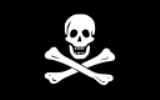
Jolly Roger

Encyclopedia
Flag
A flag is a piece of fabric with a distinctive design that is usually rectangular and used as a symbol, as a signaling device, or decoration. The term flag is also used to refer to the graphic design employed by a flag, or to its depiction in another medium.The first flags were used to assist...
s flown to identify a ship's crew as pirate
Piracy
Piracy is an act of robbery or criminal violence at sea. The term can include acts committed on land, in the air, or in other major bodies of water or on a shore. It does not normally include crimes committed against persons traveling on the same vessel as the perpetrator...
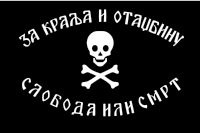
s. The flag most commonly identified as the Jolly Roger today is the skull and crossbones, a flag consisting of a human skull
Human skull
The human skull is a bony structure, skeleton, that is in the human head and which supports the structures of the face and forms a cavity for the brain.In humans, the adult skull is normally made up of 22 bones...
above two long bones set in an x-mark
X mark
An x mark is a mark used to indicate the concept of negation as well as affirmation...
arrangement on a black field. This design was used by several pirates, including Captains Edward England
Edward England
Edward England, born Edward Seegar in Ireland, was a famous African coast and Indian Ocean pirate captain from 1717 to 1720. The ships he sailed on included the Pearl and later the Fancy, for which England exchanged the Pearl in 1720...
and John Taylor
John Taylor (pirate)
John Taylor was a pirate who lived in the early 18th century.At Reunion Island in April 1721, he together with Olivier Levasseur captured the most valuable prize in pirate history, variously described as "Nostra Senora della Cabo", "Nostra Senhora do Cabo", or "Nossa Senhora do Cabo" .-Further...
. Some Jolly Roger flags also include an hourglass
Hourglass
An hourglass measures the passage of a few minutes or an hour of time. It has two connected vertical glass bulbs allowing a regulated trickle of material from the top to the bottom. Once the top bulb is empty, it can be inverted to begin timing again. The name hourglass comes from historically...
, another common symbol representing death in 17th- and 18th-century Europe. Despite its prominence in popular culture, plain black flags were often employed by most pirates in the 17th-18th century. Historically, the flag was flown to frighten pirates' victims into surrendering without a fight, since it conveyed the message that the attackers were outlaws who would not consider themselves bound by the usual rules of engagement—and might, therefore, slaughter those they defeated (since captured pirates were usually hanged, they did not have much to gain by asking quarter
No quarter
A victor gives no quarter when the victor shows no clemency or mercy and refuses to spare the life in return for the surrender at discretion of a vanquished opponent....
if defeated). The same message was sometimes conveyed by a red flag, as discussed below.
Since the decline of piracy, various military units have used the Jolly Roger, usually in skull-and-crossbones design, as a unit identification insignia
Insignia
Insignia or insigne pl -nia or -nias : a symbol or token of personal power, status or office, or of an official body of government or jurisdiction...
or a victory flag to ascribe to themselves the proverbial ferocity and toughness of pirates.
In a non-naval context the skull and crossbones motif has additional meanings, for example, to signify a hazard such as poison.
Origins
The origin of the pirate flag is lost in the murky depths of history. It is thought that pirates originally used a red flag, which was also common in naval warfare, to signal that no qaurter would be given. This red flag was called Jolie Rouge (pretty red) by the French, and may have been corrupted into English as Jolly Roger. From the red flag it seems that individual pirates began to develop their own personal flags in order to terrify their prey into a quick surrender. In contrast with the well known red flag, they used the black flag of qaurantine and disease as the base, with the universal symbol for death, the skull and bones, and modified it to suit their individual tastes. The skull and bones was also used in Captains logbooks to indicate the death of a sailor.Of course not everyone agrees on this. Some historians think the term Jolly Roger is more likely a reference to the English use of 'Roger' as a term for fornication. Especially rough fornication. Stud bulls in England were commonly named Roger. This implied that if the victem did not surrender, they would be 'Rogered'.
A third possibility is that Jolly Roger derived from 'Old Roger' as a term for the devil.
Term
The name "Jolly Roger" goes back to at least Charles JohnsonCharles Johnson (pirate biographer)
Captain Charles Johnson is the British author of the 1724 book A General History of the Robberies and Murders of the most notorious Pyrates, though his identity remains a mystery. No record of a captain by this name exists. Some scholars have suggested that "Charles Johnson" was actually Daniel...
's A General History of the Pyrates
A General History of the Pyrates
A General History of the Robberies and Murders of the most notorious Pyrates is a 1724 book published in Britain, containing biographies of contemporary pirates. Influential in shaping popular conceptions of pirates, it is the prime source for the biographies of many well known pirates...
, published in Britain in 1724.
Johnson specifically cites two pirates as having named their flag "Jolly Roger": Bartholomew Roberts
Bartholomew Roberts
Bartholomew Roberts , born John Roberts, was a Welsh pirate who raided ships off America and West Africa between 1719 and 1722. He was the most successful pirate of the Golden Age of Piracy. He is estimated to have captured over 470 vessels...
in June, 1721 and Francis Spriggs
Francis Spriggs
Francis Spriggs was a British pirate who, associated with George Lowther and Edward Low, was active in the Caribbean and the Bay of Hounduras during the early 1720s.-Early career:...
in December 1723. While Spriggs and Roberts used the same name for their flags, their flag designs were quite different, suggesting that already "Jolly Roger" was a generic term for black pirate flags rather than a name for any single specific design. Neither Spriggs' nor Roberts' Jolly Roger consisted of a skull and crossbones.
Richard Hawkins, captured by pirates in 1724, reported that the pirates had a black flag bearing the figure of a skeleton stabbing a heart with a spear, which they named "Jolly Roger".
Despite this tale, it is assumed by most that the name Jolly Roger comes from the French words jolie rouge, meaning "pretty red" and referring to a plain red flag which was flown to indicate that the ship would fight to the death, with no quarter given or expected. During the Elizabethan era
Elizabethan era
The Elizabethan era was the epoch in English history of Queen Elizabeth I's reign . Historians often depict it as the golden age in English history...
"Roger" was a slang term for beggars and vagrants who "pretended scholarship." "Sea Beggars
Geuzen
Geuzen was a name assumed by the confederacy of Calvinist Dutch nobles and other malcontents, who from 1566 opposed Spanish rule in the Netherlands. The most successful group of them operated at sea, and so were called Watergeuzen...
" had been a popular name for Dutch privateers since the 16th century. Another theory states that "Jolly Roger" is an English corruption of "Ali Raja," supposedly a 17th century Tamil pirate. Yet another theory is that it was taken from a nickname for the devil, "Old Roger". The "jolly" appellation may be derived from the apparent grin of a skull.
Design
The first record of the skull-and-crossbones design being used by pirates is found in a December 6, 1687 entry in a log book held by the Bibliothèque nationale de FranceBibliothèque nationale de France
The is the National Library of France, located in Paris. It is intended to be the repository of all that is published in France. The current president of the library is Bruno Racine.-History:...
. The entry describes pirates using the flag, not on a ship but on land.
"And we put down our white flag, and raised a red flag with a Skull head on it and two crossed bones (all in white and in the middle of the flag), and then we marched on."
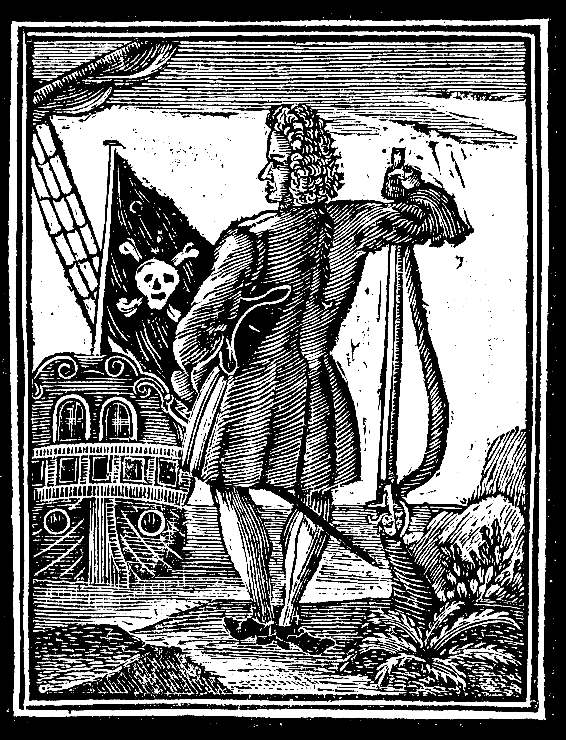
Black flags are known to have been used by pirates at least five years before the name "Jolly Roger" became popularized. Contemporary accounts show Captain Martel's pirates using a black flag in 1716, Edward Teach, Charles Vane
Charles Vane
Charles Vane was an English pirate who preyed upon English and French shipping. His pirate career lasted from 1716 - 1719. His flagship was a brigantine named the Ranger....
, and Richard Worley
Richard Worley
Richard Worley was an English pirate who was active in the Caribbean Sea and the east coast of the American colonies during the early 18th century. He is credited as one of the earliest pirates to fly the first version of the skull and crossbones pirate flag...
in 1718, and Howell Davis
Howell Davis
Captain Howell Davis was a Welsh pirate. His piratical career lasted just 11 months, from July 11, 1718 to June 19, 1719, when he was ambushed and killed. His ships were the Cadogan, Buck, Saint James, and Rover...
in 1719. An even earlier use of a black flag with skull, crossbones, and hourglass is attributed to pirate captain Emanuel Wynn
Emanuel Wynn
Emanuel Wynn was a French pirate of the 18th century, and is often considered the first pirate to fly the Jolly Roger. His design incorporated an hourglass beneath the bones to represent that time was running out....
in 1700, according to a wide variety of secondary sources. Reportedly, these secondary sources are based on the account of Captain John Cranby of the HMS Poole and are verified at the London Public Record Office
Public Record Office
The Public Record Office of the United Kingdom is one of the three organisations that make up the National Archives...
.
With the end of the War of the Spanish Succession in 1714, many privateers turned to piracy. They still used red and black flags, but now they decorated them with their own designs. Edward England, for example, flew three different flags: from his mainmast the black flag depicted above; from his foremast a red version of the same; and from his ensign staff the English National flag.
Just as variations on the Jolly Roger’s design existed, red flags sometimes incorporated yellow stripes or images symbolic of death. Colored pennants and ribbons could also be used alongside flags.
While pirates used the red, or bloody, flag as well as black flags, there was a distinction between the two. In the mid-18th century, Captain Richard Hawkins confirmed that pirates gave quarter beneath the black flag, while no quarter was given beneath the red flag.
Jolly Roger gallery
The gallery below showing pirate flags in use from 1693 (Thomas TewThomas Tew
Thomas Tew , also known as the Rhode Island Pirate, was a 17th century English privateer-turned-pirate. Although he embarked on only two major piratical voyages, and met a bloody death on the latter journey, Tew pioneered the route which became known as the Pirate Round. Many other famous pirates,...
's) to 1724 (Edward Low's) appears in multiple extant works on the history of piracy. All the secondary sources cited in the gallery below are in agreement except as to the background color of Every's flag.
Other Jolly Rogers
Sources exist describing the Jolly Rogers of other pirates than the ones above; also, the pirates described above sometimes used other Jolly Rogers than those shown above. However, no pictures of these alternate Jolly Rogers are easily located.- John PhillipsJohn Phillips (pirate)John Phillips was an English pirate captain. He started his piratical career in 1721 under Thomas Anstis, and stole his own pirate vessel in 1723. He died in a surprise attack by his own prisoners...
. At the hanging of two of John Phillips' pirates, the Boston News-Letter reported "At one end of the gallows was their own dark flag, in the middle of which an anatomy, and at one side of it a dart in the heart, with drops of blood proceeding from it; and on the other side an hour-glass."
- Edward Low. Low used at least two other flags besides his famous red skeleton. One was "a white Skeliton in the Middle of it, with a Dart in one Hand striking bleeding Heart, and in the other, an Hour-Glass." The other was described by George Roberts, a prisoner of Low, as a call to council among Low's ships: "a green silk flag with a yellow figure of a man blowing a trumpet on it."
- Francis SpriggsFrancis SpriggsFrancis Spriggs was a British pirate who, associated with George Lowther and Edward Low, was active in the Caribbean and the Bay of Hounduras during the early 1720s.-Early career:...
is reported to have flown a Jolly Roger identical to one of Low's, from whom he had deserted: "a white Skeliton in the Middle of it, with a Dart in one Hand striking bleeding Heart, and in the other, an Hour-Glass."
- Walter KennedyWalter Kennedy (pirate)Walter Kennedy was an Irish pirate who served as a crew member under Howell Davis and Bartholomew Roberts.Kennedy served in the Royal Navy during the War of Spanish Succession, where he heard tales of pirates from Henry Morgan to Henry Every, and dreamed of becoming a pirate himself...
. The Jolly Roger flag pictured above for Kennedy was flown at his ensign staff, i.e. at the stern of his ship. Kennedy also flew a jack (at the bow of the ship) and a pennant (a long narrow flag flown from the top of a mast). Both Kennedy's jack and his pennant had "only the head and cross bones."
- Florida Strait pirates. On May 2, 1822, the Massachusetts brigantine Belvidere fended off an attack by a pirate schooner in the Florida Strait. The pirates "hoisted a red flag with death's head and cross under it." Neither the pirate schooner's name nor her captain was identified by the Belvidere.
- In 1783, William FalconerWilliam FalconerWilliam Falconer was a Scottish poet.Falconer was the son of a barber in Edinburgh, where he was born, became a sailor, and was thus thoroughly competent to describe the management of the storm-tossed vessel, the career and fate of which are described in his poem, The Shipwreck , a work of...
reported that the "[t]he colours usually displayed by pirates are laid to be a black field, with a death's head, a battle-axe and hour-glass," but does not state which pirate or pirates allegedly showed this device.
Use in practice
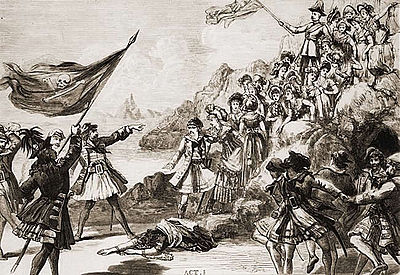
The flag was probably intended as communication of the pirates' identity, which may have given target ships an opportunity to change their mind and surrender without a fight. For example in June 1720 when Bartholomew Roberts
Bartholomew Roberts
Bartholomew Roberts , born John Roberts, was a Welsh pirate who raided ships off America and West Africa between 1719 and 1722. He was the most successful pirate of the Golden Age of Piracy. He is estimated to have captured over 470 vessels...
sailed into the harbour at Trepassey, Newfoundland
Newfoundland and Labrador
Newfoundland and Labrador is the easternmost province of Canada. Situated in the country's Atlantic region, it incorporates the island of Newfoundland and mainland Labrador with a combined area of . As of April 2011, the province's estimated population is 508,400...
with black flags flying, the crews of all 22 vessels in the harbour abandoned them in panic. If a ship then decided to resist, the Jolly Roger was taken down and a red flag was flown, indicating that the pirates intended to take the ship by force and without mercy. Richard Hawkins reports that "When they fight under Jolly Roger, they give quarter
No quarter
A victor gives no quarter when the victor shows no clemency or mercy and refuses to spare the life in return for the surrender at discretion of a vanquished opponent....
, which they do not when they fight under the red or bloody flag."
In this view of models, it was important for a prey ship to know that its assailant was a pirate, and not a privateer or government vessel, as the latter two generally had to abide by a rule that if a crew resisted, but then surrendered, it could not be executed:
An angry pirate therefore posed a greater danger to merchant ships than an angry Spanish coast guard or privateer vessel. Because of this, although, like pirate ships, Spanish coast guard vessels and privateers were almost always stronger than the merchant ships they attacked, merchant ships may have been more willing to attempt resisting these "legitimate" attackers than their piratical
counterparts. To achieve their goal of taking prizes without a costly fight, it was therefore important for pirates to distinguish themselves from these other ships also taking prizes on the seas.
Flying a Jolly Roger was a reliable way of proving oneself a pirate. Just possessing or using a Jolly Roger was considered proof that one was a criminal pirate rather than something more legitimate; only a pirate would dare fly the Jolly Roger, as he was already under threat of execution.
By submarines

Arthur Knyvet Wilson
Admiral of the Fleet Sir Arthur Knyvet Wilson VC, GCB, OM, GCVO was an English Admiral and briefly First Sea Lord who was awarded the Victoria Cross for gallantry during the war in Sudan...
, the First Sea Lord
First Sea Lord
The First Sea Lord is the professional head of the Royal Navy and the whole Naval Service; it was formerly known as First Naval Lord. He also holds the title of Chief of Naval Staff, and is known by the abbreviations 1SL/CNS...
of the British Royal Navy
Royal Navy
The Royal Navy is the naval warfare service branch of the British Armed Forces. Founded in the 16th century, it is the oldest service branch and is known as the Senior Service...
, stated that submarines were "underhand, unfair, and damned un-English", and that he would convince the British Admiralty
Admiralty
The Admiralty was formerly the authority in the Kingdom of England, and later in the United Kingdom, responsible for the command of the Royal Navy...
to have the crews of enemy submarines captured during wartime be hanged
Hanging
Hanging is the lethal suspension of a person by a ligature. The Oxford English Dictionary states that hanging in this sense is "specifically to put to death by suspension by the neck", though it formerly also referred to crucifixion and death by impalement in which the body would remain...
as pirates.
In September 1914, the British submarine successfully torpedoed the German criuser SMS Hela
SMS Hela
SMS Hela was a light cruiser of the German Imperial Navy prior to and during World War I. The only ship of her class, Hela was built as an aviso and launched on 28 March 1895 in Bremen. She was named after the Hela peninsula near Danzig...
. Remembering Wilson's statements, commanding officer Max Horton instructed his sailors to manufacture a Jolly Roger, which was flown from the submarine as she entered port. Each successful patrol saw Horton's submarine fly an additional Jolly Roger until there was no more room for flags, at which point Horton then had a large Jolly Roger manufactured, onto which symbols indicating E9s achievements were sewn. A small number of other submarines adopted the practice: flew a red flag with the skull and crossbones on return from a foray into the Dardanelles
Dardanelles
The Dardanelles , formerly known as the Hellespont, is a narrow strait in northwestern Turkey connecting the Aegean Sea to the Sea of Marmara. It is one of the Turkish Straits, along with its counterpart the Bosphorus. It is located at approximately...
in June 1915, and the first known photograph of the practice was taken in July 1916 aboard .
The practice restarted during World War II
World War II
World War II, or the Second World War , was a global conflict lasting from 1939 to 1945, involving most of the world's nations—including all of the great powers—eventually forming two opposing military alliances: the Allies and the Axis...
. In October 1941, following a successful patrol by , during which she sank the Italian destroyer Palestro the submarine returned to Alexandria
Alexandria
Alexandria is the second-largest city of Egypt, with a population of 4.1 million, extending about along the coast of the Mediterranean Sea in the north central part of the country; it is also the largest city lying directly on the Mediterranean coast. It is Egypt's largest seaport, serving...
, but was ordered to remain outside the boom net
Anti-submarine net
An anti-submarine net is a device placed across the mouth of a harbour or a strait for protection against submarines.-Examples of anti-submarine nets:*Lake Macquarie anti-submarine boom*Indicator net*Naval operations in the Dardanelles Campaign...
until the motorboat assigned to the leader of the 1st Submarine Flotilla had come alongside. The flotilla leader wanted to recognise the boat's achievement, so had a Jolly Roger made and delivered to Osiris. After this, the commanders of submarine flotillas began to hand out the flags to successful submarines. Although some sources claim that all British submarines used the flag, the practice was not taken up by those submarine commanders who saw it as boastful and potentially inaccurate, as sinkings could not always be confirmed. During the war, British submarines were entitled to fly the Jolly Roger on the day of their return from a successful patrol: it would be hoisted as the boat passed the boom net, and remain raised until sunset.
Symbols on the flag indicated the history of the submarine, and it was the responsibility of the boat's personnel to keep the flag updated. The Royal Navy Submarine Museum
Royal Navy Submarine Museum
The Royal Navy Submarine Museum at Gosport is a museum tracing the international history of submarine development from the age of Alexander the Great to the present day, and particularly the history of the Submarine Service from the tiny Holland 1 to the nuclear powered Vanguard class submarine...
(which, as of 2004, possessed fifteen Jolly Rogers) recognises 20 unique symbols. A bar denotes the torpedoing of a ship: red bars indicated warships, white bars represented merchant vessels, and black bars with a white "U" stood for U-boat
U-boat
U-boat is the anglicized version of the German word U-Boot , itself an abbreviation of Unterseeboot , and refers to military submarines operated by Germany, particularly in World War I and World War II...
s. A dagger indicated a 'cloak and dagger
Cloak and dagger
Cloak and dagger is a term sometimes used to refer to situations involving intrigue, secrecy, espionage, or mystery.Cloak and dagger may refer to:-Music:* Cloak & Dagger * Cloak & Dagger , 1992...
' operation: typically the delivery or recovery of shore parties from enemy territory. Stars (sometimes surrounding crossed cannon
Cannon
A cannon is any piece of artillery that uses gunpowder or other usually explosive-based propellents to launch a projectile. Cannon vary in caliber, range, mobility, rate of fire, angle of fire, and firepower; different forms of cannon combine and balance these attributes in varying degrees,...
) stood for occasions where the deck gun was fired. Minelaying operations were shown by the silhouette of a sea mine: a number inside the mine indicated how many such missions. A lighthouse or torch symbolised the boat's use as a navigational marker for an invasion force. Rescue of personnel from downed aircraft or sunken ships was marked by a lifebuoy
Lifebuoy
A lifebuoy, ring buoy, lifering, lifesaver, life preserver or lifebelt, also known as a "kisby ring" or "perry buoy", is a life saving buoy designed to be thrown to a person in the water, to provide buoyancy, to prevent drowning...
. Unique symbols are used to denote one-off incidents: for example, the Jolly Roger of included a can-opener, referencing an incident where an Italian destroyer attempted to ram the submarine, but ended up worse off because of damage to the destroyer's hull by the submarine's hydroplane
Diving plane
A diving plane, also known as a hydroplane, is a control surface found on submarines which allow the vessel to pitch its bow and stern up or down to assist in the process of submerging or surfacing the boat, as well as controlling depth when submerged....
s.
Flying the Jolly Roger continued in the late 20th century and on into the 21st: raised the flag decorated with the sillouette of a cruiser to recognise her successful attack on the Argentine cruiser ARA General Belgrano
ARA General Belgrano
The ARA General Belgrano was an Argentine Navy light cruiser in service from 1951 until 1982. Formerly the , she saw action in the Pacific theater of World War II before being sold to Argentina. After almost 31 years of service, she was sunk during the Falklands War by the Royal Navy submarine ...
during the Falklands War of 1982, while flew a flag carrying crossed tomahawks (representing the launching of Tomahawk cruise missiles
BGM-109 Tomahawk
The Tomahawk is a long-range, all-weather, subsonic cruise missile. Introduced by General Dynamics in the 1970s, it was designed as a medium- to long-range, low-altitude missile that could be launched from a surface platform. It has been improved several times and, by way of corporate divestitures...
) on returning from a 2003 Iraq War deployment. In April and again in June 2011 returning from Operation Ellamy
Operation Ellamy
Operation Ellamy was the codename for the United Kingdom participation in the 2011 military intervention in Libya. The operation was part of an international coalition aimed at enforcing a Libyan no-fly zone in accordance with the United Nations Security Council Resolution 1973 which stipulated...
also flew a Jolly Roger adorned with Tomahawk axes, six in total, to indicate the missiles fired by the submarine in the operation.
The practice, while commonly associated with British submarines, is not restricted to them. During World War II, Allied submariners working with Royal Navy fleets adopted the process from their British counterparts. While operating in the Mediterranean, the Polish submarines ORP Sokół
ORP Sokół
One ship and three submarines of the Polish Navy have been named ORP Sokół :* Sokół, a tugboat launched in 1920 and disposed of in 1957....
and ORP Dzik
ORP Dzik
ORP Dzik was a U-class submarine built by Vickers-Armstrong at Barrow-in-Furness. She was laid down on 30 December 1941 as P-52 for the Royal Navy, but was transferred to the Polish Navy during construction. Launched on November 11, 1942, ORP Dzik was commissioned into the Polish Navy on December...
were presented with Jolly Rogers by General Władysław Sikorski, and continued to update it during the war. At least one British surface ship recorded their U-boat
U-boat
U-boat is the anglicized version of the German word U-Boot , itself an abbreviation of Unterseeboot , and refers to military submarines operated by Germany, particularly in World War I and World War II...
kills through silhouettes on a Jolly Roger. The Australian submarine flew the Jolly Roger in 1980, following her successful participation in the Kangaroo 3 wargame as an opposing submarine
Opposing force
An opposing force or enemy force is a military unit tasked with representing an enemy, usually for training purposes in war game scenarios...
. The flag bore the silhouettes of the seven surface ships involved in the exercise: Onslow had successfully 'sunk' all seven.
In U.S. military aviation
Fifth Air Force
The Fifth Air Force is a numbered air force of the United States Air Force Pacific Air Forces . It is headquartered at Yokota Air Base, Japan....
under General George C. Kenney, commanded by Colonel Art Rogers were known as the Jolly Rogers. Easily distinguished by the white skull and crossed bombs, from 1943, the four squadrons all displayed the insignia on the twin tail fins of their B-24 heavy bombers (heavies) with different color backgrounds for each squadron. The 319th's tail fin background was blue, the 320th's red, the 321st, green, and the 400th, the most graphic of the four, black. The skull and crossed bombs remains the heritage insignia of the group's successor, the 90th Operations Group
90th Operations Group
The 90th Operations Group is the operational component of the United States Air Force 90th Missile Wing. It is stationed at Francis E...
.
The 90th Bombardment Group, commanded by Col. Rogers, known as the Jolly Rogers, used the Skull and Crossed bombs insignia. The Skull and Crossed bones was used by an outfit called Russell's Raiders.
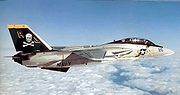
Several United States Navy squadrons have used the Jolly Roger insignia, VF-17/VF-5B/VF-61, VF-84
VF-84
VF-84, Fighter Squadron 84 was an aviation unit of the United States Navy active from 1955 to 1995. The squadron was nicknamed the Jolly Rogers and was based at NAS Oceana.-Related squadrons:Five distinct U.S...
and VF-103, since redesignated as VFA-103
VFA-103
Strike Fighter Squadron 103 , nicknamed the Jolly Rogers is an aviation unit of the United States Navy established in 1952. VFA-103 flies the F/A-18F Super Hornet and is based at Naval Air Station Oceana, Virginia...
.
In fiction
- The 1982 anime series MacrossMacrossis a series of science fiction mecha anime, directed by Shōji Kawamori of Studio Nue in 1982. The franchise features a fictional history of Earth/Humanity after the year 1999. It consists of three TV series, four movies, six OVAs, one light novel and five manga series, all sponsored by Big West...
, and the Americanized version, RobotechRobotechRobotech is an 85-episode science fiction anime adaptation produced by Harmony Gold USA in association with Tatsunoko Production Co., Ltd. and first released in the United States in 1985...
featured a transformable aerospace fighterVF-1This article is about the fighter squadron; for the mecha seen in Macross/Robotech, see VF-1 Valkyrie.Fighter Squadron 1 was a fighter squadron of the United States Navy. Known as the "Wolfpack" the squadron saw combat during World War II, the Vietnam War and Operation Desert Storm...
with a passing resemblance to the F-14. Some aircraft bore a paint scheme inspired by VF-84VF-84VF-84, Fighter Squadron 84 was an aviation unit of the United States Navy active from 1955 to 1995. The squadron was nicknamed the Jolly Rogers and was based at NAS Oceana.-Related squadrons:Five distinct U.S...
. Elite pilots were members of "Skull Squadron," and the vertical stabilizers their aircraft bore a white jolly roger on a black field with a yellow strip along the top and a white stripe on the leading edge. - In FlashpointFlashpoint (TV series)Flashpoint is a Canadian police drama television series that debuted on July 11, 2008, on CTV in Canada and ran on CBS in the United States for its first three and a half seasons. In 2011, Ion Television began airing new episodes of the series in the United States...
the logo of the SRU is Henry Every's Jolly Roger with the bones replaced with swords. - In J.M. Barrie's novel Peter PanPeter PanPeter Pan is a character created by Scottish novelist and playwright J. M. Barrie . A mischievous boy who can fly and magically refuses to grow up, Peter Pan spends his never-ending childhood adventuring on the small island of Neverland as the leader of his gang the Lost Boys, interacting with...
(1911), Jolly Roger was the name of Captain Hook's ship. - The 2009 Coen Brothers film A Serious ManA Serious ManA Serious Man is a 2009 dark comedy written, produced, and directed by Joel and Ethan Coen. The film stars Michael Stuhlbarg as a Minnesota Jewish man whose life crumbles both professionally and personally, leading to questions about his faith...
, featured a motel called the Jolly Roger that had a skull and crossbones on the sign. - In the 1996 movie Independence DayIndependence Day (film)Independence Day is a 1996 science fiction film about an alien invasion of Earth, focusing on a disparate group of individuals and families as they converge in the Nevada desert and, along with the rest of the human population, participate in a last-chance counterattack on July 4 – the same...
, the virus that Jeff GoldblumJeff GoldblumJeffrey Lynn "Jeff" Goldblum is an American actor. His career began in the mid-1970s and he has appeared in major box-office successes including The Fly, Jurassic Park and its sequel Jurassic Park: The Lost World, and Independence Day...
uploads to the alien mothership is called jollyroger.exe - In the pirate manga series One PieceOne Pieceis a Japanese shōnen manga series written and illustrated by Eiichiro Oda. It has been serialized in Weekly Shōnen Jump since August 4, 1997; the individual chapters are being published in tankōbon volumes by Shueisha, with the first released on December 24, 1997, and the 64th volume released as...
, flags of Jolly Roger present throughout the story and the skull design usually represents the captain of the ship. For example, the manga's protagonist, Monkey D Luffy, always wear a straw hat, and so his pirate flag is a Jolly Roger with a straw hat. - In the movie "Down Periscope' the Stingray flew the Jolly Roger when they fired flares in Charleston Harbour and when XO Pascal is made to walk the plank
- Pirates of the Caribbean is a series of fantasy-adventure which is all about pirates, basically focusing on Jack Sparrow (Johnny Depp). The films represent various Jolly Roger flags.
In music
On the cover of the 20062006 in music
This is a list of notable events in music that took place in the year 2006.-January:*January 10 – Eric Burdon releases his album Soul of a Man and begins touring with a new band....
Iron Maiden
Iron Maiden
Iron Maiden are an English heavy metal band from Leyton in east London, formed in 1975 by bassist and primary songwriter Steve Harris. Since their inception, the band's discography has grown to include a total of thirty-six albums: fifteen studio albums; eleven live albums; four EPs; and six...
album, A Matter of Life and Death
A Matter of Life and Death (album)
A Matter of Life and Death is the fourteenth studio album by British heavy metal band Iron Maiden. It was released on 25 August 2006 in Italy and Finland, and 28 August worldwide, excluding the United States, Canada and Japan on 5 September 2006....
, a version of a Jolly Roger depicting a helmeted skull
Eddie the Head
Eddie, also known as Eddie The Head, is the mascot for the British heavy metal band, Iron Maiden. He is a perennial fixture of the group's artwork, appearing in all of their record covers and in their merchandise, which includes t-shirts, posters and action figures...
and two assault rifles instead of bones is displayed hanging from a tank.
The re-issued version of the Megadeth
Megadeth
Megadeth is an American heavy metal band from Los Angeles, California which was formed in 1983 by guitarist/vocalist Dave Mustaine, bassist Dave Ellefson and guitarist Greg Handevidt, following Mustaine's expulsion from Metallica. The band has since released 13 studio albums, three live albums, two...
album, Killing Is My Business... and Business Is Good!
Killing Is My Business... And Business Is Good!
Killing Is My Business... and Business Is Good! is the debut album by the American heavy metal band Megadeth, released in June 1985 through Combat and Relativity Records. During the beginning of 1985, the band was given $8,000 by Combat Records to record and produce their debut album, but this...
, shows a stylized Vic Rattlehead skull on top of crossed swords and crossed bones.
Also on the cover of Michael Jackson's Dangerous album it can be seen on the left sde with the alteration of a skull over two swords.
By the pirate movement
Before changing to a stylized 'P', the Pirate Party used the Jolly Roger as its symbol; it is still used extensively in the Pirate movement. The PiratbyrånPiratbyrån
Piratbyrån was a Swedish organization established to support people opposed to current ideas about intellectual property — by freely sharing information and culture...
and The Pirate Bay
The Pirate Bay
The Pirate Bay is a Swedish website which hosts magnet links and .torrent files, which allow users to share electronic files, including multimedia, computer games and software via BitTorrent...
also use either the skull and crossbones symbol, or derivatives of it, such as the logo of Home taping is killing music
Home Taping is Killing Music
"Home Taping Is Killing Music" was the slogan of a 1980s anti-copyright infringement campaign by the British Phonographic Industry , a British music industry trade group. With the rise in cassette recorder popularity, the BPI feared that people being able to record music from the radio onto...
.
In professional sports
A number of sports teams have been known to use variations of the Jolly Roger, with one of the best known in current use, an adaptation of Calico JackCalico Jack
John Rackham , commonly known as Calico Jack, was an English pirate captain operating in the Bahamas during the early 18th century...
's pirate flag, with a red background instead of the black, being that of the National Football League
National Football League
The National Football League is the highest level of professional American football in the United States, and is considered the top professional American football league in the world. It was formed by eleven teams in 1920 as the American Professional Football Association, with the league changing...
's Tampa Bay Buccaneers
Tampa Bay Buccaneers
The Tampa Bay Buccaneers are a professional American football franchise based in Tampa, Florida, U.S. They are currently members of the Southern Division of the National Football Conference in the National Football League – they are the only team in the division not to come from the old NFC West...
, with an American football over the crossing area of the two swords.
The supporters of FC St. Pauli
FC St. Pauli
Fußball-Club St. Pauli is a German sports club based in the St. Pauli quarter of Hamburg. The football section is part of a larger club that also has Rugby Fußball-Club St. Pauli is a German sports club based in the St. Pauli quarter of Hamburg. The football section is part of a larger club that...
, a sports club from Hamburg
Hamburg
-History:The first historic name for the city was, according to Claudius Ptolemy's reports, Treva.But the city takes its modern name, Hamburg, from the first permanent building on the site, a castle whose construction was ordered by the Emperor Charlemagne in AD 808...
, Germany
Germany
Germany , officially the Federal Republic of Germany , is a federal parliamentary republic in Europe. The country consists of 16 states while the capital and largest city is Berlin. Germany covers an area of 357,021 km2 and has a largely temperate seasonal climate...
, best known for its association football team, have adopted a variation of Richard Worley's flag as their own unofficial emblem. Also, the Jolly Roger is the popular icon of all University College Cork (Ireland) sports teams.
It is also used in a statement by Pittsburgh Pirates
Pittsburgh Pirates
The Pittsburgh Pirates are a Major League Baseball club based in Pittsburgh, Pennsylvania. They play in the Central Division of the National League, and are five-time World Series Champions...
Announcer Greg Brown
Greg Brown (broadcaster)
Greg Brown is a sports announcer, born in Washington, D.C., who currently works for the Pittsburgh Pirates on Root Sports Pittsburgh and 93.7 the fan . He has worked in the booth for the Pirates since 1994. He works with Steve Blass, Bob Walk, John Wehner, and Tim Neverett...
when the Pirates win a game. Brown is known for his call "Raise the Jolly Roger" after every Pirates win. This is keeping in line with Pirate broadcasters, such as former announcers Lanny Frattare
Lanny Frattare
Lanny Lawrence Frattare is a former American sportscaster. For 33 years he was a play-by-play announcer for Major League Baseball's Pittsburgh Pirates, the longest such tenure in the team's history...
and Bob Prince
Bob Prince
Robert Ferris Prince was an American radio and television sportscaster and commentator best known for his 28-year stint as the voice of the Pittsburgh Pirates Major League Baseball club, with whom he earned the nickname “The Gunner” and became a cultural icon in Pittsburgh, Pennsylvania.Prince was...
, who like to end a Pirate win with a similar statement.
Another such variation is the Oakland Raiders
Oakland Raiders
The Oakland Raiders are a professional American football team based in Oakland, California. They currently play in the Western Division of the American Football Conference in the National Football League...
, it uses a head with facial features, wearing an eye patch and a helmet, crossed swords behind the helmet completes the image.
All these variations are seen as the logos of sporting teams in (Scotland):
The Braehead Paisley Pirates/Paisley Pirates
Paisley Pirates
The Paisley Pirates were founded in 1946 and are one of the oldest ice hockey clubs in Scotland and the UK . The Pirates were the epitome of the game in Scotland during the 1950s...
of the Scottish National League
Scottish National League
The Scottish National League is the ice hockey league in Scotland.Seen as the third-tier of ice hockey, below the British Elite Ice Hockey League and the English Premier Ice Hockey League . However, its standard of play has been considered closer to the English National Ice Hockey Division One,...
Ice Hockey the and Paisley Buccaneers and Riversdale Pirates of the Scottish Recreational Ice Hockey Conference
The East Kilbride Pirates American Football team in BAFA Division 1
The Edinburgh Buccaneers Basketball club of the Scottish Men's National League
Scottish Men's National League
The Scottish Men's National League is the top men's basketball league in Scotland, and forms the second tier of British basketball after the professional setup of the BBL, where Scotland has just one representative in the Scottish Rocks.The governing body of basketball in Scotland is...
The South African football or soccer team Orlando Pirates also has the classic Jolly Roger as their logo.
In business
The early development team of the Apple MacintoshMacintosh
The Macintosh , or Mac, is a series of several lines of personal computers designed, developed, and marketed by Apple Inc. The first Macintosh was introduced by Apple's then-chairman Steve Jobs on January 24, 1984; it was the first commercially successful personal computer to feature a mouse and a...
used a pirate flag to maintain a "rebellious" spirit.