

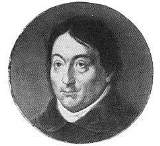
Johann Heinrich Friedrich Link

Encyclopedia
Johann Heinrich Friedrich Link (February 2, 1767 - January 1, 1851) was a German
naturalist
and botanist.
Link was born at Hildesheim
as a son of the minister August Heinrich Link (1738–1783), who taught him the love for nature through collection of 'natural objects'. He studied medicine and natural sciences at the Hannoverschen Landesuniversität of Göttingen
, and graduated as MD in 1789, promoting on his thesis "Flora der Felsgesteine rund um Göttingen" (Flora of the rocky beds around Göttingen). One of teachers was the famous natural scientist Johann Friedrich Blumenbach
(1752–1840). He became a private tutor (Privatdozent) in Göttingen.
In 1792 he became the first professor
of the new department of chemistry
, zoology
and botany
at the University of Rostock
. During his stay at Rostock, he became an early follower of the antiphlogistic theory of Lavoisier, teaching about the existence of oxygen
instead of phlogiston. He was also a proponent of the attempts of Richter to involve mathematics in chemistry, introducing stoichiometry
in his chemistry lessons. In 1806 he set up the first chemical laboratory at Rostock in the "Seminargebäude". He began to write an abundant number of articles and books on the most different subjects, such as physics and chemistry, geology and mineralogy, botany and zoology, natural philosophy and ethics, prehistoric and early history. He was twice elected rector
of the university.
In 1793 he married Charlotte Juliane Josephi (1768?–1829), sister of his colleague at the university Prof. Wilhelm Josephi (1763–1845).
During 1797-1799 he visited Portugal
with Count
Johann Centurius Hoffmannsegg
, a botanist, entomologist and ornithologist from Dresden
. This trip made him finally choose for botany as his main scientific calling.
In 1800 he was elected to the prestigious Leopoldina Academy
, the oldest school for natural history in Europe.
In 1808 he was awarded a prize at the Academy of Saint Petersburg
for his monography Von der Natur und den Eigenschaften des Lichts (nature and characteristics of light).
His scientific reputation grew and became widely known. In 1811 he was appointed professor of chemistry and botany at Breslau university, where he was equally elected twice rector of the university.
After the death of Carl Ludwig Willdenow
in 1815, he became professor of natural history, curator of the herbarium and director of the botanic garden (Hortus regius Berolinensis) in Berlin
until he died. This period became the most fruitful period of his academic life. He augmented the collection of the garden to 14,000 specimens, many of them rare plants. He worked in close collaboration with Cristoph Friedrich Otto (1783-1856), conservator at the botanical garden. In 1827 he named with him the cacti
genera Echinocactus
and Melocactus
. Most of the fungi
that he named, are still recognised under the original name, proving the high quality of his work (such as Cordyceps
, Creopus, Fusarium
, Leocarpus, Myxomycetes, Phragmidium
).
He was elected member of the Berlin Academy of Science and many other scientific societies, including the Royal Swedish Academy of Sciences
, which elected him a foreign member in 1840.
He trained a whole new generation of natural scientists, such as Christian Gottfried Ehrenberg
(1795-1876). Throughout his life, he traveled extensively throughout Europe. He benefited from his knowledge of foreign languages, even Arabic and ancient Sanskrit
.
He died in Berlin on 1 January 1851, almost 84 years old. He was succeeded by Alexander Heinrich Braun
(1805–1877),
 He is recognized as one of the last scientists of the 19th century with a universal knowledge. Link was also one of the few German botanists of his time, who aimed at a complete understanding of plants, through a systematic anatomical and physiological research.
His most important work is the Handbuch zur Erkennung der nutzbarsten und am häufigsten vorkommenden Gewächse (three volumes, published between 1829-1833).
Germany
Germany , officially the Federal Republic of Germany , is a federal parliamentary republic in Europe. The country consists of 16 states while the capital and largest city is Berlin. Germany covers an area of 357,021 km2 and has a largely temperate seasonal climate...
naturalist
Natural history
Natural history is the scientific research of plants or animals, leaning more towards observational rather than experimental methods of study, and encompasses more research published in magazines than in academic journals. Grouped among the natural sciences, natural history is the systematic study...
and botanist.
Link was born at Hildesheim
Hildesheim
Hildesheim is a city in Lower Saxony, Germany. It is located in the district of Hildesheim, about 30 km southeast of Hanover on the banks of the Innerste river, which is a small tributary of the Leine river...
as a son of the minister August Heinrich Link (1738–1783), who taught him the love for nature through collection of 'natural objects'. He studied medicine and natural sciences at the Hannoverschen Landesuniversität of Göttingen
Göttingen
Göttingen is a university town in Lower Saxony, Germany. It is the capital of the district of Göttingen. The Leine river runs through the town. In 2006 the population was 129,686.-General information:...
, and graduated as MD in 1789, promoting on his thesis "Flora der Felsgesteine rund um Göttingen" (Flora of the rocky beds around Göttingen). One of teachers was the famous natural scientist Johann Friedrich Blumenbach
Johann Friedrich Blumenbach
Johann Friedrich Blumenbach was a German physician, physiologist and anthropologist, one of the first to explore the study of mankind as an aspect of natural history, whose teachings in comparative anatomy were applied to classification of what he called human races, of which he determined...
(1752–1840). He became a private tutor (Privatdozent) in Göttingen.
In 1792 he became the first professor
Professor
A professor is a scholarly teacher; the precise meaning of the term varies by country. Literally, professor derives from Latin as a "person who professes" being usually an expert in arts or sciences; a teacher of high rank...
of the new department of chemistry
Chemistry
Chemistry is the science of matter, especially its chemical reactions, but also its composition, structure and properties. Chemistry is concerned with atoms and their interactions with other atoms, and particularly with the properties of chemical bonds....
, zoology
Zoology
Zoology |zoölogy]]), is the branch of biology that relates to the animal kingdom, including the structure, embryology, evolution, classification, habits, and distribution of all animals, both living and extinct...
and botany
Botany
Botany, plant science, or plant biology is a branch of biology that involves the scientific study of plant life. Traditionally, botany also included the study of fungi, algae and viruses...
at the University of Rostock
University of Rostock
The University of Rostock is the university of the city Rostock, in the German state of Mecklenburg-Vorpommern.Founded in 1419, it is the oldest and largest university in continental northern Europe and the Baltic Sea area...
. During his stay at Rostock, he became an early follower of the antiphlogistic theory of Lavoisier, teaching about the existence of oxygen
Oxygen
Oxygen is the element with atomic number 8 and represented by the symbol O. Its name derives from the Greek roots ὀξύς and -γενής , because at the time of naming, it was mistakenly thought that all acids required oxygen in their composition...
instead of phlogiston. He was also a proponent of the attempts of Richter to involve mathematics in chemistry, introducing stoichiometry
Stoichiometry
Stoichiometry is a branch of chemistry that deals with the relative quantities of reactants and products in chemical reactions. In a balanced chemical reaction, the relations among quantities of reactants and products typically form a ratio of whole numbers...
in his chemistry lessons. In 1806 he set up the first chemical laboratory at Rostock in the "Seminargebäude". He began to write an abundant number of articles and books on the most different subjects, such as physics and chemistry, geology and mineralogy, botany and zoology, natural philosophy and ethics, prehistoric and early history. He was twice elected rector
Rector
The word rector has a number of different meanings; it is widely used to refer to an academic, religious or political administrator...
of the university.
In 1793 he married Charlotte Juliane Josephi (1768?–1829), sister of his colleague at the university Prof. Wilhelm Josephi (1763–1845).
During 1797-1799 he visited Portugal
Portugal
Portugal , officially the Portuguese Republic is a country situated in southwestern Europe on the Iberian Peninsula. Portugal is the westernmost country of Europe, and is bordered by the Atlantic Ocean to the West and South and by Spain to the North and East. The Atlantic archipelagos of the...
with Count
Count
A count or countess is an aristocratic nobleman in European countries. The word count came into English from the French comte, itself from Latin comes—in its accusative comitem—meaning "companion", and later "companion of the emperor, delegate of the emperor". The adjective form of the word is...
Johann Centurius Hoffmannsegg
Johann Centurius Hoffmannsegg
Johann Centurius Hoffmann Graf von Hoffmannsegg was a German botanist, entomologist and ornithologist.Hoffmannsegg was born at Rammenau and studied at Leipzig and Göttingen. He travelled through Europe acquiring vast collections of plants and animals. He visited Hungary, Austria and Italy in...
, a botanist, entomologist and ornithologist from Dresden
Dresden
Dresden is the capital city of the Free State of Saxony in Germany. It is situated in a valley on the River Elbe, near the Czech border. The Dresden conurbation is part of the Saxon Triangle metropolitan area....
. This trip made him finally choose for botany as his main scientific calling.
In 1800 he was elected to the prestigious Leopoldina Academy
German Academy of Natural Scientists Leopoldina
The Leopoldina is the national academy of Germany.Historically it was known under the German name Deutsche Akademie der Naturforscher Leopoldina until 2007, when it was declared the national academy of Germany.The Leopoldina is currently located in Halle...
, the oldest school for natural history in Europe.
In 1808 he was awarded a prize at the Academy of Saint Petersburg
Saint Petersburg
Saint Petersburg is a city and a federal subject of Russia located on the Neva River at the head of the Gulf of Finland on the Baltic Sea...
for his monography Von der Natur und den Eigenschaften des Lichts (nature and characteristics of light).
His scientific reputation grew and became widely known. In 1811 he was appointed professor of chemistry and botany at Breslau university, where he was equally elected twice rector of the university.
After the death of Carl Ludwig Willdenow
Carl Ludwig Willdenow
Carl Ludwig Willdenow was a German botanist, pharmacist, and plant taxonomist. He is considered one of the founders of phytogeography, the study of the geographic distribution of plants...
in 1815, he became professor of natural history, curator of the herbarium and director of the botanic garden (Hortus regius Berolinensis) in Berlin
Berlin
Berlin is the capital city of Germany and is one of the 16 states of Germany. With a population of 3.45 million people, Berlin is Germany's largest city. It is the second most populous city proper and the seventh most populous urban area in the European Union...
until he died. This period became the most fruitful period of his academic life. He augmented the collection of the garden to 14,000 specimens, many of them rare plants. He worked in close collaboration with Cristoph Friedrich Otto (1783-1856), conservator at the botanical garden. In 1827 he named with him the cacti
Cactus
A cactus is a member of the plant family Cactaceae. Their distinctive appearance is a result of adaptations to conserve water in dry and/or hot environments. In most species, the stem has evolved to become photosynthetic and succulent, while the leaves have evolved into spines...
genera Echinocactus
Echinocactus
Echinocactus is a genus of cacti in the subfamily Cactoideae. The generic name derives from the Ancient Greek εχινος , meaning "spiny," and cactus. It and Ferocactus are the two genera of barrel cactus. Members of the genus usually have heavy spination and relatively large flowers...
and Melocactus
Melocactus
Melocactus is a genus of cactus with about 40 species. They are native to the Caribbean, northern South America, with some species along the Andes down to southern Peru, and a concentration of species in northeastern Brazil....
. Most of the fungi
Fungus
A fungus is a member of a large group of eukaryotic organisms that includes microorganisms such as yeasts and molds , as well as the more familiar mushrooms. These organisms are classified as a kingdom, Fungi, which is separate from plants, animals, and bacteria...
that he named, are still recognised under the original name, proving the high quality of his work (such as Cordyceps
Cordyceps
Cordyceps is a genus of ascomycete fungi that includes about 400 described species. All Cordyceps species are endoparasitoids, mainly on insects and other arthropods ; a few are parasitic on other fungi. The best known species of the genus is Cordyceps sinensis, first recorded as yartsa gunbu in...
, Creopus, Fusarium
Fusarium
Fusarium is a large genus of filamentous fungi widely distributed in soil and in association with plants. Most species are harmless saprobes, and are relatively abundant members of the soil microbial community. Some species produce mycotoxins in cereal crops that can affect human and animal health...
, Leocarpus, Myxomycetes, Phragmidium
Phragmidium
Phragmidium is a genus of rust fungus that typically infects plant species in the Rosaceae. It is characterised by having stalked teliospores borne on telia each having a row of four or more cells. All species have a caeoma which is a diffuse aecidium lacking a peridiumThere are a number of...
).
He was elected member of the Berlin Academy of Science and many other scientific societies, including the Royal Swedish Academy of Sciences
Royal Swedish Academy of Sciences
The Royal Swedish Academy of Sciences or Kungliga Vetenskapsakademien is one of the Royal Academies of Sweden. The Academy is an independent, non-governmental scientific organization which acts to promote the sciences, primarily the natural sciences and mathematics.The Academy was founded on 2...
, which elected him a foreign member in 1840.
He trained a whole new generation of natural scientists, such as Christian Gottfried Ehrenberg
Christian Gottfried Ehrenberg
Christian Gottfried Ehrenberg , German naturalist, zoologist, comparative anatomist, geologist, and microscopist, was one of the most famous and productive scientists of his time.- Early collections :...
(1795-1876). Throughout his life, he traveled extensively throughout Europe. He benefited from his knowledge of foreign languages, even Arabic and ancient Sanskrit
Sanskrit
Sanskrit , is a historical Indo-Aryan language and the primary liturgical language of Hinduism, Jainism and Buddhism.Buddhism: besides Pali, see Buddhist Hybrid Sanskrit Today, it is listed as one of the 22 scheduled languages of India and is an official language of the state of Uttarakhand...
.
He died in Berlin on 1 January 1851, almost 84 years old. He was succeeded by Alexander Heinrich Braun
Alexander Braun
Alexander Carl Heinrich Braun was a German botanist from Regensburg, Bavaria.He studied botany in Heidelberg, Paris and Munich. In 1833 he began teaching botany at the Polytechnic School of Karlsruhe, staying there until 1846...
(1805–1877),
His most important work is the Handbuch zur Erkennung der nutzbarsten und am häufigsten vorkommenden Gewächse (three volumes, published between 1829-1833).
Selected works
- Grundlehren der Anatomie und Physiologie der Pflanzen (Göttingen. 1807); (Fundamental principles of the anatomy and physiology of plants) (proving for the first time that plant cells existed independently and were not part of a homogeneous vegetable mass).
- Nachträge zu den Grundlehren etc. (Göttingen. 1809) (Supplement to the fundamental principles etc. )
- Die Urwelt und das Altertum, erläutert durch die Naturkunde (Berlin 1820-1822, 2nd ed. 1834); (Prehistoric times and antiquity, explained by natural history)
- Das Altertum und der Übergang zur neuern Zeit (Berlin 1842); (Antiquity and the transition to modern times)
- Elementa philosophiae botanicae (Berlin 1824; 2nd ed., in Latin and German 1837);
- Anatomisch-botanische Abbildungen zur Erläuterung der Grundlehren der Kräuterkunde (Berlin 1837-42); (Anatomical-botanical illustrations explaining the basic teachings for herbalists)
- Ausgewählte anatomisch-botanische Abbildungen (Berlin 1839-42) (Selected anatomical botanical illustrations) (
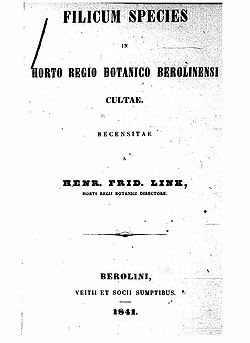
- Filicum species in horto regio Berolinensi cultae (Berlin 1841) (Fern species in Berlin botanical garden)
- Anatomie der Pflanzen in Abbildungen (Berlin. 1843-47). (Illustrated anatomy of plants)
- He published together with Friedrich Otto :
- Icones plantarum selectarum horti regii botanici Berolinensis (Berlin 1820-28) (Illustrations of selected plants in Berlin botanic garden)
- He published with Christoph Friedrich Otto (this work was finished by the Friedrich Klotzsch, 1841-1844, curator at the Botanical Museum)
-
- Icones plantarum rariorum horti regii botanici Berolinensis (Berlin 1828-31) (Illustrations of rare plants in the Berlin botanic garden)
-
- He published together with count von Hoffmansegg
- Flore portugaise" (Berlin. 1809-1840) (Portuguese Flora) (remaining a standard work for a long time)