

Jaffa orange

Encyclopedia
Orange (fruit)
An orange—specifically, the sweet orange—is the citrus Citrus × sinensis and its fruit. It is the most commonly grown tree fruit in the world....
variety. Originally developed by Palestinian farmers in the mid-19th century, it takes its name from the city of Jaffa
Jaffa
Jaffa is an ancient port city believed to be one of the oldest in the world. Jaffa was incorporated with Tel Aviv creating the city of Tel Aviv-Yafo, Israel. Jaffa is famous for its association with the biblical story of the prophet Jonah.-Etymology:...
where it was first produced for export. It became a primary citrus export of the State of Israel following its establishment in 1948. One of three main varieties of oranges grown in the Middle East
Middle East
The Middle East is a region that encompasses Western Asia and Northern Africa. It is often used as a synonym for Near East, in opposition to Far East...
, the Jaffa orange is also cultivated in Cyprus
Cyprus
Cyprus , officially the Republic of Cyprus , is a Eurasian island country, member of the European Union, in the Eastern Mediterranean, east of Greece, south of Turkey, west of Syria and north of Egypt. It is the third largest island in the Mediterranean Sea.The earliest known human activity on the...
, Iraq
Iraq
Iraq ; officially the Republic of Iraq is a country in Western Asia spanning most of the northwestern end of the Zagros mountain range, the eastern part of the Syrian Desert and the northern part of the Arabian Desert....
, Lebanon
Lebanon
Lebanon , officially the Republic of LebanonRepublic of Lebanon is the most common term used by Lebanese government agencies. The term Lebanese Republic, a literal translation of the official Arabic and French names that is not used in today's world. Arabic is the most common language spoken among...
, Syria
Syria
Syria , officially the Syrian Arab Republic , is a country in Western Asia, bordering Lebanon and the Mediterranean Sea to the West, Turkey to the north, Iraq to the east, Jordan to the south, and Israel to the southwest....
and Turkey
Turkey
Turkey , known officially as the Republic of Turkey , is a Eurasian country located in Western Asia and in East Thrace in Southeastern Europe...
.
Characteristics
Jaffa oranges, also known as shamouti, are practically seedless, with a flavour that has been described as "excellent" and "sweet and fine." The two other main orange varieties cultivated in the region are the navel orange and the bitter orangeBitter orange
The name "bitter orange", also known as Seville orange, sour orange, bigarade orange, and marmalade orange, refers to a citrus tree and its fruit. Many varieties of bitter orange are used for their essential oil, which is used in perfume and as a flavoring...
; the latter is grown in Iran
Iran
Iran , officially the Islamic Republic of Iran , is a country in Southern and Western Asia. The name "Iran" has been in use natively since the Sassanian era and came into use internationally in 1935, before which the country was known to the Western world as Persia...
for its peel. The Jaffa orange is distinguished by its oval shape and thick peel, which is deep orange in color and normally very easy to remove from the fruit. Its tough skin makes it "especially suitable for export". As it produces very little juice and has a tendency towards delayed bitterness, it is unsuitable for juice production, though it does store well.
These oranges are very cold-tolerant, allowing them to grow outside of the subtropical regions normally associated with growing oranges. Jaffa oranges are susceptible to Alternaria
Alternaria
Alternaria is a genus of ascomycete fungi. Alternaria species are known as major plant pathogens. They are also common allergens in humans, growing indoors and causing hay fever or hypersensitivity reactions that sometimes lead to asthma...
, a type of fungus
Fungus
A fungus is a member of a large group of eukaryotic organisms that includes microorganisms such as yeasts and molds , as well as the more familiar mushrooms. These organisms are classified as a kingdom, Fungi, which is separate from plants, animals, and bacteria...
, and are prone to alternate bearing.
In Palestine
Palestine
Palestine is a conventional name, among others, used to describe the geographic region between the Mediterranean Sea and the Jordan River, and various adjoining lands....
produced a number of commodities for export via imperial and global distribution networks throughout the late Islamic period (1200-1900 CE). Among these were soap
Nabulsi soap
Nabulsi soap is a type of castile soap produced only in Nablus in the West Bank, Palestine. An olive oil-based soap, it is made up of three primary ingredients: virgin olive oil, water, and a sodium compound...
, sugar, barley, oranges, and cotton. Though cotton left its mark throughout the region, the only commodity, "that remains a symbol of production in Israel is the Jaffa orange."
The Jaffa orange was a new variety developed by Arab
Arab
Arab people, also known as Arabs , are a panethnicity primarily living in the Arab world, which is located in Western Asia and North Africa. They are identified as such on one or more of genealogical, linguistic, or cultural grounds, with tribal affiliations, and intra-tribal relationships playing...
farmers after emerging in mid-19th century Palestine as a mutation on a tree of the Baladi variety near Jaffa. While the sour orange (C. Aurantium) was brought westward from China
China
Chinese civilization may refer to:* China for more general discussion of the country.* Chinese culture* Greater China, the transnational community of ethnic Chinese.* History of China* Sinosphere, the area historically affected by Chinese culture...
and India
India
India , officially the Republic of India , is a country in South Asia. It is the seventh-largest country by geographical area, the second-most populous country with over 1.2 billion people, and the most populous democracy in the world...
by Arab traders, who probably introduced it to Sicily
Sicily
Sicily is a region of Italy, and is the largest island in the Mediterranean Sea. Along with the surrounding minor islands, it constitutes an autonomous region of Italy, the Regione Autonoma Siciliana Sicily has a rich and unique culture, especially with regard to the arts, music, literature,...
and Spain
Spain
Spain , officially the Kingdom of Spain languages]] under the European Charter for Regional or Minority Languages. In each of these, Spain's official name is as follows:;;;;;;), is a country and member state of the European Union located in southwestern Europe on the Iberian Peninsula...
, the Jaffa orange was developed from the sweet orange (C. sinensis) which was brought from China to the Mediterranean region by Vasco de Gama, the Portuguese explorer, in 1498.
After the Crimean War
Crimean War
The Crimean War was a conflict fought between the Russian Empire and an alliance of the French Empire, the British Empire, the Ottoman Empire, and the Kingdom of Sardinia. The war was part of a long-running contest between the major European powers for influence over territories of the declining...
(1853–56), the most important innovation in Palestinian agriculture was the rapid expansion in citrus cultivation. Foremost among the varieties cultivated was the Jaffa orange, and mention of it being exported to Europe
Europe
Europe is, by convention, one of the world's seven continents. Comprising the westernmost peninsula of Eurasia, Europe is generally 'divided' from Asia to its east by the watershed divides of the Ural and Caucasus Mountains, the Ural River, the Caspian and Black Seas, and the waterways connecting...
first appears in British consular reports in the 1850s. One factor cited in the growth of the export market was the development of steam ships in the first half of the 19th century. Their arrival in the Port of Jaffa enabled the export of oranges to the European markets in days rather than weeks. Another reason cited for the increased concentration on the production of Jaffa oranges was the relative lack of European control over the cultivation of this crop, as compared to the cultivation of cotton; while the latter had been the primary commodity crop of Palestine, it was soon outpaced by the Jaffa orange.
Exports grew from 200,000 oranges in 1845 to 38 million oranges by 1870. The citrus plantations of this time were primarily owned by wealthy Arab merchants and notables, rather than small farmers, as the fruits required large capital investments with no yield for several years. An 1872 account of Jaffa by a European traveller notes that, "Surrounding Jaffa are the orange gardens for which it is justly extolled, and which are a considerable source of wealth to the owners. The annual value of fruits grown in Jaffa was said to be 10,000 pounds."
The prosperity of the orange industry brought increased European interest and involvement in the development of Jaffa. In 1902, a study of the growth of the orange industry by Zionist officials outlined the different Arab owners and their primary export markets as England, Turkey, Egypt and Austria-Hungary. While Arab cultivation methods were considered "primitive," an in-depth study of the financial expenditure involved reveals that they were ultimately more cost-efficient than the Zionist-European enterprises that followed them some two decades later.
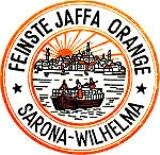
The first fruits to carry the "Jaffa orange" label were marketed by the farmers of Sarona, a German Templer
Templers (religious believers)
Templers are members of the Temple Society , a German Protestant sect with roots in the Pietist movement of the Lutheran Church. The Templers were expelled from the church in 1858 because of their millennial beliefs. Their aim was to realize the apocalyptic visions of the prophets of Israel in the...
colony established in 1871. In the 1880s, an American grower, H.S. Sanford, tried to cultivate the Jaffa orange in Florida.
Jewish immigrants to Palestine adopted the Jaffa orange variety from Arab farmers. According to the Hope Simpson Royal Commission
Hope Simpson Royal Commission
The Report on Immigration, Land Settlement and Development or Hope Simpson Report of October 1930 was an investigation into governance of the British Mandate of Palestine, which had been recommended by the Shaw Report, following the widespread 1929 Palestine riots.Headed by Sir John Hope Simpson,...
Report of 1930,
"The cultivation of the orange, introduced by the Arabs before the commencement of Jewish settlement, has developed to a very great extent in consequence of that settlement. There is no doubt that the pitch of perfection to which the technique of plantation and cultivation of the orange and grape-fruit have been brought in Israel is due to the scientific methods of the Jewish agriculturist."
Partnerships in growing and exporting these oranges was an example of Arab-Jewish cooperation despite rising political tensions.
By 1939, Jewish and Arab orange orchards in Palestine covered 75000 acres (303.5 km²), employed over 100,000 workers, and their produce was a primary export. During World War II
World War II
World War II, or the Second World War , was a global conflict lasting from 1939 to 1945, involving most of the world's nations—including all of the great powers—eventually forming two opposing military alliances: the Allies and the Axis...
(1939–1945) citrus-growing declined, but recovered after the war with the vigorous assistance of the British Mandate authorities.
In Israel
Jaffa oranges are harvested in Israel between November and March, with the marketing season beginning in September and extending through until April. More than half the annual crop is exported, and Israel is a main provider of other citrus fruits to the European UnionEuropean Union
The European Union is an economic and political union of 27 independent member states which are located primarily in Europe. The EU traces its origins from the European Coal and Steel Community and the European Economic Community , formed by six countries in 1958...
. In the 1950s and 1960s, Jaffa oranges became emblems of the Israeli state. A general decline in the importance of agriculture to the Israeli economy, extreme limits on available water resources, and the reliance on migrant laborers has reduced productivity. Overshadowed by manufacturing industries, such as diamonds and precision instruments, Israel nonetheless continues to export a large number of citrus fruits to Europe.
The Jaffa orange is also known for lending the city of Tel Aviv-Yafo the nickname "Big Orange".